
France Energy Recovery Ventilator Market Size & Forecast
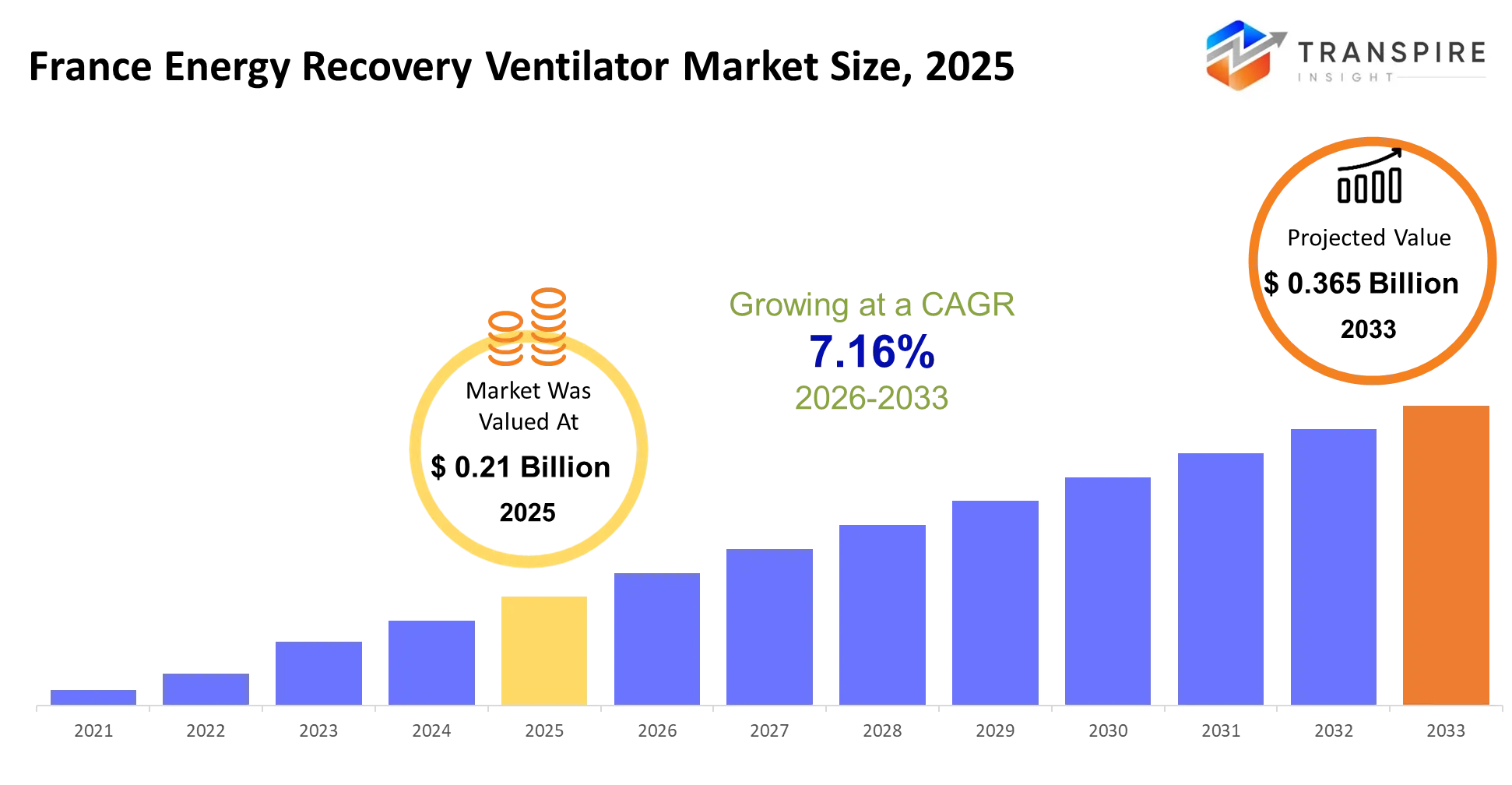
- France Energy Recovery Ventilator Market Size 2025: USD 0.21 Billion
- France Energy Recovery Ventilator Market Size 2033: USD 0.365 Billion
- France Energy Recovery Ventilator Market CAGR: 7.16%
- France Energy Recovery Ventilator Market Segments: By Type (Plate Heat Exchanger, Rotary Heat Exchanger, Heat Pipe, Others), By Application (Residential, Commercial, Industrial, Others), By End-User (Households, Offices, Hospitals, Industrial Sector, Others), By Installation (New, Retrofit, Others)
To learn more about this report,  Download Free Sample Report
France Energy Recovery Ventilator Market Summary
The France ERV market reached USD 0.21 Billion in 2025 and is projected to expand to USD 0.365 Billion by 2033, growing at a 7.16% CAGR. Energy recovery ventilators extract heat and moisture from exhaust air, transferring it to incoming fresh air to minimize heating and cooling loads. A residential apartment in Paris uses an ERV to recover 70 to 85 percent of exhaust heat, reducing annual heating costs by 15 to 25 percent.
The defining structural shift in the France market has been the tightening of building energy efficiency regulations. The EU Energy Efficiency Directive (EED) and French thermal regulations (RT 2020, evolving toward RE 2020) mandate progressive reductions in building energy consumption. These regulations classify ERV systems as mandatory components in new construction exceeding certain performance thresholds, shifting market demand from discretionary purchases to regulatory compliance requirements.
The real-world trigger accelerating adoption is the widespread retrofit renovation wave across France's aging residential stock. Approximately 42 percent of French buildings were constructed before 1975 and lack modern ventilation infrastructure. Government programs including MaPrimeRénov and Eco-PTZ provide subsidies and tax credits for energy efficiency upgrades, explicitly covering ERV installation as a qualifying improvement. This policy support has converted ERV systems from premium luxury features into accessible capital improvements for middle-income households, generating sustained retrofit demand.
Key France Energy Recovery Ventilator Market Insights
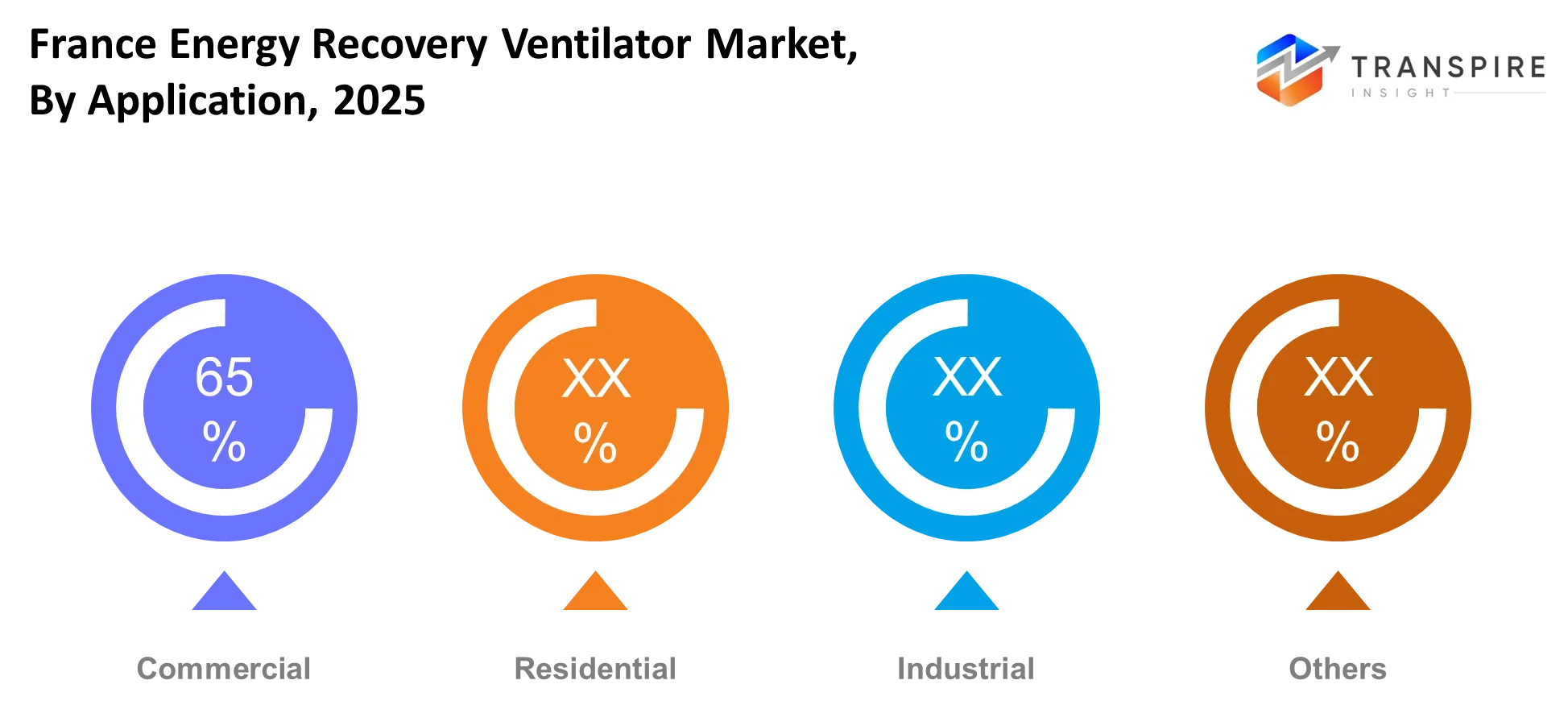
- Commercial applications account for 65% of ERV market revenue in France in 2025, driven by office buildings, retail spaces, and hospitality facilities requiring HVAC system upgrades to meet regulatory standards and operational efficiency targets.
- Plate heat exchanger technology dominates the market at approximately 58% share, favored for residential applications due to cost effectiveness, compact dimensions, and straightforward installation compatible with existing ductwork.
- Retrofit installations represent 62% of France's ERV market volume, as property owners prioritize energy efficiency upgrades to reduce operating costs and improve indoor air quality in existing buildings rather than waiting for new construction projects.
- Daikin and Mitsubishi Electric maintain the strongest market positions through established HVAC distribution channels and integrated product portfolios covering compressors, controls, and ventilation systems that simplify specification and installation.
- Heat recovery efficiency improvement drives market growth, with leading systems now achieving 85 to 92% thermal efficiency, up from 70 to 75% efficiency in devices deployed five years ago, enabling faster payback periods and improved building performance metrics.
- Policy support through government subsidy programs including MaPrimeRénov provides up to EUR 4,000 per household for ERV installation, significantly reducing effective cost and accelerating adoption among price-sensitive residential customers.
- Rotary heat exchanger systems are the fastest-growing technology segment, expanding at 9.2% CAGR through 2033, as manufacturers improve moisture recovery performance and reduce mechanical complexity relative to older rotary designs.
- Integration with smart building management systems is becoming a standard feature, with ERV systems now offering connectivity to building automation platforms, enabling demand-controlled ventilation and energy optimization based on occupancy and external air quality.
- Industrial applications including food processing, pharmaceutical manufacturing, and data centers are emerging as high-value segments where ERV systems deliver rapid payback through operational cost reduction and improved product stability through temperature and humidity control.
- Supply chain constraints affecting heat recovery components have created 12 to 18 week lead times for some specialty materials, pushing system manufacturers toward design standardization and modular architectures that enable faster assembly and delivery.
What are the Key Drivers, Restraints, and Opportunities in the France Energy Recovery Ventilator Market?
Driver: The primary expansion force is France's commitment to net-zero building energy targets by 2050. The RE 2020 regulation mandates that all new buildings achieve zero energy balance by 2025 for public buildings and 2027 for residential developments. Meeting these targets requires ERV systems as fundamental components. Simultaneously, France's carbon reduction targets under the European Green Deal create financial incentives through carbon pricing mechanisms that reward building operators installing energy-efficient ventilation. Combined with MaPrimeRénov subsidies covering 40 to 90 percent of ERV installation costs, depending on household income level, these policy mechanisms create structural demand across both new construction and retrofit segments.
Restraint: The most significant barrier is high upfront capital cost. ERV system installation typically costs EUR 3,500 to EUR 8,000 per unit, representing a substantial investment relative to gross household income for lower-income families. Although subsidy programs partially offset this cost, eligibility criteria and application processes create friction that discourages adoption among populations most likely to benefit from energy cost reduction. Additionally, qualified installation labor shortages persist in some regions, extending project timelines and increasing installation costs by 15 to 30 percent above published manufacturer pricing.
Opportunity: The clearest expansion opportunity is the integration of ERV systems into whole-building renovation packages that bundle insulation, window replacement, heating system upgrades, and ventilation into comprehensive retrofits. Renovation companies that position ERV as a mandatory component of energy-efficient building packages and that develop turnkey installation processes reduce customer decision friction and accelerate project execution. Additionally, emerging opportunities in industrial applications including food processing and pharmaceutical facilities, where ERV systems enable process optimization and regulatory compliance simultaneously, create high-margin segments with favorable unit economics and long replacement cycles.
What Has the Impact of Artificial Intelligence Been on the France Energy Recovery Ventilator Market?
AI-driven building simulation and thermal modeling tools are accelerating ERV system design optimization. Engineers use machine learning algorithms to model heat transfer characteristics across diverse climate scenarios, window configurations, and occupancy patterns specific to French building archetypes. These simulations reduce design cycle time by 40 to 60 percent compared to traditional manual calculation methods, enabling faster system specification and cost estimation that supports rapid project deployment.
Predictive maintenance powered by IoT sensors and machine learning algorithms is emerging as a high-value service layer for commercial ERV installations. AI models trained on performance data from thousands of systems detect degradation patterns in heat recovery efficiency, identify fouling in heat exchangers before performance collapse, and forecast component failure windows. Facility managers receive maintenance alerts weeks before failure risk escalates, reducing unplanned downtime and extending system lifespan by 15 to 25 percent. This predictive capability supports recurring service revenue models that supplement one-time equipment sales.
Energy optimization algorithms continuously adjust ERV operation based on external weather patterns, building occupancy, and energy prices in real-time. Machine learning models learn facility-specific thermal characteristics and occupancy cycles, adjusting ERV fan speed and heat recovery bypass settings to minimize total energy consumption rather than fixed operational schedules. Buildings implementing this AI-driven optimization report 8 to 15 percent additional energy savings beyond baseline ERV performance, accelerating payback period and justifying higher system costs to price-sensitive customers.
Key Market Trends
The France energy recovery ventilator market is expanding at 7.16% CAGR from USD 0.21 Billion in 2025 to USD 0.365 Billion by 2033, driven by regulatory tightening, government subsidy programs, and widespread recognition of indoor air quality and energy efficiency as standard building features rather than premium options. Commercial applications dominate market revenue at 65%, with retrofit installations representing 62% of unit volumes as property owners prioritize energy cost reduction and regulatory compliance upgrades in existing buildings.
- Commercial applications hold 65% of ERV market revenue, supported by office buildings, retail facilities, and hospitality venues requiring HVAC modernization to meet regulatory standards and reduce operating expenses.
- Plate heat exchanger technology maintains 58% market share, favored for residential retrofit applications due to low cost, minimal space requirements, and compatibility with existing ductwork infrastructure.
- Retrofit installations account for 62% of market volume, as energy renovation wave accelerates across France's aging building stock driven by government subsidy programs and energy cost pressures.
- Rotary heat exchanger technology grows at 9.2% CAGR through 2033, as manufacturers improve moisture recovery and reduce mechanical complexity, expanding application range beyond traditional commercial segments.
- Heat pipe technology gains traction in specific applications requiring passive heat recovery without moving parts, particularly in high-contamination environments where mechanical fouling risk is elevated.
- Smart building integration becomes standard feature, with ERV systems now offering BMS connectivity enabling demand-controlled ventilation and optimization based on occupancy and air quality sensors.
- Government support through MaPrimeRénov and other subsidy programs accelerates adoption by reducing effective system cost to EUR 1,500 to EUR 2,500 per household after subsidies, driving retrofit market expansion.
- Industrial applications expand into food processing, pharmaceutical, and data center segments, where ERV systems deliver rapid payback through operational cost reduction and process optimization.
- Efficiency improvements enable faster payback periods, with modern systems achieving 85 to 92% thermal efficiency compared to 70 to 75% five years ago, reducing cost recovery timeframe from 12-15 years to 8-10 years.
- Supply chain stabilization reduces lead times from 18 weeks to 10-12 weeks, improving project delivery speed and reducing installation coordination costs for contractors managing multiple concurrent renovation projects.
France Energy Recovery Ventilator Market Segmentation
By Type
Plate heat exchanger technology dominates the France ERV market at approximately 58% share, delivering compact, cost-effective heat recovery in residential and small commercial applications. Aluminum or plastic plates stacked in alternating patterns allow warm exhaust air to transfer heat to cold incoming air without mixing air streams. Installation compatibility with existing rectangular ductwork and minimal maintenance requirements make plate exchangers the preferred retrofit solution for residential buildings where space is constrained. Manufacturing costs have declined 25 to 30 percent over the past five years through standardization and economies of scale, enabling broader adoption among cost-sensitive segments. The primary limitation is moisture recovery capability: plate exchangers cannot recover latent heat from humidity, requiring supplemental dehumidification in high-occupancy buildings.
Rotary heat exchanger systems are expanding at 9.2% CAGR through 2033, driven by improvements in moisture recovery performance and mechanical reliability. A rotating wheel or cylinder transfers both sensible and latent heat from exhaust air to incoming supply air, achieving overall efficiency rates of 70 to 85 percent including moisture recovery. This dual-mode performance enables superior indoor air quality control in humid environments including bathrooms and kitchens. Rotary systems occupy more physical space than plate exchangers and require periodic cleaning to prevent fouling, but the combination of high efficiency and moisture recovery justifies higher capital costs in commercial and industrial applications where occupancy densities are high.
Heat pipe technology serves niche applications requiring passive heat recovery without moving parts. Sealed tubes containing working fluid transfer heat between exhaust and supply air streams through capillary action, eliminating mechanical complexity and associated maintenance. Heat pipes excel in contaminated environments and applications where moving parts present mechanical or safety risks. Adoption remains limited to approximately 12 percent of market volume due to lower absolute efficiency compared to mechanical systems and higher cost per unit of transferred energy, but growth accelerates in pharmaceutical, food processing, and cleanroom environments where contamination risk justifies the cost premium.
By Application
Residential applications encompass single-family homes, apartments, and multi-unit dwellings where ERV systems provide whole-building ventilation with heat recovery. This segment represents approximately 35 percent of market revenue despite commercial dominance in total volume, as residential systems typically operate at lower capacities and price points than commercial equivalents. Government subsidy programs explicitly target residential retrofit projects, providing EUR 1,500 to EUR 4,000 per household depending on income level and energy savings achieved. The retrofit renovation wave across France's aging residential stock, with approximately 42 percent of buildings predating 1975, creates sustained demand as property owners upgrade ventilation systems to meet thermal comfort and indoor air quality standards. Residential adoption accelerates among households prioritizing energy cost reduction and health-related benefits of improved air filtration and humidity control.
Commercial applications including office buildings, retail spaces, hospitality facilities, and mixed-use developments account for 65 percent of ERV market revenue in France. Building operators prioritize HVAC system upgrades to achieve regulatory compliance, reduce energy operating costs, and improve tenant comfort through superior air quality control. Office tenancy agreements increasingly mandate energy efficiency features including ERV systems as standard building specifications. Retail and hospitality operators view ERV investment as operational cost reduction and competitive differentiation that attracts environmentally conscious customers. Commercial systems typically operate continuously or on extended schedules compared to residential patterns, enabling faster payback through higher utilization and absolute energy cost savings.
Industrial applications including food processing, pharmaceutical manufacturing, and data centers represent the highest-growth segment, expanding at 12 to 15 percent annually. Manufacturing facilities require precise temperature and humidity control for product stability and process efficiency. ERV systems enable this control while recovering heat for process use or space heating, delivering payback periods of 3 to 5 years. Data centers utilize ERV for cooling air supply preprocessing, reducing cooling energy consumption by 10 to 20 percent. These industrial applications prioritize performance and reliability over cost, supporting premium pricing and justifying investments in high-efficiency rotary systems and supplemental heat recovery devices.
To learn more about this report, Download Free Sample Report
By End-User
Households represent the largest residential end-user segment, spanning single-family homes and apartment dwellers implementing energy efficiency upgrades. Primary motivations include energy cost reduction, improved indoor air quality, and eligibility for government subsidy programs. MaPrimeRénov coverage reaching EUR 4,000 per household for qualifying projects has dramatically expanded addressable market beyond affluent households, enabling middle-income families to justify ERV installation based on energy savings alone. Adoption accelerates in regions experiencing high heating degree days, where heat recovery delivers maximum cost savings relative to installation investment.
Offices and commercial workspaces account for 45 to 50 percent of commercial segment revenue, driven by tenant expectations for high-quality indoor environments and building operator priorities to reduce HVAC operating expenses. Commercial real estate investors and facility managers view ERV installation as capital improvement that improves asset valuation and operational efficiency. Modern office buildings increasingly incorporate ERV into baseline HVAC specifications rather than treating it as optional equipment.
Hospitals and healthcare facilities represent a distinct end-user segment with specific requirements for infection control ventilation and precise humidity management. Healthcare facility operators prioritize indoor air quality and contamination prevention, justifying premium ERV systems with enhanced filtration and air segregation capabilities. These applications support higher system pricing and create recurring revenue through specialized filter replacement and maintenance service contracts.
By Installation
New installation projects account for approximately 38 percent of market unit volumes, encompassing all residential new construction and greenfield commercial developments. Building codes and thermal regulations increasingly mandate ERV systems in new construction meeting energy efficiency thresholds, shifting installation from optional upgrade to required component. Developers incorporate ERV systems into project budgets and specification documents as baseline HVAC equipment rather than discretionary features, creating consistent demand tied to regional new construction activity.
Retrofit installations represent 62 percent of market volume, as property owners prioritize energy efficiency upgrades in existing buildings. Retrofit applications drive higher revenue per unit relative to new construction because system selection complexity is greater, ductwork modifications are often necessary, and installation labor hours exceed new construction scenarios. Government subsidy programs including MaPrimeRénov explicitly target retrofits, providing up to EUR 4,000 per household and accelerating adoption among middle-income households that would otherwise lack capital for discretionary energy efficiency investments.
Report Overview Table
|
Report Metrics |
Details |
|
Market size value in 2025 |
USD 0.21 Billion |
|
Market size value in 2026 |
USD 0.225 Billion |
|
Revenue forecast in 2033 |
USD 0.365 Billion |
|
Growth rate |
CAGR of 7.16% from 2026 to 2033 |
|
Base year |
2025 |
|
Historical data |
2021 - 2024 |
|
Forecast period |
2026 - 2033 |
|
Report coverage |
Revenue forecast, competitive landscape, growth factors, and trends |
|
Regional scope |
France |
|
Key companies profiled |
Daikin, Mitsubishi Electric, Panasonic, LG, Carrier, Trane, Johnson Controls, Lennox, Systemair, Greenheck, Zehnder, Swegon, FlaktGroup, Toshiba, Hitachi |
|
Customization scope |
Free report customization (segmentation scope). Avail customized purchase options to meet your exact research needs. |
|
Report Segmentation |
By Type (Plate Heat Exchanger, Rotary Heat Exchanger, Heat Pipe, Others), By Application (Residential, Commercial, Industrial, Others), By End-User (Households, Offices, Hospitals, Industrial Sector, Others), By Installation (New, Retrofit, Others) |
France ERV Market by Geography and Building Type
France's ERV market concentrates in urban centers and regions with high heating demand. Paris and surrounding Ile-de-France represents approximately 28 percent of national ERV revenue, driven by high building density, age-related energy efficiency deficiencies, and concentrated availability of qualified installation contractors. Northern regions including Hauts-de-France and Grand Est experience 35 to 40 percent higher per-capita ERV adoption rates relative to southern France due to longer heating seasons and greater heating cost pressure motivating energy efficiency investments.
Social housing renovation programs create distinct market segments. Approximately 42 percent of French housing stock consists of apartments, with significant proportions in social housing managed by public agencies. Government mandates for social housing energy efficiency improvements require owners to install ERV systems or achieve equivalent energy performance through alternative investments. This creates procurement channels distinct from private residential markets, with standardized equipment specifications and centralized purchasing decisions enabling volume-based pricing negotiations.
Secondary cities including Lyon, Marseille, Toulouse, and Bordeaux represent growth opportunities as regional development programs allocate renovation funding and local HVAC contractors expand service capacity. These markets show lower ERV penetration than Paris due to contractor availability constraints and lower awareness among building owners, creating opportunity for market development and customer education initiatives.
Who are the Key Players in the France Energy Recovery Ventilator Market and How Do They Compete?
Daikin and Mitsubishi Electric maintain dominant market positions through vertically integrated HVAC product portfolios and established distribution channels serving France's building services sector. Daikin operates regional service centers and maintains direct relationships with mechanical contractors and building owners accumulated over decades of air conditioning and heating equipment sales. Mitsubishi Electric competes through premium product positioning and energy performance superiority, targeting high-specification new construction and retrofit projects where efficiency and reliability justify premium pricing.
Carrier, Trane, and Johnson Controls leverage commercial HVAC market relationships to cross-sell ERV systems into office buildings and hospitality properties. These conglomerates compete through integrated building management solutions bundling ventilation, heating, cooling, and controls into unified platforms. Specialist competitors including Systemair, Greenheck, and Zehnder differentiate through superior design efficiency, lower installed cost, and focused market positioning in specific segments including residential retrofit and industrial applications.
French regional companies including FlaktGroup maintain strong positions in specific applications through specialized engineering and customized design capabilities. These companies compete on application expertise, installation support, and local service responsiveness rather than global brand recognition. Market consolidation pressures are minimal because technical specialization and regional distribution advantages create defensible competitive positions that are difficult for global competitors to replicate without significant investment in local engineering and service infrastructure.
France Energy Recovery Ventilator Market Companies
- Daikin
- Mitsubishi Electric
- Panasonic
- LG
- Carrier
- Trane
- Johnson Controls
- Lennox
- Systemair
- Greenheck
- Zehnder
- Swegon
- FlaktGroup
- Toshiba
- Hitachi
Recent Developments
In March 2026, Daikin announced the launch of a next-generation rotary heat exchanger system specifically optimized for French residential retrofit applications, featuring improved moisture recovery, reduced noise performance, and modular components compatible with existing ductwork. https://www.daikin.com
In February 2026, Johnson Controls secured a contract to supply ERV systems for the EUR 1.2 billion French social housing renovation program, providing 15,000 units to be deployed across social housing properties in Paris and surrounding regions through 2028. https://www.johnsoncontrols.com
What Strategic Insights Define the Future of the France Energy Recovery Ventilator Market?
Over the next five to seven years, the France ERV market will bifurcate into two distinct value chains. Premium efficiency systems targeting commercial properties and industrial applications where operational cost savings justify higher capital investment will consolidate around global conglomerates with integrated building management capabilities. Standardized residential retrofit products optimized for cost and installation speed will commoditize and compete primarily on price, creating margin compression pressures for competitors lacking differentiation through service, installation expertise, or specialized market positioning.
The hidden risk is regulatory saturation. If new building energy standards become so stringent that ERV installation becomes nearly universal in new construction, growth opportunities narrow exclusively to retrofit segments and industrial applications. Retrofit demand is ultimately limited by renovation pace and building owner capital availability. Companies relying on new construction growth face revenue headwinds if building regulations achieve their stated energy targets and new buildings become standardized to near-zero energy levels that require only modest ERV equipment.
The clearest opportunity lies in integrated renovation packages and whole-building energy services. Renovation contractors that position ERV as a mandatory component of comprehensive energy efficiency packages, combined with insulation, windows, heating system upgrades, and building controls, capture higher margins than pure equipment suppliers. Developing turnkey installation services, securing long-term service contracts, and leveraging government subsidy programs to reduce customer acquisition friction creates competitive advantages that pure manufacturers struggle to replicate.
By Type
- Plate Heat Exchanger
- Rotary Heat Exchanger
- Heat Pipe
- Others
By Application
- Residential
- Commercial
- Industrial
- Others
By End-User
- Households
- Offices
- Hospitals
- Industrial Sector
- Others
By Installation
- New
- Retrofit
- Others
Frequently Asked Questions
Find quick answers to common questions.
The France Energy Recovery Ventilator Market size is expected to reach USD 0.365 Billion by 2033.
The key segments of the France Energy Recovery Ventilator Market are By Type (Plate Heat Exchanger, Rotary Heat Exchanger, Heat Pipe, Others), By Application (Residential, Commercial, Industrial, Others), By End-User (Households, Offices, Hospitals, Industrial Sector, Others), and By Installation (New, Retrofit, Others).
Major players in the France Energy Recovery Ventilator Market include Daikin, Mitsubishi Electric, Panasonic, LG, Carrier, Trane, Johnson Controls, Lennox, Systemair, Greenheck, Zehnder, Swegon, FlaktGroup, Toshiba, and Hitachi.
The France Energy Recovery Ventilator Market size is USD 0.21 Billion in 2025.
The France Energy Recovery Ventilator Market CAGR is 7.16% from 2026 to 2033.
- Daikin
- Mitsubishi Electric
- Panasonic
- LG
- Carrier
- Trane
- Johnson Controls
- Lennox
- Systemair
- Greenheck
- Zehnder
- Swegon
- FlaktGroup
- Toshiba
- Hitachi
Recently Published Reports
-
Apr 2026
Active Power Filter Market
Active Power Filter Market Size, Share & Analysis Report By Type (Shunt Active Power Filters, Series Active Power Filter, Hybrid Active Power Filter), By Application (Harmonics Mitigation, Reactive Power Compensation, Voltage Regulation, Power Factor Correction), By Phase (Single Phase, Three Phase), By End-User Industry (Manufacturing, Healthcare, Commercial, Automotive, Oil and Gas, Others), and Geography (North America, Europe, Asia-Pacific, Middle East and Africa, South and Central America), 2021 - 2031
-
Apr 2026
Electrical Transformer Market
Electrical Transformer Market Size, Share & Analysis Report By Core (Closed, Shell, and Berry), By Insulation (Gas, Oil, Solid, Air, and Other), By Phase (Single, and Three), By Rating (100 MVA to 500 MVA, 501 MVA to 800 MVA, and 801 MVA to 1200 MVA), and Geography (North America, Europe, Asia-Pacific, Middle East and Africa, South and Central America), 2021 – 2031
-
Apr 2026
Hydraulic Piston Pumps Market
Hydraulic Piston Pumps Market Size, Share & Analysis Report By Type (Axial Piston Pumps, Radial Piston Pumps), By Operating Pressure (Low Pressure, Medium Pressure, High Pressure), By Application (Construction, Mining, Agriculture, Automotive, Oil & Gas, Industrial Machinery, Others), By End-User (OEMs, Aftermarket), and Geography (North America, Europe, Asia-Pacific, Middle East and Africa, South and Central America), 2021 – 2031
-
Apr 2026
Laboratory Gas Generators Market
Laboratory Gas Generators Market Size, Share & Analysis Report By Product (Nitrogen Gas Generator, Hydrogen Gas Generator, Zero Air Gas Generator, Purge Gas Generator, TOC Gas Generators, Others), By Application (Gas Chromatography, Liquid Chromatography-mass Spectrometry (LC-MS), Gas Analyzers, Others), By End-user (Life Science, Chemical & Petrochemical, Food & Beverage, Others), and Geography (North America, Europe, Asia-Pacific, Middle East and Africa, South and Central America), 2021 – 2031