

United Kingdom Polymethyl Methacrylate Market Size & Forecast:
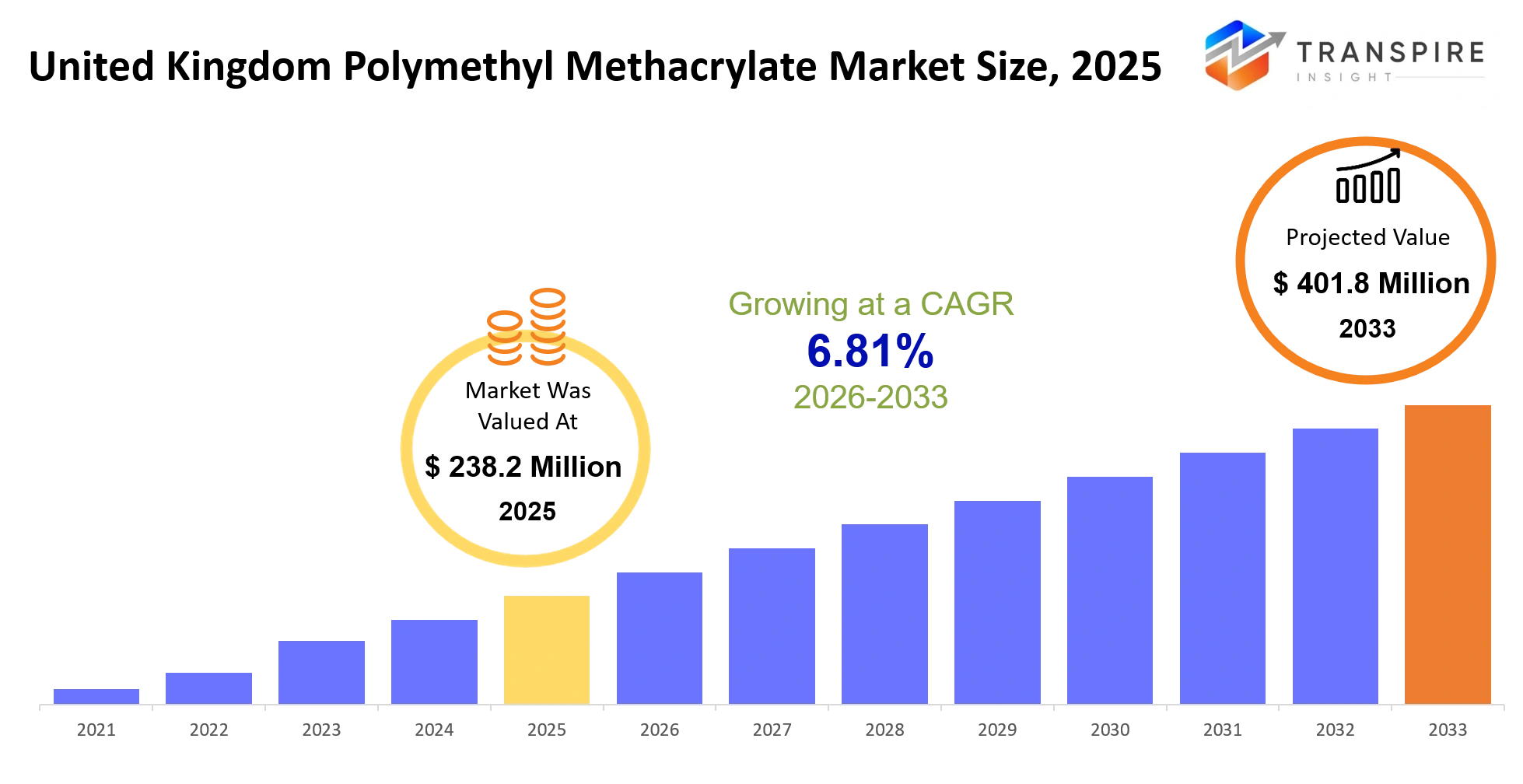
- United Kingdom Polymethyl Methacrylate Market Size 2025: USD 238.2 Million
- United Kingdom Polymethyl Methacrylate Market Size 2033: USD 401.8 Million
- United Kingdom Polymethyl Methacrylate Market CAGR: 6.81%
- United Kingdom Polymethyl Methacrylate Market Segments: By Product Type (Extruded PMMA, Cast PMMA, Beads PMMA, Pellets PMMA, Recycled PMMA, UV-resistant PMMA, Optical-grade PMMA, Others); By Application (Automotive Components, Signage & Displays, Construction Materials, Electronics, Medical Devices, Lighting Systems, Others); By End User (Automotive Industry, Construction Industry, Electronics Industry, Healthcare Industry, Others); By Form (Sheets, Pellets, Resins, Rods & Tubes, Others).
To learn more about this report,  Download Free Sample Report
United Kingdom Polymethyl Methacrylate Market Summary
The United Kingdom Polymethyl Methacrylate Market was valued at USD 238.2 Million in 2025. It is forecast to reach USD 401.8 Million by 2033. That is a CAGR of 6.81% over the period.
The United Kingdom Polymethyl Methacrylate (PMMA) market seems to play a big, kind of crucial part in providing lightweight, clear, and weather resistant materials that show up in construction, automotive, electronics, healthcare, and signage too. PMMA really works as a decent alternative to glass , especially in places where durability, design flexibility, and weight reduction are all kind of on the list at the same time. You can keep seeing it in architectural glazing, retail displays, vehicle lighting systems, and medical devices. Because of that ongoing use, the market keeps moving forward, and it supports broader growth.
In the last five years, the market sort of shifted its structure toward more advanced, specialty grade PMMA products meant for higher performance use. This change shows up most in electric vehicles, and, in sustainable building projects too. One big factor, kind of a trigger was the global supply chain disruption during and after the COVID-19 period, and it really highlighted weak spots in raw material sourcing it also pushed producers to improve domestic and regional supply networks. Plus, when more money goes into energy saving buildings premium automotive components and healthcare infrastructure, PMMA adoption keeps rising. So, manufacturers and processors across the United Kingdom keep getting steadier revenue streams, which in turn keeps the momentum going, even when conditions feel a little uneven .
Key Market Insights
- England pretty much leads the United Kingdom Polymethyl Methacrylate Market, taking about 68% share in 2025, mostly because manufacturing and construction activity are pretty concentrated there.
- Scotland on the other hand looks like the fastest mover through 2033, it is being pushed along by renewable energy infrastructure , and also by commercial development spending.
- When it comes to product types, extruded PMMA is still out in front, roughly 45% in 2025, mainly due to its cost efficiency plus that flexible, easy to use versatility angle.
- Cast PMMA sits as the next big segment with around second place, because the optical clarity is stronger, and it performs well in premium architectural uses.
- Specialty grades, and impact-modified PMMA too, are projected to grow at the quickest pace from 2025 to 2033, a lot of that is tied to transportation needs , and electronics related applications.
- In terms of end use, construction applications dominate demand at about 38% market share, and this is linked to glazing , skylights, partitions and architectural panels all together.
- Automotive use is expanding pretty quickly as makers chase vehicle weight reductions in the 10–15% range, aiming to boost efficiency and EV performance at the same time.
- Healthcare and medical equipment demand has also picked up since 2021, supported by new investments in durable transparent protective components.
- Key players still keep moving, like Röhm GmbH, Mitsubishi Chemical Group, Trinseo, LG Chem, and Chi Mei Corporation , all expanding their specialty product portfolios.
- Overall, competitive advantage is increasingly about recycled PMMA development, advanced optical grade materials, supply chain localization, plus money put into low-carbon manufacturing technologies.
What are the Key Drivers, Restraints, and Opportunities in the United Kingdom Polymethyl Methacrylate Market?
The main driver of market growth is the widening use of lightweight , high-performance materials across both construction and transportation, honestly. Tighter building efficiency rules, plus vehicle emission targets, pushed manufacturers and developers to swap heavier, more conventional materials for PMMA based solutions. And since the shift toward electric vehicles keeps rolling forward, adoption speeds up again, because reducing mass directly helps battery efficiency and stretches driving range a bit more. So overall, PMMA demand is moving higher across glazing systems, lighting elements, protective panels and also more internal applications, and this shows up as real revenue growth for suppliers who serve those industries.
The biggest restraint is the market dependence on petrochemical derived raw inputs , especially methyl methacrylate monomer. Pricing for these materials stays exposed to global energy market swings, and also to supply disruptions. This isn’t just a temporary hiccup either, it feels structural because it links back to upstream chemical production capacity and international feedstock markets, not some short term operational problem. When costs jump, manufacturer margins get squeezed, and purchasing decisions can get delayed in price sensitive sectors like construction, which then slows wider market penetration.
A strong opportunity sits in circular economy programs and newer recycling technologies. Mechanical and chemical recycling approaches are getting better at recovering high-quality PMMA from post consumer waste and industrial waste streams. At the same time, investments in sustainable construction efforts and environmentally aligned procurement policies are making the path smoother for recycled PMMA adoption.
What Has the Impact of Artificial Intelligence Been on the United Kingdom Polymethyl Methacrylate Market?
Artificial intelligence and more advanced digital technologies are, kind of, reshaping how PMMA manufacturers handle production, run quality control, and coordinate supply chain tasks. In many modern plants they now use AI monitoring systems that look at temperature pressure, and the polymerization variables, pretty much live as the process happens. These setups can tweak process parameters on their own, so the final product stays consistent and they throw away less material.
Machine learning is also making predictive maintenance feel more practical across extrusion and casting equipment. By studying vibration patterns and energy consumption signals plus general equipment performance trends, manufacturers can flag possible failures, before those failures actually show up. This way companies can cut down on unexpected downtime, stretch the useful life of machines, and generally lift how much of the plant is effectively used.
On the supply chain side, AI forecasting tools help producers estimate demand changes with greater precision. That makes it easier to fine tune inventory levels and also lower procurement related risks, overall. A lot of operational gains follow from this too: better production efficiency, reduced scrap rates, steadier product quality, and stronger delivery dependability. Some manufacturers even claim double digit reductions in interruptions linked to maintenance once predictive analytics platforms go in.
Still, AI adoption isn’t totally smooth because integration costs can be high and the supply of strong operational datasets is often limited. A lot of facilities keep older equipment running, and those setups need significant upgrades before advanced analytics can be used in a meaningful way. So, the roll out across the industry can end up moving slower than people hoped.
Key Market Trends
- Since 2021, manufacturers have increased their investment in specialty optical-grade PMMA type products, for automotive lighting and also kind of advanced architectural glazing, you know.
- Between 2022 and 2025, recycled PMMA initiatives grew quite a bit as sustainability targets started sitting at the center of procurement tactics, more or less.
- Construction firms then leaned toward lighter transparent materials, which helped PMMA adoption rise across commercial renovation work.
- Automotive suppliers said PMMA component usage went up by roughly 12%–15% in vehicle lighting and in interior systems, overall.
- From 2023 onward, digital manufacturing methods improved production efficiency by nearly 10% across several advanced processing sites.
- After pandemic related disruptions, supply chain diversification picked up fast, because it really highlighted how dependent some groups were on overseas raw material sources.
- More and more, product development now favors impact-resistant as well as UV-resistant grades, made for tough outdoor usage.
- Meanwhile, strategic partnerships between material producers and construction companies expanded, to back energy-efficient building efforts.
- Also, top premium electronics brands increased their use of optical-grade acrylic materials, for display panels and consumer device parts.
- And from 2022 through 2025, leading producers bolstered regional distribution routes, so deliveries felt steadier and customers got quicker responses.
United Kingdom Polymethyl Methacrylate Market Segmentation
By Product Type
Extruded PMMA kinda holds the dominant position, mainly due to cost efficiency , easier fabrication, and the fact it fits large-scale industrial work pretty well so it spreads across a bunch of sectors. In construction projects, retail displays and even protective barriers, it’s used a lot because the quality stays consistent, and the performance is reliable , not to mention predictable. Cast PMMA comes in as the second-largest option , mostly because of better optical clarity and a smoother surface finish , so it shows up frequently in premium architectural work and other specialty uses. Then Beads PMMA and Pellets PMMA keep supporting manufacturing activities where flexible processing matters, plus teams like the idea of customized product development, more or less.
Recycled PMMA is projected to grow the fastest, sustainability targets are pushing more recovered material into industrial supply chains, and that momentum is pretty strong. UV-resistant PMMA is also gaining attention for outdoor installations , where long-term exposure to weather means durability needs to be stronger and color stability has to last. Optical-grade PMMA stays important in electronics, lighting systems, and precision-based applications where exceptional transparency and light transmission are basically non-negotiable. Other specialized PMMA types will keep filling niche industrial requirements too, through ongoing product innovation and development that’s centered on performance focused results.
By Application
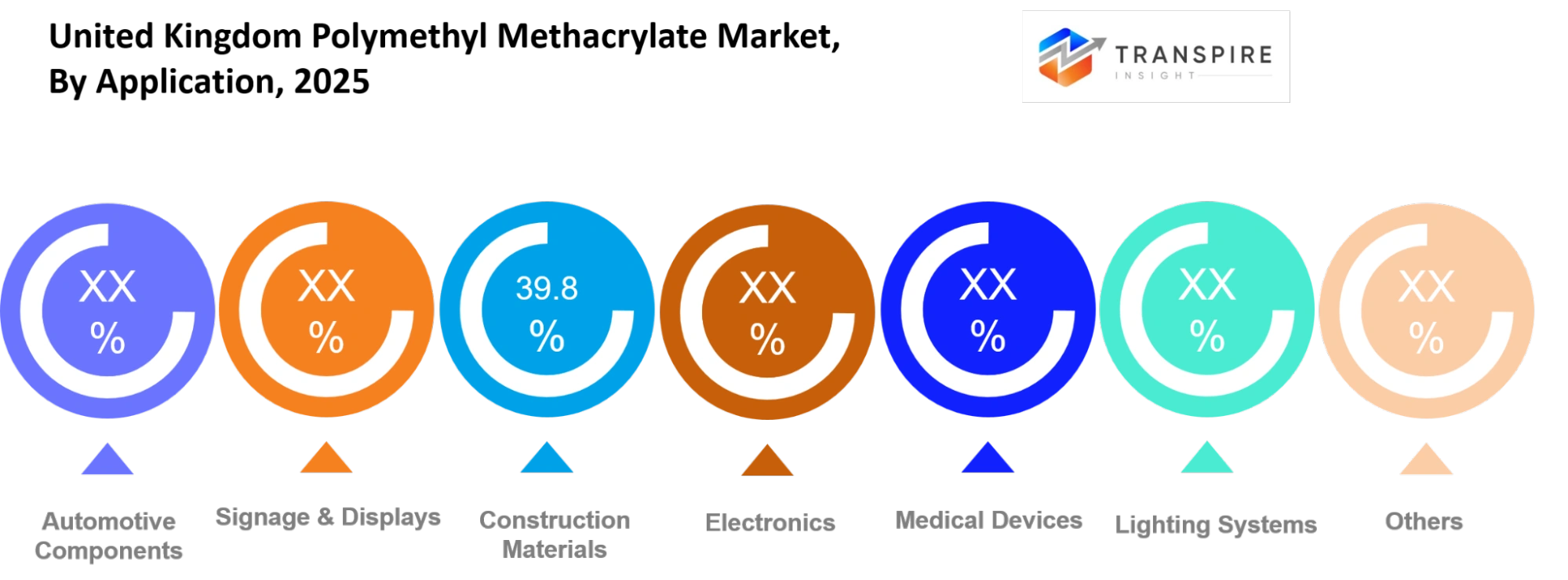
Automotive Components basically hold the dominant position because lightweight materials help vehicle efficiency, while still keeping strength, durability, and that clean visual appeal. PMMA also gets used a lot in lighting assemblies, interior panels, instrument displays, and various exterior design elements. Signage & Displays keep the second-largest position too, mostly because retail environments and commercial advertising really need clear solutions, plus public information systems keep pushing demand. Construction Materials take up a substantial share as well since transparent panels, skylights, and architectural features are becoming more normal in modern building projects.
Automotive Components are expected to keep leading as manufacturers stay focused on weight reduction and those advanced design requirements that come with it. Electronics are projected to grow the fastest, largely due to wider use in display screens, smart devices, and optical applications. Medical Devices keep gaining adoption, mainly because healthcare settings want transparent, durable, and hygienic materials that actually work day to day. Lighting Systems, along with other applications, should support broader market expansion, as energy-efficient technologies improve and specialized industrial solutions keep getting developed.
To learn more about this report, Download Free Sample Report
By End User
The Automotive Industry is still in the dominant position, mainly because steady production of passenger vehicles, electric vehicles, and commercial transportation systems keeps pushing strong demand for high-performance acrylic materials. It’s not just about speed though, Lightweight construction and enhanced design flexibility are still kind of big factors, really supporting why people pick these materials in the first place.
The Construction Industry sits in the second-largest spot, largely from the broad use across glazing systems, partitions, roofing solutions, and decorative architectural structures, which is pretty straightforward. In the Electronics Industry side, it also matters a lot, since there are applications that need transparency, impact resistance, and optical precision, and those requirements are not small.
For what comes next, the Automotive Industry is expected to keep the lead as advanced mobility technologies and vehicle modernization programs keep expanding what materials are needed. The Electronics Industry is projected to see the fastest growth, since digital devices, display technologies, and smart equipment are increasingly dependent on specialized acrylic materials. Meanwhile, the Healthcare Industry keeps strengthening its market participation, driven by the growing use of transparent components in diagnostic equipment and protective solutions. Other end users will also gain ground through ongoing industrial diversification and the broader adoption of engineered materials across commercial sectors.
By Form
Sheets still hold the dominant position, mainly due to versatility, ease of installation, and how well they fit construction , signage, and industrial tasks. Large-format panels offer really good transparency, but also allow easy fabrication so they fit multiple commercial and industrial needs. Pellets keep the second-largest place, because manufacturing facilities rely on pelletized materials for smoother, more efficient processing and for big scale production. Resins keep supporting tailored product development, especially when specialized performance characteristics are needed.
Sheets are expected to stay strong as infrastructure projects and commercial developments keep using transparent building materials. Resins are projected to be the fastest mover, mainly because the need for advanced formulations is expanding, plus high-performance applications are getting more attention. Rods & Tubes will still matter for engineering, industrial, and specialty fabrication, where precise dimensions and durability are non-negotiable. Other forms will keep contributing too, through customized solutions made for specific operational, and technical requirements.
What are the Key Use Cases Driving the United Kingdom Polymethyl Methacrylate Market?
In the United Kingdom, PMMA still stays one of the biggest things for construction, like honestly the most noticeable application area. Architects, developers, and other teams use it a lot for skylights , transparent roof setups, windows, room partitions, and even decorative building parts because it has that optical clarity, plus it feels lighter, and it also resists bad weather really well. Because of this mix, it becomes especially useful in commercial and public infrastructure work where you want dependable performance.
But it does not stop there. Automotive and healthcare uses keep growing in importance. Car makers put PMMA into headlamp lenses, interior display surfaces, and different exterior trim elements, aiming to cut down weight yet still keep durability in place. In healthcare, producers use PMMA for protective screens, diagnostic equipment, and transparent medical parts that need steady optical performance every time, not just “good enough.”
Meanwhile, there are newer uses showing up too, especially around renewable energy infrastructure, smart buildings, and advanced electronics. PMMA is being used more often in solar panel components , intelligent display arrangements, and in next‑generation lighting concepts. And as innovation keeps spreading across these fields, new high‑performance PMMA grades are expected to show up, which should open up more growth chances through the whole forecast period.
|
Report Metrics |
Details |
|
Market size value in 2025 |
USD 238.2 Million |
|
Market size value in 2026 |
USD 253.4 Million |
|
Revenue forecast in 2033 |
USD 401.8 Million |
|
Growth rate |
CAGR of 6.81% from 2026 to 2033 |
|
Base year |
2025 |
|
Historical data |
2021 - 2024 |
|
Forecast period |
2026 - 2033 |
|
Report coverage |
Revenue forecast, competitive landscape, growth factors, and trends |
|
Regional scope |
United Kingdom |
|
Key company profiled |
Arkema, Mitsubishi Chemical, Röhm GmbH, Sumitomo Chemical, Trinseo, Chi Mei Corporation, LG Chem, Asahi Kasei, Kuraray, Evonik Industries, SABIC, Toray Industries, Lotte Chemical, Kolon Industries, Dow. |
|
Customization scope |
Free report customization (country, regional & segment scope). Avail customized purchase options to meet your exact research needs. |
|
Report Segmentation |
By Product Type (Extruded PMMA, Cast PMMA, Beads PMMA, Pellets PMMA, Recycled PMMA, UV-resistant PMMA, Optical-grade PMMA, Others); By Application (Automotive Components, Signage & Displays, Construction Materials, Electronics, Medical Devices, Lighting Systems, Others); By End User (Automotive Industry, Construction Industry, Electronics Industry, Healthcare Industry, Others); By Form (Sheets, Pellets, Resins, Rods & Tubes, Others). |
Which Regions are Driving the United Kingdom Polymethyl Methacrylate Market Growth?
England still looks like the most dominant region in the United Kingdom Polymethyl Methacrylate market, mainly because manufacturing facilities are concentrated there, along with active commercial construction and a fairly developed transportation sector. It also seems to enjoy real momentum from urban redevelopment schemes, energy saving building programs ,and a lot of high-value industrial production that really leans on durable, clear materials for visibility and longevity. In practice, big hubs like London, Birmingham, and Manchester keep demand steady for PMMA used in architectural glazing, retail infrastructure, healthcare settings, and transit related uses. Add a mature supply chain network, a skilled workforce, and close proximity to major distribution hubs, and England ends up with the kind of stable groundwork that supports longer term market expansion.
Scotland, on the other hand, sits as the second-largest regional market, though its growth rhythm feels a bit different from England’s more industrial and commercial emphasis. The region gains from steady investment in renewable energy initiatives, public infrastructure refreshes, and specialized engineering applications where weather resistant materials matter a lot. Scotland’s wider economic resilience plus long-range planning for infrastructure has helped produce a predictable setting for PMMA consumption across commercial, industrial, and public-sector work. Even if the market is smaller overall, the dependable stream of projects makes it a meaningful contributor to national revenue generation.
Wales is showing up as the fastest-growing area during the forecast period, and that shift is being linked to more investment in advanced manufacturing ,sustainable construction projects, and regional economic development initiatives. These things are basically opening up new windows of opportunity for PMMA suppliers over the coming years.
Who are the Key Players in the United Kingdom Polymethyl Methacrylate Market and How Do They Compete?
The United Kingdom PMMA market has a pretty moderately consolidated competitive setup, where global material producers sort of compete by leaning on technology innovation, product performance, sustainability credentials, and supply reliability more than just plain pricing. A lot of manufacturers are now paying attention to specialty acrylic grades, recycled-content materials, and even application-specific solutions for construction, automotive electronics, and healthcare. In general, the competition moved away from basic commodity output toward higher value items that give stronger optical clarity , better durability, and more environmentally friendly behavior.
Röhm GmbH tends to stand out thanks to its PLEXIGLAS lineup, plus its ongoing investment into circular PMMA technologies. In 2026 the company added industrial-scale chemical recycling capabilities, aiming to build a closed loop PMMA value chain, and it’s helping them stay strong with customers who want lower-carbon material options.Mitsubishi Chemical Group is centered on advanced material invention and recycling related know-how. The group has collaborated with automotive makers to bring recycled acrylic resin applications into commercial use, which helps create a clearer edge in sustainable mobility markets.
Trinseo pushes specialty , and also sustainable PMMA options via the ALTUGLAS™ portfolio. Their approach leans on advanced recycling technologies, and on partnerships that broaden commercial adoption of recycled acrylic materials into more premium usage like optical lenses and consumer goods. LG Chem and Chi Mei Corporation, more or less compete through manufacturing scale, wide product availability, and solid standing in electronics plus industrial applications. Together they run extensive production networks , so they can maintain steady supply, and they also support growth into emerging PMMA uses across
Company List
- Arkema
- Mitsubishi Chemical
- Röhm GmbH
- Sumitomo Chemical
- Trinseo
- Chi Mei Corporation
- LG Chem
- Asahi Kasei
- Kuraray
- Evonik Industries
- SABIC
- Toray Industries
- Lotte Chemical
- Kolon Industries
- Dow
Recent Development News
"In March 2026, Röhm GmbH announced an investment in industrial-scale chemical recycling technology at its Worms facility. The project enables chemically recycled methyl methacrylate to be integrated into existing production and supports the development of a closed-loop PMMA value chain.
Source: https://www.roehm.com
"In February 2025, Trinseo entered a partnership with Lapo Srl to develop eyewear lenses containing recycled PMMA resin with at least 86% recycled content. The collaboration expanded commercial applications for recycled acrylic materials and strengthened sustainability-focused product development.
Source: https://www.trinseo.com
"In September 2025, Mitsubishi Chemical and Honda commercialized recycled acrylic resin for the door visors of the new N-ONE e: electric vehicle. The development marked the first automotive application of recycled PMMA door visors and demonstrated the viability of closed-loop acrylic recycling in transportation markets.
Source: https://www.mcgc.com
What Strategic Insights Define the Future of the United Kingdom Polymethyl Methacrylate Market?
The United Kingdom PMMA market seems to be drifting toward a higher value and more sustainability-oriented shape, over the next five to seven years. The main “push” behind this change is sort of a mix, circular economy expectations together with fresh advanced manufacturing investment, plus the fact that transport and energy efficient buildings keep demanding lighter materials. So instead of just racing on pure volume, suppliers are going more nuanced— they are trying to stand out via recycled content, niche formulations, and performance boosting technologies, you know that kind of thing.
There’s also a risk that is less obvious but still there. It comes from how much the market still leans on methyl methacrylate feedstocks and from how concentrated global production capacity is. If raw material supply stays tight for a while, margins can get squeezed, and downstream manufacturing can slow down too. At the same time, chemically recycled PMMA is turning into a real opportunity. Recycling methods are getting more reliable, and when regulations keep stressing material circularity, recycled acrylic products should become more accepted in mainstream commercial settings. Firms that lock in recycling partnerships, put money into specialty-grade output, and build regional supply resilience now, will likely be better placed to win premium opportunities across the forecast window.
United Kingdom Polymethyl Methacrylate Market Report Segmentation
By Product Type
- Extruded PMMA
- Cast PMMA
- Beads PMMA
- Pellets PMMA
- Recycled PMMA
- UV-resistant PMMA
- Optical-grade PMMA
- Others
By Application
- Automotive Components
- Signage & Displays
- Construction Materials
- Electronics
- Medical Devices
- Lighting Systems
- Others
By End User
- Automotive Industry
- Construction Industry
- Electronics Industry
- Healthcare Industry
- Others
By Form
- Sheets
- Pellets
- Resins
- Rods & Tubes
- Others
Frequently Asked Questions
Find quick answers to common questions.
The expected United Kingdom Polymethyl Methacrylate Market size for the market will be USD 401.8 Million in 2033.
Key segments for the United Kingdom Polymethyl Methacrylate Market are By Product Type (Extruded PMMA, Cast PMMA, Beads PMMA, Pellets PMMA, Recycled PMMA, UV-resistant PMMA, Optical-grade PMMA, Others); By Application (Automotive Components, Signage & Displays, Construction Materials, Electronics, Medical Devices, Lighting Systems, Others); By End User (Automotive Industry, Construction Industry, Electronics Industry, Healthcare Industry, Others); By Form (Sheets, Pellets, Resins, Rods & Tubes, Others).
Major United Kingdom Polymethyl Methacrylate Market players are Arkema, Mitsubishi Chemical, Röhm GmbH, Sumitomo Chemical, Trinseo, Chi Mei Corporation, LG Chem, Asahi Kasei, Kuraray, Evonik Industries, SABIC, Toray Industries, Lotte Chemical, Kolon Industries, Dow.
The United Kingdom Polymethyl Methacrylate Market size is USD 238.2 Million in 2025.
The United Kingdom Polymethyl Methacrylate Market CAGR is 6.81% from 2026 to 2033.
- Arkema
- Mitsubishi Chemical
- Röhm GmbH
- Sumitomo Chemical
- Trinseo
- Chi Mei Corporation
- LG Chem
- Asahi Kasei
- Kuraray
- Evonik Industries
- SABIC
- Toray Industries
- Lotte Chemical
- Kolon Industries
- Dow
About the Authors

Pankaj Ghogare Patil
I am Pankaj Ghogare Patil, a Senior Research Analyst at Transpire Insight, specializing in the Pharmaceutical, Chemicals & Materials, Healthcare IT, and Biotechnology industry. My expertise lies in conducting comprehensive market research, analyzing industry trends, evaluating competitive landscapes, and translating complex data into actionable insights. At Transpire Insight, I closely follow emerging technologies, regulatory developments, and market innovations to create accurate, well-researched, and informative content that helps businesses and professionals make informed decisions. I am committed to producing credible, evidence-based articles that reflect industry best practices while making technical topics accessible and valuable for a broad audience.

Chakradhar Khansole
Chakradhar serves as the Research Director at Transpire Insight, bringing over 8 years of experience in technology, innovation, and strategic market intelligence. He specializes in transforming complex market data into actionable business insights that enable organizations to make informed, growth-oriented decisions. Recognized for his strategic vision and analytical expertise, Chakradhar leads high-impact research initiatives, delivering comprehensive market assessments, competitive intelligence, and forward-looking industry analysis.
Recently Published Reports
-
May 2026
Healthcare Polymer Packaging Market
Healthcare Polymer Packaging Market Size, Share & Analysis Report By Packaging Type (Syringes, IV Bottles and Pouches, Clamshells, Blisters, Bottles & Jars, Containers, Tubes, IV Parental Packaging, Others), By Type (Regulated, Non-regulated), By Polymer Type (LDPE (Low-Density Polyethylene), HDPE (High-Density Polyethylene), Homo-polymer (Homo), Random Copolymer (Random), Block Copolymer (Block), PET, Polystyrene, Polyvinyl Chloride, Polyamide/EVOH, Others), and Geography (North America, Europe, Asia-Pacific, Middle East and Africa, South and Central America), 2021 - 2031
-
Apr 2026
Hydrophilic Tape (Waterstop) Market
Hydrophilic Tape (Waterstop) Market Size, Share & Analysis Report By Type (Bentonite-Based Hydrophilic Tape, Rubber-Based Hydrophilic Tape), By Application (Residential Buildings, Commercial Buildings, Infrastructure Projects), and Geography (North America, Europe, Asia-Pacific, Middle East and Africa, South and Central America), 2021 - 2031
-
Apr 2026
Metalens Market
Metalens Market Size, Share & Analysis Report By Type (Visible Light Metalens, and Infrared Metalens), By Application (Consumer Electronics, Automotive Electronics, Industrial, Medical, and Others), and Geography (North America, Europe, Asia-Pacific, Middle East and Africa, South and Central America), 2021 - 2031
-
Apr 2026
PBT Resin Market
PBT Resin Market Size, Share & Analysis Report By Type (Reinforced PBT Resin, Unreinforced PBT Resin), By Processing Method (Injection Molding, Extrusion, Blow Molding, Others), By End-User (Automotive, Electrical & Electronics, Consumer Appliances, Industrial Machinery, Medical Devices, Packaging, Others), and Geography (North America, Europe, Asia-Pacific, Middle East and Africa, South and Central America), 2021 - 2031