

United Kingdom Pet Hospice Services Market Size & Forecast
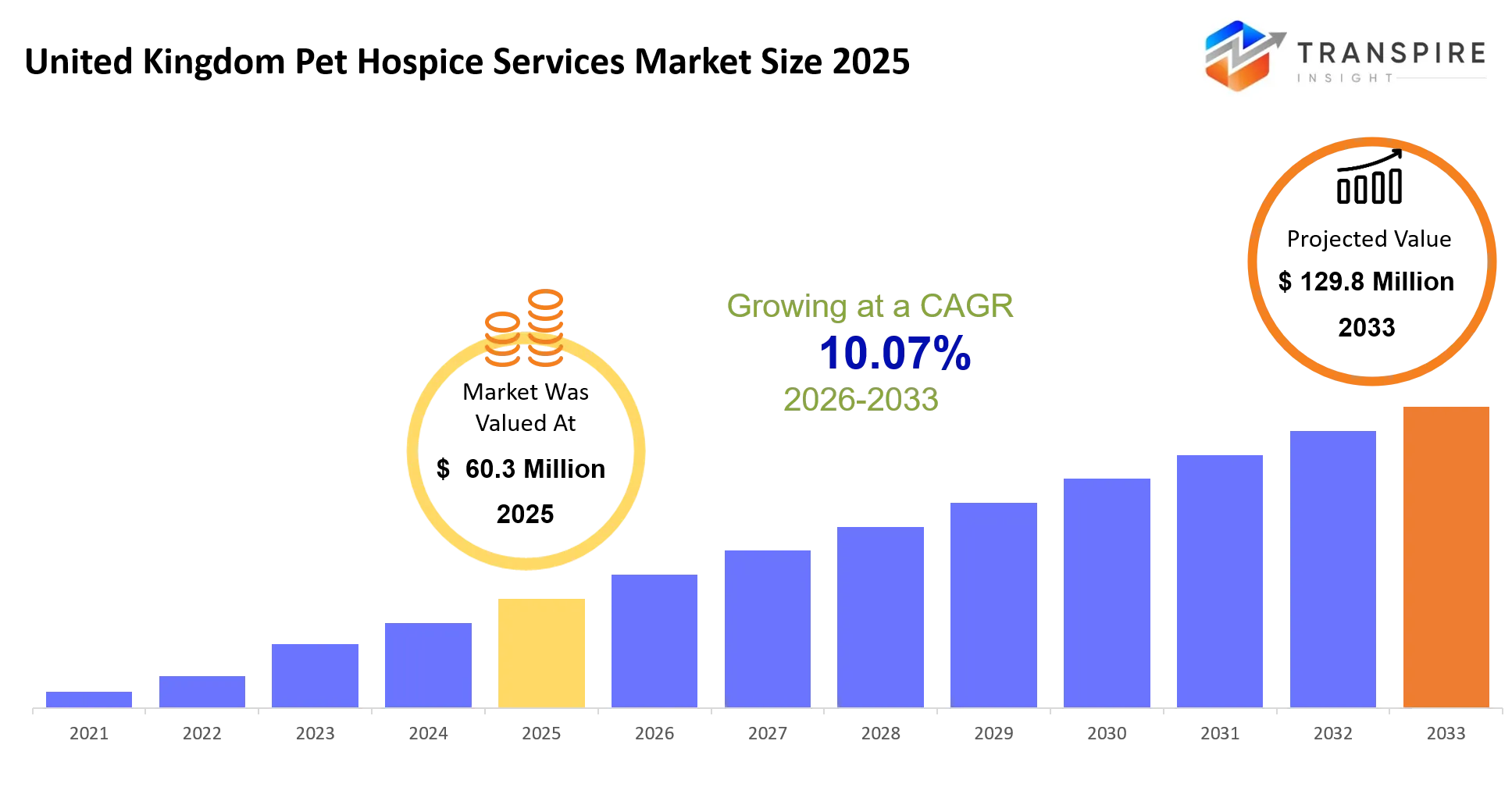
- United Kingdom Pet Hospice Services Market Size 2025: USD 60.3 Million
- United Kingdom Pet Hospice Services Market Size 2026: USD 66.3 Million
- United Kingdom Pet Hospice Services Market Size 2033: USD 129.8 Million
- United Kingdom Pet Hospice Services Market CAGR: 10.07%
- United Kingdom Pet Hospice Services Market Segments: By Service Type (Palliative Care, Pain Management, Euthanasia Services, Bereavement Support, Home Hospice Services, Others); By Pet Type (Dogs, Cats, Birds, Small Mammals, Others); By Service Provider (Veterinary Clinics, Specialty Centers, Home Care Providers, Others); By Delivery Mode (In-Clinic, At-Home, Telehealth, Others); By End User (Pet Owners, Animal Shelters, Rescue Organizations, Others); By Payment Type (Insurance, Out-of-Pocket, Subscription Plans, Others)
United Kingdom Pet Hospice Services Market Summary
As per Transpire Insight Analysis, the United Kingdom pet hospice services market covers this entire care pathway: palliative treatment, pain management, at-home and in-clinic euthanasia, and the bereavement support that follows. Valued at USD 60.3 Million in 2025, the market is set to reach USD 129.8 Million by 2033. Pet hospice services handle the last stages of a beloved animal's life. A veterinary nurse goes to a family's house to give pain relief to an old dog with kidney failure - or a special center in Surrey really helps a family plan a very peaceful, in-house euthanasia instead of a hasty clinic visit.
The most obvious structural change driving this expansion is the move away from clinic-only end-of-life care towards more at-home hospice models. UK pet owners much more often refuse the notion that a pet's last moments ought to occur in some unfamiliar clinical environment. Home Hospice Services now command 38. 3% of the market - the biggest single sector - showing a real change in what UK pet owners view as acceptable end-of-life care rather than a minor shift in preference.
The catalyst for this shift was the pandemic-induced surge in pet acquisition throughout the UK coupled with the aging of that pandemic pet group. Roughly 3. 2 million UK households got a new pet during 2020 and 2021, based on the PDSA Animal Wellbeing Report. Lots of these were older rescue animals or pets that developed unusually strong bonds with their owners while under lockdown isolation. As this batch of pets enters its golden years between 2025 and 2028, the UK sees a large number of end-of-life care choices concentrated over a pretty brief period, and it's this particular wave that's driving our current revenue increase in the market - not simply a general increase in pet ownership.
Key United Kingdom Pet Hospice Services Market Insights
- Home Hospice Services holds a major position within our market, holding a 38. 3% share of market revenue by 2025 - thanks to more and more UK pet owners preferring at-home end-of-life care over clinic-based options.
- England really dominates the regional breakdown of the UK pet hospice services market, especially because there are many more veterinary specialty centres in London, the South East, and the North West here.
- Scotland is actually growing at the fastest rate among all UK countries for pet hospice adoption, with rural mobile vet services greatly expanding their home-visit coverage to reach even more remote areas by 2033.
- Dogs are definitely the biggest pet type segment, accounting for over 55% of market revenue by 2025, thanks to our country's huge dog-owning population (around 13 million) - and also because they tend to cost more per end-of-life care episode compared to cats.
- Cats make up the second-biggest pet type segment, and we're seeing a rise in feline hospice adoption due to longer-lived indoor cats and consequently an increase in chronic and terminal illnesses among older cats themselves.
- Veterinary Clinics still hold the top spot when it comes to service providers, yet Home Care Providers are really taking off - at a projected compound annual growth rate (CAGR) above 13% by 2033 - as dedicated mobile hospice operators spread out beyond just London itself.
- At-Home delivery mode is gaining quite a lot of ground when it comes to new bookings, with families often citing reduced pet stress and greater family privacy as the main reasons for opting for in-home euthanasia instead of going to a clinic.
- Telehealth is becoming another option for delivering services, mainly used for palliative consultations and adjusting pain management plans between in-person visits - which helps reduce unnecessary travel for severely ill pets that may have mobility issues themselves.
- Out-of-pocket payments continue to be the most common way people pay, although pet insurance companies like Animal Trust and others based in the UK have started offering limited hospice and euthanasia coverage riders since 2023 itself.
- Lap of Love and BluePearl Pet Hospice are really expanding their UK presence through partnerships with independent veterinary practices, while Blue Cross and PDSA extend subsidised hospice access to lower-income pet owners through their charitable clinic networks.
What are the Key Drivers, Restraints, and Opportunities in the United Kingdom Pet Hospice Services Market?
Driver: The main driver here is the aging of the UK's pandemic-era pet population. The 3. 2 million pets bought in 2020 and 2021 are now getting on in years - where chronic illnesses, loss of mobility, and terminal diagnoses are becoming more common - and there are enough of them to produce a sustained, demographically very predictable rise in end-of-life care needs over the late 2020s. Owners who really bonded with their pets during lockdown are also a lot more likely to spend money on extended palliative care instead of choosing immediate euthanasia when they first get a diagnosis - which makes the average revenue-generating care period per case last longer and pushes segment revenues towards palliative and pain management services right along with euthanasia itself.
Restraint: The biggest structural obstacle is indeed the lack of veterinary professionals specially trained in palliative and hospice care within the UK. The Royal College of Veterinary Surgeons actually highlighted a broader shortage of vets nationwide back in 2022, and hospice care requires even more specific training in pain assessment, setting up visits at home, and communicating with grieving families - things that regular practice vets don't usually get as part of their standard education. This shortage won't be fixed easily since specialty hospice training programs in the UK still have quite limited availability - which severely limits how fast home hospice providers can grow their capacity even as demand keeps going up, and it holds back revenue too by making some providers keep waiting lists all year round during times of peak seasonal demand.
Opportunity: Really the clearest opportunity lies in expanding UK pet insurance products to include hospice and bereavement services. Conventional UK pet insurance policies have always left out end-of-life and palliative care from their basic plans - viewing euthanasia as something you pay out-of-pocket for yourself. Animal Trust's introduction of hospice-inclusive policy add-ons in 2023 actually showed us that people really want these services if they're made available, and as even more UK insurers start offering similar products, the financial hurdle that right now prevents some owners from opting for extra palliative care over early euthanasia will gradually disappear - unlocking much higher-value, longer-lasting care episodes all over the market.
What Has the Impact of Artificial Intelligence Been on the United Kingdom Pet Hospice Services Market?
Artificial intelligence has entered the pet hospice sector mainly through pain assessment and quality-of-life scoring tools. Several UK hospice providers, including operators affiliated with the Lap of Love model, now use app-based quality-of-life scales that apply machine learning to owner-reported symptom logs to flag when a pet's condition has crossed a threshold that warrants a care plan review. This gives families and vets a more objective basis for difficult timing decisions around euthanasia than subjective daily observation alone.
Scheduling and logistics optimisation is the second major application. Home hospice providers covering rural areas of Scotland and Wales use route-planning software with predictive elements to cluster home visits efficiently, which has measurably reduced average response time for urgent end-of-life visits in areas previously served by a single mobile vet covering a wide radius. Predictive models are also beginning to appear in bereavement support: some UK charities are piloting AI-assisted triage of grief support requests to route higher-risk cases, such as owners showing signs of complicated grief, to a human counsellor faster than manual intake allows.
The clearest current limitation is emotional nuance. Grief and end-of-life decision support are contexts where families expect and need a human response, and AI tools that oversimplify a pain score or a bereavement risk flag into a binary recommendation risk feeling clinical or dismissive at precisely the moment families need empathy. Providers report that AI tools work best as a triage aid behind the scenes, not as a family-facing decision-maker.
Key Market Trends
- Home-based euthanasia bookings rose sharply across UK providers between 2022 and 2025, with several independent operators reporting more than 40% of total euthanasia cases now occurring at home rather than in clinic.
- Bereavement support services expanded beyond informal counselling into structured, multi-session programmes, with Blue Cross and PDSA both formalising dedicated pet loss support lines since 2023.
- Specialty hospice centres opened in previously underserved regions including the North West and parts of Wales between 2023 and 2025, reducing average travel distance for families seeking in-clinic palliative consultations.
- Subscription-based payment plans for ongoing palliative care emerged as a new offering from several private providers in 2024, spreading the cost of extended pain management programmes across monthly instalments.
- Telehealth consultations for pain management adjustment grew as a supplementary service, reducing the number of in-person visits required for pets on stable palliative medication regimens.
- Animal Trust introduced hospice-inclusive insurance riders in 2023, signalling the beginning of a shift away from purely out-of-pocket payment for end-of-life care.
- Mobile hospice fleets expanded route coverage into rural Scotland during 2024 and 2025, cutting average urgent response times for families located outside major population centres.
- Cat-specific palliative protocols gained ground as feline longevity increased, with providers developing separate quality-of-life assessment tools tailored to how cats express chronic pain differently from dogs.
United Kingdom Pet Hospice Services Market Segmentation
By Service Type
Home Hospice Services leads this segment with 38.3% of market revenue in 2025, driven by the strong owner preference for a familiar setting during a pet's final days. Palliative Care and Pain Management follow closely, generating steady repeat-visit revenue as owners extend care duration before opting for euthanasia. Euthanasia Services remain a core revenue base across every provider type, while Bereavement Support is the fastest-growing category as UK charities formalise grief counselling programmes. Over the forecast period, providers offering integrated packages spanning several service types within one home visit will outperform single-service competitors, since families increasingly prefer a continuous relationship with one care team through the entire end-of-life process rather than separate providers for each stage.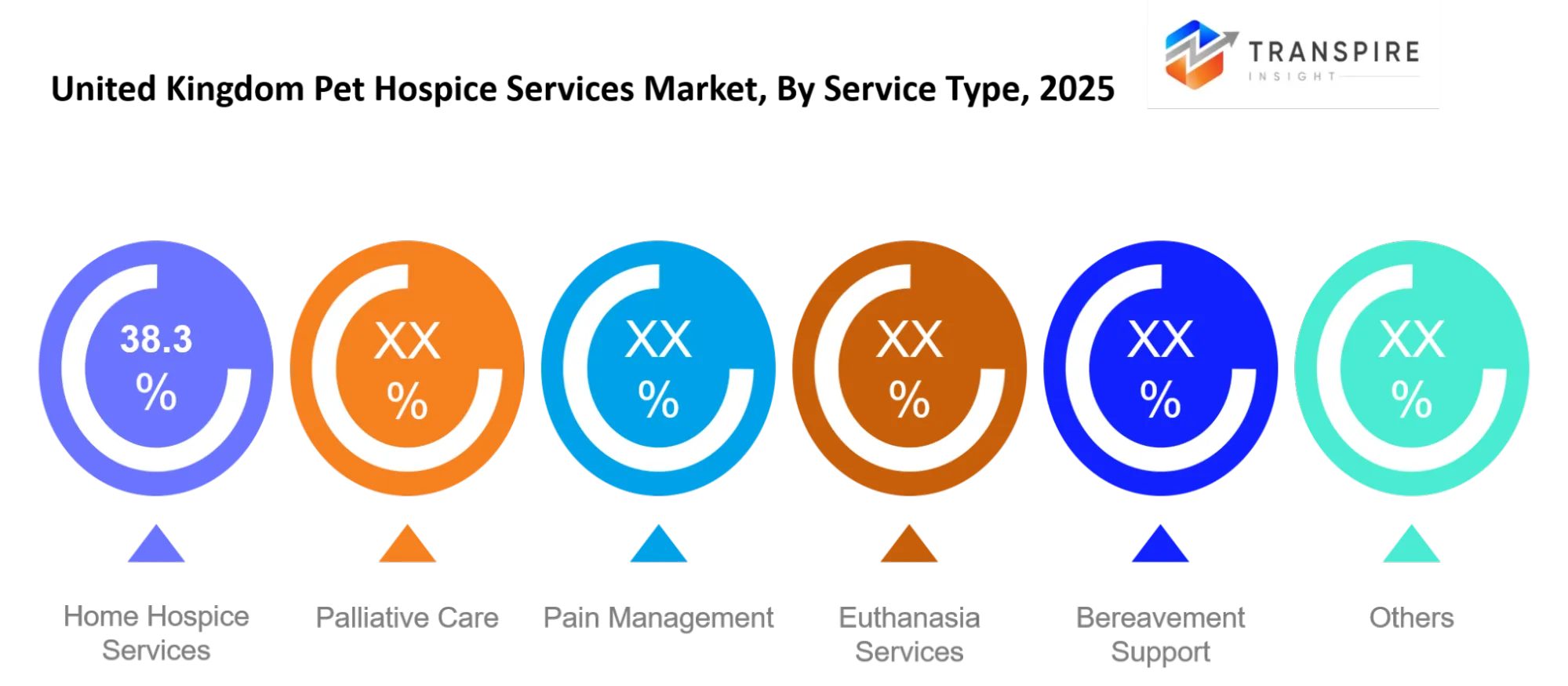
By Pet Type
Dogs dominate pet type revenue at over 55% share, reflecting the UK's roughly 13 million-dog population and higher average spend per hospice case for larger animals requiring more medication and staff time. Cats hold the second-largest share, with revenue accelerating as feline longevity rises and owners seek dedicated hospice protocols suited to how cats mask pain. Birds and Small Mammals remain niche segments served mainly by specialty exotic veterinary practices rather than general hospice providers, though demand is growing slowly as exotic pet ownership expands among younger UK households seeking lower-maintenance companion animals.
By Service Provider
Veterinary Clinics remain the largest provider category, benefiting from established trust relationships and existing patient records that make end-of-life conversations a natural clinical extension. Specialty Centers capture higher per-case revenue through dedicated hospice suites and extended consultation time unavailable in general practice. Home Care Providers are the fastest-growing category, expanding beyond London into regional markets as independent mobile vets build hospice-specific practices. This shift favours providers who can combine clinical credibility with the flexibility to serve families directly in their homes, a combination general veterinary clinics have historically been slower to offer at scale.
By Delivery Mode
In-Clinic delivery still accounts for a meaningful share of total visits, particularly for palliative diagnostics requiring equipment unavailable outside a clinical setting. At-Home delivery is growing fastest, now representing a large share of euthanasia bookings specifically, as families prioritise comfort and privacy over clinical convenience. Telehealth remains a smaller, supplementary delivery mode used for medication adjustment and follow-up consultation rather than primary end-of-life care, though its role is expanding as providers seek to reduce unnecessary travel for pets with limited mobility.
By End User
Pet Owners generate the overwhelming majority of market revenue, reflecting the direct, personal nature of hospice care decisions. Animal Shelters and Rescue Organizations represent a smaller but stable revenue source, particularly for senior and terminally ill rescue animals that shelters cannot rehome and must provide end-of-life care for directly. This segment often relies on charitable partnerships with providers like Blue Cross and PDSA, which extend subsidised or discounted hospice services to shelters operating on constrained budgets, sustaining access for animals that would otherwise go without proper palliative support.
By Payment Type
Out-of-Pocket payment remains dominant, as UK pet insurance has traditionally excluded hospice and euthanasia coverage from standard policies. Insurance-covered hospice care is a small but growing category following Animal Trust's 2023 introduction of dedicated riders. Subscription Plans are a newer payment model, allowing owners to spread the cost of extended palliative programmes across monthly payments rather than a single large bill, a structure several private providers adopted in 2024 to reduce the financial barrier to choosing longer, higher-quality end-of-life care over immediate euthanasia.
What are the Key Use Cases Driving the United Kingdom Pet Hospice Services Market?
The dominant use case is at-home end-of-life care for senior dogs and cats diagnosed with terminal or degenerative conditions such as kidney failure, cancer, or severe arthritis. Families choose a coordinated pathway of pain management, palliative monitoring, and eventually at-home euthanasia rather than a single clinic visit, generating multi-visit revenue across the Home Hospice Services and Pain Management segments that together account for the largest share of total market spend.
A growing secondary use case is structured bereavement support following pet loss, particularly among owners of the pandemic-era pet cohort who report unusually strong attachment to animals acquired during periods of isolation. Charities and private providers alike are building dedicated grief counselling programmes linked directly to the Bereavement Support segment, often bundled with the euthanasia service itself as a follow-up offering rather than a separate purchase decision.
An emerging use case involves shelter and rescue animal end-of-life care, where organisations increasingly contract specialty hospice providers for senior rescue animals unlikely to be rehomed. This use case, still small relative to individual pet owner demand, is expected to grow as UK shelters formalise partnerships with hospice providers to manage the ethical and financial complexity of caring for ageing rescue populations.
|
Report Metrics |
Details |
|
Market size value in 2025 |
USD 60.3 Million |
|
Market size value in 2026 |
USD 66.3 Million |
|
Revenue forecast in 2033 |
USD 129.8 Million |
|
Growth rate |
CAGR of 10.07% from 2026 to 2033 |
|
Base year |
2025 |
|
Historical data |
2021 - 2024 |
|
Forecast period |
2026 - 2033 |
|
Report coverage |
Revenue forecast, competitive landscape, growth factors, and trends |
|
Regional scope |
England; Scotland; Wales; Northern Ireland |
|
Key companies profiled |
BluePearl Pet Hospice, Lap of Love, Medivet, Vets4Pets, Linnaeus Group, CVS Group, Goddard Veterinary Group, Compassion Understood, Blue Cross, PDSA, Animal Trust, Village Vet, Pet Hospice UK, The Ralph Veterinary Referral Centre, Beaumont Sainsbury Animal Hospital |
|
Customization scope |
Free report customization (country, regional & segment scope). Avail customized purchase options to meet your exact research needs. |
|
Report Segmentation |
By Service Type (Palliative Care, Pain Management, Euthanasia Services, Bereavement Support, Home Hospice Services, Others); By Pet Type (Dogs, Cats, Birds, Small Mammals, Others); By Service Provider (Veterinary Clinics, Specialty Centers, Home Care Providers, Others); By Delivery Mode (In-Clinic, At-Home, Telehealth, Others); By End User (Pet Owners, Animal Shelters, Rescue Organizations, Others); By Payment Type (Insurance, Out-of-Pocket, Subscription Plans, Others) |
Which Regions are Driving the United Kingdom Pet Hospice Services Market Growth?
England holds the largest share of the UK pet hospice services market, anchored by London and the South East, where specialty veterinary centre density and higher average household income support premium end-of-life care spending. The concentration of national providers including BluePearl Pet Hospice, Lap of Love, and The Ralph Veterinary Referral Centre in and around London gives England both the deepest service infrastructure and the most competitive provider landscape in the country, sustaining its position as the primary revenue base for the market through the forecast period.
Scotland is the fastest-growing UK nation for pet hospice adoption. Historically, rural areas north of the central belt had limited access to specialised end-of-life veterinary care, forcing families to travel long distances or forgo hospice options entirely. Mobile hospice fleet expansion into these areas since 2024 has opened a previously underserved market, and this infrastructure investment, rather than a shift in underlying demand, is what is driving Scotland's outsized growth rate relative to its population size.
Wales and Northern Ireland remain smaller markets by absolute revenue but show steady, policy-supported growth as regional veterinary networks including Linnaeus Group and CVS Group extend hospice-adjacent services into their existing practice footprints. Growth in both nations depends more on incremental service expansion within established veterinary groups than on new specialist entrants, giving them a more gradual but stable growth trajectory compared to Scotland's infrastructure-driven surge.
Who are the Key Players in the United Kingdom Pet Hospice Services Market and How Do They Compete?
The UK pet hospice services market is fragmented, spanning large veterinary corporate groups, dedicated hospice specialists, and charitable providers, with no single company holding a dominant national share. Competition centres on three factors: geographic coverage for home-visit services, depth of bereavement and emotional support offerings, and the ability to bundle hospice care within existing veterinary patient relationships. Large corporate veterinary groups compete on scale and existing patient trust, while dedicated hospice specialists compete on service depth and family experience.
BluePearl Pet Hospice and Lap of Love differentiate through hospice-only specialisation, building care teams trained specifically in palliative protocols and family bereavement communication rather than treating hospice as an add-on to general practice. Medivet and Vets4Pets, both large multi-site groups, compete by embedding hospice referral pathways directly into their existing clinic networks, converting general patients into hospice clients at the point of terminal diagnosis without requiring a separate provider search. Linnaeus Group and CVS Group pursue a similar embedded model at larger scale across their combined UK practice networks. Blue Cross and PDSA compete on accessibility rather than premium service, extending subsidised hospice and euthanasia care to lower-income owners and shelter partners, a segment the private specialists generally do not prioritise. Animal Trust stands out through its early move into hospice-inclusive insurance products, giving it a payment-model advantage that pure fee-for-service competitors have yet to replicate.
United Kingdom Pet Hospice Services Market Companies
- BluePearl Pet Hospice
- Lap of Love
- Medivet
- Vets4Pets
- Linnaeus Group
- CVS Group
- Goddard Veterinary Group
- Compassion Understood
- Blue Cross
- PDSA
- Animal Trust
- Village Vet
- Pet Hospice UK
- The Ralph Veterinary Referral Centre
- Beaumont Sainsbury Animal Hospital
Recent Developments
In February 2026, CVS Group announced the expansion of its in-house hospice and palliative care training programme across its UK practice network, aiming to standardise end-of-life protocols across more than 500 affiliated clinics. https://www.cvsukltd.co.uk/news (CVS Group Press Office).
In December 2025, Animal Trust extended its hospice-inclusive insurance rider to cover at-home euthanasia costs in full for policyholders enrolled for over 12 months, broadening a product first introduced in 2023. https://www.animaltrust.org.uk/news (Animal Trust).
In April 2026, Lap of Love confirmed the opening of two new regional coordination hubs in the North West and South West of England to support faster mobile hospice dispatch outside London. https://www.lapoflove.com/press (Lap of Love Newsroom).
What Strategic Insights Define the Future of the United Kingdom Pet Hospice Services Market?
Over the next five to seven years, the UK pet hospice services market will be shaped by the specific demographic bulge of pandemic-era pets reaching senior age, not by a general rise in pet ownership. This is a timing-driven market: demand will likely peak sometime between 2027 and 2030 as this cohort concentrates its end-of-life care needs, then moderate toward a steadier, more typical replacement rate once that generation passes through the market.
The hidden risk is veterinary workforce capacity. If the UK's broader vet shortage persists or worsens, hospice providers may be unable to scale fast enough to meet the demographic surge, leading to waiting lists and service rationing precisely when demand peaks, a risk not visible in headline growth projections that assume unconstrained supply.
The opportunity not yet fully priced into most market forecasts is insurance product expansion. As more UK insurers follow Animal Trust's lead in covering hospice and euthanasia costs, the out-of-pocket barrier that currently limits extended palliative care will fall, and providers able to build direct billing relationships with insurers early will capture a disproportionate share of this shift. The strategic recommendation for market participants is to invest now in workforce training pipelines and insurer partnerships simultaneously, since capacity and payment access are the two constraints most likely to determine which providers capture the coming demand surge.
United Kingdom Pet Hospice Services Market Report Segmentation
By Service Type
- Palliative Care
- Pain Management
- Euthanasia Services
- Bereavement Support
- Home Hospice Services
- Others
By Pet Type
- Dogs
- Cats
- Birds
- Small Mammals
- Others
By Service Provider
- Veterinary Clinics
- Specialty Centers
- Home Care Providers
- Others
By Delivery Mode
- In-Clinic
- At-Home
- Telehealth
- Others
By End User
- Pet Owners
- Animal Shelters
- Rescue Organizations
- Others
By Payment Type
- Insurance
- Out-of-Pocket
- Subscription Plans
- Others
Frequently Asked Questions
Find quick answers to common questions.
The United Kingdom Pet Hospice Services Market size is expected to reach USD 129.8 Million by 2033.
The key Segments are By Service Type (Palliative Care, Pain Management, Euthanasia Services, Bereavement Support, Home Hospice Services, Others); By Pet Type (Dogs, Cats, Birds, Small Mammals, Others); By Service Provider (Veterinary Clinics, Specialty Centers, Home Care Providers, Others); By Delivery Mode (In-Clinic, At-Home, Telehealth, Others); By End User (Pet Owners, Animal Shelters, Rescue Organizations, Others); and By Payment Type (Insurance, Out-of-Pocket, Subscription Plans, Others).
Major Players include BluePearl Pet Hospice, Lap of Love, Medivet, Vets4Pets, Linnaeus Group, CVS Group, Goddard Veterinary Group, Compassion Understood, Blue Cross, PDSA, Animal Trust, Village Vet, Pet Hospice UK, The Ralph Veterinary Referral Centre, and Beaumont Sainsbury Animal Hospital.
The Current United Kingdom Pet Hospice Services Market size is USD 60.3 Million in 2025.
The United Kingdom Pet Hospice Services Market CAGR is 10.07% from 2026 to 2033.
- BluePearl Pet Hospice
- Lap of Love
- Medivet
- Vets4Pets
- Linnaeus Group
- CVS Group
- Goddard Veterinary Group
- Compassion Understood
- Blue Cross
- PDSA
- Animal Trust
- Village Vet
- Pet Hospice UK
- The Ralph Veterinary Referral Centre
- Beaumont Sainsbury Animal Hospital
About the Authors

Pankaj Ghogare Patil
I am Pankaj Ghogare Patil, a Senior Research Analyst at Transpire Insight, specializing in the Pharmaceutical, Chemicals & Materials, Healthcare IT, and Biotechnology industry. My expertise lies in conducting comprehensive market research, analyzing industry trends, evaluating competitive landscapes, and translating complex data into actionable insights. At Transpire Insight, I closely follow emerging technologies, regulatory developments, and market innovations to create accurate, well-researched, and informative content that helps businesses and professionals make informed decisions. I am committed to producing credible, evidence-based articles that reflect industry best practices while making technical topics accessible and valuable for a broad audience.

Chakradhar Khansole
Chakradhar serves as the Research Director at Transpire Insight, bringing over 8 years of experience in technology, innovation, and strategic market intelligence. He specializes in transforming complex market data into actionable business insights that enable organizations to make informed, growth-oriented decisions. Recognized for his strategic vision and analytical expertise, Chakradhar leads high-impact research initiatives, delivering comprehensive market assessments, competitive intelligence, and forward-looking industry analysis.
Recently Published Reports
-
Jul 2026
Alopecia Treatment Market
Alopecia Treatment Market Size, Share & Analysis Report By Disease Type (Alopecia Areata, Cicatricial Alopecia, Traction Alopecia, Alopecia Totalis, Androgenetic Alopecia, Alopecia Universalis, and Other Disease Types), By Treatment Type (Topical Treatments, Oral Medications, Injectable Therapies, and Hair Transplantation), By Gender (Male, and Female), By Distribution Channel (Hospitals and Clinics, Retail Pharmacies, and Online Retailers), and Geography (North America, Europe, Asia-Pacific, Middle East and Africa, South and Central America), 2021 - 2031
-
Jul 2026
Medical Ultrasound Probe Market
Medical Ultrasound Probe Market Size, Share & Analysis Report By Type (Linear Type, Convex Type, Endocavitary Probe, Phased Array/Cardiac Probe, Transesophageal (TEE) Probe, and Others), By Application (Ophthalmology, Cardiology, Musculoskeletal, Oncology, Obstetrics & Gynecology, General Imaging, and Others), By End User (Hospitals & Clinics, Diagnostic Centers, Ambulatory Surgical Centers, and Others), and Geography (North America, Europe, Asia-Pacific, Middle East and Africa, South and Central America), 2021 – 2031
-
May 2026
Biosimilars Market
Biosimilars Market By Product Type (Monoclonal Antibodies, Recombinant Hormones, Erythropoietin, G-CSF, Others), By Indication (Oncology, Autoimmune Diseases, Blood Disorders, Diabetes, Others), By Manufacturing Type (In-House Manufacturing, Contract Manufacturing), By Distribution Channel (Hospital Pharmacies, Retail Pharmacies, Online Pharmacies), By Industry Analysis, Size, Share, Growth, Trends, and Forecasts 2021-2033
-
Apr 2026
Gastrointestinal Endoscopy Market
Gastrointestinal Endoscopy Market By Type (Rigid Gastrointestinal Endoscope, Flexible Gastrointestinal Endoscopes, Disposable Gastrointestinal Endoscope), By Procedure Type (Colonoscopy, Gastroscopy, Duodenoscopy, Enteroscopy, Flexible Sigmoidoscopy, Others), By Application (Diagnosis, Treatment), By End-Users (Hospitals, Ambulatory Surgical Centers, Specialty Clinics, Laboratories, Others), By Industry Analysis, Size, Share, Growth, Trends, and Forecasts 2021-2033