

Middle East and Africa Pet Products Market Size & Forecast:
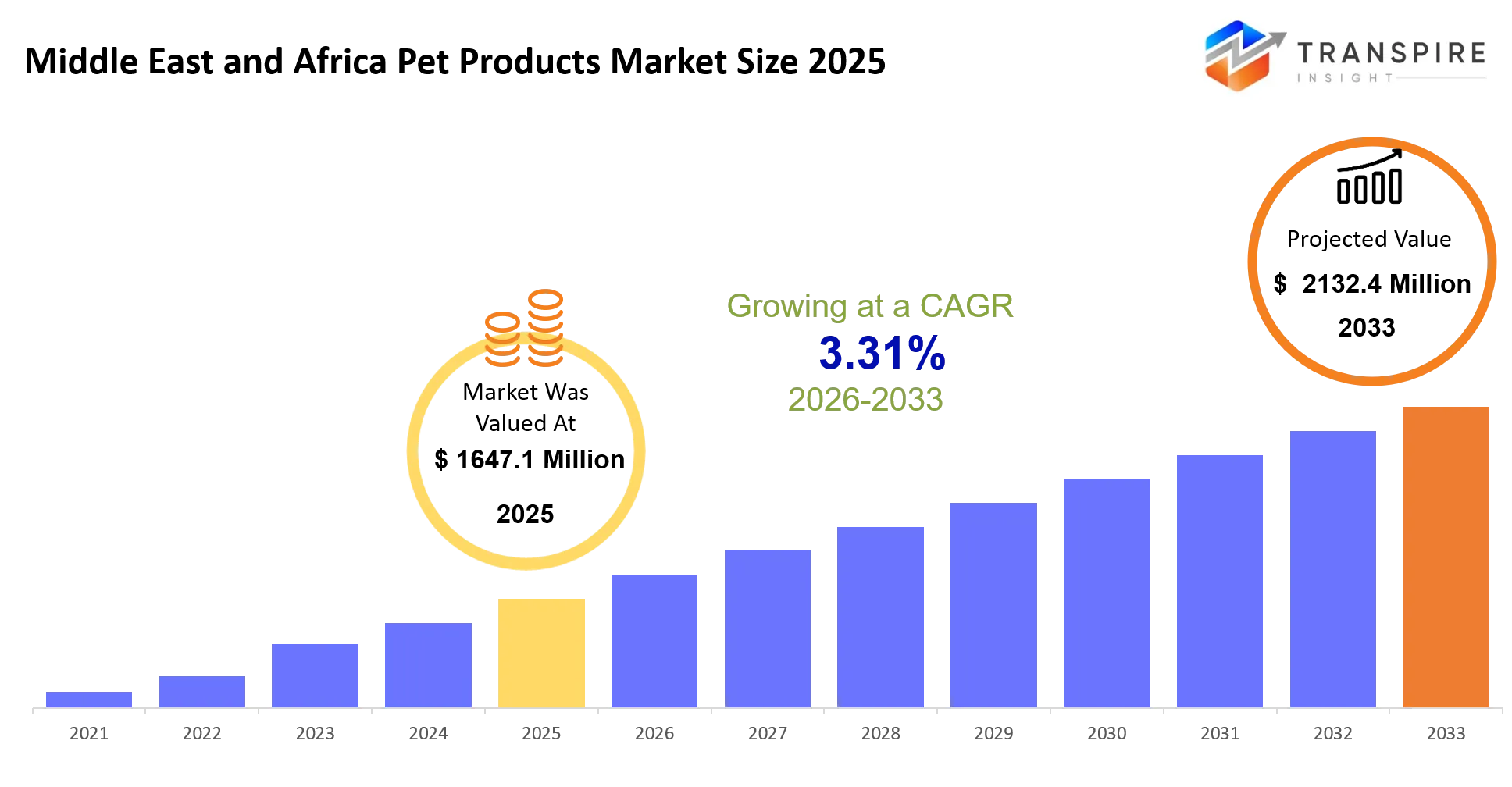
- Middle East and Africa Pet Products Market Size 2025: USD 1647.1 Million
- Middle East and Africa Pet Products Market Size 2033: USD 2132.4 Million
- Middle East and Africa Pet Products Market CAGR: 3.31%
- Middle East and Africa Pet Products Market Segments: By Product Type (Pet Food, Pet Toys, Pet Grooming Products, Pet Healthcare Products, Pet Accessories, Pet Bedding, Others); By Pet Type (Dogs, Cats, Birds, Fish, Small Mammals, Others); By Distribution Channel (Pet Stores, Supermarkets, Online Retail, Veterinary Clinics, Others); By End User (Households, Pet Shelters, Breeders, Others)
Middle East and Africa Pet Products Market Summary
The Middle East and Africa Pet Products Market was valued at USD 1647.1 Million in 2025. It is forecast to reach USD 2132.4 Million by 2033. That is a CAGR of 3.31% over the period.
The pet products industry, kind of plays a critical part in helping with animal nutrition, healthcare, hygiene comfort and just general well being across homes, shelters, veterinary networks and breeding facilities. You see everything from specialized pet food and healthcare solutions to toys accessories and bedding, and all that stuff helps owners handle pet health while also bumping up the day to day quality of life for companion animals. Over the last five years the market has changed a lot, mostly because pet ownership habits started leaning away from basic care, and more toward premium nutrition, preventive healthcare and those more specialized lifestyle products.
One big structural change has been a move toward nutrition that’s scientifically formulated, plus health products that are supported by veterinary expertise. Manufacturers have widened what they offer, including breed specific diets, functional treats and preventive healthcare options. One big trigger that really messed with how the market moves was the disruption of global supply chains during and kind of after the pandemic. This disruption highlighted weaknesses in how ingredients and components were sourced , and it also made firms invest more in nearby production, like regional manufacturing. Then, as disposable incomes improved in several places including parts of the Gulf Cooperation Council, and as urban pet ownership expanded in South Africa and other African economies, spending per pet went up. Because of that, new revenue streams opened up for premium brands, retail distribution networks grew too, and more investment went into digital pet care platforms, which in turn supports stronger, long term adoption across the region.
Key Market Insights
- The Middle East and Africa pet products Market is seeing USD 1.65 billion in 2025 and it is expected to top USD 2.13 billion by 2033, somehow.
- Gulf Cooperation Council countries contribute around 38% of the regional revenue, mainly because disposable income stays relatively higher and premium product penetration is stronger than before.
- South Africa is still the biggest single-country source of revenue, backed by well established pet food manufacturing and retail infrastructure, too.
- Online retail sales grew by more than 20% from 2022 to 2025, and that changed distribution strategies across the whole pet care industry, in practice.
- Pet food is leading, with roughly a 45% market share which points to the recurring habit of nutrition-related buying.
- Pet healthcare products come in as the second-largest category, since preventive veterinary care is gaining commercial importance over time.
- Premium and functional nutrition products are the fastest growing segment through 2033, pushed by specialized dietary requirements that consumers are asking for more.
- Households make up over 70% of total consumption, so residential pet ownership becomes the main revenue engine, honestly.
- Veterinary clinics keep expanding their influence as trusted channels, especially for therapeutic nutrition and healthcare products.
- Companies like Mars Petcare , Nestlé Purina, Hill’s Pet Nutrition, Zoetis, PetSafe, and Spectrum Brands are going after product innovation, regional growth, and omnichannel distribution plans.
What are the Key Drivers, Restraints, and Opportunities in the Middle East and Africa Pet Products Market?
The strongest growth driver comes from this shift toward premium pet care and, you know, scientifically formulated nutrition. Urbanization across Gulf countries , and big African cities, seems to have rearranged the way people keep pets, and now companion animals are more and more treated like kind of long-term household members. Also , veterinary professionals increasingly suggest specialized diets, preventive healthcare products and wellness oriented solutions , so the amount people spend per animal keeps trending higher. This is structural because it sort of mirrors broader economic conditions, fragmented supply chains , and also limited veterinary access in many places.
Premium products usually carry higher import costs that push retail prices up, and that in turn limits adoption among price sensitive consumers. So market players end up managing slower penetration rates, and less revenue potential outside the main big urban centers too.
A big opportunity is in building an integrated digital pet care ecosystem, like combining e-commerce, veterinary consults, subscription nutrition services, and even health monitoring. The United Arab Emirates and Saudi Arabia are seeing fast digital commerce adoption, which makes the conditions pretty favorable for tech enabled pet care platforms. Firms that connect healthcare, nutrition, and direct to consumer services can set recurring revenue models while also improving retention of customers.
What Has the Impact of Artificial Intelligence Been on the Middle East and Africa Pet Products Market?
Artificial intelligence is slowly and kinda steadily reshaping operations throughout the pet products value chain, especially in manufacturing, inventory management, demand forecasting, and the whole customer engagement side. In pet food manufacturing, companies often rely on AI based analytics to fine tune production schedules, cut down raw material waste and also keep inventory more reliably on hand across different retail networks. At the same time machine learning models study purchasing behavior, which lets retailers suggest nutrition plans that feel more personal, plus more targeted healthcare items depending on pet age, breed, and a range of health conditions, sort of like a quiet assistant that remembers everything.
Beyond that, advanced predictive analytics helps with supply chain optimization too. Firms use forecasting tools to foresee demand swings and better distribute stock across stores and online channels. Digital platforms increasingly bring in AI powered recommendation engines, and those tend to lift customer conversion rates while also supporting subscription retention for repeat buys, think food and healthcare products delivered on a schedule. In practice, this means smoother day to day execution with faster inventory turnover, reduced logistics costs, better product availability, and sharper customer targeting.
There’s also a veterinary angle showing up. Veterinary focused businesses are starting to look at AI supported diagnostic tools, tools that can assist with preventive care suggestions and ongoing health monitoring, rather than waiting until something becomes urgent. Even so, there are real limits. Adoption is still held back by integration expenses, fragmented digital infrastructure, and a shortage of high quality regional pet health datasets. Smaller retailers and manufacturers frequently do not have the technical capacity for deploying advanced AI systems, so implementation across the broader pet care ecosystem moves slower than it could.
Key Market Trends
- Premium pet food sales went up, like almost 15% from 2022 to 2025, across the big Gulf markets, generally.
- Meanwhile online pet product purchases rose more than 20% in those three years, especially as e-commerce platforms got better at delivery and routing.
- Veterinary backed nutrition programs started getting more attention as people moved toward preventive pet health management, not just reacting later.
- Functional ingredients aimed at digestion, immunity, and joint health showed up in more new launches after 2023, and it feels like that trend stuck.
- Mars Petcare, plus Nestlé Purina both expanded their innovation push, focused on advanced nutrition and also alternative ingredient development.
- Subscription based pet food delivery services cropped up more in urban areas, helping customer retention, and adding that repeat revenue stream.
- Regional distributors also increased investment in localized manufacturing. This is partly to lower exposure to international supply disruptions, which sounds important now.
- Smart pet devices and health monitoring technologies that used to be kind of niche, moved into mainstream retail visibility, more often than before.
- Veterinary clinics gained extra influence over purchasing decisions through therapeutic nutrition options and preventive care recommendations that clients actually follow.
- And sustainability initiatives accelerated too, with manufacturers testing alternative proteins and more resource efficient production methods, overall.
Middle East and Africa Pet Products Market Segmentation
By Product Type
Pet Food still sits as the largest category , because nutrition is kind of a recurring requirement across essentially all pet groups. Premium formulations, breed specific diets, functional treats, and therapeutic nutrition keep expanding the product variety in regional markets. Pet Healthcare Products also hold solid demand, driven by supplements, preventive treatments, and wellness solutions that veterinary professionals keep recommending.
Pet Toys, Pet Grooming Products, Pet Accessories, and Pet Bedding generally support everyday pet care plus enrichment routines. Items like collars, leashes, carriers, and feeding equipment continue to draw consumer spend, mainly because lifestyle oriented purchasing behavior seems to be strong these days. Other offerings cover training aids, hygiene solutions, and specialty care products made for specific animal needs. Overall product innovation through these categories helps the market grow, since it creates more chances beyond just basic nutrition purchases.
By Pet Type
Dogs kinda are the biggest pet group, mainly because most people in urban and suburban areas keep them. Money flows into dog nutrition, healthcare products, training accessories, and grooming solutions, which together really pushes market revenue up. Cats follow close behind, and that trend is backed by more and more people adopting them, plus a higher need for specialized nutrition and litter related items.
For birds, fish, and small mammals the demand feels steady, mostly because each species has its own kind of food, habitat gear, and healthcare products. With fish especially, owners tend to also buy aquariums, filtration systems, and nutritional products so the sales stay consistent. Meanwhile other companion animals still matter too, they just create smaller niche openings for manufacturers who focus on specialized pet care across different consumer segments.
By Distribution Channel
Pet Stores keep going as a major sales route, sort of because specialized product know how and also a wide assortment pull in devoted pet owners. Supermarkets still do well in overall volume, since they offer easy access to everyday nutrition and caretaking items.
Online Retail has picked up steam, mainly through more expansive product listings, home delivery, and even subscription style buying. Veterinary Clinics remain relevant for health goods , therapeutic nutrition, and medically recommended options. There are also other paths, like standalone retailers, breeders, and specialty distributors, who help with localized purchasing needs across regional markets, which is kinda the whole point.
By End User
Most consumption comes from households, because companion animal ownership is kinda the main base for market demand. What counts as spending includes nutrition , healthcare, grooming, accessories, bedding, and all kinds of enrichment products bought during a pet’s life cycle.
Pet shelters also help drive the demand, especially for bulk nutrition, healthcare supplies, and welfare goods needed for the animal care operations. Breeders put money into premium nutrition , healthcare management, plus specialized care products that are made to support animal development and breeding results.
Other end users include rescue groups, training centers, and pet boarding facilities which need steady procurement of products, you know, on a regular basis.
What are the Key Use Cases Driving the Middle East and Africa Pet Products Market?
The main use case is kinda around daily nutrition plus health upkeep for companion animals . Pet food ends up being the biggest driver because owners are buying nutritional items over and over again across a pet’s whole lifetime. You also see specialized diets, preventive supplements and healthcare solutions, which really add weight to this whole application space.
Other use cases show up in grooming and hygiene management , behavioral enrichment too, and preventive healthcare programs that stay on the radar . Veterinary clinics are starting to push therapeutic nutrition and wellness products more often, while shelters and breeders also rely on specialized care tools to keep animal welfare steady and support development.
Newer applications are forming around connected pet care services, personalized nutrition programs , and tech assisted health monitoring. Digital platforms that include subscription based food delivery, tele-veterinary consultations, and health tracking solutions look promising as regional pet care ecosystems mature .
|
Report Metrics |
Details |
|
Market size value in 2025 |
USD 1647.1 Million |
|
Market size value in 2026 |
USD 1698.2 Million |
|
Revenue forecast in 2033 |
USD 2132.4 Million |
|
Growth rate |
CAGR of 3.31% from 2026 to 2033 |
|
Base year |
2025 |
|
Historical data |
2021 - 2024 |
|
Forecast period |
2026 - 2033 |
|
Report coverage |
Revenue forecast, competitive landscape, growth factors, and trends |
|
Regional scope |
United States; Canada; Mexico; United Kingdom; Germany; France; Italy; Spain; Denmark; Sweden; Norway; China; Japan; India; Australia; South Korea; Thailand; Brazil; Argentina; South Africa; Saudi Arabia; United Arab Emirates |
|
Key company profiled |
Mars Petcare, Nestlé Purina, Colgate-Palmolive, Spectrum Brands, Central Garden & Pet, Petmate, Hartz, Blue Buffalo, Champion Petfoods, Hill's Pet Nutrition, Zoetis, PetSafe, Kong, Ferplast, Trixie |
|
Customization scope |
Free report customization (country, regional & segment scope). Avail customized purchase options to meet your exact research needs. |
|
Report Segmentation |
By Product Type (Pet Food, Pet Toys, Pet Grooming Products, Pet Healthcare Products, Pet Accessories, Pet Bedding, Others); By Pet Type (Dogs, Cats, Birds, Fish, Small Mammals, Others); By Distribution Channel (Pet Stores, Supermarkets, Online Retail, Veterinary Clinics, Others); By End User (Households, Pet Shelters, Breeders, Others) |
Which Regions are Driving the Middle East and Africa Pet Products Market Growth?
The Gulf Cooperation Council region is basically the one leading market revenue generation, because people generally have higher disposable incomes, there is a solid retail infrastructure, and premium international brands are available almost everywhere. Places like Saudi Arabia and the United Arab Emirates gain a lot from advanced distribution networks, plus urban households are increasingly getting pets and staying with the idea. With modern retail formats in play, pet owners can find a wide range of items across nutrition, healthcare, and accessory categories. All of that strong purchasing power keeps premium products being chosen across the region.
South Africa still shows up as another major contributor but its growth pattern looks a bit different. The country already has a pet food manufacturing base, it also has mature veterinary infrastructure and organized retail networks, so the market tends to deliver stable performance. Local production capabilities then help with supply reliability, and they also cut down dependence on imports. Since consumer spending stays steady, it builds a dependable revenue foundation for market participants too.
Meanwhile the rest of Africa is showing the fastest growing regional opportunity, more than others. Urbanization keeps moving forward, retail modernization is picking up, and the expanding middle-income population in multiple emerging markets has accelerated pet ownership. In addition, newer investments in distribution networks and digital commerce platforms mean products are easier to get. Growth across those markets, especially between 2026 and 2033, creates interesting options for companies aiming for geographic expansion.
Who are the Key Players in the Middle East and Africa Pet Products Market and How Do They Compete?
Competition is still kind of moderately concentrated, with multinational brands keeping solid footing in premium nutrition and healthcare, while regional distributors kind of fight back using pricing, accessibility, and very localized product offerings. Product quality, veterinary credibility, brand recognition and distribution reach remain the main levers behind competitive results, honestly.
Mars Petcare stands out thanks to broad nutrition portfolios, it includes Royal Canin, Pedigree and Whiskas. The business keeps putting money into nutrition innovation, the development of alternative ingredient sources, and stronger supply chain capabilities. In particular, recent innovation programs, aimed at next generation pet food technologies, keep pushing long term competitiveness forward.
Nestlé Purina leans into science based nutrition and category expansion. Fresh product launches aimed at specialized cat nutrition show the company is still investing in premium and functional pet food segments. It also leans on research capabilities and wide retail penetration to maintain a stronger market presence.
Hill's Pet Nutrition stays differentiated with veterinary backed therapeutic nutrition, plus clinical research. Relationships with veterinary professionals remain a big part of the premium posture and customer trust.
Zoetis competes by offering companion animal healthcare solutions, like vaccines, dermatology products, and preventive treatments. Growth in companion animal healthcare revenue shows that its healthcare centered strategy is actually working.
PetSafe and Spectrum Brands focus on pet technology, containment systems, training solutions, and lifestyle accessories. They drive product innovation and expand toward connected pet care solutions, which helps them handle those changing consumer tastes, more or less.
Company List
- Mars Petcare
- Nestlé Purina
- Colgate-Palmolive
- Spectrum Brands
- Central Garden & Pet
- Petmate
- Hartz
- Blue Buffalo
- Champion Petfoods
- Hill's Pet Nutrition
- Zoetis
- PetSafe
- KONG
- Ferplast
- Trixie
Recent Development News
In May 2026, Mars Petcare entered a partnership with Big Idea Ventures, AAK, Bühler, Givaudan, and Ingredion to launch the 2026 Global Pet Food Innovation Program. The initiative supports alternative proteins and next-generation pet nutrition technologies, strengthening innovation across the global pet food value chain.https://www.mars.com
In March 2026, Nestlé Purina launched Felix Gravy Lover and Pro Plan Cat products. The launch expanded the company's premium cat nutrition portfolio and strengthened participation in the specialized pet food segment.https://www.nestle.in
What Strategic Insights Define the Future of the Middle East and Africa Pet Products Market?
The market is kind of moving toward a more integrated pet care ecosystem where nutrition, healthcare, digital services, and wellness products are basically connected offerings, not really separate standalone categories . The main driver behind this shift is that pet owners are increasingly more willing to put money into longer-term health outcomes via premium products and preventive care solutions, like they actually plan for the future more.
There’s also a risk that is a bit less obvious , which is the continued dependence on imported ingredients and finished products. If supply gets disrupted, or if currency moves a lot, or if trade policy changes happen, margins can get squeezed and product availability can become a problem, especially in developing markets. Still, at the same time, localized manufacturing and regional sourcing strategies do offer a notable opening for companies that want cost advantages , and a sturdier supply situation overall.
And then there’s an emerging chance that looks pretty tied to technology: tech-enabled pet care platforms that bring together e-commerce, veterinary services, subscription-based nutrition, and health monitoring into one unified customer experience . Firms that go early on building digital ecosystems, developing regional production capacity, and pushing science-backed product innovation will likely be in a better spot to win long-term market share, and also improve customer retention across the Middle East and Africa.
Middle East and Africa Pet Products Market Report Segmentation
-
By Product Type
Pet Food
Pet Toys
Pet Grooming Products
Pet Healthcare Products
Pet Accessories
Pet Bedding
Others -
By Pet Type
Dogs
Cats
Birds
Fish
Small Mammals
Others -
By Distribution Channel
Pet Stores
Supermarkets
Online Retail
Veterinary Clinics
Others -
By End User
Households
Pet Shelters
Breeders
Others
Frequently Asked Questions
Find quick answers to common questions.
The Expected Middle East and Africa Pet Products Market size for the Market will be USD 2132.4 Million in 2033.
Key Segments for the Middle East and Africa Pet Products Market are By Product Type (Pet Food, Pet Toys, Pet Grooming Products, Pet Healthcare Products, Pet Accessories, Pet Bedding, Others); By Pet Type (Dogs, Cats, Birds, Fish, Small Mammals, Others); By Distribution Channel (Pet Stores, Supermarkets, Online Retail, Veterinary Clinics, Others); By End User (Households, Pet Shelters, Breeders, Others).
Major Middle East and Africa Pet Products Market Players are Mars Petcare, Nestlé Purina, Colgate-Palmolive, Spectrum Brands, Central Garden & Pet, Petmate, Hartz, Blue Buffalo, Champion Petfoods, Hill's Pet Nutrition, Zoetis, PetSafe, Kong, Ferplast, Trixi.
The Current Middle East and Africa Pet Products Market size is USD 1647.1 Million in 2025.
The Middle East and Africa Pet Products Market CAGR is 3.31% from 2026 to 2033.
- Mars Petcare
- Nestlé Purina
- Colgate-Palmolive
- Spectrum Brands
- Central Garden & Pet
- Petmate
- Hartz
- Blue Buffalo
- Champion Petfoods
- Hill's Pet Nutrition
- Zoetis
- PetSafe
- KONG
- Ferplast
- Trixie
About the Authors

Chetan Dhatrak
I’m Chetan Dhatrak, a Senior Research Analyst at Transpire Insight, specializing in the Consumer Goods, Foods and Beverages industry. I focus on analyzing market trends, consumer behavior, competitive landscapes, and industry developments to deliver accurate, data-driven insights. My research at Transpire Insight is built on credible sources and in-depth analysis, helping businesses and readers better understand market dynamics, emerging opportunities, and evolving consumer preferences. I’m committed to creating reliable, well-researched content that supports informed decision-making and reflects the latest developments in the consumer goods and food & beverage sectors.

Chakradhar Khansole
Chakradhar serves as the Research Director at Transpire Insight, bringing over 8 years of experience in technology, innovation, and strategic market intelligence. He specializes in transforming complex market data into actionable business insights that enable organizations to make informed, growth-oriented decisions. Recognized for his strategic vision and analytical expertise, Chakradhar leads high-impact research initiatives, delivering comprehensive market assessments, competitive intelligence, and forward-looking industry analysis.
Recently Published Reports
-
Apr 2026
Bottled Water Market
Bottled Water Market Size, Share & Analysis Report By Product Type (Still Bottled Water, Carbonated Bottled Water, Functional Bottled Water, and Others), By Packaging (PET, Cans, and Others), By Sales Channel (Supermarkets/Hypermarkets, Convenience Stores/Drug Stores, Grocery Stores/Club Stores, Foodservice, and Others) and Geography (North America, Europe, Asia-Pacific, Middle East and Africa, South and Central America), 2021 - 2032
-
Apr 2026
Color Cosmetic Packaging Market
Color Cosmetic Packaging Market Size, Share & Analysis Report By Application (Mascara Packaging, Liquid Packaging, and Liquid Face), By Type (Tubes & Bottles, Pens & Markers, Compacts & Containers, and Droppers & Pumps), and Geography (North America, Europe, Asia-Pacific, Middle East and Africa, South and Central America), 2021 - 2031
-
Apr 2026
External Microphone For Camera Market
External Microphone For Camera Market Size, Share & Analysis Report By Type (Shotgun Microphone, Lavalier Microphone, and Others), By Application (Digital Camera, Professional Video Camera, and Others), and Geography (North America, Europe, Asia-Pacific, Middle East and Africa, South and Central America), 2021 - 2031
-
Apr 2026
Foot Orthotic Insoles Market
Foot Orthotic Insoles Market Size, Share & Analysis Report By Type (Pre-fabricated, and Custom-made), By Material (Thermoplastic, Composite Carbon Fiber, and Others), By Distribution Channel (Drug Stores, Hospitals & Clinics, and Others), and Geography (North America, Europe, Asia-Pacific, Middle East and Africa, South and Central America), 2021 - 2031