

France Exotic Pets Market Size & Forecast:
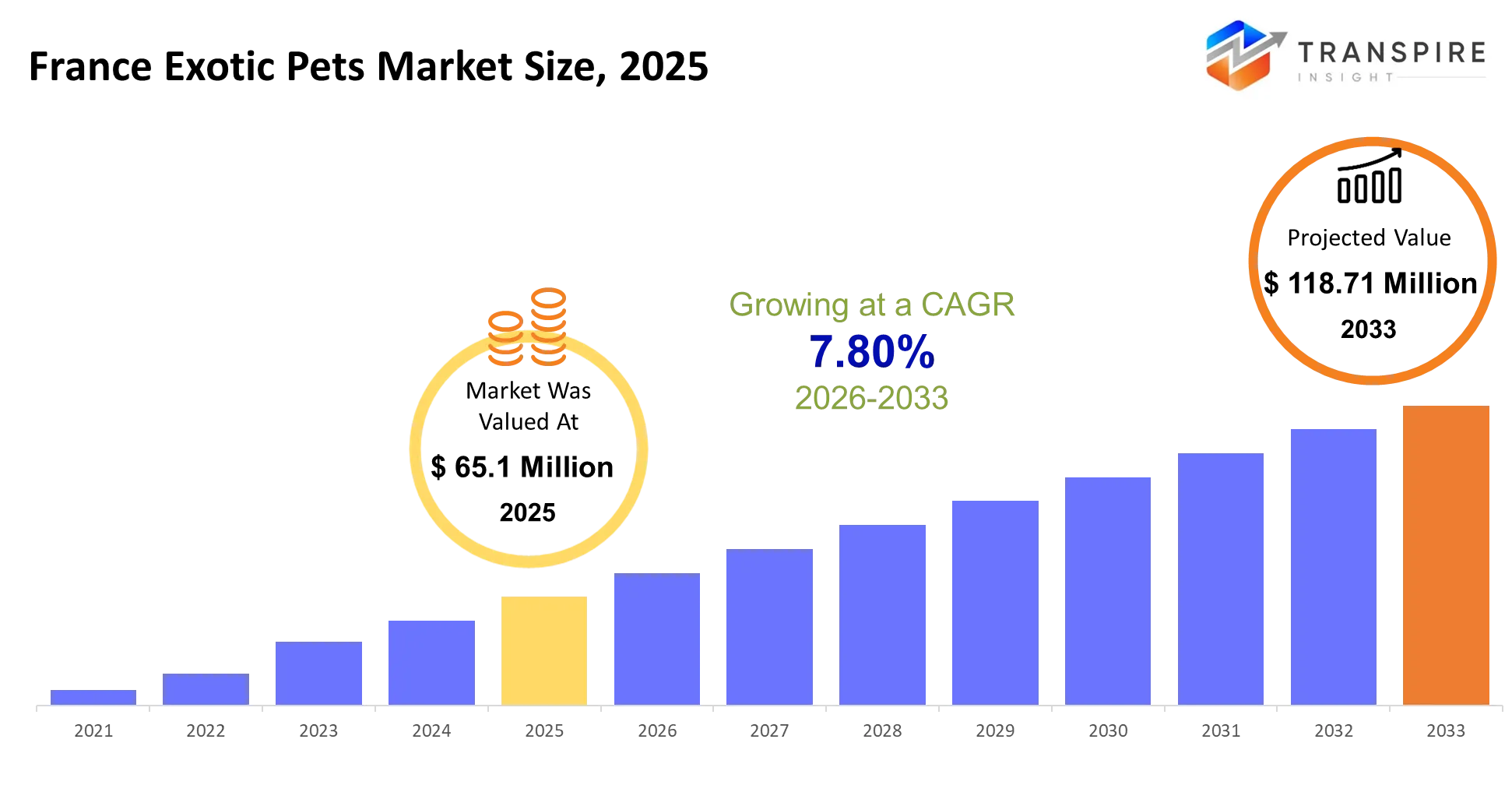
- France Exotic Pets Market Size 2025: USD 65.1 Million
- France Exotic Pets Market Size 2033: USD 118.71 Million
- France Exotic Pets Market CAGR: 7.80%
- France Exotic Pets Market Segments: By Type (Reptiles, Birds, Small Mammals, Aquatic Pets, Amphibians, Others); By Application (Pet Ownership, Breeding, Trading, Exhibition, Others); By End-User (Households, Pet Shops, Breeders, Zoos, Hobbyists, Others); By Distribution (Offline Stores, Online Platforms, Specialty Stores, Others)
To learn more about this report,  Download Free Sample Report
France Exotic Pets Market Summary
The France Exotic Pets Market was valued at USD 65.1 Million in 2025. It is forecast to reach USD 118.71 Millionby 2033. That is a CAGR of 7.80% over the period.
The France exotic pets market kind of supports a specialized ecosystem, with breeders, veterinary clinics, nutrition suppliers, habitat equipment manufacturers, and digital retail platforms all working together to serve non-traditional companion animals like reptiles exotic birds, amphibians and small mammals. In a way, it meets a very real consumer need for, let’s say, more differentiated pet ownership experiences, while also building repeat income from premium feed, medical care, environmental control systems, and species-specific accessories. Over the last five years, the market has shifted from a pretty fragmented hobbyist trade toward regulated, service driven ownership, supported by traceability standards and tougher animal welfare oversight, even if it feels slow at first.
Also the tightening of European wildlife trade regulations and some post-pandemic shifts in household spending behavior pushed people more toward online purchasing and increased the demand for professional veterinary services for exotic species. That change means spending per pet went up, not only the number of pets people keep. So, as owners invest in specialized care, climate controlled enclosures and preventive healthcare, suppliers are managing to pull in higher-margin revenue across nutrition diagnostics and premium pet services.
Key Market Insights
- In 2025, Northern France kinda pulled ahead with almost 38% market share, mostly because urban households had higher disposable income and the exotic veterinary infrastructure is very concentrated, you know, in a few places.
- Southern France is showing the quickest momentum through 2033, as reptile and tropical bird ownership keeps spreading among younger consumers, kind of steadily.
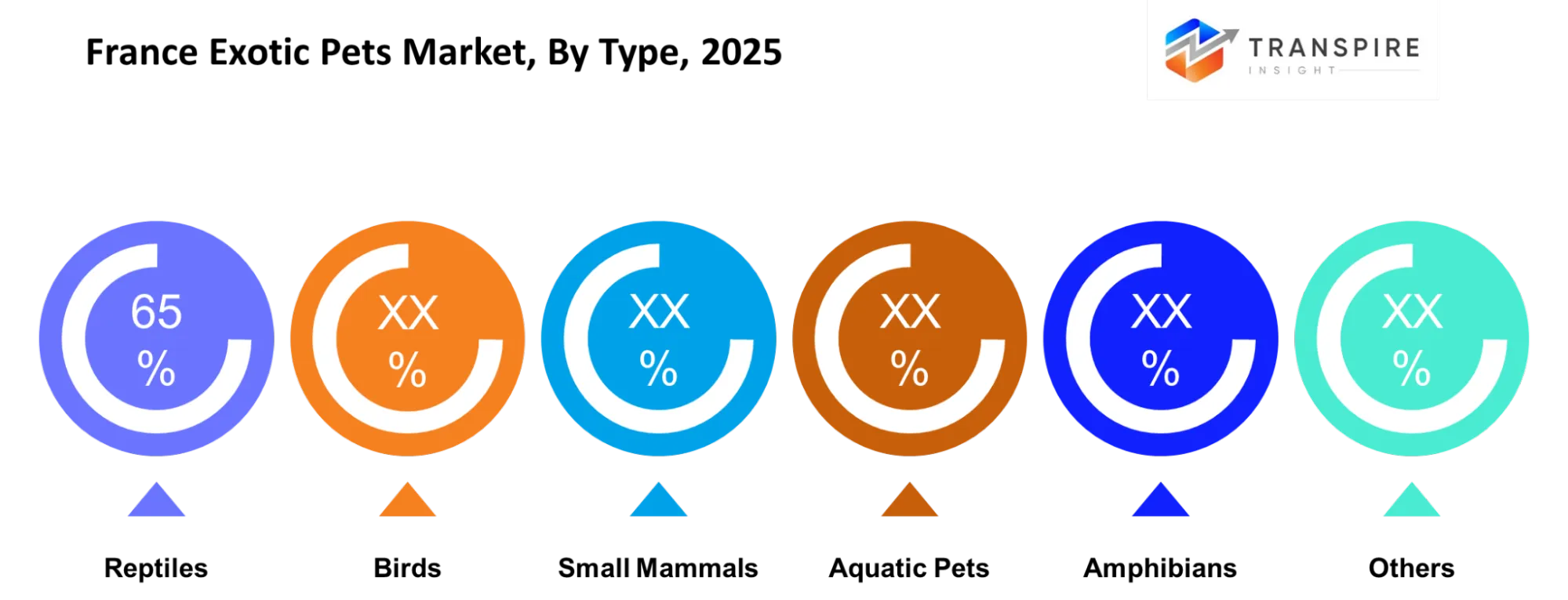
- In 2025, reptiles were clearly the main segment in the France Exotic Pets Market, holding around 34% share , and that happened largely due to smaller space needs, plus ownership tends to last longer.
- Exotic birds stayed in the second position too, driven by premium aviary add-ons and nutritional supplements, which leads to stronger recurring spending patterns.
- After 2022, amphibians became the fastest-growing category, helped by more breeder partnerships and online learning communities across France.
- On the application side, veterinary healthcare captured more than 29% market share in 2025, since specialized diagnostics and preventive care adoption accelerated.
- Smart habitat systems are also starting to show up as an emerging application segment, with automated humidity, lighting, and temperature controls supporting better survival conditions for exotic species.
- For end users, individual household owners stayed in front, contributing over 70% of total France Exotic Pets Market spending in 2025.
- Meanwhile, commercial breeders and exotic pet cafés became the fastest-growing end-user group, as hands-on pet interaction businesses expand across urban areas.
- And then, broader moves into tele-veterinary services, plus AI-driven habitat monitoring, have improved customer loyalty , and also boosted conversion toward premium products.
What are the Key Drivers, Restraints, and Opportunities in the France Exotic Pets Market?
The main growth engine in the France exotic pets space is kind of this fast premium shift in companion animal care. In the last several years, French pet owners have been moving their spending toward more specialized diets, advanced veterinary diagnostics, climate-regulated habitats, and also preventive services for reptiles, birds, and amphibians. This momentum really picked up after the pandemic, when home focused routines made people more willing to stay committed to long-term keeping. Since exotic species usually demand tailored care surroundings plus ongoing upkeep products, suppliers often end up with higher per-customer lifetime value than you’d see in the more normal pet categories. At the same time, veterinary clinics that focus on non-traditional animals have grown, and they’ve gained pricing strength, which helps push revenue growth across both healthcare offerings and habitat equipment lines.
Still, the biggest drag in the market is the built in structural complexity of regulation and animal welfare compliance. France, along with the wider European Union, keeps tight import rules, species traceability requirements, and wildlife protection statutes that restrict the legitimate trade of a number of exotic animals. These rules tend to raise licensing expenses, create delays in getting products on shelves, and reduce breeding adaptability for smaller operators. And because enforcement ties into international biodiversity structures, plus customs surveillance, the limitation can’t be fixed fast. So you get slower inventory turnover and, for certain high interest species, a kind of muted expansion.
A big future opening is connected habitat ecosystems, and digital veterinary platforms. Smart terrariums, with automated humidity control, UV calibration, and remote monitoring set ups, are pulling in higher income urban owners who want low risk exotic pet routines.
What Has the Impact of Artificial Intelligence Been on the France Exotic Pets Market?
Artificial intelligence and modern digital systems are starting to reshape the France exotic pets market, in a way that feels kind of gradual but still noticeable. They’re improving animal care precision, habitat management, and also the overall veterinary efficiency. With AI enabled habitat monitoring, owners get automated control over things like temperature regulation, humidity balancing, UV light scheduling, and feeding cycles , especially for reptiles, amphibians and tropical birds. In practice this cuts down the amount of hands on work and it also helps people keep steadier living conditions, which then affects animal survival and that longer term health result
Then there’s machine learning models that back predictive veterinary diagnostics. Specialized clinics now use AI assisted imaging alongside behavioral tracking, to spot stress patterns, nutritional gaps and disease signals earlier than just watching the animal in a traditional way . On premium breeding sites, predictive analytics is used to tune breeding cycles and mortality management, by reading environmental swings plus species response patterns. As a result operations feel more consistent, animal loss rates drop, and emergency healthcare costs can go down for breeders and distributors.
Digital retail platforms are also joining in, using recommendation algorithms to make nutrition products habitat accessories and preventive healthcare subscriptions more tailored. They base this on species profiles and on how the owner behaves over time. That change seems to have increased repeat buying and it strengthened customer retention across online exotic pet marketplaces. However AI adoption still hits a real constraint. A lot of exotic species simply don’t have big enough behavioral and medical datasets, so predictive accuracy can stay lower than what we see with traditional companion animals like dogs and cats
Key Market Trends
- Since 2021, French consumers kinda moved away from buying exotic pets on a whim and more toward keeping them for the long run, backed by subscription style nutrition and preventive healthcare services, which feels… more stable, I guess.
- Between 2022 and 2025, reptile habitat manufacturers started folding in automated humidity and UV-control setups more and more, so they could lower species mortality rates, not just “better vibes” for owners.
- After the post-pandemic pet ownership patterns grew, veterinary clinics broadened their exotic animal specialization programs, and with that came more demand for advanced diagnostic services.
- Online exotic pet retailers gained a bigger market footprint once digital compliance tracking improved, especially for legal species verification and customer transparency, as they could show everything more clearly.
- Breeders leaned less on imported species after European wildlife trade restrictions got tighter, and from 2022 onward the whole supply chain became less flexible, even if nobody said it out loud.
- Premium nutrition providers, for example Royal Canin, expanded species-specific formulations aimed at reptiles, birds, and exotic mammals, particularly where healthcare sensitivity is higher.
- Urban apartment owners increasingly picked amphibians and small reptiles instead, because compact habitats fit metropolitan living conditions more, and honestly it’s easier to manage in smaller spaces.
- Tele-veterinary consultations ramped up quickly after 2023, which improved access to specialized exotic pet expertise outside the biggest French cities.
- Smart habitat startups introduced app-connected monitoring systems, enabling owners to manage temperature, lighting, and feeding schedules remotely, in real time, no drama.
- Overall, the competitive strategy sort of shifted toward ecosystem-based offerings, where retailers bundle nutrition, habitat equipment, insurance, and veterinary partnerships into recurring service models, kinda like a single ongoing plan.
France Exotic Pets Market Segmentation
By Type
Reptiles kinda hold the dominant position in the market, mostly because animals like geckos, snakes, and turtles end up adapting pretty well to apartment life and they generally need less day to day attention than those bigger exotic pets. You still see stable demand for terrariums, UV lighting systems, heating tools and also specialized food, so urban households keep spending on repeat. With longer ownership cycles plus more breeder availability coming online this tends to make commercial stability feel stronger for reptile retailers and veterinary clinics. Manufacturers are also moving forward with more automated enclosure technologies and climate monitoring systems, but they’re being designed specifically for reptilian needs.
Birds keep a solid share too, since tropical ornamental birds tend to pull in customers who want interactive companions with strong visual charm. Things like premium aviary add ons, nutritional supplements, and behavioral enrichment products push average spending higher for bird keepers. Small mammals are growing in a steady way as rabbits, ferrets, and guinea pigs stay fairly reachable as entry level exotic pets for younger families, and for first time buyers too. Aquatic pets and amphibians are gaining momentum, largely because smaller habitat setups work and people seem more into home displays that look immersive, while the rest of those niche species are expected to open selective chances for specialized healthcare providers and regulated breeders during the forecast period.
To learn more about this report, Download Free Sample Report
By Application
Pet Ownership is still the leading application segment, mainly because in France most exotic animal purchases are pulled by long term companion care, especially in city households. People keep paying for nutrition, habitat gear equipment, preventive veterinary visits, plus digital monitoring systems, so the revenue stays quite steady across the whole ownership cycle. On top of that, the push toward premium options has boosted interest in tailored healthcare and automated environmental control tools meant for fragile or sensitive species. Also, more apartment based living habits keep making it easier to choose smaller exotic pets, like reptiles, amphibians, and decorative birds.
Breeding also stays important commercially since regulated captive breeding networks help maintain legal species availability and they lower the need for wildlife imports. Trading goes on through licensed retailers and online commerce channels, where traceability rules are becoming a key factor for transaction trustworthiness, and even pricing logic. Exhibition uses are growing slowly too, within educational wildlife centers, pet cafés, and niche events that rely on exotic animals to get visitors involved and to spark public interaction. Other uses, like research driven ownership, and conservation focused breeding initiatives, are expected to open longer term pathways for advanced veterinary diagnostics and species specific habitat innovation.
By End-User
Households kind of lead the end-user space, because in practice individual consumers make up most of the exotic pet ownership, and also most of the recurring care expenditure across France. People in cities are leaning more and more toward species that behave well in smaller, compact living setups, so demand stays solid for terrariums, aquariums, nutritional products and also preventive healthcare services. On top of that, when households spend more on premium habitat automation , and digital veterinary support it really bumps the revenue side inside this household category. With more remote work and home centered routines continuing , younger consumers keep the long term commitment going, at least that is what the trend looks like.
Pet Shops still hold a strong market position by acting as regulated sales channels, and then also offering advisory support, plus specific care guidance for people who are new. Breeders are growing at a steady pace too, partly because tougher traceability rules push certified captive breeding operations rather than informal wildlife sourcing networks. Zoos and educational facilities add a different kind of pull, they create specialized demand for more advanced habitat systems, nutritional programs, and veterinary know-how that is tuned to rare species management. Meanwhile hobbyists and other niche end users are expected to increase their spend on collectible, high value species over the forecast period, which then supports selective growth for premium suppliers, and specialty healthcare providers.
By Distribution
Offline Stores hold the biggest market share, mainly because exotic pet buying often needs a real world look , a quick behavioral check , and a professional talk before the sale is finalized. People tend to lean on in-store help for things like habitat setup, feeding requirements, and the long term care plan, especially when it comes to reptiles, birds, and amphibians. Plus the established retail chains get more clear sight on regulatory compliance, and they can move faster with direct ties to certified breeders and veterinary clinics. With this kind of face to face purchasing experience staying popular, revenue across physical retail channels keeps feeling pretty steady.
Online Platforms are also growing quickly, since digital commerce makes it easier to reach specialty nutrition items, habitat gear, and even rare species add-ons across different regions. Subscription based supply models, plus AI product suggestions, are helping keep customers coming back in the online space. Specialty Stores are picking up momentum too, by focusing on high value species, better habitat technologies, and expert advisory support that feels more distinct than mass market pet retailers. Other routes, like veterinary linked shopping setups and event based sales, are likely to open smaller niche opportunities for premium product developers and regulated exotic species suppliers during the forecast period.
What are the Key Use Cases Driving the France Exotic Pets Market?
The main use case in the France exotic pets market kind of revolves around people keeping companion reptiles, tropical birds, and small mammals inside city homes , you know, the usual apartment vibe. Reptile ownership really pulls ahead, mostly because geckos, snakes, and turtles adapt pretty well to apartment living and they still need those specialized habitats, proper lighting systems, and nutrition related products. So you end up with spending that comes back again and again, like veterinary care, climate controlled enclosures, and then the higher end feed categories too.
After that, the secondary side of things is slowly growing via commercial breeding facilities , educational wildlife centers, and also niche pet cafés that show exotic species to visitors. It’s more about engagement and carefully managed interaction, rather than just casual keeping. At the same time, veterinary clinics that specialize in avian and reptile medicine are taking more customers since owners want preventive diagnostics and healthcare plans that match each species, not generic guidance.
What’s starting to show up more recently are emerging use cases such as AI enabled smart terrariums and subscription based remote habitat monitoring for high value species. Also, some luxury hospitality venues and experiential retail operators are checking out curated exotic animal interaction areas, especially around bigger metropolitan regions where premium leisure concepts keep getting attention, and yes, demand.
|
Report Metrics |
Details |
|
Market size value in 2025 |
USD 65.1 Million |
|
Market size value in 2026 |
USD 70.05 Million |
|
Revenue forecast in 2033 |
USD 118.71 Million |
|
Growth rate |
CAGR of 7.80% from 2026 to 2033 |
|
Base year |
2025 |
|
Historical data |
2021 - 2024 |
|
Forecast period |
2026 - 2033 |
|
Report coverage |
Revenue forecast, competitive landscape, growth factors, and trends |
|
Regional scope |
France |
|
Key company profiled |
PetSmart, Petco, Zooplus, Maxi Zoo, Pet Supplies Plus, Chewy, Pets at Home, Petland, Central Garden & Pet, Spectrum Brands, Hagen Group, Ferplast, Tetra, Vitakraft, Beaphar |
|
Customization scope |
Free report customization (country, regional & segment scope). Avail customized purchase options to meet your exact research needs. |
|
Report Segmentation |
By Type (Reptiles, Birds, Small Mammals, Aquatic Pets, Amphibians, Others); By Application (Pet Ownership, Breeding, Trading, Exhibition, Others); By End-User (Households, Pet Shops, Breeders, Zoos, Hobbyists, Others); By Distribution (Offline Stores, Online Platforms, Specialty Stores, Others) |
Which Regions are Driving the France Exotic Pets Market Growth?
Île-de-France remains the dominant regional market, mainly because Paris and the nearby dense urban areas gather high-income consumers, specialized veterinary clinics and pretty advanced pet retail infrastructure . At the same time, the region gets an advantage from stricter enforcement of animal welfare rules, so organized retailers and certified breeders usually do better than informal trade corridors. Big digital commerce networks plus premium pet service providers run wide fulfillment systems all over the area, which in turn helps exotic species owners find products more easily. This whole setup basically encourages stronger repeat spending on healthcare, habitat automation, and imported niche nutrition items.
Auvergne-Rhône-Alpes is the second-largest contributor, yet its dynamics do not mirror Île-de-France, not really. Here growth is linked more to stable breeder communities and a long-term ownership mindset, rather than just premium urban consumption. Places like Lyon have a calmer blend of veterinary research centers, specialty retailers, and regional pet exhibitions, and that combination keeps market activity fairly steady. There’s also more resilience in household spending, along with continued investment in regulated breeding operations. So suppliers that focus on habitat equipment, nutritional products, and preventive veterinary services tend to see more predictable revenue.
Provence-Alpes-Côte d’Azur is picking up speed, and it’s becoming the fastest-growing region because lifestyle habits are shifting and demand is rising for compact exotic pets that fit apartment life in coastal zones. Starting around 2023 , tourism-led retail expansion and higher spending on premium pet services have sped up the adoption of reptiles, amphibians and tropical birds across the urban coastline. Local shops increasingly introduced smart habitat
Who are the Key Players in the France Exotic Pets Market and How Do They Compete?
The France exotic pets market still feels kind of moderately fragmented, with competition driven less by bare pricing, and more by product specialization, digital retail capability, and veterinary integration, I mean those things together. International retailers plus pet care brands are pushing hard toward premium and species specific categories, while the regional operators sort of protect their share using localized know-how and regulated breeding networks. Also the whole competitive focus seems to shift toward keeping customers around through subscription nutrition plans, tele-veterinary services, and automated habitat technologies, rather than chasing them with one off product sales.
Zooplus stands out with a digital first move, where big assortments are paired with aggressive pricing campaigns and a growing private label lineup. The company improved customer retention by widening premium nutrition offerings and by cutting prices on proprietary brands in 2025, just to keep online volume growing. Maxi Zoo competes using physical retail density and in store advice services, aimed at exotic species owners especially across city based French markets where veterinary referrals affect what people buy. Their strategy is getting more omnichannel as well, and it includes premium habitat accessories, not only the essentials.
Ferplast concentrates on habitat engineering and specialized enclosures for reptiles, birds, and small mammals. It differentiates through durable modular terrarium systems, and transport certified carriers that fit tighter European animal transport rules. Vitakraft keeps expanding via species specific nutrition and functional supplement formats for exotic birds and small mammals, while Beaphar leans into veterinary oriented wellness products and preventive healthcare formulations, like those targeted ingredients that people associate with prevention.
Company List
- PetSmart
- Petco
- Zooplus
- Maxi Zoo
- Pet Supplies Plus
- Chewy
- Pets at Home
- Petland
- Central Garden & Pet
- Spectrum Brands
- Hagen Group
- Ferplast
- Tetra
- Vitakraft
- Beaphar
Recent Development News
In March 2026, European regulators intensified oversight of exotic animal traceability and wildlife trade compliance across EU member states. The stricter enforcement environment increased demand for certified breeders, regulated transport systems, and compliance-focused exotic pet retailers in France.http://www.euronews.com
In April 2026, Ferplast expanded its specialty habitat and transport accessory portfolio through new enclosure and carrier product releases. The development reinforced the company’s position in regulated pet mobility and premium habitat equipment categories supporting exotic species care.http://www.ferplast.com
What Strategic Insights Define the Future of the France Exotic Pets Market?
The France exotic pets market is, like… kinda moving in a premium direction, more or less because ownership is getting more regulated, and the whole ecosystem around it is leaning toward recurring healthcare, digital monitoring, and compliance services. It’s starting to feel like these ongoing services bring more value than animal sales by themselves. And yeah, this is being pushed by tighter European wildlife trade oversight, plus the reality of urban living constraints, and also the growing way veterinary technology is getting baked into everyday pet management. Over the next five to seven years , suppliers that can blend habitat automation, species-specific healthcare, and digital commerce are likely to grab a disproportionate share.
One risk people don’t really talk about enough, is how legal supply channels are becoming more concentrated. When compliance costs keep rising , smaller breeders and independent retailers could struggle to stay afloat, which may lead to supply bottlenecks and a drop in species diversity inside the formal market. At the same time, AI-enabled habitat ecosystems and tele-veterinary subscription platforms are a real emerging opportunity, especially in high density city areas.
So market participants should focus on partnerships with veterinary networks and smart habitat technology providers , instead of just trying to win through product assortment or pricing alone.
France Exotic Pets Market Report Segmentation
By Type
- Reptiles
- Birds
- Small Mammals
- Aquatic Pets
- Amphibians
- Others
By Application
- Pet Ownership
- Breeding
- Trading
- Exhibition
- Others
By End-User
- Households
- Pet Shops
- Breeders
- Zoos
- Hobbyists
- Others
By Distribution
- Offline Stores
- Online Platforms
- Specialty Stores
- Others
Frequently Asked Questions
Find quick answers to common questions.
The approximate France Exotic Pets Market Market size for the market will be USD 118.71 Million in 2033.
Key segments for the France Exotic Pets Market Market are By Type (Reptiles, Birds, Small Mammals, Aquatic Pets, Amphibians, Others); By Application (Pet Ownership, Breeding, Trading, Exhibition, Others); By End-User (Households, Pet Shops, Breeders, Zoos, Hobbyists, Others); By Distribution (Offline Stores, Online Platforms, Specialty Stores, Others).
Major France Exotic Pets Market players are PetSmart, Petco, Zooplus, Maxi Zoo, Pet Supplies Plus, Chewy, Pets at Home, Petland, Central Garden & Pet, Spectrum Brands, Hagen Group, Ferplast, Tetra, Vitakraft, Beaphar.
The France Exotic Pets Market Market size is USD 65.1 Million in 2025.
The France Exotic Pets Market CAGR is 7.80% from 2026 to 2033.
- PetSmart
- Petco
- Zooplus
- Maxi Zoo
- Pet Supplies Plus
- Chewy
- Pets at Home
- Petland
- Central Garden & Pet
- Spectrum Brands
- Hagen Group
- Ferplast
- Tetra
- Vitakraft
- Beaphar
Recently Published Reports
-
Apr 2026
Bottled Water Market
Bottled Water Market Size, Share & Analysis Report By Product Type (Still Bottled Water, Carbonated Bottled Water, Functional Bottled Water, and Others), By Packaging (PET, Cans, and Others), By Sales Channel (Supermarkets/Hypermarkets, Convenience Stores/Drug Stores, Grocery Stores/Club Stores, Foodservice, and Others) and Geography (North America, Europe, Asia-Pacific, Middle East and Africa, South and Central America), 2021 - 2032
-
Apr 2026
Color Cosmetic Packaging Market
Color Cosmetic Packaging Market Size, Share & Analysis Report By Application (Mascara Packaging, Liquid Packaging, and Liquid Face), By Type (Tubes & Bottles, Pens & Markers, Compacts & Containers, and Droppers & Pumps), and Geography (North America, Europe, Asia-Pacific, Middle East and Africa, South and Central America), 2021 - 2031
-
Apr 2026
External Microphone For Camera Market
External Microphone For Camera Market Size, Share & Analysis Report By Type (Shotgun Microphone, Lavalier Microphone, and Others), By Application (Digital Camera, Professional Video Camera, and Others), and Geography (North America, Europe, Asia-Pacific, Middle East and Africa, South and Central America), 2021 - 2031
-
Apr 2026
Foot Orthotic Insoles Market
Foot Orthotic Insoles Market Size, Share & Analysis Report By Type (Pre-fabricated, and Custom-made), By Material (Thermoplastic, Composite Carbon Fiber, and Others), By Distribution Channel (Drug Stores, Hospitals & Clinics, and Others), and Geography (North America, Europe, Asia-Pacific, Middle East and Africa, South and Central America), 2021 - 2031