

United Kingdom Natural Gas Storage Market Size & Forecast:
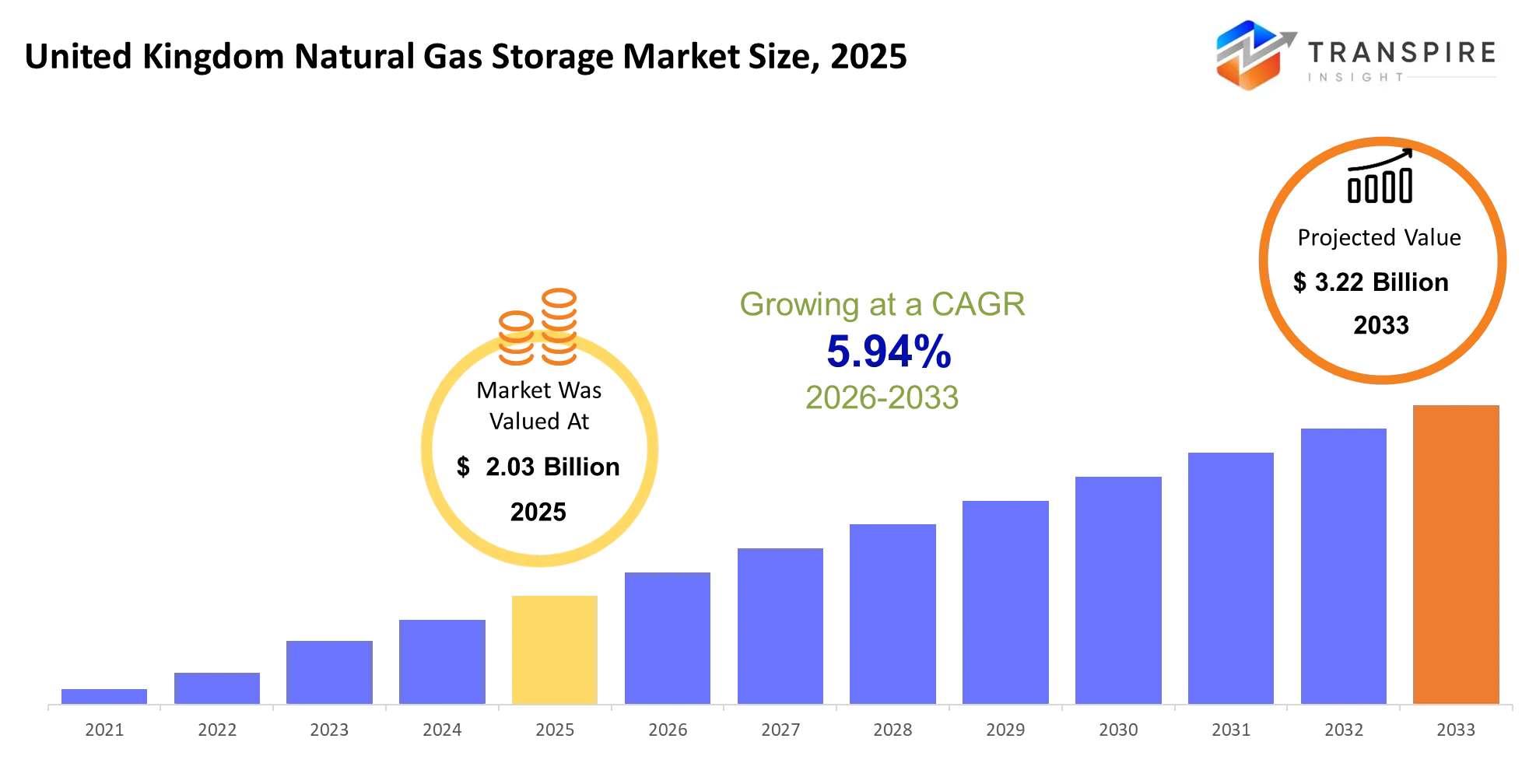
- United Kingdom Natural Gas Storage Market Size 2025: USD 2.03 Billion
- United Kingdom Natural Gas Storage Market Size 2033: USD 3.22 Billion
- United Kingdom Natural Gas Storage Market CAGR: 5.94%
- United Kingdom Natural Gas Storage Market Segments: By Storage Type (Underground Storage, LNG Storage, Salt Cavern Storage, Depleted Reservoir Storage, Aquifer Storage, Floating Storage, Others); By Application (Seasonal Demand Balancing, Emergency Supply Backup, Industrial Supply, Power Generation, LNG Export & Import, Others); By End User (Utilities, Industrial Companies, Power Plants, LNG Operators, Government Agencies, Others); By Technology (Cryogenic Storage, Compression Systems, AI-based Monitoring, IoT-enabled Monitoring, Others)
To learn more about this report,  Download Free Sample Report
United Kingdom Natural Gas Storage Market Summary
The United Kingdom Natural Gas Storage Market was valued at USD 2.03 Billion in 2025. It is forecast to reach USD 3.22 Billion by 2033. That is a CAGR of 5.94% over the period.
The United Kingdom natural gas storage market, honestly it matters a lot for balancing seasonal demand surges, and also to keep energy supply steady during moments when the market gets disrupted a bit. Storage sites let gas be injected when supply is plentiful, and then it is withdrawn when consumption is at its highest, which helps utilities, industrial users, and power generators stay on track. In other words it assists with price swings, but also keeps operations running without too much interruption. Over time this role has become even more important because the UK domestic gas production base is maturing, and the whole energy system is now more exposed to what is happening in global market dynamics.
Over the last five years, the market has shifted in a more structural way toward energy security and supply resilience, rather than just chasing commercial storage optimization, and honestly it has been more… tangled than simple. The Russia-Ukraine conflict was a big trigger, it revealed weak points in European gas supply chains so it pushed everyone to look again at strategic storage capacity, not only at cost efficiency. As a result, many operators have moved ahead with facility upgrades, expansion of capacity, and improvements in flexibility, sort of fine tuning how the assets respond, even when the demand mood changes. This change has boosted storage utilization rates and also opened up new revenue avenues. Those can come from balancing services, seasonal arbitrage, and the security-of-supply expectations, which together support ongoing growth in the market.
Key Market Insights
- More demand for flexible energy infrastructure is kind of “boosting” the longer term outlook for the United Kingdom Natural Gas Storage Market, more or less.
- Market players are basically zeroing in on storage reliability, withdrawal flexibility and also on infrastructure upgrades , to match the changing needs of the energy system.
- England is leading, and in 2025 it accounts for around 75% of total storage capacity, this is helped by large underground storage facilities.
- Northern England keeps a big chunk as well, mainly because it’s close to industrial demand centers and gas transmission networks , so logistics are smoother.
- Scotland looks like the fastest-moving region during the forecast window. That growth is supported by energy transition investments and a steady push toward strategic infrastructure development.
- Also , coastal areas are drawing new storage related investments lately, largely because they sit near import terminals and offshore energy assets.
- By facility type, underground gas storage facilities dominate the market, with an estimated 70%+ share in 2025.
- This is largely due to big seasonal storage needs that have to be managed at scale. Salt cavern storage comes in as the second largest segment , mainly because it can inject and withdraw gas very quickly.
- Then depleted reservoir storage is expected to be the fastest-growing segment through 2032, since operators can reuse existing energy infrastructure rather than starting from scratch.
- Finally , facility modernization services are starting to gain traction, as operators improve storage efficiency and extend asset longevity, even if they call it different names.
What are the Key Drivers, Restraints, and Opportunities in the United Kingdom Natural Gas Storage Market?
The strongest driver pushing the United Kingdom natural gas storage market forward is basically the renewed, sort of urgent, focus on energy security after the European gas supply disruptions that followed the Russia-Ukraine conflict. After that , the wholesale gas price volatility spiked, and it really highlighted the downside of having limited domestic storage capacity, plus a heavy dependence on imported gas. So, operators along with policymakers leaned hard into storage availability, facility upgrades, and more precise capacity optimization. As a result, storage utilization rates have climbed, and storage operators are seeing steadier revenue via balancing services, some seasonal arbitrage plays, and longer term capacity arrangements with utilities and energy suppliers.
Meanwhile the biggest restraint is tied to geology, because suitable underground formations just aren’t easy to come by, and new storage projects take a long time to develop. Storage sites usually rely on specific salt caverns or depleted reservoirs, and those are not something you can just build overnight, or move somewhere else later. On top of that, permitting steps, environmental assessments , and the large capital expenditure required can stretch timelines by several years. This kind of built-in limitation slows down capacity expansion, postpones commercialization for new projects, and makes it harder for the market to fully benefit when gas price spreads widen and when storage demand is especially high.
A big future opening lies in the repurposing of existing gas storage facilities, for hydrogen and also multi gas storage uses. Several UK energy companies are looking at salt cavern schemes that could hold both natural gas and low-carbon hydrogen, kinda at the same time or with flexible changes. As hydrogen production hubs start to show up in industrial areas like Yorkshire and the Humber, the storage players might pull in new income streams, and at the same time they’re reusing underground capacity and the know-how they already have from operations.
What Has the Impact of Artificial Intelligence Been on the United Kingdom Natural Gas Storage Market?
Artificial intelligence and advanced digital technologies are starting to, kind of, reshape the United Kingdom natural gas storage market, mainly by making assets more steady, storage more efficient, and day to day decisions more reliable. Storage operators are rolling out AI–enabled control systems that keep an eye on pressure levels, gas injection rates, withdrawal performance, and even equipment health, all across underground storage sites. The whole thing automates routine adjustments, and it seems to help keep storage conditions in the right range while also cutting down on the amount of manual work.
On top of that, machine learning models are getting used for predictive maintenance, which is kind of like seeing trouble before it turns real. Instead of waiting around, they take a look at the sensor readings that come from compressors, pipelines, valves, and other monitoring hardware, and then operators can catch early signals of mechanical wear, before actual failures show up. So, in practice they tend to have fewer unexpected shutdowns, longer service life for the equipment , and also reduced maintenance expenses.There are also advanced analytics platforms that back demand forecasting and inventory optimization, by blending weather information, consumption trends and market price signals together. That makes it easier to improve withdrawal timing and potentially earn more from seasonal price differences.
Digital twins, plus real time monitoring platforms, are adding even more operational visibility. This helps facilities stay online, and respond faster when market conditions start shifting. Some operators even say they’re seeing measurable drops in downtime linked to maintenance, along with better asset utilization when operations are driven by data.
Still, AI adoption isn’t completely smooth, because the costs can be heavy. Integrating older, legacy infrastructure with modern digital systems can be expensive and complicated. A lot of storage facilities were built decades ago, so data standardization, sensor rollouts, and overall system interoperability become tricky, plus capital requirements keep piling up.
Key Market Trends
- After the 2022 European energy crisis, storage operators put a lot more emphasis on supply security, sort of replacing the earlier playbook that was mostly about seasonal trading margins ,and yeah it looked simpler in hindsight.
- Utilities started signing longer term capacity agreements from 2023, which means they’re less stuck in volatile spot gas markets, and storage assets get used more consistently in practice.
- Firms like Centrica have also pushed forward with upgrades to their storage setups, to extend the facility’s lifetime and make withdrawal options more adaptive when demand spikes, especially during peak hours.
- Since 2021, digital monitoring platforms have become more normal, letting operators spot equipment problems earlier and cut down on those unpleasant unplanned maintenance events.
- Meanwhile, more market participants are looking at salt cavern sites as a future home for hydrogen storage, basically a strategic move toward multipurpose energy infrastructure, not just one job.
- Regulatory focus has drifted toward resilience planning too, and policymakers are urging higher storage readiness after the disruptions showed where capacity was falling short.
- Storage operators now lean harder on predictive analytics, mixing weather forecasts and consumption data to fine tune injection and withdrawal schedules ,so it’s not just “on the fly” anymore.
- The growth in LNG imports has changed the whole rhythm of storage, because facilities increasingly act like balancing tools for gas volumes that swing with arrivals and demand.
- Since 2022, industrial customers have expanded their use of storage-backed supply contracts, trying to shield themselves from price spikes and procurement uncertainty, without getting trapped in sudden market moves.
- And competition is shifting away from only owning capacity. Now it’s more about operational flexibility, stronger digital capabilities, and hydrogen-readiness as the big differentiators between participants.
United Kingdom Natural Gas Storage Market Segmentation
By Storage Type :
Underground storage is really leading the United Kingdom Natural Gas Storage Market because it lets operators do large seasonal balancing and keep supply fairly steady when demand spikes hit. Salt cavern storage is also getting more notice lately , mainly for faster injection and withdrawal cycles so companies can react quickly to price shifts and those short-term supply needs that pop up unexpectedly.
Depleted reservoir storage still keeps getting used, largely because it can reduce development costs by reusing older gas fields. LNG storage is growing, but only slowly, as import dependency keeps rising. Aquifer storage stays somewhat limited though, since there is more technical uncertainty and commercialization usually takes longer across the market.
By Application :
Seasonal demand balancing stays the big purpose of the United Kingdom Natural Gas Storage Market, supporting winter consumption peaks while managing summer surplus periods too. Emergency supply backup has become more meaningful in recent years after global supply disruptions , which helps strengthen energy security for essential users.
Industrial supply use looks stable enough , since factories depend on a continuous gas flow to maintain operations without too many interruptions. Power generation usage has moved upward as flexible gas-fired plants help respond to electricity demand swings. Also, LNG import and export support has expanded , because trade flows shift around the European supply networks.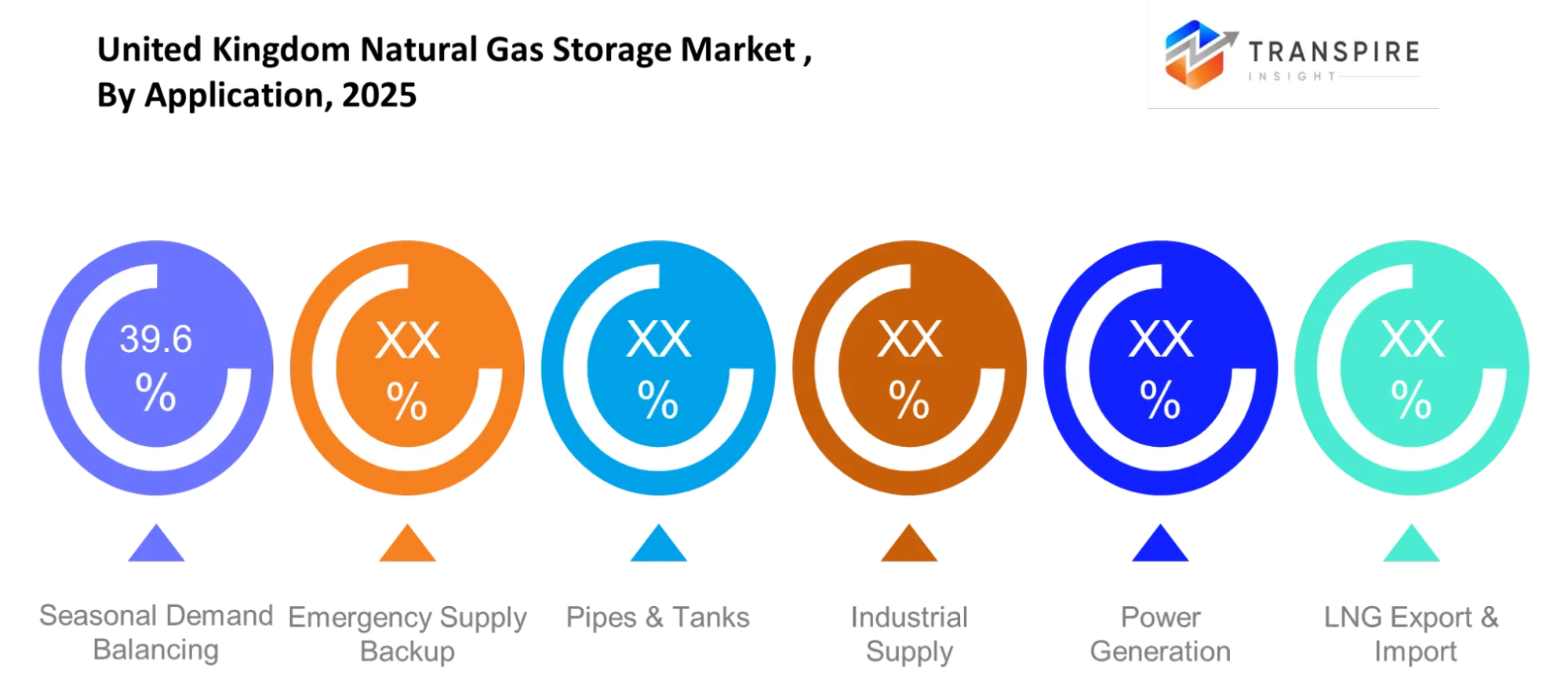
To learn more about this report, Download Free Sample Report
By End User :
Utilities dominate the United Kingdom Natural Gas Storage Market because they manage large customer bases and depend on storage to balance supply and demand. Industrial companies use storage to stabilize energy costs and avoid operational interruptions.
Power plants rely on stored gas for backup generation during peak electricity demand periods. LNG operators are increasing involvement due to rising import activity and storage-linked logistics needs. Government agencies play a role in strategic reserve planning to ensure supply continuity during emergencies and market shocks.
By Technology :
Cryogenic storage technology is widely used for LNG handling, supporting safe low-temperature storage and transport. Compression systems are essential for maintaining pressure control across underground facilities and improving operational efficiency. AI-based monitoring is gaining adoption as operators use predictive models to detect equipment issues early and reduce downtime.
IoT-enabled monitoring systems are expanding across storage sites, improving real-time data collection and asset tracking. Other emerging technologies include automation tools that enhance safety, reduce manual errors, and improve overall storage performance.
What are the Key Use Cases Driving the United Kingdom Natural Gas Storage Market?
In the United Kingdom Natural Gas Storage Market, the main or primary thing is basically seasonal demand balancing , where utilities kind of rely on stored gas to cope with quick winter consumption surges. That use case tends to pull the most demand, because residential heating and electricity generation needs jump quite a bit when it gets cold, so operators are then withdrawing large volumes in a short period, all while keeping supply stability, you know.
Then there are the secondary scenarios that are getting broader, like industrial supply assurance, plus support for power generation. In practice, industrial manufacturers lean on storage-backed contracts to steady fuel availability so production can keep running, and gas-fired power plants depend on these inventories to cover peak electricity needs when the grid is under stress. Overall these efforts are mainly pushed by utilities, and by power sector operators who are looking for more flexibility in procurement and dispatch planning.
For emerging use cases, you also see emergency reserve provisioning, and LNG trade balancing showing up more often. Government agencies are strengthening strategic backup storage to cut exposure to outside supply shocks, and LNG operators are using storage to smooth out import variability , also to handle short term cargo scheduling differences across terminals as well as inland networks.
|
Report Metrics |
Details |
|
Market size value in 2025 |
USD 2.03 Billion |
|
Market size value in 2026 |
USD 2.15 Billion |
|
Revenue forecast in 2033 |
USD 3.22 Billion |
|
Growth rate |
CAGR of 5.94% from 2026 to 2033 |
|
Base year |
2025 |
|
Historical data |
2021 - 2024 |
|
Forecast period |
2026 - 2033 |
|
Report coverage |
Revenue forecast, competitive landscape, growth factors, and trends |
|
Regional scope |
Middle East and Africa (Saudi Arabia, United Arab Emirates, South Africa, Rest of Middle East and Africa) |
|
Key company profiled |
National Grid, Centrica, Shell, BP, SSE, Equinor, Uniper, TotalEnergies, ENGIE, E.ON, Gazprom, Enbridge, Cheniere Energy, Kinder Morgan, Fluxys |
|
Customization scope |
Free report customization (country, regional & segment scope). Avail customized purchase options to meet your exact research needs. |
|
Report Segmentation |
By Storage Type (Underground Storage, LNG Storage, Salt Cavern Storage, Depleted Reservoir Storage, Aquifer Storage, Floating Storage, Others); By Application (Seasonal Demand Balancing, Emergency Supply Backup, Industrial Supply, Power Generation, LNG Export & Import, Others); By End User (Utilities, Industrial Companies, Power Plants, LNG Operators, Government Agencies, Others); By Technology (Cryogenic Storage, Compression Systems, AI-based Monitoring, IoT-enabled Monitoring, Others) |
Which Regions are Driving the United Kingdom Natural Gas Storage Market Growth?
England basically leads the United Kingdom natural gas storage scene , because it has those big underground facilities and it’s tightly connected to the national transmission systems. The salt cavern and depleted reservoir areas work like a real backbone, letting utilities and power generators do high capacity seasonal balancing without much drama. There’s also a pretty solid regulatory setup that nudges everyone toward long term capacity contracts and keeps reliability expectations operational, which matters in day to day planning. On top of that, it’s close enough to major demand centers, plus there are mature gas trading hubs around, so the whole ecosystem kind of reinforces itself.
Scotland feels like a steady secondary area rather than the headline player, with dependable industrial energy demand and some slow but real infrastructure improvements. Instead of England’s sheer scale, Scotland’s function tends to be more about consistent consumption habits from manufacturing and refining. The regulatory rollout has stayed pretty predictable , so operators can plan storage use over the long run with less exposure to volatility , and that helps decision making. Investment from energy companies has remained fairly consistent, so Scotland continues to contribute reliably to the broader national storage operations.
Northern England is moving fastest, mainly because recent transmission upgrades improved connectivity , and because new storage optimization projects keep appearing. Since 2023 especially , pipeline modernization investment has made it easier to reach inland industrial users and participate in balancing markets. This upward momentum is also helped by stronger links with LNG import flows, via coastal terminals that are not too far off. For investors , the signal looks pretty clear: more entry points for mid-scale storage and flexibility services through 2026 to 2033, kind of like a widening set of options.
Who are the Key Players in the United Kingdom Natural Gas Storage Market and How Do They Compete?
The competitive landscape of the United Kingdom Natural Gas Storage Market is, kinda moderately consolidated ,not fully though—there’s a small cluster of infrastructure-heavy operators who basically control most of the storage capacity. You can say the fight isn’t only about price, it’s more about whether you can get to the right geological sites, secure long-term utility contracts and also keep operations dependable. The incumbents usually try to hold on to market share by doing capacity expansion and efficiency upgrades, while anyone trying to enter later runs into big capital barriers and long approval timelines for new projects. So in practice, service reliability and infrastructure flexibility matter more than short-term cost positioning, even if that sounds less dramatic.
Centrica Storage leans into large-scale offshore and underground storage optimization, and it uses its Rough facility to sharpen seasonal balancing capacity, plus it improves withdrawal efficiency when winter demand really spikes. National Gas, meanwhile, emphasizes transmission-linked storage coordination, so it links storage assets tightly with pipeline management to boost flexibility across the whole system. SSE plc is more focused on energy system balancing services, and it grows through partnerships that back grid stability with storage. Shell plc goes for a tech-forward approach, leaning on trading expertise and integrated LNG operations, which helps it optimize storage use across wider global supply chains. Equinor ASA, Finally, strengthens its position by supporting cross-border energy integration—bringing experience from North Sea infrastructure and low-carbon transition projects to back UK storage requirements.
Company List
- National Grid
- Centrica
- Shell
- BP
- SSE
- Equinor
- Uniper
- TotalEnergies
- ENGIE
- E.ON
- Gazprom
- Enbridge
- Cheniere Energy
- Kinder Morgan
- Fluxys
Recent Development News
In August 2025, Centrica and Energy Capital Partners (ECP) announced acquisition of the Isle of Grain LNG terminal from National Grid. The £1.5 billion transaction strengthens UK gas import and storage-linked infrastructure and enhances long-term LNG supply security through a 50-50 joint venture structure.Source https://www.ecpgp.com/
In April 2026, the North Sea Transition Authority granted Centrica extended consent to operate the Rough offshore gas storage site until April 2027. The approval ensures continued operation of the UK’s largest gas storage facility, preserving critical seasonal balancing capacity for national gas security.Source https://www.ogj.com/
What Strategic Insights Define the Future of the United Kingdom Natural Gas Storage Market?
The United Kingdom natural gas storage market seems to be drifting toward a more structurally tight arrangement where flexibility and fast reaction capacity matter more than raw total volume. In the next five to seven years, demand will likely get shaped by grid instability from renewable penetration, plus a bigger reliance on LNG imports. As a result, operators are starting to place emphasis on fast-cycle storage and digital optimization, instead of leaning on static, seasonal reserves. It also means the value of assets that can respond quickly to short lived price swings and supply disruptions should rise.
There is also a quieter risk that is easy to miss, namely accelerated substitution pressure. With hydrogen blending, and electrification moving forward, long term gas demand can slide faster than infrastructure investment cycles can realistically adjust. That could strand or underuse some of the more expensive storage assets, particularly those that have slower conversion pathways. On the other hand, an emerging opportunity is starting to show up in hybrid storage hubs around coastal England, where LNG terminals alongside underground facilities can be stitched together with hydrogen-ready infrastructure. This is still early stage, but it is getting more policy attention, and momentum.
So market participants might want to focus on modular storage upgrades and digital control systems. The goal is to stretch asset flexibility while at the same time lowering the risk of long-term stranded infrastructure exposure.
United Kingdom Natural Gas Storage Market Report Segmentation
By Storage Type
- Underground Storage
- LNG Storage
- Salt Cavern Storage
- Depleted Reservoir Storage
- Aquifer Storage
- Floating Storage
By Application
- Seasonal Demand Balancing
- Emergency Supply Backup
- Industrial Supply
- Power Generation
- LNG Export & Import
By End User
- Utilities
- Industrial Companies
- Power Plants
- LNG Operators
- Government Agencies
By Technology
- Cryogenic Storage
- Compression Systems
- AI-based Monitoring
- IoT-enabled Monitoring
Frequently Asked Questions
Find quick answers to common questions.
The United Kingdom Natural Gas Storage Market size is USD 3.22 Billion in 2033.
Key Segments for the United Kingdom Natural Gas Storage Market are By Storage Type (Underground Storage, LNG Storage, Salt Cavern Storage, Depleted Reservoir Storage, Aquifer Storage, Floating Storage, Others); By Application (Seasonal Demand Balancing, Emergency Supply Backup, Industrial Supply, Power Generation, LNG Export & Import, Others); By End User (Utilities, Industrial Companies, Power Plants, LNG Operators, Government Agencies, Others); By Technology (Cryogenic Storage, Compression Systems, AI-based Monitoring, IoT-enabled Monitoring, Others).
Major United Kingdom Natural Gas Storage Market players are National Grid, Centrica, Shell, BP, SSE, Equinor, Uniper, TotalEnergies, ENGIE, E.ON, Gazprom, Enbridge, Cheniere Energy, Kinder Morgan, Fluxys.
The Current United Kingdom Natural Gas Storage Market size is USD 2.03 Billion in 2025.
The United Kingdom Natural Gas Storage Market CAGR is 5.94% from 2026 to 2033.
- National Grid
- Centrica
- Shell
- BP
- SSE
- Equinor
- Uniper
- TotalEnergies
- ENGIE
- E.ON
- Gazprom
- Enbridge
- Cheniere Energy
- Kinder Morgan
- Fluxys
About the Authors

Avinash Kumar
I’m Avinash Kumar, a Senior Research Analyst at Transpire Insight, with expertise in the Electronics and Semiconductor and Energy & Power industry. My work focuses on analyzing emerging technologies, market trends, industry developments, and innovation across these sectors. I specialize in transforming complex technical and market insights into clear, research-backed content that helps professionals, businesses, and decision-makers stay informed. Through continuous industry research and data-driven analysis, I strive to deliver accurate, reliable, and practical perspectives on the latest advancements shaping the semiconductor and energy landscape.

Chakradhar Khansole
Chakradhar serves as the Research Director at Transpire Insight, bringing over 8 years of experience in technology, innovation, and strategic market intelligence. He specializes in transforming complex market data into actionable business insights that enable organizations to make informed, growth-oriented decisions. Recognized for his strategic vision and analytical expertise, Chakradhar leads high-impact research initiatives, delivering comprehensive market assessments, competitive intelligence, and forward-looking industry analysis.
Recently Published Reports
-
Apr 2026
Active Power Filter Market
Active Power Filter Market Size, Share & Analysis Report By Type (Shunt Active Power Filters, Series Active Power Filter, Hybrid Active Power Filter), By Application (Harmonics Mitigation, Reactive Power Compensation, Voltage Regulation, Power Factor Correction), By Phase (Single Phase, Three Phase), By End-User Industry (Manufacturing, Healthcare, Commercial, Automotive, Oil and Gas, Others), and Geography (North America, Europe, Asia-Pacific, Middle East and Africa, South and Central America), 2021 - 2031
-
Apr 2026
Electrical Transformer Market
Electrical Transformer Market Size, Share & Analysis Report By Core (Closed, Shell, and Berry), By Insulation (Gas, Oil, Solid, Air, and Other), By Phase (Single, and Three), By Rating (100 MVA to 500 MVA, 501 MVA to 800 MVA, and 801 MVA to 1200 MVA), and Geography (North America, Europe, Asia-Pacific, Middle East and Africa, South and Central America), 2021 – 2031
-
Apr 2026
Hydraulic Piston Pumps Market
Hydraulic Piston Pumps Market Size, Share & Analysis Report By Type (Axial Piston Pumps, Radial Piston Pumps), By Operating Pressure (Low Pressure, Medium Pressure, High Pressure), By Application (Construction, Mining, Agriculture, Automotive, Oil & Gas, Industrial Machinery, Others), By End-User (OEMs, Aftermarket), and Geography (North America, Europe, Asia-Pacific, Middle East and Africa, South and Central America), 2021 – 2031
-
Apr 2026
Laboratory Gas Generators Market
Laboratory Gas Generators Market Size, Share & Analysis Report By Product (Nitrogen Gas Generator, Hydrogen Gas Generator, Zero Air Gas Generator, Purge Gas Generator, TOC Gas Generators, Others), By Application (Gas Chromatography, Liquid Chromatography-mass Spectrometry (LC-MS), Gas Analyzers, Others), By End-user (Life Science, Chemical & Petrochemical, Food & Beverage, Others), and Geography (North America, Europe, Asia-Pacific, Middle East and Africa, South and Central America), 2021 – 2031