

Germany Natural Gas Storage Market Size & Forecast:
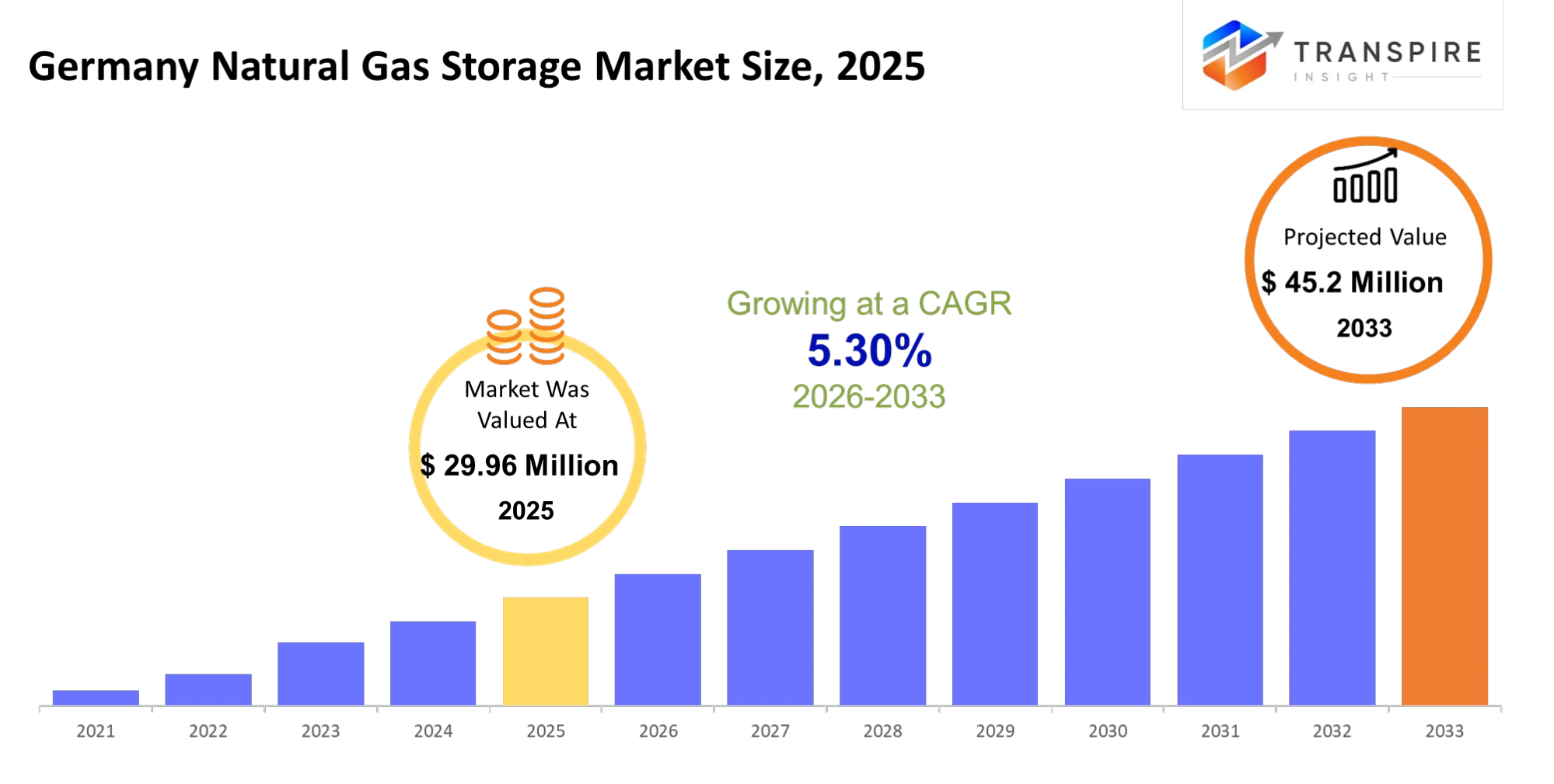
- Germany Natural Gas Storage Market Size 2025: USD 29.96 Million
- Germany Natural Gas Storage Market Size 2033: USD 45.2 Million
- Germany Natural Gas Storage Market CAGR: 5.30%
- Germany Natural Gas Storage Market Segments: ByStorage Type (Underground Storage, LNG Storage), By Application (Power Generation, Residential, Industrial), By End-User (Utilities, Energy Companies)
To learn more about this report,  Download Free Sample Report
Germany Natural Gas Storage Market Summary:
The Germany Natural Gas Storage Market size is estimated at USD 29.96 Million in 2025 and is anticipated to reach USD 45.2 Million by 2033, growing at a CAGR of 5.30% from 2026 to 2033.
The Germany natural gas storage market operates as part of the broader Germany energy infrastructure industry. It has, therefore, continued to influence the manner in which the country maintains the security of supply during the winter season. In the process, facilities across the country support demand during the winter season and help maintain price stability, which is affected by international trade. In the recent past, the European Union’s regulatory actions, as well as the security of supply concerns arising from the disruptions from Russia, have made the operators of the facilities across the country realize the need to enhance the underground storage.
Key Market Trends & Insights:
A stronger plan for energy security will influence the way storage facilities operate. Authorities will keep reserve levels high to avoid any supply disruptions during the winter season. Underground storage facilities will focus more on fast-cycle injections and monitoring systems, enabling them to respond quickly to changes in import flows or industrial consumption.
Digitalization of underground storage facilities management will eventually take place. Companies will incorporate digitalization tools, including sensors, pressure monitoring, and predictive maintenance. These tools will help the companies monitor the performance of the reservoir more accurately, thus reducing risks associated with the facilities. In the future, digitalization of the facilities’ management will enhance efficiency while ensuring the availability of the storage facilities.
Regulatory direction from the European Union will also play a role in the way storage facilities function. Filling targets and the need for transparency will dictate the way the market behaves. Market players will have to adjust their strategies in line with regulatory direction, while traders will increasingly rely on stored reserves to compensate for supply swings during the colder months.
Changing patterns of energy consumption will also play a role in the way the storage facilities function. Industrial buyers, as well as municipal utilities, will require more flexible withdrawal schedules to address price volatility. In the future, the discussions on hydrogen-ready infrastructure will see some of the storage facilities consider the possibility of adapting the existing underground caverns as well as depleted gas reservoirs.
Germany Natural Gas Storage Market Segmentation
By Storage Type
Underground Storage- Underground facilities will be key to the country's future energy security. Salt caverns and depleted reservoirs will be used to store large amounts of gas on a seasonal basis. This will help operators inject excess gas during the summer and draw it out during the winter.
LNG Storage- Liquefied natural gas storage terminals will be used to diversify the country's supplies. Cryogenic storage facilities will be used to store the LNG imported via ships. This will help to increase the country's supplies of natural gas.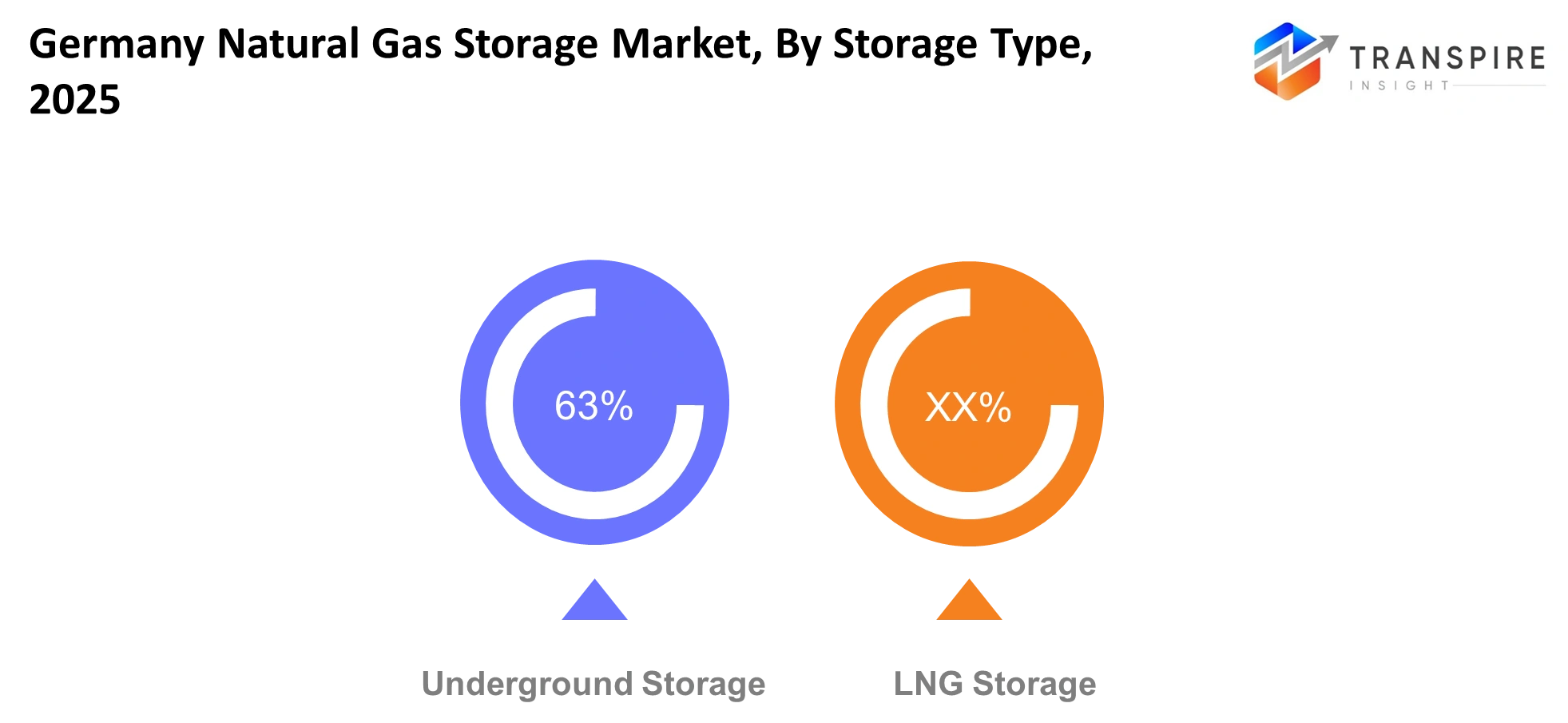
To learn more about this report, Download Free Sample Report
By Application
Power Generation- Gas-fired power plants will use their stored reserves to maintain stable electricity supply for the country. The system will provide essential support during times of peak electricity consumption and when wind and solar power generation experience fluctuations.
Residential- Residential heating will be a key driver of the country's need to draw on stored supplies. During the winter months, stored supplies will be used to meet the country's residential heating needs. This will be especially important during periods of cold weather and potential pipeline supply disruptions.
Industrial- Industrial companies, such as chemical plants and manufacturing facilities, would also depend on stored gas for continuous operations. The access to storage facilities would enable companies to ensure fuel security and manage procurement timing.
By End-User
Utilities- Utility companies would also depend on storage facilities for managing regional distribution networks. They would be able to maintain continuous supplies by injecting and withdrawing stored gas during low and high demand periods, respectively. This would help them respond to weather-related demand fluctuations.
Energy Companies- Energy companies that trade and supply would also depend on storage facilities for managing procurement strategies. They would be able to maintain stored reserves and respond to price volatility, contract requirements, and manage imports during different seasons.
Country Insights
Germany is also committed to building up its gas storage capacities to ensure supplies over winter and to reduce its dependence on uncertain imports. The gas storage operators in Germany have been keeping their reserve levels high after the recent gas supply shocks. The government is overseeing this to ensure that the storage facilities are sufficiently filled up before the onset of the peak winter seasons.
The direction of the European Union's energy policies is important to determine the operating requirements for the gas storage operators. The gas storage operators must ensure that they comply with the gas storage requirements.
The process of modernization in infrastructure would become more apparent in large storage facilities. This would involve upgrading monitoring facilities, automating injection facilities, and improving safety features. This would ensure that facilities are run more efficiently while responding to changing demand in industrial and home energy markets.
Germany would also focus on long-term energy transformation strategies while keeping gas reserves intact. Discussions about changing underground facilities for storing hydrogen would begin to take place. This would ensure that facilities are used for longer while shifting to alternative energy sources and reducing emissions.
Recent Development News
Storage Incentive Challenges and Winter Prep- Germany’s gas storage operators have warned that, in the absence of new economic incentives, the germany natural gas storage market will face challenges in replenishing gas reserves in time for the upcoming heating season. Gas is cheaper in winter than in summer, and this has been cited as one of the reasons for the lack of interest in replenishing gas reserves.
Strategic Reserve Discussions Intensify- The government is in talks regarding the direction to be taken regarding gas supply in the country. The talks are aimed at ensuring that strategic reserves play a bigger role in gas supply, given that EU storage targets will expire in 2027.
|
Report Metrics |
Details |
|
Market size value in 2025 |
USD 29.96 Million |
|
Market size value in 2026 |
USD 31.49 Million |
|
Revenue forecast in 2033 |
USD 45.2 Million |
|
Growth rate |
CAGR of 5.30% from 2026 to 2033 |
|
Base year |
2025 |
|
Historical data |
2021 – 2024 |
|
Forecast period |
2026 – 2033 |
|
Report coverage |
Revenue forecast, competitive landscape, growth factors, and trends |
|
Country scope |
Germany |
|
Key company profiled |
Uniper SE, RWE AG, Gazprom Germania, E.ON SE, VNG AG, Astora GmbH, Fluxys SA, Engie SA, Shell PLC, TotalEnergies SE, OMV AG, Wintershall Dea, EnBW AG, Open Grid Europe, Storengy Deutschland. |
|
Customization scope |
Free report customization (country, regional & segment scope). Avail customized purchase options to meet your exact research needs. |
|
Report Segmentation |
By Storage Type (Underground Storage, LNG Storage), By Application (Power Generation, Residential, Industrial), By End-User (Utilities, Energy Companies) |
Key Germany Natural Gas Storage Market Company Insights
The Germany natural gas storage market is controlled by a small number of major companies which operate most of its underground storage facilities. State-supported organizations and integrated energy companies and dedicated storage companies create the competitive environment which provides supply security and seasonal capacity support and operating system flexibility.
A state-backed entity (formerly part of Gazprom Germania) operates major storage assets such as Astora. SEFE holds a significant share of Germany's storage capacity and is central to national energy security strategies particularly post-2022 energy crisis.
Company List
- Uniper SE
- RWE AG
- Gazprom Germania
- E.ON SE
- VNG AG
- Astora GmbH
- Fluxys SA
- Engie SA
- Shell PLC
- TotalEnergies SE
- OMV AG
- Wintershall Dea
- EnBW AG
- Open Grid Europe
- Storengy Deutschland
Germany Natural Gas Storage Market Report Segmentation
By Storage Type
- Underground Storage
- LNG Storage
By Application
- Power Generation
- Residential
- Industrial
By End-User
- Utilities
- Energy Companies
Frequently Asked Questions
Find quick answers to common questions.
The approximate Germany Natural Gas Storage Market size for the market will be USD 45.2 Million in 2033.
Key segments for the Germany Natural Gas Storage Market By Storage Type (Underground Storage, LNG Storage), By Application (Power Generation, Residential, Industrial), By End-User (Utilities, Energy Companies)
Major players in the Germany Natural Gas Storage Market are Uniper SE, RWE AG, Gazprom Germania, E.ON SE, VNG AG, Astora GmbH, Fluxys SA, Engie SA, Shell PLC, TotalEnergies SE, OMV AG, Wintershall Dea, EnBW AG, Open Grid Europe, Storengy Deutschland.
The Germany Natural Gas Storage Market size is USD 29.96 Million in 2025.
The Germany Natural Gas Storage Market CAGR is 5.30%.
- Uniper SE
- RWE AG
- Gazprom Germania
- E.ON SE
- VNG AG
- Astora GmbH
- Fluxys SA
- Engie SA
- Shell PLC
- TotalEnergies SE
- OMV AG
- Wintershall Dea
- EnBW AG
- Open Grid Europe
- Storengy Deutschland
Recently Published Reports
-
Apr 2026
Active Power Filter Market
Active Power Filter Market Size, Share & Analysis Report By Type (Shunt Active Power Filters, Series Active Power Filter, Hybrid Active Power Filter), By Application (Harmonics Mitigation, Reactive Power Compensation, Voltage Regulation, Power Factor Correction), By Phase (Single Phase, Three Phase), By End-User Industry (Manufacturing, Healthcare, Commercial, Automotive, Oil and Gas, Others), and Geography (North America, Europe, Asia-Pacific, Middle East and Africa, South and Central America), 2021 - 2031
-
Apr 2026
Electrical Transformer Market
Electrical Transformer Market Size, Share & Analysis Report By Core (Closed, Shell, and Berry), By Insulation (Gas, Oil, Solid, Air, and Other), By Phase (Single, and Three), By Rating (100 MVA to 500 MVA, 501 MVA to 800 MVA, and 801 MVA to 1200 MVA), and Geography (North America, Europe, Asia-Pacific, Middle East and Africa, South and Central America), 2021 – 2031
-
Apr 2026
Hydraulic Piston Pumps Market
Hydraulic Piston Pumps Market Size, Share & Analysis Report By Type (Axial Piston Pumps, Radial Piston Pumps), By Operating Pressure (Low Pressure, Medium Pressure, High Pressure), By Application (Construction, Mining, Agriculture, Automotive, Oil & Gas, Industrial Machinery, Others), By End-User (OEMs, Aftermarket), and Geography (North America, Europe, Asia-Pacific, Middle East and Africa, South and Central America), 2021 – 2031
-
Apr 2026
Laboratory Gas Generators Market
Laboratory Gas Generators Market Size, Share & Analysis Report By Product (Nitrogen Gas Generator, Hydrogen Gas Generator, Zero Air Gas Generator, Purge Gas Generator, TOC Gas Generators, Others), By Application (Gas Chromatography, Liquid Chromatography-mass Spectrometry (LC-MS), Gas Analyzers, Others), By End-user (Life Science, Chemical & Petrochemical, Food & Beverage, Others), and Geography (North America, Europe, Asia-Pacific, Middle East and Africa, South and Central America), 2021 – 2031