
United Kingdom Men’s Underwear Market Size & Forecast:
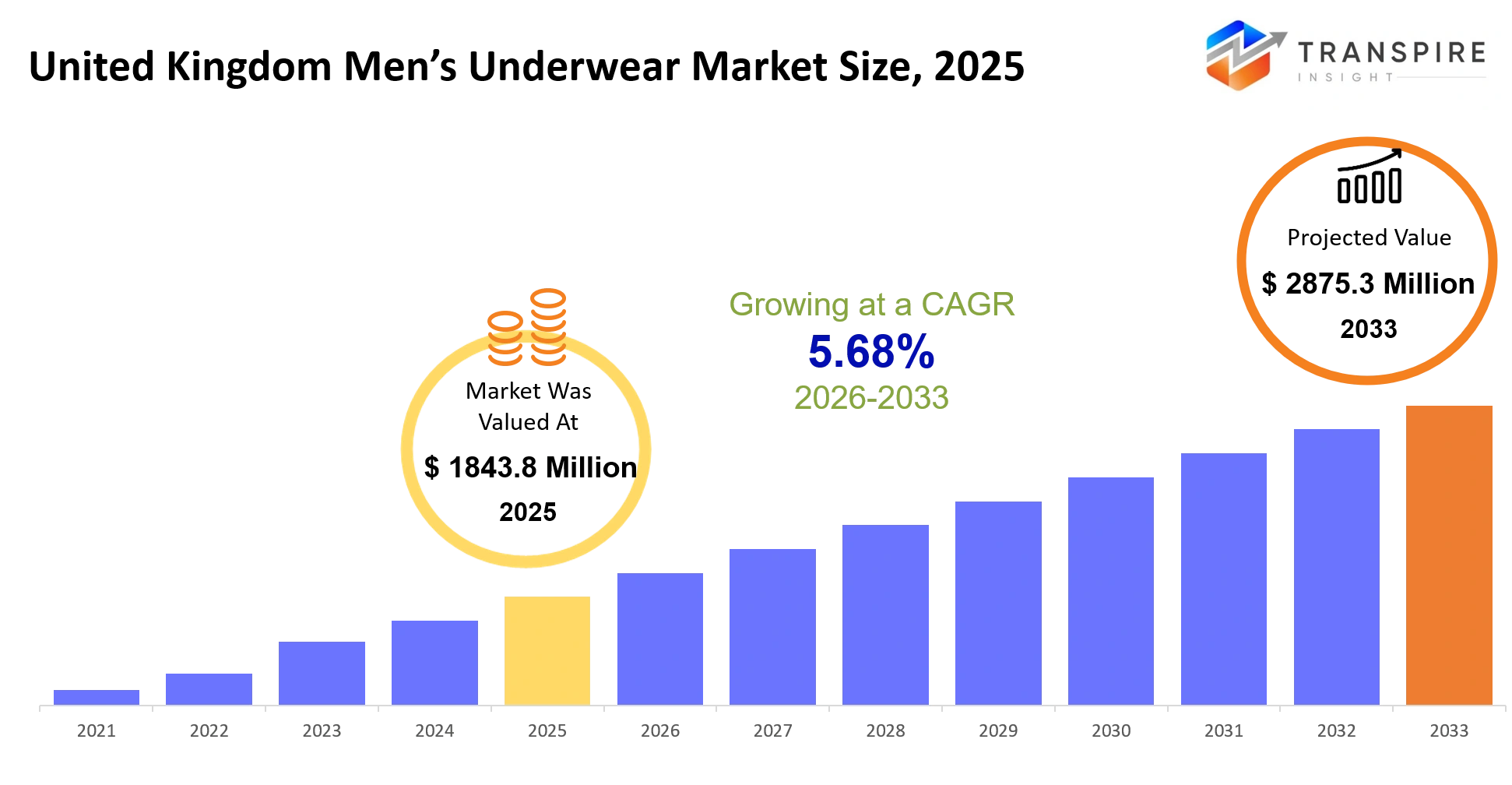
- United Kingdom Men’s Underwear Market Size 2025: USD 1843.8 Million
- United Kingdom Men’s Underwear Market Size 2033: USD 2875.3 Million
- United Kingdom Men’s Underwear Market CAGR: 5.68%
- United Kingdom Men’s Underwear Market Segments: By Product Type (Boxers, Briefs, Boxer Briefs, Trunks, Thermal Underwear, Compression Underwear, Others); By Material (Cotton Underwear, Modal Underwear, Synthetic Underwear, Bamboo Fabric Underwear, Others); By Distribution Channel (Online Retail, Supermarkets, Brand Stores, Department Stores, Specialty Stores, Others); By End User (Teenagers, Adults, Athletes, Premium Consumers, Others).
To learn more about this report,  Download Free Sample Report
United Kingdom Men’s Underwear Market Summary
The United Kingdom Men’s Underwear Market was valued at USD 1843.8 Million in 2025. It is forecast to reach USD 2875.3 Million by 2033. That is a CAGR of 5.68% over the period.
The United Kingdom Men’s Underwear Market is something that people need every day. It is about being comfortable, clean and having the fit. Men’s underwear is important for work, leisure, sports and daily life.. It is more than just something you wear. It is also about how it helps you perform and feel good. People are looking for underwear that is made with fabrics and materials that are good for them.
In the last five years people have started to think about more than just the price when they buy underwear. They want to know that it is well made. It is good for the environment. The COVID-19 pandemic changed the way people shop. Many stores had problems. It was hard to get things from other countries. This made people start shopping more. Companies then wanted to sell their products to customers.
When people started shopping they could find special brands that they did not know about before. This made it harder for companies to stand out. So they had to make their products different. Now companies can charge more for their products. They can also offer subscriptions and special product lines. This helps them make money and keeps customers coming back to buy more United Kingdom Men’s Underwear.
Key Market Insights
- England has the part of the United Kingdom Men’s Underwear Market with about 72 percent of the market in 2025. This is because England has a lot of people who buy things.
- The United Kingdom Men’s Underwear Market in Scotland is growing fast until 2033. This is happening because more people in Scotland are buying clothes online and they like to buy underwear.
- Big cities in the United Kingdom Men’s Underwear Market are still getting a lot of attention from companies that make underwear. These companies are investing in these cities which helps them sell underwear and makes their products more well known.
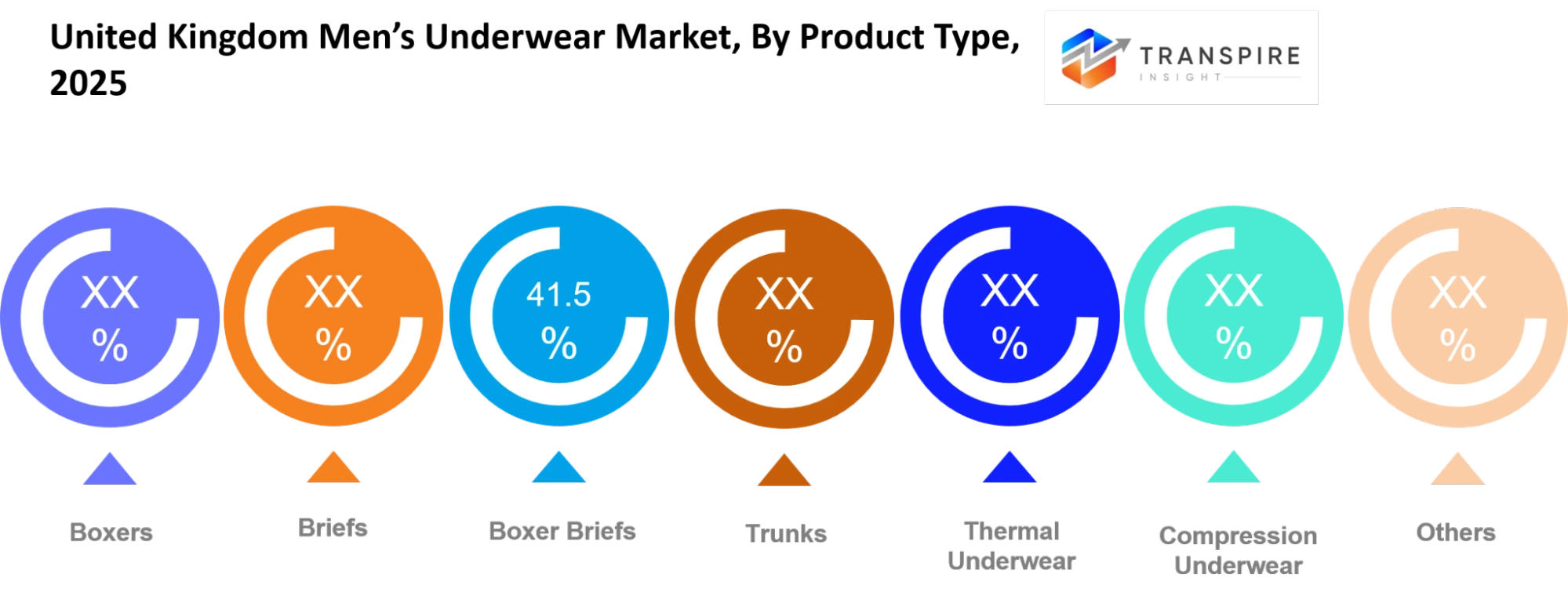
- Boxer briefs are the popular type of underwear in the United Kingdom Men’s Underwear Market with about 38 percent of the market in 2025. People like boxer briefs because they are comfortable and can be worn in different situations.
- The second popular type of underwear in the United Kingdom Men’s Underwear Market is briefs. Briefs are still very popular among people who like underwear and people who like to wear underwear that helps them perform well when they exercise.
- The United Kingdom Men’s Underwear Market for performance and moisture-wicking underwear is growing fast. This is because more people are exercising and they need underwear that can help keep them dry.
- The United Kingdom Men’s Underwear Market is also seeing a growth in fabric collections. This is because companies are making underwear from eco-friendly materials.
- Most of the money made in the United Kingdom Men’s Underwear Market comes from wear. In 2025 everyday wear accounted for 60 percent of the market.
- Grown ups are the buyers in the United Kingdom Men’s Underwear Market. In 2025 they accounted for more than 75 percent of the market.
- Young people aged 18 to 34 are buying underwear online which makes them the fastest growing group of buyers in the United Kingdom Men’s Underwear Market.
What are the Key Drivers, Restraints, and Opportunities in the United Kingdom Men’s Underwear Market?
The main force behind the market expansion of underwear is the shift toward premium and performance-minded underwear. Over the several years progress in fabric technology has allowed manufacturers to bring in materials that wick away moisture, cloth that stretches treatments that control odor and construction that is seamless. This has made underwear a lot better. Then the growth of brands that sell directly to customers and online retail platforms has made these items easier to buy for a group of customers. As people care more about comfort, durability and how well something works, than just the price brands can sell their products for higher prices, which means they make more money and have better profits.
The biggest problem though is that the cost of making underwear can be unpredictable. This is because the prices of cotton, synthetic fibers, packaging and transportation can change a lot. These prices can go up and down because of problems in the supply chain. Unfortunately these problems are not easy to fix because companies that make underwear get their materials from around the world. When the cost of materials goes up, brands usually have to accept that they will make money or they have to raise the prices of their products, which can make customers less likely to buy them.
There is an opportunity for underwear companies to offer subscription services and personalized products especially when they use online shopping platforms. Underwear companies are using data and customer information to make their products better and to keep customers coming back. For example premium underwear brands that send products to customers on a basis can make a steady income and also spend less money on finding new customers. As more people shop online, underwear companies can do more to meet the needs of their customers. The market for underwear is changing and underwear companies are changing too to meet the needs of their customers. The underwear market is getting better.
What Has the Impact of Artificial Intelligence Been on the United Kingdom Men’s Underwear Market?
Artificial intelligence is currently reshaping the United Kingdom Men’s Underwear market in a pretty direct way, mainly by tweaking product development, inventory handling, and customer connection. Apparel brands, like, increasingly lean on AI-powered demand forecasting tools to sift through what people buy, how seasons shift buying habits, and even what’s showing up in online search activity. With this setup, retailers can practically automate inventory planning and cut down on those awkward stock imbalances across physical shops plus e-commerce channels. In the end, companies often manage to reduce excess inventory expenses while also keeping high-demand styles and sizes more available, so customers don’t keep waiting.
At the time machine learning models are getting better at making predictions, across the whole value chain not just at one step. Brands look at customer reviews, returns and fit preferences then use that information to guess what customers will buy next and improve product designs.
AI-powered recommendation engines help online retailers suggest items that're more relevant, which can increase conversion rates and average order values.
Digital sizing technologies also help, as they make fit precise lower return rates and improve customer satisfaction.
Operationally AI helps with supply chain decisions, makes it easier to optimize replenishment schedules and boosts marketing efficiency.
When these things get better inventory holding costs often go down in fulfillment performance. Customer retention increases However AI adoption isn't perfect everywhere.
Many apparel companies have fragmented consumer data and high integration costs, which can limit the accuracy and scaling of analytics platforms.
Smaller brands in particular might not have data to fully benefit from AI-driven decision-making leading to uneven resultsMachine learning models and AI are making a difference but some brands still face challenges.
Brands are using machine learning models to improve their business.
AI is helping brands to make decisions.Machine learning models are getting better at predicting what customers will buy.AI-driven recommendation engines are helping retailers.Digital sizing technologies are improving precision.AI is supporting a run of supply chain choices.AI is making replenishment schedules easier to optimize.AI is boosting marketing efficiency.Inventory holding costs are dropping.Fulfillment performance is getting better.Customer retention is rising.AI adoption is not perfectApparel companies have fragmented consumer dataApparel companies have integration costs.Advanced analytics platforms have limited accuracy.Advanced analytics platforms have limited scaling.Smaller brands do not have data volume,brands are not benefiting from AI-driven decision-makingResults are looking uneven.
Key Market Trends
- Since 2021 people have been buying premium underwear because they want it to be comfortable, last a long time and work well.They do not want to buy the kind anymore.
- Direct-to-consumer brands have been growing fast since the pandemic.This means they do not have to sell their products in stores much.They can also get to know their customers
- Nowadays people like underwear that can pull moisture away from their skin, control odor and stretch.People between 18 and 34 years old like these features a lot.Some brands started letting people buy underwear every month in 2022.
- This helps the brands get money from their customers every month.It also helps them keep their customers.Big brands like Calvin Klein and Hugo Boss are making clothes that are good for the Earth.
- They use materials to make new clothes and get their cotton from people who grow it in a good way.More and more people are buying clothes online.This is why stores are trying to make it easier for people to buy clothes on the internet.
- They are using computers to help people find the size.There were some problems with getting clothes from countries between 2021 and 2023.This made brands try to get their clothes from more than one place.
- They do not want to get all their clothes from one country.Now people are making underwear for people who like to exercise, travel and be activeThis kind of underwear is becoming more popular than the kind.
- Stores are using computers to figure out how many clothes to keep in stock.This helps them make sure they have clothes for everyone.
- It also helps them get the clothes to the customers faster.Now brands are competing with each other to make the clothes.They want to make clothes that're good quality fit well and are good for the Earth.
- They also want to make shopping a fun experience for their customers.Premium underwear is still very popular.
- People want premium underwear because it is comfortable and works well.Brands are trying to make the premium underwear they can.
United Kingdom Men’s Underwear Market Segmentation
By Product Type:
The Product Test shows that people like different kinds of underwear for different reasons. Boxers, briefs, boxer briefs, trunks, thermal underwear and compression underwear are all popular because they meet needs. Some people like boxer briefs because they are comfortable and give support. They like that they can move around easily and feel good all day.
Other people like briefs because they are traditional and give support too. Briefs are great for people who want to feel secure and comfortable. Boxers are also popular because they are breathable and loose. People who like to move a lot like boxers because they feel free and comfortable.Thermal underwear and compression underwear are also getting more popular. More people are exercising and going on adventures so they need underwear that can keep up. Compression underwear is great for sports and training because it helps people perform better. Thermal underwear is good for weather because it keeps people warm.
The way underwear fits and feels is always changing. New fabrics and technologies are being developed all the time. This means that people have more choices than ever before. The Product Test shows that people will keep looking for underwear that meets their needs and makes them feel good.
To learn more about this report, Download Free Sample Report
By Material:
Cotton underwear still seems like the go-to option for many people, mainly for its softness, breathability, and just everyday comfort. People already know it well, and it shows up everywhere, so demand keeps staying steady across age brackets and income ranges, even when fashions shift a bit. Modal underwear has also been getting more attention because of that smoother feel, solid durability, and the way it manages moisture pretty well. On top of that, synthetic underwear remains relevant too, since newer fabric technologies support better flexibility, extra stretch, and overall performance.
Meanwhile, bamboo fabric underwear is drawing even more interest now, as brands bring in alternative material choices that promise comfort benefits. Product development efforts keep moving toward lightweight construction, improved moisture control, and durable results that don’t fall apart fast. In general, material selection is starting to steer purchasing behavior more directly, because consumers often weigh comfort, longevity, and functionality before they finally decide to buy. With continued innovation in textile manufacturing, the market should keep diversifying across different material categories, sort of naturally.
By Distribution Channel:
Online retail really changed how people shop. It gives people convenience. Let them buy things that are not available in their area. People can now shop from their homes. Buy things from big brands easily. They can look at styles and prices on the computer without going to a store.
As more people shop online companies are selling their products directly to customers. Making their websites better. They are also offering services where they send people things they might like. This has helped online shopping get better over time.People still like to go to supermarkets and other stores to buy things. They like to touch and try on things before they buy them. Some stores are really good at helping people find what they want and making them want to come. These stores sell things that are very good quality.I think people will keep shopping in stores. We need both ways of shopping to make sure everyone can buy what they want. Online retail and stores in our towns are both important for people to be able to buy things.
By End User:
Teenagers and adults and athletes and premium consumers and other customer groups all contribute to market demand, in ways. This is because they have purchasing priorities and it feels like the demand is staggered.
Adults are the consumer category. This is because they use these products every day and they need to replace them and buy them again and again. So it just keeps going on its own. When adults buy these products they think about comfort and durability and fit. They also like it when there are different products to choose from and when these products are easy to find. This helps to keep sales strong.Athletes like to buy underwear that helps them perform better. This underwear keeps them dry. Is stretchy and gives them good support. They do not just want underwear.
Premium consumers want quality materials and modern fabrics and they want to buy from brands that are fancy.Teenagers also like to buy these products because they like to look good and be comfortable. They like to shop too.In the future companies will make products that are personalized and premium. This will give them opportunities to sell to all kinds of customers including teenagers and adults and athletes and premium consumers.
What are the Key Use Cases Driving the United Kingdom Men’s Underwear Market?
Everyday wear is still the main use case, supporting market revenue almost directly. Men need comfortable, durable, supportive underwear for office work, commuting, education, and just day-to-day activities. Because people replace items often and wear them year-round, this segment ends up as the biggest driver for product sales across both retail and online e-commerce channels.
Sports and fitness are starting to pull more attention, since athletes and active shoppers want moisture management, better stretch performance, and enhanced support. As gym memberships grow and recreational sports participation becomes more common, plus wellness lifestyles keep spreading, people are more willing to pick performance-oriented products. There’s also travel and business wear, which are quietly expanding too, especially for customers who will spend more for lightweight breathable fabrics with odor control, not just “okay” comfort.
At the same time, new chances are forming in smart apparel and in personalized subscription-based products. Some brands are looking at advanced textiles that can do temperature regulation while also improving comfort for long wear. And data-driven subscription services that curate customized selections based on fit and buying preferences seem really promising throughout the forecast period, sort of a quiet but steady momentum.
|
Report Metrics |
Details |
|
Market size value in 2025 |
USD 1843.8 Million |
|
Market size value in 2026 |
USD 1952.6 Million |
|
Revenue forecast in 2033 |
USD 2875.3 Million |
|
Growth rate |
CAGR of 5.68% from 2026 to 2033 |
|
Base year |
2025 |
|
Historical data |
2021 - 2024 |
|
Forecast period |
2026 - 2033 |
|
Report coverage |
Revenue forecast, competitive landscape, growth factors, and trends |
|
Regional scope |
United Kingdom Men’s Underwear Market-England, Scotland, Wales, Northern Ireland |
|
Key company profiled |
Calvin Klein, Hanesbrands, Jockey, Tommy Hilfiger, Hugo Boss, Marks & Spencer, Fruit of the Loom, Under Armour, SAXX, BN3TH, Uniqlo, Next plc, H&M, Levi Strauss & Co., Adidas. |
|
Customization scope |
Free report customization (country, regional & segment scope). Avail customized purchase options to meet your exact research needs. |
|
Report Segmentation |
By Product Type (Boxers, Briefs, Boxer Briefs, Trunks, Thermal Underwear, Compression Underwear, Others); By Material (Cotton Underwear, Modal Underwear, Synthetic Underwear, Bamboo Fabric Underwear, Others); By Distribution Channel (Online Retail, Supermarkets, Brand Stores, Department Stores, Specialty Stores, Others). |
Which Regions are Driving the United Kingdom Men’s Underwear Market Growth?
England is, in a way, leading the market growth mainly because it has a big population base, a heavy concentration of retail activity, and a strong footprint of well-known apparel brands. Cities like London, Manchester, Birmingham, and a few others still work as real fashion retail hubs. They also support e-commerce operations and brand marketing campaigns that keep things moving. A mature distribution network, along with a broad digital commerce setup, helps products stay available across both premium and mass-market categories. Meanwhile, strong consumer spending on apparel plus personal care products keeps reinforcing the regional lead, even when trends shift a bit.
Scotland plays more like a stable contributor, and its growth is shaped by reasons other than England. Shoppers are slowly moving toward quality-first, performance-oriented apparel, so demand for premium underwear stays steady. Retailers keep a sensible blend of physical stores and online channels, and that lets brands reach customers in cities as well as in less dense places. With consistent buying habits and a gradual rollout of digital retail platforms, revenue remains dependable, almost like clockwork.
Wales looks like the fastest-growing region, mostly due to people adopting online shopping at a quicker pace and better access to premium apparel brands. There have been recent investments in e-commerce logistics and fulfillment networks, and those upgrades improve how easily customers can get products and how fast deliveries happen. At the same time, interest is rising in performance fabrics, sustainable materials, and direct-to-consumer purchasing models, which opens fresh doors for manufacturers and retailers. If this momentum continues, Wales should become a very attractive focus area for new entrants and for brand expansion strategies during 2026–2033.
Who are the Key Players in the United Kingdom Men’s Underwear Market and How Do They Compete?
The United Kingdom Men’s Underwear Market features a mix of global apparel brands, heritage retailers, and digitally native companies competing across premium, mid-range, and value segments. Competition is moderately fragmented, with established brands defending market share through product innovation, brand recognition, and direct-to-consumer capabilities. Differentiation increasingly depends on fabric performance, fit technology, sustainability credentials, and customer experience rather than price alone. New online-focused entrants continue to challenge traditional retailers by using subscription models, personalized recommendations, and digital marketing strategies to attract younger consumers.
Calvin Klein competes through premium positioning, minimalist design, and strong brand equity in the fashion apparel category. The company differentiates itself with recognizable waistband branding, premium fabric selections, and extensive retail and e-commerce distribution. Hugo Boss focuses on the premium consumer segment, offering high-quality materials and tailored comfort features that appeal to professionals seeking luxury everyday apparel. Expansion efforts center on strengthening digital sales channels and enhancing direct customer engagement.
Marks & Spencer leverages a strong domestic retail network and trusted product quality to maintain a loyal customer base. The company differentiates through value-focused multipack offerings and broad accessibility across physical and online stores. Hanesbrands competes through scale, affordability, and extensive product variety, while Under Armour emphasizes moisture management, compression technology, and athletic performance benefits. Both companies continue expanding through product innovation, digital commerce investments, and targeted collections designed for active lifestyle and performance-oriented consumers.
Company List
- Calvin Klein
- Hanesbrands
- Jockey
- Tommy Hilfiger
- Hugo Boss
- Marks & Spencer
- Fruit of the Loom
- Under Armour
- SAXX
- BN3TH
- Uniqlo
- Next plc
- H&M
- Levi Strauss & Co.
- Adidas
Recent Development News
In January 2025, HUGO BOSS launched the BOSS ONE Bodywear collection in partnership with David Beckham. The collection expanded the company’s premium men’s underwear portfolio and strengthened brand visibility in the global bodywear segment.
Source: https://group.hugoboss.com (HUGO BOSS Group).
In February 2025, Hanes entered a partnership with Urban Outfitters to launch the Hanes Heritage capsule collection. The collaboration introduced a new range of innerwear and apparel products, helping Hanes expand consumer reach through lifestyle-focused retail channels.
Source: https://ir.hanesbrands.com (Hanesbrands Inc.).
In April 2025, HanesBrands launched Bonds in the United States market. The expansion increased international brand exposure for the company’s underwear portfolio and supported broader growth opportunities across premium innerwear categories.
Source: https://ir.hanesbrands.com(Hanesbrands Inc.).
What Strategic Insights Define the Future of the United Kingdom Men’s Underwear Market?
The United Kingdom Men’s Underwear Market is moving toward a more premium, digitally connected, and data-driven business model over the next five to seven years. The underlying force behind this shift is the growing consumer preference for products that combine comfort, performance, personalization, and convenience rather than competing solely on price. As digital commerce platforms collect more customer data, brands will increasingly use predictive analytics, fit optimization tools, and subscription models to strengthen customer retention and increase lifetime value.
A hidden risk lies in the growing concentration of raw material sourcing and apparel manufacturing within a limited number of global supply chains. Future disruptions related to cotton availability, trade policies, or production costs could create margin pressure even during periods of strong consumer spending.
An emerging opportunity is the development of AI-enabled personalization platforms that recommend products based on body type, purchasing history, and lifestyle preferences. Companies should invest in direct-to-consumer ecosystems that integrate personalized product recommendations, subscription services, and premium fabric innovation to build stronger customer relationships and sustainable long-term growth.
United Kingdom Men’s Underwear Market Report Segmentation
By Product Type
- Boxers
- Briefs
- Boxer Briefs
- Trunks
- Thermal Underwear
- Compression Underwear
- Others
By Material
- Cotton Underwear
- Modal Underwear
- Synthetic Underwear
- Bamboo Fabric Underwear
- Others
By Distribution Channel
- Online Retail
- Supermarkets
- Brand Stores
- Department Stores
- Specialty Stores
- Others
By End User
- Teenagers
- Adults
- Athletes
- Premium Consumers
- Others
Frequently Asked Questions
Find quick answers to common questions.
The expected United Kingdom Men’s Underwear Market size for the market will be USD 2875.3 Million in 2033.
Key segments for the United Kingdom Men’s Underwear Market are Type By Product Type (Boxers, Briefs, Boxer Briefs, Trunks, Thermal Underwear, Compression Underwear, Others); By Material (Cotton Underwear, Modal Underwear, Synthetic Underwear, Bamboo Fabric Underwear, Others); By Distribution Channel (Online Retail, Supermarkets, Brand Stores, Department Stores, Specialty Stores, Others); By End User (Teenagers, Adults, Athletes, Premium Consumers, Others).
Major United Kingdom Men’s Underwear Market players are Calvin Klein, Hanesbrands, Jockey, Tommy Hilfiger, Hugo Boss, Marks & Spencer, Fruit of the Loom, Under Armour, SAXX, BN3TH, Uniqlo, Next plc, H&M, Levi Strauss & Co., Adidas.
The United Kingdom Men’s Underwear Market size is USD 1843.8 Million in 2025.
The United Kingdom Men’s Underwear Market CAGR is 5.68% from 2026 to 2033.
- Calvin Klein
- Hanesbrands
- Jockey
- Tommy Hilfiger
- Hugo Boss
- Marks & Spencer
- Fruit of the Loom
- Under Armour
- SAXX
- BN3TH
- Uniqlo
- Next plc
- H&M
- Levi Strauss & Co.
- Adidas
About the Authors

Chetan Dhatrak
I’m Chetan Dhatrak, a Senior Research Analyst at Transpire Insight, specializing in the Consumer Goods, Foods and Beverages industry. I focus on analyzing market trends, consumer behavior, competitive landscapes, and industry developments to deliver accurate, data-driven insights. My research at Transpire Insight is built on credible sources and in-depth analysis, helping businesses and readers better understand market dynamics, emerging opportunities, and evolving consumer preferences. I’m committed to creating reliable, well-researched content that supports informed decision-making and reflects the latest developments in the consumer goods and food & beverage sectors.

Chakradhar Khansole
Chakradhar serves as the Research Director at Transpire Insight, bringing over 8 years of experience in technology, innovation, and strategic market intelligence. He specializes in transforming complex market data into actionable business insights that enable organizations to make informed, growth-oriented decisions. Recognized for his strategic vision and analytical expertise, Chakradhar leads high-impact research initiatives, delivering comprehensive market assessments, competitive intelligence, and forward-looking industry analysis.
Recently Published Reports
-
Apr 2026
Bottled Water Market
Bottled Water Market Size, Share & Analysis Report By Product Type (Still Bottled Water, Carbonated Bottled Water, Functional Bottled Water, and Others), By Packaging (PET, Cans, and Others), By Sales Channel (Supermarkets/Hypermarkets, Convenience Stores/Drug Stores, Grocery Stores/Club Stores, Foodservice, and Others) and Geography (North America, Europe, Asia-Pacific, Middle East and Africa, South and Central America), 2021 - 2032
-
Apr 2026
Color Cosmetic Packaging Market
Color Cosmetic Packaging Market Size, Share & Analysis Report By Application (Mascara Packaging, Liquid Packaging, and Liquid Face), By Type (Tubes & Bottles, Pens & Markers, Compacts & Containers, and Droppers & Pumps), and Geography (North America, Europe, Asia-Pacific, Middle East and Africa, South and Central America), 2021 - 2031
-
Apr 2026
External Microphone For Camera Market
External Microphone For Camera Market Size, Share & Analysis Report By Type (Shotgun Microphone, Lavalier Microphone, and Others), By Application (Digital Camera, Professional Video Camera, and Others), and Geography (North America, Europe, Asia-Pacific, Middle East and Africa, South and Central America), 2021 - 2031
-
Apr 2026
Foot Orthotic Insoles Market
Foot Orthotic Insoles Market Size, Share & Analysis Report By Type (Pre-fabricated, and Custom-made), By Material (Thermoplastic, Composite Carbon Fiber, and Others), By Distribution Channel (Drug Stores, Hospitals & Clinics, and Others), and Geography (North America, Europe, Asia-Pacific, Middle East and Africa, South and Central America), 2021 - 2031