
Asia Pacific Smart Fabrics Market Size & Forecast:
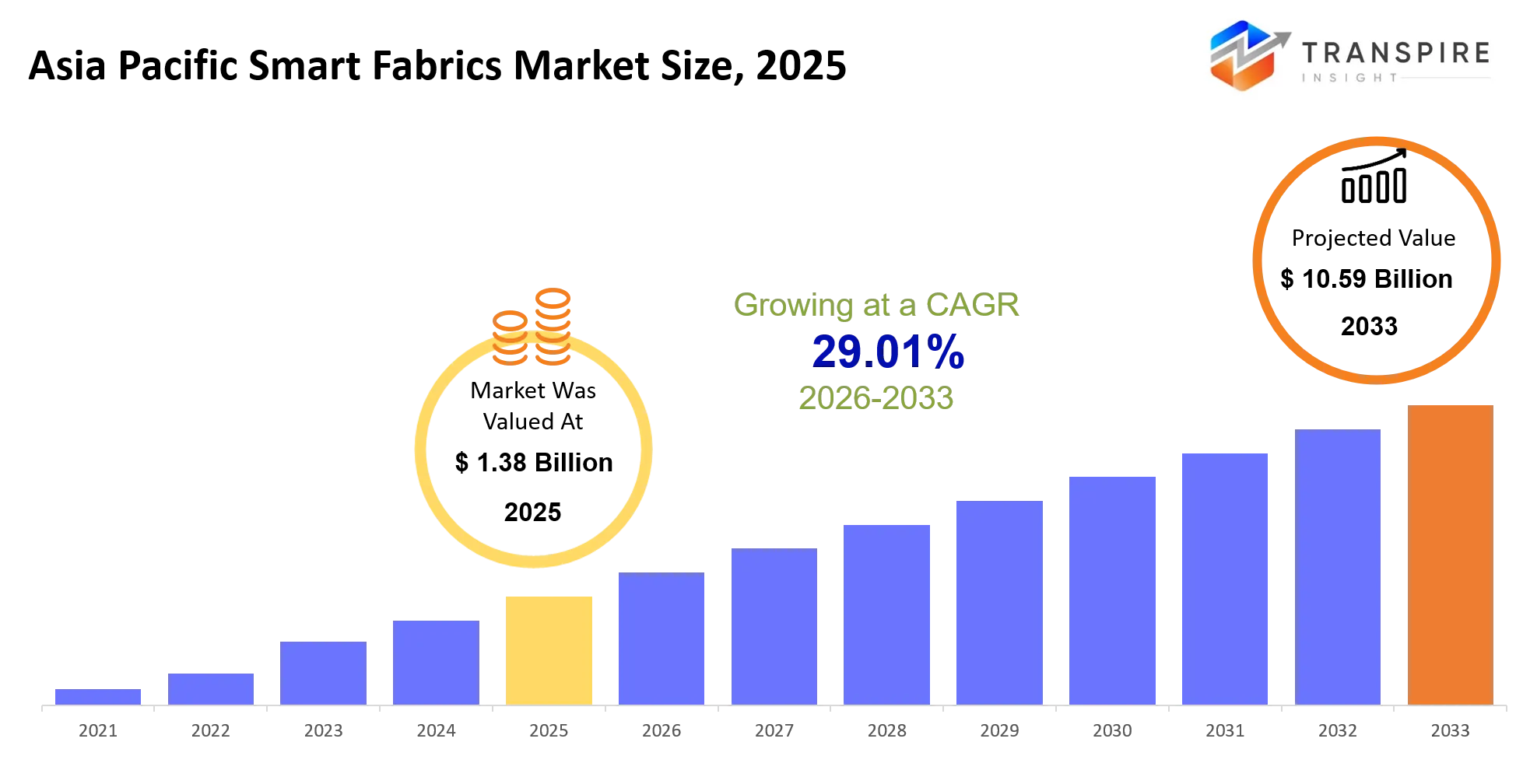
- Asia Pacific Smart Fabrics Market Size 2025: USD 1.38 Billion
- Asia Pacific Smart Fabrics Market Size 2033: USD 10.59 Billion
- Asia Pacific Smart Fabrics Market CAGR:29.01%
- Asia Pacific Smart Fabrics Market Segments: By Product Type (Passive Smart Fabrics, Active Smart Fabrics, Ultra-Smart Fabrics, Conductive Fabrics, Shape Memory Fabrics, Temperature Responsive Fabrics, Sensor Integrated Fabrics, Others); By Functionality (Energy Harvesting, Sensing & Monitoring, Communication, Thermal Regulation, Health Monitoring, Military Applications, Sports Performance Tracking, Others); By Application (Healthcare, Sports & Fitness, Military & Defense, Fashion & Entertainment, Automotive, Industrial Safety, Consumer Electronics, Others); By End User (Healthcare Providers, Sports Organizations, Defense Agencies, Fashion Industry, Industrial Companies, Consumers, Others)
To learn more about this report,  Download Free Sample Report
Asia Pacific Smart Fabrics Market Summary
The Asia Pacific Smart Fabrics Market was valued at USD 1.38 billion in 2025. It is forecast to reach USD 10.59 billion by 2033. That is a CAGR of29.01% over the period.
Smart fabrics kind of blend sensing, watchful monitoring, thermal tuning, and even communication into the textile itself, so companies can gather real-time data without slapping on big, bulky gadgets everywhere. Like, in healthcare,e wearable clothing can track a patient's vital nonstop. On the industrial side, connected work uniforms watch over fatigue levels, heat exposure, and other risky situations. Sports groups also lean on performance tracking apparel, aiming for better training feedback and less injury exposure, whereas defense agencies use adaptive textile materials for soldier monitoring and environmental reactions.
Over roughly the last five years, the Asia Pacific Smart Fabrics Market has moved from experimental wearable tech into something more scalable for both industrial and medical use. Better conductive yarns, bendable sensing films, and low-power electronics eased production steps and also helped the fabric last longer. The COVID-19 pandemic then pushed money faster into remote patient monitoring, and the whole idea of connected healthcare textiles, which kept turning into longer-term commercial demand for sensor-integrated garments in hospitals and elderly care centers. Meanwhile, regional manufacturing is growing in China, Japan, South Korea, and India, which improves supply chain capability for advanced textile components. So this mix of healthcare digitization, industrial automation, and more local making is lifting adoption rates, and it supports higher-value textile income across the region.
Key Market Insights
- In 202,5 China sat at around 34% market share, mainly because strong electronics manufacturing and this sort of advanced textile production know-how helped it stay competitive.
- Meanwhile, India is projected to turn into the fastest-growing regional market through 2032, driven by healthcare digitization that keeps expanding and defense modernization programs.
- In 2025, sensor-integrated fabrics basically took the lead in product demand, partly because hospitals and sports organizations leaned harder into continuous monitoring use cases.
- Conductive fabrics stayed in the second-largest spot too, as flexible electronics adoption picked up speed, especially for industrial safety apparel plus wearable communication systems.
- Looking ahead, temperature-responsive fabrics are expected to grow the quickest across the forecast period, with healthcare and military sectors acting as the main pull.
- Healthcare applications also grabbed more than 29% revenue share in 2025, as remote patient monitoring programs rolled out across a lot of urban medical networks.
- Sports and fitness, meanwhile,e showed the fastest adoption growth, since biometric performance tracking has started to become normal among professional training organizations.
- Healthcare providers were the top end-user category because connected garments improved patient tracking efficiency and cut down on some of that manual monitoring work.
- On the industrial side, companies increased smart textile purchasing after workplace safety rules got tighter across manufacturing and mining operations in Southeast Asia.
- Key players, such as DuPont, Toray Industries, Samsung Electronics, Google, Adidas, and Nike, are strengthening their market position by pushing conductive textile innovation, building regional partnerships, and tying in more wearable technology.
What are the Key Drivers, Restraints, and Opportunities in the Asia Pacific Smart Fabrics Market?
Healthcare digitization is still the most persistent push behind market expansion across the Asia Pacific, as it keeps rolling forward. In hospitals and across healthcare providers, wearable monitoring garments are being used more and more to lessen dependence on those stationary monitoring systems and to make patient tracking feel faster and less clunky. Meanwhile, aging populations in Japan, South Korea, and China put extra strain on healthcare infrastructure. That pressure then drives medical institutions to lean into continuous remote monitoring technologies. Flexible biosensors plus conductive fabrics now help with heart rate tracking, respiratory analysis, and temperature observation in near real-time clinical moments. And this whole movement boosts commercial adoption pretty directly, since healthcare systems are increasingly routing technology budgets toward preventive monitoring solutions instead of only handling episodic, “event-based” care.
Still, adoption is not easy. High production costs and complicated integration processes keep acting as obstacles, quietly but consistently. Smart textile manufacturing needs advanced conductive fibers, embedded electronics, specialized coatings, and sensor systems that can survive washing without losing function. Scaling up is also tough because textile suppliers and electronics manufacturers often work in separate supply chains, with different technical standards. On top of that, limited interoperability between different sensor platforms makes deployments slower and sometimes messier than expected. These structural barriers end up delaying cost reduction, and they suppress adoption among price-sensitive industrial and consumer segments, especially across developing economies in Asia.
Defense modernization, together with industrial safety digitization,n is showing a huge long-term chance, I guess. Governments in India, South Korea, and Australia keep upping investment into wearable soldier monitoring setups, adaptive camouflage substances, and heat-resistant smart uniforms. And on the industry side, companies are bringing in connected safety garments that can track worker fatigue, toxic gas exposure, and even hazardous temperature situations. Also, the progress in lightweight flexible batteries and printed electronics is making everything more usable in real life, like less trouble to carry, so that textile businesses and wearable technology developers can open new revenue paths.
What Has the Impact of Artificial Intelligence Been on the Asia Pacific Smart Fabrics Market?
Artificial intelligence is quietly changing smart textile systems, from “just collecting data” sort of tools into adaptive monitoring platforms that can do real-time analysis and make predictive choices. In healthcare, providers are using AI-driven wearable garments to keep track of a patient’s vitals all day, then spot unusual patterns before a really critical medical moment happens. Machine learning algorithms sort through biometric signals gathered by conductive fabrics and embedded sensors, so hospitals can improve early-action accuracy and cut down on manual monitoring effort, day after day.
For sports performance, AI-enabled apparel is being used to judge muscle activity, fatigue level, movement efficiency, and recovery behaviors during training. Sports organizations in Japan, China, a nd Australia are leaning into these systems as part of athlete conditioning routines, aiming to reduce injury risks while tightening up performance metrics. Meanwhile, industrial safety is growing too, because connected workwear uses predictive analytics to flag heat stress, hazardous exposure, and fatigue-related risks in manufacturing and mining settings.
Operational efficiency has gotten better mainly because automated monitoring systems cut down on the usual manual inspections and help enable faster response times. In several healthcare deployments, there were measurable reductions in patient observation workloads, plus remote monitoring became more efficient overall. Still, AI adoption has a big stumbling block, mostly because the integration costs stay high and the data ecosystems are fragmented, sort of everywhere. For smart textile systems, the situation can get messy too: they often create inconsistent datasets since sensor accuracy shifts when you move them into real-world conditions like sweat, heat, repeated washing, and physical strain. That, in turn, limits how dependable large-scale prediction can really be.
Key Market Trends
- •Since 2021, healthcare providers have increasingly started to adopt sensor-integrated garments for remote patient monitoring, so there has been a real drop in how much they rely on the old-fashioned bedside monitoring gear.
- Textile manufacturers then sorta moved away from just wearable extras, and leaned more into sensing textiles that can be washed, with conductive materials and flexible electronics all stitched in more or less.
- Between 2022 and 2025, China and South Korea also expanded their own domestic conductive fiber production, which helped lower dependence on imported electronic textile components.
- At the same time, industrial firms were buying more connected safety apparel after stricter workplace monitoring rules popped up across manufacturing and mining.
- Sports apparel brands,s including Nike and Adidas, have pushed biometric performance tracking deeper into higher-end athletic wear collections.
- Meanwhile, military agencies across India and Australia made faster investments in adaptive uniforms that can monitor soldier fatigue, plus environmental exposure, kind of stuff.
- Conductive textile producers also increasingly teamed up with semiconductor companies, particularly after demand for flexible sensors surged between 2023 and 2025.
- On the other side, consumer electronics companies started to emphasize low-power wearable systems, mainly to stretch battery life and improve fabric durability in connected garments.
- Healthcare-oriented smart textile startups ended up securing stronger regional investment support, too, because aging populations are putting more and more pressure on medical infrastructure capacity.
- And finally, manufacturers acceleratedAI-enabledd textile analytics integration to improve predictive monitoring accuracy across healthcare, sports, and industrial safety
Asia Pacific Smart Fabrics Market Segmentation
By Product Type
Passive smart fabrics keep on supporting fairly basic sensing and monitoring roles in healthcare and sports clothing. Active smart fabrics got more real-world commercial momentum because they can actually respond to outdoor conditions, via embedded electronics plus responsive material behavior. Conductive fabrics also pushed deeper into the market, since wearable electronics makers were increasingly looking for lightweight, pliant conductive textile platforms. Fabric types with built-in sensors saw especially strong commercial pulls both in medical monitoring setups and in industrial safety garments.
Fabrics that rely on shape memory widened their adoption within defense and industrial uses, mainly because the adaptive material response can boost operational efficiency. Temperature-responsive fabrics started to be more common in sportswear and healthcare products, mostly due to thermal regulation abilities and general comfort improvements. As for ultra-smart fabrics, they were still being worked on in a handful of advanced research programs, centered on communication mechanisms and intelligent response style functionality. In different regions, textile manufacturers raised spending on durable washable sensor systems, so the end product stays usable for the long run across multiple industries.
By Functionality
Because sensing and monitoring functions kept getting the largest commercial slice, mainly, healthcare and industrial sectors wanted real-time biometric plus environmental mapping systems more and more. In that sense, health monitoring use grew fast, with wearable garments now tracking temperature, breathing, pulse rates, and even physical activity levels, pretty regularly. The thermal regulation part also started mattering more, especially in sportswear and industrial safety textile products made for rough environmental conditions.
At the same time, communication-enabled fabrics moved forward too, through their tie-ins with flexible electronics and low-power wireless setups. Sports performance tracking then pushed even more demand from professional training groups as well as fitness technology makers. Military applications went ahead quickly, with funds going into adaptive textiles that can do environmental sensing and soldier monitoring at the same time.
Energy harvesting stayed mostly in the developmental phase, but it still got a lot of interest for future self-powered wearable solutions. Overall, manufacturers leaned more and more toward multifunctional textile platforms, basically stuff that blends monitoring, communication, and thermal management together in one wearable solution.
By Application
Healthcare is where the largest revenue came from, because connected garments helped with remote patient observation, and honestly made continuous monitoring feel more efficient. Hospitals started adopting sensor-embedded textiles more and more to cut down on manual checking, plus to back up preventive care approaches. Sports and fitness also grew significantly, especially once biometric tracking and injury-prevention systems were built directly into premium athletic clothing. At the same time, consumer electronics companies moved faster on partnerships with textile manufacturers, aiming to get wearable device integration to work smoothly in everyday use garments.
Then, in Military and defense, they ramped up smart uniform deployment, the kind that can handle environmental monitoring and physiological tracking in the field. For Industrial safety, the momentum stayed strong across mining, manufacturing, and construction, where connected protective apparel improved workplace monitoring efficiency, without as much friction. Automotive players went exploring smart seating materials, along with driver monitoring textiles, as a step toward future mobility needs. Fashion and entertainment brands also showed up with interactive garments—lighting plus connectivity and responsive textile elements—basically to strengthen that premium consumer engagement feel, and keep people coming back.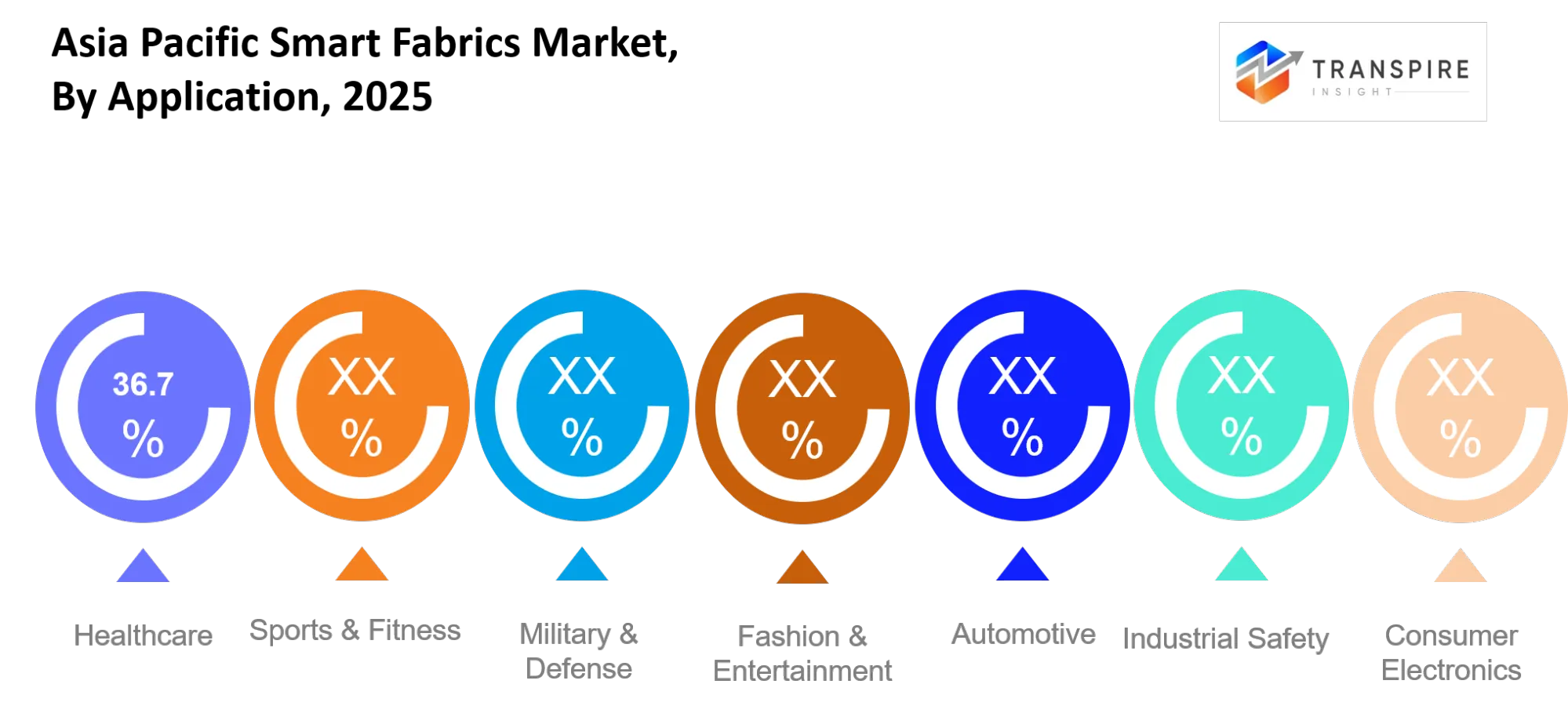
To learn more about this report, Download Free Sample Report
By End User
Healthcare providers kinda took the lead end-user spot, mostly because hospitals and elderly care facilities adopted connected monitoring garments at scale, like a lot faster than others. Medical institutions started folding wearable textiles into remote patient observation programs, aiming to raise operational efficiency and also keep patient management more accurate. Sports organizations followed, pushing smart apparel out to support professional athlete training and rehabilitation systems, more or less in a steady way. Industrial companies, too,o leaned harder into procurement of connected safety garments, designed to track worker fatigue and environmental exposure conditions, which honestly is a big deal day to day.
Defense agencies strengthened their investment in wearable monitoring systems and also adaptive combat uniforms to boost operational readiness and protect soldiers better. Consumer adoption then progressed gradually through smart fitness apparel and connected lifestyle garments paired with mobile health applications. The fashion industry participants introduced technology-enabled apparel collections aimed at premium urban consumers, along with digital lifestyle trends that continue to grow. Meanwhile, regional manufacturers kept improving partnerships with electronics developers, with the goal of better durability and flexibility, and stronger large-scale commercialization abilities.
What are the Key Use Cases Driving the Asia Pacific Smart Fabrics Market?
Healthcare providers kind of took the lead, end-user-wise, mostly because hospitals and elderly care facilities rolled out connected monitoring garments at scale, way faster than the rest. Medical institutions started folding wearable textiles into remote patient observation programs, trying to boost operational efficiency and keep patient management more accurate at the same time. Sports organizations then followed, pushing smart apparel out to support professional athlete training and rehabilitation systems, more or less steadily. Industrial companies also leaned harder into procurement of connected safety garments, made to track worker fatigue and exposure conditions in the environment, and honestly, that’s a big deal day to day.
Defense agencies stepped up their investment in wearable monitoring systems, plus adaptive combat uniforms, to raise operational readiness and protect soldiers better. Consumer adoption then moved forward gradually, through smart fitness apparel and connected lifestyle garments that pair with mobile health applications. The fashion industry participants brought out tech-enabled apparel collections for premium urban consumers, along with those digital lifestyle trends that keep expanding. Meanwhile, regional manufacturers kept sharpening partnerships with electronics developers, so they can deliver better durability and flexibility, while building stronger large-scale commercialization capabilities.
|
Report Metrics |
Details |
|
Market size value in 2025 |
USD 1.38 Billion |
|
Market size value in 2026 |
USD 1.78 Billion |
|
Revenue forecast in 2033 |
USD 10.59 Billion |
|
Growth rate |
CAGR of 29.01% from 2026 to 2033 |
|
Base year |
2025 |
|
Historical data |
2021 - 2024 |
|
Forecast period |
2026 - 2033 |
|
Report coverage |
Revenue forecast, competitive landscape, growth factors, and trends |
|
Regional scope |
Asia Pacific (India, China, Japan, Australia, South Korea, Rest of Asia Pacific) |
|
Key company profiled |
DuPont, Textronics, Sensoria, Interactive Wear, Adidas, Nike, Under Armour, Hexoskin, AiQ Smart Clothing, Schoeller Textiles, Google, Samsung Electronics, Toray Industries, Milliken & Company, Clothing+ |
|
Customization scope |
Free report customization (country, regional & segment scope). Avail customized purchase options to meet your exact research needs. |
|
Report Segmentation |
By Product Type (Passive Smart Fabrics, Active Smart Fabrics, Ultra-Smart Fabrics, Conductive Fabrics, Shape Memory Fabrics, Temperature Responsive Fabrics, Sensor Integrated Fabrics, Others); By Functionality (Energy Harvesting, Sensing & Monitoring, Communication, Thermal Regulation, Health Monitoring, Military Applications, Sports Performance Tracking, Others); By Application (Healthcare, Sports & Fitness, Military & Defense, Fashion & Entertainment, Automotive, Industrial Safety, Consumer Electronics, Others); By End User (Healthcare Providers, Sports Organizations, Defense Agencies, Fashion Industry, Industrial Companies, Consumers, Others) |
Which Regions are Driving the Asia Pacific Smart Fabrics Market Growth?
East Asia kind of holds the dominant position in the market, mostly because advanced textile manufacturing is concentrated there, plus semiconductor integration know-how and a lot of large-scale electronics production all across China, Japan, and South Korea. China in particular drives regional commercialization, thanks to government-backed industrial modernization, and also because its supply chains feel more connected… linking conductive fibers, flexible sensors, and wearable electronics manufacturing in a way that actually works at scale. Japan keeps pushing market leadership forward with precision material engineering and wearable textile development that leans into healthcare, especially systems aimed at elderly care monitoring. South Korea supports the whole regional ecosystem through AI-enabled wearable innovation and strong integration with consumer electronics, led by companies like Samsung Electronics, which ends up creating a pretty coordinated production environment that keeps commercial scale alive over the long run.
Southeast Asia, though, is the second-largest regional contributor, but the growth pattern is not really the same as East Asia. Countries such as Singapore, Thailand, Malaysia, and Vietnam get momentum from steadier industrial expansion, increasing healthcare digitization, and ongoing foreign investment focused more on electronics-enabled textile production rather than deep material innovation. Singapore still functions as a key regional innovation hub because medical technology firms and research institutes continue to finance wearable healthcare textile development for clinical monitoring use cases. Vietnam and Thailand are increasingly drawing manufacturing relocation strategies from multinational apparel and electronics companies, mainly to reduce production expenses and diversify supply chain exposure, and that helps generate dependable long-term revenue, without the high capital intensity that you often see in East Asia.
South Asia is kind of emerging as the fastest-growing regional market, mainly because healthcare infrastructure is getting built out fast, defense modernization programs are moving ahead, and government-supported textile digitization pushes are actually taking shape. India then really took a bit more momentum, after it increased spending in domestic wearable electronics manufacturing and also started smart textile research partnerships, linking technology institutes with defense agencies. Meanwhile, industrial safety rules across mining, construction, and manufacturing are tightening too, so there is more demand for connected worker monitoring garments that can track heat exposure and fatigue states, not just the basic stuff. All of this growth path is creating solid openings for new entrants and investors from 2026 to 203,3 especially for localized manufacturing, healthcare monitoring platforms, and lower cost sensor integrated textile systems built for large scale rollouts.
Who are the Key Players in the Asia Pacific Smart Fabrics Market and How Do They Compete?
Competition across the Asia Pacific Smart Fabrics Market still looks pretty moderately fragmented, largely because textile manufacturers, electronics companies, wearable technology developers, and healthcare monitoring firms show up in different layers of the value chain. Big material science players keep trying to defend their position with proprietary conductive fibers, tougher coatings, and manufacturing that can actually scale up. Meanwhile, newer wearable technology firms seem to push harder on software integration and more specialized monitoring abilities, kind of like they move faster where it counts. In general, technology innovation remains the main lever, especially around washable sensor integration, lighter conductive material options, better battery efficiency, and AI‑driven analytics, which is what everyone claims they need. Even geography matters too because firms with integrated electronics plus textile production networks can usually launch products sooner and lower production costs more effectively.
Toray Industries operates with a sort of advanced material engineering mindset, focusing on high-performance conductive textiles built for healthcare, industrial, and defense uses. It also benefits from a strong manufacturing backbone across Japan and wider Asia, which helps keep product consistency and support lalarge-scaleommercial supply. DuPont differentiates by leaning into durable protective textile systems and specialty fibers aimed at industrial safety and military-level applications, where heat resistance and long-term durability become the real deciding buying criteria. AiQ Smart Clothing takes a more niche route, and instead of chasing broad industrial coverage i, it leans into wearable integration by mixing conductive yarn technologies with biometric monitoring systems for sportswear and healthcare garments, so customization cycles can happen faster than what the larger competitors typically offer.
Samsung Electronics plays the whole game via ecosystem integration, linking wearable textile technologies to AI platforms, mobile devices, and low-power semiconductor systems, not just in a line but kind of as one fabric. They also lean on partnerships with wearable developers and AI‑oriented hardware initiatives, which help keep their placelong-termm in connected apparel plus intelligent wearable systems.
Meanwhile Ni, Nike and Adidas keep pushing biometric sports apparel programs, mostly by working with athlete performance tracking partners and rolling out data-driven training systems. Both brands lean hard on their established brand ecosystems and hands-on consumer engagement capabilities, so adoption of connected athletic wear can move faster, especially in premium fitness and professional sports categories. This is pretty noticeable across Asia Pacific markets, as far as I can tell.
Company List
- DuPont
- Textronics
- Sensoria
- Interactive Wear
- Adidas
- Nike
- Under Armour
- Hexoskin
- AiQ Smart Clothing
- Schoeller Textiles
- Samsung Electronics
- Toray Industries
- Milliken & Company
- Clothing+
Recent Development News
“In May 2026, Samsung Electronics and Google unveiled intelligent AI-powered eyewear developed in partnership with Gentle Monster and Warby Parker. The launch strengthened integration between wearable electronics, AI systems, and smart textile-compatible wearable ecosystems across Asia Pacific consumer technology markets.https://news.samsung.com
“In March 2026, Samsung Electronics expanded its AI-driven wearable ecosystem strategy at Mobile World Congress 2026. The initiative highlighted deeper integration between connected wearable devices, AI-powered monitoring systems, and next-generation smart apparel technologies supporting broader wearable innovation.https://news.samsung.com
“In August 2025, Toray Group announced expanded advanced material technology showcasing at CAMX 2025 focu, focused on lightweight high-performance composites and industrial innovation. The development reinforced regional investment momentum in advanced functional materials supporting future smart textile and wearable technology applications.https://www.toraytac.com
What Strategic Insights Define the Future of the Asia Pacific Smart Fabrics Market?
The market is kind of structurally moving toward fully integrated intelligent textile systems that stitch together biometric sensing, AI-enabled analytics, low-power communication, and adaptive material functionality inside lightweight wearable platforms. Healthcare digitization and industrial workforce monitoring will stay the main forces behind this shift, especially because aging populations and labor-intensive industries want continuous real-time monitoring solutions outside the usual fixed setups . Over the next five to seven years, commercialization will lean more and more on interoperability between textile manufacturers, semiconductor companies, and software developers, not just standalone material innovation.
One less obvious risk has to do with raw material concentration and supply chain dependency around conductive fibers, flexible semiconductors, and hose advanced sensor components. If too much depends on a small number of electronics and specialty material suppliers, pricing could get unstable, and production may bottleneck later during geopolitical or trade disruptions . But there is an opportunity too, especially popping up in India and Southeast Asia, where industrial safety digitization programs are expanding. That’s creating demand for lower-cost connected workwear solutions, made for manufacturing and mining sectors, not generic stuff. Market participants should focus on scalable regional partnerships between textile producers, AI developers, and wearable electronics firms, so integration happens faster, and costs come down before competitive consolidation really kicks in .
Asia Pacific Smart Fabrics Market Report Segmentation
-
By Product Type
- Passive Smart Fabrics
- Active Smart Fabrics
- Ultra-Smart Fabrics
- Conductive Fabrics
- Shape Memory Fabrics
- Temperature Responsive Fabrics
- Sensor Integrated Fabrics
- Others
-
By Functionality
- Energy Harvesting
- Sensing & Monitoring
- Communication
- Thermal Regulation
- Health Monitoring
- Military Applications
- Sports Performance Tracking
- Others
-
By Application
- Healthcare
- Sports & Fitness
- Military & Defense
- Fashion & Entertainment
- Automotive
- Industrial Safety
- Consumer Electronics
- Others
-
By End User
- Healthcare Providers
- Sports Organizations
- Defense Agencies
- Fashion Industry
- Industrial Companies
- Consumers
- Others
Frequently Asked Questions
Find quick answers to common questions.
The Expected Asia Pacific Smart Fabrics Market size for the Market will be USD 9 Billion in 2033.
By Product Type (Passive Smart Fabrics, Active Smart Fabrics, Ultra-Smart Fabrics, Conductive Fabrics, Shape Memory Fabrics, Temperature Responsive Fabrics, Sensor Integrated Fabrics, Others); By Functionality (Energy Harvesting, Sensing & Monitoring, Communication, Thermal Regulation, Health Monitoring, Military Applications, Sports Performance Tracking, Others); By Application (Healthcare, Sports & Fitness, Military & Defense, Fashion & Entertainment, Automotive, Industrial Safety, Consumer Electronics, Others); By End User (Healthcare Providers, Sports Organizations, Defense Agencies, Fashion Industry, Industrial Companies, Consumers, Others).
Major Asia Pacific Smart Fabrics Market players are DuPont, Textronics, Sensoria, Interactive Wear, Adidas, Nike, Under Armour, Hexoskin, AiQ Smart Clothing, Schoeller Textiles, Google, Samsung Electronics, Toray Industries, Milliken & Company, Clothing+
The Current Asia Pacific Smart Fabrics Market size is USD 1.38 billion.
The Asia Pacific Smart Fabrics Market CAGR is 29.01% from 2026 to 2033.
- DuPont
- Textronics
- Sensoria
- Interactive Wear
- Adidas
- Nike
- Under Armour
- Hexoskin
- AiQ Smart Clothing
- Schoeller Textiles
- Samsung Electronics
- Toray Industries
- Milliken & Company
- Clothing+
About the Authors

Chetan Dhatrak
I’m Chetan Dhatrak, a Senior Research Analyst at Transpire Insight, specializing in the Consumer Goods, Foods and Beverages industry. I focus on analyzing market trends, consumer behavior, competitive landscapes, and industry developments to deliver accurate, data-driven insights. My research at Transpire Insight is built on credible sources and in-depth analysis, helping businesses and readers better understand market dynamics, emerging opportunities, and evolving consumer preferences. I’m committed to creating reliable, well-researched content that supports informed decision-making and reflects the latest developments in the consumer goods and food & beverage sectors.

Chakradhar Khansole
Chakradhar serves as the Research Director at Transpire Insight, bringing over 8 years of experience in technology, innovation, and strategic market intelligence. He specializes in transforming complex market data into actionable business insights that enable organizations to make informed, growth-oriented decisions. Recognized for his strategic vision and analytical expertise, Chakradhar leads high-impact research initiatives, delivering comprehensive market assessments, competitive intelligence, and forward-looking industry analysis.
Recently Published Reports
-
Apr 2026
Bottled Water Market
Bottled Water Market Size, Share & Analysis Report By Product Type (Still Bottled Water, Carbonated Bottled Water, Functional Bottled Water, and Others), By Packaging (PET, Cans, and Others), By Sales Channel (Supermarkets/Hypermarkets, Convenience Stores/Drug Stores, Grocery Stores/Club Stores, Foodservice, and Others) and Geography (North America, Europe, Asia-Pacific, Middle East and Africa, South and Central America), 2021 - 2032
-
Apr 2026
Color Cosmetic Packaging Market
Color Cosmetic Packaging Market Size, Share & Analysis Report By Application (Mascara Packaging, Liquid Packaging, and Liquid Face), By Type (Tubes & Bottles, Pens & Markers, Compacts & Containers, and Droppers & Pumps), and Geography (North America, Europe, Asia-Pacific, Middle East and Africa, South and Central America), 2021 - 2031
-
Apr 2026
External Microphone For Camera Market
External Microphone For Camera Market Size, Share & Analysis Report By Type (Shotgun Microphone, Lavalier Microphone, and Others), By Application (Digital Camera, Professional Video Camera, and Others), and Geography (North America, Europe, Asia-Pacific, Middle East and Africa, South and Central America), 2021 - 2031
-
Apr 2026
Foot Orthotic Insoles Market
Foot Orthotic Insoles Market Size, Share & Analysis Report By Type (Pre-fabricated, and Custom-made), By Material (Thermoplastic, Composite Carbon Fiber, and Others), By Distribution Channel (Drug Stores, Hospitals & Clinics, and Others), and Geography (North America, Europe, Asia-Pacific, Middle East and Africa, South and Central America), 2021 - 2031