

United Kingdom Instant Coffee Market Summary
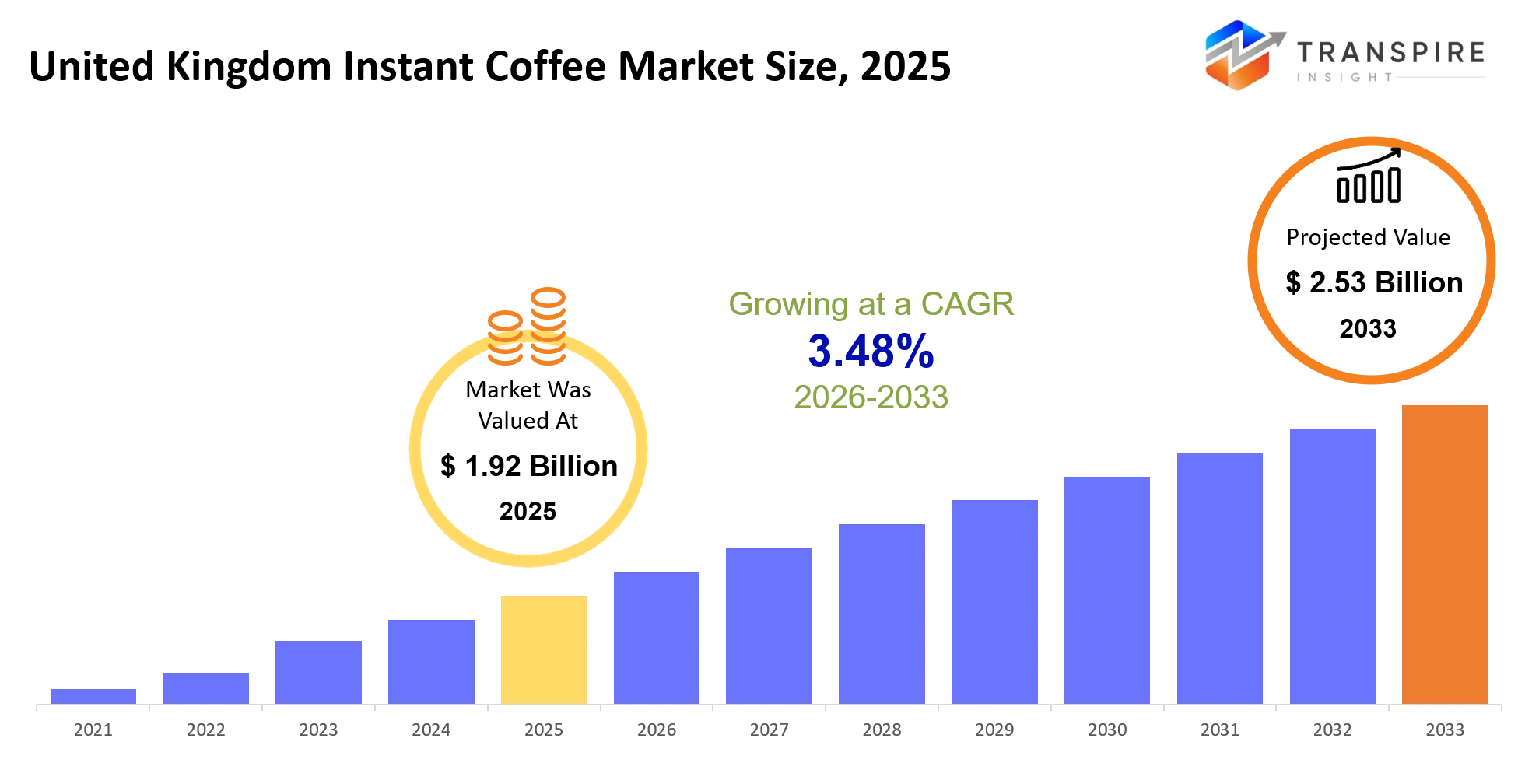
As per Transpire Insight Analysis the United Kingdom Instant Coffee Market size is estimated at USD 1.92 Billion in 2025 and is anticipated to reach USD 2.53 Billion by 2033, growing at a CAGR of 3.48% from 2026 to 2033.
The United Kingdom instant coffee market kinda supports quick and steady coffee making across households, office spaces, hospitality venues, travel moments, and all kinds of foodservice operations. That format helps cut down preparation time, reduces the amount of equipment that’s needed, and keeps serving costs lower, so instant coffee stays pretty practical where speed, portion control, and shelf stability really do matter. Over the last 3–5 years , you can see the market drifting toward more premium instant options, single serve packs , freeze dried coffee , and products that are sold with this idea of both quality and convenience.
The COVID-19 pandemic made home consumption jump, partly because the workday routines and hospitality habits shifted . Later , when cost pressure arrived , buyers began leaning into a better taste but they still tried to stay within affordability. Besides that, supply chain disruptions , along with higher input costs, made producers rethink things like how they source ingredients, how they pack the products, and even how they manage inventory.
Today’s growth seems like it’s coming from a mix of convenience, premiumisation and operational efficiency, all at once. Manufacturers can earn more by using differentiated blends and different formats, while retailers get advantages from repeat purchases across multiple consumption occasions and everyday scenarios.
United Kingdom Instant Coffee Market Size & Forecast:
- United Kingdom Instant Coffee Market Size 2025: USD 1.92 Billion
- Expected Market Value 2033: USD 2.53 Billion
- Forecast CAGR: 3.48%
- Leading region in 2025: England
- Fastest Growing region: Scotland
- Key Profile: Nestlé, JDE Peet's, Tata Consumer Products, Starbucks, Lavazza, Tchibo, Kraft Heinz, UCC Holdings, Moccona, Bewley's, Little's Coffee, Douwe Egberts, Maxwell House, Costa Coffee, illycaffè.
Key Market Insights
- England kind of dominates overall UK coffee consumption , mainly because London-led retail density is strong and instant coffee has already really taken root in most households.
- London and Southeast England are expected to lead on premium coffee uptake during 2025–2030 too, backed by urban convenience channels and yes, those more compact store formats.
- The leading bit is Jars . In 2024 they held a 51.33% revenue share and kept that top spot thanks to steady household repurchases and better pack economics that kinda make sense day to day.
- Pouches keep growing as retailers and manufacturers push toward lighter packaging , plus things like refill routines and cheaper distribution per unit.
- The fastest-growing format is forecast to be Sachets , specifically through 2030. This is mostly because portion control feels easier and it fits that on-the-go lifestyle, without too much fuss.
- At-home use still rules the market , with 80% of UK households historically buying instant coffee for home consumption.
- Also, cold-style and coffee-shop-style preparation is speeding up. In fact, iced coffee sales logged double-digit growth in 2025.
- Household buyers stay important here since instant coffee keeps offering low-equipment preparation and dependable serving economics, even when people are busy.
- Younger consumers, they’re expanding into premium and iced varieties , and that is pushing brands to aim at 18–24-year-olds via digital campaigns , though some days it feels like everyone is doing the same thing.
What are the Key Drivers, Restraints, and Opportunities in the United Kingdom Instant Coffee Market?
The main growth driver is format innovation linked to convenience, and also a premium at-home prep vibe. Nescafé’s 2025 launch of Espresso Concentrated basically pushed barista-style iced coffee into the ambient retail aisle, then for 2026 they added more options, like Mocha and Decaf too. The cause-effect link is pretty direct: simpler prep makes people use it more often, the differentiated formats help premium pricing, and when the occasions widen, you end up with more revenue per household, not just volume.
The biggest brake is volatile coffee input economics plus supply-chain exposure, kind of the double hit. Coffee is still dependent on imported green beans, and the producers have to manage sourcing, roasting, packaging and retail costs all at once, which is not easy. When prices swing, launches can get pushed back or they might shrink pack sizes, that will slow volume growth, and it also squeezes margins. From Transpire Insight’s review of regional procurement announcements and launch timelines, supply chain concentration stays the leading execution risk.
The clearest chance is automated, high-throughput premium sachet making. Nestlé’s £28 million Dalston investment adds two advanced packing lines that can produce up to 60,000 sachets per hour while improving recipe accuracy and cutting manual handling by 80% maybe. Similar moves across other sites could reduce unit costs, and enable quicker product variation, so there’s more space for premium single-serve formats and even new consumption moments.
What Has the Impact of Artificial Intelligence Been on the United Kingdom Instant Coffee Market?
AI and digital technologies are getting more useful in coffee manufacturing, especially in areas where automated checking, recipe control, stock planning, and even packing correctness can really move margins. On modern production lines, it’s possible to tie together sensor information with machine learning models, so temperature, moisture, flow rate , and how equipment behaves can be watched all at once. This helps operators spot small departures early, before they turn into quality losses, and then into cost.
Nestlé’s UK manufacturing investment shows this wider drift toward high tech packing and more automated handling, with the Dalston upgrade aiming for better efficiency and improved recipe accuracy, kind of a stronger handle on both. On top of that, predictive analytics can raise demand forecasting quality by blending historical sales, promotions, seasonality, retailer orders, and also those emerging consumption signals that people only notice later.
When forecasts get better, companies usually cut down on overproduction and stockouts, while improving production scheduling in a more tuned way. Digital demand sensing is especially relevant because iced coffee, plus premium formats, tend to shift buying behavior faster than older categories. Nestlé noted a 380% year on year increase in searches for iced coffee on its website in 2025, which kind of suggests that digital signals can point toward new moments before the wider market catches up.
The lingering issue, though, is integration cost. Older production assets, scattered datasets, and uneven sensor setup can make dependable AI deployment pretty expensive, even when the models themselves are ready.
Key Market Trends
- Premiumisation sort of ramped up after 2024, with brands refreshing their packaging, also bringing in more differentiated formats and basically aiming at people who want that coffee-shop mood at home, not just a quick cup.
- Cold coffee really showed up strong in 2025, since Nescafé rolled out Espresso Concentrated and said it delivered double digit growth, specifically in iced coffee sales.
- Digital engagement turned into a sharper demand signal in 2025, Nescafé reported a 380% year-on-year jump in iced coffee website searches so you could say interest moved online first.
- Single-serve formats gained strategic weight during this period, while sachets became the fastest-growing packaging category through the 2030 forecast window.
- On the production side, manufacturing automation advanced in 2025, as Nestlé committed £28 million to modernise its Dalston coffee facility.
- High-speed packaging capacity expanded too in 2025, with Dalston’s new lines set up to produce as much as 60,000 sachets per hour.
- Then in 2026 portfolio diversification seemed to speed up , with Nescafé adding Mocha and Decaf to its Espresso Concentrated range, kind of like “alright we’re doing more of this”.
- Ready-to-drink coffee also slipped into mainstream channels in 2026, when Nescafé rolled out 250ml chilled Iced Latte cans across the UK and Ireland , pretty quietly at first, or maybe it just felt that way.
- Responsible sourcing became more visible after 2024 and Nescafé kept emphasizing 100% responsibly sourced coffee across refreshed packaging,as if it was now part of the headline story.
- Overall, coffee consumption patterns continue to diversify, with coffee becoming more common among younger consumers, while traditional instant still stays widely used in UK households.
United Kingdom Instant Coffee Market Segmentation
By Product Type :
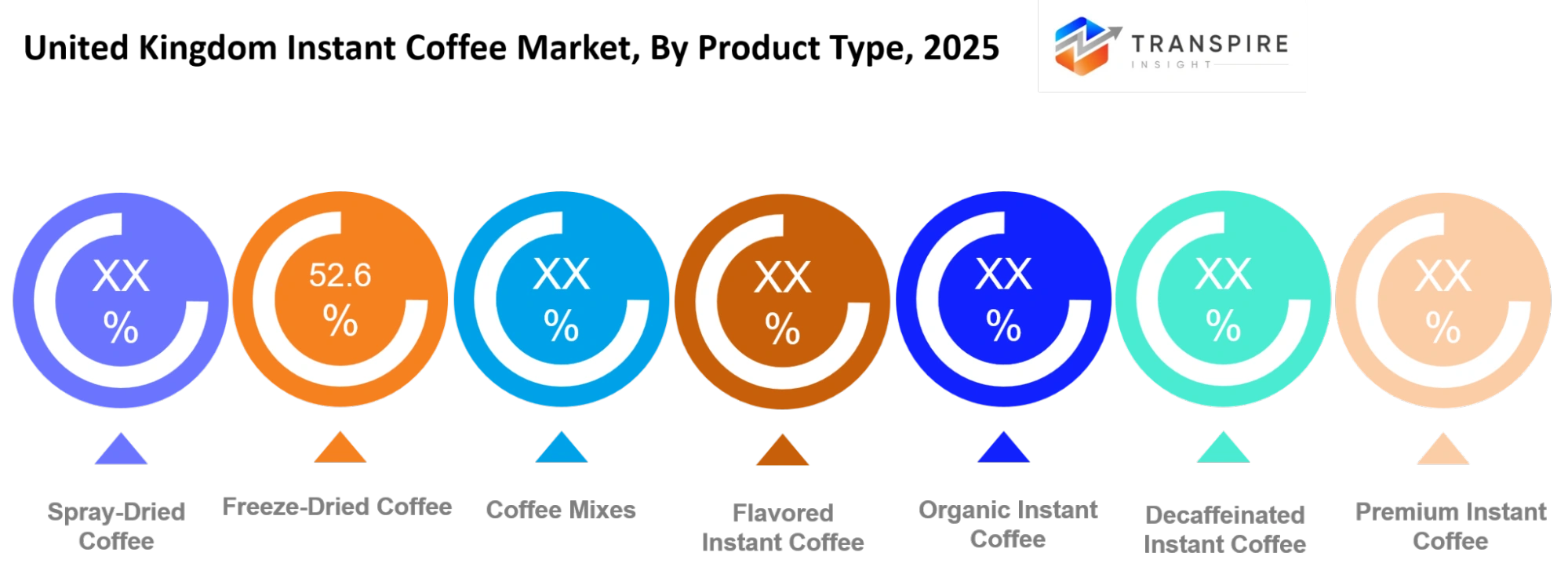
Spray-dried coffee keeps plugging along as a mainstream choice, pretty much because lower production costs let retailers offer competitive prices, so it stays in the mix. Freeze-dried coffee is doing well with people who want deeper aroma plus more pronounced taste, while premium instant coffee is getting more attention as roasting, blending, and preparation processes get better. Also, coffee mixes help with convenience by bundling coffee with milk ingredients, plus sweeteners, into a single serving thingy.
Meanwhile flavored options, organic selections, and decaffeinated versions are widening the menu for different drinking preferences. Premium brands will probably keep leaning on better beans, enhanced processing, and more distinctive flavor profiles to help explain those higher prices. Future product development should still circle around taste, ease of use, and a coffee experience that feels different, and meanwhile those established spray-dried and freeze-dried lines will keep solid household penetration, even when people experiment a bit.
By Packaging Type :
Glass jars still stay popular in household storage, mainly because resealable containers let people do the same daily preparation again and again, you know. Sachets, plus stick packs are getting more attention too because single portions mean less setup and they fit offices, travel, and those quick-serving moments that come up often. Also pouches and refill packs help with repeat purchases, while they cut packaging weight compared with the older jar approach.
Cans and bulk packs, on the other hand, suit foodservice and institutional needs where bigger quantities support regular preparation cycles. Packaging development will keep leaning into portion control, storage convenience, transport efficiency, and practical retail use. Premium packaging will matter as well for higher-value products, giving differentiated blends clearer shelf visibility and a more distinctive presentation, like it actually stands out.
By Distribution Channel :
Supermarkets and hypermarkets still remain relevant sales channels because broad product ranges let shoppers kinda compare brands, pack sizes, prices, and different product types in one spot, so yes it works. Convenience stores help with quick buys especially when people just need smaller packs or single serving items. Online retail will keep picking up momentum too, since digital shopping makes premium items easier to get, along with specialty blends and larger packs, which basically removes some friction.
Meanwhile specialty stores and direct sales give extra shelf or floor space for differentiated offerings, with specific sourcing or preparation characteristics, you know the kind. Wholesale stores and foodservice suppliers then back offices, hotels, restaurants cafés, and institutional buyers via larger volume orders. Retailers and suppliers will also lean more into promotions, subscription options, digital visibility, and targeted product placement to reinforce repeat purchases and make channel performance better overall, even if it sounds simple.
By End User :
Households still are the biggest end users, mainly because instant coffee is quick to make, easy to store, and the cups come out in a fairly consistent way every time. Offices keep a steady rhythm too, since instant formats need less equipment and let employees brew coffee during those short breaks, without much hassle. In hotels, restaurants, and cafés they often pick specific instant options where speed really counts, and also for portion control, plus the day to day operating costs are more manageable.
Institutional buyers, and corporate teams, keep generating demand via routine procurement, plus bulk purchasing agreements. In travel and hospitality, sachets , stick packs and other compact packing are preferred because convenient storage and simple preparation help them serve people at high frequency. For end user buying going forward, it will likely lean more toward cost discipline, perceived product quality, serving speed, and whether the packaging actually fits the workflow rather than just sticking with one basic type of instant coffee.
By Application :
Daily consumption still feels like the core application, mostly because instant coffee gives a quick brew style, which people use for normal home days. Workplace consumption kinda keeps steady momentum too , since offices can keep coffee available without going through complicated brewing kit installation. For travel and outdoor activities it really helps that the packaging is lightweight, the preparation stays simple, and the product holds up longer, shelf wise.
Ready-to-drink preparation is also getting more attention these days, because shoppers want something closer to coffee-shop vibes but with less time spent. Vending machines and catering services lean on it as well , mainly for dependable portion sizes and predictable preparation expenses. The next chunk of application growth will likely come from items built around convenience, portability, speed, and flexible consumption moments across household, office, hospitality, and foodservice contexts.
What are the Key Use Cases Driving the United Kingdom Instant Coffee Market?
Daily consumption is still the main thing, more or less, and it is backed largely by household buyers wanting quick preparation at reasonable costs. Retail purchases stay common too, because instant formats need only limited equipment , they fit usual morning routines, and they keep well for repeat use , without much trouble.
Workplace use and catering are also picking up momentum among offices, corporate buyers, and foodservice providers. Employers like the easy, simple prep, and catering operators get predictable portioning plus quicker throughput when the place is busy.
Ready to drink use, plus vending machine placement, is starting to look interesting in travel, hospitality, and institutional environments. Compact formats can work well for transport hubs, hotels, hospitals, and schools, where fast service, controlled portions, and tight preparation space (will) strongly affect what people buy.
|
Report Metrics |
Details |
|
Market size value in 2025 |
USD 1.92 Billion |
|
Market size value in 2026 |
USD 1.99 Billion |
|
Revenue forecast in 2033 |
USD 2.53 Billion |
|
Growth rate |
CAGR of 3.48% from 2026 to 2033 |
|
Base year |
2025 |
|
Historical data |
2021 - 2024 |
|
Forecast period |
2026 - 2033 |
|
Report coverage |
Revenue forecast, competitive landscape, growth factors, and trends |
|
Regional scope |
United Kingdom (England, Scotland, Wales, Northern Ireland) |
|
Key company profiled |
Nestlé, JDE Peet's, Tata Consumer Products, Starbucks, Lavazza, Tchibo, Kraft Heinz, UCC Holdings, Moccona, Bewley's, Little's Coffee, Douwe Egberts, Maxwell House, Costa Coffee, illycaffè. |
|
Customization scope |
Free report customization (country, regional & segment scope). Avail customized purchase options to meet your exact research needs. |
|
Report Segmentation |
By Product Type (Spray-Dried Coffee, Freeze-Dried Coffee, Coffee Mixes, Flavored Instant Coffee, Organic Instant Coffee, Decaffeinated Instant Coffee, Premium Instant Coffee, Others); By Packaging Type (Glass Jars, Sachets, Pouches, Cans, Stick Packs, Bulk Packs, Refill Packs, Others); By Distribution Channel (Supermarkets & Hypermarkets, Convenience Stores, Online Retail, Specialty Stores, Wholesale Stores, Direct Sales, Foodservice Suppliers, Others); By End User (Households, Offices, Hotels & Restaurants, Cafés, Institutional Buyers, Travel & Hospitality, Corporate Users, Others); By Application (Daily Consumption, Ready-to-Drink Preparation, Vending Machines, Travel Use, Workplace Consumption, Outdoor Activities, Catering Services, Others). |
Which Regions are Driving the United Kingdom Instant Coffee Market Growth?
The English region holds the largest share of UK instant coffee consumption, with London and surrounding areas accounting for a substantial portion of premium coffee buys, but a precise regional market share figure is not always published in a consistent way. Thick retail coverage, big office workforces and a strong hospitality vibe give England a kind of structural advantage, in terms of product availability, and how often people actually purchase. Nestlé, JDE Peet’s, Lavazza, and other suppliers keep up broad distribution via supermarkets, convenience outlets, foodservice channels and online retailers. Overall strong retail coverage plus high population clustering, and ongoing product innovation, should carry England through the forecast period.
Scotland looks like a structurally different market, where demand is supported more by household purchasing, hospitality activity and regional retail networks , rather than a London-focused corporate pull. Stable food safety rules and steady UK wide retail requirements help manufacturers and distributors plan, and operate under predictable conditions. Tourism and local hospitality keep adding repeat procurement across hotels, restaurants, cafes, and catering companies. With reliable household consumption and long standing distribution relationships, Scotland should remain a steady revenue contributor during the forecast period.
Wales gives a smaller, but still developing, chance in convenience retail, tourism, workplace consumption, and online purchasing—basically the access to differentiated coffee products keeps getting broader. Lately, retail-channel expansion kind of helps, and the stronger digital purchasing has made it easier to find premium, decaffeinated, and specialty instant formats. Regional suppliers as well as national brands can use flexible distribution models to reach more dispersed buyers without needing lots of physical infrastructure, which is important. From 2026–2033 the opportunity should favor new entrants that focus on retail spots that are underserved, hospitality procurement, and convenient single serve formats.
Who are the Key Players in the United Kingdom Instant Coffee Market and How Do They Compete?
Competition in the United Kingdom instant coffee market stays kind of concentrated, mostly around multinational brands, even though private-label products and specialist roasters keep pushing in some of the categories. Cost, product quality, packaging format, brand recognition, and retail distribution feel like the big competitive levers. The larger incumbents are busy protecting household share with premium launches plus convenience formats, yet smaller brands still try to win attention using distinctive blends, ethical sourcing, and that more narrow consumer positioning.
Nestlé competes by leaning into product innovation and manufacturing investment, and it uses Nescafé to push instant coffee into more concentrated plus iced type formats. Nescafé Espresso Concentrated, including Mocha and Decaf variants, goes after people who want quicker preparation and coffee-shop-ish drinks at home. Nestlé also put £28 million into the Dalston facility, adding automated packing capacity, and basically tightening UK production efficiency. JDE Peet’s works with a broad portfolio method across brands like Kenco, supporting rivalry through different price points, roast profiles, and packaging choices, so they can flex depending on the channel or shopper.
Lavazza, meanwhile, leans harder on premium positioning, Italian coffee heritage, and quality-first product differentiation, giving retail and foodservice buyers a different option than the usual mass-market instant products. Private-label suppliers compete in a more price-led, retailer relationship style, so supermarkets can run lower-cost alternatives while still keeping control over packaging plus promotional activity. Overall, the competitive edge across the market will likely come down to balancing affordable daily options with premium formats, speeding up innovation, maintaining dependable supply, and building stronger retail visibility, because that’s where most choices get made.
Company List
- Nestlé
- JDE Peet's
- Tata Consumer Products
- Starbucks
- Lavazza
- Tchibo
- Kraft Heinz
- UCC Holdings
- Moccona
- Bewley's
- Little's Coffee
- Douwe Egberts
- Maxwell House
- Costa Coffee
- illycaffè
Recent Development News
In March 2026, Nestlé launched Nescafé Espresso Concentrated in Mocha and Decaf variants across the UK. The expansion adds two new formats to the concentrated iced coffee range and strengthens premium at-home consumption occasions.
Source: https://www.nestle.co.uk/
In November 2025, Nestlé committed £28 million to upgrade the Dalston factory in Cumbria. The investment adds a new mixing plant and two high-tech packing lines, increasing manufacturing efficiency and supporting production of up to 60,000 coffee sachets per hour.
Source: https://www.nestle.co.uk/
What Strategic Insights Define the Future of the United Kingdom Instant Coffee Market?
Over the next 5–7 years , the UK instant coffee sector will drift toward more premium , portion-controlled and convenience-led formats, with changes in when people drink coffee and more robust product innovation pushing it along. The real pull will be that manufacturers can turn instant coffee into higher-value, almost ritual like experiences, instead of leaning mainly on raw volume, and the UK market is expected to climb to US$11.85 billion by 2030.
A quieter, less visible risk sits in raw coffee supply swings , because climate pressures , crop conditions, and input costs can tighten margins very fast , and then price increases follow, which can dent volume growth. There’s also a growing opening though , regenerative sourcing paired with traceable premium products. For instance Nescafé said it sourced 53% of green coffee from farmers using regenerative practices in 2025.
Market participants should therefore build capabilities in flexible sourcing, automated production and differentiated formats all at once, so they can respond quicker to commodity shocks while still keeping those premium margins protected.
United Kingdom Instant Coffee Market Report Segmentation
By Product Type
- Spray-Dried Coffee
- Freeze-Dried Coffee
- Coffee Mixes
- Flavored Instant Coffee
- Organic Instant Coffee
- Decaffeinated Instant Coffee
- Premium Instant Coffee
By Packaging Type
- Glass Jars
- Sachets
- Pouches
- Cans
- Stick Packs
- Bulk Packs
- Refill Packs
By Distribution Channel
- Supermarkets & Hypermarkets
- Convenience Stores
- Online Retail
- Specialty Stores
- Wholesale Stores
- Direct Sales
- Foodservice Suppliers
By End User
- Households
- Offices
- Hotels & Restaurants
- Cafés
- Institutional Buyers
- Travel & Hospitality
- Corporate Users
By Application
- Daily Consumption
- Ready-to-Drink Preparation
- Vending Machines
- Travel Use
- Workplace Consumption
- Outdoor Activities
- Catering Services
Frequently Asked Questions
Find quick answers to common questions.
The expected United Kingdom Instant Coffee Market size for the market will be USD 2.53 Billion in 2033.
Key segments for the United Kingdom Instant Coffee Market are By Product Type (Spray-Dried Coffee, Freeze-Dried Coffee, Coffee Mixes, Flavored Instant Coffee, Organic Instant Coffee, Decaffeinated Instant Coffee, Premium Instant Coffee, Others); By Packaging Type (Glass Jars, Sachets, Pouches, Cans, Stick Packs, Bulk Packs, Refill Packs, Others); By Distribution Channel (Supermarkets & Hypermarkets, Convenience Stores, Online Retail, Specialty Stores, Wholesale Stores, Direct Sales, Foodservice Suppliers, Others); By End User (Households, Offices, Hotels & Restaurants, Cafés, Institutional Buyers, Travel & Hospitality, Corporate Users, Others); By Application (Daily Consumption, Ready-to-Drink Preparation, Vending Machines, Travel Use, Workplace Consumption, Outdoor Activities, Catering Services, Others).
Major United Kingdom Instant Coffee Market players are Nestlé, JDE Peet's, Tata Consumer Products, Starbucks, Lavazza, Tchibo, Kraft Heinz, UCC Holdings, Moccona, Bewley's, Little's Coffee, Douwe Egberts, Maxwell House, Costa Coffee, illycaffè.
The United Kingdom Instant Coffee Market size is USD 1.92 Billion in 2025.
The United Kingdom Instant Coffee Market CAGR is 3.48% from 2026 to 2033.
- Nestlé
- JDE Peet's
- Tata Consumer Products
- Starbucks
- Lavazza
- Tchibo
- Kraft Heinz
- UCC Holdings
- Moccona
- Bewley's
- Little's Coffee
- Douwe Egberts
- Maxwell House
- Costa Coffee
- illycaffè
About the Authors

Chetan Dhatrak
I’m Chetan Dhatrak, a Senior Research Analyst at Transpire Insight, specializing in the Consumer Goods, Foods and Beverages industry. I focus on analyzing market trends, consumer behavior, competitive landscapes, and industry developments to deliver accurate, data-driven insights. My research at Transpire Insight is built on credible sources and in-depth analysis, helping businesses and readers better understand market dynamics, emerging opportunities, and evolving consumer preferences. I’m committed to creating reliable, well-researched content that supports informed decision-making and reflects the latest developments in the consumer goods and food & beverage sectors.

Chakradhar Khansole
Chakradhar serves as the Research Director at Transpire Insight, bringing over 8 years of experience in technology, innovation, and strategic market intelligence. He specializes in transforming complex market data into actionable business insights that enable organizations to make informed, growth-oriented decisions. Recognized for his strategic vision and analytical expertise, Chakradhar leads high-impact research initiatives, delivering comprehensive market assessments, competitive intelligence, and forward-looking industry analysis.
Recently Published Reports
-
Apr 2026
Baby Infant Formula Market
Baby Infant Formula Market Size, Share & Analysis Report By ype (Infant Milk, Follow On Milk, Specialty Baby Milk, Growing-Up Milk), By Ingredient (Carbohydrate, Fat, Protein, Minerals, Vitamins, and Others), By Product Form (Powder, Liquid, and Ready-to-feed), By Distribution Channels (Supermarket/Hypermarket, Specialty Store, Pharmacies, Online Retail, and Others), and Geography (North America, Europe, Asia-Pacific, Middle East and Africa, South and Central America), 2021 - 2031
-
Apr 2026
Edible Insects for Animal Feed Market
Edible Insects for Animal Feed Market Size, Share & Analysis Report By Type (Insect Powder, Insect Meal, Insect Bar, Insect Paste, Insect Oil, and Others), By Insect Type (Beetles, Cricket, Caterpillar, Hymenoptera, Orthoptera, Tree Bugs, and Others), By Application (Livestock, Pet Food, and Aquaculture), By Livestock Type (Poultry, Swine, and Others), and Geography (North America, Europe, Asia-Pacific, Middle East and Africa, South and Central America), 2021 - 2031
-
Apr 2026
Food Industry Disinfection and Bacterial Control Market
Food Industry Disinfection and Bacterial Control Market Size, Share & Analysis Report By Type (Chemical Disinfectants, Physical Disinfectants, and Biocides and Antimicrobials), By Application (Food Processing Equipment Surface Disinfection, Food Preparation Areas Surface Disinfection, Storage Areas Surface Disinfection, Anti-microbial Coatings Food Preservation, and Preservative Solutions Food Preservation), By End User (Meat and Poultry Processing, Dairy Processing, Seafood Processing, Bakery and Confectionery, Restaurants and Commercial Kitchens, and Food Service Providers), By Sales Channel (Online, Offline), and Geography (North America, Europe, Asia-Pacific, Middle East and Africa, South and Central America), 2021 - 2031
-
May 2026
Freeze Dried Food Market
Freeze Dried Food Market Size, Share & Analysis Report By Product Type (Fruits, Vegetables, Freeze-Dried Dairy Products, Freeze-Dried Meat and Seafood, Freeze-Dried Pet Food, and Prepared Meal), By Nature (Organic, and Conventional), By Form (Powdered, Granules, and Diced), By End Use (Breakfast Cereals, Dairy Products, Bakery & Confectionery, Nutritional Bars & Supplements, Powdered Beverages, Snacks, and Retail (Household)), and Geography (North America, Europe, Asia-Pacific, Middle East and Africa, South and Central America), 2021 - 2031