
United Kingdom Direct Reduced Iron Market Size & Forecast:
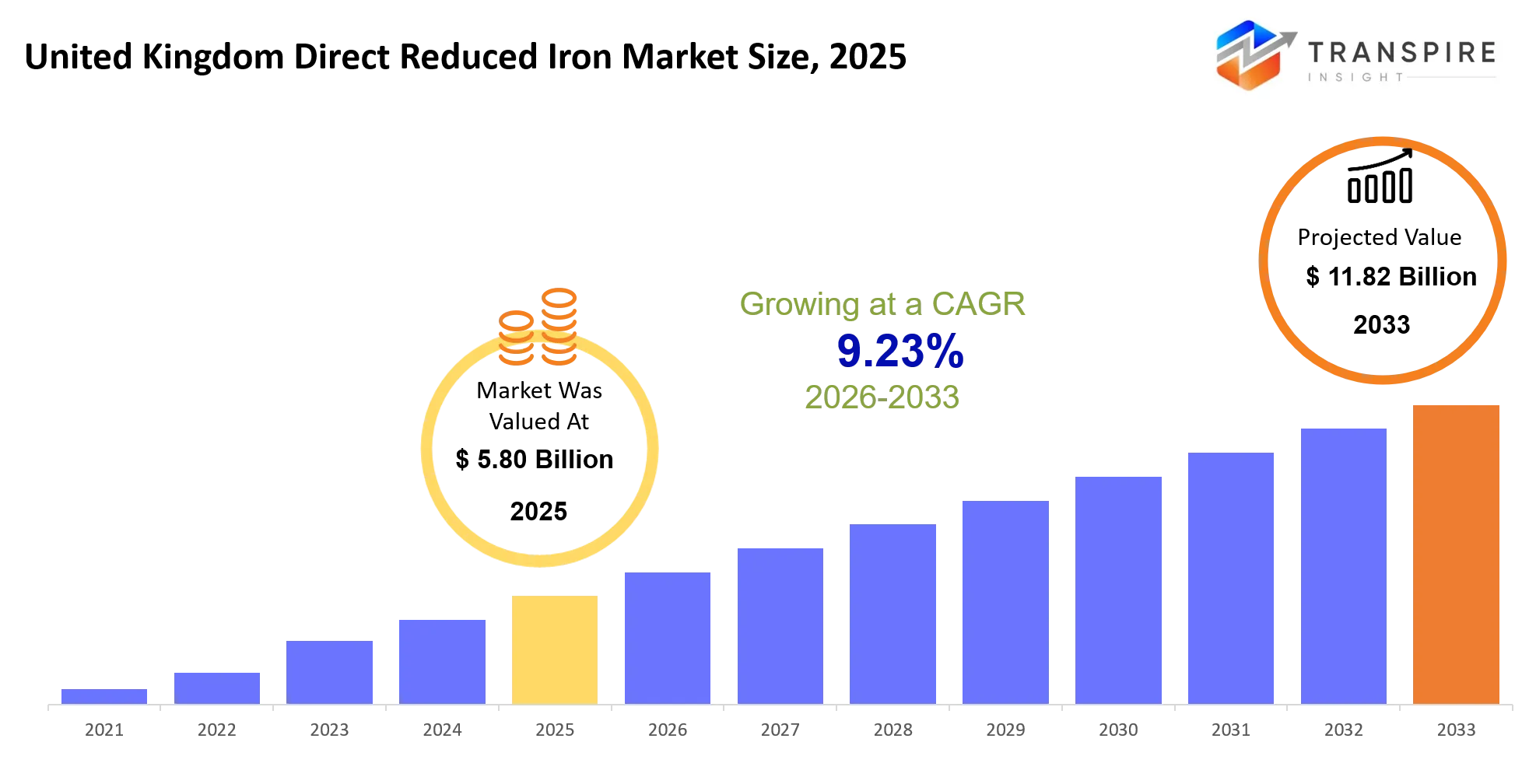
- United Kingdom Direct Reduced Iron Market Size 2025: USD 5.80 Billion
- United Kingdom Direct Reduced Iron Market Size 2033: USD 11.82 Billion
- United Kingdom Direct Reduced Iron Market CAGR: 9.23%
- United Kingdom Direct Reduced Iron Market Segments: By Product Type (Hot Briquetted Iron, Cold Direct Reduced Iron, Lump DRI, Pellet DRI, Others); By Production Technology (Gas-based DRI, Coal-based DRI, Hydrogen-based DRI, Electric Arc Furnace Integration, Others); By Application (Steel Manufacturing, Automotive Components, Construction Steel, Machinery Production, Others); By End User (Steel Industry, Automotive Industry, Construction Industry, Machinery Industry, Others)
To learn more about this report,  Download Free Sample Report
United Kingdom Direct Reduced Iron Market Summary
The United Kingdom Direct Reduced Iron Market was valued at USD 5.80 Billion in 2025. It is forecast to reach USD 11.82 Billion by 2033. That is a CAGR of 9.23% over the period.
In the United Kingdom Direct Reduced Iron market, the material basically works as a crucial feedstock that lets steel producers dial back reliance on older blast furnace routes, and also gives them better control over metallic input quality. In practice, it ends up supporting electric arc furnace operations, where consistent iron units are needed so the output stays steady and producers can lessen how much they’re exposed to scrap volatility. Over the last few years, the market has kind of moved in a more structural way toward lower-carbon steelmaking pathways, because industrial decarbonization targets started getting tighter across UK heavy industry policy frameworks.
One big trigger behind that change was the tightening of industrial emissions rules, plus energy price volatility after European gas supply disruptions, and that combination made producers rethink feedstock efficiency and sourcing approaches. Because of that, adoption now leans toward higher-grade, low-impurity iron inputs, which in turn help cleaner melting processes run more predictably. In the end, this shift shows up as stronger procurement commitments from integrated steelmakers, they want dependable performance and regulatory compliance, all while keeping production more stable.
Key Market Insights
- The United Kingdom Direct Reduced Iron market is seeing more integration with electric arc furnace systems, across UK steel recycling hubs and mini-mills, like really quietly but steadily.
- Since policies on low-carbon steel rolled out after 2022, the shift away from blast furnace inputs and toward DRI-based feedstock solutions is getting faster.
- Meanwhile UK steel output modernization efforts are also pushing a higher reliance on high-purity iron units, for steadier melt efficiency and tighter cost control.
- Even so, market share concentration is still rather heavy, most notably among integrated steel producers, with more than 55% of procurement tied to major steelmakers in 2025.
- The fastest adoption growth shows up in electric arc furnace use, and it’s projected to grow quite a bit through the 2033 forecast window, even if the timing varies by site.
- On the supply side, port-based import logistics across Northern Europe is shaping nearly 40% of UK DRI supply chain inflows in 2025, more than many people expect.
- Strategic expansions by large global suppliers such as ArcelorMittal and Nucor Corporation are also reinforcing UK supply reliability.
- Plus, process technology upgrades in direct reduction, including hydrogen-ready systems, are rearranging long-term procurement decisions.
- Overall, competitive positioning in the United Kingdom Direct Reduced Iron market is being guided by cost effectiveness, carbon intensity reduction, and feedstock purity, not just one factor.
- And digital monitoring of furnace efficiency and input quality is becoming a major differentiator in procurement contract terms, which is where things get a little unusual.
What are the Key Drivers, Restraints, and Opportunities in the United Kingdom Direct Reduced Iron Market?
The main push in the United Kingdom Direct Reduced Iron market comes from this broad, structural move toward low emission steelmaking, kind of driven by industrial decarbonization rule sets and carbon pricing. In practice, steel makers are swapping toward electric arc furnace setups, and those setups really want steady metallic inputs like DRI to keep the melt quality steadier and also trim reliance on scrap price swings. You can see the momentum also because energy costs bounce around, which makes the older blast furnace approach feel less reliable financially, so producers start leaning on more careful feedstock tactics that support yield consistency and a cleaner compliance fit, in a way.
The main holdback is that direct reduction gear is very capital heavy. On top of that, the UK has limited domestic output capacity for DRI, so supply still leans heavily on imports. That means buyers end up dealing with freight cost fluctuations, and broader geopolitical issues tied to iron ore pellet flows across regions. Because of that, mid sized steel processors often hesitate, they can’t really take on long term procurement uncertainty, nor can they easily fund dedicated material handling systems.
A significant opening is showing up with hydrogen based direct reduction technology. This is being tested and developed by large players, including Tenova and Midrex Technologies. As UK ports and nearby industrial hubs start working on hydrogen-ready infrastructure, there’s a chance for more local, low carbon DRI supply chains, and that could meaningfully reduce import dependence and kick off new rounds of industrial investment.
What Has the Impact of Artificial Intelligence Been on the United Kingdom Direct Reduced Iron Market?
Artificial intelligence is slowly, almost quietly, reshaping operational efficiency in the United Kingdom Direct Reduced Iron ecosystem by improving process control across both upstream ironmaking and downstream steel melting activities. In current steel plants, AI-enabled automation is getting used for furnace stability monitoring, temperature profile optimization and feed ratio adjustments in real time—so energy waste drops and metallic yield becomes steadier. This in turn helps DRI blend more smoothly into electric arc furnace systems, where fluctuations in input quality can really move the needle on overall output performance.
\At the same time, predictive analytics models are being applied to foresee equipment wear in pellet handling systems and reduction reactors, which supports maintenance planning before a failure shows up. Machine learning approaches are also used to estimate emissions intensity throughout production cycles, making it easier for operators to stay aligned with stricter UK environmental compliance rules. In practice these changes usually show up as higher uptime and fewer unexpected shutdowns, especially where throughput is high in steel processing environments.
Still, take-up is held back because the data is fragmented across older steel infrastructure, and sensor integration is uneven in plants that were built earlier. On top of that, offshore supply chain coordination can slow or restrict real-time data exchange between import terminals and inland steel facilities, which makes full-scale AI deployment across the United Kingdom Direct Reduced Iron Market value chain harder than it should be.
Key Market Trends
- UK steelmakers, sort of increased DRI purchasing by mixing scrap-DRI blends, to help keep furnace chemistry steady from 2023 up to 2025.
- And at the same time, hydrogen-ready reduction projects started showing up, which Liberty Steel basically points to as the long-run decarbonization kind of reshaping.
- Also the electric arc furnace share in UK steel output, in some industrial clusters it went past 60% by 2025, not exactly everywhere, but in those spots.
- Meanwhile the import dependency for DRI inputs grew because domestic pelletization capacity stayed a bit capped across UK supply chains.
- Since energy prices have been all over the place since 2022, many producers leaned harder into feedstock optimization, kind of faster than before, it seems.
- There were also digital furnace monitoring upgrades, and in 2024–2025 they improved melt efficiency by lowering temperature deviation losses.
- Strategic partnerships between European and UK steel companies then widened, DRI sourcing reliability across ports. On top of that, carbon compliance costs pushed procurement toward low-impurity iron inputs within industrial contracts.
- And global suppliers like POSCO, expanded low-carbon steel programs which then influenced UK sourcing approaches.
- Finally, trade flow diversification reduced how much the UK relied on a single region for iron ore pellet suppliers, after disruptions since 2023, so yeah.
United Kingdom Direct Reduced Iron Market Segmentation
By Product Type
Hot Briquetted Iron, Cold Direct Reduced Iron, Lump DRI, Pellet DRI and other forms all kinda come together to shape the product structure in the United Kingdom Direct Reduced Iron Market. Hot Briquetted Iron is usually preferred in big steel plants because it has this dense structure, it’s more or less easier to manage safely, and it performs well during transport, even when distances get longer. Cold Direct Reduced Iron on the other hand, gives more flexibility for storage and it allows delayed furnace charging, so it fits better with batch style production systems. Lump DRI is used in older, more traditional steel operations that are slowly moving to cleaner inputs. Pellet DRI also keeps gaining attention, partly because the grain is uniform, and the furnace behavior stays pretty steady. Other forms exist for niche industrial needs, where iron properties are basically customized, depending on what they’re trying to achieve.
Across every type, demand mostly tracks with how much steelmaking equipment gets modernized, plus the ongoing rise in electric arc furnace usage. Hot Briquetted Iron and Pellet DRI match well with high-efficiency setups, while Cold Direct Reduced Iron tends to help with inventory control in mid-sized facilities. Lump DRI is still around in legacy systems, though it’s gradually being replaced or blended with more advanced materials. The other types stay limited, but they’re still useful when a specialized application needs something specific. In the end, product preference in the United Kingdom Direct Reduced Iron Market is likely to keep drifting toward higher purity and process-efficient iron inputs, as steel makers focus on stability, lower emissions, and smoother day-to-day operations, overall.
By Production Technology
Gas based DRI, Coal based DRI, Hydrogen based DRI, electric arc furnace integration, and a few other technologies basically set the production framework for the United Kingdom Direct Reduced Iron Market . In practice, gas based DRI is still the go to option for many operators, mostly because the output quality stays pretty steady, and emissions are typically lower than what coal based systems deliver . Coal based DRI keeps showing up in cost sensitive operations and older facilities where the existing infrastructure makes a quicker swap harder, sometimes it’s just not straightforward .Hydrogen based DRI is also coming into view as a kind of forward route, it ties in with decarbonization targets and the growing use of renewable energy. Meanwhile electric arc furnace integration helps make DRI more useful at scale, it supports efficient steelmaking by blending scrap with iron, or iron with scrap depending on the plant setup . Other approaches usually sit in experimental or hybrid production setups and they tend to be used in niche settings, more like trials than replacements.
When you look at adoption patterns, they’re shifting pretty clearly toward cleaner, more efficient ways of producing . Gas based DRI still leads today because it’s reliable, and it scales without too many surprises. Coal based systems gradually lose momentum, mainly due to environmental limits and compliance pressure . Hydrogen based DRI is likely to become more relevant over time as clean energy infrastructure and supply networks improve across industrial hubs. Electric arc furnace integration backs that shift too, because it increases the need for higher quality DRI feedstock . The remaining technologies are still comparatively limited, but they do add new ideas to steel production. So overall, even if the transition is uneven, the United Kingdom Direct Reduced Iron Market is expected to move toward low carbon and energy efficient production systems over the long term, bit by bit.
By Application
Steel manufacturing, automotive components, construction steel, machinery production, and a bunch of other uses are basically the demand base of the United Kingdom Direct Reduced Iron Market. Steel manufacturing still leads, because DRI helps make the furnace more efficient and it kind of supports more consistent steel quality, which matters. For automotive components production, the DRI-based steel is used for strength and precision too, plus fewer impurities which is a big deal in vehicle parts. Construction steel applications lean on durable and high-quality material for infrastructure work. Meanwhile machinery production needs strong and reliable metal inputs, so industrial equipment can keep running without issues. Then there are other applications, like specialized engineering, where people need customized steel grades, not just whatever is available.
Even with all that, application demand is still moving upward as industry modernizes and as electric arc furnace-based steel production gets adopted more and more. In practice steel manufacturing keeps pulling the overall numbers up, since it needs large-scale output and keeps improving efficiency. Automotive and construction, they help maintain steady demand through infrastructure development and more vehicle production. Machinery production stays fairly consistent too, because it ties directly to ongoing manufacturing activity. Other applications are smaller in volume, but they remain important for those niche, specialized sectors. So overall, the United Kingdom Direct Reduced Iron Market is expected to maintain demand growth, driven by industrial expansion, stronger material quality expectations, and the shift toward cleaner steel production systems.
To learn more about this report, Download Free Sample Report
By End User
Steel industry, automotive industry, construction industry, machinery industry, and other end users sorta shape the demand in the United Kingdom Direct Reduced Iron Market. For the steel industry, DRI is still the primary “thing” because it is essential to improve production efficiency and cut emissions during steelmaking, you know, the whole process. The automotive industry uses DRI-based steel for vehicle structures and components that need high strength and precise tolerances. The construction industry depends on steel inputs for infrastructure building, covering buildings and also transport structures. The machinery industry leans on tough, durable steel materials for heavy equipment and industrial systems. Other end users include specialized manufacturing sectors which ask for tailored steel inputs, for specific grades and uses.
In a more general way, end user demand is heavily influenced by industrial modernization and by the shift toward low-carbon production systems. The steel industry remains dominant, mainly because large-scale production still requires DRI, and because electric arc furnace technology keeps being adopted. Automotive and construction industries keep a fairly steady demand too, backed by manufacturing growth and infrastructure expansion. The machinery industry helps with stable consumption, driven by ongoing industrial activity and maintenance cycles. Other sectors bring niche but consistent demand. So overall, the United Kingdom Direct Reduced Iron Market is likely to see steady growth across every end user segment, as industries prioritize efficiency, material quality, and emissions reduction targets.
What are the Key Use Cases Driving the United Kingdom Direct Reduced Iron Market?
In the United Kingdom Direct Reduced Iron market, the main use case is basically its role as a metallic feedstock for electric arc furnace steelmaking. In practice, it helps steel producers keep a steady chemical makeup, lowers scrap contamination related concerns, and supports output stability, especially when they are targeting high-quality steel grades for construction and engineering use, you know the kind that needs reliability.
Other secondary use cases are also growing, particularly in specialty steel production and automotive-grade steel making, where impurity levels have to stay under tighter control if the end components are going to perform well. In several industrial centers, steelmakers are leaning more into blending DRI with scrap to control costs, and at the same time reduce variation in melt efficiency.
There’s also an emerging use case around hydrogen- driven low-carbon steel production trials. Here, DRI becomes a kind of transitional input for routes aiming at near-zero emissions. This approach is getting more attention from integrated producers mapping out long-term decarbonization roadmaps.
|
Report Metrics |
Details |
|
Market size value in 2025 |
USD 5.80 Billion |
|
Market size value in 2026 |
USD 6.37 Billion |
|
Revenue forecast in 2033 |
USD 11.82 Billion |
|
Growth rate |
CAGR of9.23% from 2026 to 2033 |
|
Base year |
2025 |
|
Historical data |
2021 - 2024 |
|
Forecast period |
2026 - 2033 |
|
Report coverage |
Revenue forecast, competitive landscape, growth factors, and trends |
|
Regional scope |
United Kingdom |
|
Key company profiled |
ArcelorMittal, Tata Steel, Midrex Technologies, Tenova, JSW Steel, Nucor Corporation, Kobe Steel, Voestalpine, Emirates Steel, Qatar Steel, Metalloinvest, Jindal Steel & Power, POSCO, HBIS Group, Liberty Steel |
|
Customization scope |
Free report customization (country, regional & segment scope). Avail customized purchase options to meet your exact research needs. |
|
Report Segmentation |
By Product Type (Hot Briquetted Iron, Cold Direct Reduced Iron, Lump DRI, Pellet DRI, Others); By Production Technology (Gas-based DRI, Coal-based DRI, Hydrogen-based DRI, Electric Arc Furnace Integration, Others); By Application (Steel Manufacturing, Automotive Components, Construction Steel, Machinery Production, Others); By End User (Steel Industry, Automotive Industry, Construction Industry, Machinery Industry, Others) |
Which Regions are Driving the United Kingdom Direct Reduced Iron Market Growth?
Northern England still shows up as the main regional hub, mostly because you have this thick cluster of steel processing sites, plus good port links, and an already solid heavy industrial foundation. The area kind of “rides” on how close it is to big import terminals, those terminals move iron ore pellets and DRI shipments in a pretty efficient way. On top of that, strong emissions regulation has basically pushed nearby producers to speed up electric arc furnace uptake. So yeah this whole setup makes it the chief consumption center in the United Kingdom Direct Reduced Iron market, without much debate.
Then you get the Midlands, which feels more like a stable secondary region with steady industrial demand, coming from a mix of manufacturing activities. Compared with the North, it’s less about exports and more about domestic supply chains that support automotive production and machinery output. Investment trends stay fairly consistent too, since industrial contracts run long and modernization of steel usage happens gradually. That kind of steadiness helps keep demand contribution predictable, not this sudden sharp volatility.
Scotland is starting to stand out as the fastest-growing region, driven by specific decarbonization investments and how renewable energy is getting folded into industrial clusters. There have been recent upgrades at port facilities, and the clean energy supply is making it easier for new low-carbon steel initiatives to take root. Policy-backed funding aimed at green industrial transformation has sped up adoption of cleaner feedstocks. Looking at 2026–2033, this effectively places Scotland as a key growth frontier for new entrants.
Who are the Key Players in the United Kingdom Direct Reduced Iron Market and How Do They Compete?
The United Kingdom Direct Reduced Iron market feels moderately consolidated, and honestly the competition is not only about price, more like tech capability, carbon efficiency, and how well the supply chain locks together. The older steel producers are mostly defending their ground by grabbing long term feedstock deals and throwing money into low-emission production tech. New entrants seem kind of held back, because the infrastructure costs are big, and the technical complexity of direct reduction systems is not small either, so it becomes a barrier that tends to favor vertically integrated players.
Companies like ArcelorMittal compete by building heavy integration where DRI feeds into electric arc furnace operations, and they push on cost optimization plus global sourcing muscle . Nucor Corporation also improves its position using efficient scrap-to-DRI blending technologies, then pairs that with more capable electric arc furnace productivity systems. Voestalpine goes a different route, it leans into high-grade specialty steel output and low-carbon process innovation, aimed especially at automotive and engineering customers.
Then you have the technology providers, for example Midrex Technologies and Tenova, they end up playing a critical role by offering hydrogen-ready direct reduction systems and process optimization solutions. Their growth approach usually centers on licensing more advanced reduction technologies and working with steelmakers, so they can speed up the decarbonization roadmap efforts across Europe and the UK, at least that’s the general idea.
Company List
• ArcelorMittal
• Tata Steel
• Midrex Technologies
• Tenova
• JSW Steel
• Nucor Corporation
• Kobe Steel
• Voestalpine
• Emirates Steel
• Qatar Steel
• Metalloinvest
• Jindal Steel & Power
• POSCO
• HBIS Group
• Liberty Steel
Recent Development News
In January 2026, U.S. Steel announced a US$1.9 billion investment in a new direct reduced iron (DRI) facility at its Big River steel operations in partnership with Nippon Steel. The project is designed to integrate hot-briquetted iron output directly into electric arc furnace production, improving energy efficiency and reducing emissions intensity across supply chains that serve European steel buyers, including the UK transition market.http://www.aist.org
In April 2025, Clariant and Midrex Technologies renewed and expanded their collaboration to advance catalyst and process efficiency in MIDREX DRI systems. The partnership focuses on improving hydrogen readiness and lowering CO₂ emissions per ton of steel, supporting the next generation of low-carbon ironmaking technologies that underpin UK steel decarbonization strategies.https://www.clariant.com
In March 2026, Midrex Technologies highlighted new hydrogen-enabled direct reduction and electric arc furnace integration developments in its “Direct From Midrex” Q1 2026 update. The announcement emphasized expanding industrial deployment of hydrogen-ready DRI plants and rising global project activity that supports long-term low-carbon iron supply chains relevant to UK steel import and modernization pathways.https://www.midrex.com
What Strategic Insights Define the Future of the United Kingdom Direct Reduced Iron Market?
The United Kingdom Direct Reduced Iron market seems, kind of, to be structurally drifting toward a low-carbon steel ecosystem, mostly tied to electric arc furnace expansion and hydrogen based reduction technologies. Honestly this shift is being pushed by long-term decarbonization mandates, and also by the slow winding down of high-emission blast furnace capacity across Europe. There is also a risk that is less obvious at first glance, like, over reliance on imported DRI and iron ore pellets, which makes the whole market more exposed to supply concentration issues and even maritime logistics disruptions that can mess with production continuity, for a while.
At the same time, there’s an opportunity that feels more visible now: localized hydrogen-ready DRI production hubs close to UK ports, supported by the integration of renewable energy. Over the next decade, firms that can secure early access to green hydrogen infrastructure plus long term feedstock contracts will likely lock in structural cost advantages, and that matters. A practical approach for market participants is to invest in hybrid supply models, blending import resilience with phased domestic low-carbon production capability.
United Kingdom Direct Reduced Iron Market Report Segmentation
By Product Type
- Hot Briquetted Iron
- Cold Direct Reduced Iron
- Lump DRI
- Pellet DRI
- Others
By Production Technology
- Gas-based DRI
- Coal-based DRI
- Hydrogen-based DRI
- Electric Arc Furnace Integration
- Others
By Application
- Steel Manufacturing
- Automotive Components
- Construction Steel
- Machinery Production
- Others
By End User
- Steel Industry
- Automotive Industry
- Construction Industry
- Machinery Industry
- Others
Frequently Asked Questions
Find quick answers to common questions.
The Expected United Kingdom Direct Reduced Iron Market size for the Market will be USD 11.82 Billion in 2033.
Key Segments for the United Kingdom Direct Reduced Iron Market are By Product Type (Hot Briquetted Iron, Cold Direct Reduced Iron, Lump DRI, Pellet DRI, Others); By Production Technology (Gas-based DRI, Coal-based DRI, Hydrogen-based DRI, Electric Arc Furnace Integration, Others); By Application (Steel Manufacturing, Automotive Components, Construction Steel, Machinery Production, Others); By End User (Steel Industry, Automotive Industry, Construction Industry, Machinery Industry, Others).
Major United Kingdom Direct Reduced Iron Market Players are ArcelorMittal, Tata Steel, Midrex Technologies, Tenova, JSW Steel, Nucor Corporation, Kobe Steel, Voestalpine, Emirates Steel, Qatar Steel, Metalloinvest, Jindal Steel & Power, POSCO, HBIS Group, Liberty Steel.
The Current United Kingdom Direct Reduced Iron Market size is USD 5.80 Billion in 2025.
The United Kingdom Direct Reduced Iron Market CAGR is 9.23% from 2026 to 2033.
• ArcelorMittal
• Tata Steel
• Midrex Technologies
• Tenova
• JSW Steel
• Nucor Corporation
• Kobe Steel
• Voestalpine
• Emirates Steel
• Qatar Steel
• Metalloinvest
• Jindal Steel & Power
• POSCO
• HBIS Group
• Liberty Steel
About the Authors

Pankaj Ghogare Patil
I am Pankaj Ghogare Patil, a Senior Research Analyst at Transpire Insight, specializing in the Pharmaceutical, Chemicals & Materials, Healthcare IT, and Biotechnology industry. My expertise lies in conducting comprehensive market research, analyzing industry trends, evaluating competitive landscapes, and translating complex data into actionable insights. At Transpire Insight, I closely follow emerging technologies, regulatory developments, and market innovations to create accurate, well-researched, and informative content that helps businesses and professionals make informed decisions. I am committed to producing credible, evidence-based articles that reflect industry best practices while making technical topics accessible and valuable for a broad audience.

Chakradhar Khansole
Chakradhar serves as the Research Director at Transpire Insight, bringing over 8 years of experience in technology, innovation, and strategic market intelligence. He specializes in transforming complex market data into actionable business insights that enable organizations to make informed, growth-oriented decisions. Recognized for his strategic vision and analytical expertise, Chakradhar leads high-impact research initiatives, delivering comprehensive market assessments, competitive intelligence, and forward-looking industry analysis.
Recently Published Reports
-
May 2026
Healthcare Polymer Packaging Market
Healthcare Polymer Packaging Market Size, Share & Analysis Report By Packaging Type (Syringes, IV Bottles and Pouches, Clamshells, Blisters, Bottles & Jars, Containers, Tubes, IV Parental Packaging, Others), By Type (Regulated, Non-regulated), By Polymer Type (LDPE (Low-Density Polyethylene), HDPE (High-Density Polyethylene), Homo-polymer (Homo), Random Copolymer (Random), Block Copolymer (Block), PET, Polystyrene, Polyvinyl Chloride, Polyamide/EVOH, Others), and Geography (North America, Europe, Asia-Pacific, Middle East and Africa, South and Central America), 2021 - 2031
-
Apr 2026
Hydrophilic Tape (Waterstop) Market
Hydrophilic Tape (Waterstop) Market Size, Share & Analysis Report By Type (Bentonite-Based Hydrophilic Tape, Rubber-Based Hydrophilic Tape), By Application (Residential Buildings, Commercial Buildings, Infrastructure Projects), and Geography (North America, Europe, Asia-Pacific, Middle East and Africa, South and Central America), 2021 - 2031
-
Apr 2026
Metalens Market
Metalens Market Size, Share & Analysis Report By Type (Visible Light Metalens, and Infrared Metalens), By Application (Consumer Electronics, Automotive Electronics, Industrial, Medical, and Others), and Geography (North America, Europe, Asia-Pacific, Middle East and Africa, South and Central America), 2021 - 2031
-
Apr 2026
PBT Resin Market
PBT Resin Market Size, Share & Analysis Report By Type (Reinforced PBT Resin, Unreinforced PBT Resin), By Processing Method (Injection Molding, Extrusion, Blow Molding, Others), By End-User (Automotive, Electrical & Electronics, Consumer Appliances, Industrial Machinery, Medical Devices, Packaging, Others), and Geography (North America, Europe, Asia-Pacific, Middle East and Africa, South and Central America), 2021 - 2031