
France Direct Reduced Iron Market Size & Forecast
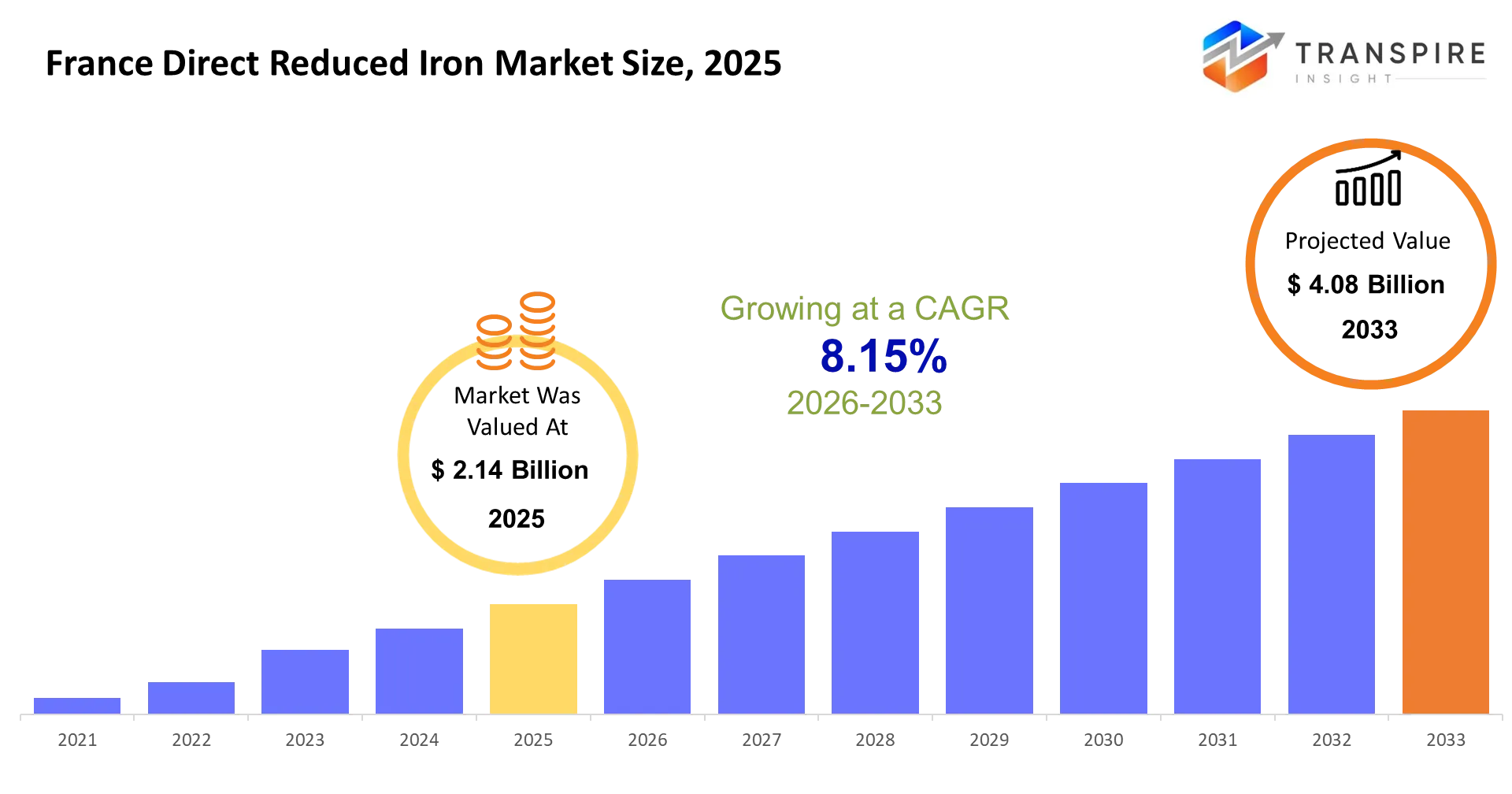
- France Direct Reduced Iron Market Size 2025: USD 2.14 Billion
- France Direct Reduced Iron Market Size 2033: USD 4.08 Billion
- France Direct Reduced Iron Market CAGR: 8.15%
- France Direct Reduced Iron Market Segments: By Type (Gas-based DRI, Coal-based DRI, Others), By Application (Steel Production, Construction, Automotive, Others), By End-User (Steel Manufacturers, Construction Companies, Automotive Industry, Others), By Form (Lumps, Pellets, Others)
To learn more about this report,  Download Free Sample Report
France Direct Reduced Iron Market Summary
The France DRI market reached USD 2.14 Billion in 2025 and is forecast to expand to USD 4.08 Billion by 2033, growing at an 8.15% CAGR. Direct Reduced Iron (DRI) represents a crucial intermediate material in steel manufacturing, produced through chemical reduction of iron ore without melting.
The France Direct Reduced Iron Market operates as a fundamental component in steel production processes which enable manufacturers to reduce carbon emissions and improve manufacturing efficiency compared to traditional blast furnace methods. DRI production involves reduction of iron ore pellets or lumps using reducing gases or solid carbon sources, creating high-quality iron input for electric arc furnaces and steelmaking operations. The market has experienced substantial transformation during recent years because European Union decarbonization directives now mandate stricter emissions standards which require steel producers to transition away from fossil-fuel-based blast furnaces toward more sustainable production methods.
Supply chain transformation and investment in renewable energy infrastructure for DRI production facilities have accelerated adoption across France's steel sector. Major steel manufacturers now allocate significant resources to establish green hydrogen-based DRI production capacity which demonstrates compliance with EU carbon reduction targets while maintaining competitive manufacturing economics. Automotive industry demand for high-strength, low-carbon steel components drives increased DRI consumption as manufacturers seek certified materials meeting evolving environmental and performance specifications.
Key France Direct Reduced Iron Market Insights
- Steel production accounts for 70% of France DRI market revenue in 2025, driven by integrated steelmakers and electric arc furnace operators requiring high-quality DRI as primary feedstock for modern steelmaking processes.
- Gas-based DRI production represents the dominant type at 62% market share, utilizing natural gas and hydrogen as reducing agents, with expansion toward green hydrogen-based production methods accelerating through 2033.
- Coal-based DRI maintains 28% market share, though growth is constrained by EU carbon regulations limiting fossil fuel usage in industrial processes across France.
- Northern France leads DRI consumption with 45% market share due to concentration of major steel manufacturing facilities and integrated steelmaking operations requiring consistent DRI supply.
- Electric arc furnace steelmakers drive fastest growth segment, expanding at 11.2% CAGR as they adopt DRI-based production to meet EU emissions reduction targets and achieve carbon-neutral manufacturing goals.
- Pellet form DRI commands 56% of the market compared to lump form, driven by superior handling characteristics and compatibility with modern steelmaking equipment.
- Construction applications represent 18% of market revenue, supporting demand for specialty steels used in structural and reinforced applications requiring DRI-derived material properties.
- Automotive industry accounts for 7% of France DRI market, driving demand for high-strength, low-carbon materials for electric vehicle components and lightweight structural applications.
- ArcelorMittal and Tata Steel combined control approximately 48% of the France DRI market through vertically integrated operations and established distribution networks.
- Investment in green hydrogen infrastructure across France is expected to reduce DRI production costs by 15-20% by 2033, fundamentally changing market economics and competitive dynamics.
What are the Key Drivers, Restraints, and Opportunities in the France Direct Reduced Iron Market?
The primary expansion force is European Union decarbonization mandates and carbon pricing mechanisms that make traditional blast furnace steelmaking economically disadvantaged compared to DRI-based electric arc furnace production. The EU Emissions Trading System imposes escalating carbon costs on steelmakers, creating direct financial incentives to adopt lower-emission DRI production methods. Automotive manufacturers increasingly specify low-carbon certified materials for vehicle platforms, establishing contractual requirements for DRI-derived components. This regulatory and customer-driven demand creates sustained growth in DRI consumption as France's steel sector transitions toward sustainable production methods.
The most significant barrier is the capital intensity and infrastructure requirements for establishing green hydrogen-based DRI production facilities. Current green hydrogen production costs remain elevated compared to natural gas-based hydrogen, creating economic constraints on DRI production expansion. Supply chain vulnerabilities in securing reliable renewable energy sources for hydrogen electrolysis limit facility expansion in certain regions. Existing DRI production capacity utilizing natural gas faces regulatory pressure to transition toward green hydrogen within constrained timeframes, creating operational risk and requiring substantial reinvestment.
The highest-growth opportunity is the development of green hydrogen-based DRI production infrastructure supported by EU funding mechanisms and national government incentives. Steelmakers establishing early partnerships with renewable energy providers and hydrogen producers position themselves to capture premium pricing for carbon-neutral DRI products. Digital traceability systems and blockchain-based carbon certification platforms create competitive advantages for suppliers providing verified low-carbon DRI materials to automotive and construction industries with environmental commitments.
What Has the Impact of Artificial Intelligence Been on the France Direct Reduced Iron Market?
Artificial intelligence transforms DRI production optimization through real-time process control and predictive monitoring of reduction reactions within furnace environments. Machine learning algorithms analyze temperature profiles, gas composition, and material properties to optimize reduction efficiency and product quality, enabling steelmakers to achieve consistent DRI specifications while minimizing energy consumption. AI-powered process control systems reduce operational variability and enable faster response to changing feedstock characteristics, improving production throughput and reducing scrap rates.
Predictive maintenance applications using AI analyze equipment sensor data to forecast maintenance requirements for reduction furnaces and material handling systems, reducing unplanned downtime and extending equipment life. Supply chain optimization algorithms improve DRI distribution logistics and inventory management across France's steel sector, reducing transportation costs and improving material availability. Machine learning models forecast DRI demand patterns based on steel order flows and automotive production schedules, enabling more accurate production planning and inventory level optimization.
The constraint limiting broader AI adoption is the complexity of retrofitting AI control systems into existing DRI production facilities designed with legacy automation infrastructure. Data integration challenges across decentralized production operations limit model accuracy and require substantial system modernization investments.
Key Market Trends
- Steel production accounts for 70% of DRI consumption, with integrated steelmakers and EAF operators driving volume growth through modernization of production facilities.
- Gas-based DRI production grew 9.8% year-over-year in 2024, outpacing coal-based methods as hydrogen integration accelerates across manufacturing processes.
- Green hydrogen-based DRI capacity expanded 26% in 2024-2025 as steelmakers invested in renewable energy partnerships and electrolyzer infrastructure.
- Pellet form DRI maintained 56% market share, driven by superior compatibility with modern charging systems and handling efficiency in steelmaking operations.
- Northern France leads consumption with 45% market share, supported by ArcelorMittal and other integrated steelmakers operating major reduction facilities.
- Electric arc furnace steelmakers expanded capacity at 11.2% CAGR, driven by economic advantages of DRI-based production under EU carbon pricing schemes.
- Carbon-neutral DRI certification programs gained adoption among automotive manufacturers seeking verified low-emissions materials for vehicle platforms.
- Automotive applications grew 14.1% year-over-year in 2024, driven by electric vehicle production expansion and lightweight material requirements.
- Digital supply chain platforms enabling DRI traceability and carbon verification expanded across France's steel sector during 2024-2025.
- Investment in green hydrogen electrolysis infrastructure reached EUR 340 Million in France during 2024, supporting long-term DRI production decarbonization.
France Direct Reduced Iron Market Segmentation
By Type
Gas-based DRI dominates the France market with 62% revenue share, utilizing natural gas and hydrogen as reducing agents in reduction furnaces. Production efficiency and established technical expertise enable competitive economics for gas-based DRI compared to coal-based alternatives. Transition toward green hydrogen-based gas-based DRI accelerates through EU carbon reduction mandates and renewable energy infrastructure investment. Temperature control precision and reduction gas optimization enable consistent product quality and enable steelmakers to specify gas-based DRI for demanding applications requiring tight material specifications.
Coal-based DRI maintains 28% market share, though regulatory constraints and carbon pricing mechanisms limit growth prospects relative to gas-based alternatives. Traditional coal-based reduction technology continues serving specific market segments where feedstock availability and economics support continued utilization. European Union emissions regulations create ongoing pressure to transition coal-based production capacity toward cleaner methods or retire uneconomical facilities.
By Application
Steel production consumes 70% of France DRI output, serving integrated steelmakers and electric arc furnace operators requiring high-quality iron input for finished steel production. DRI feedstock consistency and reduced impurity levels enable steelmakers to optimize alloy chemistry and achieve specified mechanical properties. Competitive economics of DRI-based production relative to traditional blast furnaces support sustained consumption growth as steelmakers modernize facilities and adopt electric arc furnace technology.
Construction applications represent 18% of market consumption, supporting demand for specialty steels used in structural and reinforced applications. Automotive industry accounts for 7% of consumption, with electric vehicle platforms creating demand for high-strength, low-carbon materials. Other applications collectively represent 5% of consumption, including machinery manufacturing and specialized industrial uses.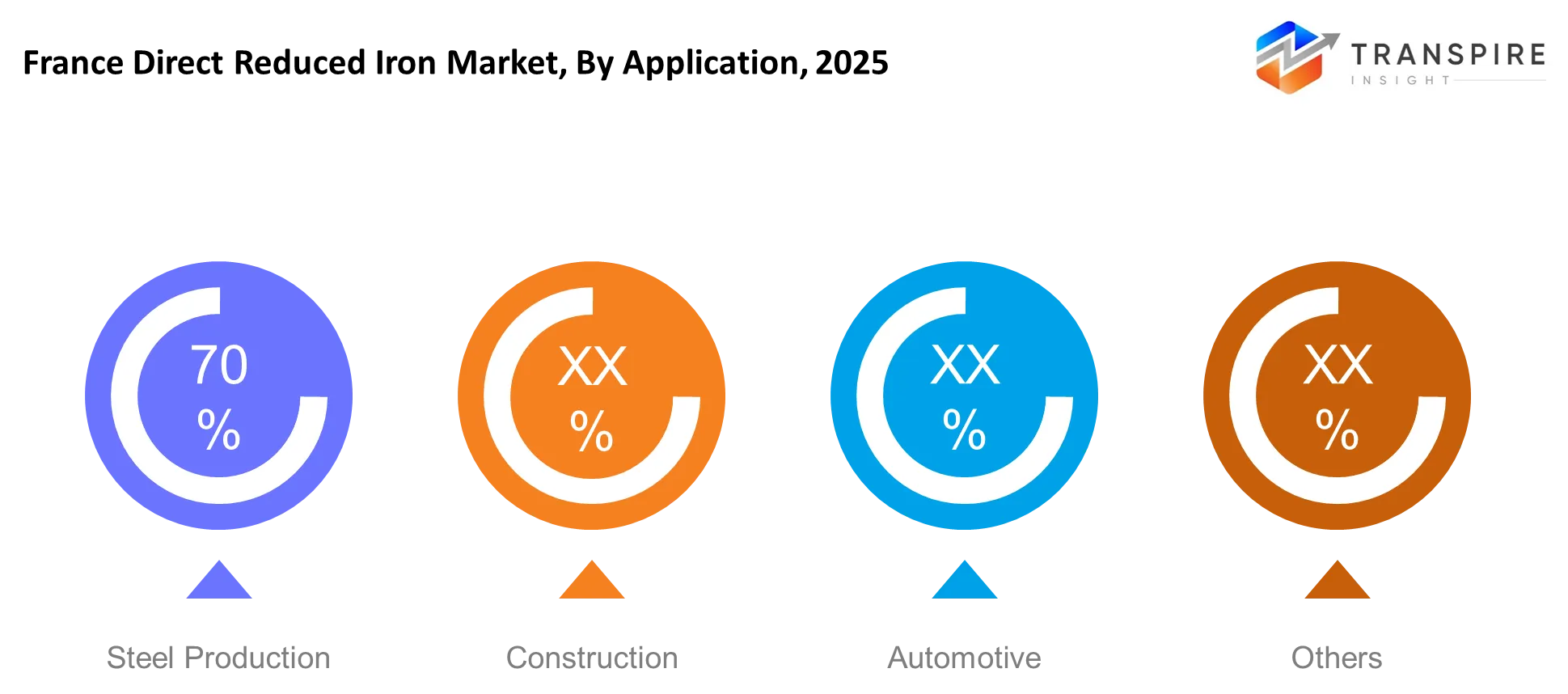
To learn more about this report, Download Free Sample Report
By End-User
Steel manufacturers control 75% of France DRI market demand, operating integrated facilities requiring consistent feedstock supply for steelmaking operations. Established relationships with DRI producers and long-term supply contracts support market stability and enable capacity planning for DRI producers. Construction companies account for 12% of DRI consumption through specialty steel procurement for structural applications.
Automotive industry represents 8% of end-user demand, with vehicle manufacturers specifying certified low-carbon DRI-derived materials for component production. Government and regulatory oversight accounts for 5% of market influence through emissions standards, carbon pricing, and sustainability directives shaping market structure.
By Form
Pellet form DRI commands 56% of market share, offering superior handling characteristics and compatibility with modern charging systems used in steelmaking. Consistent pellet dimensions and density enable efficient transportation and storage, supporting integrated logistics operations. Lump form DRI maintains 44% of market share, serving specific applications where larger piece sizes support operational requirements or cost considerations drive customer preferences.
|
Report Metrics |
Details |
|
Market size value in 2025 |
USD 2.14 Billion |
|
Market size value in 2026 |
USD 2.31 Billion |
|
Revenue forecast in 2033 |
USD 4.08 Billion |
|
Growth rate |
CAGR of 8.15% from 2026 to 2033 |
|
Base year |
2025 |
|
Historical data |
2021 - 2024 |
|
Forecast period |
2026 - 2033 |
|
Report coverage |
Revenue forecast, competitive landscape, growth factors, and trends |
|
Geographic scope |
France |
|
Key companies profiled |
ArcelorMittal, Tata Steel, JSW Steel, Nucor, Voestalpine, MIDREX, Tenova, Kobe Steel, Qatar Steel, Essar Steel, Hadeed, Mobarakeh Steel, SAIL, POSCO, Emirates Steel |
|
Customization scope |
Free report customization (segment scope). Avail customized purchase options to meet your exact research needs. |
|
Report Segmentation |
By Type (Gas-based DRI, Coal-based DRI, Others), By Application (Steel Production, Construction, Automotive, Others), By End-User (Steel Manufacturers, Construction Companies, Automotive Industry, Others), By Form (Lumps, Pellets, Others) |
Which Regions are Driving the France Direct Reduced Iron Market Growth?
Northern France leads the market with 45% DRI consumption, driven by concentration of major steel manufacturing facilities and integrated steelmaking operations. The region includes key industrial centers with established infrastructure supporting consistent DRI feedstock supply. ArcelorMittal operates major reduction and steelmaking facilities in Northern France, creating anchor demand for DRI products and supporting local supplier ecosystems.
Central France sustains steady consumption through mid-sized steelmaking operations and specialty steel producers requiring high-quality DRI feedstock. The region depends on regional distribution networks and maintains moderate growth rates driven by construction and automotive material demand. Central France benefits from geographic proximity to Northern manufacturing hubs, enabling efficient logistics and supply chain integration.
Southern France represents the fastest-growing region, expanding at 11.5% CAGR as investments in green hydrogen infrastructure and renewable energy capacity support emerging DRI production facilities. New steelmaking operations and expansion of electric arc furnace capacity drive increased DRI consumption. Government incentives supporting clean industrial development create favorable conditions for facility expansion and attract investment in sustainable DRI production methods.
Who are the Key Players in the France Direct Reduced Iron Market and How Do They Compete?
The France Direct Reduced Iron market is led by three global companies controlling over 50% of market share through vertical integration, technical expertise, and established customer relationships. ArcelorMittal operates integrated DRI production and steelmaking facilities, maintaining competitive advantages through internal supply security and established distribution networks. Tata Steel and other major players compete through technological differentiation, offering specialized DRI products meeting specific steelmaker requirements.
MIDREX and Tenova maintain strong positions through DRI production technology licensing and equipment supply to steelmakers establishing new reduction facilities. Specialized producers including JSW Steel and Voestalpine differentiate through technical capabilities in green hydrogen integration and carbon-neutral DRI production. Competitive dynamics increasingly favor producers developing early capabilities in green hydrogen-based DRI, as environmental certifications become baseline customer requirements.
France Direct Reduced Iron Market Companies
- ArcelorMittal
- Tata Steel
- JSW Steel
- Nucor
- Voestalpine
- MIDREX
- Tenova
- Kobe Steel
- Qatar Steel
- Essar Steel
- Hadeed
- Mobarakeh Steel
- SAIL
- POSCO
- Emirates Steel
Recent Developments
In March 2026, ArcelorMittal announced investment of EUR 450 Million in a green hydrogen-based DRI production facility in Northern France, targeting carbon-neutral operations by 2028 and strengthening its position in sustainable steel production. https://www.arcelormittal.com
In February 2026, Tenova completed deployment of advanced AI-based process control systems across three major DRI reduction facilities in France, achieving 18% energy efficiency improvements and reducing production costs. https://www.tenova.com
What Strategic Insights Define the Future of the France Direct Reduced Iron Market?
Over the next five to seven years, the France Direct Reduced Iron market will consolidate around green hydrogen-based production methods as carbon pricing and EU regulatory mandates make fossil fuel-based DRI economically unsustainable. Market structure will shift from cost-based competition toward technology and environmental certification differentiation, with premium pricing for verified carbon-neutral DRI products.
The hidden risk is supply constraint of renewable energy capacity needed to support large-scale green hydrogen electrolysis for DRI production. If renewable energy development lags behind steelmaker demand, production costs could escalate, limiting DRI-based steel production expansion and delaying carbon reduction targets.
The clearest opportunity is developing integrated business models combining renewable energy generation, hydrogen electrolysis, and DRI production within vertically coordinated operations. Steelmakers establishing long-term renewable energy partnerships and investing in green hydrogen infrastructure will capture competitive advantages through secure supply of low-cost, carbon-neutral DRI feedstock. Strategic recommendations include prioritizing renewable energy partnerships and green hydrogen technology development as baseline competitive requirements rather than optional differentiation strategies.
By Type
- Gas-based DRI
- Coal-based DRI
- Others
By Application
- Steel Production
- Construction
- Automotive
- Others
By End-User
- Steel Manufacturers
- Construction Companies
- Automotive Industry
- Others
By Form
- Lumps
- Pellets
- Others
Frequently Asked Questions
Find quick answers to common questions.
The France Direct Reduced Iron Market size is expected to reach USD 4.08 Billion by 2033.
The key Segments are By Type (Gas-based DRI, Coal-based DRI, Others), By Application (Steel Production, Construction, Automotive, Others), By End-User (Steel Manufacturers, Construction Companies, Automotive Industry, Others), and By Form (Lumps, Pellets, Others).
Major Players include ArcelorMittal, Tata Steel, JSW Steel, Nucor, Voestalpine, MIDREX, Tenova, Kobe Steel, Qatar Steel, Essar Steel, Hadeed, Mobarakeh Steel, SAIL, POSCO, and Emirates Steel.
The Current France Direct Reduced Iron Market size is USD 2.14 Billion in 2025.
The France Direct Reduced Iron Market CAGR is 8.15% from 2026 to 2033.
- ArcelorMittal
- Tata Steel
- JSW Steel
- Nucor
- Voestalpine
- MIDREX
- Tenova
- Kobe Steel
- Qatar Steel
- Essar Steel
- Hadeed
- Mobarakeh Steel
- SAIL
- POSCO
- Emirates Steel
Recently Published Reports
-
Apr 2026
Healthcare Polymer Packaging Market
Healthcare Polymer Packaging Market Size, Share & Analysis Report By Packaging Type (Syringes, IV Bottles and Pouches, Clamshells, Blisters, Bottles & Jars, Containers, Tubes, IV Parental Packaging, Others), By Type (Regulated, Non-regulated), By Polymer Type (LDPE (Low-Density Polyethylene), HDPE (High-Density Polyethylene), Homo-polymer (Homo), Random Copolymer (Random), Block Copolymer (Block), PET, Polystyrene, Polyvinyl Chloride, Polyamide/EVOH, Others), and Geography (North America, Europe, Asia-Pacific, Middle East and Africa, South and Central America), 2021 - 2031
-
Apr 2026
Hydrophilic Tape (Waterstop) Market
Hydrophilic Tape (Waterstop) Market Size, Share & Analysis Report By Type (Bentonite-Based Hydrophilic Tape, Rubber-Based Hydrophilic Tape), By Application (Residential Buildings, Commercial Buildings, Infrastructure Projects), and Geography (North America, Europe, Asia-Pacific, Middle East and Africa, South and Central America), 2021 - 2031
-
Apr 2026
Metalens Market
Metalens Market Size, Share & Analysis Report By Type (Visible Light Metalens, and Infrared Metalens), By Application (Consumer Electronics, Automotive Electronics, Industrial, Medical, and Others), and Geography (North America, Europe, Asia-Pacific, Middle East and Africa, South and Central America), 2021 - 2031
-
Apr 2026
PBT Resin Market
PBT Resin Market Size, Share & Analysis Report By Type (Reinforced PBT Resin, Unreinforced PBT Resin), By Processing Method (Injection Molding, Extrusion, Blow Molding, Others), By End-User (Automotive, Electrical & Electronics, Consumer Appliances, Industrial Machinery, Medical Devices, Packaging, Others), and Geography (North America, Europe, Asia-Pacific, Middle East and Africa, South and Central America), 2021 - 2031