
United Kingdom DC Fast Charging Market Size & Forecast:
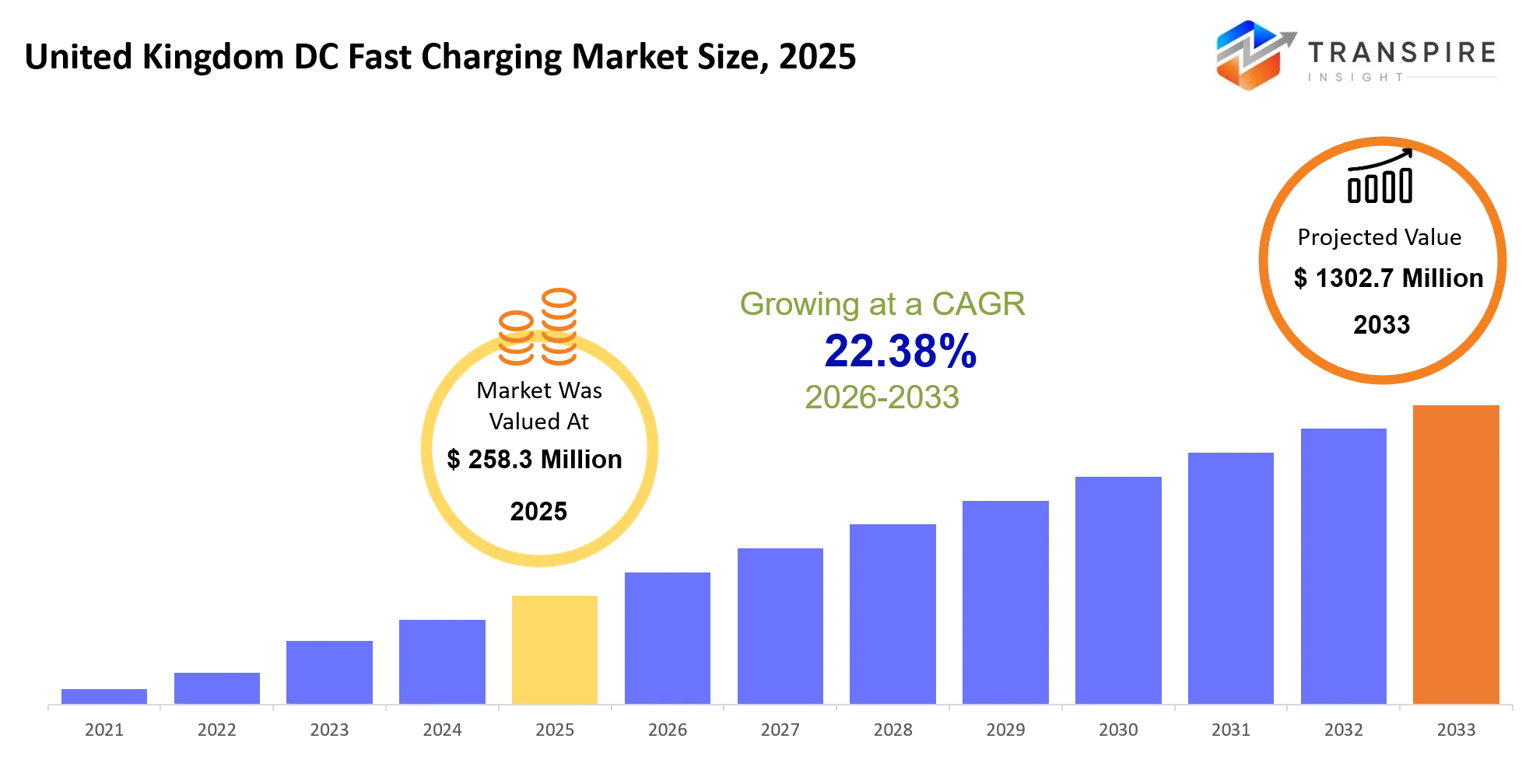
- United Kingdom DC Fast Charging Market Size 2025: USD 258.3 Million
- United Kingdom DC Fast Charging Market Size 2033: USD 1302.7 Million
- United Kingdom DC Fast Charging Market CAGR: 22.38%
- United Kingdom DC Fast Charging Market Segments: By Charger Type (Ultra-fast Chargers, Level 3 Chargers, Portable Fast Chargers, Public DC Chargers, Highway Fast Chargers, Smart Chargers, Others); By Connector Type (CCS Connectors, CHAdeMO Connectors, Tesla Connectors, GB/T Connectors, Others); By Application (Public Charging Stations, Commercial Fleets, Highway Corridors, Residential Complexes, Others); By End User (EV Owners, Fleet Operators, Commercial Establishments, Government Agencies, Others)
To learn more about this report,  Download Free Sample Report
United Kingdom DC Fast Charging Market Summary
The United Kingdom DC Fast Charging Market was valued at USD 258.3 Million in 2025. It is forecast to reach USD 1302.7 Million by 2033. That is a CAGR of 22.38% over the period.
The United Kingdom’s DC fast charging market basically hands out the charging infrastructure that makes it possible for electric vehicle drivers to top up batteries in just minutes , not hours. So long-distance trips, commercial fleet work, and high utilization transport services become actually realistic on the ground. In plain day to day language, it tackles range plus downtime concerns that, historically, made it more difficult for EVs to spread across both passenger commuting and commercial vehicle operations.
Over the last five years, the whole scene has moved in a more structural manner, drifting away from scattered pilot spots toward larger rollouts of high-power charging corridors and quick urban hubs. One clear catalyst was the UK government pushing transport decarbonization faster, via things like the phaseout roadmap for new petrol and diesel sales. That pressure nudged automakers, charge point operators , and infrastructure investors to expand their charging networks. When it’s easier to spot charging, and the power is genuinely higher, fleet operators feel steadier about electrification plans, and everyday consumers hit fewer small obstacles when they’re imagining EV ownership. From there, you get this kind of reinforcing cycle where more vehicle adoption lifts charger utilization, which then helps justify more investment , and it even brings more revenue models into the market.
Key Market Insights
- England kind of dominates the United Kingdom DC fast charging Market, taking in over 80% of what’s installed for DC fast charging infrastructure by 2025.
- London and Southeast England, they keep a big chunk of the market, mostly because EV ownership is higher there ,and because the city areas basically demand denser charging.
- Scotland looks like the quickest mover across the forecast period, helped by clean transport investments and that rural charging build-out that’s been expanding bit by bit.
- Meanwhile Wales is starting to show newer demand too, as local authorities speed up public charging deployment along key transport corridors, a bit like they’re trying to remove the “gap” between places.
- On the charger side, ultra-fast units (150 kW and above) seem to lead everything, sitting at roughly 45% market share in 2025, largely because reduced dwell time at the plug is a real selling point.
- The 50–149 kW fast chargers still stay in the second place, driven by broad placement across retail sites and public charging hubs.
- Then systems at 350 kW and up grow the fastest through 2030, since operators are basically future-proofing their infrastructure investments.
- Also, smart charging software and network management platforms are getting more attention ,as operators chase higher utilization and revenue optimization.
- In terms of where the money comes from, public charging stations bring in nearly 60% of the United Kingdom DC fast charging market revenue, mainly due to accessibility rules and widespread availability.
- Finally, motorway service areas remain the leading application segment, supporting longer-distance EV journeys and also commercial transportation.
What are the Key Drivers, Restraints, and Opportunities in the United Kingdom DC Fast Charging Market?
The main force moving the United Kingdom DC Fast Charging market is, kind of, the quick spread of electric vehicle adoption, reinforced by government decarbonization policies and those infrastructure funding programs. The UK intent to cut transport emissions , paired with rules that nudge the switch away from classic internal combustion vehicles, has pushed automakers, fleet managers, and charging companies to invest more aggressively into their networks. And as more EVs hit the roads , utilization at fast charging stations goes up, which improves asset profitability and helps charge point operators form more steady revenue. This loop seems like it feeds itself, like it encourages additional deployment, and then lifts the total market value, overall.
Still, the biggest obstacle is cost. And not just the sticker price either, but all that practical complexity around getting high capacity grid connections. A lot of proposed fast charging sites actually require big electrical upgrades before they can even install chargers. Those upgrades come with long approval timelines, network reinforcement tasks , and a large capital spend. Since grid infrastructure has to be coordinated between utilities regulators and private investors, it can not be settled fast. So deployment slows down in the very places where demand is
highest and coverage is most needed, which then limits network reach, and delays revenue generation across the broader market.
One major opportunity is the growth of ultra fast charging hubs that are tied in with battery energy storage systems. Operators are putting more money into locations where high power chargers run alongside on site storage, so they can reduce grid bottlenecks and manage electricity prices in a more controlled way.
What Has the Impact of Artificial Intelligence Been on the United Kingdom DC Fast Charging Market?
Artificial intelligence and advanced digital technologies are now getting better at improving the efficiency and reliability of the United Kingdom DC fast charging market. Charge point operators are increasingly using AI driven network management platforms, to automate things like charger monitoring, fault detection, load balancing, and energy distribution across different sites. In practice these systems keep analyzing charger status power availability and user demand patterns , so operators can cut down on the amount of manual work and still keep the network more available
Alongside this , machine learning models are also giving predictive strength to fast-charging infrastructure. By looking at earlier equipment records, session behavior , temperature swings, and component performance , operators can often spot possible failures before they turn into actual outages. Predictive maintenance programs help reduce surprise downtime, extend the equipment useful life, and keep maintenance expenses lower. Some charging networks even rely on AI based forecasting tools to guess when peak demand will show up, align electricity procurement more accurately, and raise overall site utilization. Taken together these tools support steadier asset performance and a cleaner approach to managing energy
Beyond that, advanced digital platforms contribute additional gains by allowing remote diagnostics, automated software updates, and pricing approaches that can shift in real time. So, operators can push charger uptime higher, improve customer experience, and boost revenue generation from the infrastructure they already have in place
Still, AI adoption comes with hurdles. For one, integrating analytics with older charging equipment and the variety of software platforms in the field, usually takes major investment. Also, limited historical operating data for newer ultra-fast assets can weaken prediction quality especially in areas where technology and usage patterns change fast
Key Market Trends
- Since 2021, the whole deployment kinda shifted away from 50 kW chargers toward 150 kW and also 350 kW systems, cutting down the charging time on the major routes a lot, which is nice.
- Gridserve , InstaVolt , and BP Pulse started building big charging hubs between 2022 and 2025, sort of swapping out the messy patchwork setups with those destination-scale networks.
- After 2023, a lot of fleet operators, started using more dedicated rapid-charging facilities, like they really went for it. This shift is largely pushed by the electrification of delivery vans and other commercial vehicles, and yeah it makes sense because the charging side had to keep up, you know.
- Charging providers moved past those charger-count targets, and started focusing much more on uptime metrics—plus remote diagnostics, and yeah, predictive maintenance abilities too. It’s like they’re trying to keep everything running smoothier, instead of only chasing numbers.
- Since 2022, motorway service areas have been drawing more investment, as regulators and operators keep focusing on cutting the charging gaps along those strategic corridors. And it is like, a gradual shift, where different stakeholders are chasing the same improvements, not just in one place but across routes.
- Battery energy storage integration became more common after 2023, which helped operators getting past grid connection delays and handling those peak electricity demands more smoothly, in a kinda steady way.
- Competition seems to have shifted away from geographic expansion only, more toward customer experience sort of thing. A bunch of leading networks are investing in contactless payments, and also in real-time availability data, so customers can basically see what’s there right now.
- Between 2021 and 2025 local authorities, started partnering more often with private operators, like in a sort of steady shift that sped things up. It helped the deployment of services reach more underserved regions beyond London and Southeast England, rather than staying mostly there.
- Automakers like Tesla started expanding public charging access, kind of marking a shift away from the old proprietary setups to more broader interoperability across charging networks, if that makes sense.
- After 2024, AI based demand forecasting and energy optimization tool started getting used more and more, like sort of, by a bunch of operators . This helped them boost utilization rate s and lower their day to day operating costs, in a more steady way .
United Kingdom DC Fast Charging Market Segmentation
By Charger Type:
Rapid growth in electric mobility around the United Kingdom is pushing up demand for various charging arrangements, like people can see it day by day. DC fast chargers help cut down the charging time, and they feel more practical for public transportation corridors, commercial venues, and highway stops. High-capacity charging devices keep getting noticed by fleet managers, plus urban infrastructure initiatives, mainly because electric vehicle adoption is rising everywhere. Broader market momentum is also boosted by government efforts, tied to transport electrification and carbon reduction commitments.
Meanwhile, low-power setups and ultra-fast charging approaches create slightly different usage behavior between city areas and rural zones. Charging service providers tend to prioritize deploying advanced systems near malls, parking spaces, and transit hubs, so access becomes easier, and that matters for commuters. Car makers, in a similar way, encourage compatibility
with high-speed charging systems—so the overall customer experience feels smoother. On top of that, strong investment activity from energy providers, as well as private infrastructure companies, keeps reinforcing the rollout and growth of charging networks across the entire country.
By Connector Type:
Connector compatibility keeps showing up as a key concern in the United Kingdoms DC fast charging scene. The Combined Charging System plugs keep a pretty big footprint, mostly because so many European vehicle manufacturers have already leaned into them. Meanwhile Chademo connectors are still being used for older electric vehicle models, plus a number of selected Asian automotive brands that operate through out the region, not just in one place. Tesla connector systems also stay relevant, largely tied to dedicated charging infrastructure and, you know, that whole premium electric vehicle ownership vibe.
Charging station developers tend to chase multi connector setups, more or less, so they can cover a wider range of vehicles and limit the usual customer frustrations. Standardization work across the automotive sector helps drivers find and use public charging stations with less hassle. A lot of infrastructure expansion across metropolitan areas is also pushing more universal charging points into the mix. And as demand for cross brand charging convenience grows, it keeps nudging how connector development happens, and how station installation strategies get planned.
By Application:
Public transportation, business mobility, and passenger vehicle charging create pretty strong application demand within the United Kingdom DC fast charging market. Along major highways, charging stations help long-distance travel, and they boost confidence for electric vehicle users, kinda clearly. At the same time, commercial delivery services plus ride sharing operators make even more use of fast charging infrastructure so their day to day operations stay efficient. Retail centers and hospitality sites keep adding charging points to pull in electric vehicle owners, and yes, that also lifts customer engagement.
Industrial logistics hubs, and even municipal transport systems, contribute to the rising installation activity too. Urban planning programs push for charging infrastructure close to business districts and also near residential communities, improving accessibility overall. Fast charging technology helps cut down downtime for electric fleets that operate in densely populated areas, which matters a lot. And the expansion of renewable energy integration within these charging systems strengthens sustainability goals linked to transportation development.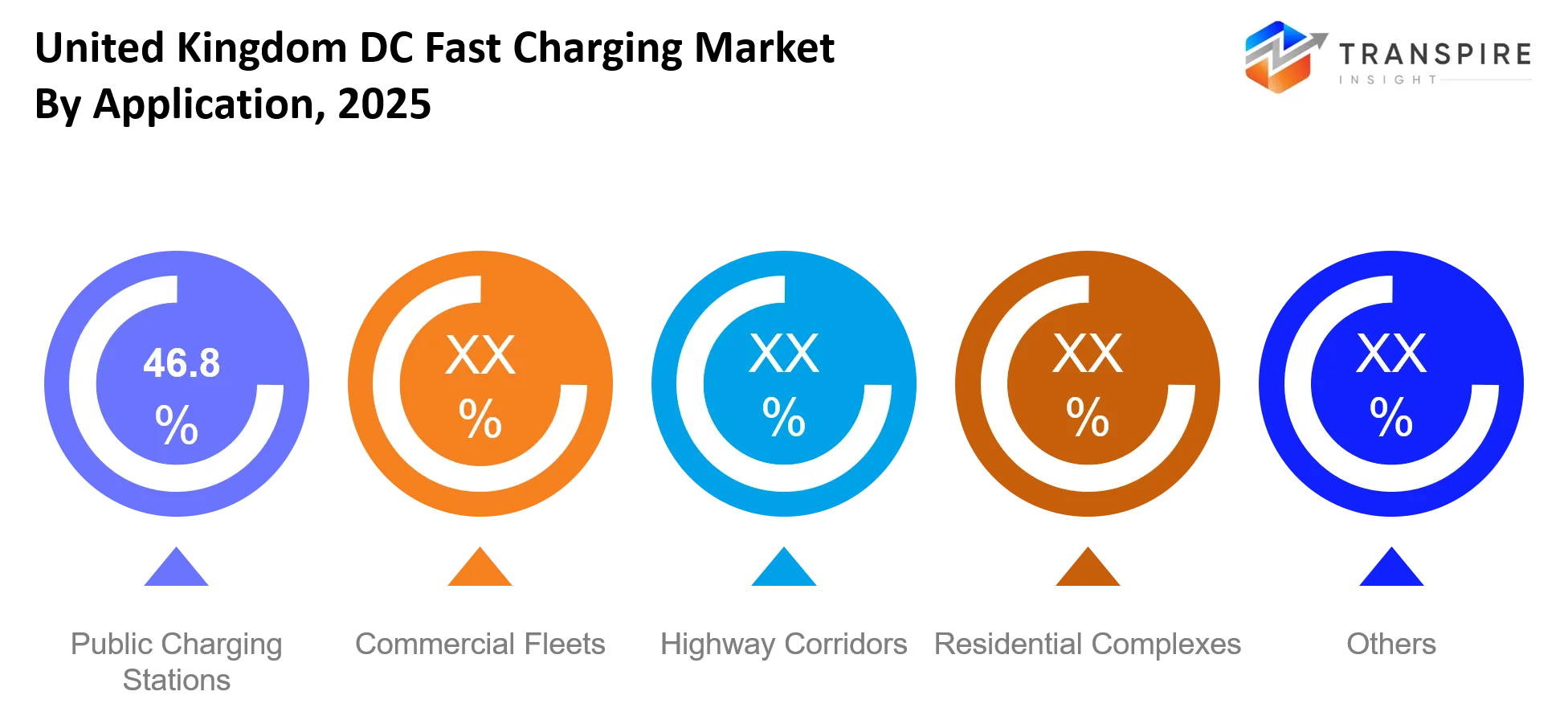
To learn more about this report, Download Free Sample Report
By End User:
Fleet operators, commercial businesses , public authorities and private electric vehicle owners are some of the major end users in the United Kingdom DC fast charging market, basically. Public charging network providers keep on expanding station placement to handle the higher demand coming from daily commuters and travelers that are going further. Commercial organizations are also putting money into workplace charging systems, helping with employee mobility and broader sustainability aims . Retail and hospitality businesses view charging
infrastructure as a sort of extra service, it can keep customers around longer and strengthens brand perception too.
Government agencies stay involved by backing infrastructure investment via funding programs and regulatory initiatives tied to cleaner transportation targets . Meanwhile, residential communities that have limited private parking access create extra pull for public fast charging, you know, the kind that you can use quickly. Taxi operators and logistics companies are leaning more and more on high speed charging solutions in order to maintain smoother operations and cut down on fuel dependency. Ongoing technological upgrades together with the rising adoption of electric vehicles will back continued market expansion across a range of end user groups .
What are the Key Use Cases Driving the United Kingdom DC Fast Charging Market?
Public fast charging networks kind of act as the main real world scenario, the one that really helps market adoption across the UK. In other words, high power charging points along motorways, in city centers, and along bigger travel corridors serve passenger electric cars, which need speedy recharging during both everyday commutes and those longer trips. Because people use these sites all the time and they’re generally easy to access, this specific role ends up being the biggest contributor to how often charging happens.
Another, more secondary but still growing, use case is commercial fleet operations. Logistics firms, parcel delivery players, and ride hailing operators increasingly lean on rapid charging infrastructure so their vehicles stay available through out the day. At the same time, retail venues and charging hubs at workplaces support business fleets that run on set timetables, so they really need charging access that’s reliable and pretty predictable.
Looking ahead, a few newer applications should start mattering more during the forecast period. For example, dedicated charging hubs for electric trucks are drawing investment since freight operators gear up for their electrification targets. Also, ultra fast charging installations that include battery energy storage systems seem to have strong momentum, especially in areas where grid capacity constraints might otherwise slow down or complicate deployment.
|
Report Metrics |
Details |
|
Market size value in 2025 |
USD 258.3 Million |
|
Market size value in 2026 |
USD 316.9 Million |
|
Revenue forecast in 2033 |
USD 1302.7 Million |
|
Growth rate |
CAGR of 22.38% from 2026 to 2033 |
|
Base year |
2025 |
|
Historical data |
2021 - 2024 |
|
Forecast period |
2026 - 2033 |
|
Report coverage |
Revenue forecast, competitive landscape, growth factors, and trends |
|
Regional scope |
United Kingdom. |
|
Key company profiled |
ABB, Siemens, Tesla, ChargePoint, EVBox, Tritium, Delta Electronics, Schneider Electric, Blink Charging, Shell Recharge, BP Pulse, Wallbox, Eaton, Alfen, Kempower. |
|
Customization scope |
Free report customization (country, regional & segment scope). Avail customized purchase options to meet your exact research needs. |
|
Report Segmentation |
By Charger Type (Ultra-fast Chargers, Level 3 Chargers, Portable Fast Chargers, Public DC Chargers, Highway Fast Chargers, Smart Chargers, Others); By Connector Type (CCS Connectors, CHAdeMO Connectors, Tesla Connectors, GB/T Connectors, Others); By Application (Public Charging Stations, Commercial Fleets, Highway Corridors, Residential Complexes, Others); By End User (EV Owners, Fleet Operators, Commercial Establishments, Government Agencies, Others) |
Which Regions are Driving the United Kingdom DC Fast Charging Market Growth?
England still stays the main region for the United Kingdom DC Fast Charging Market, mostly because electric vehicle ownership sits high there, the motorway web is really broad, and there’s been solid public infrastructure money put in. Cities like London, Birmingham, Manchester,and Bristol help keep charger utilization strong thanks to close packed population areas and a lot of day to day commuter flow. Both national and local government programs have kind of pushed faster rollout across cities and key transport corridors. You also have a fairly mature supporting network of charge point operators, utility providers, fleet businesses, and private investors, which keeps reinforcing that regional edge.
Scotland is the second biggest contributor, but the way it grows doesn’t match England so neatly. Instead of depending mainly on big urban demand zones, Scotland leans more on long term public investment and a steady emphasis on improving access to charging across countryside and even more remote locations. Local authorities have backed infrastructure placement via specific funding schemes and transport decarbonization efforts. With policy that stays consistent and infrastructure upgrades that keep moving, Scotland helps deliver a pretty reliable contribution toward the national charging network buildout.
Wales is currently the quickest grower, since infrastructure funding is ramping up along transport routes that used to feel underserved, and also around regional economic hubs. Recent steps to widen public charging coverage and improve links between town and rural communities have opened up new deployment possibilities. More cooperation between local authorities and private charging operators has boosted project activity in the last few years. If this continues, further expansion should create interesting chances for infrastructure developers, tech compan
Who are the Key Players in the United Kingdom DC Fast Charging Market and How Do They Compete?
Competition in the United Kingdom DC Fast Charging Market is still pretty moderately fragmented , like you have the usual established charging network operators, but also infrastructure specialists and automotive-backed charging providers, all trying to overlap in the same space . In practice players seem to compete a bit less on outright pricing, and more on things such as charger reliability, charging velocity , site quality, network coverage, and then that whole customer experience angle . You can also see operators leaning harder into uptime performance and digital services, plus very strategic placement near motorways, retail destinations, and the higher traffic urban zones . New entrants keep appearing in selected locations too, though honestly scale, grid access know-how and long term infrastructure investment stay pretty decisive advantages.
Tesla has, in a way, carved out a more differentiated position by building a tightly connected charging ecosystem . That ecosystem blends high-power charging hardware with software coordination, and a lot of user experience tuning . It also matters that Tesla has expanded access to select sites for non-Tesla vehicles, so the wider network is used more often while the company still keeps fairly strong charger performance standards . Gridserve meanwhile is more centered on large electric forecourts, designed for high vehicle throughput , and with customer facilities meant to feel convenient . The differentiation here comes more from destination-style charging locations, sort of like places you actually want to stop, rather than standalone charger installations . Their continued investment along motorway corridors and major travel routes keeps driving expansion.
Company List
- ABB
- Siemens
- Tesla
- ChargePoint
- EVBox
- Tritium
- Delta Electronics
- Schneider Electric
- Blink Charging
- Shell Recharge
- BP Pulse
- Wallbox
- Eaton
- Alfen
- Kempower
Recent Development News
"In February 2026, Shell-owned Ubitricity announced the acquisition of FM Conway’s SureCharge EV Charging network. The transaction added more than 2,400 charge points across London to the Shell Recharge network, strengthening charging infrastructure scale and supporting network consolidation in the UK market.https://transportandenergy.com
"In February 2025, Shell Recharge entered a partnership with Be.EV through a new roaming agreement. The collaboration provided Shell Recharge users access to more than 750 additional rapid charge points and expanded network coverage to over 38,000 charging points, improving accessibility for EV drivers across the United Kingdom.https://www.shell.co.uk
"In December 2025, Kempower supported the launch of EVCP Solutions’ first UK charging site in Merseyside using Kempower DC fast-charging technology. The project marked the market entry of a new charge point operator and demonstrated continued investment in high-power charging infrastructure to expand rapid charging availability in the United Kingdom.https://kempower.com
What Strategic Insights Define the Future of the United Kingdom DC Fast Charging Market?
Over the next five to seven years, the United Kingdom DC Fast Charging Market is likely to move from a network build-out phase into an infrastructure optimization phase, kinda. In that shift, value creation will rely less on just having more installed chargers and more on things like utilization rates, energy management know how, and how well the systems can be meshed with the broader power networks. The main push behind this transition is the steady rise in electric vehicle adoption across both passenger and commercial categories. Because of that, the spotlight shifts toward network efficiency and grid resilience, not only basic geographic coverage , you know.
One risk that still feels a bit underappreciated is market concentration, particularly around a small set of major charging operators and grid connection providers. As competition gets more tied to premium locations and the available electrical capacity, the barriers to entry could also rise. If that happens, it may curb innovation, and it might reduce competitive variety in a not so helpful way.
At the same time, there is a genuine emerging opportunity that deserves more attention: charging hubs paired with battery energy storage systems in spots where the grid is constrained. This configuration can accelerate the rollout of the infrastructure while cutting down on reliance on long, drawn out network upgrades. Market players should focus on investing in energy management technologies and building strategic partnerships with the grid. Over time, competitive advantage will increasingly come from operational performance rather than from charger deployment alone.
United Kingdom DC Fast Charging Market Report Segmentation
By Charger Type
- Ultra-fast Chargers
- Level 3 Chargers
- Portable Fast Chargers
- Public DC Chargers
- Highway Fast Chargers
- Smart Chargers
- Others
By Connector Type
- CCS Connectors
- CHAdeMO Connectors
- Tesla Connectors
- GB/T Connectors
- Others
By Application
- Public Charging Stations
- Commercial Fleets
- Highway Corridors
- Residential Complexes
- Others
By End User
- EV Owners
- Fleet Operators
- Commercial Establishments
- Government Agencies
- Others
Frequently Asked Questions
Find quick answers to common questions.
The Expected United Kingdom DC Fast Charging Market size for the Market will be USD 1302.7 Million in 2033.
Key Segments for the United Kingdom DC Fast Charging Market are Type (by Charger Type (Ultra-fast Chargers, Level 3 Chargers, Portable Fast Chargers, Public DC Chargers, Highway Fast Chargers, Smart Chargers, Others); By Connector Type (CCS Connectors, CHAdeMO Connectors, Tesla Connectors, GB/T Connectors, Others); By Application (Public Charging Stations, Commercial Fleets, Highway Corridors, Residential Complexes, Others); By End User (EV Owners, Fleet Operators, Commercial Establishments, Government Agencies, Others).
Major United Kingdom DC Fast Charging Market Players are [ABB, Siemens, Tesla, ChargePoint, EVBox, Tritium, Delta Electronics, Schneider Electric, Blink Charging, Shell Recharge, BP Pulse, Wallbox, Eaton, Alfen, Kempower].
The Current United Kingdom DC Fast Charging Market size is USD 258.3 Million in 2025.
The United Kingdom DC Fast Charging Market CAGR is 22.38%% from 2026 to 2033.
- ABB
- Siemens
- Tesla
- ChargePoint
- EVBox
- Tritium
- Delta Electronics
- Schneider Electric
- Blink Charging
- Shell Recharge
- BP Pulse
- Wallbox
- Eaton
- Alfen
- Kempower
About the Authors

Avinash Kumar
I’m Avinash Kumar, a Senior Research Analyst at Transpire Insight, with expertise in the Electronics and Semiconductor and Energy & Power industry. My work focuses on analyzing emerging technologies, market trends, industry developments, and innovation across these sectors. I specialize in transforming complex technical and market insights into clear, research-backed content that helps professionals, businesses, and decision-makers stay informed. Through continuous industry research and data-driven analysis, I strive to deliver accurate, reliable, and practical perspectives on the latest advancements shaping the semiconductor and energy landscape.

Chakradhar Khansole
Chakradhar serves as the Research Director at Transpire Insight, bringing over 8 years of experience in technology, innovation, and strategic market intelligence. He specializes in transforming complex market data into actionable business insights that enable organizations to make informed, growth-oriented decisions. Recognized for his strategic vision and analytical expertise, Chakradhar leads high-impact research initiatives, delivering comprehensive market assessments, competitive intelligence, and forward-looking industry analysis.
Recently Published Reports
-
Apr 2026
Active Power Filter Market
Active Power Filter Market Size, Share & Analysis Report By Type (Shunt Active Power Filters, Series Active Power Filter, Hybrid Active Power Filter), By Application (Harmonics Mitigation, Reactive Power Compensation, Voltage Regulation, Power Factor Correction), By Phase (Single Phase, Three Phase), By End-User Industry (Manufacturing, Healthcare, Commercial, Automotive, Oil and Gas, Others), and Geography (North America, Europe, Asia-Pacific, Middle East and Africa, South and Central America), 2021 - 2031
-
Apr 2026
Electrical Transformer Market
Electrical Transformer Market Size, Share & Analysis Report By Core (Closed, Shell, and Berry), By Insulation (Gas, Oil, Solid, Air, and Other), By Phase (Single, and Three), By Rating (100 MVA to 500 MVA, 501 MVA to 800 MVA, and 801 MVA to 1200 MVA), and Geography (North America, Europe, Asia-Pacific, Middle East and Africa, South and Central America), 2021 – 2031
-
Apr 2026
Hydraulic Piston Pumps Market
Hydraulic Piston Pumps Market Size, Share & Analysis Report By Type (Axial Piston Pumps, Radial Piston Pumps), By Operating Pressure (Low Pressure, Medium Pressure, High Pressure), By Application (Construction, Mining, Agriculture, Automotive, Oil & Gas, Industrial Machinery, Others), By End-User (OEMs, Aftermarket), and Geography (North America, Europe, Asia-Pacific, Middle East and Africa, South and Central America), 2021 – 2031
-
Apr 2026
Laboratory Gas Generators Market
Laboratory Gas Generators Market Size, Share & Analysis Report By Product (Nitrogen Gas Generator, Hydrogen Gas Generator, Zero Air Gas Generator, Purge Gas Generator, TOC Gas Generators, Others), By Application (Gas Chromatography, Liquid Chromatography-mass Spectrometry (LC-MS), Gas Analyzers, Others), By End-user (Life Science, Chemical & Petrochemical, Food & Beverage, Others), and Geography (North America, Europe, Asia-Pacific, Middle East and Africa, South and Central America), 2021 – 2031