
Europe Smart EV Charging Networks Market Size & Forecast:
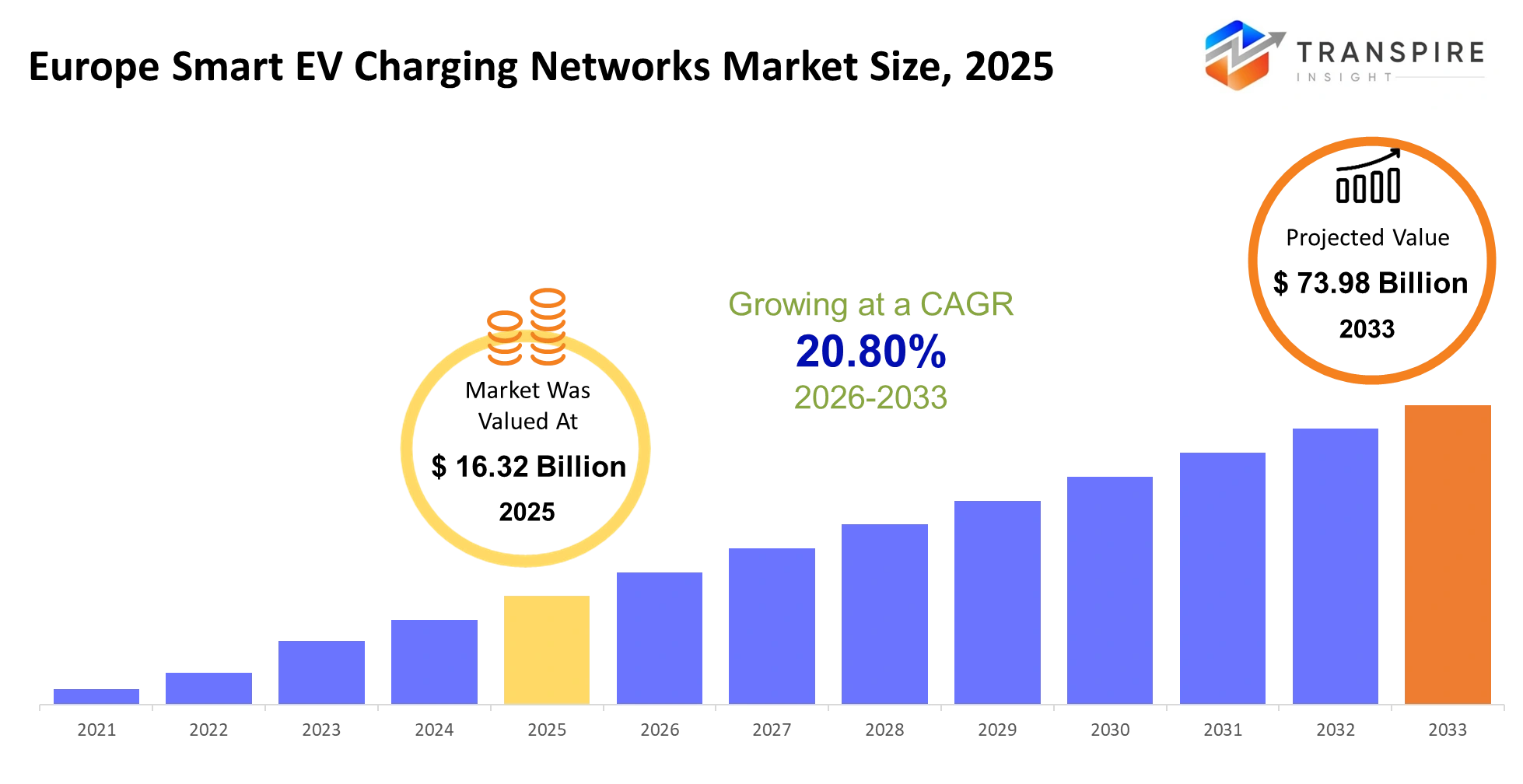
- Europe Smart EV Charging Networks Market Size 2025: USD 16.32 Billion
- Europe Smart EV Charging Networks Market Size 2033: USD 73.98 Billion
- Europe Smart EV Charging Networks Market CAGR: 20.80%
- Europe Smart EV Charging Networks Market Segments: By Type (AC Charging, DC Fast Charging, Wireless Charging, Others); By Application (Residential Charging, Commercial Charging, Public Charging, Fleet Charging, Highway Charging, Others); By End-User (EV Owners, Fleet Operators, Businesses, Government, Charging Network Operators, Utilities, Others); By Connectivity (IoT-enabled, App-based, RFID-based, Cloud-connected, Others).
To learn more about this report,  Download Free Sample Report
Europe Smart EV Charging Networks Market Summary:
The Europe Smart EV Charging Networks Market size is estimated at USD 16.32 Billion in 2025 and is anticipated to reach USD 73.98 Billion by 2033, growing at a CAGR of 20.80% from 2026 to 2033. Europe Smart EV Charging Networks Market in the Clean Mobility & Energy Infrastructure industry will become a digitally orchestrated network that is able to integrate electric vehicles, power grids, and consumers using smart platforms. This market will be driven by the needs of drivers for fast charging, clear cost estimates, and user-friendly app usage regardless of the country they are in. Utility companies as well as private firms will use AI-based load balancing and predictive maintenance technologies to improve reliability and optimize the grid operations. There will be an ongoing need for interoperability standards from the EU in the form of legislation.
What Has the Impact of Artificial Intelligence Been on the Europe Smart EV Charging Networks Market?
The development of artificial intelligence technologies will become a critical factor in determining the direction of development of operational intelligence and decision-making in europe smart ev charging networks market. With the increase in the scope of digital infrastructure, the usage of artificial intelligence in europe smart ev charging networks market applications will help identify trends in the market through the collection of real-time data about the use of charging facilities, peak hours for charging, and underutilized regions. Moreover, through advanced machine learning techniques, companies can predict demand accurately and provide energy delivery services based on consumer needs.
In addition, artificial intelligence in europe smart ev charging networks market will be able to improve the efficiency of production processes as well as ensure smart automation of the network operation. Artificial intelligence technology will be used to identify any failures prior to them becoming problematic and will also allow better control over logistics to ensure proper equipment deployment and lower costs. Such developments will have a direct impact on market trends.
In addition to efficiency, AI will bring about a new dimension of innovation and personalization in the europe smart ev charging networks market. The AI platform will personalize charging suggestions depending on the preferences of the user, their driving behavior, and even fluctuations in the price of energy. Personalization will enhance engagement while ensuring that the providers have a competitive edge in delivering a unique service.
Key Market Trends & Insights:
- The Europe smart ev charging networks market is dominated by Western Europe, accounting for more than 45% market share in 2025, thanks to the developed electric vehicle infrastructure.
- Northern Europe is expected to experience the highest growth rate during the period of 2025-2030 backed by rapid electrification initiatives and green energy generation.
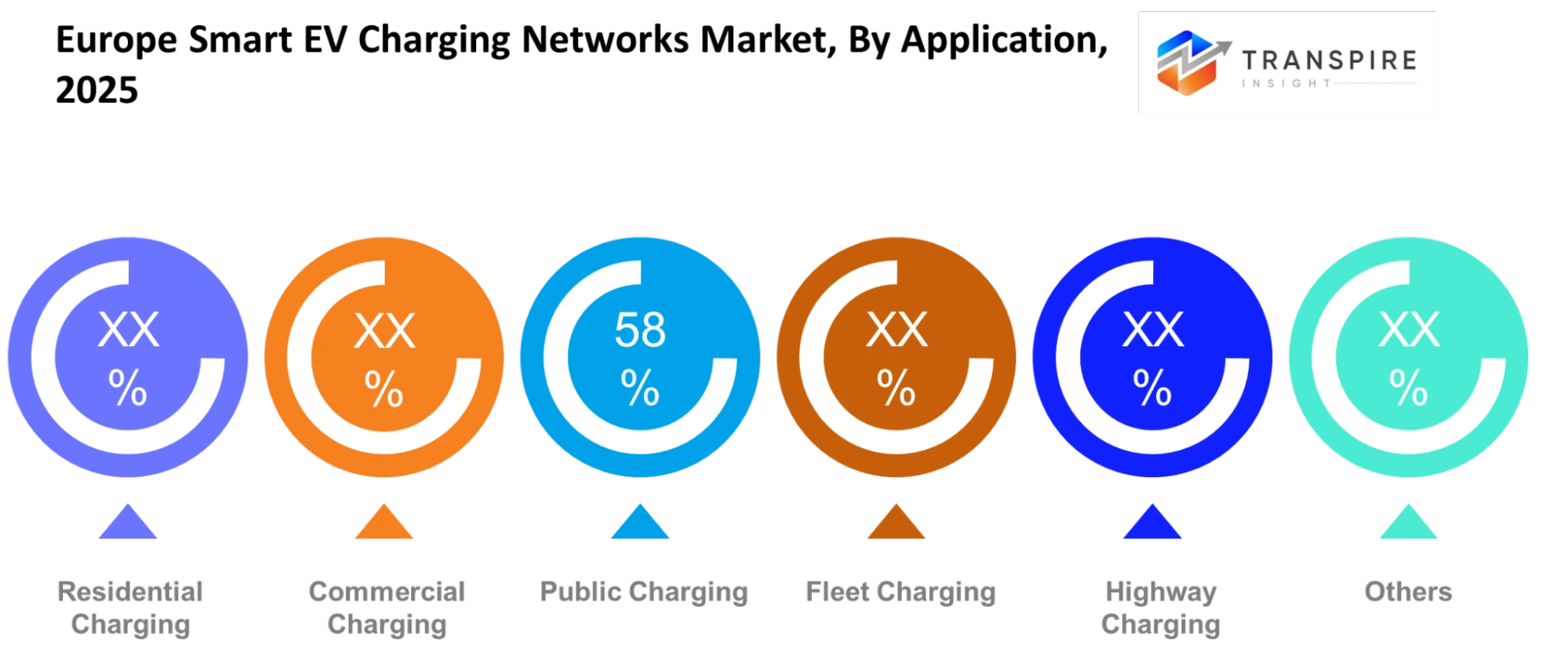
- Public charging networks account for around 60% share, influenced by the need for charging facilities and government initiatives on infrastructure development.
- Private/Home chargers are expected to account for the second-highest share, supported by growing residential EV adoption rates.
- The fast-charging (DC) infrastructure is expected to witness the highest growth during 2025-2032 owing to the growing demand for decreased charging times.
- Passenger vehicles account for more than 70% share in 2025 backed by mass adoption of electric vehicles.
- Commercial fleet charging is the fastest-growing application segment, propelled by increasing logistics electrification initiatives.
- Consumers account for more than 65% share in the europe smart ev charging networks market, backed by growing EV ownership rates.
Europe Smart EV Charging Networks Market Segmentation
By Type
The AC charging technology will keep dominating due to affordability and practicality in the process of charging. The DC fast charging technology will be adopted more because of the increasing frequency in traveling farther. The wireless charging technology will also grow along with technological development and will attract many buyers in premium cars and urban developments. There will also be more innovation and improvement from the integration of hybrid and advanced technologies for more specific purposes.
Technology will be the main determinant of performance and efficiency for all categories, with energy efficiency and faster charging processes. Customer expectations for faster charging experiences will lead to changes within the current structure of the infrastructure. Legal standards will be set to secure compatibility and safety, thus making charging stations more efficient and convenient. More funding will go to both segments equally.
By Application
Residential charging will remain a preferred choice due to its ease of implementation and simplicity of installation. Charging will be provided in offices, shopping centers, and other commercial places to meet the growing demand for electric vehicles during working hours. Public charging will be vital to ensure access to energy sources for those who cannot charge their vehicles at home. Charging of fleets and highway charging will gain traction with time to address the requirements of long trips and logistics operations.
New applications will arise based on changes in mobility patterns and the penetration of vehicles in several sectors. Smart charging will be used to distribute loads between residential and public networks to prevent grid congestion. Government policies will facilitate the creation of necessary infrastructure in urban and semi-urban regions.
To learn more about this report, Download Free Sample Report
By End-User
Owners of EVs will form an important segment, considering the increasing adoption and the desire to have charging stations closer. Fleet owners will also increase their usage in the context of switching to electric vehicles in order to save costs and be environmentally sustainable. Businesses will incorporate charging stations to serve customer demands and requirements of their employees. The government and utilities will help to advance the network infrastructure.
The behavior of end users will greatly determine the business models, pricing, and the growth of the networks. The charging network operators will concentrate on the dependability and availability of charging networks to sustain their competitive position in the market. In addition, utilities will contribute to ensuring that there is balance of the energy demand and incorporation of renewable energy in the charging networks.
By Connectivity
With IoT-enabled systems, real-time monitoring and control of charging stations would be achieved to increase efficiency in operations. Through app-based connectivity, users will be able to know the locations of the stations, as well as other important information like pricing and payment options. For instance, through RFID, quick and secure identification of frequent users will be made possible.
Connectivity innovations will facilitate automatic processes and predictive maintenance. With the analysis of data collected through connectivity innovations, informed decisions about the infrastructure development process and other issues will be made. The security and privacy laws in place will influence the way that data is handled and processed in the system.
What are the Main Challenges for the Europe Smart EV Charging Networks Market Growth?
Technical and operational problems will still be holding back growth in the europe smart ev charging networks market. The stability of the network will be an issue, because fluctuations in power generation, network congestion, and software errors can all disrupt its functionality. Scaling up will be an issue too, as demand fluctuates regionally and puts strain on current capacities. Such limitations in the europe smart ev charging networks market environment will mean constant upgrades in terms of hardware reliability and system integration.
The difficulties with manufacturing and marketing of technology will be another factor influencing the growth rate in the europe smart ev charging networks market. Since the development of smart charging stations is expensive and since regulations in European countries will be strict, entry into the market will not be easy. Certification and installation delays will complicate the process even further. Limitations in the market environment will be evident.
Adoption issues will be major, especially in places where infrastructure is limited and there is no high level of penetration of EVs. Challenges such as availability of personnel required for the installation and maintenance of the systems will affect the growth of the europe smart ev charging networks market. Limited funding from underdeveloped locations will hamper market expansion, creating disparities between urban and rural areas.
Challenges related to competition and potential threats will form another aspect influencing the europe smart ev charging networks market in the coming years. Competitors in the shape of other renewable energy sources and personal charging stations will exert pressure on pricing in addition to making public stations redundant. Frequent innovation and associated need for ongoing investments will pose risks for companies.
Regional Insights
Western Europe Region: The region will take a commanding lead because of its earlier adoption of electric cars, established grid systems, and robust policy framework. Countries like Germany, France, and the Netherlands will continue increasing charging capacity by both government and private entities. Urban areas will exhibit greater utilization because of smart cities initiatives and mobility policies.
Northern Europe Region: Northern Europe is expected to make quick strides in charging infrastructure adoption owing to the extensive use of renewables and environmental policies. South and East Europe will have steady growth but may lack adequate financing and delayed rollout of charging infrastructure. There will be an increase in cross-border connectivity driven by the efforts of the European Union.
Recent Development News
In 04 2026, Milepost AB announced acquisition of Mer’s EV charging network in Sweden. The deal added around 250 AC charging points and expanded Milepost’s presence across more than 70 municipalities, strengthening regional network density.
Source: https://www.mobilityplaza.org
In 04 2026, Milepost AB completed acquisition of Mer’s charging stations for everyday charging. The expansion will support wider accessibility and accelerate infrastructure consolidation within Sweden’s EV charging ecosystem.
Source: https://kommunikasjon.ntb.no
|
Report Metrics |
Details |
|
Market size value in 2025 |
USD 16.32 Billion |
|
Market size value in 2026 |
USD 19.71 Billion |
|
Revenue forecast in 2033 |
USD 73.98 Billion |
|
Growth rate |
CAGR of 20.80% from 2026 to 2033 |
|
Base year |
2025 |
|
Historical data |
2021 - 2024 |
|
Forecast period |
2026 - 2033 |
|
Report coverage |
Revenue forecast, competitive landscape, growth factors, and trends |
|
Regional scope |
Europe (Germany, United Kingdom, France, Italy, Spain, Rest of Europe) |
|
Key company profiled |
ChargePoint, ABB, Siemens, Schneider Electric, Tesla, EVBox, BP Pulse, Shell Recharge, Enel X, Webasto, Blink Charging, Wallbox, Alfen, Ionity, Tritium. |
|
Customization scope |
Free report customization (country, regional & segment scope). Avail customized purchase options to meet your exact research needs. |
|
Report Segmentation |
By Type (AC Charging, DC Fast Charging, Wireless Charging, Others); By Application (Residential Charging, Commercial Charging, Public Charging, Fleet Charging, Highway Charging, Others); By End-User (EV Owners, Fleet Operators, Businesses, Government, Charging Network Operators, Utilities, Others); By Connectivity (IoT-enabled, App-based, RFID-based, Cloud-connected, Others). |
How Can New Companies Establish a Strong Foothold in the Europe Smart EV Charging Networks Market?
The European smart electric vehicle charging networks market enables new market entrants to establish strong market positions by supplying specialized services to unserved market segments and developing products that meet particular needs of fleet electrification and smart city and commercial hub operations. Businesses should direct their efforts toward addressing essential market needs which include last-mile delivery charging and workplace charging solutions instead of fighting against existing charging networks.
The European smart EV charging networks market will enable new companies to acquire initial market presence since they can use established demand patterns which define market development. Organizations will achieve their competitive advantage through innovation strategies which will create unique market identities for their business operations in the European smart electric vehicle charging networks market. Startups can use artificial intelligence to develop load management systems which include predictive analytics and dynamic pricing models that will increase operational efficiency and enhance customer satisfaction. Solutions which use technological advancements to solve industry problems will create solutions that address operational downtime and energy optimization needs and enable customers to make payments effortlessly.
The competitive advantage of Fastned comes from its ongoing development of ultra-fast charging hubs which compete with Gridserve's solar-powered charging ecosystems. Strategic partnerships will further strengthen market entry and scalability in the europe smart ev charging networks market. The establishment of partnerships with automotive companies and utility providers and property developers will enable faster installation of charging infrastructure while decreasing the expenses related to building charging stations. The new market entrants who partner with renewable energy providers and smart grid platforms will achieve sustainable market benefits because sustainability has become an essential business requirement. The new companies will build strong market presence through niche market entry and market access through advanced technology and strategic partnerships.
Key Europe Smart EV Charging Networks Market Company Insights
Experienced players will secure their market position via network expansion, technology advancement, and collaboration with energy firms and automobile makers. The emphasis will still be on delivering fast charging and efficient services to ensure users are attracted to use them.
Innovative start-ups will leverage their competitive advantage through new ideas, effective implementation, and focus on specific needs, such as fleet charging or intelligent cities. Collaborations can serve as an entry facilitator, enabling start-ups to scale more effectively. As more players join the market, there will be increased competition via pricing and service offerings.
Company List
- ChargePoint
- ABB
- Siemens
- Schneider Electric
- Tesla
- EVBox
- BP Pulse
- Shell Recharge
- Enel X
- Webasto
- Blink Charging
- Wallbox
- Alfen
- Ionity
- Tritium
What are the Key Use-Cases Driving the Growth of the Europe Smart EV Charging Networks Market?
In terms of use-cases impacting the europe smart ev charging networks market, the practical aspect is what is going to determine market growth in the future. Public charging stations will be used for regular commuting purposes, particularly since many people would not have a charging station at their homes. Retail stores will introduce smart charging solutions to make customers stay there for longer periods and earn some extra money in the process. Such use-cases will prove beneficial for europe smart ev charging networks market expansion.
Electrification of fleets is expected to become a new use-case that is going to boost the europe smart ev charging networks market. Companies providing logistics services and ride-sharing apps will introduce smart charging stations for electric vehicles in order to ensure maximum operational efficiency and save on fuel costs.
Industrial and enterprise settings will also drive demand for the europe smart ev charging networks market. Industrial areas and enterprise sites will implement charging stations to cater to the transportation requirements of their employees and electric vehicles. The integration of renewable energy sources into the system will also help cut costs and fulfill other objectives. All these use cases will pave the way for substantial investments in infrastructure for different purposes.
Charging corridors along highways will be crucial for facilitating the traveling needs of EV users. Charging stations that employ modern technologies will provide quicker charging services. In addition, the innovative use cases will ensure that the europe smart ev charging networks market offers high value to its stakeholders.
Europe Smart EV Charging Networks Market Report Segmentation
By Type
- AC Charging
- DC Fast Charging
- Wireless Charging
- Others
By Application
- Residential Charging
- Commercial Charging
- Public Charging
- Fleet Charging
- Highway Charging
- Others
By End-User
- EV Owners
- Fleet Operators
- Businesses
- Government
- Charging Network Operators
- Utilities
- Others
By Connectivity
- IoT-enabled
- App-based
- RFID-based
- Cloud-connected
- Others
Frequently Asked Questions
Find quick answers to common questions.
The approximate Europe Smart EV Charging Networks Market size for the market will be USD 73.98 Billion in 2033.
Key segments for the Europe Smart EV Charging Networks Market are By Type (AC Charging, DC Fast Charging, Wireless Charging, Others); By Application (Residential Charging, Commercial Charging, Public Charging, Fleet Charging, Highway Charging, Others); By End-User (EV Owners, Fleet Operators, Businesses, Government, Charging Network Operators, Utilities, Others); By Connectivity (IoT-enabled, App-based, RFID-based, Cloud-connected, Others).
Major Europe Smart EV Charging Networks Market players are ChargePoint, ABB, Siemens, Schneider Electric, Tesla, EVBox, BP Pulse, Shell Recharge, Enel X, Webasto, Blink Charging, Wallbox, Alfen, Ionity, Tritium.
The Europe Smart EV Charging Networks Market size is USD 16.32 Billion in 2025.
The Europe Smart EV Charging Networks Market CAGR is 20.80%.
- ChargePoint
- ABB
- Siemens
- Schneider Electric
- Tesla
- EVBox
- BP Pulse
- Shell Recharge
- Enel X
- Webasto
- Blink Charging
- Wallbox
- Alfen
- Ionity
- Tritium
Recently Published Reports
-
Apr 2026
ATV & UTV Market
ATV & UTV Market Size, Share & Analysis Report By Type (ATV, and UTV), By Variants (Less Than 400 CC, 400 CC To 800 CC, and More Than 800 CC), and Geography (North America, Europe, Asia-Pacific, Middle East and Africa, South and Central America), 2021 - 2031
-
Apr 2026
Automotive Central Gateway Module Market
Automotive Central Gateway Module Market Size, Share & Analysis Report By Type (Ethernet Central Gateway Module, CAN Central Gateway Module, LIN Central Gateway Module, and FlexRay), By Application (Powertrain Control, Body Control, Infotainment System, Advanced Driver Assistance Systems (ADAS), and Others), By End User (Passenger Vehicles, and Commercial Vehicles), and Geography (North America, Europe, Asia-Pacific, Middle East and Africa, South and Central America), 2021 - 2031
-
Apr 2026
Automotive Engine Oil Filter Market
Automotive Engine Oil Filter Market Size, Share & Analysis Report By Filter Type (Fuel Filter, Engine Oil Filter, Hydraulic Oil Filter, and Others), By Filter Media (Cellulose, Synthetic, and Micro), By Sales Channel (OEMs, and Aftermarket), By Vehicle Type (Passenger Cars, Light Commercial Vehicles, Heavy Duty Trucks, Buses and Coaches, and Off-road Vehicles), and Geography (North America, Europe, Asia-Pacific, Middle East and Africa, South and Central America), 2021 - 2031
-
Apr 2026
Automotive Parts Aluminium Die Casting Market
Automotive Parts Aluminium Die Casting Market Size, Share & Analysis Report By Production Process (Pressure Die Casting, Vacuum Die Casting, Squeeze Die Casting, Gravity Die Casting), By Application (Body Parts, Engine Parts, Transmission Parts, Battery And Related Components, Other Application Types), and Geography (North America, Europe, Asia-Pacific, Middle East and Africa, South and Central America), 2021 - 2031
Our Clients