
United Kingdom Commercial Drone Market Summary
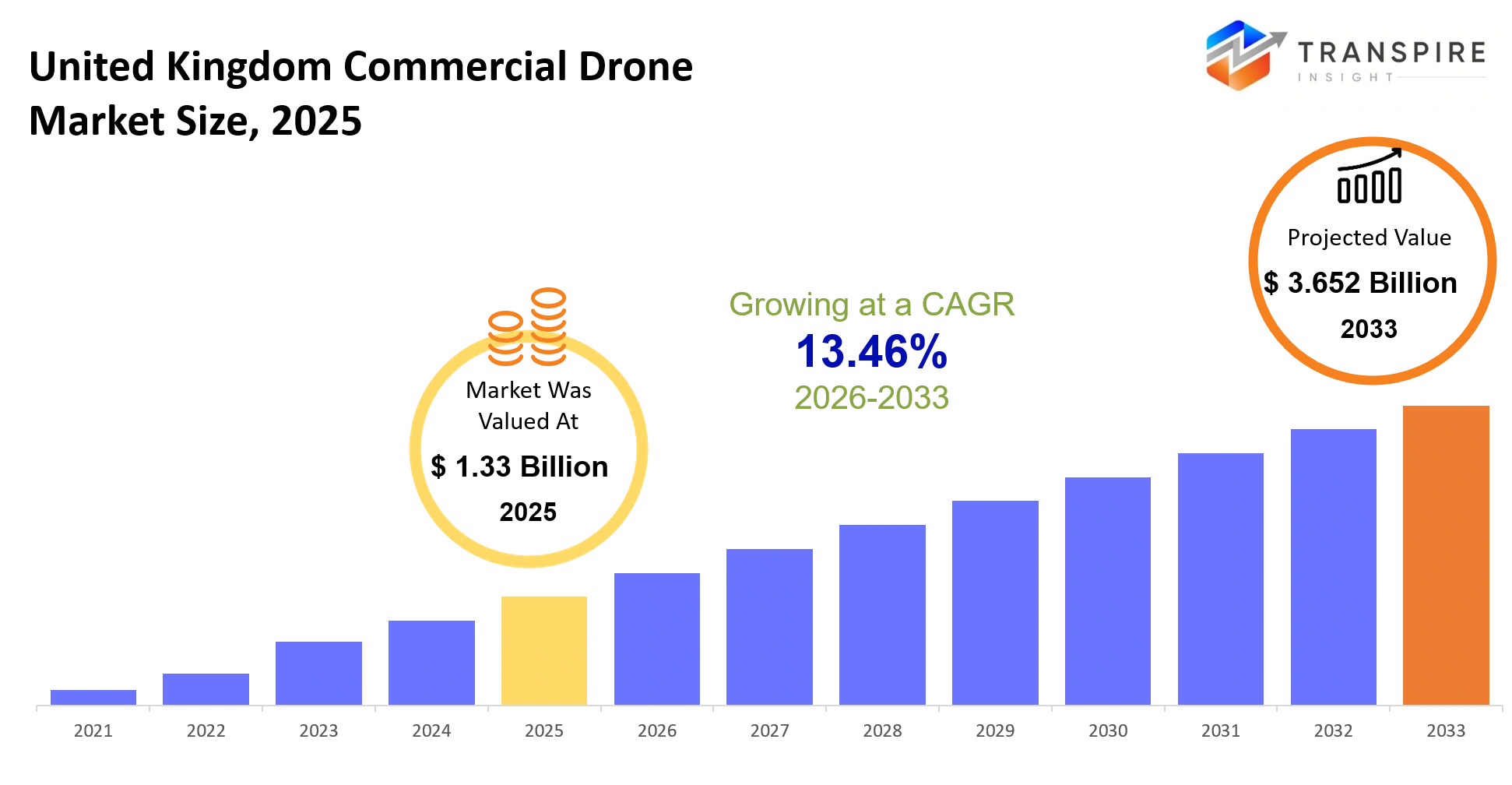
As per Transpire Insight Analysis the United Kingdom Commercial Drone Market size is estimated at USD 1.33 Billion in 2025 and is anticipated to reach USD 3.652 Billion by 2033, growing at a CAGR of 13.46% from 2026 to 2033.
The United Kingdom commercial drone market helps organizations do stuff like inspect infrastructure, survey land, keep track of construction progress, back emergency response, and gather high-accuracy data, all without throwing people into risky situations or long, time intensive field work. In practice, commercial drones are now real business instruments , not just gadgets, that cut inspection expenses, raise day to day precision, and speed up project deliveries across energy , utilities, agriculture, logistics, and also public safety. In the last five years, the whole vibe moved away from single standalone aerial imaging toward a more blended data intelligence model , where artificial intelligence, cloud analytics and automated flight control are basically supporting the workflow. Newer aviation rules, plus broader comfort with beyond visual line of sight trials , have nudged industry toward more capable commercial deployments. At the same time , after the COVID-19 period, supply chain hiccups and labor shortages pushed teams to switch to remote inspection and digital asset surveillance. Put together, regulatory momentum and the practical need have widened the range of commercial uses, improved the return on investment, and made bigger enterprise deals more common, so the market has a steadier revenue base overall.
United Kingdom Commercial Drone Market Size & Forecast:
- United Kingdom Commercial Drone Market Size 2025: USD 1.33 Billion
- Expected Market Value 2033: USD 3.652 Billion
- Forecast CAGR: 13.46%
- Leading region in 2025: England
- Fastest Growing region: Scotland
- Key Profile: DJI, Parrot, AeroVironment, Delair, Skydio, AgEagle Aerial Systems, DroneDeploy, senseFly, Yuneec, Teledyne FLIR, Wingcopter, Zipline, Flyability, Autel Robotics, Quantum Systems
Key Market Insights
- England sorta dominated the United Kingdom Commercial Drone Market around 2025, sitting at roughly 68% market share, helped by pretty dense industrial infrastructure and a lot of technology investment that kept rolling in.
- Scotland, meanwhile, is expected to grow the quickest during 2025–2032, mainly because offshore energy inspections plus remote asset monitoring are speeding up commercial deployments, bit by bit, almost like an incremental snowball effect.
- When it comes to product types, fixed-wing drones took the lead with about 42% market share in 2025, since long-range surveying kept expanding across utilities, agriculture, and infrastructure projects.
- Rotary-wing drones came in as the second-largest segment, driven by adoption for construction inspections, emergency response, and precision industrial upkeep which is, honestly, pretty important day to day.
- Hybrid drone platforms are predicted to be the fastest-growing product segment through 2032, because operators want longer endurance while still benefiting from vertical take-off capability, which is kinda the best of both worlds.
- For applications, infrastructure inspection led at around 31% market share in 2025, and that fits with the stronger push toward digital asset management and predictive maintenance.
- Logistics and commercial delivery is set to be the fastest-growing application across the forecast window, as regulatory trials broaden operational scope and practical usage keeps getting easier.
- For end users, energy and utilities stayed on top with approximately 28% market share in 2025, mostly because grid inspections and offshore operations need frequent aerial monitoring.
- Finally, construction and engineering is forecast to be the fastest-growing end-user segment through 2032, as digital site management becomes the norm across major developments, not just in pilot programs.
What are the Key Drivers, Restraints, and Opportunities in the United Kingdom Commercial Drone Market?
The main growth driver seems to be regulatory modernization along with quick progress in autonomous flight technologies, it’s sort of a package deal. Civil Aviation Authority programs that back wider operational permissions and more beyond visual line of sight trials, did lower the commercial frictions for industrial operators. Also inspection costs fell a bit, and that shifted investment choices in a practical way. Projects move quicker too, because data is collected faster, which helps delivery cycles. In the end, asset owners are swapping manual inspections for drone-based surveying more often, not only because it is safer and causes less downtime but because the digital output is higher-quality, so you get real operational savings. And, that naturally turns into repeating software and services revenue.
Still, airspace integration is the biggest structural limitation. Commercial drones have to share the sky safely with conventional aviation, even as the operating environment gets more complex. National unmanned traffic management infrastructure needs coordinated spending, agreed technical standards and regulatory alignment, and that stuff cannot be rushed. Enterprise efforts often run into long approval schedules before everything is fully rolled out. From the Transpire Insight review of regional procurement announcements and launch timing, supply chain concentration is still the top execution risk. If components show up late, or if certification steps take longer than expected, fleet growth stalls. That then reduces near-term service revenue and it also slows down new commercial launches, overall.
The most compelling window is in AI driven beyond visual line of sight operations that are helped along by digital airspace management platforms. Offshore wind plus electricity transmission, rail infrastructure, and environmental monitoring all show really big markets where nonstop autonomous inspections bring in concrete, measurable value. On top of that, government backed innovation grants and private capital flowing into aviation technology make the path to commercialization look a bit more solid, even if timelines can wobble. As comms networks keep improving, and autonomous navigation keeps getting more mature, operators are likely to roll out subscription based inspection mapping and analytics offerings that create recurring revenue, not just one time hardware sales, or so it seems.
What Has the Impact of Artificial Intelligence Been on the United Kingdom Commercial Drone Market?
Artificial intelligence is really changing how commercial drone work gets done, like it helps with mission planning, makes obstacle avoidance more automatic, handles image interpretation, and even deals with compliance reporting across industrial inspection, surveying, and infrastructure management. With more advanced computer vision, the aircraft can spot structural defects, vegetation that’s creeping in, and thermal anomalies without someone having to manually recheck images for hours. Then machine learning steps in as well, kind of like supporting predictive maintenance by noticing early equipment degradation from repeated inspection datasets so asset owners can line up repairs before failures start interrupting operations, or before it becomes a bigger incident.
All of this usually boosts fleet utilization, trims inspection cycles down, and lowers operational costs while also keeping results more consistent across big infrastructure networks. On top of that, digital twin platforms make the decision process better by mixing aerial data with engineering models, which helps teams rank maintenance tasks faster and plan projects with improved accuracy. Cloud based analytics also makes it easier for field operators to coordinate with enterprise asset managers, so reporting and regulatory documentation move along more quickly.
Still, even with these advances, broad AI adoption is kind of held back because integrating everything isn’t trivial, and performance can be inconsistent when weather turns rough, lighting varies a lot, or connectivity is limited. Many organizations end up needing to modernize older asset management systems first, and until that happens, they don’t fully get the automation upside. So implementation costs rise, and deployment timelines stretch out for advanced commercial drone solutions.
Key Market Trends
- BVLOS operational trials sort of expanded a lot after 2023, which supported more broad commercial inspection, logistics, and even infrastructure monitoring opportunities.
- AI based image analytics largely replaced manual review across many industrial sectors , so in some deployments the reporting times dropped by more than 50% .
- Offshore wind operators pushed drone inspections harder between 2023 and 2025, which helped limit technician exposure while also making maintenance planning feel more predictable.
- Hybrid drone platforms have picked up steam since 2024, mostly because longer endurance backs up utility corridor inspections, and also helps with large scale surveying.
- Cloud connected fleet management platforms basically became a normal enterprise tool by 2025, improving compliance monitoring and giving stronger operational visibility.
- Skyports expanded their commercial drone delivery partnerships, which in turn strengthened the logistics ecosystem development, across healthcare and urban mobility efforts.
- Altitude Angel increased funding for digital airspace integration technologies, supporting safer autonomous commercial operations across the United Kingdom.
- Construction companies leaned into drone enabled digital twin workflows after 2023 , improving project tracking, progress verification, and site documentation in the day to day.
- Telecommunications operators also adopted automated aerial inspections, to speed up network maintenance while reducing the need for field workforce deployment in remote locations.
United Kingdom Commercial Drone Market Segmentation
By Drone Type:
Fixed-wing drones help with long distance surveying, corridor checks and also big area mapping because the longer air time makes the whole operation more efficient, especially for infrastructure and environmental work. Rotary-wing drones still feel like the go to choice for nearby inspection, construction tracking and emergency response, mainly because vertical takeoff and steady hovering gives real world, practical benefits. Hybrid systems are getting more attention too, they blend long flight duration with the ability for flexible take offs, so deployment can spread across a wider range of industrial needs. And then there are other drone types that cover more niche commercial demands when “normal” platforms can’t really hit the technical or day to day operational requirements.
Commercial funding keeps moving toward platforms that can deliver stronger endurance, greater payload versatility, and dependable data gathering. Ongoing tech upgrades should boost how well operations run, while also cutting down maintenance tasks, and reducing those annoying flight pauses. Choosing a product more and more depends on how complex the mission is, the operating surroundings, and the total cost of ownership. If adoption stays balanced across several drone categories, it should back a larger commercial expansion during the forecast window.
By Component:
Hardware still shows up as the biggest revenue driver, because airframes with propulsion modules, plus sensors, camera suites, and communications gear kinda sit at the root of each real commercial deployment. Meanwhile software keeps rolling out via flight routing or planning, fleet management, mapping, artificial intelligence, and data analytics offerings, all aimed at raising operational value, not just features. Services keep delivering steady business outcomes through maintenance work, pilot training, system integration, consulting, and operational assistance. Other component buckets also cover niche add-ons and adjacent technologies that the industry needs for its own specific use cases.
At the enterprise level, buyers are starting to look more and more at end to end operational solutions, rather than grabbing standalone equipment only. Software integration should further sharpen decision-making by turning aerial observations into usable business intelligence. Service providers meanwhile keep adding recurring revenue, mostly through long term support agreements and managed operations. With a balanced investment across hardware, software, and services, industrial customers should end up with stronger overall commercial value, even if the mix varies by region.
By Application:
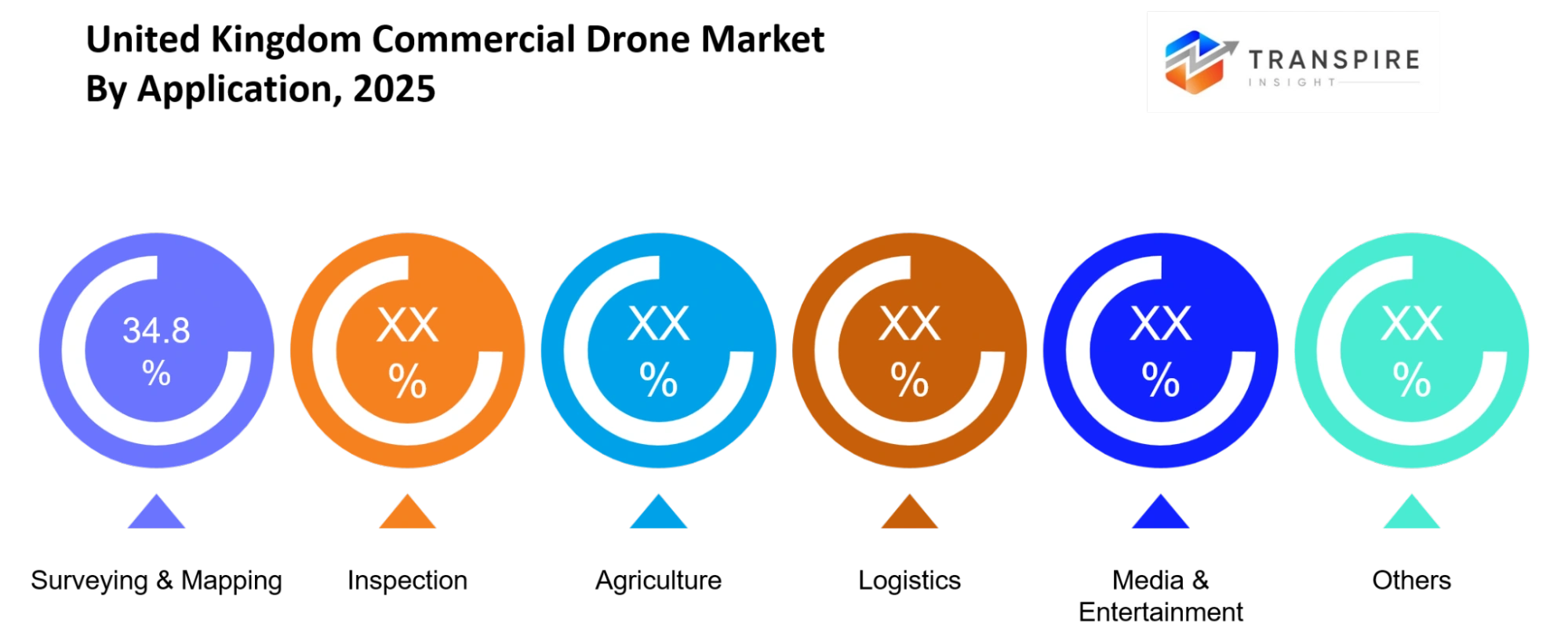
Surveying and mapping still count as major uses, mainly because dependable aerial data helps shrink project timelines and it makes planning feel more solid across construction , mining and land development. Inspection works well for energy sites, transport corridors utilities and industrial assets, it enables quicker and safer condition checks. In farming, crop monitoring and field analysis keep paying off, while logistics is pushing ahead with commercial delivery trials. Media and entertainment also keep taking to aerial photography, broadcasting, and content production, and meanwhile other efforts keep showing up in public safety and environmental monitoring too.
Overall, the variety of applications keeps growing, since organizations start noticing clear, measurable operational gains. Artificial intelligence together with more advanced imaging tools should boost analytical precision and raise reporting standards. When projects wrap faster and field inspection costs drop, more businesses feel comfortable jumping in. As the industry gets broader buy in, demand tends to stay steady across several business areas.
By End User:
Construction stays a leading end-user since project oversight, progress tracking, and aerial site surveys help plan better, and in the process cut down on the amount of hand checking needed. Energy companies , depend on aerial inspection for transmission lines, wind and solar facilities, plus offshore operations where safety is still a top priority. Agriculture benefits from precision farming and crop evaluation, while government groups reinforce public safety, infrastructure monitoring, and environmental stewardship. Media organizations keep growing their aerial production abilities, and plenty of other sectors take up commercial drone services for special operational requirements.
Investment in the industry is shifting more and more toward clear productivity gains rather than “trial and error” type initiatives. Digital workflows will build stronger operational awareness and also improve maintenance scheduling across the most critical assets. Better quality data means quicker business decisions, and it helps with more efficient allocation of resources. As adoption continues across different industries, the overall long-term commercial chances should keep strengthening.
By Mode of Operation:
Remotely piloted systems still seem to dominate a lot of commercial work because trained operators keep direct control while doing inspections, survey work, and infrastructure monitoring, kinda like they are right there the whole time. Semi-autonomous platforms make the same, repetitive flight patterns easier since automated navigation handles the routine part, yet a human stays in the loop during the really critical phases. Autonomous systems keep advancing as artificial intelligence improves , advanced sensors get sharper and digital airspace tools become more trustworthy for reliability. Other operating modes also show up, for missions that need a tailored flight management approach, so not every task uses the same setup.
Automation is reshaping commercial operations more and more by bringing steadier outcomes and lowering the manual effort required. Regulatory progress should, eventually, make it easier to deploy advanced autonomous capabilities across industrial applications. Improvements in navigation help increase operational efficiency while also backing safer execution during missions. As technology matures over time, confidence in higher levels of flight automation tends to rise gradually.
By Distribution Channel:
Direct sales still end up being the go to distribution channel, mainly because enterprise customers often want customized systems, a bit of technical consultation , installation backing and longer term service agreements too. Distributors help in that other part, they widen the market reach by providing equipment and support through regional business networks. Online channels keep getting stronger with broader product availability, easier procurement, and faster purchasing steps. Then there are a few more distribution ways that come in handy for specialized contracts, government procurement , and industry specific supply setups.
Meanwhile commercial purchasing decisions are leaning more toward lifecycle support than the equipment cost alone. Channel partners can deepen customer relationships through technical knowhow, maintenance services, and operational training sessions. Digital procurement platforms tend to make buying more efficient while also improving product accessibility for smaller businesses. If the distribution network stays balanced, it should keep supporting steady market expansion across the different commercial industries.
What are the Key Use Cases Driving the United Kingdom Commercial Drone Market?
Inspection is still the top use case, basically because infrastructure owners need repeated , careful, and secure asset checks across energy, building ,and transport networks. Utility operators, engineering shops, and industrial site managers are turning to commercial drone services to cut down site downtime, refine maintenance timing, and gather solid inspection data without having to stop the everyday work happening on ground.
Surveying and mapping keep growing too, especially on construction projects where developers, engineering consultancies, and land survey companies want quick topographical facts for design decisions and progress verification. Agriculture is also seeing more traction , since many farming businesses rely on aerial information to help with crop assessment, field watch, and resource scheduling over big rural expanses.
On the other hand, commercial logistics plus autonomous emergency response are newer ideas that could last. Healthcare providers and logistics operators are testing regulated drone delivery corridors for time-critical materials, while nearby authorities and emergency agencies roll out pilot efforts for disaster assessment, wildfire tracking, and fast incident review as aviation rules slowly allow broader beyond visual line of sight operations.
|
Report Metrics |
Details |
|
Market size value in 2025 |
USD 1.33 Billion |
|
Market size value in 2026 |
USD 1.509 Billion |
|
Revenue forecast in 2033 |
USD 3.652 Billion |
|
Growth rate |
CAGR of 13.46% from 2026 to 2033 |
|
Base year |
2025 |
|
Historical data |
2021 - 2024 |
|
Forecast period |
2026 - 2033 |
|
Report coverage |
Revenue forecast, competitive landscape, growth factors, and trends |
|
Regional scope |
United Kingdom (England, Scotland, Wales, Northern Ireland) |
|
Key company profiled |
DJI, Parrot, AeroVironment, Delair, Skydio, AgEagle Aerial Systems, DroneDeploy, senseFly, Yuneec, Teledyne FLIR, Wingcopter, Zipline, Flyability, Autel Robotics, Quantum Systems . |
|
Customization scope |
Free report customization (country, regional & segment scope). Avail customized purchase options to meet your exact research needs. |
|
Report Segmentation |
By Drone Type (Fixed-Wing, Rotary-Wing, Hybrid, Others); By Component (Hardware, Software, Services, Others); By Application (Surveying & Mapping, Inspection, Agriculture, Logistics, Media & Entertainment, Others); By End User (Construction, Energy, Agriculture, Government, Media, Others); By Mode of Operation (Remotely Piloted, Semi-Autonomous, Autonomous, Others); By Distribution Channel (Direct Sales, Distributors, Online, Others) |
Which Regions are Driving the United Kingdom Commercial Drone Market Growth?
England is at about 68% of commercial drone activity and it still feels like the main regional market, mostly because there’s this heavy pileup of industrial and infrastructure work happening there. The Civil Aviation Authority keeps making regulatory steps forward, plus the testing surroundings are more advanced, and the transport and utility networks are extensive, so more companies are willing to roll out drones in practice. You end up with a linked up business setup where technology developers, drone service providers, engineering firms and research partnerships sort of mesh together, so product building and day to day operations can expand. And then, the ongoing funding for digital infrastructure, asset management, and autonomous aviation should keep England in front for the whole forecast period.
Wales looks different in a more structural way, because aerospace development, defence activity, and dedicated flight testing facilities generate specialized needs, not that huge deployment volume. There’s also long term government backing for aviation innovation, plus steady investment in research programs, which gives commercial players more confidence across the region. Industrial work is fairly stable, and procurement behaves in a predictable way, so technology providers can snag repeat agreements across public and private channels. That kind of balanced operating situation makes Wales a reliable contributor to commercial revenue, even if the number of industries it serves is narrower than in England.
Scotland is expected to see the quickest upturn between 2026 and 2033, as offshore energy investment and remote infrastructure management keep speeding up, and advanced drones get adopted more widely. The expansion of offshore wind schemes, electricity transmission upgrades and industrial modernization has opened up fresh chances for long-range aerial survey work plus autonomous operations. Even the location itself helps too ,because a lot of key infrastructure is still hard to reach with standard checking methods. With solid project pipelines in place there should be attractive moments for technology suppliers, software developers, and service providers aiming for sustained business growth during the forecast stretch.
Who are the Key Players in the United Kingdom Commercial Drone Market and How Do They Compete?
Competition still seems a bit moderately fragmented, since technology developers drone manufacturers software specialists , and service providers are chasing different commercial needs, instead of going head to head with one unified business model. In a way innovation , operational know how, and sector specific solutions end up shaping competitive position more than pure pricing. Meanwhile, established aviation firms keep pushing advanced technologies forward, but the more specialized businesses are rolling out new software platforms, autonomous capabilities, and managed drone services too, which basically widens commercial uptake across industrial areas.
BAE Systems leans heavily into autonomous flight methods and advanced sensing tools, backing defence, infrastructure, plus industrial surveillance work where reliability really matters. Skyports goes for differentiation via drone logistics networks, along with operational partnerships, so their commercial delivery services move faster even when regulated environments are involved. Altitude Angel concentrates on digital airspace management and offers software platforms that make it easier to handle flight authorization, coordinate traffic, and integrate safely with existing aviation systems.
Flyby Technology expands using a mix of pilot training, enterprise drone operations, and inspection services, so they can build recurring revenue beyond just aircraft sales. BT Group strengthens its position by stitching drone based inspections into telecommunications infrastructure management, which improves how efficiently networks get maintained , and also supports wider digital transformation goals. Continued spending on automation, artificial intelligence, and strategic partnerships helps these companies sharpen their commercial strengths, and compete across the growing set of industrial applications.
Company List
- DJI
- Parrot
- AeroVironment
- Delair
- Skydio
- AgEagle Aerial Systems
- DroneDeploy
- senseFly
- Yuneec
- Teledyne FLIR
- Wingcopter
- Zipline
- Flyability
- Autel Robotics
- Quantum Systems
Recent Development News
In May 2025, Vertical Aerospace expanded its long-term partnership with Honeywell to certify critical flight management and fly-by-wire systems for the VX4 aircraft. The agreement strengthens certification capability, supports commercial deployment, and reinforces the United Kingdom's advanced aerospace and unmanned aviation ecosystem.
Source https://www.reuters.com/
In April 2025, Altitude Angel entered a strategic partnership with AirHub to integrate GuardianUTM airspace management technology into AirHub's enterprise drone platform. The collaboration improves digital airspace management and supports wider commercial drone operations across Europe using technology developed by the United Kingdom company.
Source https://www.altitudeangel.com/
What Strategic Insights Define the Future of the United Kingdom Commercial Drone Market?
Over the next five to seven years, the commercial drone industry in the United Kingdom is likely to drift, away from pure hardware bickering, and toward this sort of integrated aerial intelligence built on autonomous operations, AI, cloud analytics and connected digital infrastructure. If rules keep loosening in a more meaningful way—especially for beyond visual line of sight—plus stronger enterprise integration, then the whole structure should shift. That shift matters because it tends to expand recurring software and service revenue, not only aircraft sales.
There’s also a quieter risk, one that kinda shows up later: reliance on just a few advanced sensor, battery, and semiconductor suppliers. That can make real-world commercial deployment a bit shaky, since supply chain disruptions and longer certification timelines aren’t just theoretical.
At the same time, autonomous inspection services for offshore renewable energy assets and critical infrastructure look like an underdeveloped opening. The opportunity is real, and the long-term commercial potential is substantial. Market participants should probably focus on investing in interoperable software platforms, regulatory compliance capabilities, and partnerships that blend flight operations with high-value analytics. Not just competing mainly on hardware performance or price, as if that’s the whole game.
United Kingdom Commercial Drone Market Report Segmentation
By Drone Type
- Fixed-Wing
- Rotary-Wing
- Hybrid
By Component
- Hardware
- Software
- Services
By Application
- Surveying & Mapping
- Inspection
- Agriculture
- Logistics
- Media & Entertainment
By End User
- Construction
- Energy
- Agriculture
- Government
- Media
By Mode of Operation
- Remotely Piloted
- Semi-Autonomous
- Autonomous
By Distribution Channel
- Direct Sales
- Distributors
- Online
Frequently Asked Questions
Find quick answers to common questions.
The expected United Kingdom Commercial Drone Market size for the market will be USD 3.652 Billion in 2033.
Key segments for the United Kingdom Commercial Drone Market are By Drone Type (Fixed-Wing, Rotary-Wing, Hybrid, Others); By Component (Hardware, Software, Services, Others); By Application (Surveying & Mapping, Inspection, Agriculture, Logistics, Media & Entertainment, Others); By End User (Construction, Energy, Agriculture, Government, Media, Others); By Mode of Operation (Remotely Piloted, Semi-Autonomous, Autonomous, Others); By Distribution Channel (Direct Sales, Distributors, Online, Others).
Major United Kingdom Commercial Drone Market players are DJI, Parrot, AeroVironment, Delair, Skydio, AgEagle Aerial Systems, DroneDeploy, senseFly, Yuneec, Teledyne FLIR, Wingcopter, Zipline, Flyability, Autel Robotics, Quantum Systems.
The United Kingdom Commercial Drone Market size is USD 1.33 Billion in 2025.
The United Kingdom Commercial Drone Market CAGR is 13.46% from 2026 to 2033.
- DJI
- Parrot
- AeroVironment
- Delair
- Skydio
- AgEagle Aerial Systems
- DroneDeploy
- senseFly
- Yuneec
- Teledyne FLIR
- Wingcopter
- Zipline
- Flyability
- Autel Robotics
- Quantum Systems
About the Authors

Tejashri Dhatrak
I am Tejashri Dhatrak, a Senior Research Analyst at Transpire Insight, specializing in the Aerospace and Defence sector. My work focuses on analyzing industry trends, defence technologies, market developments, and emerging innovations that shape the global aerospace and security landscape. At Transpire Insight, I research complex topics, evaluate credible sources, and transform technical insights into accurate, well-structured, and easy-to-understand content for industry professionals and decision-makers. My goal is to provide reliable, research-backed information that helps readers stay informed about defence capabilities, aerospace advancements, strategic developments, and the evolving dynamics of the global defence ecosystem.

Chakradhar Khansole
Chakradhar serves as the Research Director at Transpire Insight, bringing over 8 years of experience in technology, innovation, and strategic market intelligence. He specializes in transforming complex market data into actionable business insights that enable organizations to make informed, growth-oriented decisions. Recognized for his strategic vision and analytical expertise, Chakradhar leads high-impact research initiatives, delivering comprehensive market assessments, competitive intelligence, and forward-looking industry analysis.
Recently Published Reports
-
Apr 2026
Aerospace Fluoropolymers Market
Aerospace Fluoropolymers Market Size, Share & Analysis Report By Type (PTFE, FEP, PFA, ETFE, and Others), By Application (Electrical Insulation, Seals & Gaskets, Coatings, and Others), By End User (Commercial Aviation, Military Aviation, General Aviation, and Others), and Geography (North America, Europe, Asia-Pacific, Middle East and Africa, South and Central America), 2021 - 2031
-
Apr 2026
Airborne SATCOM System Market
Airborne SATCOM System Market Size, Share & Analysis Report By Type (SATCOM Terminals, Transceivers, Airborne Radio, Modems and Routers, SATCOM Radomes, and Other), By Application (Government and Defense and Commercial), and Geography (North America, Europe, Asia-Pacific, Middle East and Africa, South and Central America), 2021 – 2031
-
Apr 2026
Ship Leasing Market
Ship Leasing Market Size, Share & Analysis Report By Vessel Type (Container Ships, Bulk Carriers, Tankers, and Specialized Vessels), By Lease Duration (Short-Term Lease (Less than 1 year), Medium-Term Lease (1-5 years), and Long-Term Lease (More than 5 years)), By Lease Type (Bareboat Charter, Time Charter, Financial Lease, and Others), By End-User Industry (Oil and Gas, Manufacturing and Industrial, Automotive, Agriculture and Food, Retail and Consumer Goods, and Others), and Geography (North America, Europe, Asia-Pacific, Middle East and Africa, South and Central America), 2021 – 2031
-
Apr 2026
Thread Rolling Dies Market
Thread Rolling Dies Market Size, Share & Analysis Report By Type (Flat Thread Rolling Dies, Circular (Cylindrical) Dies, Tangential Thread Rolling Dies, Planetary Thread Rolling Dies, and Other Types), By Material Type (High-Speed Steel (HSS), Carbide, Tool Steel, Alloy Steel, and Other Specialized Alloys), By Distribution Channel (Direct Sales, Distributors and Dealers, and Online Platforms), By Application (Automotive Industry, Aerospace and Defense, Construction and Infrastructure, Industrial Machinery, Electronics and Electrical Components, Medical Devices, and Fastener Production), and Geography (North America, Europe, Asia-Pacific, Middle East and Africa, South and Central America), 2021 – 2031
Our Clients