

United Kingdom Cell on Wheels Market Size & Forecast:
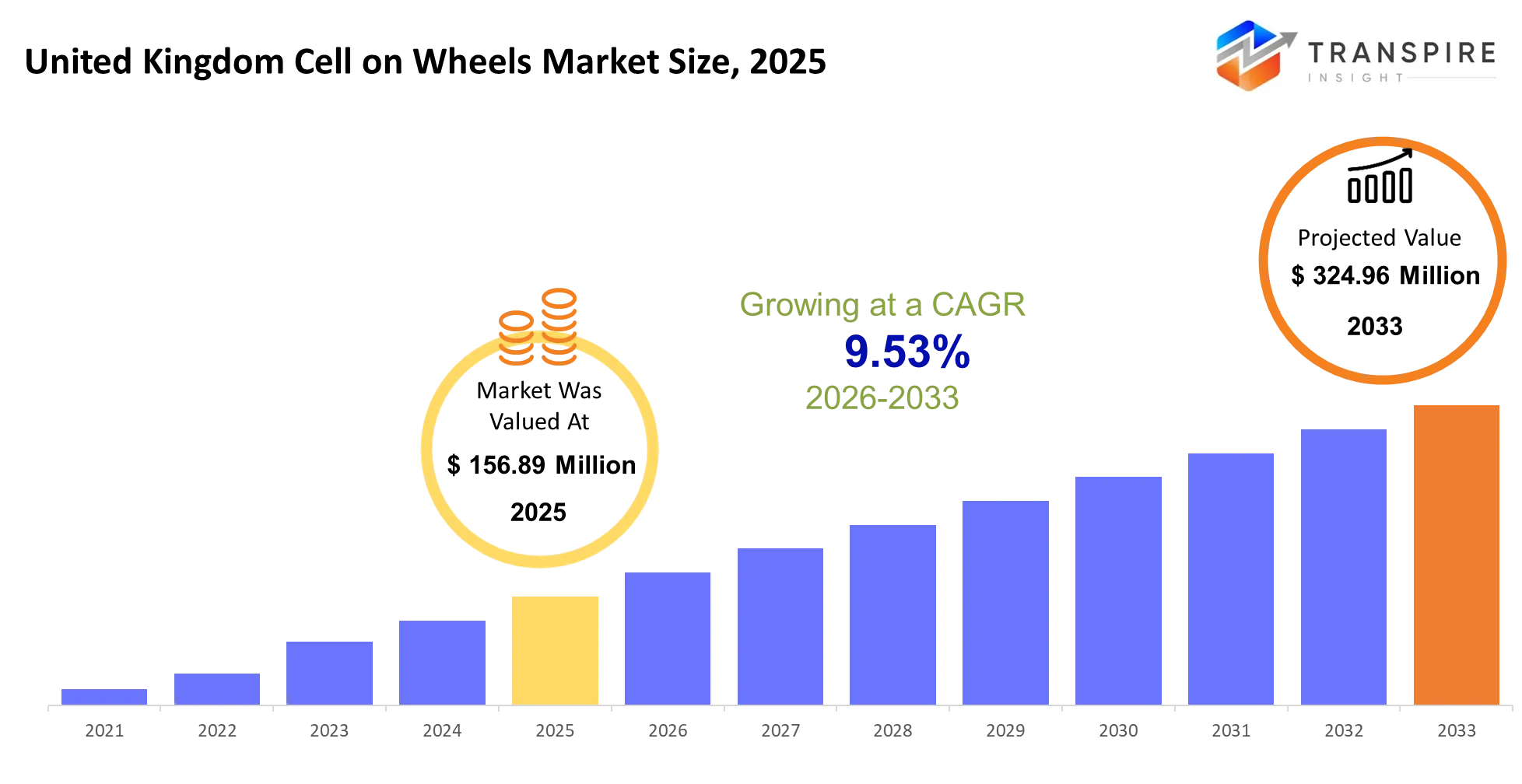
- United Kingdom Cell on Wheels Market Size 2025: USD 156.89 Million
- United Kingdom Cell on Wheels Market Size 2033: USD 324.96 Million
- United Kingdom Cell on Wheels Market CAGR: 9.53%
- United Kingdom Cell on Wheels Market Segments: By Vehicle Type (Truck-mounted COWs, Trailer-mounted COWs, Portable COWs, Rapid Deployment Units, Emergency COWs, Military COWs, Compact COWs, Others); By Application (Emergency Communication, Large Events, Disaster Recovery, Military Communications, Rural Connectivity, Network Expansion, Temporary Coverage, Others); By Technology (4G LTE COWs, 5G-enabled COWs, Satellite-integrated COWs, IoT-enabled Systems, Cloud-managed Systems, Edge-enabled Systems, Others); By End User (Telecom Operators, Defense Organizations, Government Agencies, Event Organizers, Broadcasters, Enterprises, Utilities, Others); By Deployment (Temporary Deployments, Permanent Deployments, Rapid-response Deployments, Outdoor Deployments, Indoor Deployments, Others)
To learn more about this report,  Download Free Sample Report
United Kingdom Cell on Wheels Market Summary
The United Kingdom Cell on Wheels Market was valued at USD 156.89 Million in 2025. It is forecast to reach USD 324.96 Million by 2033. That is a CAGR of 9.53% over the period.
Cell on Wheels units in the UK are quickly deployable mobile base station setups that telecom operators, and sometimes emergency planners use to bring back coverage during outages, handle high-density gatherings, and even stretch capacity in underserved rural areas. Basically they function like a stop-gap network lifeline when fixed towers get overloaded, or end up damaged, which helps keep connectivity steady for end users, logistics teams, and the whole public safety side.
Over the last five years, the market has shifted in a more fundamental way, moving away from standalone 4G emergency rollouts toward modular, 5G-ready, and Open RAN compatible systems. That shift lets teams integrate faster with the existing network landscape and also reduces the deployment friction, in real terms. A major driver was the big rise in large public events and resilience planning after extreme weather incidents, plus a few high-profile national gatherings. Those situations highlighted coverage gaps in dense city corridors. So now operators are more inclined to invest in flexible, rapidly scalable infrastructure that can be used across events, emergency response, and also planned capacity upgrades.
Key Market Insights
- The United Kingdom Cell on Wheels Market is pushed mainly by the need for fast telecom coverage back on line during outages, disasters, and big nationwide events, sort of a “no time to waste” situation.
- A noticeable structural shift is happening too, with 5G-enabled, modular, and Open RAN-compatible units gradually changing the way services get rolled out across the United Kingdom Cell on Wheels Market, even the deployment model itself.
- Operators also start blending Cell on Wheels with hybrid cloud networks, this helps with real-time elasticity, and it lowers reliance on fixed tower infrastructure, which is kind of limiting in remote areas.
- In terms of geography, London basically leads the United Kingdom Cell on Wheels Market, holding almost 38% share in 2025, thanks to dense populations and constant event-driven connectivity demand.
- Northern England is the fastest-growing region through 2030, driven by industrial digitization and also rural connectivity expansion initiatives , not just one factor.
- When it comes to form factor, vehicle-mounted systems take the second-largest share, they are used broadly for emergency telecom restoration and public safety communications, including coordinated incident response.
- Portable 5G-ready units are the fastest-growing segment through 2030, fueled by private network rollouts and smart city pilot projects that keep getting approved.
- For applications, emergency communication keeps the top position, with nearly 42% share in the United Kingdom Cell on Wheels Market , so yes, that’s still the primary use case.
- Telecom operators lead the end market with about 55% share, using Cell on Wheels for network densification and outage management, especially when capacity spikes suddenly.
- Lastly, government and defense agencies are the fastest-growing end-user group because investment in resilient communications infrastructure keeps increasing, and that direction doesn’t seem to slow down anytime soon.
What are the Key Drivers, Restraints, and Opportunities in the United Kingdom Cell on Wheels Market?
The United Kingdom Cell on Wheels Market is mostly pushed by the fast densification of 5G networks and a growing, almost urgent need for temporary capacity add ons in busy zones. Telecom operators have started deploying more quickly after spectrum refarming, and when 5G standalone rollouts revealed coverage gaps across dense cities, the whole rhythm changed. That’s why many operators now depend on mobile base stations that can be set in place within hours, which in turn helps stabilize service continuity during peak moments, like major national events, transport disruptions or emergency response scenes. Because of this, utilization levels for Cell on Wheels assets are climbing, and that tends to mean more rental cycles as well as steadier recurring service revenue streams.
Still, a key drag on the United Kingdom Cell on Wheels Market is the heavy capital intensity tied to advanced, 5G-enabled units, plus the backhaul setup that has to run alongside them. A lot of operators deal with long procurement timing and budget limits, since these units need integration with fiber or microwave links. And those links are not always there, especially not in remote, or disaster-prone, areas. This kind of structural snag slows the real deployment pace and keeps adoption from spreading outside main metropolitan regions, so the near term revenue upside gets kind of capped.
On the opportunity side, private 5G and smart infrastructure initiatives are beginning to stand out, especially across logistics hubs and industrial corridors in Northern England. Ports such as Felixstowe, and Teesside, are increasingly trialing dedicated mobile network deployments to back automated operations. In practice that opens doors for new long term leasing deals and managed service agreements for Cell on Wheels providers, so demand could stick around rather than fading quickly.
What Has the Impact of Artificial Intelligence Been on the United Kingdom Cell on Wheels Market?
Artificial intelligence and advanced digital technologies are kind of reshaping the United Kingdom Cell on Wheels Market by changing how mobile network assets are deployed, watched, and adjusted in real time. In practice, operators are using AI-driven orchestration platforms more and more, to automate site selection, tune radio settings, and coordinate fleet movement using live traffic pressure, plus outage alerts. It cuts down those annoying manual coordination lags and it helps teams restore connectivity quicker when things get intense, like during stadium gatherings or urgent disruptions.
On the other hand, machine learning models are also boosting predictive maintenance across mobile base station fleets. They dig into generator behavior, battery cycles, and radio frequency load trends to estimate potential equipment failures ahead of time. Because of that, many operators have seen fewer unexpected stoppages, and better fuel economy from temporary power solutions, which then supports stronger operating efficiency and steadier service continuity.
Then there’s AI-enabled network analytics. They improve spectrum usage and traffic balancing, which makes the user experience less painful in overcrowded areas, while also trimming operational overhead. Still, adoption isn’t fully smooth, mostly because of structural limitations tied to high integration costs and uneven real-world data coming from fast field deployments. Plus, intermittent connectivity at temporary sites makes it harder to stream data consistently, so model precision can drop in highly changing conditions.
Key Market Trends
- The United Kingdom Cell on Wheels Market seemed to shift after 2021, from disaster recovery use to more of that continuous network densification across high-density urban corridors and whatnot
- Between 2022 and 2025, 5G standalone rollout pushed a lot more temporary mobile site deployments up by nearly 35% , with London and Manchester being the clearest examples
- Telecom operators also cut back on fixed-site reliance after spectrum refarming,so they leaned harder on deployable base stations for those peak load moments
- In 2024 Vodafone expanded its mobile emergency fleet contracts , basically for national resilience support and event-driven coverage surges
- Equipment manufacturers like Ericsson rolled out modular 5G-ready units , swapping older 4G-only Cell on Wheels systems sometime after 2023
- Rental-based deployment models grew noticeably after 2022 ,because operators moved from ownership toward flexible infrastructure leasing strategies that feel easier to adjust
- Northern England recorded about a 28% rise in deployments since 2023, tied to industrial digitization and upgrades for logistics hub connectivity
- By 2025, AI-based network optimization tools started cutting down deployment decision timeframes by roughly 40% across major UK telecom operators
- And in the regulatory side, after severe weather events in 2023, the focus on network resilience nudged operators to keep bigger standby mobile base station fleets around, just in case
United Kingdom Cell on Wheels Market Segmentation
By Vehicle Type:
Truck-mounted COWs, trailer-mounted COWs, portable COWs, rapid deployment units, emergency COWs, military COWs, compact COWs, and others support the flexible network footprint, across temporary and high-demand areas, pretty much on short notice. Truck-mounted and trailer-mounted systems still lead, mostly because they are quicker to get in place and transport is less of a headache. Portable and compact units are the go-to option for smaller scale missions, where room and time constraints keep heavier buildouts out of the picture.
Emergency and military COWs show up more and more for continuity, especially when disruptions or security operations interrupt normal comms. Rapid deployment units also fit the need for fast service recovery in regions that tend to lose network stability. And the demand for vehicle-based setups keeps sliding toward lighter modular designs, those that cut installation time and boost mobility in both urban streets and rural stretches.
By Application:
Emergency communication, large events, disaster recovery, military communications, rural connectivity, network expansion, temporary coverage, and a few other categories shape the real-world use across different operating scenarios. Emergency communication stays the most dependable use case because it directly ties to outage response. Large events and temporary coverage have grown too, mainly due to heavier data load during public gatherings and commercial activities.
For disaster recovery, organizations continue to depend on rapid-response mobile infrastructure to bring essential services back. Rural connectivity is widening as operators go after dead spots in remote regions. Network expansion use cases keep moving alongside 5G rollout, while military and government deployments aim at secure, resilient channels during sensitive missions.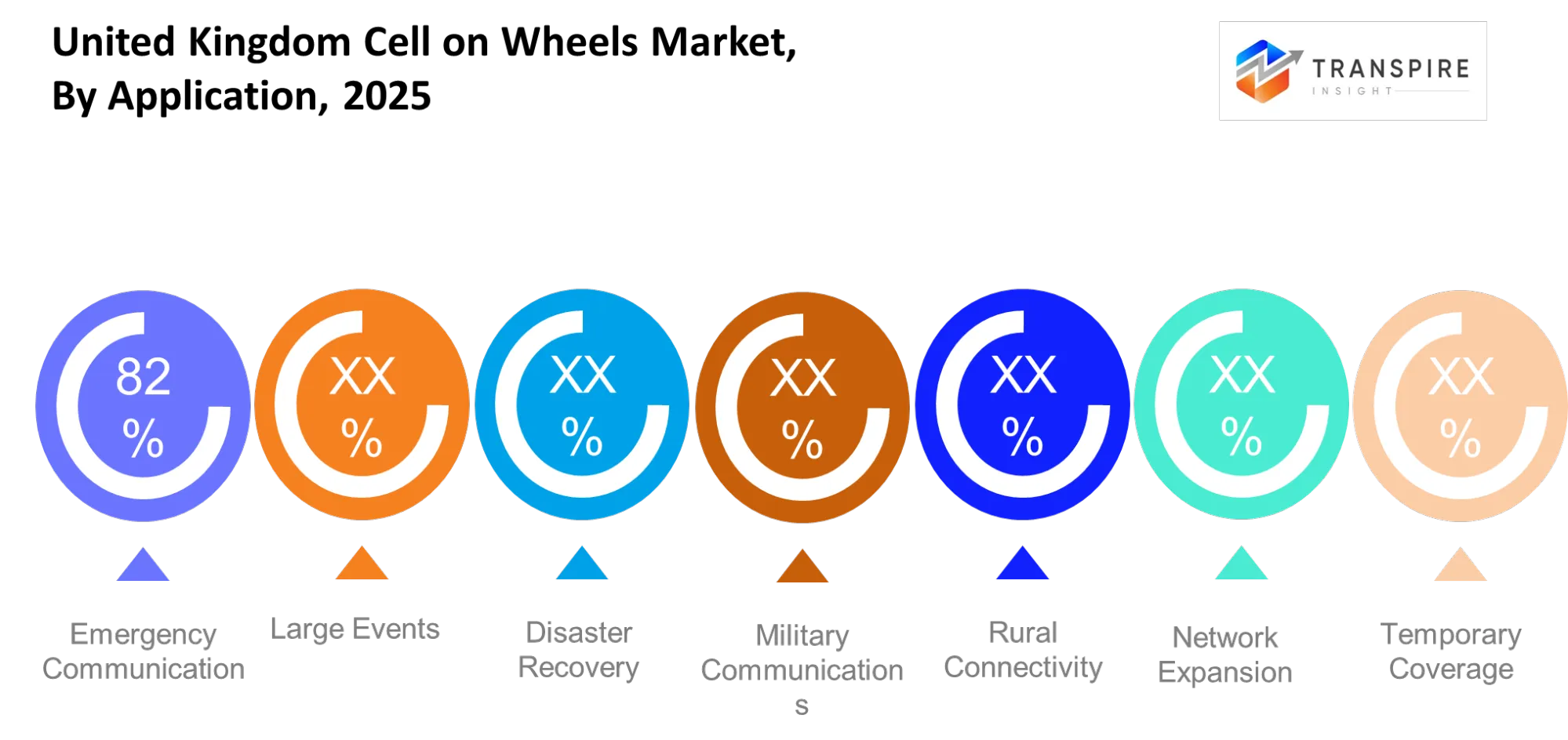
To learn more about this report, Download Free Sample Report
By Technology:
4G LTE COWs , 5G-enabled COWs, satellite-integrated COWs, IoT-enabled systems, cloud-managed systems, edge-enabled systems, and other variants show this slow but steady evolution in technology adoption. The 4G LTE units still cover a lot of legacy expectations, yet 5G-enabled setups are getting more attention, especially when high-capacity rollouts are required. Satellite-integrated systems, on the other hand, make the connection more reliable in remote places or where the local infrastructure is limited.
Meanwhile, IoT-enabled and cloud-managed systems are used for real-time observation and centralized command over mobile network fleets. Edge-enabled systems cut latency, and they also boost on-site processing efficiency, which matters when every second counts. Overall, the shift is moving toward combined platforms where cloud, edge, and satellite connectivity are brought together, to raise speed, strengthen reliability, and support better operational coordination.
By End User:
In practice, telecom operators, defense organizations, government agencies, event organizers, broadcasters, enterprises, utilities, and more use Cell on Wheels systems because they are flexible communication support on demand. Telecom operators are still the main buyers, since network augmentation and outage recovery are constant needs. Government agencies and defense organizations often choose these solutions for secure, fast-deploy communication infrastructure, mainly for emergency readiness.
Event organizers and broadcasters depend on temporary mobile networks to handle surges in data during live moments. Enterprises and utilities are also adopting the same idea for operational continuity, particularly at remote or infrastructure-limited sites. Finally, the end-user demand is leaning toward shared and rental-based models, which helps reduce ownership costs and improves deployment flexibility, even if the setup is short-term.
By Deployment:
Temporary deployments, permanent deployments, rapid-response deployments, outdoor deployments, indoor deployments , and others sorta shape the operational usage pattern. Temporary deployments still win most often, mostly because short term capacity is needed during events and all sorts of disruptions. Rapid-response deployments seem to be rising, operators basically push for faster restoration of communication services when outages happen, or when emergency situations show up.
Outdoor deployments are still the most common, largely because installation is flexible in open environments. Indoor deployments are slowly growing too, especially in commercial complexes and big venues, where controlled coverage matters more. Permanent deployments are more limited, but they do show up in hybrid network strategies, where long term supplemental coverage is required. Overall, the deployment models keep shifting toward flexible, on-demand infrastructure use.
What are the Key Use Cases Driving the United Kingdom Cell on Wheels Market?
Emergency communication is still the main use case, basically driving the United Kingdom Cell on Wheels Market, because telecom operators roll out mobile base stations when connectivity gets hit by outages, congestion, or infrastructure failures. The need looks especially big in city areas where traffic jumps often, and where service continuity is kinda non negotiable for public safety and business operations.
After that, big events connectivity and disaster recovery keep growing as secondary uses, mainly for event organizers and government agencies. Places with lots of people, like stadiums and transport hubs, need quick temporary capacity boosts, and during disruptions emergency response teams lean on fast deployment units so coordination doesn’t fall apart.
Also there are military communications and rural broadband extensions which are starting to show real, longer term promise. Defense orgs are adopting secure mobile networks for on ground field work, while telecom providers are testing Cell on Wheels systems to plug stubborn coverage gaps in remote parts across the United Kingdom.
|
Report Metrics |
Details |
|
Market size value in 2025 |
USD 156.89 Million |
|
Market size value in 2026 |
USD 171.84 Million |
|
Revenue forecast in 2033 |
USD 324.96 Million |
|
Growth rate |
CAGR of 9.53% from 2026 to 2033 |
|
Base year |
2025 |
|
Historical data |
2021 - 2024 |
|
Forecast period |
2026 - 2033 |
|
Report coverage |
Revenue forecast, competitive landscape, growth factors, and trends |
|
Regional scope |
Middle East and Africa (Saudi Arabia, United Arab Emirates, South Africa, Rest of Middle East and Africa) |
|
Key company profiled |
Ericsson, Nokia, Huawei, Samsung Networks, ZTE Corporation, American Tower, Crown Castle, AT&T, Verizon Communications, BT Group, Vodafone, Telefonica, CommScope, NEC Corporation, Parallel Wireless |
|
Customization scope |
Free report customization (country, regional & segment scope). Avail customized purchase options to meet your exact research needs. |
|
Report Segmentation |
By Vehicle Type (Truck-mounted COWs, Trailer-mounted COWs, Portable COWs, Rapid Deployment Units, Emergency COWs, Military COWs, Compact COWs, Others); By Application (Emergency Communication, Large Events, Disaster Recovery, Military Communications, Rural Connectivity, Network Expansion, Temporary Coverage, Others); By Technology (4G LTE COWs, 5G-enabled COWs, Satellite-integrated COWs, IoT-enabled Systems, Cloud-managed Systems, Edge-enabled Systems, Others); By End User (Telecom Operators, Defense Organizations, Government Agencies, Event Organizers, Broadcasters, Enterprises, Utilities, Others); By Deployment (Temporary Deployments, Permanent Deployments, Rapid-response Deployments, Outdoor Deployments, Indoor Deployments, Others) |
Which Regions are Driving the United Kingdom Cell on Wheels Market Growth?
London and South East England, kind of lead the United Kingdom Cell on Wheels Market, mainly because the network load gets concentrated really heavily and there is strong regulatory pressure focused on service continuity. With dense city infrastructure around, telecom operators have to roll out mobile base stations more often, especially when congestion spikes or there are big public events. The region also has advanced fiber backhaul availability, plus well-established telecom operator headquarters, so the deployment coordination moves faster. On top of that, the ongoing policy push for national connectivity resilience really helps adoption, and that’s why London stays the most active deployment hub.
Scotland, on the other hand, shows a steady and structurally stable contribution, driven more by geographic coverage challenges than by sudden urban demand spikes. The remote terrain and scattered population areas push operators to reinforce mobile networks periodically, especially during seasonal tourism and periods of industrial activity. Unlike London, the growth here is not really event driven, it is more tied to long-term infrastructure consistency, along with gradual expansion of 5G rollout. Utility operators and public service networks keep investment cycles on a steady cadence, which supports predictable demand for short term connectivity options across the region.
Northern England is the fastest growing area because industrial digitization is accelerating, and logistics corridor upgrades are spreading across ports and manufacturing zones. Newer investments in smart port infrastructure and automated warehousing systems have pushed demand for flexible, high capacity connectivity solutions. As a result, deployment opportunities are showing up beyond the typical telecom use cases. For market entrants and investors, this region basically signals strong expansion potential from 2026 to 2033, especially across industrial private network builds and hybrid connectivity projects.
Who are the Key Players in the United Kingdom Cell on Wheels Market and How Do They Compete?
The United Kingdom Cell on Wheels Market is sort of moderately consolidated, with global telecom equipment providers and a handful of telecom operators that basically control most deployments. In practice, competition gets shaped mostly by technology readiness and how fast they can roll out, not so much by pure pricing. Bigger vendors try to keep their share by stitching mobile base stations together with a 5G core network, while smaller specialists sometimes win via more flexible rental models and quicker on-the-ground response, which yes, matters. Overall demand driven by emergency coverage and heavy event connectivity keeps pushing rivalry higher, between suppliers.
Ericsson handles it with advanced 5G-ready portable network solutions that plug into existing operator infrastructure with minimal hassle. Their edge comes from modular system design that trims setup time and makes interoperability smoother, especially when traffic gets really intense. They’re also growing their UK footprint using partnerships with telecom operators tied to national resilience programs and temporary capacity scaling efforts, the kind that need to be moved quickly.
Nokia, on the other hand, leans into integrated radio access together with edge-enabled Cell on Wheels systems, built for real-time network optimization. A key strength is software-driven orchestration tools, these help boost deployment efficiency in dense city areas where everything is crowded. Their expansion includes collaborations linked to government-backed connectivity initiatives and private 5G pilots running across industrial zones, where reliability is non-negotiable.
Vodafone boosts its position by running its own mobile emergency fleets, aiming for rapid outage recovery when timing is tight. Meanwhile CommScope competes with cost-efficient hardware and scalable trailer-mounted systems, with a focus on rental service providers and event-based connectivity demand.
Company List
- Ericsson
- Nokia
- Huawei
- Samsung Networks
- ZTE Corporation
- American Tower
- Crown Castle
- AT&T
- Verizon Communications
- BT Group
- Vodafone
- Telefonica
- CommScope
- NEC Corporation
- Parallel Wireless
Recent Development News
In February 2026, Virgin Media O2 launched “O2 Satellite” in partnership with Starlink Direct-to-Cell technology. The service enables UK smartphones to connect directly to satellites for messaging and limited data in rural and coverage-blackspot areas, significantly strengthening emergency and temporary mobile connectivity capabilities that underpin deployable network solutions like Cell on Wheels.Source https://www.benton.org/
In March 2026, Centrica and Delta Electronics entered a strategic partnership to deploy solid oxide fuel cell (SOFC) off-grid power systems across the UK and Europe. The collaboration targets data centres and energy-intensive infrastructure by providing fast-deployable, grid-independent power solutions, which are increasingly important for supporting temporary telecom infrastructure and mobile network expansion units.
Source https://h2-tech.com/
What Strategic Insights Define the Future of the United Kingdom Cell on Wheels Market?
The United Kingdom Cell on Wheels Market is moving, kind of slowly but definitely, toward a hybrid mobile infrastructure kind of model where temporary base stations end up becoming a lasting piece of telecom network planning, rather than only being treated as an emergency only asset. At the same time, this change is being pushed by ongoing 5G traffic increase, rural coverage economics that stay uneven, and higher expectations from users for nonstop connectivity in both public places and commercial spaces. Over the next five to seven years, deployment plans will likely give more weight to mobility, automation, and shared infrastructure setups that are tightly integrated with cloud-managed network operations.
There is also a quieter risk though, the growing dependence on centralized software orchestration platforms. That dependence can turn into vendor lock-in, and it can also raise operational exposure if interoperability norms stay uneven across different equipment providers. In practice, this might reduce flexibility for operators when they run multi vendor deployments, and it may worsen response speed during high impact outages.
On the opportunity side, one of the more promising angles is private 5G networks for industrial corridors and logistics clusters, especially across Northern England. There smart port modernization is accelerating, and the whole segment is still underpenetrated but is slowly gaining traction. It’s being supported, at least in part, by government-backed digital infrastructure programs. Market players should focus on modular, vendor-agnostic Cell on Wheels offerings that can slot in easily with private 5G ecosystems and edge computing environments, so they can better secure long-term recurring deployment contracts.
United Kingdom Cell on Wheels Market Report Segmentation
By Vehicle Type
- Truck-mounted COWs
- Trailer-mounted COWs
- Portable COWs
- Rapid Deployment Units
- Emergency COWs
- Military COWs
- Compact COWs
By Application
- Emergency Communication
- Large Events
- Disaster Recovery
- Military Communications
- Rural Connectivity
- Network Expansion
- Temporary Coverage
By Technology
- 4G LTE COWs
- 5G-enabled COWs
- Satellite-integrated COWs
- IoT-enabled Systems
- Cloud-managed Systems
- Edge-enabled Systems
By End User
- Telecom Operators
- Defense Organizations
- Government Agencies
- Event Organizers
- Broadcasters
- Enterprises
- Utilities
By Deployment
- Temporary Deployments
- Permanent Deployments
- Rapid-response Deployments
- Outdoor Deployments
- Indoor Deployments
Frequently Asked Questions
Find quick answers to common questions.
The United Kingdom Cell on Wheels Market size is USD 324.96 Million in 2033.
Key Segments for the United Kingdom Cell on Wheels Market are By Vehicle Type (Truck-mounted COWs, Trailer-mounted COWs, Portable COWs, Rapid Deployment Units, Emergency COWs, Military COWs, Compact COWs, Others); By Application (Emergency Communication, Large Events, Disaster Recovery, Military Communications, Rural Connectivity, Network Expansion, Temporary Coverage, Others); By Technology (4G LTE COWs, 5G-enabled COWs, Satellite-integrated COWs, IoT-enabled Systems, Cloud-managed Systems, Edge-enabled Systems, Others); By End User (Telecom Operators, Defense Organizations, Government Agencies, Event Organizers, Broadcasters, Enterprises, Utilities, Others); By Deployment (Temporary Deployments, Permanent Deployments, Rapid-response Deployments, Outdoor Deployments, Indoor Deployments, Others).
Major United Kingdom Cell on Wheels Market Players are Ericsson, Nokia, Huawei, Samsung Networks, ZTE Corporation, American Tower, Crown Castle, AT&T, Verizon Communications, BT Group, Vodafone, Telefonica, CommScope, NEC Corporation, Parallel Wireless.
The Current United Kingdom Cell on Wheels Market size is USD 156.89 Million in 2025.
The United Kingdom Cell on Wheels Market CAGR is 9.53% from 2026 to 2033.
- Ericsson
- Nokia
- Huawei
- Samsung Networks
- ZTE Corporation
- American Tower
- Crown Castle
- AT&T
- Verizon Communications
- BT Group
- Vodafone
- Telefonica
- CommScope
- NEC Corporation
- Parallel Wireless
Recently Published Reports
-
Apr 2026
3D Optical Profiler Market
3D Optical Profiler Market Size, Share & Analysis Report By Type (Desktop 3D Optical Profiler, and Portable 3D Optical Profiler), By Technology (Confocal Technology, and White Light Interference), By End-Use Industry (Manufacturing, Research Institutions, Automotive, Aerospace and Defense, Medical Devices, and Other), and Geography (North America, Europe, Asia-Pacific, Middle East and Africa, South and Central America), 2021 - 2031
-
Apr 2026
Depth Sensor Market
Depth Sensor Market Size, Share & Analysis Report By Type (Infrared Depth Sensors, Time-of-Flight (ToF) Sensors, Stereo Vision Sensors, Structured Light Sensors, Ultrasonic Depth Sensors), By Application (Automotive, Robotics, Gaming, Consumer Electronics, Industrial Automation, Healthcare, Security & Surveillance, Others), By End Users (Automotive Manufacturers, Consumer Electronics Companies, Healthcare Providers, Industrial Companies, Security Agencies, Gaming Companies, Robotics Companies, Others), and Geography (North America, Europe, Asia-Pacific, Middle East and Africa, South and Central America), 2021 – 2031
-
Apr 2026
Digital Manufacturing Market
Digital Manufacturing Market Size, Share & Analysis Report By Component (Hardware, Software, and Services), By Technology (Robotics, 3D Printing, Internet of Things (IoT), and Others), By Application (Automotive and Transportation, Aerospace and Defense, Consumer Electronics, Industrial Machinery, and Others), By Process Type (Computer-Based Designing, Computer-Based Simulation, Computer 3D Visualization, Analytics, and Others), and Geography (North America, Europe, Asia-Pacific, Middle East and Africa, South and Central America), 2021 – 2031
-
Apr 2026
Digital Visa Services Market
Digital Visa Services Market Size, Share & Analysis Report By Type (Individual Travelers, Group Travelers), By Application (Tourism, Business Travel, Others), and Geography (North America, Europe, Asia-Pacific, Middle East and Africa, South and Central America), 2021 – 2031