

United Kingdom Business Process Outsourcing Market Size & Forecast:
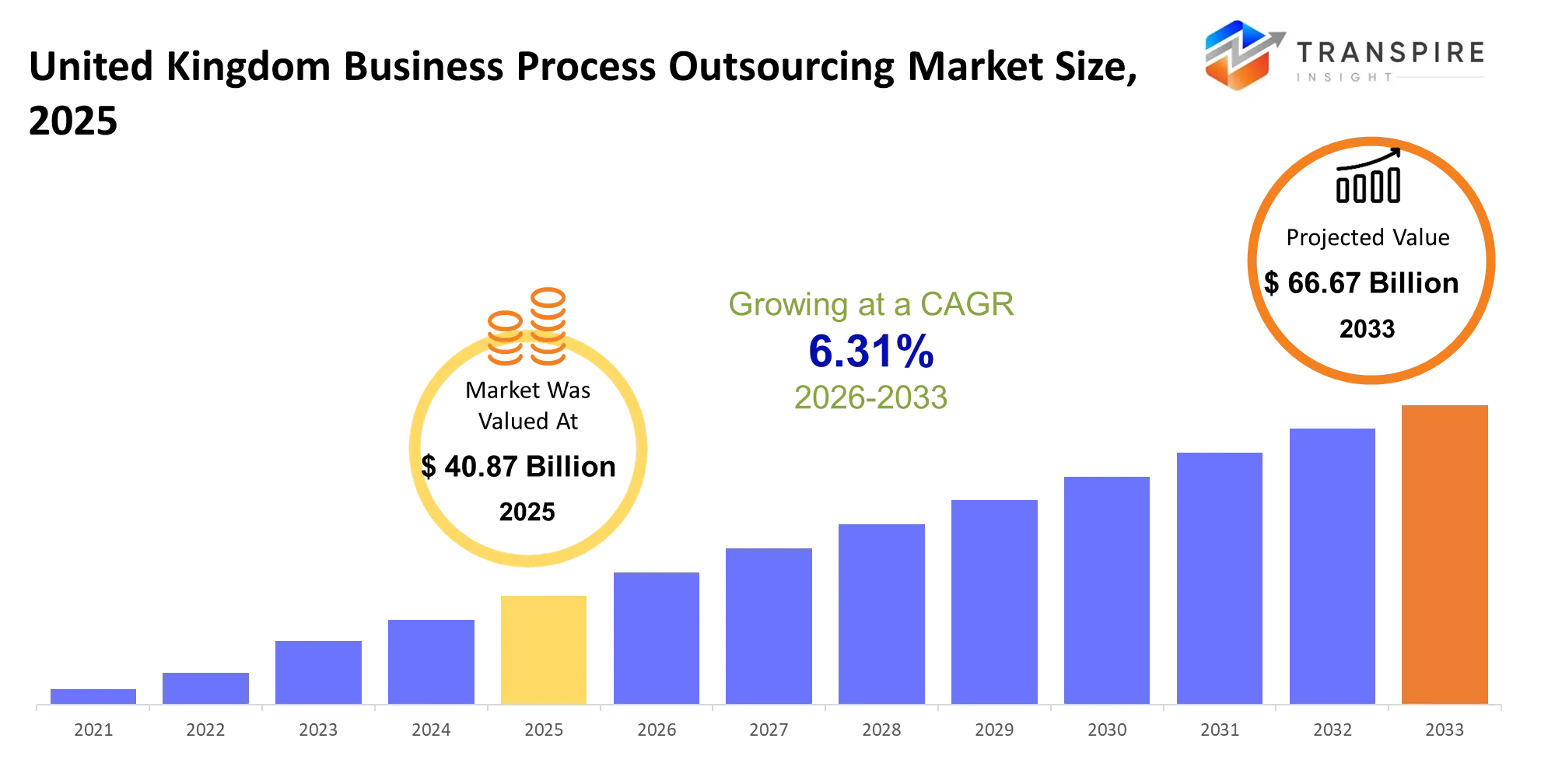
- United Kingdom Business Process Outsourcing Market Size 2025: USD 40.87 Billion
- United Kingdom Business Process Outsourcing Market Size 2033: USD 66.67 Billion
- United Kingdom Business Process Outsourcing Market CAGR: 6.31%
- United Kingdom Business Process Outsourcing Market Segments: By Service Type (Customer Support Services, Finance & Accounting Outsourcing, HR Outsourcing, Procurement Outsourcing, IT Support Services, Knowledge Process Outsourcing, Back-office Services, Others); By Deployment (Onshore Outsourcing, Offshore Outsourcing, Nearshore Outsourcing, Cloud-based BPO, AI-enabled BPO, Others); By Application (BFSI, Healthcare, Retail, IT & Telecom, Manufacturing, Government, E-commerce, Others); By Enterprise Size (Large Enterprises, SMEs, Startups, Global Enterprises, Others)
To learn more about this report,  Download Free Sample Report
United Kingdom Business Process Outsourcing Market Summary
The United Kingdom Business Process Outsourcing Market was valued at USD 40.87 Billion in 2025. It is forecast to reach USD 66.67 Billion by 2033. That is a CAGR of 6.31% over the period.
The United Kingdom Business Process Outsourcing (BPO) market kind of matters a lot, because it helps organizations handle areas like customer support, finance and accounting, human resources, procurement, and IT operations without having to keep huge in-house teams around all the time. In real life, it lets companies lower operational complexity, make service quality more consistent, and then steer internal efforts toward core strategic things.
Over the last five years, the market shifted in a noticeable way, from outsourcing that mostly depends on labor to outsourcing that is powered by technology and also delivers services in a more enabled manner. Automation , cloud platforms, artificial intelligence, and advanced analytics have slowly moved to the center of outsourcing agreements, so providers can aim for higher-value outcomes instead of just sending manpower. Also the COVID-19 pandemic sort of pushed everything faster , because many organizations had to work remotely and speed up digital transformation initiatives. When businesses rewired their workflows and customer engagement journeys, outsourcing partners became more than just vendors— they became actual implementation and operational support allies. That broader change has widened the range of what gets outsourced, driven up contract values, and opened up fresh revenue pathways for providers who can blend domain expertise with digital capability, not only one or the other.
Key Market Insights
- England kinda dominates the United Kingdom Business Process Outsourcing Market, grabbing something like 75% of all industry revenue , mostly because big enterprises are clustered there , not elsewhere.
- London still keeps a major slice of outsourcing demand, and it is helped along by strong financial services, tech, and professional services fields too.
- Scotland is the fastest-growing regional area over the forecast window, largely tied to digital transformation investments , plus the rise of nearshore service delivery centers, which feels very “in the flow” for clients.
- Northern England keeps pulling in outsourcing work thanks to relatively competitive operating expenses and also broader technology talent reservoirs.
- On the services side, customer service outsourcing leads the pack with about 35% share , backed by omnichannel engagement, and digital customer experience approaches that are pretty widely adopted now.
- Human resource outsourcing is still getting more attention as organizations streamline workforce management and payroll administration workflows, in a way that reduces friction.
- Customer relationship management applications are the top segment with nearly 30% of the market, and this points to steady demand for customer retention alongside service excellence.
- Back office processing stays a big revenue driver across banking, retail, telecommunications, and healthcare.
- Data analytics and business intelligence applications are the quickest-growing category, since enterprises want actionable operational signals not just reports.
- AI enabled customer support platforms are also starting to show real momentum, with emerging demand across multiple industry verticals, which is a trend you can pretty much see spreading.
What are the Key Drivers, Restraints, and Opportunities in the United Kingdom Business Process Outsourcing Market?
The strongest force moving the United Kingdom Business Process Outsourcing (BPO) market forward is the shift toward technology- enabled operating models. Over the last few years, rising labour costs, ongoing pressure to boost service quality, and the widespread uptake of cloud based business systems have pushed organizations to reconsider how support functions are actually handled. Instead of just adding more internal headcount, many companies now outsource customer service, finance, procurement, and IT processes to specialist providers that are set up with automation, artificial intelligence and analytics. That move tends to cut operating costs, yes, but also speeds up processes and improves scalability, so you end up seeing higher contract values and more outsourcing happening across different industries.
Data security and regulatory compliance duties still feel like the biggest structural obstacle in the market. Firms working in tightly regulated areas—think banking, healthcare, and public services—have to follow demanding data governance rules, including UK GDPR and additional sector specific requirements. Getting the infrastructure right, keeping compliance certifications current, and dealing with cross border data transfers all take meaningful spend, plus long implementation timelines. And since these requirements are embedded into both legal and day to day operational frameworks, they generally can’t be sorted out quickly. It often means outsourcing decisions get pushed back, and providers without strong compliance know how to end up with less growth, even though there is demand for it.
Generative AI integration feels like a big chance for the next phase, of market expansion. In the UK, enterprises are more and more putting money into AI-powered customer service, smarter document handling, and automated workflow management which is pretty much everywhere lately. The providers that mix human know-how with AI-enabled service delivery , they can boost productivity, cut down on answer times and also open up fresher high-value outsourcing deals especially within financial services, healthcare administration, and the professional services kind of sector.
What Has the Impact of Artificial Intelligence Been on the United Kingdom Business Process Outsourcing Market?
Artificial intelligence and newer digital technologies are changing the United Kingdom business process outsourcing market, basically by moving day to day service delivery away from labor-heavy stuff and toward data-driven, mostly automated workflows. In practice, many BPO providers now roll out AI-powered chatbots, virtual assistants, intelligent document processing, and robotic process automation, so they can deal with repetitive customer service, finance, human resources, and those back-office routines. These setups can sort through invoices, validate customer information, steer claims workflows, and handle standard service requests with very little human input. As a result, processing time tends to drop, and operational consistency becomes more steady.
Also, machine learning models are getting used to sharpen predictive abilities across multiple outsourced business functions. Providers apply predictive analytics to estimate how many customer contacts are coming, flag possible service disruptions, spot fraudulent transactions, and fine tune workforce scheduling. When they look at past plus real-time operational data, these tools can help companies place resources where they matter most, and generally boost service-level performance. A lot of enterprises say they see quicker case resolution, reduced transaction processing costs, stronger compliance monitoring, and better customer satisfaction after adopting AI-enabled outsourcing offerings.
Still, there is a key limitation with all this. AI adoption can get slowed down when advanced AI platforms have to plug into legacy enterprise systems, because it often means a big financial commitment, a long rollout, and a lot of data preparation. On top of that, many organizations run into fragmented datasets, and that can quietly lower model accuracy , plus it may prevent the predictive automation programs from reaching their full potential.
Key Market Trends
- Since 2021, UK enterprises have kinda shifted their outsourcing deals toward automation led services, and that reduces the whole reliance on those classic labor-arbitrage style business models a bit more than before.
- After 2023, Generative AI adoption really picked up steam, so providers started folding in smarter chatbots , document handling, and workflow automation features , into the offerings.
- In financial services, a growing number of firms are outsourcing compliance monitoring and reporting, especially because the rules keep getting more complicated and, honestly, more resource intensive.
- Also, hybrid work setups that took off after the pandemic, have broadened remote service delivery networks, and in turn lowered dependence on one or two centralized operational hubs.
- Between 2020 and 2025, cloud-native outsourcing platforms gained more share, they started replacing older infrastructure and they improved scalability across client operations too.
- Buyers are leaning more and more toward outcome based contracts, meaning the provider gets paid in relation to customer satisfaction, efficiency metrics , and specific service level performance targets.
- And under UK GDPR, data security needs have gone up, so investment in cybersecurity infrastructure, compliance frameworks, and secure outsourcing environments has increased as well, not lightly either.
- Providers like Accenture, Capgemini, and Teleperformance have expanded their AI powered service portfolios, just to stay differentiated in the market, kind of.
- Finally, analytics driven workforce management tools have boosted forecasting accuracy, which helps providers fine tune staffing levels and reduce service disruptions.
United Kingdom Business Process Outsourcing Market Segmentation
By Service Type :
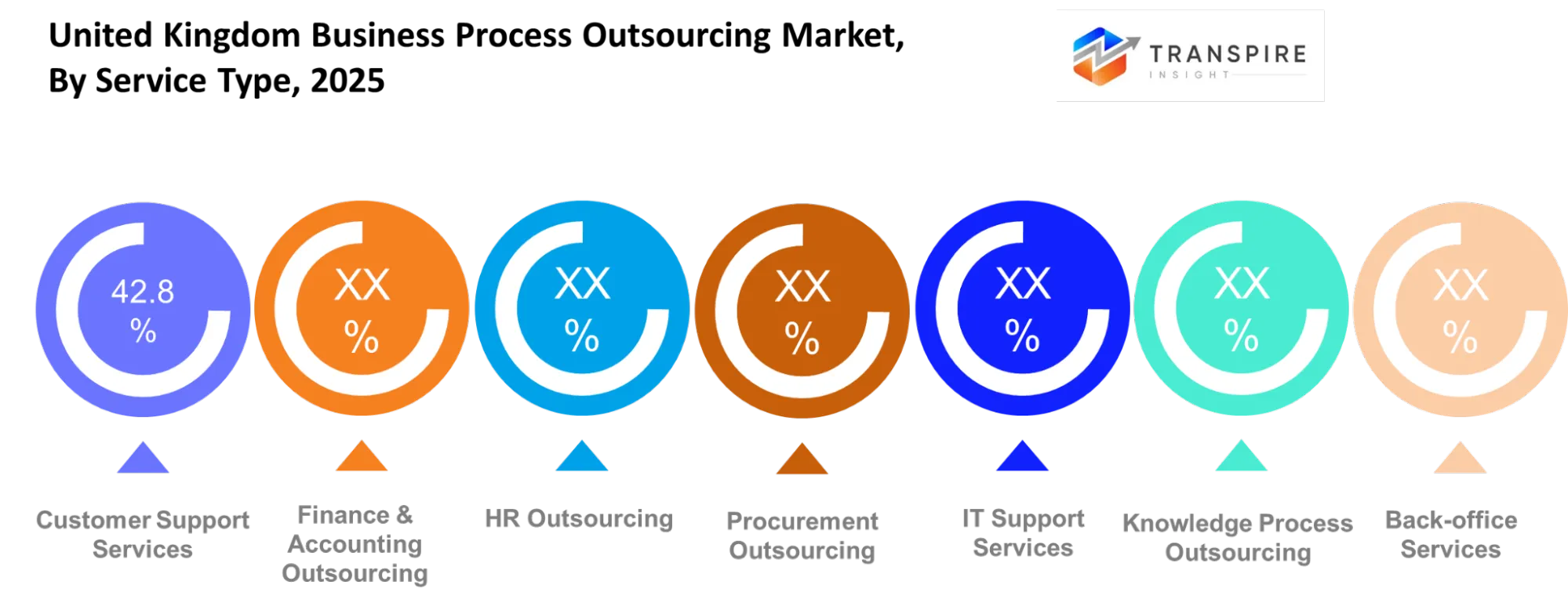
Customer support services kind of handle customer conversations across voice, email, chat , and the whole bunch of digital channels. Finance and accounting outsourcing takes care of bookkeeping stuff, payroll processing, tax support, and also financial reporting and summaries. HR outsourcing meanwhile, covers recruitment assistance, employee administration, benefits management, and the workforce-related workflow details.
Procurement outsourcing helps with supplier management, sourcing activities, contract administration, and day to day purchasing operations. IT support services do the technical assistance part, infrastructure monitoring, plus help desk functions. Knowledge process outsourcing delivers specialized offerings like research work, analytics, and business intelligence.
Then there are back-office services, which basically manage admin tasks—data entry, records management, and transaction processing. Other services also exist to cover industry specific operational needs, and more customized business operations that don’t quite fit the standard categories.
To learn more about this report, Download Free Sample Report
By Deployment :
Onshore outsourcing usually means the service gets delivered within the United Kingdom, so it helps with closer communication, better regulatory alignment and some extra operational oversight. Offshore outsourcing, on the other hand, moves business functions out to far away international locations so the company can chase cost efficiencies, plus get access to bigger talent pools. Nearshore outsourcing lands work in nearby regions that still feel geographically and culturally connected in a more practical way.
For cloud-based BPO, organizations use cloud infrastructure to provide scalable, more flexible services, with easier access to business applications and the actual data. AI-enabled BPO is when artificial intelligence, automation tools, predictive analytics and machine learning get folded into how the services are delivered, not just bolted on. Then there are other deployment models too, they sort of answer unique organizational needs by using hybrid arrangements, and customized operating structures that fit the situation.
By Application :
BFSI apps tend to cover the customer service side, claims processing, compliance assistance, plus the everyday financial transaction management. On the healthcare side, you usually see patient administration, medical billing support, record keeping ,and appointment coordination. Retail organizations often outsource things for customer engagement, inventory related help, and order processing tasks, but it depends on the shop size.
For IT and telecom businesses they lean on outsourced services for technical support, customer care, and network administration type work. Manufacturing outfits commonly use business process outsourcing for procurement, supply chain coordination, and administrative duties. Government agencies apply outsourcing for citizen services, document management, and a bunch of paperwork handling. E-commerce companies use outsourced support for customer questions, returns handling, and online transaction management. Beyond that , other applications can cover extra operational needs that fit each particular industry, a bit differently than the rest.
By Enterprise Size :
Large enterprises often rely on outsourcing to handle those extensive operations, boost efficiency, and help support their expansion… like, sometimes it’s just easier that way. SMEs typically pick outsourced services because they want access to professional skills without building and keeping huge internal groups. Startups use outsourcing too, not only to keep costs under control but also to quicken growth, and to put more attention on the “core” work they do every day.
At the global level, enterprises usually roll out outsourcing methods across different regions, aiming to make operations more uniform, raise service quality, and keep scalability in a better shape. Besides that, there are other organization types, such as those with specialized operational setups or distinct business needs. In the end, every category seems to choose outsourcing solutions based on operational complexity, budget constraints, and their longer-term business purposes.
What are the Key Use Cases Driving the United Kingdom Business Process Outsourcing Market?
Customer support still feels like the main thing that is really pushing adoption across the United Kingdom Business Process Outsourcing Market. Big enterprises in banking, telecommunications, retail,and e-commerce lean on outsourced customer service operations to deal with massive interaction volumes, keep service levels steady, and also offer support 24/7, while trying to keep operational expenses in check, basically.
Alongside that, finance and accounting services, plus HR process management, are getting used more and more across healthcare providers, manufacturers, and small and medium-sized enterprises. These groups bring in outsourced know-how to run payroll, compliance reporting, employee administration, and transaction processing in a more efficient way, and at the same time reduce the load on their own internal squads.
More new use cases are starting to appear, especially around AI-enabled business analytics, intelligent document processing, and compliance monitoring. Financial institutions are looking into predictive analytics for risk assessment, while healthcare organizations are rolling out automated records management solutions. Right now these things are still kind of early-stage, but they are expected to pick up speed later on, as organizations push for better efficiency, stronger accuracy, and decision-making that is more data-driven during the forecast period.
|
Report Metrics |
Details |
|
Market size value in 2025 |
USD 40.87 Billion |
|
Market size value in 2026 |
USD 43.45 Billion |
|
Revenue forecast in 2033 |
USD 66.67 Billion |
|
Growth rate |
CAGR of 6.31% from 2026 to 2033 |
|
Base year |
2025 |
|
Historical data |
2021 - 2024 |
|
Forecast period |
2026 - 2033 |
|
Report coverage |
Revenue forecast, competitive landscape, growth factors, and trends |
|
Regional scope |
Middle East and Africa (Saudi Arabia, United Arab Emirates, South Africa, Rest of Middle East and Africa) |
|
Key company profiled |
Accenture, Infosys BPM, TCS, Wipro, Genpact, Capgemini, Cognizant, Teleperformance, Concentrix, HCLTech, IBM, Tech Mahindra, EXL Service, Serco Group, Sitel Group |
|
Customization scope |
Free report customization (country, regional & segment scope). Avail customized purchase options to meet your exact research needs. |
|
Report Segmentation |
By Service Type (Customer Support Services, Finance & Accounting Outsourcing, HR Outsourcing, Procurement Outsourcing, IT Support Services, Knowledge Process Outsourcing, Back-office Services, Others); By Deployment (Onshore Outsourcing, Offshore Outsourcing, Nearshore Outsourcing, Cloud-based BPO, AI-enabled BPO, Others); By Application (BFSI, Healthcare, Retail, IT & Telecom, Manufacturing, Government, E-commerce, Others); By Enterprise Size (Large Enterprises, SMEs, Startups, Global Enterprises, Others) |
Which Regions are Driving the United Kingdom Business Process Outsourcing Market Growth?
England still feels like the main place in the United Kingdom Business Process Outsourcing Market, mostly because it has the biggest pile up of financial institutions, multinational corporations, and technology firms. London especially works as a key outsourcing hub , so companies can pull in customer service, finance, compliance, and IT support functions from there. The whole setup is helped by solid digital infrastructure and a deep pool of professionals, plus those older, well known business networks that keep deals moving. In practice, it lets service providers ramp up operations pretty efficiently , yet still stay close to high-value enterprise contracts.
Scotland is also important, but it’s kind of a different story compared with England. The activity there is backed by a stable business setting, a strong footprint of financial services operations, and ongoing investment in digital skills. Edinburgh and Glasgow, in particular, have drawn outsourcing centers that concentrate on specialized business processes and shared services. With steady corporate spending and lower operating costs, Scotland tends to hold a dependable position in the country’s outsourcing revenue.
Northern England is growing faster , and that seems to be tied to more investment in regional business service centers , plus technology driven outsourcing work. In recent years, firms have been moving or expanding into Manchester Leeds and Newcastle, partly to tap skilled talent at prices that are still competitive. Local economic development efforts , together with continuing improvements in digital infrastructure, make these locations even more attractive. This momentum then opens up fresh chances for new market entrants and investors who want reliable expansion platforms, especially between 2026 and 2033.
Who are the Key Players in the United Kingdom Business Process Outsourcing Market and How Do They Compete?
The United Kingdom Business Process Outsourcing Market shows a kind of blend of global service providers, tech-oriented specialists, and also a handful of regional outsourcing firms that are more local. Overall the competitive scene feels moderately fragmented, not fully centralized, with the big providers keeping pretty solid enterprise ties while newer participants push harder via automation, artificial intelligence, and niche industry knowledge. Cost is still a factor, yes, but the tech know-how, cybersecurity standards , the way data is handled, and the capacity to produce clear business results are starting to matter a lot more. In practice, buyers tend to assess vendors on operational efficiency, support for digital transformation, and compliance depth not just on labor cost.
Accenture stands out by stitching artificial intelligence, cloud services, and consulting knowhow into its outsourcing contracts. It aims more for technology-led service evolution, rather than plain process management. Capgemini kind of follows a nearby pathway too, combining business process services with cloud migration, analytics, and broader digital modernization efforts. That style helps both companies win large agreements from financial services, healthcare, and public sector organizations, especially those looking for long term operational shift and not just short fixes.
Teleperformance sort of competes via customer experience specialization , with multilingual service delivery and this more advanced analytics, that help sustain global customer engagement operation. Concentrix leans more into digital customer interaction platforms and data-driven performance steering, in order to lift service quality. Tata Consultancy Services keeps expanding through strategic partnerships , automation investments, and integrated IT-business service provisions , so clients can merge a few operational functions under one kind of service framework, and then push efficiency across those complicated business processes.
Company List
- Accenture
- Infosys BPM
- TCS
- Wipro
- Genpact
- Capgemini
- Cognizant
- Teleperformance
- Concentrix
- HCLTech
- IBM
- Tech Mahindra
- EXL Service
- Serco Group
- Sitel Group
Recent Development News
In April 2026, BDO partnered with iplicit to enhance its Business Services & Outsourcing offering for UK mid-market clients. The partnership enables BDO to deploy iplicit’s cloud-native accounting platform for fast-growing businesses, improving outsourcing efficiency and supporting more complex finance operations without requiring full enterprise ERP migrations. Source https://www.bdo.co.uk/
In May 2026, Capita announced it had been selected to deliver the Synergy Business Process Services contract, valued at approximately £370 million over a potential ten-year term. The agreement covers technology-enabled HR, payroll, recruitment, finance, procurement, and service desk outsourcing services for four major UK government departments, reinforcing Capita’s position in the UK public-sector BPO market. Source https://www.capita.com/
What Strategic Insights Define the Future of the United Kingdom Business Process Outsourcing Market?
The United Kingdom Business Process Outsourcing Market seems to be shifting toward a setup where technology enabled service delivery turns out to matter more than the old labor heavy outsourcing style. Over the next five to seven years, growth will mostly come from what companies are trying to do internally, like integrating artificial intelligence, automation, advanced analytics and cloud platforms into everyday business operations. And so providers that manage to blend domain know-how with digital execution skills should end up taking a bigger chunk of fresh contracts, because clients are looking for clear productivity gains, not just simple cost cutting.
There is also a risk that is kinda quieter , and it has to do with market concentration around a small group of big technology and outsourcing providers. When organizations start relying on connected digital ecosystems more and more, the switching costs can climb. That may lower flexibility and it can also make them more exposed if something goes wrong, like an operational disruption, especially if a major vendor has service trouble or compliance issues.
At the same time, a noticeable opportunity is starting to show up in the form of industry specific AI outsourcing solutions for healthcare , financial services and regulatory compliance related functions. These offerings are still relatively new, they are not widely rolled out yet, but they do have solid upside as organizations want higher accuracy and more process automation. Market participants should probably invest in their own proprietary AI capabilities, deepen sector focused expertise, and set up secure data management frameworks, so they can differentiate in a practical way and keep moving toward long term growth.
United Kingdom Business Process Outsourcing Market Report Segmentation
By Service Type
- Customer Support Services
- Finance & Accounting Outsourcing
- HR Outsourcing
- Procurement Outsourcing
- IT Support Services
- Knowledge Process Outsourcing
- Back-office Services
By Deployment
- Onshore Outsourcing
- Offshore Outsourcing
- Nearshore Outsourcing
- Cloud-based BPO
- AI-enabled BPO
By Application
- BFSI
- Healthcare
- Retail
- IT & Telecom
- Manufacturing
- Government
- E-commerce
By Enterprise Size
- Large Enterprises
- SMEs
- Startups
- Global Enterprises
Frequently Asked Questions
Find quick answers to common questions.
The United Kingdom Business Process Outsourcing Market size is USD 66.67 Billion in 2033.
Key segments for the United Kingdom Business Process Outsourcing Market are By Service Type (Customer Support Services, Finance & Accounting Outsourcing, HR Outsourcing, Procurement Outsourcing, IT Support Services, Knowledge Process Outsourcing, Back-office Services, Others); By Deployment (Onshore Outsourcing, Offshore Outsourcing, Nearshore Outsourcing, Cloud-based BPO, AI-enabled BPO, Others); By Application (BFSI, Healthcare, Retail, IT & Telecom, Manufacturing, Government, E-commerce, Others); By Enterprise Size (Large Enterprises, SMEs, Startups, Global Enterprises, Others).
Major United Kingdom Business Process Outsourcing Market players are Accenture, Infosys BPM, TCS, Wipro, Genpact, Capgemini, Cognizant, Teleperformance, Concentrix, HCLTech, IBM, Tech Mahindra, EXL Service, Serco Group, Sitel Group.
The United Kingdom Business Process Outsourcing Market size is USD 40.87 Billion in 2025.
The United Kingdom Business Process Outsourcing Market CAGR is 6.31% from 2026 to 2033.
- Accenture
- Infosys BPM
- TCS
- Wipro
- Genpact
- Capgemini
- Cognizant
- Teleperformance
- Concentrix
- HCLTech
- IBM
- Tech Mahindra
- EXL Service
- Serco Group
- Sitel Group
About the Authors

Mayur Shinde
I am Mayur Shinde, a Senior Research Analyst at Transpire Insight, specializing in the Automotive & Transportation and Information & Communication Technology (ICT) Industry. My work focuses on analyzing emerging market trends, technological advancements, competitive landscapes, and industry developments to deliver accurate, data-driven insights. I am passionate about transforming complex market information into clear, actionable content that helps businesses, professionals, and decision-makers stay informed and make confident strategic decisions.

Chakradhar Khansole
Chakradhar serves as the Research Director at Transpire Insight, bringing over 8 years of experience in technology, innovation, and strategic market intelligence. He specializes in transforming complex market data into actionable business insights that enable organizations to make informed, growth-oriented decisions. Recognized for his strategic vision and analytical expertise, Chakradhar leads high-impact research initiatives, delivering comprehensive market assessments, competitive intelligence, and forward-looking industry analysis.
Recently Published Reports
-
Apr 2026
3D Optical Profiler Market
3D Optical Profiler Market Size, Share & Analysis Report By Type (Desktop 3D Optical Profiler, and Portable 3D Optical Profiler), By Technology (Confocal Technology, and White Light Interference), By End-Use Industry (Manufacturing, Research Institutions, Automotive, Aerospace and Defense, Medical Devices, and Other), and Geography (North America, Europe, Asia-Pacific, Middle East and Africa, South and Central America), 2021 - 2031
-
Apr 2026
Depth Sensor Market
Depth Sensor Market Size, Share & Analysis Report By Type (Infrared Depth Sensors, Time-of-Flight (ToF) Sensors, Stereo Vision Sensors, Structured Light Sensors, Ultrasonic Depth Sensors), By Application (Automotive, Robotics, Gaming, Consumer Electronics, Industrial Automation, Healthcare, Security & Surveillance, Others), By End Users (Automotive Manufacturers, Consumer Electronics Companies, Healthcare Providers, Industrial Companies, Security Agencies, Gaming Companies, Robotics Companies, Others), and Geography (North America, Europe, Asia-Pacific, Middle East and Africa, South and Central America), 2021 – 2031
-
Apr 2026
Digital Manufacturing Market
Digital Manufacturing Market Size, Share & Analysis Report By Component (Hardware, Software, and Services), By Technology (Robotics, 3D Printing, Internet of Things (IoT), and Others), By Application (Automotive and Transportation, Aerospace and Defense, Consumer Electronics, Industrial Machinery, and Others), By Process Type (Computer-Based Designing, Computer-Based Simulation, Computer 3D Visualization, Analytics, and Others), and Geography (North America, Europe, Asia-Pacific, Middle East and Africa, South and Central America), 2021 – 2031
-
Apr 2026
Digital Visa Services Market
Digital Visa Services Market Size, Share & Analysis Report By Type (Individual Travelers, Group Travelers), By Application (Tourism, Business Travel, Others), and Geography (North America, Europe, Asia-Pacific, Middle East and Africa, South and Central America), 2021 – 2031