

North America Saas CRM Market Size & Forecast:
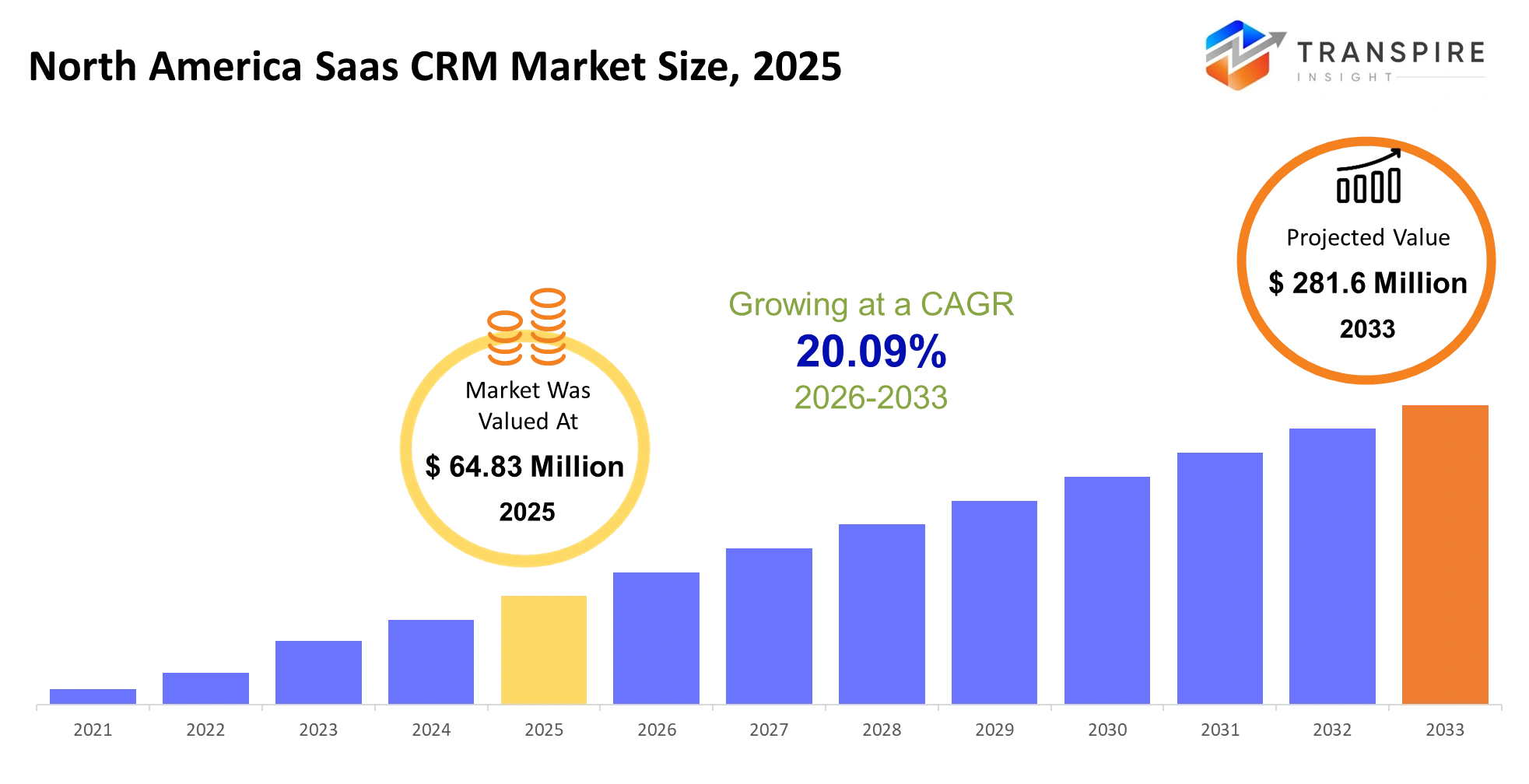
- North America Saas CRM Market Size 2025: USD 64.83 Million
- North America Saas CRM Market Size 2033: USD 281.6 Million
- North America Saas CRM Market CAGR: 20.09%
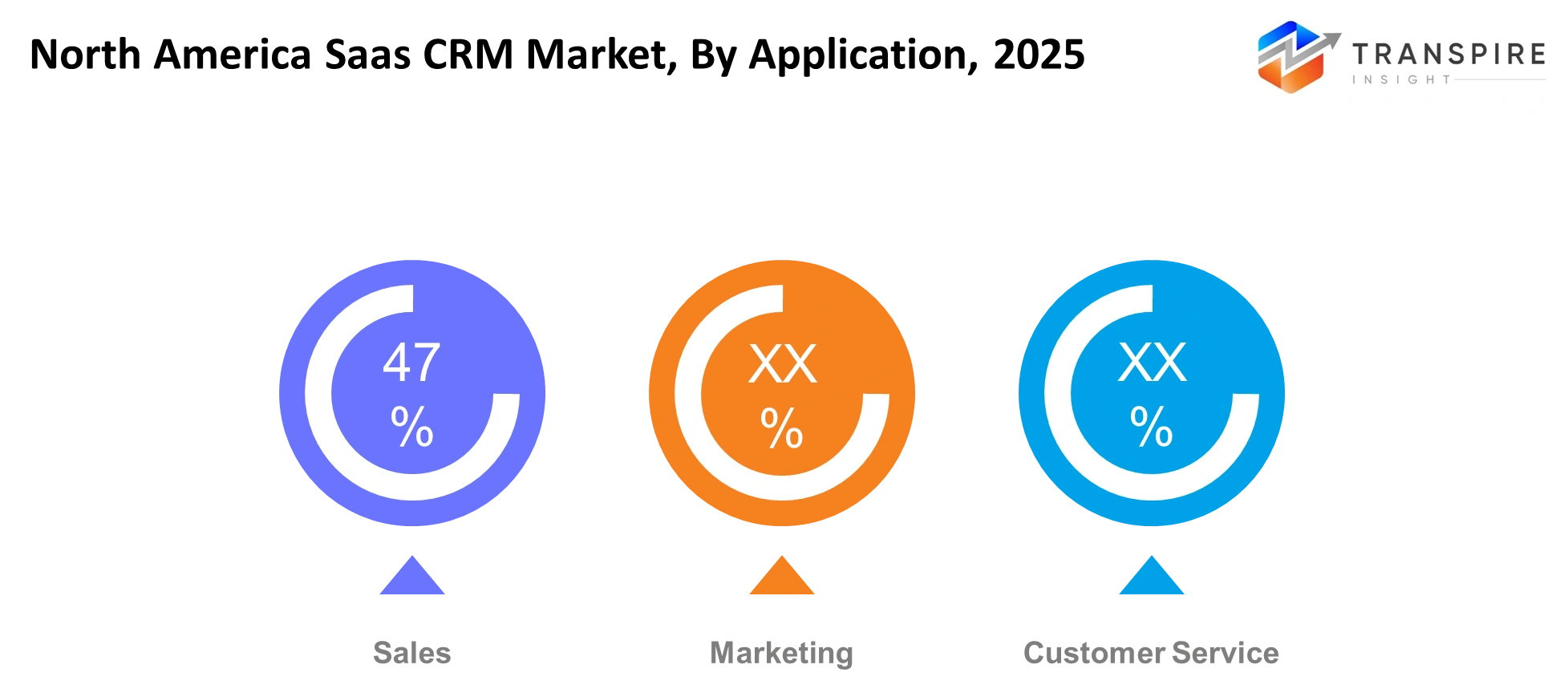
- North America Saas CRM Market Segments: By Application (Sales, Marketing, Customer Service), By Enterprise Size (SMEs, Large Enterprises), By End-User (BFSI, Retail, IT & Telecom).
To learn more about this report,  Download Free Sample Report
North America Saas CRM Market Summary:
The North America Saas CRM Market size is estimated at USD 64.83 Million in 2025 and is anticipated to reach USD 281.6 Million by 2033, growing at a CAGR of 20.09% from 2026 to 2033. The cloud software industry has established the Saas CRM market in North America which includes Canada and the United States and Mexico as a new standard for developing and maintaining customer relationships. According to buyer demands for quick and customized digital experiences businesses will adopt intelligent systems which use data to create personalized customer interactions. The companies will use automation together with predictive analytics and AI-based insights to create systems which anticipate customer behavior. The combination of rising customer privacy requirements and more stringent data protection regulations will compel software vendors to build systems which provide users with secure and clear operational environments. The subscription technology with flexible terms will see increasing adoption by small and mid-sized businesses whereas large companies will establish deep CRM connections with their sales and service and marketing systems to create complete customer experiences.
Key Market Trends & Insights:
The North American Saas CRM Market which includes Canada and the USA and Mexico will experience a transition toward hyper-personalisation as businesses seek to use real-time data for personalized customer interactions. The businesses will use behavioral analytics to measure customer intent because they want to go beyond traditional market segmentation methods. This will be fueled by increased customer demands for a seamless digital experience, which will become a necessity, especially on mobile and social media platforms.
The other trend that will become more evident in the Saas CRM Market will be the increased usage of artificial intelligence within CRM systems. Businesses will look to leverage artificial intelligence tools for scoring, responding, and forecasting sales. This will enable businesses to reduce their workload while improving accuracy in decision-making processes. As artificial intelligence becomes more robust, CRM systems will become more proactive, guiding businesses on when to engage with their customers based on data pattern analysis.
The market will also witness growing demand for industry-specific CRM solutions which are designed to meet the needs of healthcare and finance and retail. Companies will seek platforms that provide exact matches between their operational processes and their essential compliance obligations. This preference will encourage vendors to create products which meet specific customer needs instead of designing standard software products. Businesses will select customer management tools which help them solve their specific customer management issues because customization will become mandatory.
North America will use its evolving regulatory frameworks together with data protection standards to determine the design and implementation of CRM platforms. Organizations will place stronger emphasis on data governance, consent management, and transparency in customer data usage. The vendors will develop their products with advanced security features and compliance solutions which enable businesses to build customer trust while following the latest regulatory requirements and adapting to changing legal standards.
North America Saas CRM Market Segmentation
By Application
Sales- The north american saas crm market will see sales operations which depend on intelligent automation to handle pipeline management and revenue forecasting work. Teams will shift toward data-backed selling, where insights from customer interactions will guide outreach timing and messaging. Sales professionals will use integrated dashboards to monitor their performance which they can access through mobile devices to make decisions while traveling thus helping organizations achieve faster deal closure and better sales success rates.
Marketing- Marketing applications will move toward highly targeted, data-driven campaigns which will evolve according to changing consumer expectations. Businesses will utilize the CRM system to collect data from different points of interaction with the customers, which will allow them to send messages to the customers through emails and social media and advertisements. This will be made possible through the use of automation and analytics. This approach enables brands to present pertinent content at specific times which enhances their ability to acquire new customers and maintain existing ones.
Customer Service-Business operations will change through the implementation of centralized CRM systems which enable organizations to access complete customer history information. Support teams will handle inquiries faster by accessing unified data, while AI-powered chatbots will manage routine queries. Human agents will dedicate their time to handling intricate problems which will result in better service delivery. Organizations will respond to the increasing customer expectations by implementing faster response systems and offering reliable support services through various communication platforms.
To learn more about this report, Download Free Sample Report
By Enterprise Size
SMEs- Small and medium enterprises will increasingly adopt CRM solutions that offer affordable pricing and scalable capabilities and simple installation processes. These businesses will choose cloud-based platforms that enable them to decrease initial expenses and expand their operations as their business needs change. CRM systems will allow SMEs to manage customer data while automating some of the processes and improving customer interaction without requiring technical expertise. This will allow smaller companies to compete better with the larger ones.
Large Enterprises- Large enterprises will continue to implement CRM systems throughout their various departments to establish a unified customer management system. These organizations will concentrate on developing advanced functions which include artificial intelligence-powered analytics and automated workflow systems and systems that connect different communication channels. CRM platforms will act as key systems which connect sales, marketing, and service teams to provide customers with consistent experiences. Companies will focus on data governance and security measures to handle extensive data because they need to protect confidential information and meet compliance requirements.
By End-User
BFSI- The BFSI sector will use CRM platforms to improve customer engagement while fulfilling their needs for compliance with regulations. Financial institutions will utilize CRM tools to oversee client interactions and handle their sales leads and provide customized financial services. The operation of these systems will be determined by the organizations' need to maintain data security and meet compliance requirements. Relationship managers will utilize CRM systems to deliver customized services which will enhance customer trust and increase customer retention.
Retail- Retail businesses will apply CRM systems to study customer behavior which will enable them to create customized shopping experiences. Retailers will develop specific promotional campaigns and loyalty programs through the examination of customer purchasing patterns and their product preferences. E-commerce platform integration will create smooth customer experiences that work across digital and physical shopping environments. Customer relationship management tools will help businesses meet consumer demands for easy access and customized experiences which will result in higher customer satisfaction and increased customer loyalty.
IT & Telecom- The IT and telecom sector will depend on CRM platforms to manage large customer bases and complex service offerings. The companies will utilize CRM tools to monitor customer service requests and assess customer satisfaction levels while improving their communication processes. Providers will concentrate on delivering quicker support services together with customized solutions because of the rising market competition. CRM systems will help organizations handle their subscription services which will help them decrease customer attrition while building lasting customer relationships in their fast changing business environment.
Regional Insights
The saas crm market in the United States will reach new stages of development because businesses will spend their resources on advanced customer engagement technologies. Organizations will select systems which merge their sales, marketing and service information into one unified platform. Vendors will need to improve their analytical tools because customers require immediate access to data. The development of platform systems will proceed according to data privacy regulations which will require businesses to use systems that provide personalized experiences while meeting all compliance standards.
Canadian organizations will move toward cloud-based customer management systems because they need operational flexibility and cost-efficient solutions. Companies will show increasing preference for systems which enable remote work and support their distributed workforce. Companies will choose vendors based on data protection standards which require them to select solutions with robust security systems. Local businesses will focus on building customer trust through CRM systems which provide clear information about their data handling and storage practices.
The implementation of CRM systems is also set to rise in Mexico as organizations in various sectors continue with the process of digital transformation. Small and mid-sized businesses will also contribute significantly towards the adoption of CRM systems, as they seek tools that make customer tracking easier. The use of mobile strategies is also set to rise, as the behavior of consumers continues to change. Organizations will start using CRM systems which combine multiple communication channels to create unified customer service experiences because competition between companies will increase.
CRM systems will require adjustments because businesses across North America conduct cross-border operations. Companies operating in multiple countries will demand platforms capable of handling diverse regulatory environments and customer preferences. Future implementations will depend on how organizations adopt new technologies which include AI and automation. Vendors will increasingly design adaptable solutions that cater to varying market needs while maintaining consistent performance across the United States, Canada, and Mexico.
Recent Development News
United States: AI-led CRM expansion and acquisition activity
Recent developments in the United States highlight a strong push toward AI-enhanced CRM ecosystems. Companies such as Freshworks are actively pursuing acquisitions to strengthen AI capabilities within customer engagement platforms, signaling a broader consolidation trend in cloud software. This movement will reshape how CRM vendors deliver integrated solutions, with automation and predictive tools becoming standard expectations for enterprises seeking more intelligent and scalable customer management systems.
Canada: Leadership shifts and platform consolidation strategies
In Canada and across North America, enterprise software providers are focusing on leadership restructuring to drive unified platform strategies. Firms like JumpCloud are strengthening executive teams to align sales, customer success, and identity management into cohesive systems. This reflects a wider shift where CRM platforms will merge with broader IT and customer experience tools, allowing businesses to operate through centralized, secure environments that simplify operations and improve decision-making consistency.
Mexico: Rising influence of AI disruption and custom software models
Across Mexico and the wider region, emerging discussions around AI-driven disruption are influencing CRM adoption strategies. Industry leaders, including Okta, are preparing for a shift where businesses may build internal AI-powered tools instead of relying solely on traditional SaaS vendors. This trend will push CRM providers to innovate rapidly, focusing on flexibility, security, and adaptability as organizations explore more customized and autonomous customer management solutions.
|
Report Metrics |
Details |
|
Market size value in 2025 |
USD 64.83 Million |
|
Market size value in 2026 |
USD 78.20 Million |
|
Revenue forecast in 2033 |
USD 281.6 Million |
|
Growth rate |
CAGR of 20.09% from 2026 to 2033 |
|
Base year |
2025 |
|
Historical data |
2021 – 2024 |
|
Forecast period |
2026 – 2033 |
|
Report coverage |
Revenue forecast, competitive landscape, growth factors, and trends |
|
Regional scope |
North America (Canada, The United States, and Mexico) |
|
Key company profiled |
Salesforce Inc., Microsoft Corporation, Oracle Corporation, SAP SE, Zoho Corporation, HubSpot Inc., Freshworks Inc., Zendesk Inc., SugarCRM Inc., Creatio, Pipedrive Inc., Monday.com Ltd., Insightly Inc., Nimble Inc., Copper CRM Inc. |
|
Customization scope |
Free report customization (country, regional & segment scope). Avail customized purchase options to meet your exact research needs. |
|
Report Segmentation |
By Application (Sales, Marketing, Customer Service), By Enterprise Size (SMEs, Large Enterprises), By End-User (BFSI, Retail, IT & Telecom). |
Key North America Saas CRM Market Company Insights
The competitive environment for the North American region's SaaS CRM companies will be determined by the ability to develop new products, build operational capabilities, and develop market expertise. The integration of artificial intelligence, analytics, and automation controls will help companies such as Salesforce, Microsoft, Oracle, Adobe, and HubSpot consolidate their market positions. The mid-sized companies will develop their market identities through the provision of specialized products as well as flexible payment methods, while the new companies will focus on the provision of specialized products with expertise in various industries. The companies will invest in cloud infrastructure as well as data security to ensure compliance while offering seamless customer experiences.
Company List
- Salesforce Inc.
- Microsoft Corporation
- Oracle Corporation
- SAP SE
- Zoho Corporation
- HubSpot Inc.
- Freshworks Inc.
- Zendesk Inc.
- SugarCRM Inc.
- Creation
- Pipedrive Inc.
- Monday.com Ltd.
- Insightly Inc.
- Nimble Inc.
- Copper CRM Inc.
North America Saas CRM Market Report Segmentation
By Application
- Sales
- Marketing
- Customer Service
By Enterprise Size
- SMEs
- Large Enterprises
By End-User
- BFSI
- Retail
- IT & Telecom
Frequently Asked Questions
Find quick answers to common questions.
The approximate North America Saas CRM Market size for the market will be USD 281.6 Million in 2033.
Key segments for the North America Saas CRM Market By Application (Sales, Marketing, Customer Service), By Enterprise Size (SMEs, Large Enterprises), By End-User (BFSI, Retail, IT & Telecom).
Major players in the North America Saas CRM Market are Salesforce Inc., Microsoft Corporation, Oracle Corporation, SAP SE, Zoho Corporation, HubSpot Inc., Freshworks Inc., Zendesk Inc., SugarCRM Inc., Creatio, Pipedrive Inc., Monday.com Ltd., Insightly Inc., Nimble Inc., Copper CRM Inc.
The North America Saas CRM Market size is USD 64.83 Million in 2025.
The North America Saas CRM Market CAGR is 20.09%.
- Salesforce Inc.
- Microsoft Corporation
- Oracle Corporation
- SAP SE
- Zoho Corporation
- HubSpot Inc.
- Freshworks Inc.
- Zendesk Inc.
- SugarCRM Inc.
- Creation
- Pipedrive Inc.
- Monday.com Ltd.
- Insightly Inc.
- Nimble Inc.
- Copper CRM Inc.
Recently Published Reports
-
Apr 2026
3D Optical Profiler Market
3D Optical Profiler Market Size, Share & Analysis Report By Type (Desktop 3D Optical Profiler, and Portable 3D Optical Profiler), By Technology (Confocal Technology, and White Light Interference), By End-Use Industry (Manufacturing, Research Institutions, Automotive, Aerospace and Defense, Medical Devices, and Other), and Geography (North America, Europe, Asia-Pacific, Middle East and Africa, South and Central America), 2021 - 2031
-
Apr 2026
Depth Sensor Market
Depth Sensor Market Size, Share & Analysis Report By Type (Infrared Depth Sensors, Time-of-Flight (ToF) Sensors, Stereo Vision Sensors, Structured Light Sensors, Ultrasonic Depth Sensors), By Application (Automotive, Robotics, Gaming, Consumer Electronics, Industrial Automation, Healthcare, Security & Surveillance, Others), By End Users (Automotive Manufacturers, Consumer Electronics Companies, Healthcare Providers, Industrial Companies, Security Agencies, Gaming Companies, Robotics Companies, Others), and Geography (North America, Europe, Asia-Pacific, Middle East and Africa, South and Central America), 2021 – 2031
-
Apr 2026
Digital Manufacturing Market
Digital Manufacturing Market Size, Share & Analysis Report By Component (Hardware, Software, and Services), By Technology (Robotics, 3D Printing, Internet of Things (IoT), and Others), By Application (Automotive and Transportation, Aerospace and Defense, Consumer Electronics, Industrial Machinery, and Others), By Process Type (Computer-Based Designing, Computer-Based Simulation, Computer 3D Visualization, Analytics, and Others), and Geography (North America, Europe, Asia-Pacific, Middle East and Africa, South and Central America), 2021 – 2031
-
Apr 2026
Digital Visa Services Market
Digital Visa Services Market Size, Share & Analysis Report By Type (Individual Travelers, Group Travelers), By Application (Tourism, Business Travel, Others), and Geography (North America, Europe, Asia-Pacific, Middle East and Africa, South and Central America), 2021 – 2031