
United Kingdom Active Power Steering Market Size & Forecast:
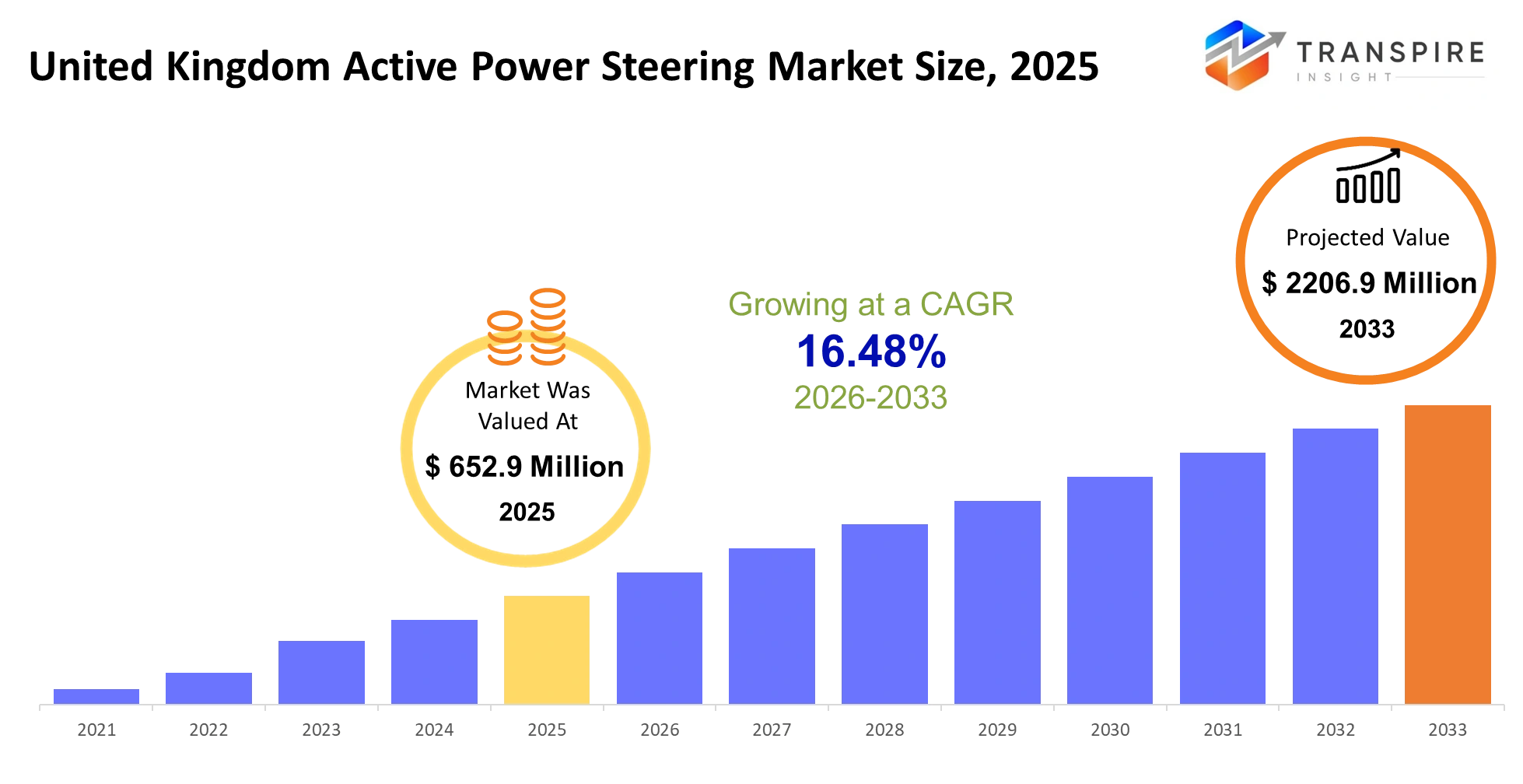
- United Kingdom Active Power Steering Market Size 2025: USD 652.9 Million
- United Kingdom Active Power Steering Market Size 2033: USD 2206.9 Million
- United Kingdom Active Power Steering Market CAGR: 16.48%
- United Kingdom Active Power Steering Market Segments: By Vehicle Type (Passenger Vehicles, Commercial Vehicles, Electric Vehicles, Luxury Vehicles, Autonomous Vehicles, Others); By Component (Steering ECU, Steering Sensors, Electric Motors, Steering Columns, Rack & Pinion Systems, Others); By Technology (Electric Power Steering, Electro-hydraulic Steering, Steer-by-wire Systems, AI-enabled Steering, Others); By Application (Lane Keeping Assistance, Autonomous Driving, Parking Assistance, Driver Assistance Systems, Others); By End User (OEMs, Aftermarket Suppliers, Fleet Operators, Others).
To learn more about this report,  Download Free Sample Report
United Kingdom Active Power Steering Market Summary
The United Kingdom Active Power Steering Market was valued at USD 652.9 Million in 2025. It is forecast to reach USD 2206.9 Million by 2033. That is a CAGR of 16.48% over the period.
The United Kingdom active power steering market plays this key role in boosting vehicle handling , fuel efficiency, and driver control across passenger and commercial fleets, you know. These systems keep making small tweaks to steering assistance depending on speed and the actual driving situation, so manufacturers can hit tighter safety plus efficiency targets, while also making it easier for drivers in both city traffic and long-distance travel environments .
Over the last five years , the market basically shifted away from hydraulic steering architectures toward electronically managed steering systems, and these are often tied in with advanced driver assistance technologies. The move really picked up after stricter UK and European vehicle emission rules pushed automakers to lower mechanical load and squeeze more energy efficiency out of the system. Meanwhile, semiconductor shortages and broader supply chain disruption after the pandemic showed cracks in older component sourcing, so companies started localizing electronics production, and they also reworked their steering platforms for more flexibility, kind of a modular feel .
As electric vehicle production keeps expanding in the UK, active power steering adoption is sliding from higher priced models into mid-range vehicle segments. That means wider revenue chances not only for steering system suppliers , but also for software integration providers, who get pulled into the redesign work more than before.
Key Market Insights
- The United Kingdom Active Power Steering Market is basically riding the wave of electric passenger car registrations, which went past 380,000 units in 2025 over the UK automotive ecosystem.
- Electronic power steering setups keep taking the lead in industry size, making up almost 68% market share in 2025, largely because the energy needs are reduced, and that makes it sound better for fleet managers.
- What really pushes demand are the tougher emission compliance targets, plus autonomous driving R&D, and also the rising uptake of software-controlled steering in connected vehicles, where everything is supposed to talk to everything.
- Looking ahead, the United Kingdom Active Power Steering Market has real growth room, especially since premium steering technologies keep trickling down into mid-range passenger vehicle groups.
- In terms of regions, England dominates the regional landscape with more than 82% revenue share in 2025, aided by concentrated automotive manufacturing and extra EV infrastructure investment.
- Scotland is expected to be the quickest growing regional area over the forecast window because of clean mobility initiatives and the stronger adoption of commercial electric fleets, even when budgets get a bit tight.
- For product types, column-assist electric power steering is leading with roughly 44% market share, mainly due to cost effectiveness and its compact fitment for smaller vehicle layouts.
- Rack-assist power steering stays in the second position, and it’s widely used in SUVs and commercial vehicles that need better steering accuracy, along with durability that doesn’t quit too fast.
- Pinion-assist steering systems are projected to grow the fastest through 2030, driven by increasing demand for lightweight steering structures in EV platform designs.
- Finally, passenger vehicles take the application spotlight with nearly 74% share in 2025, as automakers keep expanding active steering integration across hatchbacks and crossover variants, whether it’s “extra” or just the new normal.
What are the Key Drivers, Restraints, and Opportunities in the United Kingdom Active Power Steering Market?
The strongest force pushing the United Kingdom active power steering market forward is this rapid pivot toward electric vehicle manufacturing, kinda hard to miss. The change really picked up speed after the UK government confirmed tighter emission-cutting targets and also rolled out expanded incentives for zero-emission vehicle production. And unlike older hydraulic steering systems, active electric power steering lowers engine load while also helping battery efficiency, so it becomes basically a must-have for modern EV layouts. Automakers working in the UK now use electronically managed steering systems, to back lane centering, automated parking, and more capable driver assistance features. As EV output keeps growing, steering suppliers often win higher value contracts linked to software integration, sensor packages, and electronic control units, and that directly lifts market revenue per vehicle platform.
Still, semiconductor dependency stays the biggest structural obstacle when it comes to market growth. Active power steering needs microcontrollers, torque sensors, and electronic modules, and all of that comes from complex global supply networks. The shortages that showed up during the pandemic made it obvious how much the UK auto industry leans on imported chips and precision electronics. Setting up domestic semiconductor production takes years, plus serious capital investment, regulatory approvals , and building a technical workforce. Because of that bottleneck, production timelines get delayed, component costs tend to rise , and adoption slows especially for mid-range vehicle manufacturers that are already operating with tighter margins.
Steer-by-wire tech feels like the next big growth shot for the market, and honestly it’s probably going to keep climbing. In the UK, autonomous mobility testing programs along with connected-vehicle investments are making things easier for software-focused steering systems that basically remove the mechanical steering columns. A few premium electric vehicle makers are already running pilots with steer-by-wire platforms, to get more cabin flexibility, shave off some vehicle weight , and also to back autonomous driving capabilities. Then as regulatory frameworks mature, suppliers who have advanced steering software and solid fail-safe electronic architectures should be better placed to win steady long-term contracts through next-generation mobility programs.
What Has the Impact of Artificial Intelligence Been on the United Kingdom Active Power Steering Market?
Artificial intelligence and advanced digital technologies are quietly, and kind of fast reshaping the United Kingdom Active Power Steering Market, by making steering systems into software-driven control platforms, not just mechanical parts. Automotive manufacturers and steering suppliers now lean on AI-enabled electronic control units, to fine tune the steering reaction based on vehicle speed, road conditions, and what the driver seems to do. In practice these setups raise lane-centering accuracy and help advanced driver assistance features, especially in electric cars and semi-autonomous vehicles.
At the same time machine learning is strengthening predictive maintenance across connected vehicle fleets. Steering sensors are constantly gathering torque, vibration, and alignment information, so manufacturers can spot early signals of component wear before a mechanical failure even shows up. Fleet operators then use that kind of foresight analytics to cut unplanned downtime and stretch steering system life cycles. In commercial electric vehicles, software based steering optimization can also improve battery efficiency, because it lowers needless power draw during slow speed maneuvers and typical city driving scenarios.
Digital twin technology is also getting more attention among UK automotive engineering teams, mainly for testing steering calibration inside simulated road environments, which trims down development time and lowers prototype expenses. Still, AI adoption is not totally smooth, since integration costs can be high and validating steering algorithms is complicated when real-world driving keeps shifting. Smaller vehicle manufacturers often find it hard to justify the spending needed for advanced sensor integration, cybersecurity safeguards, and ongoing software updates.
Key Market Trends
- Between 2021 and 2025, UK automakers began weaving electronic power steering more deeply, like EV platforms slowly replaced hydraulic steering in a bunch of fresh passenger vehicle launches, kinda rapidly too.
- ZF Friedrichshafen AG along with Nexteer Automotive pushed further into software driven steering development after UK autonomous vehicle testing programs got regulatory approval in 2023, and honestly it felt like that opened the door.
- During the semiconductor shortages in 2021 and 2022, steering suppliers had to split up their sourcing routes, plus they worked on localizing the most critical electronic component inventories across Europe, even when it was inconvenient.
- From 2024, mid-range vehicle manufacturers started using active steering systems that were once basically reserved for premium models, mostly because sensor and controller costs kept dropping, step by step.
- UK fleet operators increasingly lean on predictive steering diagnostics as connected vehicle platforms cut down on unplanned maintenance downtime across commercial electric vehicle operations.
- In 2025, automakers moved toward steer-by-wire pilot programs because autonomous mobility developers wanted quicker steering response and less mechanical complexity, which sounded efficient.
- Robert Bosch GmbH raised spending on AI enabled steering control systems to boost lane-centering accuracy and improve driver assistance features across EV platforms.
- Vehicle manufacturers reduced hydraulic steering deployments a lot after stricter UK emission targets made the energy inefficiencies of engine driven steering mechanisms impossible to ignore, not even for a moment.
- Since 2022, suppliers have folded cybersecurity protocols into steering software platforms, as connected vehicle regulations tightened across European automotive markets.
- Commercial electric delivery fleets ramped up their uptake of advanced steering systems when urban logistics operators focused on battery optimization and better low-speed maneuverability improvements, all at once.
United Kingdom Active Power Steering Market Segmentation
By Vehicle Type :
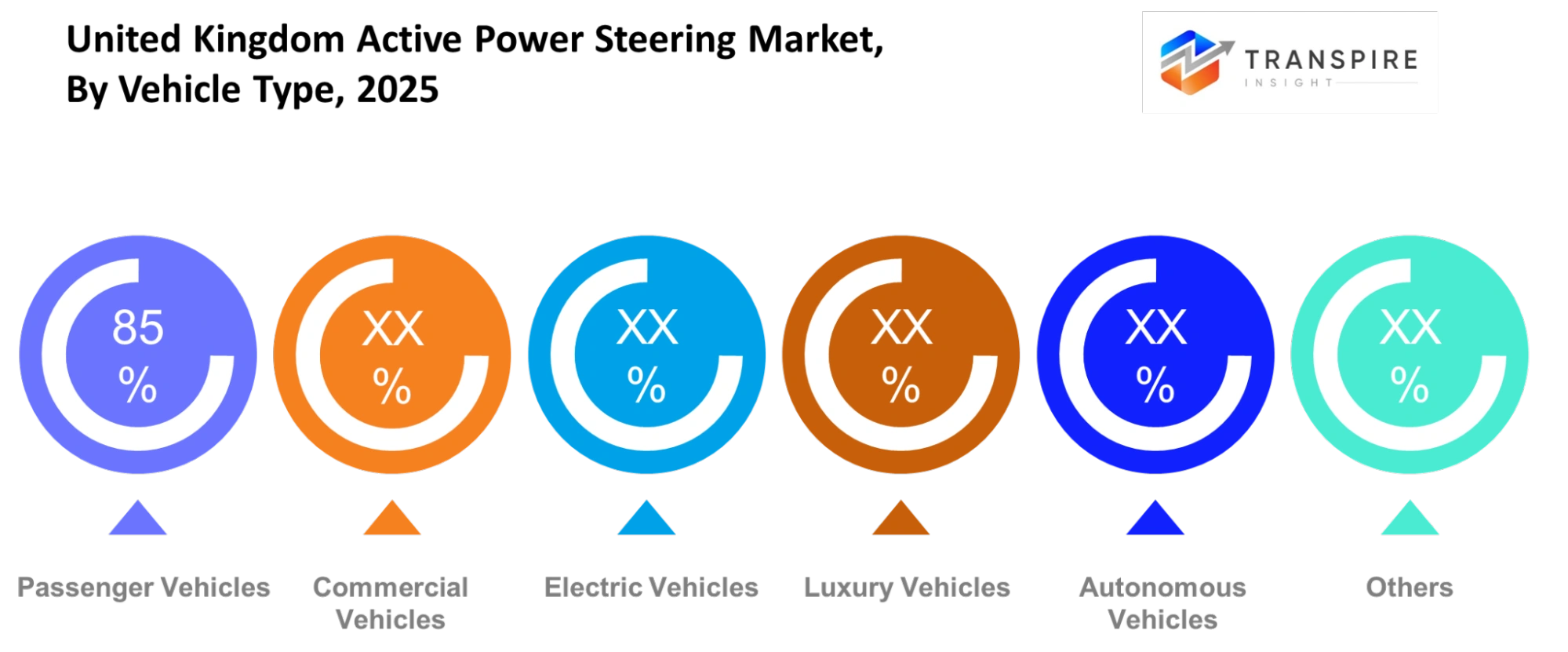
Passenger vehicles keep a strong grip on the United Kingdom Active Power Steering Market, partly because manufacturers keep sliding in advanced steering systems into compact cars, sedans and sport utility vehicles. The steering response feels better, fuel savings are more noticeable, and driving becomes smoother, so they install it more often in everyday transportation models. Commercial vehicle adoption is still climbing too, since logistics operators care about vehicle steadiness and driver comfort during long distance transportation, not just speed.
Electric vehicles open brand new chances for steering system suppliers, since electronic steering solutions fit well with battery efficiency and help reduce the mechanical load. Luxury vehicles, along with autonomous vehicles, also push uptake, because premium brands focus on lane-centering, assisted parking support, and automated driving functions. Other vehicle classes continue folding in steering upgrades as connected mobility solutions become more common through the whole automotive industry.
To learn more about this report, Download Free Sample Report
By Component :
Steering ECU systems stay important, because electronic control units handle steering accuracy , the driving response, and the connection between vehicle safety features. Automotive firms keep working on better processing power so advanced driver assistance systems can run more smoothly, and automated steering control can respond faster. Also, steering sensors still see strong demand since real-time vehicle monitoring boosts precision , and that matters for operational safety as well.
Electric motors help enable steadier steering motion, while cutting energy loss compared with older hydraulic setups. Steering columns and rack and pinion systems keep evolving, now with lighter materials and more compact designs that help the whole vehicle operate more efficiently. Meanwhile, other supporting parts gain extra weight in the design, since makers push integrated steering platforms, where mechanical strength is paired with software based control functions.
By Technology :
Electric power steering kind of leads the technology adoption curve because automakers generally like energy-efficient setups that still improve how the vehicle grips and steers, while also keeping emissions lower. Strong electric vehicle output across the United Kingdom further supports broader usage of electronic steering solutions, both for private rides and for commercial movement. Even so, electro-hydraulic steering remains around in some heavy-duty scenarios, where extra steering force is still kinda needed.
Steer-by-wire keeps pulling in funding, since manufacturers are after more flexibility, especially for autonomous and connected vehicles. AI-enabled steering also keeps growing, as firms roll out predictive steering adjustments , lane correction help and automated parking support. Meanwhile, other emerging technologies keep slipping into the market as onboard vehicle software becomes more capable and more digitally connected.
By Application :
Lane keeping assistance kinda became this big deal application area since vehicle manufacturers keep putting driver safety at the top and pushing technologies to reduce accidents, you know. Nowadays steering systems work hand-in-hand with cameras and different sensors, to keep the vehicle aligned on highways plus on city streets. Also, parking assistance keeps expanding pretty fast, because automated steering is really improving convenience in tight, crowded urban places, where traffic feels never ending.
Meanwhile autonomous driving applications keep nudging product development forward, since automakers are investing in semi-autonomous and self-driving technologies. Driver assistance systems are still a big deal too, because steering control helps with adaptive cruise, collision prevention, and those traffic management capabilities. Other options are also growing, especially as connected vehicle technologies get more mature inside modern transportation systems, and everything starts to sync a bit better.
By End User :
OEMs hold a major share, mainly because automaker brands increasingly install advanced steering technologies while the vehicle is still coming off the factory floor. Car makers are really emphasizing integrated steering systems, they help meet safety regulations, reach fuel efficiency targets, and they mesh with digital vehicle platforms. Also, these long-term ties between OEMs and steering component suppliers keep strengthening product innovation throughout the whole market, sort of a steady feedback loop.
On the other side aftermarket suppliers are still picking up more business too, since vehicle owners want steering upgrades, replacement parts, and software improvements so the vehicle feels more responsive in daily use. Fleet operators join in as well; efficient steering systems tend to lower maintenance pressure and raise operational reliability for commercial transport. Plus, other end users add momentum, because the demand for connected and electronically controlled vehicle systems keeps growing across the United Kingdom automotive sector, even in areas where people didn’t expect it earlier.
What are the Key Use Cases Driving the United Kingdom Active Power Steering Market?
Passenger cars, still, are pretty much the main reason active power steering keeps getting adopted across the UK automotive scene. Automakers more and more often fit electronically managed steering on electric hatchbacks, sedans, and sport utility vehicles since these setups boost fuel economy, add clearer steering precision, and keep lane stability steadier, plus they line up well with the needs of advanced driver assistance.
For commercial fleets and also premium brands, the interest is widening too, especially with automated parking assistance, along with lane-centering functions. Delivery and logistics firms running electric vans and trucks use active steering tech to get better maneuverability, particularly when the city streets feel crowded and tight. At the same time, higher-end makers are rolling in adaptive steering response, hoping to improve driver comfort and also highway safety outcomes, more or less at once.
Looking ahead, steer-by-wire ideas and autonomous mobility platforms feel like the next big openings with solid long term value. UK-based self-driving trials and connected mobility projects are ongoing, and they keep checking software-defined steering systems that actually remove mechanical steering connections and help enable future self-driving transportation infrastructure.
|
Report Metrics |
Details |
|
Market size value in 2025 |
USD 652.9 Million |
|
Market size value in 2026 |
USD 758.5 Million |
|
Revenue forecast in 2033 |
USD 2206.9 Million |
|
Growth rate |
CAGR of 16.48% from 2026 to 2033 |
|
Base year |
2025 |
|
Historical data |
2021 - 2024 |
|
Forecast period |
2026 - 2033 |
|
Report coverage |
Revenue forecast, competitive landscape, growth factors, and trends |
|
Regional scope |
Middle East and Africa (Saudi Arabia, United Arab Emirates, South Africa, Rest of Middle East and Africa) |
|
Key company profiled |
Bosch, JTEKT Corporation, NSK Ltd., Nexteer Automotive, Hyundai Mobis, ZF Friedrichshafen, Schaeffler, Denso, Hitachi Astemo, Mitsubishi Electric, Continental AG, Valeo, Mando Corporation, Thyssenkrupp, Aptiv. |
|
Customization scope |
Free report customization (country, regional & segment scope). Avail customized purchase options to meet your exact research needs. |
|
Report Segmentation |
By Vehicle Type (Passenger Vehicles, Commercial Vehicles, Electric Vehicles, Luxury Vehicles, Autonomous Vehicles, Others); By Component (Steering ECU, Steering Sensors, Electric Motors, Steering Columns, Rack & Pinion Systems, Others); By Technology (Electric Power Steering, Electro-hydraulic Steering, Steer-by-wire Systems, AI-enabled Steering, Others); By Application (Lane Keeping Assistance, Autonomous Driving, Parking Assistance, Driver Assistance Systems, Others); By End User (OEMs, Aftermarket Suppliers, Fleet Operators, Others). |
Which Regions are Driving the United Kingdom Active Power Steering Market Growth?
England seems to be leading the United Kingdom active power steering market, mostly because big automotive production hubs, lots of electric vehicle investments, and some very serious research centers are still pretty clustered across the region. On top of that, government-backed rules focused on cutting emissions, plus solid help for connected mobility tools, keep nudging makers to slip in electronically governed steering systems into newer vehicle platforms. The whole area also kind of rides on a well-developed supplier web, with semiconductor providers ,software developers, and steering component manufacturers all working closely together. Then there are the large testing programs for autonomous vehicles across places like London ,and Birmingham, which really push demand for smarter steering technology.
Scotland, on the other hand, feels more stable and it keeps growing at a steady pace thanks to commercial fleet upgrades and clean transport initiatives. Compared with England, Scotland’s momentum is less tied to huge passenger vehicle output, and more tied to bus, tram, and public transport improvements as well as electric commercial mobility programs. Local authorities keep putting money into low-emission transport infrastructure, and that makes it easier for fleet operators to choose vehicles that already come with advanced steering plus driver assistance features. Even the steady investment in logistics and urban delivery services, helps keep the market calmer over the long run, across the region.
Wales is slowly emerging as one of the faster growing regional markets, mainly because more money is moving into electric mobility manufacturing and automotive component production. In recent years , there has also been an expansion of battery supply chain projects, plus regional innovation funding, which nudged suppliers to set up operations that back next generation vehicle technologies. At the same time, automotive companies increasingly see Wales as a cost efficient place, for developing connected vehicle components and software integrated steering platforms. So, the growth across the region between 2026 and 2033 is expected to really unlock strong opportunities for steering technology providers, electronics manufacturers , and investors who are aiming at expanding electric vehicle supply networks.
Who are the Key Players in the United Kingdom Active Power Steering Market and How Do They Compete?
Competition in the United Kingdom active power steering market is still moderately consolidated, kind of, because just a small set of global automotive technology firms end up controlling most of the advanced steering platforms, and the electronic integration know-how that comes with them. Lately it feels like the real fight is not simply about price—more like software intelligence, steering precision, and whether the system plays well with electric vehicles and autonomous driving features.
Larger, established suppliers keep defending their market presence using longer horizon contracts with automotive makers, and in the meantime smaller engineering firms try to step in through narrower paths such as specialized software enhancements, sensor improvements or something similarly targeted. There’s also more visible rivalry around cybersecurity protection, steer-by-wire readiness, and predictive steering analytics, especially as connected vehicle adoption grows across the UK automotive ecosystem.
Robert Bosch GmbH is leaning hard into AI-enabled steering technologies that make lane-centering responses steadier, and automated parking performance stronger, particularly in electric vehicles. Bosch differentiates, by using an integrated software architecture that links steering systems directly into advanced driver assistance platforms, with less friction than older approaches. ZF Friedrichshafen AG keeps expanding its steer-by-wire development efforts alongside autonomous mobility partnerships, which gives it a favorable position in next generation vehicle engineering. ZF also has solid manufacturing plus testing capacity throughout Europe, so it can adjust faster when regulatory standards shift, or when compliance expectations change.
Company List
- Bosch
- JTEKT Corporation
- NSK Ltd.
- Nexteer Automotive
- Hyundai Mobis
- ZF Friedrichshafen
- Schaeffler
- Denso
- Hitachi Astemo
- Mitsubishi Electric
- Continental AG
- Valeo
- Mando Corporation
- Thyssenkrupp
- Aptiv
Recent Development News
In January 2026, ZF Group expanded its passenger vehicle technology operations with local production of advanced electric park brake systems and broader steering-related vehicle control technologies. The investment supports wider electrification and chassis-control innovation trends that are influencing active power steering adoption in the United Kingdom and European automotive markets.
Source: https://timesofindia.indiatimes.com/
In April 2026, ZF Friedrichshafen AG showcased its latest Chassis 2.0 and steer-by-wire technologies at CES 2026. The technology demonstration highlighted the company’s focus on software-defined vehicle platforms and advanced steering architectures, accelerating industry adoption of intelligent active power steering systems relevant to the United Kingdom automotive market.
Source: https://timesofindia.indiatimes.com/
What Strategic Insights Define the Future of the United Kingdom Active Power Steering Market?
The United Kingdom active power steering market is edging toward almost fully software-defined steering architectures that can back autonomous mobility, connected car ecosystems, and those new electric transportation platforms. In the next five to seven years , steering systems are likely to move away from just standalone mechanical parts into more integrated digital control arrangements, tied right into vehicle sensors, artificial intelligence platforms, and over the air software updates. This shift is mostly fueled by electric vehicle production rising , plus safety rules getting tighter, so steering has to be more responsive and adaptive.
A less visible risk though is growing reliance on semiconductor suppliers and specialized electronic control systems that sit mostly with a small cluster of global manufacturers. If there’s any disruption around chip availability , or cybersecurity weaknesses, or geopolitical trade limits, it could hit production consistency fast and also shake pricing throughout the whole supply chain. Meanwhile, steer-by-wire technology is also becoming a pretty strong chance, especially as UK autonomous vehicle testing programs keep growing across urban mobility networks.
Because of that, market players should really focus on partnerships with software developers and semiconductor companies, sooner rather than later, and not only lean on old school mechanical steering know-how. Betting early on cybersecurity-ready steering platforms and predictive software features will likely shape who stays competitive over the long run.
United Kingdom Active Power Steering Market Report Segmentation
By Vehicle Type
- Passenger Vehicles
- Commercial Vehicles
- Electric Vehicles
- Luxury Vehicles
- Autonomous Vehicles
By Component
- Steering ECU
- Steering Sensors
- Electric Motors
- Steering Columns
- Rack & Pinion Systems
By Technology
- Electric Power Steering
- Electro-hydraulic Steering
- Steer-by-wire Systems
- AI-enabled Steering
By Application
- Lane Keeping Assistance
- Autonomous Driving
- Parking Assistance
- Driver Assistance Systems
By End User
- OEMs
- Aftermarket Suppliers
- Fleet Operators
Frequently Asked Questions
Find quick answers to common questions.
The United Kingdom Active Power Steering Market size is USD 2206.9 Million in 2033.
Key segments for the United Kingdom Active Power Steering Market are By Vehicle Type (Passenger Vehicles, Commercial Vehicles, Electric Vehicles, Luxury Vehicles, Autonomous Vehicles, Others); By Component (Steering ECU, Steering Sensors, Electric Motors, Steering Columns, Rack & Pinion Systems, Others); By Technology (Electric Power Steering, Electro-hydraulic Steering, Steer-by-wire Systems, AI-enabled Steering, Others); By Application (Lane Keeping Assistance, Autonomous Driving, Parking Assistance, Driver Assistance Systems, Others); By End User (OEMs, Aftermarket Suppliers, Fleet Operators, Others).
Major United Kingdom Active Power Steering Market players are Bosch, JTEKT Corporation, NSK Ltd., Nexteer Automotive, Hyundai Mobis, ZF Friedrichshafen, Schaeffler, Denso, Hitachi Astemo, Mitsubishi Electric, Continental AG, Valeo, Mando Corporation, Thyssenkrupp, Aptiv.
The United Kingdom Active Power Steering Market size is USD 652.9 Million in 2025.
The United Kingdom Active Power Steering Market CAGR is 16.48% from 2026 to 2033.
- Bosch
- JTEKT Corporation
- NSK Ltd.
- Nexteer Automotive
- Hyundai Mobis
- ZF Friedrichshafen
- Schaeffler
- Denso
- Hitachi Astemo
- Mitsubishi Electric
- Continental AG
- Valeo
- Mando Corporation
- Thyssenkrupp
- Aptiv
About the Authors

Mayur Shinde
I am Mayur Shinde, a Senior Research Analyst at Transpire Insight, specializing in the Automotive & Transportation and Information & Communication Technology (ICT) Industry. My work focuses on analyzing emerging market trends, technological advancements, competitive landscapes, and industry developments to deliver accurate, data-driven insights. I am passionate about transforming complex market information into clear, actionable content that helps businesses, professionals, and decision-makers stay informed and make confident strategic decisions.

Chakradhar Khansole
Chakradhar serves as the Research Director at Transpire Insight, bringing over 8 years of experience in technology, innovation, and strategic market intelligence. He specializes in transforming complex market data into actionable business insights that enable organizations to make informed, growth-oriented decisions. Recognized for his strategic vision and analytical expertise, Chakradhar leads high-impact research initiatives, delivering comprehensive market assessments, competitive intelligence, and forward-looking industry analysis.
Recently Published Reports
-
Apr 2026
ATV & UTV Market
ATV & UTV Market Size, Share & Analysis Report By Type (ATV, and UTV), By Variants (Less Than 400 CC, 400 CC To 800 CC, and More Than 800 CC), and Geography (North America, Europe, Asia-Pacific, Middle East and Africa, South and Central America), 2021 - 2031
-
Apr 2026
Automotive Central Gateway Module Market
Automotive Central Gateway Module Market Size, Share & Analysis Report By Type (Ethernet Central Gateway Module, CAN Central Gateway Module, LIN Central Gateway Module, and FlexRay), By Application (Powertrain Control, Body Control, Infotainment System, Advanced Driver Assistance Systems (ADAS), and Others), By End User (Passenger Vehicles, and Commercial Vehicles), and Geography (North America, Europe, Asia-Pacific, Middle East and Africa, South and Central America), 2021 - 2031
-
Apr 2026
Automotive Engine Oil Filter Market
Automotive Engine Oil Filter Market Size, Share & Analysis Report By Filter Type (Fuel Filter, Engine Oil Filter, Hydraulic Oil Filter, and Others), By Filter Media (Cellulose, Synthetic, and Micro), By Sales Channel (OEMs, and Aftermarket), By Vehicle Type (Passenger Cars, Light Commercial Vehicles, Heavy Duty Trucks, Buses and Coaches, and Off-road Vehicles), and Geography (North America, Europe, Asia-Pacific, Middle East and Africa, South and Central America), 2021 - 2031
-
Apr 2026
Automotive Parts Aluminium Die Casting Market
Automotive Parts Aluminium Die Casting Market Size, Share & Analysis Report By Production Process (Pressure Die Casting, Vacuum Die Casting, Squeeze Die Casting, Gravity Die Casting), By Application (Body Parts, Engine Parts, Transmission Parts, Battery And Related Components, Other Application Types), and Geography (North America, Europe, Asia-Pacific, Middle East and Africa, South and Central America), 2021 - 2031
Our Clients



