Europe Electric Vehicle Parts and Components Market Size & Forecast:
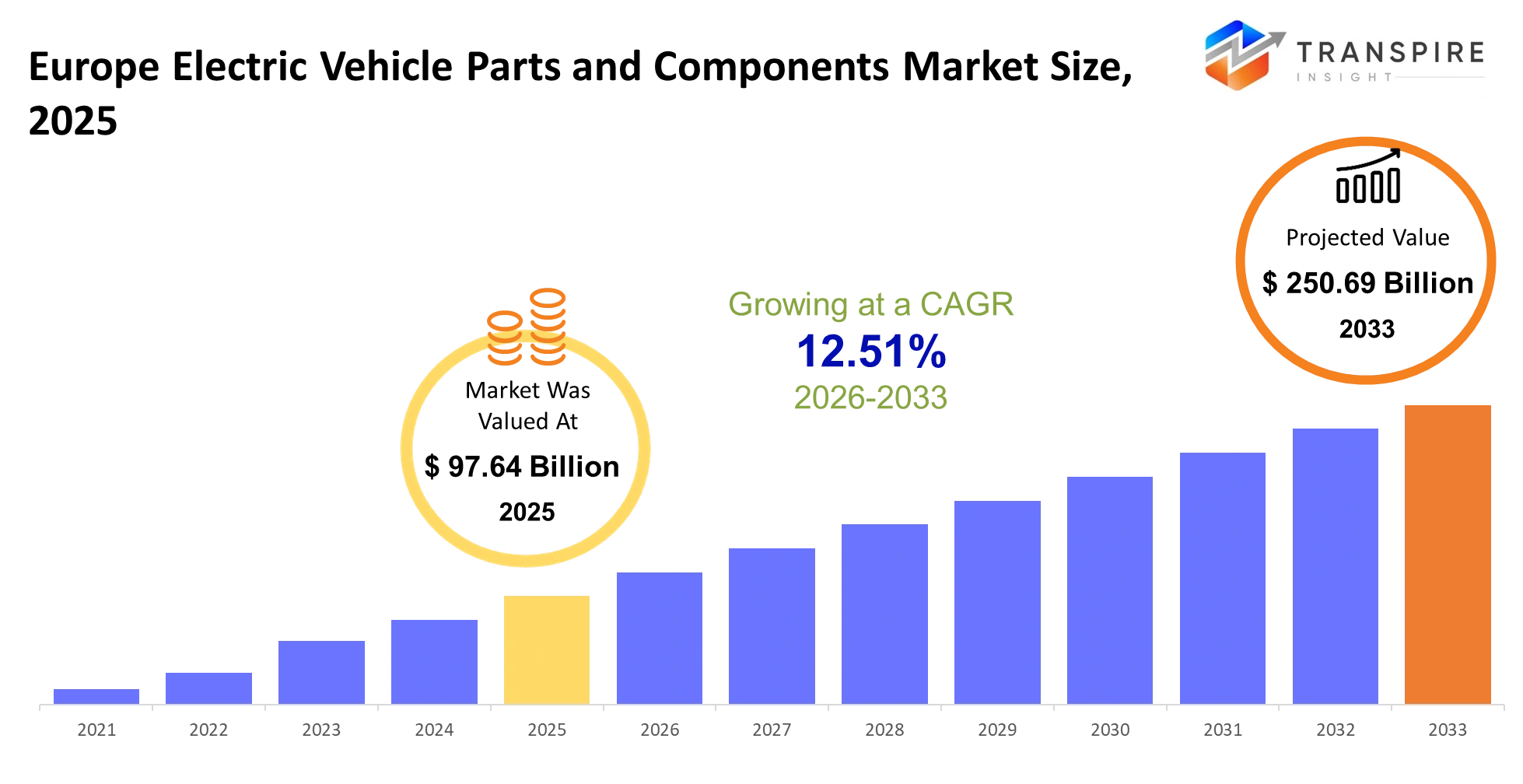
- Europe Electric Vehicle Parts and Components Market Size 2025: USD 97.64 Billion
- Europe Electric Vehicle Parts and Components Market Size 2033: USD 250.69 Billion
- Europe Electric Vehicle Parts and Components Market CAGR: 12.51%
- Europe Electric Vehicle Parts and Components Market Segments: By Type (Battery, Motor, Power Electronics, Thermal Systems, Charging Components, Others); By Application (Passenger EVs, Commercial EVs, Two-wheelers, Others); By End-User (OEMs, Aftermarket, Fleet Operators, Others); By Component (Drivetrain, Charging System, Battery Management System, Thermal System, Others).
To learn more about this report,  Download Free Sample Report
Europe Electric Vehicle Parts and Components Market Summary
The Europe Electric Vehicle Parts and Components Market was valued at USD 97.64 Billion 2025. It is forecast to reach USD 250.69 Billion by 2033. That is a CAGR of 12.51% over the period.
The Europe Electric Vehicle Parts and Components Market supplies the essential components which enable electric vehicles to operate in actual driving conditions through its propulsion and energy storage and thermal control and charging systems that serve both passenger vehicles and commercial fleets and light-duty vehicles. The system guarantees that vehicles maintain their performance capacity for European driving conditions while meeting safety requirements and charging performance standards.
The industry has transitioned from importing modular components about three to five years ago to establishing local production of electric vehicle platforms which use battery-first design methods. European original equipment manufacturers (OEMs) expanded their vehicle redesign efforts to create specific platforms for electric vehicle (EV) development instead of using their existing internal combustion engine (ICE) systems. The European Union established stricter CO₂ emission regulations which required automatic supply chain updates and production process changes because of their 2035 engine ban implementation schedule.
The semiconductor shortages which emerged during the pandemic revealed how power electronics and control system manufacturers depended on overseas suppliers. Manufacturers now secure local materials through direct sourcing methods while developing internal production capabilities according to their operational requirements. The electric mobility ecosystem has established long-term revenue paths for component suppliers because supply chain resilience and regulatory compliance have become mandatory requirements for adoption.
Key Market Insights
- Germany holds nearly 28% share of the Europe Electric Vehicle Parts and Components Market in 2025, driven by strong OEM production hubs and advanced supply chain integration.
- The Nordic region has become the fastest growing area which will continue until 2030 because of its high electric vehicle adoption and its taxation benefits and its early implementation of battery localization initiatives.
- The battery systems market segment leads product segmentation because it accounts for more than 40% of total market share while its cost drives vehicle distance performance through its essential function.
- The power electronics segment stands as the second largest part of the market because the adoption of silicon carbide technology USes high-voltage electric vehicle systems on European platforms.
- The charging components market shows the highest growth rate between now and 2030 because of the European Union's fast-charging corridor development and the creation of new urban charging systems.
- The Europe Electric Vehicle Parts and Components Market presents 70% market share to passenger electric vehicles because consumer incentives and vehicle model availability create strong support.
- The fastest growing segment of commercial electric vehicle applications operates because logistics electrification and zero-emission delivery mandates spread across European Union cities.
- The fleet operators drive end-user adoption because they require predictive maintenance systems and total cost optimization solutions which apply to vehicles that operate at high usage rates.
- The market position of Bosch and Continental and Siemens and Valeo and ZF Friedrichshafen and ABB as original equipment manufacturers strengthens through their vertical integration and investment in battery technology.
- The Europe Electric Vehicle Parts and Components Market competitive strategy centers on establishing local gigafactories and developing silicon carbide technology and forming strategic alliances with original equipment manufacturer platforms.
What are the Key Drivers, Restraints, and Opportunities in the Europe Electric Vehicle Parts and Components Market?
The fundamental factor that drives electric vehicle component development in Europe operates through two elements which include the European Union CO₂ emission reduction mandates and the 2035 combustion engine prohibition schedule. The original equipment manufacturers (OEMs) accelerate their electric vehicle development plans through three specific actions which include raising their battery and power electronics and drivetrain system purchasing activities. The regulatory requirements create an immediate revenue boost for tier suppliers because vehicle platforms transition to complete electric power systems especially in Germany and France and Nordic manufacturing regions.
The supply chain scaling process faces restrictions because the industry needs to import essential materials used in lithium and nickel and semiconductor-grade silicon production. The existing structural limitation continues because European countries do not have enough local refining facilities which results in their dependence on international market price fluctuations. Manufacturers face three negative consequences because of this situation which includes higher component expenses and extended production delays and restricted profit growth that prevents mid-range vehicle markets from adopting new technology despite existing regulatory advantages.
The most effective method for achieving business growth involves making significant investments in large-scale gigafactories. The Northvolt battery production expansion project in Sweden and the German integrated EV supply clusters show that local cell manufacturing development can decrease import needs and enhance cost predictability. The electric mobility ecosystem will achieve supply chain strength through the combination of recycling technology with second-life battery systems which will create new revenue opportunities as production volume increases.
What Has the Impact of Artificial Intelligence Been on the Europe Electric Vehicle Parts and Components Market?
European organizations use artificial intelligence to enhance their scrubber performance systems and their electric propulsion components which now operate with better control while their teams handle their complex marine and industrial operations. The AI-powered monitoring systems of exhaust gas cleaning technology currently operate through automated flow rate adjustments fuel input modifications and filtration cycle changes which occur based on real-time sensor data. This system decreases human mistakes during compliance monitoring while it enhances compliance with new EU maritime emission standards which are becoming stricter.
Machine learning models increasingly support predictive maintenance across scrubber units, battery systems, and power electronics. The models use vibration data and temperature measurements together with previous failure records to predict when system parts will deteriorate before they reach their failure point. The operators experience better results because their maintenance operations now proceed through planned service windows instead of emergency fixes which results in less unexpected downtime and decreased costs.
Advanced analytics use their capabilities to achieve energy efficiency in both propulsion and charging systems which leads to better system performance and longer equipment durability during different load circumstances. The adoption of AI technology encounters its primary obstacle on actual maritime operations because ships experience unpredictable internet service and researchers lack sufficient top-notch annotated data to study unusual failure scenarios. The system does not achieve accurate results for extreme operational conditions which prevents its implementation on all fleet vehicles.
Key Market Trends
- The battery supply chains which previously depended on Asian manufacturing operations reached a tipping point in 2020 when European countries started establishing their gigafactories through their efforts in Germany France and Nordic manufacturing regions.
- The transition to silicon carbide technology reached its peak after 2022 when developers began using it to create better inverters which used less power and delivered longer vehicle driving distances.
- The original equipment manufacturers shifted their approach from using external suppliers to build their components during the 2020s and started developing their battery systems and drivetrain systems to achieve better cost efficiency.
- The charging infrastructure investment reached a rapid growth phase after the 2021 EU Green Deal targets because the requirements for high-capacity charging components increased throughout highway systems.
- Commercial fleet operators shifted procurement toward predictive battery systems after 2023 to reduce downtime in logistics and delivery operations.
- The European battery thermal management systems became essential systems after European authorities established new battery safety rules which followed the results of multiple overheating hazard evaluations conducted in 2022.
- The demand for aftermarket products remained low until 2024 because electric vehicles had not yet reached the age needed to replace traditional internal combustion vehicles.
- The vehicle-to-grid pilot programs developed from existing testing sites into international projects which created an ecosystem for bidirectional charging technology development.
- The demand for two-wheeler parts began to rise in urban Europe because more people started using micro-mobility services although it still lagged behind passenger electric vehicle usage rates.
Europe Electric Vehicle Parts and Components Market Segmentation
By Type:
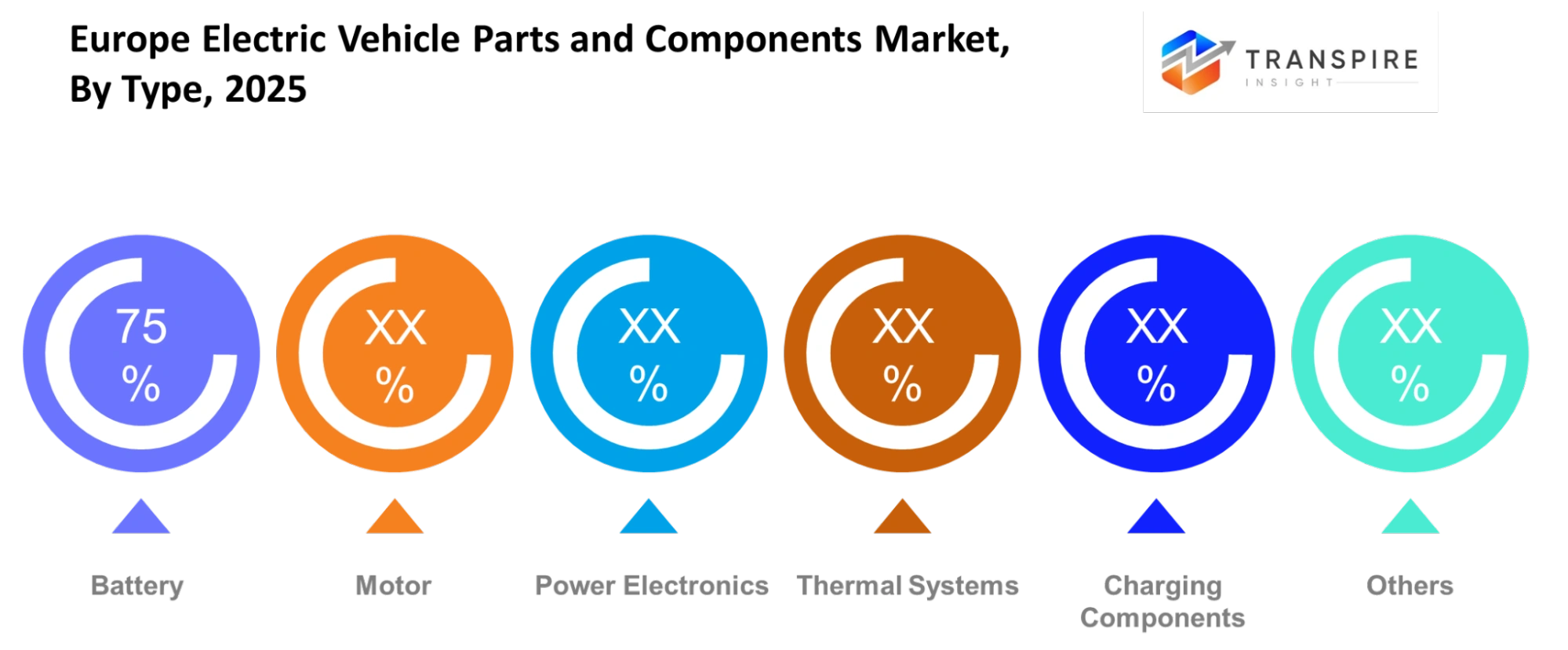
The European electric vehicle parts and components market designates battery systems as its leading segment because of their high production costs and their essential function for vehicle distance travel. Power electronics and motors follow as critical but lower value share segments. The market for charging components and thermal systems has expanded because of developing infrastructure and necessary operational efficiency standards.
European production facilities increasingly need power for their battery systems to support long range vehicle operations and their dedicated local cell manufacturing centers. The motor system market is expanding because high torque motors have become more efficient. Power electronics benefit from silicon carbide adoption because it allows for the development of higher voltage systems. The operational development of charging components results from the establishment of fast charging corridors on both highways and urban areas. The significance of thermal systems has increased because battery safety requirements and climate performance standards need them.
To learn more about this report, Download Free Sample Report
By Application:
Passenger electric vehicles hold leading share in Europe electric vehicle parts and components market due to strong consumer adoption and OEM portfolio expansion across compact and premium segments. The commercial electric vehicle market has reached a moderate market share which exists because fleet operators need to comply with electrification requirements. The European market for two-wheeler vehicles exists as a small market segment, yet there is a steady increase in their use for urban micro mobility purposes.
The growth of the passenger segment occurs because of three factors: charging network density, model variety across price bands, and subsidy frameworks. The commercial sector has increased its adoption rate because of two factors: logistics decarbonization targets and total cost of ownership advantages. The demand for two-wheelers has increased because last-mile delivery operations now use electric vehicles and urban areas face congestion problems. The future market trends show that passenger platforms will gain market control because companies will establish modular components and standardized systems.
By End-User:
The market for electric vehicle parts and components in Europe sees OEMs as the main buyers because they control the entire vehicle manufacturing process and have secured permanent supply agreements with their tierone suppliers. The share of fleet operators continues to increase because logistics and ride-hailing services and corporate fleets now use electric vehicles. The aftermarket business operates at a smaller scale because most electric vehicles in Europe today operate in their initial stage of development.
OEMs extend their control through the process of platform consolidation which allows them to manage battery and drivetrain components through their entire production chain. Fleet operators require solutions which provide durability and predictive maintenance capabilities while optimizing their overall operational expenses. The aftermarket will grow according to the vehicle aging process and the ability of independent service networks to handle services. The future market will see more OEMs taking control of their operations while their selected fleet customers will drive them to develop new charging and telematics system technologies.
By Component:
The European market for electric vehicle parts and components shows significant market share belonging to drivetrain components because they directly affect vehicle performance and operational effectiveness. Battery management systems maintain their strong market position because they provide essential safety monitoring functions and energy optimization capabilities. The importance of charging systems grows as more charging stations become established. The demand for thermal systems remains steady because they serve to regulate the temperature of batteries.
Drivetrain components now advance through the use of e-axle systems and lightweight material technologies. Battery management systems now use AI technology for their diagnostic functions while performing battery charge balancing operations. The charging systems now support ultra-fast charging through their adoption of new charging standards. Liquid cooling systems now provide thermal systems with upgraded operational capabilities. The future market direction indicates that power electronics and drivetrain systems will develop integrated systems which will produce more efficient vehicle designs.
What are the Key Use Cases Driving the Europe Electric Vehicle Parts and Components Market?
Passenger electric vehicle production at European OEM assembly lines creates a demand for batteries and power electronics and drivetrain systems as its core use case. The primary consumption channel in Europe electric vehicle parts and components market exists because strong consumer adoption together with emissions regulations sustain ongoing procurement for high-volume vehicle platforms.
Durable charging systems and thermal management solutions experience increasing demand from commercial logistics electrification and urban fleet operations. Delivery networks and fleet operators choose fast charging infrastructure and predictive battery systems for their high-utilization vehicle cycles because they want to decrease operational costs and increase operational uptime.
Vehicle-to-grid services and electric autonomous shuttle networks demonstrate initial progress toward becoming established applications. Smart grid technology and shared mobility pilot programs receive regulatory backing to create future requirements for bidirectional charging and advanced battery management solutions which will function within connected mobility systems.
|
Report Metrics |
Details |
|
Market size value in 2025 |
USD 97.64 Billion |
|
Market size value in 2026 |
USD 109.85 Billion |
|
Revenue forecast in 2033 |
USD 250.69 Billion |
|
Growth rate |
CAGR of 12.51% from 2026 to 2033 |
|
Base year |
2025 |
|
Historical data |
2021 - 2024 |
|
Forecast period |
2026 - 2033 |
|
Report coverage |
Revenue forecast, competitive landscape, growth factors, and trends |
|
Regional scope |
Europe (Germany, United Kingdom, France, Italy, Spain, Rest of Europe) |
|
Key company profiled |
Bosch, Continental, Denso, LG Energy Solution, Panasonic, CATL, Samsung SDI, BYD, Valeo, ZF Friedrichshafen, Magna, Aisin, Delphi Technologies, Infineon, NXP. |
|
Customization scope |
Free report customization (country, regional & segment scope). Avail customized purchase options to meet your exact research needs. |
|
Report Segmentation |
By Type (Battery, Motor, Power Electronics, Thermal Systems, Charging Components, Others); By Application (Passenger EVs, Commercial EVs, Two-wheelers, Others); By End-User (OEMs, Aftermarket, Fleet Operators, Others); By Component (Drivetrain, Charging System, Battery Management System, Thermal System, Others). |
Which Regions are Driving the Europe Electric Vehicle Parts and Components Market Growth?
The Europe Electric Vehicle Parts and Components Market currently operates under Western Europe as its leading market segment because the region possesses both extensive original equipment manufacturer presence and stringent emission regulations and its early adoption of electric vehicle standards. The three countries of Germany and France and the Netherlands together drive demand through their large-scale electric vehicle manufacturing operations and their extensive supplier networks. The presence of advanced R&D clusters and strong collaboration between automakers and Tier 1 suppliers reinforces rapid component innovation cycles. The existing charging infrastructure and high electric vehicle adoption rates create constant demand for replacement power electronics components and battery systems in the aftersales market.
Southern Europe operates as a region that emphasizes stability through its Italian and Spanish markets which exhibit steady growth of electric vehicle adoption that results from their industrial sector development and manufacturing operations for export. This region experiences growth through industrial policy backing and OEM factory investments instead of Western Europe which depends on regulatory frameworks for growth. Local suppliers benefit from integration into broader European supply chains rather than standalone technological leadership. This system provides manufacturers with an essential production foundation which stabilizes supply disruptions in the area while enabling efficient component procurement from international manufacturers.
The East European region exhibits its fastest growth rate because of its active manufacturing shift and recent establishment of electric vehicle supply chain operations in Poland and Hungary and the Czech Republic. The battery and electronics manufacturing sector underwent a complete transformation when companies began to increase their production facilities in order to take advantage of lower wage rates and funding from EU industrial programs. The development of new gigafactories and the expansion of supplier parks have resulted in substantial improvements to the competitive position of the area.For investors and new entrants, this signals a structural shift toward Eastern Europe becoming a critical cost and production hub in the 2026–2033 period.
Who are the Key Players in the Europe Electric Vehicle Parts and Components Market and How Do They Compete?
The European EV parts market shows a moderate level of consolidation among Tier 1 suppliers while battery and semiconductor specialists create new market disruptions. The existing companies protect their relationships with OEMs while the new companies entering the market establish new methods for generating revenue. The primary area of competition exists in system-level integration which combines software with power electronics and battery efficiency elements while EU regulations and cost reductions drive industry requirements.
Bosch develops software-based vehicle platforms and complete electrification solutions which enable the company to obtain long-term partnerships with European OEMs. Continental shifts its business focus to advanced driver assistance systems and vehicle architecture software while decreasing its reliance on traditional tire sales through organizational changes. ZF Friedrichshafen develops its modular e-drive and electric axle technology through specific acquisitions in drivetrain electronics which enable the company to grow its operational abilities.
Valeo uses its specialized thermal management and sensor technology for electric vehicle efficiency to develop new EV solutions through partnerships with European automotive manufacturers. Infineon expands its silicon carbide power semiconductor production capacity through European investments which enable the company to produce high-efficiency inverters and charging solutions for electric vehicle platforms.
Company List
- Bosch
- Continental
- Denso
- LG Energy Solution
- Panasonic
- CATL
- Samsung SDI
- BYD
- Valeo
- ZF Friedrichshafen
- Magna
- Aisin
- Delphi Technologies
- Infineon
- NXP
Recent Development News
“In March 2025, LG Energy Solution announced a supply agreement with Poland’s PGE to deliver 981MWh of grid-scale ESS batteries between 2026 and 2027. The project, involving production from LG’s Poland facility, reinforces Europe’s shift toward localized battery manufacturing and integrated energy storage infrastructure for grid stability.
Source: https://www.lgcorp.com
In April 2025, LG Energy Solution entered a joint venture with Derichebourg to establish a battery recycling plant in northern France, scheduled to begin operations in 2027. The facility targets black-mass recovery and end-of-life EV battery processing, strengthening Europe’s emerging closed-loop EV supply chain.
Source: https://www.prnewswire.co.uk
What Strategic Insights Define the Future of the Europe Electric Vehicle Parts and Components Market?
The Europe electric vehicle parts and components market will experience capacity expansion until it reaches its peak in the first five to seven years which will then lead to market consolidation through vertical integration because of strict EU decarbonization requirements and OEM demand for domestic supply chains.Competitive advantage will increasingly hinge on control over high-efficiency power electronics battery systems and software-enabled components rather than mechanical assemblies.
The upstream raw material supply chain presents a hidden danger because the requirement for lithium and nickel and rare earths creates potential supply interruptions which will affect operational performance when export controls become more strict.
The development of circular battery ecosystems presents new business opportunities through advanced recycling and second-life battery applications which are transitioning from pilot projects to commercial infrastructure throughout Europe.Market participants should prioritize securing closed-loop supply partnerships and investing early in recycling technologies to hedge input volatility while capturing long-term margin resilience.
Europe Electric Vehicle Parts and Components Market Report Segmentation
By Type
- Battery
- Motor, Power Electronics
- Thermal Systems
- Charging Components
- Others
By Application
- Passenger EVs
- Commercial EVs
- Two-wheelers
- Others
By End-User
- OEMs
- Aftermarket
- Fleet Operators
- Others
By Component
- Drivetrain
- Charging System
- Battery Management System
- Thermal System
- Others
Frequently Asked Questions
Find quick answers to common questions.
The Europe Electric Vehicle Parts and Components Market size is USD 250.69 Billion in 2033.
Key segments for the Europe Electric Vehicle Parts and Components Market are By Type (Battery, Motor, Power Electronics, Thermal Systems, Charging Components, Others); By Application (Passenger EVs, Commercial EVs, Two-wheelers, Others); By End-User (OEMs, Aftermarket, Fleet Operators, Others); By Component (Drivetrain, Charging System, Battery Management System, Thermal System, Others).
Major Europe Electric Vehicle Parts and Components Market players are Bosch, Continental, Denso, LG Energy Solution, Panasonic, CATL, Samsung SDI, BYD, Valeo, ZF Friedrichshafen, Magna, Aisin, Delphi Technologies, Infineon, NXP.
The Europe Electric Vehicle Parts and Components Market size is USD 97.64 Billion in 2025.
The Europe Electric Vehicle Parts and Components Market CAGR is 12.51% from 2026 to 2033.
- Bosch
- Continental
- Denso
- LG Energy Solution
- Panasonic
- CATL
- Samsung SDI
- BYD
- Valeo
- ZF Friedrichshafen
- Magna
- Aisin
- Delphi Technologies
- Infineon
- NXP
Recently Published Reports
-
Apr 2026
ATV & UTV Market
ATV & UTV Market Size, Share & Analysis Report By Type (ATV, and UTV), By Variants (Less Than 400 CC, 400 CC To 800 CC, and More Than 800 CC), and Geography (North America, Europe, Asia-Pacific, Middle East and Africa, South and Central America), 2021 - 2031
-
Apr 2026
Automotive Central Gateway Module Market
Automotive Central Gateway Module Market Size, Share & Analysis Report By Type (Ethernet Central Gateway Module, CAN Central Gateway Module, LIN Central Gateway Module, and FlexRay), By Application (Powertrain Control, Body Control, Infotainment System, Advanced Driver Assistance Systems (ADAS), and Others), By End User (Passenger Vehicles, and Commercial Vehicles), and Geography (North America, Europe, Asia-Pacific, Middle East and Africa, South and Central America), 2021 - 2031
-
Apr 2026
Automotive Engine Oil Filter Market
Automotive Engine Oil Filter Market Size, Share & Analysis Report By Filter Type (Fuel Filter, Engine Oil Filter, Hydraulic Oil Filter, and Others), By Filter Media (Cellulose, Synthetic, and Micro), By Sales Channel (OEMs, and Aftermarket), By Vehicle Type (Passenger Cars, Light Commercial Vehicles, Heavy Duty Trucks, Buses and Coaches, and Off-road Vehicles), and Geography (North America, Europe, Asia-Pacific, Middle East and Africa, South and Central America), 2021 - 2031
-
Apr 2026
Automotive Parts Aluminium Die Casting Market
Automotive Parts Aluminium Die Casting Market Size, Share & Analysis Report By Production Process (Pressure Die Casting, Vacuum Die Casting, Squeeze Die Casting, Gravity Die Casting), By Application (Body Parts, Engine Parts, Transmission Parts, Battery And Related Components, Other Application Types), and Geography (North America, Europe, Asia-Pacific, Middle East and Africa, South and Central America), 2021 - 2031
Our Clients