

TV Stand Market Summary:
As per the Transpire Insight Analysis, the TV Stand Market size is estimated at USD 15.78 Billion in 2025 and is anticipated to reach USD 24.23 Billion by 2033, growing at a CAGR of 5.51% from 2026 to 2033.
The TV stand industry designs, produces, and markets furniture frames, supports, and mounts for TVs that incorporate the latest accessories to match new consumer device interiors. In the past 3–5 years, the market has moved away from support-only units to entertainment stations, including interaction with PC & gaming equipment, sound bars, and appliances. A structural change has been the mainstreaming of smart TV and ultra-high-definition displays, which demand stronger, built-in-ready frames with ventilation, power, and posturization. A recent industry-level trigger is the explosion in new large-format display launches and connected-home appliance product ecosystems, which have encouraged the home to re-orchestrate a media room for set-top access and multiple users on larger screens.
The market is expanding because big screens and connected devices inspire the demand for space-saving stability, flexibility, and organization, particularly in the context of upgrade modularity and luxury.
TV Stand Market Size & Forecast:
- Market Size 2025: USD 15.78 Billion
- Expected Market Value (2033): USD 24.23 Billion
- Forecast CAGR (2026–2033): 5.51%
- Leading Region in 2025: North America
- Fastest Growing Region: Asia Pacific
- Key Company Profiles: IKEA, Ashley Furniture, Sauder Woodworking, Walker Edison, Bush Furniture, Atlantic Inc., HOMCOM, Wayfair, Walmart, Target, Ameriwood Home, Hülsta, BDI Furniture, AVF Group, FITUEYES.

Key TV Stand Market Insights:
The market is shifting from traditional display furniture to modular media-storage solutions, and technology integration and sustainability are now practical differentiators. Businesses are reacting by using flexible designs, cable management, e-commerce customisation, and material efficiency, rather than focusing on furniture design.
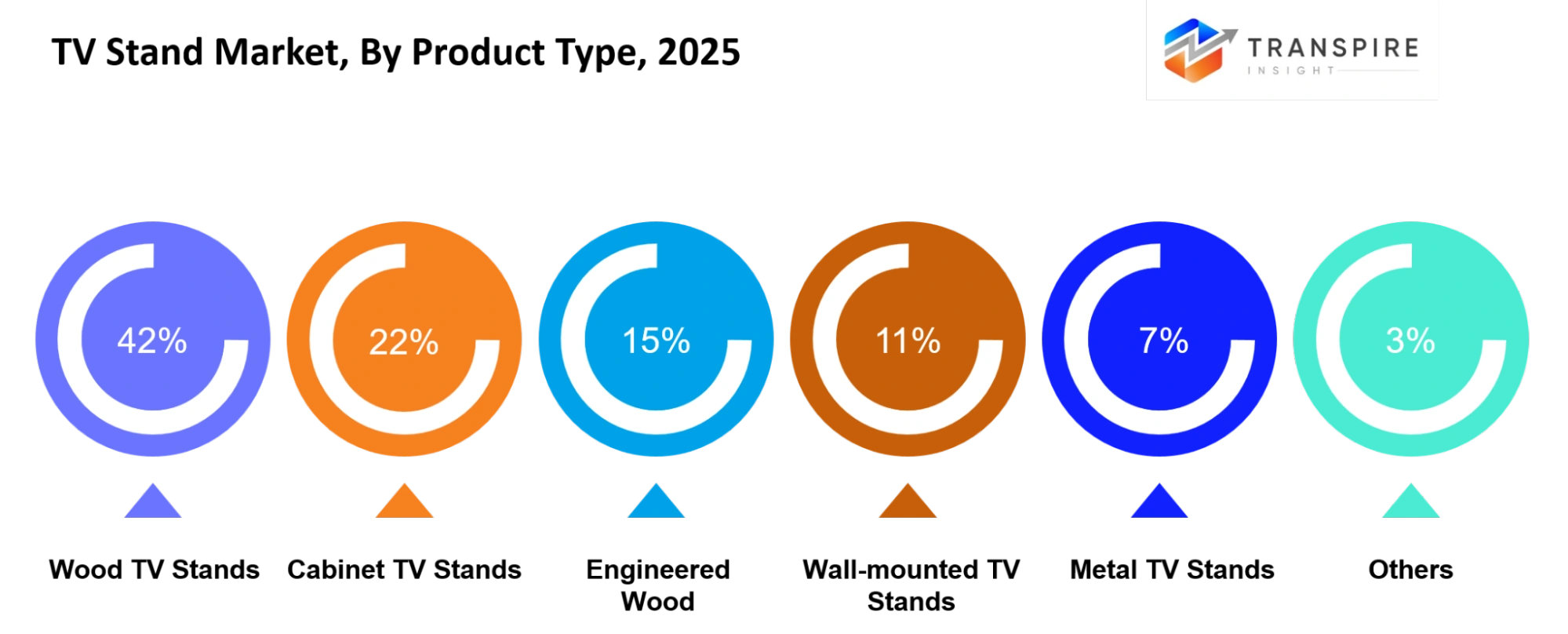
- The modular customization of the RTA segment is dominated by Wood stands, which account for a 42% share, and IKEA's BESTÅ system.
- The hidden cable technology developed by Sauder drives increased adoption in North America, while Cabinet TV remains at 22%.
- Engineered wood at 15% and Ashley Furniture's automation reduce waste by 18%, improving cost leadership.
- Attached to the wall is at 11% with 8.7% CAGR; BDI's low-profile designs are geared towards minimalist urban apartments.
- Walker Edison's industrial aesthetic aims at commercial hospitality growth, while metal stands at 7%.
- Online retail is on the rise; the AR room planners boost Wayfair's conversion by 23% in 2025.
- The compatibility range for 56-65 inches is the fastest; FITUEYES' adjustable mounts match 4K/8K screen shifts.
- Asia-Pacific holds a 27% share and a 9.4% CAGR; HOMCOM's local designs are in tune with India's middle-class boom.
What are the Key Drivers, Restraints, and Opportunities in the TV Stand Market?
Driver:
Growth is fueled by the penetration of large-screen smart TVs and connected home-entertainment ecosystems, fueling demand for rugged, cable-managed furniture. As the cost of display panels continues to drop and 4K/8K resolutions gain popularity, consumers upgrade to displays larger than 55 inches, increasing demand for wider, more powerful stands. This trend is also raising revenue per unit as consumers opt for premium units with built-in charging, LED lighting, hidden storage, cooling, and dedicated spaces for gaming and streaming gear.
Restraint:
Growth is limited by ceiling height and the transition of apartments into wall-mounted units, which remove the need for a traditional stand. Structural pressure remains as high-density living moves towards smaller interiors and minimalistic trends are embracing floating, clutter-free designs. Floor stands will need to offer more functions such as intelligent storage, cable management, modularity, and integrated technology.
Opportunity:
Potential future evolution of modular, AI-tailored TV stands may offer growth opportunities, when the customization can be determined on-demand by selecting the size, storage composition, finish, and tech set-up. Investment in parametric design tools may allow across Asia-Pacific the low-cost mass customizations for small city homes, with lowered design lead time and reduced inventory complexity. Manufacturers could leverage digital room measurements with automated configuration engines to tailor products at space level, resulting in differentiation and higher conversion rates.
What Has the Impact of Artificial Intelligence Been on the TV Stand Market?
AI is having an early impact in this market through design automation, demand prediction, and configuration and manufacturing optimization rather than embedding it into each product. Generative and language-guided design tools will be able to take in room dimensions, desired styles, materials, and storage requirements and generate many furniture configurations to help the designer speed up customization. Examples include FurniMAS research, which shows how multi-agent AI can generate furniture decoration options from user prompts, including for TV-stand applications.
AI models on the operational level can help in predicting SKU-level demands, detecting buying trends, forecasting optimal inventory allocations, and minimizing overstock in omni-channel and physical stores. Production planning through AI can adapt production sequences to batch quantities, set-up times, transportation needs, and dynamically varying customer orders to increase factory efficiency. This leads to a concurrent decrease in stock-out occurrences and a broader range of SKU offerings. The primary constraint is the cost of integration and data quality. AI systems need good product, inventory, manufacturing, and customer data, whereas small furniture manufacturers may not have ERP, MES, computing infrastructure, or the technical capabilities required.
Key TV Stand Market Trends:
The category is evolving from traditional furniture to flexible media infrastructure, where storage, design, technology compatibility, and sustainability are increasingly being combined. Digital commerce and smarter manufacturing are also helping to expand assortments, without the need for all products to be mass-produced.
- With an increasing number of screens and devices, move from open shelving to closed cabinets with hidden cable management.
- Increasingly popular are wall-mounted and corner units to optimize floor space in urban apartments.
- Standard features include integration of USB ports, wireless charging, and LED ambient lighting.
- Increased use of sustainable materials such as bamboo, repurposed wood, and low-VOC finishes, due to environmental regulations.
- Expansion of modular, flat-pack designs that allow do-it-yourself installation and scalability for e-commerce.
- AI-powered configurators for customization options, enabling consumers to personalize dimensions, colours, and storage layouts.
- Premiumization in North America and Europe using solid wood and mixed materials is a design statement.
- The Asia-Pacific region is expected to see growth as the middle class in the region continues to buy homes and smart TVs.
TV Stand Market Segmentation
By Material:
Wood TV stands are dominant at 42%, driven by durability, natural aesthetics, and versatility for traditional and modern schemes. Metal is still pertinent for lightweight and industrial configurations, while Glass answers fashion-driven schemes. MDF, particleboard, and Engineered Wood make up 15% for budget, uniformity, and flat-pack manufacturing, as Mixed Materials foster more varied surface options and integrated furniture styles.
By Product Type:
Cabinet TV Stands have a 22% share; these have the advantage of discreet storage and a tidier living room appearance. Open TV Stands are a useful format for ease of access, and Corner TV Stands are an efficient use of space. Wall-mounted TV Stands are the fastest-growing form at 8.7%, with demand for floor-space-saving units. Entertainment Centres are designed to accommodate bigger screens and several appliances.
By Size Compatibility:
33-55 inch stands continue to be the mainstay format for mainstream TV support and affordable storage needs. 56-65 inch & above 65 inch TV stands are attaining critical strategic focus as large and extra-large display units necessitate proportionally wider & stronger furniture and optimize equipment placement. Up to 32-inch format stands have niche applications for bedrooms, studios & small apartments and limited-space installations.
By Distribution Channel:
Online Retail is growing faster with broader assortment, digital imagery, personalized recommendations and simple delivery. Furniture Stores continue to be relevant where consumers prefer to see, touch, and feel the material, finish, and product stability. Home Improvement Stores cater to home improvement needs, while Specialty Stores and others address design-centric, project-centric, and space-constrained buyer requirements.
By End User:
The residential market is paramount, with living-room, bedroom, and specific media-room fits. Commercial and Hospitality clients seek robust solutions, standard footprints, and uniform equipment layouts to streamline repeated implementations. Offices are adopting small TV cabinets for conference rooms, training areas, and group working zones in which clean, flexible cabling and layout facilitate presentation equipment as well as space-efficient work surroundings.
What are the Key Use Cases Driving the TV Stand Market?
The primary application is home living room entertainment using wood-based TV stands to hold large-screen TVs, gaming devices, and streaming players with integrated storage and wiring and cable management. This fits with the high wood-and-cabinet segments, which emphasize beauty and utility.
Other growing uses are home offices and multipurpose rooms, where the stands are also used as desks or media centres with multiple USB ports and adjustable shelving.
New use-cases include those targeted at hospitality or commercial environments, like hotels or lounges, where custom-designed entertainment centres would promote a brand and maximize guest experience through high-end materials and intelligent design.
|
Report Metrics |
Details |
|
Market size value in 2025 |
USD 15.78 Billion |
|
Market size value in 2026 |
USD 16.65 Billion |
|
Revenue forecast in 2033 |
USD 24.23 Billion |
|
Growth rate |
CAGR of 5.51% from 2026 to 2033 |
|
Base year |
2025 |
|
Historical data |
2021 - 2024 |
|
Forecast period |
2026 - 2033 |
|
Report coverage |
Revenue forecast, competitive landscape, growth factors, and trends |
|
Regional scope |
United States; Canada; Mexico; United Kingdom; Germany; France; Italy; Spain; Denmark; Sweden; Norway; China; Japan; India; Australia; South Korea; Thailand; Brazil; Argentina; South Africa; Saudi Arabia; United Arab Emirates |
|
Key companies profiled |
IKEA, Ashley Furniture, Sauder Woodworking, Walker Edison, Bush Furniture, Atlantic Inc., HOMCOM, Wayfair, Walmart, Target, Ameriwood Home, Hülsta, BDI Furniture, AVF Group, FITUEYES. |
|
Customization scope |
Free report customisation (country, regional & segment scope). Available customised purchase options to meet your exact research needs. |
|
Report Segmentation |
By Material (Wood, Metal, Glass, MDF/Particle Board, Engineered Wood, Mixed Materials, Others); By Product Type (Open TV Stands, Cabinet TV Stands, Corner TV Stands, Wall-mounted TV Stands, Entertainment Centers, Others); By Size Compatibility (Up to 32-inch, 33–55-inch, 56–65-inch, Above 65-inch, Others); By Distribution Channel (Furniture Stores, Online Retail, Home Improvement Stores, Specialty Stores, Others); By End User (Residential, Commercial, Hospitality, Offices, Others). |
Which Regions are Driving the TV Stand Market Growth?
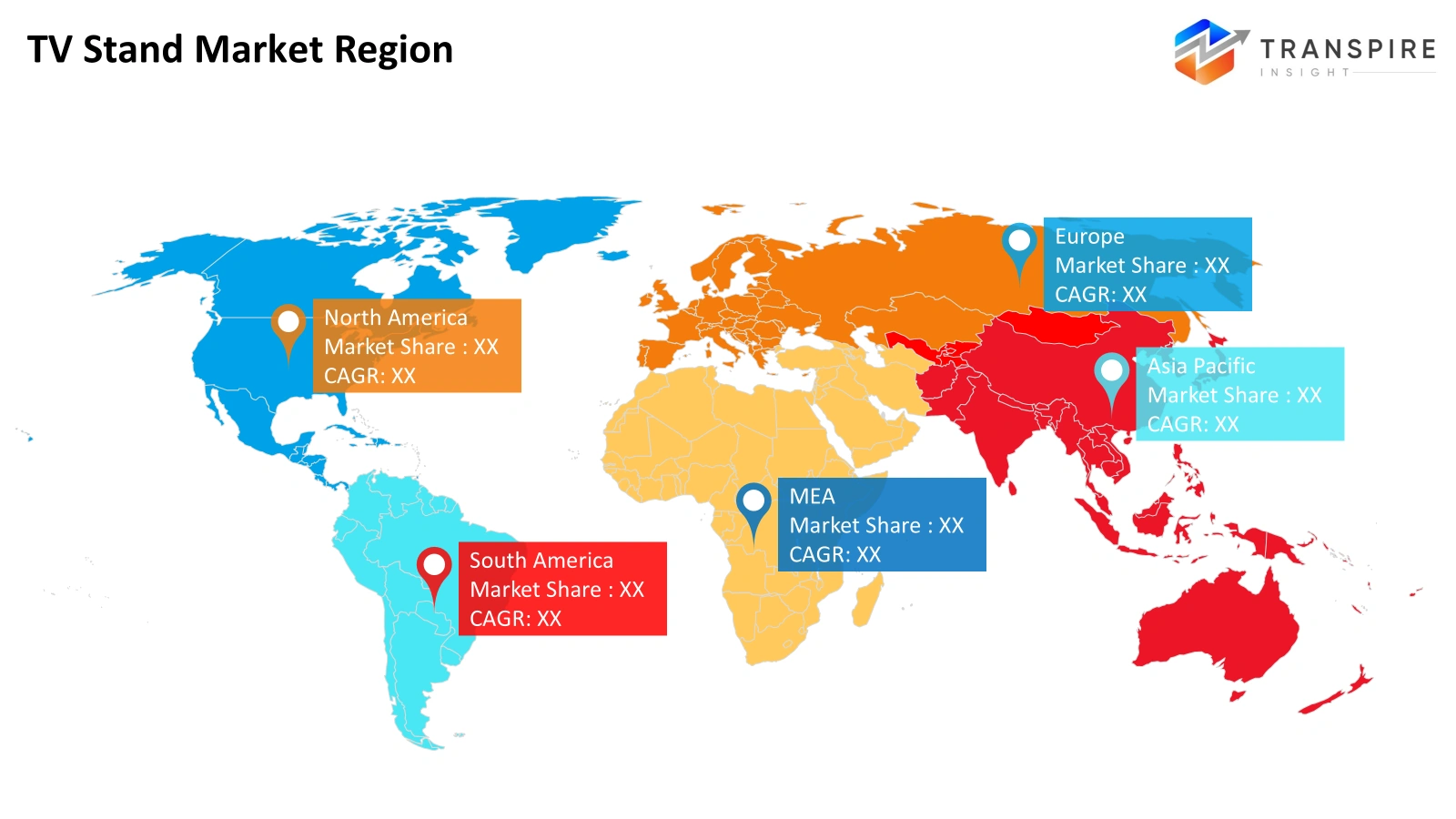
North America secures a 36% share, with attractive disposable income levels, high penetration of large-screen televisions, and a mature online retail ecosystem. Sustainability-focused manufacturing capacities and a robust logistics network create attractive opportunities for premium brands like Sauder and BDI. Consumer needs are moving toward cabinet-style TV stands with integrated cable management, storage, and smart-home capabilities. Deep digital retail penetration will drive faster new product introduction, customized product assortments, and scalable DTC offerings throughout the region. In February 2026, Sauder Woodworking launched a new sustainable, smart-enabled modular entertainment cabinet line. This rollout expanded their direct-to-consumer digital footprint and met rising regional demand for integrated cable management storage.
Europe has a 28% share and is driven by design-driven premiumisation, sustainability mandates, and increased demand for environmentally friendly materials. Small, modular TV stands appeal to city dwellers who have less space to use. Established retail networks and loyal brands provide stability with regard to IKEA and Htlsa. Fluctuations in raw-materials prices are countered by localised manufacturing, recycled inputs, repairability, and circular economy strategies that enhance resource use efficiency and the long-term worth of products. In August 2026, IKEA globally launched its KOMPISHÄNG collection, a line of 11 portable and modular pine and steel furniture items tailored specifically for young urban residents navigating smaller, transient living arrangements. This product launch directly addresses the European demand for modular, space-optimising household furniture.
Asia-Pacific contributes 27% and has a 9.4% CAGR, which is the fastest regional market growth, driven by urbanization, a booming middle class, and an expanding home ownership footprint. Regional manufacturing hubs in India and Vietnam are bringing about import substitution, reducing costs and increasing responsiveness in supply. The remaining growth opportunities will lie in smart-home integration, space-efficient modularity, and low-cost flat-pack TV stands for high-density urban dwellings and changing consumer needs.
In April 2026, the Việt Nam Trade Office in India [partnership] held strategic talks with Reliance Retail to expand the direct retail integration and market footprint of regional consumer goods and modular lifestyle products within the SMART Bazaar network, optimizing supply chain responsiveness and market access.
Who are the Key Players in the TV Stand Market and how do they Compete?
The worldwide competition in the TV stand industry is fragmented. The leading players, including IKEA, Ashley Furniture, and Sauder, have dominated the market share with over 45% through economies of scale, design innovation, and extensive sales channels. Competition focuses on price, design, and distribution channels.
IKEA applies cost leadership and modularity; BEST and BRIMNES extend IKEA's modular strategy to the European ready-to-assemble furniture segment. Ashley Furniture combines vertical integration and automation to optimize tariff risks, improve availability, and cater to North American hungry-for-value consumption. Sauder drives differentiation via engineering-driven innovation, primarily in terms of cable management, durability, and very convenient media storage. Walker Edison and Bush Furniture pursue e-commerce expertise, large digital assortment, low prices, and rapid delivery. BDI and AVF Group, premium furniture manufacturers, fight for value-driven, style-motivated buyers through designer material quality, elegant visual design, and customised finishing. Walmart and Wayfair are expanding reach by private label collaborations and digitally-driven assortment placement, facilitating product accessibility. Hlsta is design-driven and European-oriented. HOMCOM builds affordable furniture on concepts adjusted to heterogeneous Asian markets for local competition and overall coverage.
Key Players are:
- IKEA
- Ashley Furniture
- Sauder Woodworking
- Walker Edison
- Bush Furniture
- Atlantic Inc.
- HOMCOM
- Wayfair
- Walmart
- Target
- Ameriwood Home
- Hülsta
- BDI Furniture
- AVF Group
- FITUEYES
Recent Development News
In June 2026, Povison expanded its retail footprint by opening a flagship brick-and-mortar storefront in Los Angeles. This physical expansion gives consumers direct access to high-end, fully assembled entertainment centres and low-profile media consoles designed for ultra-large televisions.
Source: https://www.povison.com
In January 2026, Coors Light launched its Home DeCoors furniture line, including a multifunctional case that can serve as a TV stand. The initiative brings temporary, space-saving functionality into home entertainment setups, reflecting demand for furniture that supports flexible hosting and compact living.
Source: https://www.businesswire.com
In April 2026, Megafurniture strengthened its focus on entertainment and storage furniture, highlighting the Tomeo Wooden TV Console and Rino Wooden TV Console (Rattan). The move expands its TV-furniture offering around integrated media storage and room-based planning, supporting more cohesive living-room solutions.
Source: https://www.barchart.com
What Strategic Insights Define the Future of the TV Stand Market?
The TV stand market is consolidating toward AI-specified and modular furniture with smart-home convergence, adaptable size/ergonomics, and sustainable components. Growing usage of digital design tools empowers manufacturers to customize dimensions, storage-concept layouts, finishes, and technology integration for furniture to achieve multiple room sizes with diverse consumers. Supply-chain fragility remains a principal risk, however, due to dependencies on engineered wood, metal parts, fasteners, imported fittings, and raw-material prices. Escalating geopolitical risks, tariffs, shipping delays, and raw-material-cost fluctuations threaten margins. The Asia-Pacific region offers a promising perspective driven by rising middle-class households, urban growth, increasing disposable income levels, and stronger affinity toward easy-to-afford tech-enabled interior design. Localised manufacturing facilities will enhance cost-competitiveness and reduce reliance on sourcing from a distance. Forward-looking actions include investment in parametric design interfaces, modular product architectures, and regional manufacturing hubs for rapid mass customization, abbreviated lead times, sourcing stability, and transportation hedge.
Key Segmentations are:
By Material
- Wood
- Metal
- Glass
- MDF/Particle Board
- Engineered Wood
- Mixed Materials
- Others
By Product Type
- Open TV Stands
- Cabinet TV Stands
- Corner TV Stands
- Wall-mounted TV Stands
- Entertainment Centres
- Others
By Size Compatibility
- Up to 32-inch
- 33–55-inch
- 56–65-inch
- Above 65-inch
- Others
By Distribution Channel
- Furniture Stores
- Online Retail
- Home Improvement Stores
- Speciality Stores
- Others
By End User
- Residential
- Commercial
- Hospitality
- Offices
- Others
Regional Outlook
North America
- United States
- Canada
- Mexico
Europe
- Germany
- United Kingdom
- France
- Spain
- Italy
- Rest of Europe
Asia Pacific
- Japan
- China
- Australia & New Zealand
- South Korea
- India
- Rest of Asia Pacific
South America
- Brazil
- Argentina
- Rest of South America
Middle East & Africa
- Saudi Arabia
- United Arab Emirates
- South Africa
- Rest of the Middle East & Africa
Frequently Asked Questions
Find quick answers to common questions.
The TV stand market size was valued at USD 15.78 billion in 2025 and is poised to reach USD 24.23 billion by 2033, expanding at a 5.51% CAGR.
Key segments for the TV stand market are By Material (Wood, Metal, Glass, MDF/Particle Board, Engineered Wood, Mixed Materials, Others); By Product Type (Open TV Stands, Cabinet TV Stands, Corner TV Stands, Wall-mounted TV Stands, Entertainment Centers, Others); By Size Compatibility (Up to 32-inch, 33–55-inch, 56–65-inch, Above 65-inch, Others); By Distribution Channel (Furniture Stores, Online Retail, Home Improvement Stores, Specialty Stores, Others); By End User (Residential, Commercial, Hospitality, Offices, Others).
Growth is primarily driven by the proliferation of large-screen smart TVs requiring stable, cable-managed furniture, post-pandemic home entertainment upgrades, and rising demand for multifunctional stands with integrated charging, LED lighting, and concealed storage.
The TV stand market is led by major manufacturers including IKEA, Ashley Furniture, Sauder Woodworking, Walker Edison, Bush Furniture, Atlantic Inc., HOMCOM, Wayfair, Walmart, Target, Ameriwood Home, Hülsta, BDI Furniture, AVF Group, FITUEYES.
North America holds a 36% share, influencing dynamics through high disposable incomes, large-screen TV adoption, robust e-commerce infrastructure, policy incentives for sustainable manufacturing, and consumer preference for premium cabinet-style stands with integrated tech features.
Commercial opportunities include AI-customized modular stands, Asia-Pacific-driven localized production, smart-home integrated designs for hospitality and offices, and parametric design platforms enabling mass customization while hedging tariff and logistics risks.
- IKEA
- Ashley Furniture
- Sauder Woodworking
- Walker Edison
- Bush Furniture
- Atlantic Inc.
- HOMCOM
- Wayfair
- Walmart
- Target
- Ameriwood Home
- Hülsta
- BDI Furniture
- AVF Group
- FITUEYES
About the Authors

Chetan Dhatrak
I’m Chetan Dhatrak, a Senior Research Analyst at Transpire Insight, specializing in the Consumer Goods, Foods and Beverages industry. I focus on analyzing market trends, consumer behavior, competitive landscapes, and industry developments to deliver accurate, data-driven insights. My research at Transpire Insight is built on credible sources and in-depth analysis, helping businesses and readers better understand market dynamics, emerging opportunities, and evolving consumer preferences. I’m committed to creating reliable, well-researched content that supports informed decision-making and reflects the latest developments in the consumer goods and food & beverage sectors.

Chakradhar Khansole
Chakradhar serves as the Research Director at Transpire Insight, bringing over 8 years of experience in technology, innovation, and strategic market intelligence. He specializes in transforming complex market data into actionable business insights that enable organizations to make informed, growth-oriented decisions. Recognized for his strategic vision and analytical expertise, Chakradhar leads high-impact research initiatives, delivering comprehensive market assessments, competitive intelligence, and forward-looking industry analysis.
Recently Published Reports
-
Apr 2026
Bottled Water Market
Bottled Water Market Size, Share & Analysis Report By Product Type (Still Bottled Water, Carbonated Bottled Water, Functional Bottled Water, and Others), By Packaging (PET, Cans, and Others), By Sales Channel (Supermarkets/Hypermarkets, Convenience Stores/Drug Stores, Grocery Stores/Club Stores, Foodservice, and Others) and Geography (North America, Europe, Asia-Pacific, Middle East and Africa, South and Central America), 2021 - 2032
-
Apr 2026
Color Cosmetic Packaging Market
Color Cosmetic Packaging Market Size, Share & Analysis Report By Application (Mascara Packaging, Liquid Packaging, and Liquid Face), By Type (Tubes & Bottles, Pens & Markers, Compacts & Containers, and Droppers & Pumps), and Geography (North America, Europe, Asia-Pacific, Middle East and Africa, South and Central America), 2021 - 2031
-
Apr 2026
External Microphone For Camera Market
External Microphone For Camera Market Size, Share & Analysis Report By Type (Shotgun Microphone, Lavalier Microphone, and Others), By Application (Digital Camera, Professional Video Camera, and Others), and Geography (North America, Europe, Asia-Pacific, Middle East and Africa, South and Central America), 2021 - 2031
-
Apr 2026
Foot Orthotic Insoles Market
Foot Orthotic Insoles Market Size, Share & Analysis Report By Type (Pre-fabricated, and Custom-made), By Material (Thermoplastic, Composite Carbon Fiber, and Others), By Distribution Channel (Drug Stores, Hospitals & Clinics, and Others), and Geography (North America, Europe, Asia-Pacific, Middle East and Africa, South and Central America), 2021 - 2031