
Sustainable Materials Market Summary:
According to Transpire Insights, a detailed research report on the market reflects that the packaging application segmentdominates the Sustainable Materials Market, accounting for approximately 43% of the total market share worldwide. BASF SE leads the competitive landscape with approximately USD 74 billion in annual revenue and an estimated 9-13% market share, making it one of the leading contributors to market development through continuous innovation in bio-based materials, recycled polymers, advanced sustainable material technologies, circular economy initiatives, expanding production capabilities, and next-generation eco-friendly material solutions.
Market Snapshot
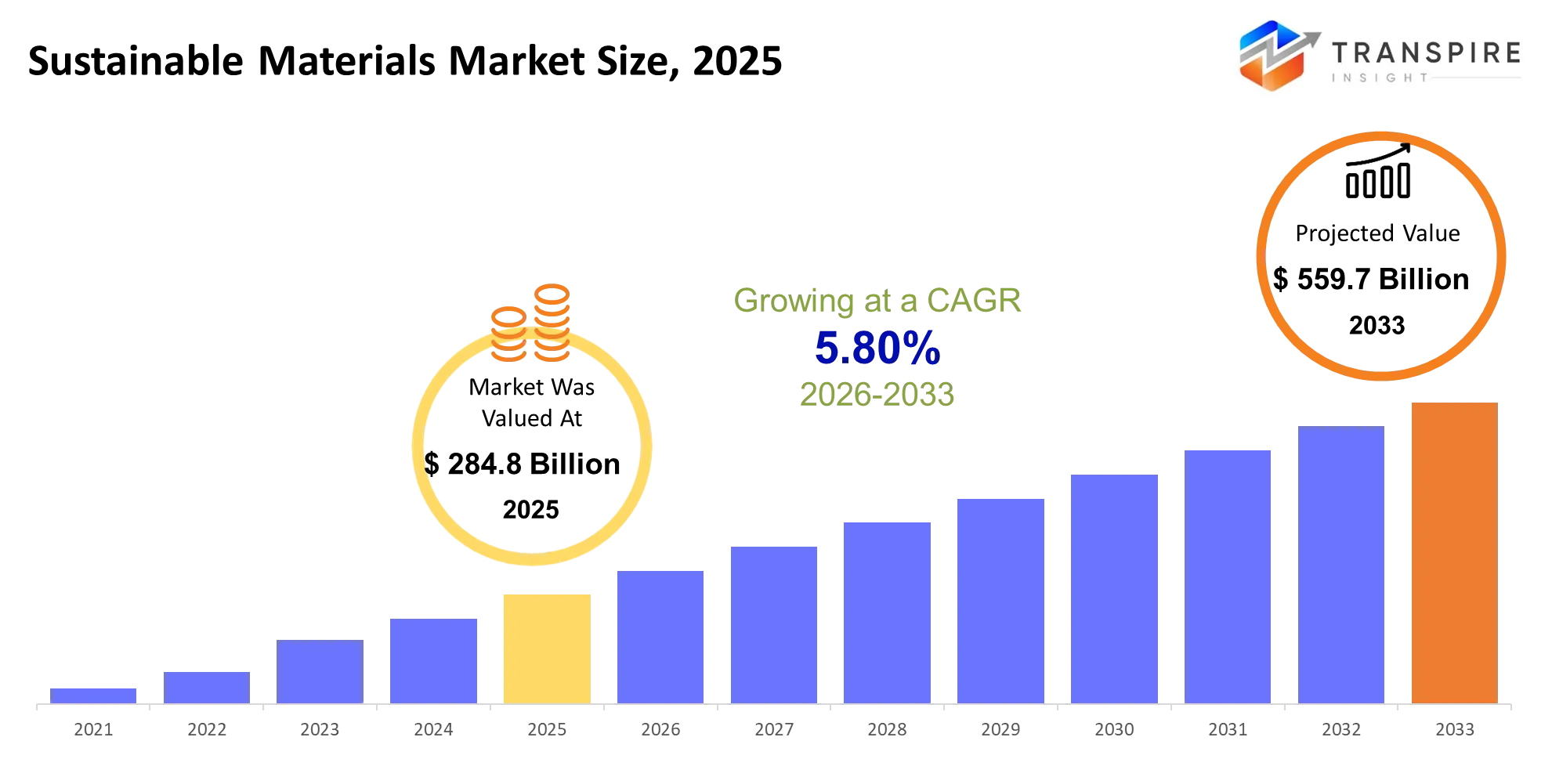
- Market Value (2025): USD 284.8 Billion.
- Expected Market Value (2026): USD 309.9 Billion.
- Estimated Market Value (2033): USD 559.7 Billion.
- Forecast CAGR (2026-2033): 5.80%.
- Leading Region in 2025: Asia-Pacific.
- Second-largest Region: Europe.
- Fastest Growing Region: North America.
Introduction
Sustainable Materials are environmentally responsible materials designed to minimize environmental impact throughout their lifecycle, from raw material sourcing and manufacturing to usage and end-of-life recycling or disposal. These materials include bio-based plastics, recycled polymers, natural fibers, biodegradable materials, green composites, recycled metals, sustainable wood products, and low-carbon construction materials. Sustainable materials offer key advantages such as reduced carbon emissions, improved resource efficiency, lower environmental footprint, enhanced recyclability, regulatory compliance, and support for circular economy initiatives. Their growing adoption across industries including packaging, construction, automotive, electronics, consumer goods, and textiles is driving significant market expansion. The Sustainable Materials Market is fueled by increasing environmental regulations, rising consumer demand for eco-friendly products, corporate sustainability commitments, advancements in material science, and growing investments in circular economy technologies.
For Instance:-
- North America, Market Outlook: North America is expected to remain one of the leading regions in the Sustainable Materials Market, supported by stringent environmental regulations, increasing adoption of recycled and bio-based materials, strong investments in green building projects, and rising demand from the automotive and packaging industries. The regional market is anticipated to witness substantial growth over the forecast period.
- Europe, Sustainability & Circular Economy: Manufacturers across Europe are investing heavily in low-carbon manufacturing processes, advanced recycling technologies, bio-based material innovation, digital material traceability systems, and circular economy initiatives to improve product sustainability, reduce greenhouse gas emissions, comply with evolving environmental regulations, and strengthen supply chain transparency. These strategic investments are accelerating the commercialization and adoption of next-generation sustainable materials across multiple industrial sectors.
Market Highlights: -
- Asia Pacific is expected to grow at a rapid CAGR in the Sustainable Materials Market by holding approximately 31% of the share during the forecast period.
- Europe is the fastest-growing region in the Sustainable Materials Market during the period, holding approximately 36% share.
- North Americais anticipated to hold approximately 25% share of the Sustainable Materials Market over the predicted timeframe.
- By material Type, the Recycled Materials segment dominated the market and holds approximately 41% share in 2025 and is projected to grow at a substantial CAGR during the forecast period. The segment's dominance is attributed to increasing demand for recycled plastics, recycled metals, recycled paper, and recycled glass driven by circular economy initiatives, stringent environmental regulations, and corporate sustainability commitments.
- By Application, the Packaging segment dominated the market and holds approximately 43% share in 2025 and is projected to grow at a substantial CAGR during the forecast period. The widespread adoption of sustainable packaging solutions across food & beverages, personal care, healthcare, and e-commerce industries continues to accelerate demand for bio-based, recyclable, and compostable materials.
- By End User, the Packaging & Consumer Goods Industry segment dominated the market and holds approximately 39% share in 2025 and is projected to grow at a substantial CAGR during the forecast period. Increasing consumer preference for environmentally friendly products, corporate ESG commitments, and regulations restricting single-use plastics are supporting significant market growth.
- European Green Deal & Circular Economy Action Plan (CEAP): The European Union continues to promote sustainable material adoption through the European Green Deal and the Circular Economy Action Plan (CEAP), encouraging investments in recycled materials, bio-based products, advanced recycling technologies, and low-carbon manufacturing. These initiatives support manufacturers, material innovators, research institutions, and industrial companies in expanding sustainable production capacity while reducing carbon emissions and resource consumption across multiple industries.
How is Technology Driving Growth in the Sustainable Materials Market?
The Sustainable Materials Market is witnessing significant growth due to rapid technological advancements in material science, bio-based polymers, advanced recycling technologies, green chemistry, nanotechnology, and circular manufacturing processes. Manufacturers are increasingly adopting chemical recycling, AI-powered material optimization, digital traceability systems, carbon capture technologies, and smart manufacturing solutionsto improve material performance, recyclability, durability, and production efficiency. Advanced processing technologies enable companies to produce lightweight, biodegradable, renewable, and low-carbon materials that meet evolving environmental regulations and sustainability targets. Furthermore, innovations inclosed-loop recycling systems, sustainable packaging technologies, and renewable feedstock processing are accelerating the commercialization of next-generation sustainable materials across packaging, automotive, construction, electronics, and consumer goods industries.
Market Drivers
Rising Demand for Circular Economy & Low-Carbon Manufacturing
The primary driver of the Sustainable Materials Market is the growing adoption of circular economy practices, stringent environmental regulations, and increasing corporate commitments toward carbon neutrality. Governments and industries worldwide are investing heavily in recycled materials, bio-based alternatives, green building materials, sustainable packaging, and low-emission manufacturing technologies to reduce environmental impact. Rising consumer awareness regarding eco-friendly products, combined with increasing investments in renewable resources and advanced recycling infrastructure, continues to accelerate market growth.
For Instance: The European Union continues to invest billions of euros through the European Green Deal, Circular Economy Action Plan (CEAP), and Horizon Europe programs to accelerate sustainable manufacturing, recycling infrastructure, bio-based material innovation, and industrial decarbonization across member countries.
Restrain
The primary restraint for the Sustainable Materials Marketis the high production cost associated with bio-based materials, recycled feedstocks, and advanced sustainable manufacturing technologies. In addition, inconsistent raw material availability, limited recycling infrastructure in developing economies, complex supply chains, performance limitations compared to conventional materials in certain applications.
Analysis of Prices and Consumer Behaviour
Packaging applications dominate theSustainable Materials Market, contributing approximately 43% of total market revenue due to increasing demand for recyclable, biodegradable, and bio-based packaging solutions across food & beverages, healthcare, cosmetics, and e-commerce industries. Premium sustainable materials are typically priced 15-25% higher than conventional materials because of higher production costs, renewable feedstocks, advanced recycling technologies, and sustainability certifications. Packaging applications account for nearly 43% of total market consumption, while the packaging and consumer goods industries contribute approximately 39% of overall market demand. Consumer preferences indicate that nearly 74% of buyers prioritize environmentally friendly products, recyclability, lower carbon footprint, sustainable sourcing, and eco-certifications, while increasing corporate ESG commitments and government regulations continue to drive long-term growth in the Sustainable Materials Market.
Top Companies in the Sustainable Materials Market
- BASF
- Dow
- Covestro
- SABIC
- Braskem
- NatureWorks
- Neste
- LyondellBasell
- UPM Biochemicals
- Toray Industries
- Novamont
- TotalEnergies Corbion
- Avient
- Mitsubishi Chemical Group
- Borealis
Market Segmentation
The Sustainable Materials Market share is divided into five categories: Product Type, Application, End User, Packaging Type, and Distribution Channel.
TheRecycled Materials segmentdominated the market, accounting for approximately 41% in 2025, and is expected to rise at a significant CAGR during the forecast period.
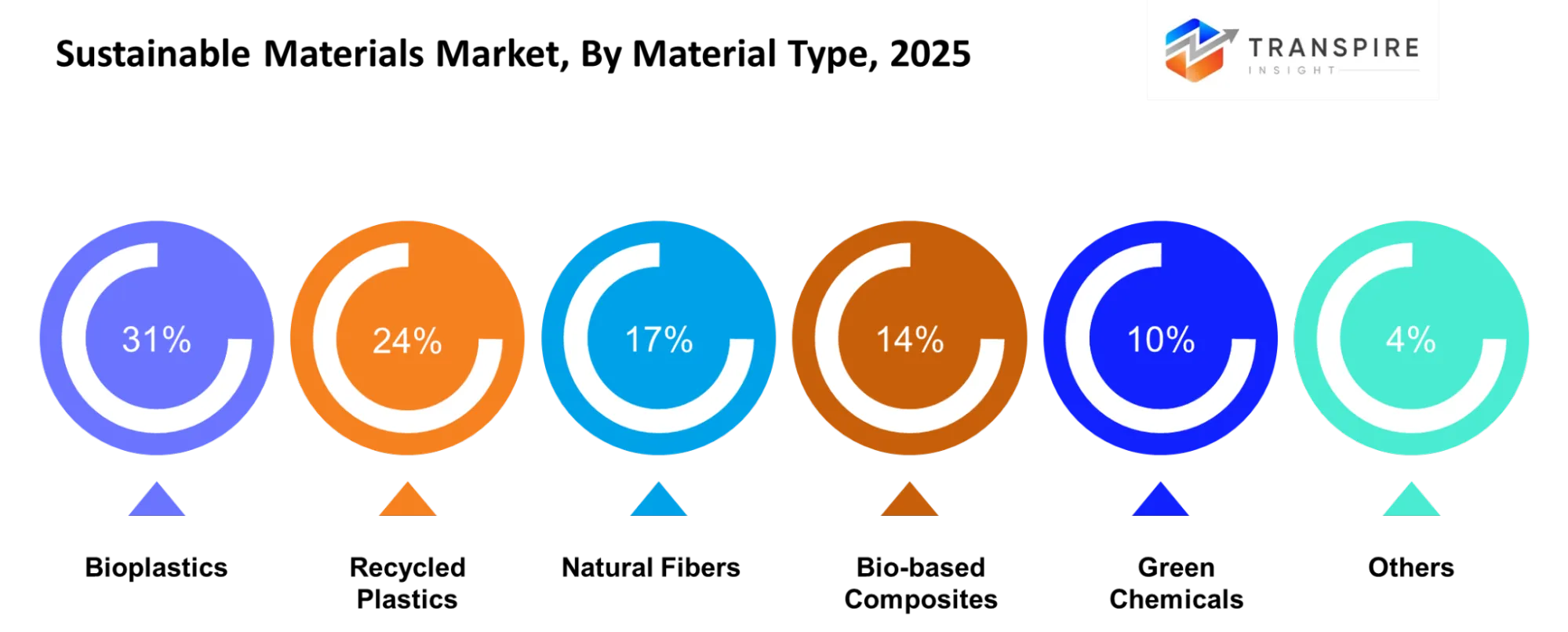
The Sustainable Materials Marketis segmented product type into Bioplastics, Recycled Plastics, Natural Fibers, Bio-based Composites, Green Chemicals, Sustainable Metals, Others ,Among these, the standard Sustainable Materials dominated the market, accounting for approximately 41% in 2025 and expected to increase at a significant CAGR during the forecast period,The recycled materials segment is dominant because of strict environmental regulations, major cost savings in energy, and rising corporate sustainability goals .
The Packaging segmentheld the greatest share of approximately 43% in 2025 and is expected to increase at a substantial CAGR over the forecast period.
The Sustainable Materials Marketis segmented by application intoPackaging Materials, Building Materials, Automotive Components, Consumer Products, Industrial Products, Others. Among these, the bakery products segment held the greatest share of approximately 43% in 2025 and is expected to increase at a substantial CAGR over the forecast period. This food and beverage application segment dominates the overall packaging industry due to essential product protection, rising consumer demand for convenience foods, and strict safety mandates
The Packaging & Consumer Goods Industry segmentsegmentheld the greatest share of approximately 39% in 2025 and is expected to increase at a high CAGR over the forecast period.
The Sustainable Materials Marketis segmented by end user intoPackaging, Construction, Automotive, Consumer Goods, Electronics, Textile, Others. Among these, the food manufacturerssegment held the greatest share of approximately 39% in 2025 and is expected to increase at a considerable CAGR over the projected period. The Packaging and Consumer Goods Industry is dominant due to high daily consumption volumes, essential repurchase cycles, and critical supply-chain functions.
Regional Segment Analysis of the Sustainable Materials Market
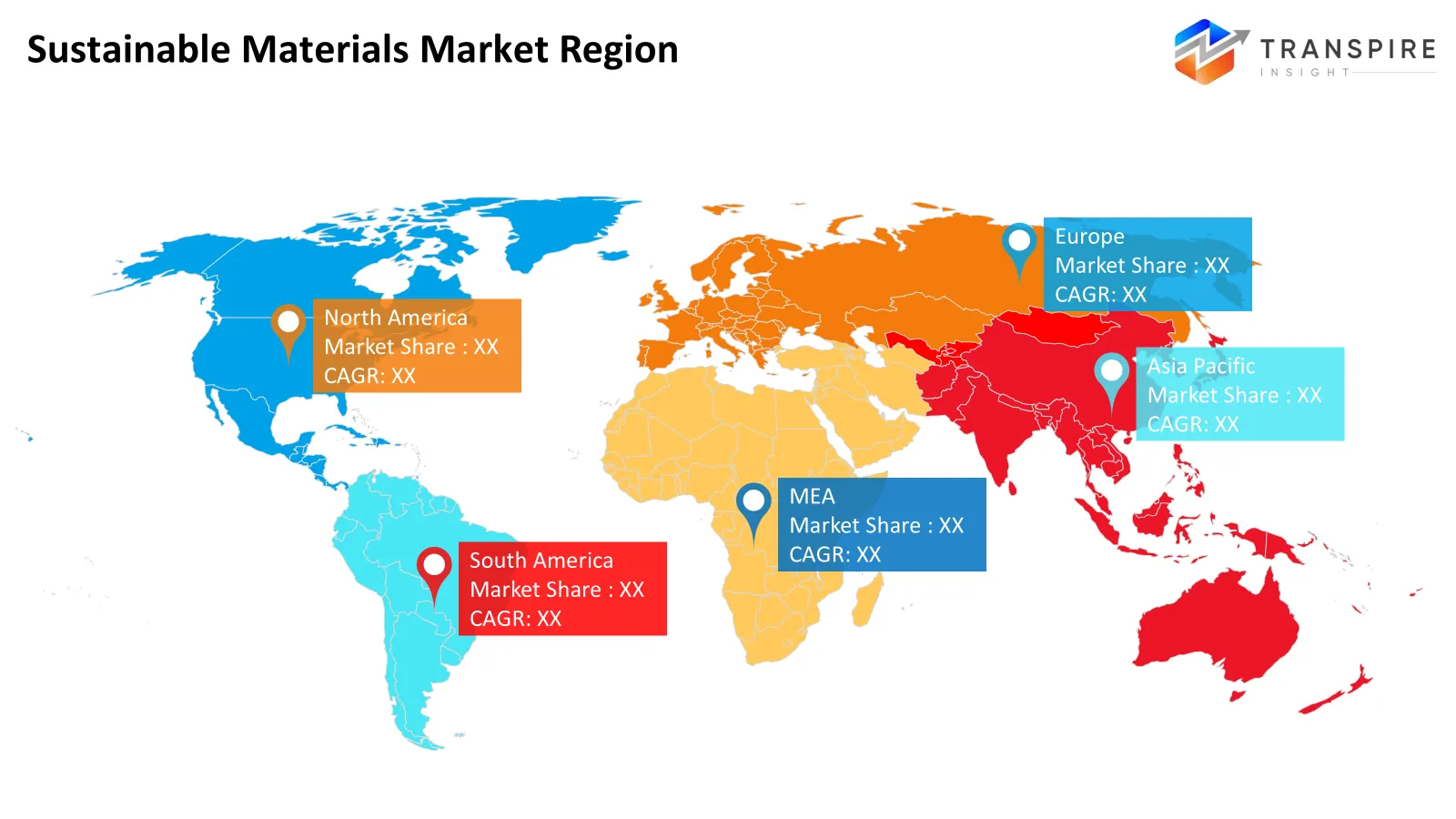
- North America (U.S., Canada, Mexico)
- Europe (Germany, France, U.K., Italy, Spain, Rest of Europe)
- Asia-Pacific (China, Japan, India, Rest of APAC)
- South America (Brazil and the Rest of South America)
- The Middle East and Africa (UAE, South Africa, Rest of MEA)
Asia Pacificis expected to grow at a rapid CAGR in the Sustainable Materials Market by holding approximately 39% of the share during the forecast period.
The region's strong growth is driven by rapid industrialization, expanding manufacturing activities, increasing environmental regulations, rising investments in green infrastructure, and growing adoption of circular economy practices. Countries such as China, India, Japan, and South Korea are witnessing significant demand for bio-based plastics, recycled materials, sustainable packaging, green construction materials, and lightweight automotive components. Furthermore, supportive government policies promoting carbon neutrality, increasing recycling capacity, and rising corporate sustainability initiatives continue to strengthen Asia Pacific's leadership in the Sustainable Materials Market.
Europe is the fastest-growing region in the Sustainable Materials Market during the forecast period, holding approximately 31% market share.
Europe remains a key growth hub due to its stringent environmental regulations, ambitious carbon neutrality targets, advanced recycling infrastructure, and strong circular economy framework. The region is witnessing increasing adoption of bio-based materials, recycled polymers, sustainable textiles, green building materials, and low-carbon manufacturing technologies across automotive, packaging, construction, and consumer goods industries. Continuous investments in green innovation, renewable feedstocks, and advanced material research are enabling European manufacturers to strengthen their competitiveness while meeting evolving sustainability requirements.
North America is anticipated to hold approximately 24% share of the Sustainable Materials Market over the forecast period.
North America continues to maintain a significant market position due to strong corporate ESG initiatives, increasing investments in sustainable manufacturing, growing adoption of recycled and renewable materials, and supportive government policies promoting decarbonization. The region benefits from advanced manufacturing capabilities, well-established recycling infrastructure, and increasing demand for sustainable packaging, electric vehicles, green buildings, and environmentally responsible consumer products. Ongoing technological innovations and investments in advanced recycling technologies continue to drive regional market expansion.
Strategies for Market Growth in Non-Leading Regions
Non-leading regions can accelerate market growth by investing in recycling infrastructure, bio-based material manufacturing facilities, and circular economy ecosystems. Governments should encourage public-private partnerships, provide financial incentives for sustainable manufacturing, and promote research & development in advanced material technologies. Strengthening local supply chains, expanding waste collection and recycling systems, improving industrial sustainability standards, and supporting technology transfer programs will enhance production capabilities. Furthermore, increasing consumer awareness regarding sustainable products, encouraging green procurement policies, and expanding international collaborations will improve market penetration and drive long-term growth across emerging economies.
Future Market Trends for the Sustainable Materials Market
- Expansion of Bio-Based Materials:
Growing environmental awareness and regulatory support are encouraging manufacturers to increase investments in bio-based polymers, renewable feedstocks, biodegradable materials, and plant-derived composites as sustainable alternatives to conventional materials. - Growth of Advanced Recycling Technologies:
The adoption of chemical recycling, AI-powered waste sorting, closed-loop recycling systems, and advanced material recovery technologies is transforming resource efficiency while supporting circular economy objectives across multiple industries. - Smart & Low-Carbon Material Innovation:
Manufacturers are increasingly developing lightweight composites, carbon-negative materials, self-healing materials, recyclable packaging, and low-emission construction products to improve product performance while reducing environmental impact and supporting net-zero targets.
Recent Developments
- In June 2026 - BASF SE: BASF expanded investments in bio-based raw materials, advanced recycling technologies, and circular economy solutions to strengthen its sustainable materials portfolio and support growing demand for low-carbon industrial materials.
- In September 2025 - Covestro AG: Covestro accelerated its circular economy strategy by expanding production of recycled-content polycarbonates and bio-attributed polymers, helping manufacturers reduce carbon emissions while improving material performance across automotive, electronics, and packaging applications.
Market Segment
This study forecasts revenue at global, regional, and country levels from 2020 to 2033. Transpire Insights has segmented the Sustainable Materials Market based on the below-mentioned segments:
Sustainable Materials Market, by material
- Bioplastics
- Recycled Plastics
- Natural Fibers
- Bio-based Composites
- Green Chemicals
- Sustainable Metals
- Others
Sustainable Materials Market, By Application
- Packaging Materials
- Building Materials
- Automotive Components
- Consumer Products
- Industrial Products
- Others
Sustainable Materials Market, By End User
- Packaging
- Construction
- Automotive
- Consumer Goods
- Electronics
- Textile
- Others
Sustainable Materials Market, By source
- Renewable Resources
- Recycled Resources
- Waste-derived Materials
- Others
Sustainable Materials Market, By Distribution Channel
- Direct Sales
- Distributors
- Online Platforms
- Retail
- Others
Sustainable Materials Market, By Regional Analysis
North America
- US
- Canada
- Mexico
Europe
- Germany
- UK
- France
- Italy
- Spain
- Russia
- Rest of Europe
Asia Pacific
- China
- Japan
- India
- South Korea
- Australia
- Rest of Asia Pacific
South America
- Brazil
- Argentina
- Rest of South America
Middle East & Africa
- UAE
- Saudi Arabia
- Qatar
- South Africa
- Rest of the Middle East & Africa
Frequently Asked Questions
Find quick answers to common questions.
Rising environmental regulations, increasing demand for eco-friendly products, growing adoption of circular economy practices, corporate sustainability commitments, and continuous advancements in bio-based materials and recycling technologies are driving the growth of the Sustainable Materials Market.
Asia Pacific dominates the market due to rapid industrialization, expanding manufacturing activities, supportive government sustainability initiatives, increasing investments in green infrastructure, and growing demand for sustainable packaging, construction materials, and recycled products.
Sustainable materials offer lower carbon emissions, improved recyclability, resource efficiency, reduced environmental impact, regulatory compliance, and enhanced product performance, making them ideal for packaging, construction, automotive, consumer goods, electronics, and textile applications.
The packaging segment leads the market, driven by increasing demand for recyclable, biodegradable, compostable, and bio-based packaging solutions, along with growing regulations restricting single-use plastics.
Major companies include BASF SE, Dow Inc., Covestro AG, SABIC, LyondellBasell Industries, Eastman Chemical Company, DuPont, Braskem S.A., NatureWorks LLC, and Arkema S.A.
- BASF
- Dow
- Covestro
- SABIC
- Braskem
- NatureWorks
- Neste
- LyondellBasell
- UPM Biochemicals
- Toray Industries
- Novamont
- TotalEnergies Corbion
- Avient
- Mitsubishi Chemical Group
- Borealis
About the Authors

Pankaj Ghogare Patil
I am Pankaj Ghogare Patil, a Senior Research Analyst at Transpire Insight, specializing in the Pharmaceutical, Chemicals & Materials, Healthcare IT, and Biotechnology industry. My expertise lies in conducting comprehensive market research, analyzing industry trends, evaluating competitive landscapes, and translating complex data into actionable insights. At Transpire Insight, I closely follow emerging technologies, regulatory developments, and market innovations to create accurate, well-researched, and informative content that helps businesses and professionals make informed decisions. I am committed to producing credible, evidence-based articles that reflect industry best practices while making technical topics accessible and valuable for a broad audience.

Chakradhar Khansole
Chakradhar serves as the Research Director at Transpire Insight, bringing over 8 years of experience in technology, innovation, and strategic market intelligence. He specializes in transforming complex market data into actionable business insights that enable organizations to make informed, growth-oriented decisions. Recognized for his strategic vision and analytical expertise, Chakradhar leads high-impact research initiatives, delivering comprehensive market assessments, competitive intelligence, and forward-looking industry analysis.
Recently Published Reports
-
May 2026
Healthcare Polymer Packaging Market
Healthcare Polymer Packaging Market Size, Share & Analysis Report By Packaging Type (Syringes, IV Bottles and Pouches, Clamshells, Blisters, Bottles & Jars, Containers, Tubes, IV Parental Packaging, Others), By Type (Regulated, Non-regulated), By Polymer Type (LDPE (Low-Density Polyethylene), HDPE (High-Density Polyethylene), Homo-polymer (Homo), Random Copolymer (Random), Block Copolymer (Block), PET, Polystyrene, Polyvinyl Chloride, Polyamide/EVOH, Others), and Geography (North America, Europe, Asia-Pacific, Middle East and Africa, South and Central America), 2021 - 2031
-
Apr 2026
Hydrophilic Tape (Waterstop) Market
Hydrophilic Tape (Waterstop) Market Size, Share & Analysis Report By Type (Bentonite-Based Hydrophilic Tape, Rubber-Based Hydrophilic Tape), By Application (Residential Buildings, Commercial Buildings, Infrastructure Projects), and Geography (North America, Europe, Asia-Pacific, Middle East and Africa, South and Central America), 2021 - 2031
-
Apr 2026
Metalens Market
Metalens Market Size, Share & Analysis Report By Type (Visible Light Metalens, and Infrared Metalens), By Application (Consumer Electronics, Automotive Electronics, Industrial, Medical, and Others), and Geography (North America, Europe, Asia-Pacific, Middle East and Africa, South and Central America), 2021 - 2031
-
Apr 2026
PBT Resin Market
PBT Resin Market Size, Share & Analysis Report By Type (Reinforced PBT Resin, Unreinforced PBT Resin), By Processing Method (Injection Molding, Extrusion, Blow Molding, Others), By End-User (Automotive, Electrical & Electronics, Consumer Appliances, Industrial Machinery, Medical Devices, Packaging, Others), and Geography (North America, Europe, Asia-Pacific, Middle East and Africa, South and Central America), 2021 - 2031