

Asia Pacific Bioplastics Market Summary
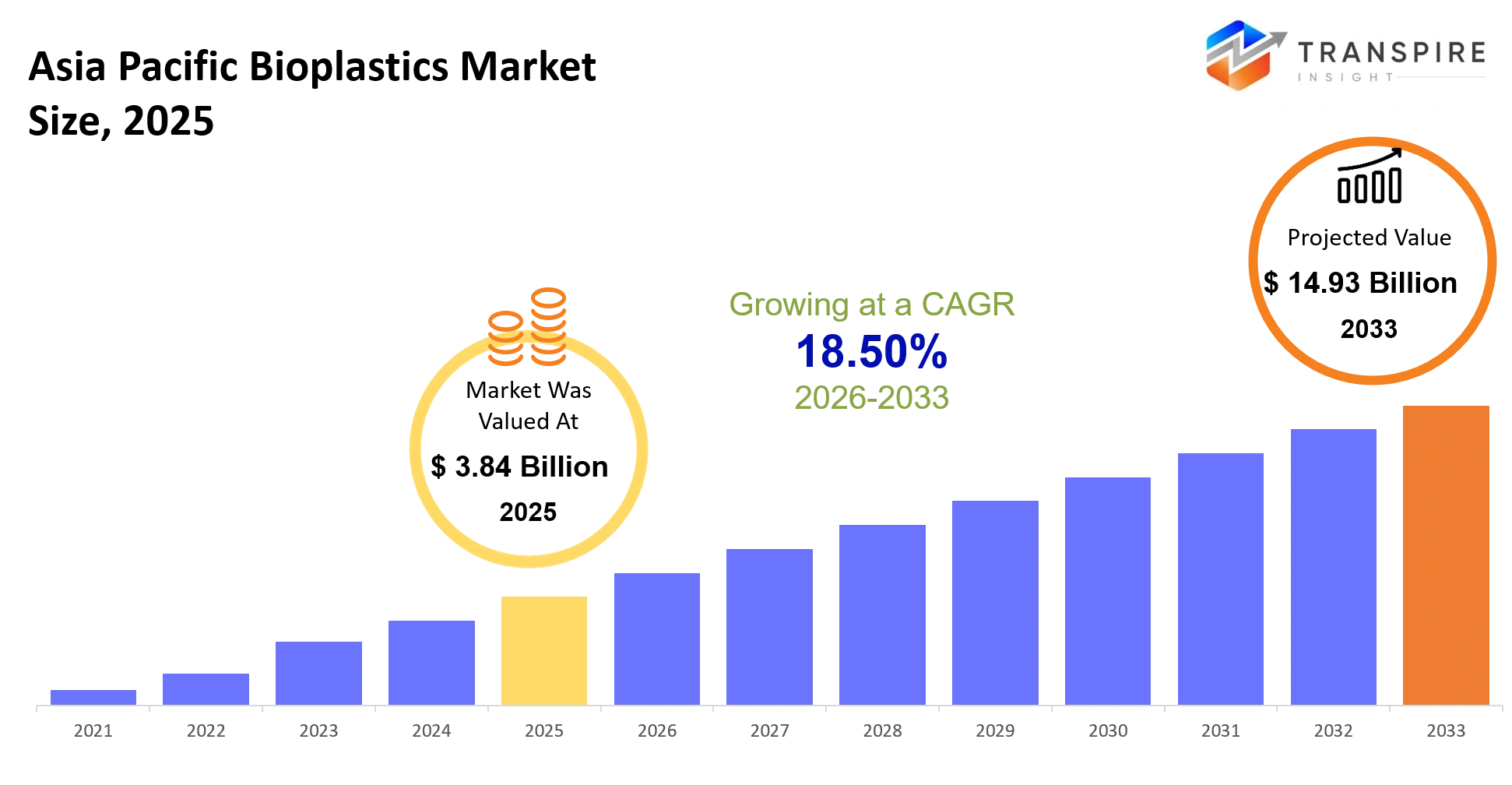
As per Transpire Insight Analysis the Asia Pacific Bioplastics Market size is estimated at USD 3.84 Billion in 2025 and is anticipated to reach USD 14.93 Billion by 2033, growing at a CAGR of 18.50% from 2026 to 2033.
Asia Pacific bioplastics industry kinda helps manufacturers swap conventional petroleum based plastics, with more renewable and lower-emission materials across packaging, consumer goods, agriculture , healthcare, and even automotive production. In a way these materials support corporate sustainability goals, and at the same time help companies follow tighter waste management and recycling requirements, without really having to change the existing manufacturing processes much. And as the production technologies mature, bioplastics are turning into a practical commercial option for big volume uses, not just some niche alternative.
Over the last five years, the market sort of moved from pilot scale adoption to large scale commercial manufacturing. This shift is backed by government limits on single use plastics, plus investments in bio based polymer capacity across China , Japan , South Korea, India , and Southeast Asia. When plastic waste rules got stricter, and global petrochemical supply chains also got disrupted, manufacturers felt pushed to diversify their raw material sourcing and speed up adoption of bio based materials. Then as capacity keeps expanding, and processing costs slowly get better, more industries are weaving bioplastics into mainstream manufacturing, which creates stronger revenue opportunities across regional value chains.
Asia Pacific Bioplastics Market Size & Forecast:
- Asia Pacific Bioplastics Market Size 2025: USD 3.84 Billion
- Expected Market Value 2033: USD 14.93 Billion
- Forecast CAGR: 18.50%
- Leading region in 2025:China
- Fastest Growing region:India
- Key Profile: NatureWorks LLC, TotalEnergies Corbion, BASF SE, Novamont S.p.A., Braskem S.A., Mitsubishi Chemical Group, Toray Industries, Kaneka Corporation, CJ CheilJedang Corporation, Danimer Scientific, FKuR Kunststoff GmbH, Biome Bioplastics, PTT MCC Biochem Co., Ltd., SABIC, LG Chem Ltd.
Key Market Insights
- China kind of dominates the Asia Pacific Bioplastics Market, with an estimated 38–40% share in 2025, mostly thanks to broad manufacturing capacity, plus steady government policy support, which helps a lot.
- India is forecast to see the quickest growth all the way through 2033, driven by packaging spending, stricter plastic waste rules and also more domestic production facilities coming online.
- On the product side PLA is still the main segment with around 30% market share in 2025, backed by strong uptake across food packaging and also everyday consumer goods.
- Bio-PET sits as the second-largest product category, while PHA is expected to show the fastest growth during the forecast window as commercialization keeps expanding.
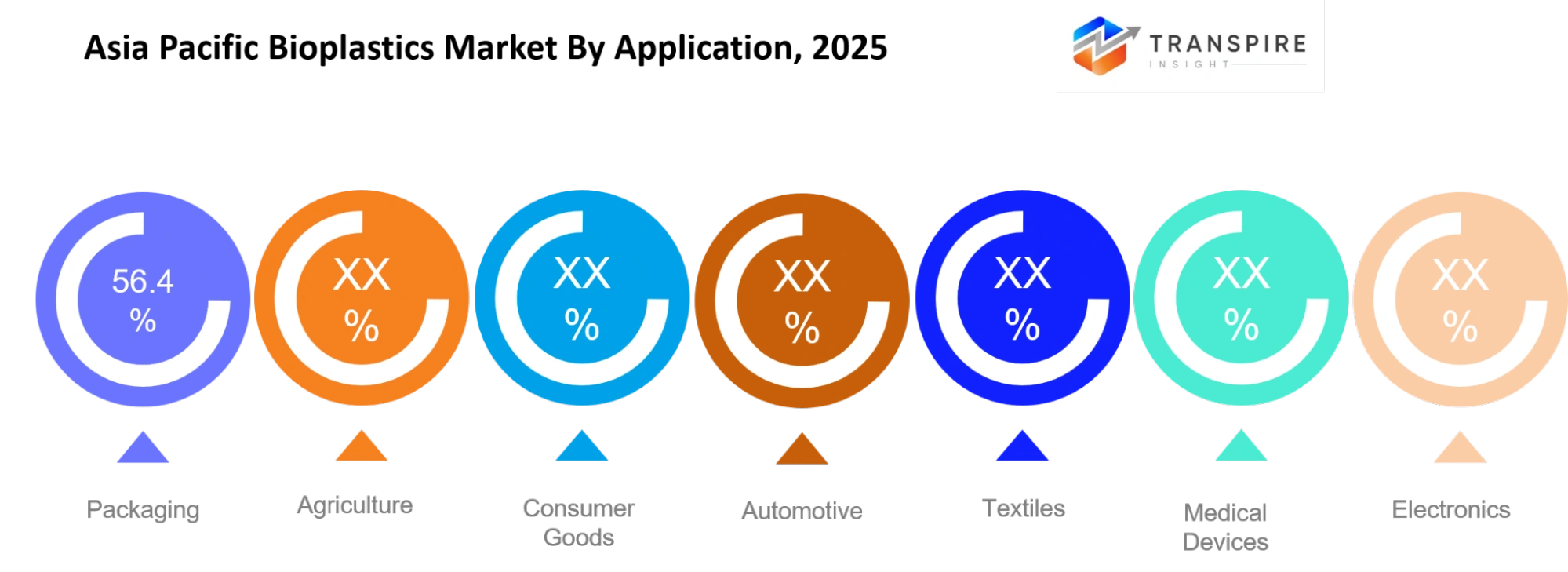
- For applications, packaging takes the lead with nearly 45% share, whereas medical devices and consumer electronics are starting to look like higher-value areas, more and more.
- When it comes to end users, packaging stays the largest group at roughly 48% share, while healthcare is expected to bring one of the strongest future growth rates, overall.
- The Asia Pacific Bioplastics Market continues to gain momentum from investments in bio-refineries, more advanced polymer processing, and a wider feedstock diversification effort across the region.
- Key players such as NatureWorks LLC, TotalEnergies Corbion, BASF SE, Novamont S.p.A., Braskem SA, and Mitsubishi Chemical Group are expanding capacity and also building regional collaborations.
- Manufacturers are also pushing product innovation faster, improving compostable polymers , raising heat resistance and boosting mechanical performance so they can cover broader industrial uses.
- Finally, strategic expansion across Southeast Asia, plus tighter coordination between resin producers, packaging manufacturers, and consumer brands is reinforcing regional competitiveness, and long term market growth.
What are the Key Drivers, Restraints, and Opportunities in the Asia Pacific Bioplastics Market?
Government policies aimed at plastic waste reduction still seem to be the most powerful push behind market growth, even if it is not the only driver. Countries such as China, India, Japan, and South Korea have put in place restrictions on certain single-use plastics, while also nudging investment toward bio based materials via industrial policies and sustainability programs. At the same time global consumer goods brands have pledged targets for recyclable or compostable packaging, which then makes packaging converters seek more bio based polymers. Taken together these policy moves and corporate promises, they keep lifting commercial production volume, raise manufacturing utilization, and generally increase revenue across the regional supply chain.
Production costs stay, honestly, the biggest structural snag. Bio based polymers often need specialized feedstocks, more advanced processing technologies, and dedicated manufacturing setups, and these are usually pricier than conventional plastics. On top of that, feedstock prices can swing around , industrial composting facilities are still limited, and recycling systems are sometimes patchy or inconsistent. Because of this, adoption gets slowed in cost sensitive sectors, and even with favorable regulation the revenue growth upside can get reduced.
There is still a major long term opportunity in next generation feedstocks and material innovation. More investment in algae based materials, turning agricultural waste into useful inputs, and second generation biomass approaches is steadily cutting reliance on food based feedstocks while also improving environmental outcomes. Also, a number of manufacturers are moving ahead by expanding facilities across Southeast Asia, where agricultural resources are plentiful and industrial support is more active. That combination creates a pretty favorable setup for new production capacity.
What Has the Impact of Artificial Intelligence Been on the Asia Pacific Bioplastics Market?
Artificial intelligence is kinda improving manufacturing efficiency across the regional bioplastics value chain by tweaking production processes, keeping an eye on equipment performance, and also improving material quality in a steadier way. AI enabled production systems continuously look at temperature, pressure, moisture content, and polymer traits during processing, so they can cut down on material waste and keep product specifications more consistent. Plus, automated quality checks using computer vision can spot defects earlier than the usual inspection methods. That means lower rejection rates, and honestly better manufacturing productivity too.
Machine learning models help with predictive maintenance by picking up equipment wear before failures show up. This reduces unexpected downtime across polymer production sites. In parallel, AI driven demand forecasting helps manufacturers line up feedstock purchasing, production timing, and inventory control even when agricultural raw materials swing with the seasons. Then there are digital twins, and process simulation platforms that boost operational efficiency by testing lots of production variations before anything physical happens, so manufacturers can trim operating costs while improving plant utilization.
Still, AI adoption is not fully widespread, because the implementation costs can be high, production data often ends up fragmented, and manufacturers across the region don’t have the same digital maturity. Smaller and medium sized producers frequently don’t have enough historical process data to train dependable machine learning models, so deployment moves slower. But as the digital infrastructure gets better and industrial automation expands, AI will likely take on a more central part in improving production efficiency, material steadiness, and supply chain resilience across the regional bioplastics industry.
Key Market Trends
- China kept growing its domestic bioplastic production capacity by more than 25% from 2021 through 2025, and that move seemed to also bolster regional supply security, kind of in the background.
- Packaging manufacturers started swapping conventional plastics for PLA and Bio-PET more often after the plastic waste rules got tighter , with several Asian economies bringing in new requirements.
- PHA production investments really picked up after 2022, which points to stronger business pull for fully biodegradable polymer technologies.
- On the feedstock side, agricultural inputs got less “one size fits all”. Instead of relying only on corn starch, more producers expanded into cassava, sugarcane, and even raw materials built from agricultural residue.
- Major global players like BASF SE, NatureWorks LLC, Braskem SA, and Mitsubishi Chemical Group upped regional investments too, through production expansions ,plus strategic partnerships.
- Meanwhile digital manufacturing technologies showed up more widely, helping with production consistency, cutting material waste, and raising overall plant efficiency inside polymer processing facilities.
- Food and beverage brands also leaned more into certified compostable packaging, partly to support sustainability pledges , and partly to stay aligned with the rules they face.
- Southeast Asia, sort of naturally emerged as a favored manufacturing destination, thanks to competitive feedstock availability and growing industrial investment incentives.
- Automotive and healthcare manufacturers began looking at bio-based engineering plastics for certain lightweight and specialty uses, especially where improved performance matters.
- Finally, cross-industry collaboration between resin producers, converters, packaging companies, and consumer brands got stronger, which fed better innovation pipelines and helped advanced bioplastic commercialization move faster.
Asia Pacific Bioplastics Market Segmentation
By Product Type
Bio-PE and PLA kinda hold a pretty big share, because both still fit fairly well with the existing plastic processing equipment , and they also help when scaling up packaging production. PLA seems to drive a lot of demand in food packaging, disposable tableware, and also consumer goods, mainly due to decent transparency, compostability, and the fact it’s commercially easy to source. Bio-PET stays quite relevant for beverage bottles and more rigid packaging too, since the current recycling systems and manufacturing setup are already there so adoption is wider, more practical. Starch blends keep getting picked up in compostable bags and agricultural films where cost efficiency stays as one of the key buying considerations.
PHA is moving fast and it’s starting to show up as one of the fastest-growing categories, mostly because full biodegradability opens doors for medical use, marine applications, and some specialty packaging. PBS backs flexible packaging and agricultural products since it offers better flexibility , plus heat resistance when you compare it with several other bio-based options. Cellulose-based bioplastics keep expanding across coatings, films, and specialty industrial work where renewable raw materials are a must. And then there are other bio-based polymers that are more niche, where tailored material performance meets specific industrial needs and that can support higher-value manufacturing.
By Source
Corn starch still looks like the leading raw material, mostly because the established farming production, plus dependable supply chains, and that mature fermentation technology basically make commercial scale polymer manufacturing easier to run. Sugarcane then shows up as another big source too , thanks to strong availability across several Asia Pacific countries, and also because the bio-based polyethylene production is pretty efficient there. Potato starch and cassava are also used as alternatives for biodegradable polymer production, especially in places where agricultural output is solid and the feedstock costs stay competitive. Cellulose helps with specialty bioplastics , by leveraging forestry resources and agricultural residues, for renewable material development which is more or less the point.
Vegetable oils contribute to a few polymer formulations that need better flexibility together with stronger chemical performance, so for industrial applications they can fit nicely. Algae-based feedstock is drawing research funding , because it doesn’t compete directly with conventional food crops, yet it still claims long-term sustainability advantages. Research organizations and manufacturers keep looking into production pathways that can reach bigger scale and at the same time lower manufacturing costs , which everyone wants. And other renewable feedstocks, including agricultural waste and industrial biomass , are slowly broadening the raw material base for future polymer production.
By Application
Packaging kinda becomes the biggest thing among all applications, because food containers, flexible films, shopping bags, beverage bottles, and protective packaging really need more sustainable material alternatives that still comply with regulatory requirements. On top of that, consumer goods keep adding a lot of demand via household products, disposable items, cosmetics packaging, and personal care applications, which is pretty consistent across markets. Agriculture also benefits, for example with biodegradable mulch films, seed coatings, and compostable plant containers, all of which make field management a little easier and help reduce plastic waste collection in practice. So overall, these uses support steady consumption across both developed and developing economies in the region, not just one side.
Automotive manufacturers keep looking into lightweight bio-based materials for certain interior components, where reduced emissions and better material efficiency end up bringing extra value. Textile companies are meanwhile moving toward renewable fibers and bio-based fabrics, so sustainable apparel production can become more mainstream. Medical devices are also increasingly using specialized biodegradable materials, especially for selected disposable products and healthcare packaging, although performance requirements are strict there. Electronics manufacturers, and other industrial users too, are investigating bio-based plastics for casings, accessories, and specialty components that match their environmental targets.
By Processing Method
Injection molding still kind of stays the main processing way , because the high production efficiency helps push out huge volumes of everyday consumer goods, automotive parts, medical components, and also packaging items. Blow molding in the meanwhile is pretty important for making bottles, containers, and other hollow shapes, typically with bio based materials, and there are established production technologies behind it. Extrusion keeps on helping with continuous manufacturing of films, sheets, pipes, and profiles, mainly for both industrial uses and packaging uses too. Thermoforming holds steady demand for trays, food containers, and disposable packaging products that need to be light , and also relatively cheap to make.
Film casting is used when flexible packaging matters a lot, plus agricultural films and specialty industrial sheets, where you want uniform thickness and consistent material performance. Compression molding covers a smaller set of industrial applications , especially where durable molded products are needed even if the production volumes are lower than the big mass methods. Three dimensional printing is opening up new chances for customized prototypes, medical products, and low-volume manufacturing, particularly when advanced bio-based polymers are in the picture. Then there are other processing technologies , which keep growing, as manufacturers keep developing specialized production approaches for next generation biodegradable materials.
By End User
The packaging industry is kind of the biggest end user, because the manufacturers end up needing renewable materials for flexible packaging , rigid containers, transport packaging, and retail items that must follow the ever changing environmental rules. Food and beverage brands keep moving toward bio based materials in bottles, trays, cups, films , plus take away packaging, all while they also back their corporate sustainability promises. In healthcare, organizations lean on specialized biodegradable materials for disposable medical items, pharmaceutical packaging, and certain clinical uses where hygiene standards are strict. So overall, these groups keep creating fairly stable commercial demand thanks to big production volumes and ongoing regulatory compliance needs.
On the automotive side, makers more and more evaluate bio based materials for lighter interior parts that help with emission reduction goals and better resource efficiency. Agriculture keeps expanding biodegradable films, planting related materials , and crop protection products, aiming for easier waste management after harvesting. Meanwhile consumer electronics manufacturers are looking into renewable plastics for accessories, protective elements , and some device housings, mainly for stronger environmental performance. The textile industry and a range of other industrial sectors also continue putting money into renewable material innovation as the production technologies become more commercially competitive, even if it takes time.
What are the Key Use Cases Driving the Asia Pacific Bioplastics Market?
Packaging is still the main thing in the Asia Pacific Bioplastics Market because food and beverage players need materials that are both compostable and bio-based, so they can comply with the plastic waste rules that keep getting tighter. Flexible films, trays, bottles, cups, and takeaway containers seem to take most of the consumption, since global brands are switching away from conventional plastics to hit their recycled and renewable content goals, all the while trying to keep product quality and shelf life stable.
In another direction, agriculture and healthcare keep pushing adoption too, with biodegradable mulch films, seedling trays, controlled-release agricultural products, medical packaging, and a few selected disposable healthcare items. Meanwhile automotive manufacturers are also blending bio-based polymers into lighter interior parts, aiming to improve material efficiency and back vehicle sustainability programs, without making huge changes to their current production lines.
More new uses are showing up as well, especially in consumer electronics and advanced manufacturing. Bio-based materials are being tested for electronic accessories, protective casings,and some device components, while 3D printing is opening doors for customized prototypes and specialist industrial pieces. If polymer performance and processing technologies keep getting better, commercial use should grow across higher value industrial applications during the forecast period.
|
Report Metrics |
Details |
|
Market size value in 2025 |
USD 78.2 Billion |
|
Market size value in 2026 |
USD 4.55 Billion |
|
Revenue forecast in 2033 |
USD 14.93 Billion |
|
Growth rate |
CAGR of 18.50% from 2026 to 2033 |
|
Base year |
2025 |
|
Historical data |
2021 - 2024 |
|
Forecast period |
2026 - 2033 |
|
Report coverage |
Revenue forecast, competitive landscape, growth factors, and trends |
|
Regional scope |
United States; Canada; Mexico; United Kingdom; Germany; France; Italy; Spain; Denmark; Sweden; Norway; China; Japan; India; Australia; South Korea; Thailand; Brazil; Argentina; South Africa; Saudi Arabia; United Arab Emirates |
|
Key company profiled |
NatureWorks LLC, TotalEnergies Corbion, BASF, Novamont, Braskem, Mitsubishi Chemical, Toray Industries, Kaneka Corporation, CJ CheilJedang, Danimer Scientific, FKuR Kunststoff, Biome Bioplastics, PTT MCC Biochem, SABIC, LG Chem |
|
Customization scope |
Free report customization (country, regional & segment scope). Avail customized purchase options to meet your exact research needs. |
|
Report Segmentation |
By Product Type (Bio-PE, PLA, PHA, Starch Blends, Bio-PET, PBS, Cellulose-Based Bioplastics, Others); By Source (Corn Starch, Sugarcane, Potato Starch, Cassava, Cellulose, Vegetable Oils, Algae-Based Feedstock, Others); By Application (Packaging, Agriculture, Consumer Goods, Automotive, Textiles, Medical Devices, Electronics, Others); By Processing Method (Injection Molding, Blow Molding, Extrusion, Thermoforming, Film Casting, Compression Molding, 3D Printing, Others); By End User (Packaging Industry, Food & Beverage, Healthcare, Automotive, Agriculture, Consumer Electronics, Textile Industry, Others) |
Which Regions are Driving the Asia Pacific Bioplastics Market Growth?
China still ends up as the top market across Asia Pacific, largely because it has that strong industrial capacity,plus a set of environmental policies that actually helps, and also those integrated manufacturing ecosystems that make large-scale production of bio-based polymers more or less straightforward. At the same time, the national restrictions on certain single-use plastics have pushed packaging and consumer goods makers, and even food manufacturers to move toward renewable materials. There’s also a lot going on with chemical manufacturing infrastructure, steady feedstock availability, and ongoing investment in polymer research,which together tighten up domestic production capabilities. And honestly the whole thing keeps getting reinforced by close collaboration between raw material suppliers, resin producers, converters, and global consumer brands,so the leadership stays solid across the regional value chain.
Japan, on the other hand, shows up as the second-largest regional contributor, but it feels more driven by technology leadership than sheer production scale. Japanese manufacturers lean heavily on advanced material science, they keep funding research and development pretty consistently,and they follow strict product quality standards. That lets them deliver high-performance bioplastics for automotive, electronics, healthcare, and specialty packaging uses. On top of that, long-term corporate sustainability plans plus stable industrial investment give the market a sort of predictable expansion, even if volume growth is relatively slower. The collaboration between chemical companies, universities, and downstream manufacturers also keeps product innovation moving and supports commercial reliability.
For India, the forecast points to the fastest growth during the forecast period,mostly because government initiatives aimed at plastic waste reduction are encouraging broader commercialization of bio-based materials, and that momentum seems to be accelerating.
Who are the Key Players in the Asia Pacific Bioplastics Market and How Do They Compete?
Competition is still pretty moderately consolidated, with multinational polymer players side by side with regional specialty producers, depending on things like technology, production size ,and application know-how. In practice product performance is getting more of the spotlight than price alone, because customers want materials that meet regulatory expectations and also fit commercial processing realities. At the same time the established groups keep guarding market share by expanding capacity, while new entrants tend to carve out attention via specialized biodegradable polymers and customized, application-driven formulations.
NatureWorks LLC sets itself apart by leaning hard on advanced PLA know-how and offering wide support across packaging, 3D printing, and consumer goods, pretty much end to end. TotalEnergies Corbion leans into high-performance Luminy® PLA grades and pushes adoption with strategic tie ups involving converters and consumer brands. BASF competes via ongoing material innovations along with a more diversified biodegradable polymer range, serving packaging , agriculture, and industrial customers while also tightening technical collaboration across Asia.
Braskem takes a very large renewable Bio-PE approach, using sugarcane as the feedstock, and that becomes a clear benefit for low-carbon packaging solutions. Mitsubishi Chemical and Toray Industries emphasize high-performance engineering materials for auto, electronics, and healthcare uses, where the technical requirements actually matter more than just raw production volume. Kaneka Corporation keeps expanding its biodegradable polymer development, and also puts money into advanced manufacturing technologies that help improve material performance and make scaling more commercial, in a practical way.
Company List
•NatureWorks LLC
• TotalEnergies Corbion
• BASF
• Novamont
• Braskem
• Mitsubishi Chemical
• Toray Industries
• Kaneka Corporation
• CJ CheilJedang
• Danimer Scientific
• FKuR Kunststoff
• Biome Bioplastics
• PTT MCC Biochem
• SABIC
• LG Chem
Recent Development News
In May 2026, TotalEnergies Corbion entered a partnership with Yuhan-Kimberly to develop bio-based washable wipe applications using Luminy® PLA. The collaboration expands commercial applications for PLA materials and supports broader adoption in sustainable consumer products.https://totalenergies-corbion.com
In April 2026, BASF showcased new sustainable plastics innovations and expanded customer collaborations at CHINAPLAS 2026. The initiative strengthened regional co-creation, sustainable material development, and technical support across the Asian plastics value chain.https://www.basf.com/
What Strategic Insights Define the Future of the Asia Pacific Bioplastics Market?
The market seems to be shifting toward those integrated regional production ecosystems, where feedstock suppliers , polymer manufacturers, converters , and consumer brands almost team up—so the whole thing can improve material performance while cutting down on carbon intensity. Regulatory requirements, corporate packaging commitments and investment in advanced bio-refineries will keep nudging this structural change along over the next five to seven years, even if it’s not always obvious day to day.
One less visible risk is still the reliance on agricultural feedstocks, where climate variability, and competing food demand could end up causing long-term pricing volatility , plus some annoying supply constraints. At the same time there’s a promising opening, which is the commercialization of second generation biomass and algae based feedstocks, especially in Southeast Asia. There, abundant renewable resources and industrial investment are basically making the expansion conditions more favorable.
Firms that start early on diversified feedstock sourcing, use advanced processing technologies , and build strategic partnerships across regional supply chains will likely be in a stronger place to boost resilience. They can also raise profitability and, maybe more importantly, capture those emerging high value applications.
Asia Pacific Bioplastics Market Report Segmentation
By Product Type
• Bio-PE
• PLA
• PHA
• Starch Blends
• Bio-PET
• PBS
• Cellulose-Based Bioplastics
• Others
By Source
• Corn Starch
• Sugarcane
• Potato Starch
• Cassava
• Cellulose
• Vegetable Oils
• Algae-Based Feedstock
• Others
By Application
• Packaging
• Agriculture
• Consumer Goods
• Automotive
• Textiles
• Medical Devices
• Electronics
• Others
By Processing Method
• Injection Molding
• Blow Molding
• Extrusion
• Thermoforming
• Film Casting
• Compression Molding
• 3D Printing
• Others
By End User
• Packaging Industry
• Food & Beverage
• Healthcare
• Automotive
• Agriculture
• Consumer Electronics
• Textile Industry
• Others
Frequently Asked Questions
Find quick answers to common questions.
The expected Asia Pacific Bioplastics Market size for the market will be USD 14.93 Billion in 2033.
Key segments for the Asia Pacific Bioplastics Market are By Product Type (Bio-PE, PLA, PHA, Starch Blends, Bio-PET, PBS, Cellulose-Based Bioplastics, Others); By Source (Corn Starch, Sugarcane, Potato Starch, Cassava, Cellulose, Vegetable Oils, Algae-Based Feedstock, Others); By Application (Packaging, Agriculture, Consumer Goods, Automotive, Textiles, Medical Devices, Electronics, Others); By Processing Method (Injection Molding, Blow Molding, Extrusion, Thermoforming, Film Casting, Compression Molding, 3D Printing, Others); By End User (Packaging Industry, Food & Beverage, Healthcare, Automotive, Agriculture, Consumer Electronics, Textile Industry, Others).
Major Asia Pacific Bioplastics Market players are NatureWorks LLC, TotalEnergies Corbion, BASF, Novamont, Braskem, Mitsubishi Chemical, Toray Industries, Kaneka Corporation, CJ CheilJedang, Danimer Scientific, FKuR Kunststoff, Biome Bioplastics, PTT MCC Biochem, SABIC, LG Chem.
The Asia Pacific Bioplastics Market size is USD 3.84 Billion in 2025.
The Asia Pacific Bioplastics Market CAGR is 18.50% from 2026 to 2033.
• NatureWorks LLC
• TotalEnergies Corbion
• BASF
• Novamont
• Braskem
• Mitsubishi Chemical
• Toray Industries
• Kaneka Corporation
• CJ CheilJedang
• Danimer Scientific
• FKuR Kunststoff
• Biome Bioplastics
• PTT MCC Biochem
• SABIC
• LG Chem
About the Authors

Pankaj Ghogare Patil
I am Pankaj Ghogare Patil, a Senior Research Analyst at Transpire Insight, specializing in the Pharmaceutical, Chemicals & Materials, Healthcare IT, and Biotechnology industry. My expertise lies in conducting comprehensive market research, analyzing industry trends, evaluating competitive landscapes, and translating complex data into actionable insights. At Transpire Insight, I closely follow emerging technologies, regulatory developments, and market innovations to create accurate, well-researched, and informative content that helps businesses and professionals make informed decisions. I am committed to producing credible, evidence-based articles that reflect industry best practices while making technical topics accessible and valuable for a broad audience.

Chakradhar Khansole
Chakradhar serves as the Research Director at Transpire Insight, bringing over 8 years of experience in technology, innovation, and strategic market intelligence. He specializes in transforming complex market data into actionable business insights that enable organizations to make informed, growth-oriented decisions. Recognized for his strategic vision and analytical expertise, Chakradhar leads high-impact research initiatives, delivering comprehensive market assessments, competitive intelligence, and forward-looking industry analysis.
Recently Published Reports
-
May 2026
Healthcare Polymer Packaging Market
Healthcare Polymer Packaging Market Size, Share & Analysis Report By Packaging Type (Syringes, IV Bottles and Pouches, Clamshells, Blisters, Bottles & Jars, Containers, Tubes, IV Parental Packaging, Others), By Type (Regulated, Non-regulated), By Polymer Type (LDPE (Low-Density Polyethylene), HDPE (High-Density Polyethylene), Homo-polymer (Homo), Random Copolymer (Random), Block Copolymer (Block), PET, Polystyrene, Polyvinyl Chloride, Polyamide/EVOH, Others), and Geography (North America, Europe, Asia-Pacific, Middle East and Africa, South and Central America), 2021 - 2031
-
Apr 2026
Hydrophilic Tape (Waterstop) Market
Hydrophilic Tape (Waterstop) Market Size, Share & Analysis Report By Type (Bentonite-Based Hydrophilic Tape, Rubber-Based Hydrophilic Tape), By Application (Residential Buildings, Commercial Buildings, Infrastructure Projects), and Geography (North America, Europe, Asia-Pacific, Middle East and Africa, South and Central America), 2021 - 2031
-
Apr 2026
Metalens Market
Metalens Market Size, Share & Analysis Report By Type (Visible Light Metalens, and Infrared Metalens), By Application (Consumer Electronics, Automotive Electronics, Industrial, Medical, and Others), and Geography (North America, Europe, Asia-Pacific, Middle East and Africa, South and Central America), 2021 - 2031
-
Apr 2026
PBT Resin Market
PBT Resin Market Size, Share & Analysis Report By Type (Reinforced PBT Resin, Unreinforced PBT Resin), By Processing Method (Injection Molding, Extrusion, Blow Molding, Others), By End-User (Automotive, Electrical & Electronics, Consumer Appliances, Industrial Machinery, Medical Devices, Packaging, Others), and Geography (North America, Europe, Asia-Pacific, Middle East and Africa, South and Central America), 2021 - 2031