
Truck Trailer Market Summary:
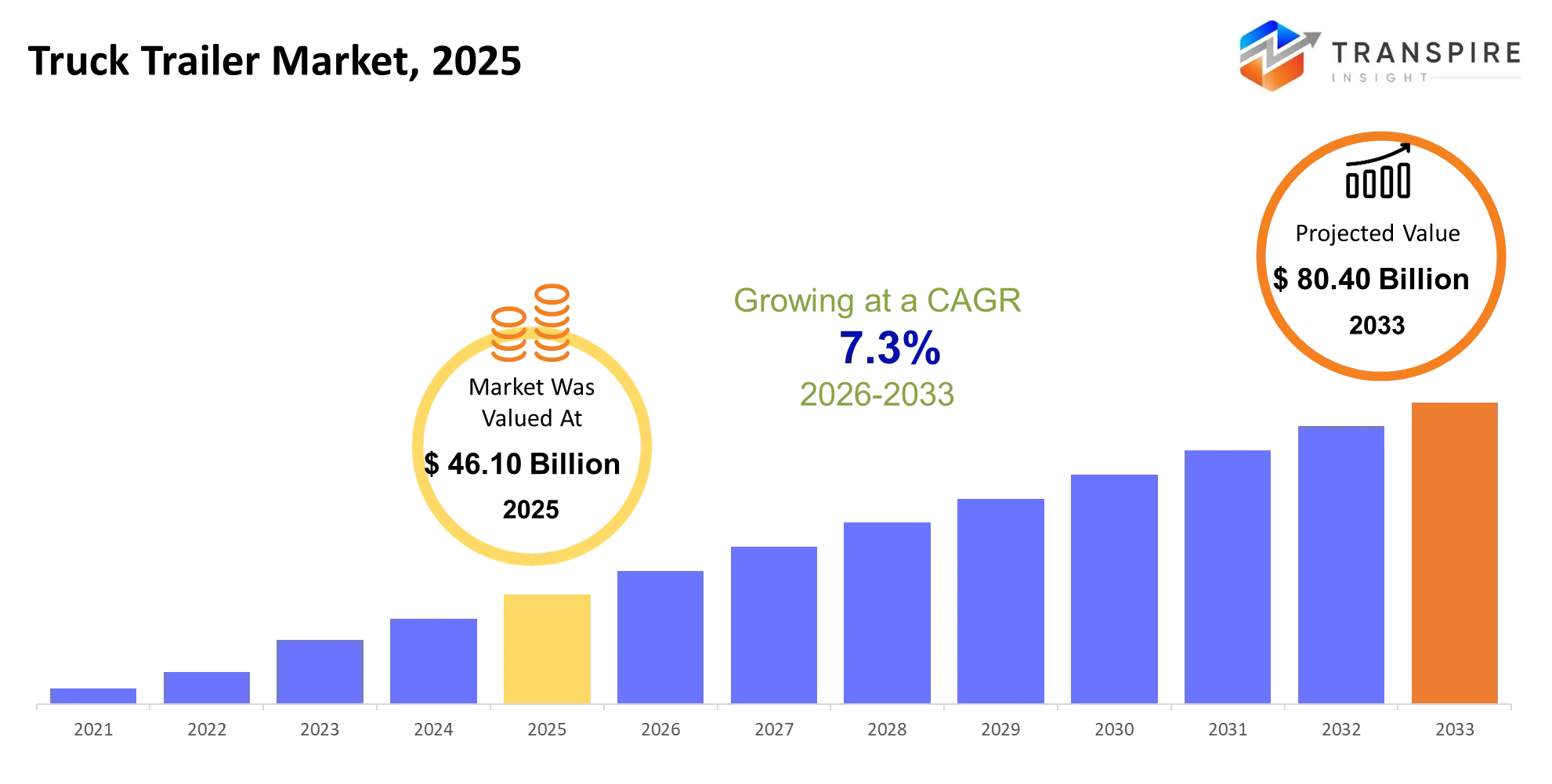
As per Transpire Insight, the Truck Trailer Market size is estimated at USD 46.10 billion in 2025 and is anticipated to reach USD 80.40 billion by 2033, growing at a CAGR of 7.3% from 2026 to 2033.
The Truck Trailer Market supports moving goods within and across supply chains. It provides trailers that are made for different kinds of cargo, varying distances, and different working conditions. These trailers are used in industries like retail, manufacturing, farming, construction and temperature-sensitive freight. In the past three to five years, the industry has started to change. It is no longer about building trailers the old way. Now there is a focus on trailers, smart fleet systems and better fuel use. The rise in shopping, changing needs for freight transport and more investment in cold storage systems have shaped how trailers are made. A major change has been the use of telematics and advanced monitoring tools. These systems help track trailers and lower operating costs. As organised logistics networks grow and as countries need international freight movement, companies are replacing old trailers and adding more capacity. These changes are making people want trailers that're more advanced and built for specific uses.
Truck Trailer Market Size & Forecast:
- Market Size 2025: USD 46.10 Billion
- Expected Market Value (2033): USD 80.40 Billion
- Forecast CAGR (2026–2033): 7.3%
- Leading Region in 2025: Asia Pacific
- Fastest Growing Region: Middle East & Africa
- Key Company Profiles: Utility Trailer Manufacturing, Wabash National, Great Dane, Hyundai Translead, Schmitz Cargobull, Krone, Kögel, CIMC Vehicles, Fontaine Trailer, Manac, Stoughton Trailers, Vanguard National Trailer, Wilson Trailer, East Manufacturing, Fruehauf
Key Market Insights:
The market is moving towards the enduring significance of traditional freight vehicles and a trend towards adoption of more connected, lightweight, and specialised trailers.
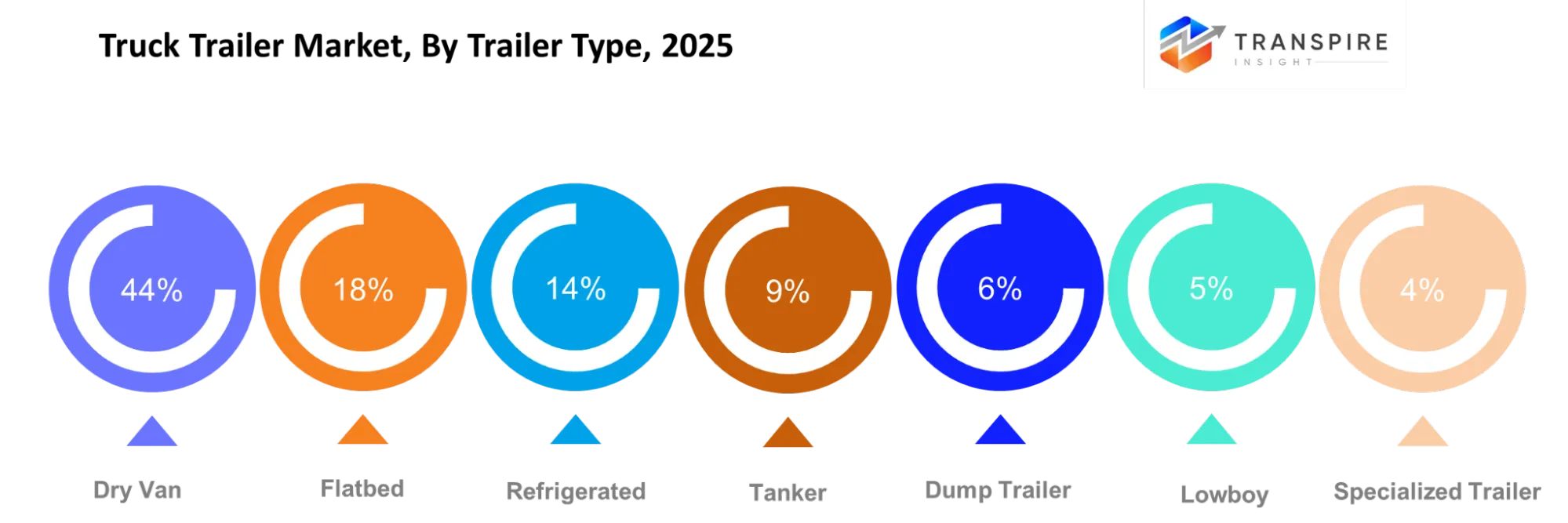
- The dry van trailers account for 43.5% of the overall market share because of their wide application in retail freight delivery, e-commerce freight services, and general freight delivery.
- The refrigerated trailers are experiencing a growth rate of 6.8% because of the need of cold chain providers to transport food, drugs, and other perishable products at controlled temperatures.
- The flatbed trailers account for 18.0% of the market share due to their capability to transport construction materials, heavy equipment, and steel, among others.
- The tanker trailers have a 9.0% market share as manufacturers continue to invest in special equipment for liquid transport and chemical handling.
- The dump trailers have a 6.0% share in the market due to construction and mining activities that demand transportation of aggregate material and soil.
- The lowboy trailers hold 5.0% of the market for transporting heavy equipment through infrastructure and industrial projects.
- The specialised trailers constitute a 4.5% share of the truck trailers market.
What are the Key Drivers, Restraints, and Opportunities in the Truck Trailer Market?
Drivers:
The expansion of organised freight networks and rising shipments are pushing logistics firms to upgrade their trailer fleets. The rise in e-commerce, regional distribution, and cross-border movements has driven high demand for reliable transportation equipment. Additionally, fleet owners are substituting old trailers with lightweight and advanced versions for better loading capacities, reduced maintenance and efficient fuel usage. The investments in food distribution and pharmaceutical logistics are helping the uptake of refrigerated trailers owing to the requirement of maintaining constant temperatures while transporting temperature-sensitive goods.
Restraints:
High production and purchase costs pose significant constraints on fleet managers, especially small fleet managers, due to a lack of sufficient funds. The rising prices of materials such as steel, aluminium, tyres, and components add to the cost pressures of manufacturing. Financing costs, along with uncertain freight charges, can hinder the decision of fleet expansion too.
Opportunities:
Electrification, connected trailer systems, and lightweight materials provide opportunities. Manufacturers can bring innovations such as solar refrigeration, monitoring systems, and predictive maintenance. For instance, there is an opportunity in the area of refrigerated trailer manufacturing and cold chain infrastructure investments in India and Southeast Asia.
|
Driver |
Relative Impact on Growth (%) |
Geographic Relevance |
Impact Timeline |
Demand Strength |
Growth Mechanism (5–10 words) |
Key Beneficiaries (5–10 words) |
Major Constraint (5–10 words) |
|
Increasing Freight Transportation and E-commerce Activities |
30% |
North America, Asia Pacific, Europe |
Short-term |
High |
Rising cargo volumes increase demand for trailers. |
Trailer manufacturers, logistics companies, freight operators, retailers. |
Fluctuating freight volumes and transportation costs. |
|
Fleet Modernization and Replacement of Aging Trailers |
25% |
North America, Europe, Asia Pacific |
Short-term |
High |
Aging fleets encourage replacement with advanced trailers. |
Trailer OEMs, fleet operators, leasing and rental companies. |
High acquisition costs and expensive financing. |
|
Expansion of Cold Chain and Refrigerated Transportation |
17% |
North America, Asia Pacific, Europe |
Medium-term |
High |
Perishable goods transportation increases refrigerated trailer demand. |
Refrigerated trailer manufacturers, food distributors, pharmaceutical logistics providers. |
High refrigeration equipment and maintenance expenses. |
|
Infrastructure Development and Industrial Transportation Investments |
15% |
Asia Pacific, North America, Middle East |
Medium-term |
High |
Infrastructure projects increase heavy-duty trailer requirements. |
Flatbed manufacturers, heavy-haul operators, construction companies, equipment suppliers. |
Project delays and fluctuating infrastructure investments. |
|
Adoption of Lightweight, Aerodynamic and Smart Trailer Technologies |
13% |
Europe, North America, Asia Pacific |
Long-term |
Medium |
Advanced designs improve fuel efficiency and fleet productivity. |
Technology vendors, trailer OEMs, fleet owners, component suppliers. |
High technology integration and development costs. |
|
Total |
100% |
— |
— |
— |
— |
— |
— |
What Has the Impact of Artificial Intelligence Been on the Truck Trailer Market?
Artificial intelligence is slowly changing the dynamics of the Truck Trailer Market by using smart fleet management, equipment monitoring, and transportation optimisation. AI-powered systems are able to analyse information gathered from sensors, GPS, tyre pressure monitoring systems, and refrigeration equipment to provide better visibility into the performance of assets. These solutions will help fleet managers to detect unusual operation modes, monitor temperatures of cargo, and schedule maintenance of equipment before any breakdowns. Predictive maintenance is one of the most useful applications, as analytical systems are able to look at the historical performance and sensor readings to determine which components need inspection or replacement. AI-based route and fleet planning can be used for logistics companies to optimise trailer usage, minimise unnecessary empty movements, and synchronise delivery times. Intelligent temperature management and handling of sensitive cargo can also be done through refrigerated transportation. The adoption of these technologies is limited by the high cost of installation, lack of data standards, poor connectivity, and integration issues with various brands of vehicles. As a result, AI is more likely to evolve into an operational technology rather than a manufacturing solution.
Instance:
In June 2026, Schmitz Cargobull launched the Cargobull Operating System (COS). It includes AI-based analytics, real-time monitoring, and predictive maintenance features. The COS allows fleet managers to detect trailer problems ahead of time and increase efficiency, demonstrating the growing use of artificial intelligence in commercial trailer technology.
Key Market Trends:
The evolution of the market is from the manufacture of durable equipment to the manufacture of durable, connected, and efficient equipment.
- Manufacturers of trailers are gradually shifting from heavy steel construction to lighter aluminium and composite construction to make the trailers more efficient in carrying loads and reduce the trailer’s weight.
- Fleet operators are gradually shifting from manual tracking of equipment to connected telematics, which can provide real-time information about the trailer’s performance, location, and utilisation.
- Technology is also advancing in the refrigerated transport segment, with manufacturers advancing their insulation, cooling systems, and remote temperature monitoring technology.
- Conventional maintenance of trailers is being supported by technologies like condition monitoring and predictive maintenance to reduce downtime of the equipment.
- E-commerce development has changed the requirements of the distribution, hence increasing the demand for flexible dry vans and trailers for loading and unloading operations.
- Product sustainability issues have driven technological innovation, and manufacturers are now developing electric refrigeration systems, aerodynamic designs, and energy-efficient trailer components.
Truck Trailer Market Segmentation
By Trailer Type:
Dry van trailers have the largest market share of 43.5% because of their extensive application in general freight, retail distribution, and e-commerce. The flatbed trailer segment commands 18.0% of the market and is predominantly used for transporting construction materials and other industrial cargo. Refrigerated trailers represent 14.0% of the total market and are expected to record the highest CAGR of 6.8% owing to growth in cold chain logistics. Tanker, dump, lowboy, and specialised trailers represent 9.0%, 6.0%, 5.0%, and 4.5% of the market, respectively, for liquid transport, bulk materials, heavy machinery, and custom cargo needs.
By Axle Configuration:
The tandem axle trailer type finds wide application in the commercial freight transportation business since it strikes a perfect balance between load-carrying capability and stability. The single-axle trailer configuration is ideal for light load transport, while triple, quad, and multi-axle trailer types are appropriate for heavy loads and special transportation.
By Length:
Trailers ranging from 46 to 53 feet in length play an essential role in long-distance transport due to their increased cargo volume needed for commercial distribution. Shorter trailers less than 28 feet in length and 28- to 35-foot-long trailers are often used for regional deliveries and city transportation. The range of 36-40 feet and 41-45 feet long trailers meets the demands for medium and large freight transportation.
By Material:
Despite recent advances in fabrication techniques, composite materials, and wood-fibre composites, steel remains the material of choice in trailer manufacturing as a result of its availability, ruggedness, and strength. Aluminium is also gaining market share given its lightweight characteristics and its contribution to payload efficiency. New advances in composite and fibreglass trailer construction are allowing use of these materials in low-weight, insulated, and corrosion-resistant applications.
By Application:
Transportation of freight is a significant application, with cargo, retail inventory and consumer products accounting for the bulk of motion. Construction and mining utilise heavy-duty trailers for machinery, aggregates and raw materials; farmers depend on trailers for crop and other farm output; oil and gas operations utilise tanker trailers and other speciality trailers; and logistics firms deploy an array of trailers to meet warehousing, distribution and other supply chain needs.
By End User:
3PLs and fleets can be lucrative customers. 3PLs and other fleet operators are also valuable customers, since they must have equipment to move freight. Retailers and manufacturers need a continuous supply of finished goods, inventory and industrial equipment, moving in between several sites. Construction and agricultural businesses need application-specific trailers for specialised equipment, as well as construction materials and agricultural products, respectively. Government entities need speciality equipment for development and transit.
What are the Key Use Cases Driving the Truck Trailer Market?
The dry van trailer is a popular type of trailer used for the transport of packaged consumer goods, retail inventories, industrial supplies, and e-commerce products. The enclosed nature of the trailer ensures that the cargo is protected from the environmental elements and facilitates the frequent transport of cargo between warehouses, manufacturing facilities, and retail stores. The refrigerated trailer is commonly used for the transport of perishable items in the food and dairy industries as well as pharmaceuticals. The flatbed and lowboy trailers are used in the construction industry and mining sector to carry heavy machinery. Some of the new applications of trailers include digital cargo transport and electric refrigeration systems. These innovations have helped fleet owners enhance cargo security and monitor transportation assets.
|
Report Metrics |
Details |
|
Market size value in 2025 |
USD 46.10 Billion |
|
Market size value in 2026 |
USD 49.07 Billion |
|
Revenue forecast in 2033 |
USD 80.40 Billion |
|
Growth rate |
CAGR of 7.3% from 2026 to 2033 |
|
Base year |
2025 |
|
Historical data |
2021 - 2024 |
|
Forecast period |
2026 - 2033 |
|
Report coverage |
Revenue forecast, competitive landscape, growth factors, and trends |
|
Regional scope |
United States; Canada; Mexico; United Kingdom; Germany; France; Italy; Spain; Denmark; Sweden; Norway; China; Japan; India; Australia; South Korea; Thailand; Brazil; Argentina; South Africa; Saudi Arabia; United Arab Emirates |
|
Key company profiled |
Utility Trailer Manufacturing, Wabash National, Great Dane, Hyundai Translead, Schmitz Cargobull, Krone, Kögel, CIMC Vehicles, Fontaine Trailer, Manac, Stoughton Trailers, Vanguard National Trailer, Wilson Trailer, East Manufacturing, Fruehauf |
|
Customization scope |
Free report customization (country, regional & segment scope). Avail customized purchase options to meet your exact research needs. |
|
Report Segmentation |
Trailer Type (Dry Van, Flatbed, Refrigerated, Tanker, Dump Trailer, Lowboy, Specialized Trailer); Axle Configuration (Single Axle, Tandem Axle, Triple Axle, Quad Axle, Multi-Axle, Lift Axle, Steerable Axle); Length (Below 28 Feet, 28–35 Feet, 36–40 Feet, 41–45 Feet, 46–53 Feet, Above 53 Feet, Custom); Material (Steel, Aluminum, Composite, Fiberglass, Carbon Fiber, Wood-Composite, Other); Application (Freight Transportation, Construction, Agriculture, Mining, Oil & Gas, Logistics, Specialized Cargo); End User (3PL Providers, Fleet Operators, Retailers, Manufacturers, Construction Companies, Agriculture Companies, Government) |
Which Regions are Driving the Truck Trailer Market Growth?
North America:
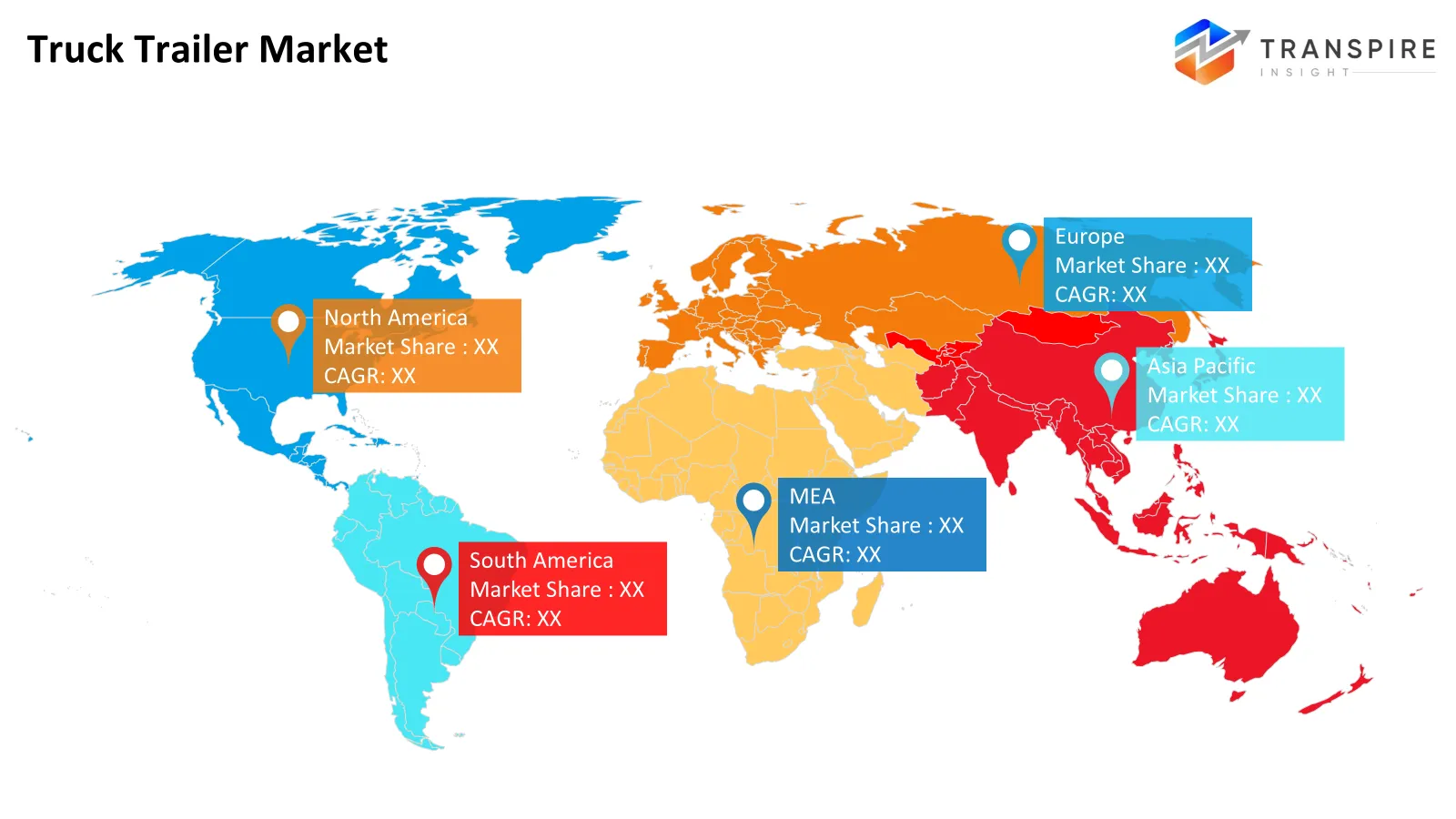
North America constitutes 28.5% of the Truck Trailer Market due to the presence of a well-established system of transportation of freight and commercial trucking. Efficient distribution systems, cross-border freight transportation between the U.S., Canada, and Mexico, along with the presence of leading manufacturers of trailers, are driving the regional demand. Modernisation of the fleet and investment in connected transportation equipment are leading to the adoption of more advanced trailer solutions. Demand for trailers is further driven by fleet replacement.
In March 2026, Hyundai Translead announced an investment of USD 450 million to set up trailer manufacturing plants in Illinois, United States of America. This move is likely to improve the capacity for manufacturing trailers in the region and will provide employment opportunities as well in keeping with the increasing demand for commercial trailers.
Europe:
Europe holds 20.5%. The presence of an efficiently developed logistics and road freight transportation infrastructure, along with the commercial vehicle manufacturing industry, is driving the demand for trailers in the region. Increasing focus on environmentally friendly regulations is driving manufacturers to design lightweight trailers, energy-efficient refrigeration units and other types of connected equipment. The presence of major manufacturers like Schmitz Cargobull and Krone ensures stability in the regional manufacturing ecosystem.
In March 2026,The operations at the new manufacturing plant of Schmitz Cargobull were launched in Oradea, Romania. The manufacturing facility will manufacture curtain-sider and tipper semi-trailers.
https://www.cargobull.com/fr/presse/2026/2026-148-geschaeftsjahresabschluss-2025-26
Asia-Pacific:
Asia-Pacific accounts for 42.0% due to significant manufacturing operations, growing trade networks, developments in infrastructure, and increased transport needs. The countries in this region, such as China, India, Japan, and Southeast Asia, create market demand due to industrial production and infrastructural development, including construction projects and increased logistics. The development of infrastructure for roads, warehouses, and transport networks creates an opportunity for trailer manufacturers.
In November 2025,The CIMC Vehicles company launched its EV-RT electric road train ecosystem at the China International Commercial Vehicle Show in Wuhan.
https://cimcvehiclesgroup.com/portal/article/index/id/4164/cid/36.html
Who are the Key Players in the Truck Trailer Market and how do they Compete?
The Truck Trailer Market features competition amongst established manufacturers who offer the production of a wide array of products including dry vans, refrigerated trailers, flatbeds, tankers, and specialised transport equipment. The players compete on the grounds of product durability, manufacturing capacities, customisations, distribution channels, technologies, and services. Important industry participants comprise CIMC Vehicles Group, Hyundai Translead, Wabash National Corporation, Great Dane, Utility Trailer Manufacturing Company, Schmitz Cargobull, Krone, Kögel Trailer, Wielton, and Manac. CIMC Vehicles specialises in mass production and market reach. On its part, Hyundai Translead specialises in engineering, customised trailer solutions and manufacturing capacities. Wabash features distinctive capabilities such as composite trailers, product durability, and integrated transport solutions. Finally, Great Dane and Utility Trailer rely on an extensive product range and strong customer base in North America.European manufacturers such as Schmitz Cargobull, Krone, and Kögel feature engineering, digitisation, and specialized trailer solutions. Wielton relies on the strategy of multi-brand expansion, while Manac concentrates on heavy-duty and specialised trailer products.
Truck Trailer Market Companies
- Utility Trailer Manufacturing
- Wabash National
- Great Dane
- Hyundai Translead
- Schmitz Cargobull
- Krone
- Kögel
- CIMC Vehicles
- Fontaine Trailer
- Manac
- Stoughton Trailers
- Vanguard National Trailer
- Wilson Trailer
- East Manufacturing
- Fruehauf
|
Company |
Est. Revenue Share Range |
Key Offerings |
Strategic Positioning |
Geographic Strength |
Technology Focus |
|
CIMC Vehicles |
5–9% |
Semi-trailers, tank trailers, refrigerated trailers, container chassis |
scale through diversified manufacturing |
Asia Pacific, North America, Europe |
Modular production and electric trailer development |
|
Schmitz Cargobull AG |
3–5% |
Refrigerated trailers, curtainsiders, box trailers, tipper trailers |
Premium positioning through integrated solutions |
Europe, Asia Pacific |
Smart telematics and advanced refrigeration |
|
Hyundai Translead |
1.5–3% |
Dry vans, refrigerated trailers, flatbeds, chassis |
Large-scale manufacturing with technology differentiation |
North America, Asia Pacific |
Intelligent monitoring and trailer connectivity |
|
KRONE Commercial Vehicle Group |
1.5–3% |
Curtainsiders, refrigerated trailers, container chassis, swap bodies |
Product innovation and strong European distribution |
Europe, Asia Pacific |
GPS telematics and fleet monitoring |
|
Great Dane LLC |
1–2.5% |
Dry freight trailers, refrigerated trailers, flatbeds, truck bodies |
Premium fleet solutions and customer relationships |
North America |
Aerodynamic designs and connected trailer systems |
|
Utility Trailer Manufacturing Company |
1–2.5% |
Dry vans, refrigerated trailers, flatbeds, curtainsiders |
High-volume manufacturing and durable products |
North America |
Lightweight construction and refrigeration efficiency |
|
Wabash National Corporation |
1–2% |
Dry freight trailers, refrigerated trailers, platform trailers, truck bodies |
Advanced materials and customized transportation solutions |
North America |
Composite materials and aerodynamic optimization |
|
Randoncorp |
0.5–1.5% |
Semi-trailers, dump trailers, tank trailers, grain trailers |
Regional manufacturing leadership and diversified products |
Latin America, North America |
Lightweight engineering and advanced manufacturing |
|
Facchini S.A. |
0.5–1.5% |
Semi-trailers, bitrains, road trains, tank trailers |
Cost competitiveness and specialized transport solutions |
Latin America |
Multi-trailer configurations and structural engineering |
Recent Development News
- In February 2025, Wabash National Corporation purchased TrailerHawk.ai, a cargo security and intelligent access management technology provider. The purchase improved its Trailers as a Service solution through the addition of intelligent cargo security and shipment monitoring features. This development helps to foster the increasing use of digital trailers. https://ir.onewabash.com/news/news-details/2025/Wabash-Acquires-TrailerHawk.ai-to-Enhance-Trailers-as-a-Service-Offering-with-Advanced-Cargo-Security-Technology/default.aspx
- In March 2026, Hyundai Translead unveiled HT ReadyVue, Trailer Blind Spot Monitoring, and HT LinkVue+. With the addition of these technologies, the company’s range of trailer technologies has been further enhanced. https://www.hyundaitranslead.com/hyundai-translead-expands-trailer-technology-portfolio/
What Strategic Insights Define the Future of the Truck Trailer Market?
The future success of the Truck Trailer Market will lie in how effectively manufacturers are able to blend traditional modes of transportation equipment with lightweight design, digital connectivity, and application-focused designs. While it’s true that dry van trailers currently have the largest market share, there exist opportunities for refrigerated and special type of trailer systems catering to high-value transportation needs. One factor that is somewhat not talked about when talking about future challenges facing the industry is the rise in cost associated with technology incorporation, which will not only drive up costs but make for increased maintenance needs. Companies that manufacture traditional trailers are also likely to come under competitive threat due to the importance given by fleet management service providers to efficiency and asset visibility. The future opportunity for manufacturers in the Truck Trailer Market will be intelligent refrigerated trailers and the customisation of lightweight equipment.
Key Segmentations are:
Trailer Type
- Dry Van
- Flatbed
- Refrigerated
- Tanker
- Dump Trailer
- Lowboy
- Specialized Trailer
Axle Configuration
- Single Axle
- Tandem Axle
- Triple Axle
- Quad Axle
- Multi-Axle
- Lift Axle
- Steerable Axle
Length
- Below 28 Feet
- 28–35 Feet
- 36–40 Feet
- 41–45 Feet
- 46–53 Feet
- Above 53 Feet
- Custom
Material
- Steel
- Aluminum
- Composite
- Fiberglass
- Carbon Fiber
- Wood-Composite
- Other
Application
- Freight Transportation
- Construction
- Agriculture
- Mining
- Oil & Gas
- Logistics
- Specialized Cargo
End User
- 3PL Providers
- Fleet Operators
- Retailers
- Manufacturers
- Construction Companies
- Agriculture Companies
- Government
By Regional Analysis
North America
- US
- Canada
- Mexico
Europe
- Germany
- UK
- France
- Italy
- Spain
- Russia
- Rest of Europe
Asia Pacific
- China
- Japan
- India
- South Korea
- Australia
- Rest of Asia Pacific
South America
- Brazil
- Argentina
- Rest of South America
Middle East & Africa
- UAE
- Saudi Arabia
- Qatar
- South Africa
- Rest of the Middle East & Africa
Frequently Asked Questions
Find quick answers to common questions.
The truck trailer market size was valued at USD 46.10 Billion in 2025 and is poised to reach USD 80.40 Billion by 2033, expanding at a 7.3% CAGR.
Key segments for the truck trailer market are Trailer Type (Dry Van, Flatbed, Refrigerated, Tanker, Dump Trailer, Lowboy, Specialized Trailer); Axle Configuration (Single Axle, Tandem Axle, Triple Axle, Quad Axle, Multi-Axle, Lift Axle, Steerable Axle); Length (Below 28 Feet, 28–35 Feet, 36–40 Feet, 41–45 Feet, 46–53 Feet, Above 53 Feet, Custom); Material (Steel, Aluminum, Composite, Fiberglass, Carbon Fiber, Wood-Composite, Other); Application (Freight Transportation, Construction, Agriculture, Mining, Oil & Gas, Logistics, Specialized Cargo); End User (3PL Providers, Fleet Operators, Retailers, Manufacturers, Construction Companies, Agriculture Companies, Government).
Growth is primarily driven by increasing freight transportation demand, expansion of e-commerce and logistics activities, rising cross-border trade, infrastructure development, growing demand for refrigerated and specialised trailers, and the adoption of lightweight, fuel-efficient, and technologically advanced trailer solutions.
The market is led by major manufacturers including Utility Trailer Manufacturing, Wabash National, Great Dane, Hyundai Translead, Schmitz Cargobull, Krone, Kögel, CIMC Vehicles, Fontaine Trailer, Manac, Stoughton Trailers, Vanguard National Trailer, Wilson Trailer, East Manufacturing, Fruehauf.
The Asia Pacific region holds the highest market share in the truck trailer market, with a 42.0% market share, driven by factors such as industrialisation, manufacturing activities, growth in freight transport, and investments in infrastructure. Other contributing factors include the demand for commercial vehicles, international trade, and e-commerce.
Commercial opportunities available in the worldwide truck trailer industry include increased demand for lightweight and fuel-efficient trailers, greater usage of electric and smart trailers, development of e-commerce and logistics infrastructure, more investments in refrigerated trailers for cold-chain transport, and higher demand for specialized trailers used in construction, agriculture, and industrial operations.
- Utility Trailer Manufacturing
- Wabash National
- Great Dane
- Hyundai Translead
- Schmitz Cargobull
- Krone
- Kögel
- CIMC Vehicles
- Fontaine Trailer
- Manac
- Stoughton Trailers
- Vanguard National Trailer
- Wilson Trailer
- East Manufacturing
- Fruehauf
About the Authors

Mayur Shinde
I am Mayur Shinde, a Senior Research Analyst at Transpire Insight, specializing in the Automotive & Transportation and Information & Communication Technology (ICT) Industry. My work focuses on analyzing emerging market trends, technological advancements, competitive landscapes, and industry developments to deliver accurate, data-driven insights. I am passionate about transforming complex market information into clear, actionable content that helps businesses, professionals, and decision-makers stay informed and make confident strategic decisions.

Chakradhar Khansole
Chakradhar serves as the Research Director at Transpire Insight, bringing over 8 years of experience in technology, innovation, and strategic market intelligence. He specializes in transforming complex market data into actionable business insights that enable organizations to make informed, growth-oriented decisions. Recognized for his strategic vision and analytical expertise, Chakradhar leads high-impact research initiatives, delivering comprehensive market assessments, competitive intelligence, and forward-looking industry analysis.
Recently Published Reports
-
Apr 2026
ATV & UTV Market
ATV & UTV Market Size, Share & Analysis Report By Type (ATV, and UTV), By Variants (Less Than 400 CC, 400 CC To 800 CC, and More Than 800 CC), and Geography (North America, Europe, Asia-Pacific, Middle East and Africa, South and Central America), 2021 - 2031
-
Apr 2026
Automotive Central Gateway Module Market
Automotive Central Gateway Module Market Size, Share & Analysis Report By Type (Ethernet Central Gateway Module, CAN Central Gateway Module, LIN Central Gateway Module, and FlexRay), By Application (Powertrain Control, Body Control, Infotainment System, Advanced Driver Assistance Systems (ADAS), and Others), By End User (Passenger Vehicles, and Commercial Vehicles), and Geography (North America, Europe, Asia-Pacific, Middle East and Africa, South and Central America), 2021 - 2031
-
Apr 2026
Automotive Engine Oil Filter Market
Automotive Engine Oil Filter Market Size, Share & Analysis Report By Filter Type (Fuel Filter, Engine Oil Filter, Hydraulic Oil Filter, and Others), By Filter Media (Cellulose, Synthetic, and Micro), By Sales Channel (OEMs, and Aftermarket), By Vehicle Type (Passenger Cars, Light Commercial Vehicles, Heavy Duty Trucks, Buses and Coaches, and Off-road Vehicles), and Geography (North America, Europe, Asia-Pacific, Middle East and Africa, South and Central America), 2021 - 2031
-
Apr 2026
Automotive Parts Aluminium Die Casting Market
Automotive Parts Aluminium Die Casting Market Size, Share & Analysis Report By Production Process (Pressure Die Casting, Vacuum Die Casting, Squeeze Die Casting, Gravity Die Casting), By Application (Body Parts, Engine Parts, Transmission Parts, Battery And Related Components, Other Application Types), and Geography (North America, Europe, Asia-Pacific, Middle East and Africa, South and Central America), 2021 - 2031
Our Clients