
Third-Party Logistics (3PL) Market Summary:
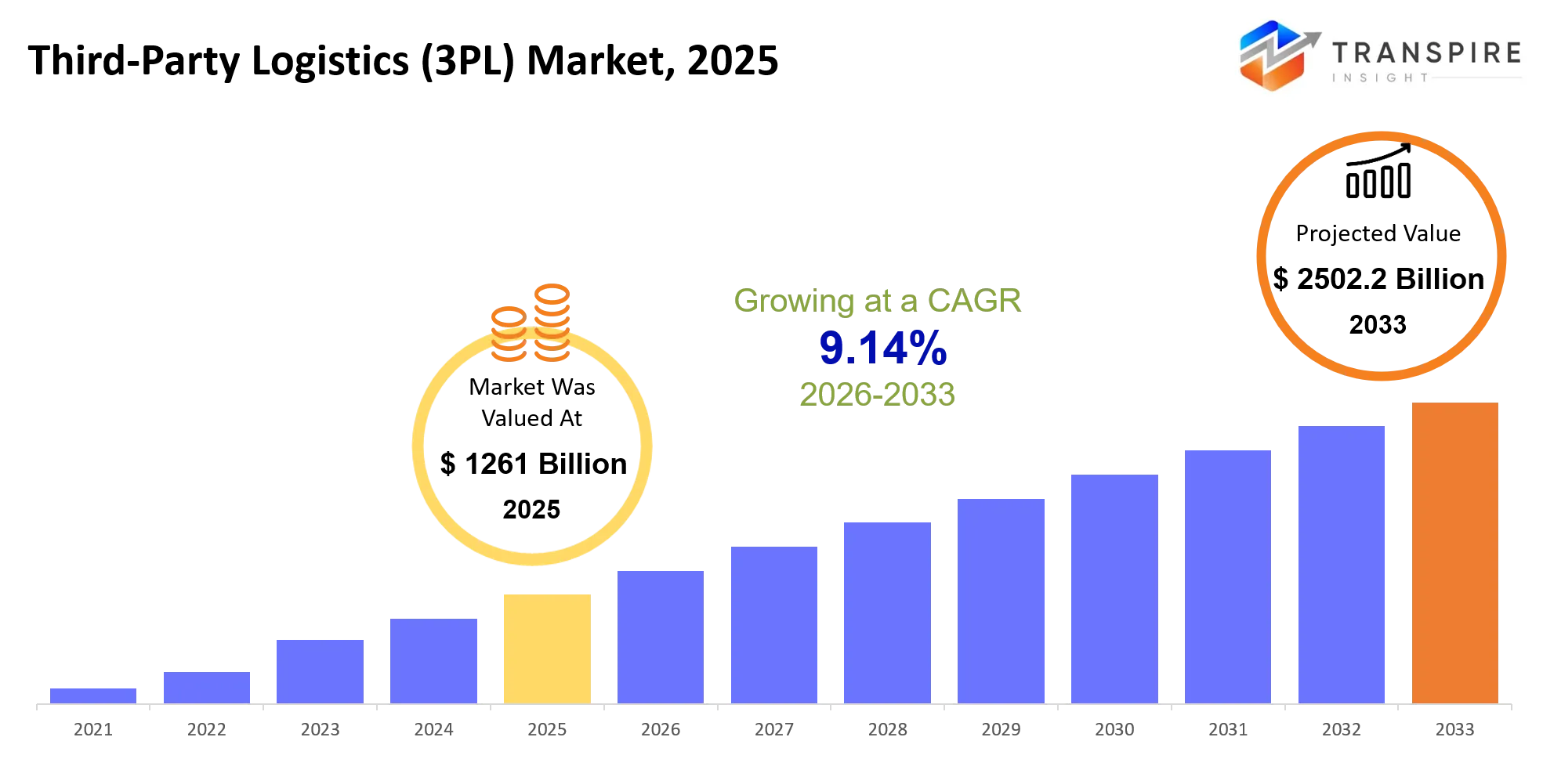
As per Transpire Insight Analysis, the Third-Party Logistics (3PL) Market size is estimated at USD 1261 billion in 2025 and is anticipated to reach USD 2502.2 billion by 2033, growing at a CAGR of 9.14% from 2026 to 2033.
The third-party logistics market helps companies handle transportation, storage getting orders ready moving inventory and dealing with products that are returned without the companies having to do all the logistics work themselves. In the three to five years the industry has gone past just sending freight out to others and now offers connected supply chain services that use digital tools real-time tracking and machines that work on their own in warehouses. The fast growth of shopping and new ideas, about what customers want have made companies try to deliver faster while also keeping logistics costs under control. A big change is the use of systems that combine transportation and warehouse management, which makes it easier to see what is happening in all parts of the supply chain. There are flexible ways to move goods and different ways to ship them. Because of this companies are depending more on specialist 3PL providers to handle changing numbers of shipments manage ways to move goods and keep services running smoothly in both local and areas.
Third-Party Logistics (3PL) Market Size & Forecast:
- Market Size 2025: USD 1261 Billion
- Expected Market Value (2033): USD 2502.2 Billion
- Forecast CAGR (2026–2033): 9.14%
- Leading Region in 2025: Asia-Pacific
- Fastest Growing Region: Middle East
- Key Company Profiles: DHL Supply Chain, Kuehne+Nagel, C.H. Robinson, DSV, FedEx, UPS, DB Schenker, Nippon Express, CEVA Logistics, J.B. Hunt, XPO, GXO Logistics, Maersk Logistics, Rhenus Group, Expeditors International
Key Market Insights:
The market is moving towards a requirement for integration of cost-effective freight transportation and technological supply chain visibility.
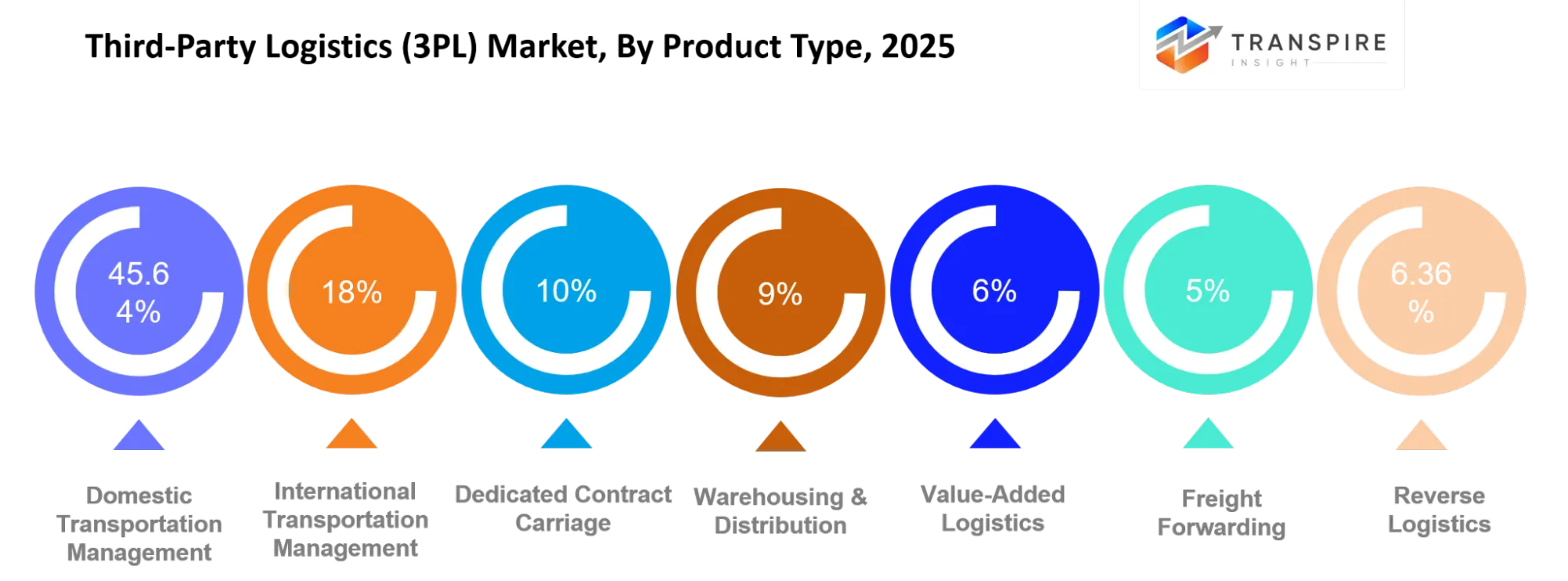
- Management of domestic transportation comprises 45.64% of the market, driven by high demand for reliable freight services.
- International transportation management constitutes 18.00% of the market and is expected to grow at a CAGR of 11.26% due to cross-border trade.
- Dedicated contract carriage accounts for 10.00% of the market as companies need reliable transportation services.
- Warehousing and distribution make up 9.00% of the market, as automated technologies are used in inventory management and order fulfilment.
- Value-added logistics constitutes 6.00% of the market, driven by demand for packaging, labelling, and customisation of products.
- Freight forwarding constitutes 5.00% of the market as companies need efficient international shipping and customs clearance.
- Reverse logistics makes up 3.00% of the market as service providers develop their capabilities in reverse logistics. Other logistics services account for 3.36% of the market.
What are the Key Drivers, Restraints, and Opportunities in the Third-Party Logistics (3PL) Market?
Drivers
increased online retail, international businesses, and logistics outsourcing, businesses have found the need to deal with logistics providers. For e-commerce firms, warehousing is flexible, quick in order fulfilment, efficient delivery service, and returns processing for their customers during peak seasons. This will allow them to generate income from transportation and ancillary services. The supply chain interruptions brought attention to how risky it was not to broaden one’s logistics network.
Restraints
Large operating expenses continue to present problems for the industry. The expense of fuel, driver shortages, rent of warehouses, labour costs and infrastructural constraints can decrease profit margins. Combining customer systems with those of the logistics provider for both transport and warehousing can also be expensive for the providers. Small logistic providers can find it hard to use modern technologies while providing quality service from multiple locations.
Opportunities
Digitised supply chains, AI-assisted routing, automated fulfilment, and specialised logistics provide opportunities for providers to be more productive and get new clients. Management of international transportation is an area that provides opportunities for expansion through customs services and multimodal freight services. The provision of investment in regional distribution centres, cold chains and logistics also presents opportunities to serve customers in the healthcare, food, and manufacturing sectors.
What Has the Impact of artificial intelligence on the Third-Party Logistics (3PL) Market?
AI is revolutionizing the process of planning shipment, organization of warehouse operations and managing disruptions in third-party logistics supply chains. AI-powered transportation management system can analyse traffic situation, delivery time frames, shipping costs and vehicle availability of vehicles to suggest routing. It enables logistics companies to reduce unnecessary mileage, improve the efficiency of vehicles and manage delivery scheduling. AI systems in warehouses allow forecasting of demand, allocation of inventory, ordering priority and automation of equipment. Predictive analytics will help to identify possible delays, forecast storage requirements for the future and detect capacity gaps that may lead to disruption. Such capabilities are extremely important in e-commerce fulfilment when orders come rapidly and customers want to have delivery estimates. There are some challenges connected with the implementation of such technology. They include high costs, poor data quality, integration with legacy systems, and inaccurate predictions in unusual situations. Providers need high-quality data and human supervision to take advantage of AI recommendations.
Instance
In November 2025, DHL Supply Chain collaborated with HappyRobot to use artificial intelligence to manage communications related to logistics, such as appointment scheduling and driver and warehouse communication. This program is aimed at making the operations process easier and more efficient for DHL.
Key Market Trends:
The industry of 3PLs is moving away from simple transportation outsourcing toward connected solutions for the management of several levels of the supply chain. The main competition in the industry is becoming based on technology and logistics.
- There is a growing trend among logistics firms to use robotics, automation, and smart picking technologies to process large numbers of orders consistently.
- Previous and current information on transport is utilised to predict any delays, plan capacity and plan contingencies in the case of transport.
- Customers have become more and more demanding of shippers that will be able to offer them transportation, warehousing, fulfilment, and returns under one contract.
- E-commerce returns have become an important part of logistics operations; therefore, service providers are developing processes of inspection, sorting, refurbishing, and reselling.
- IoT devices and dashboards are assisting customers in monitoring their freight and detecting any delays in the process of transport.
Third-Party Logistics (3PL) MarketSegmentation
By service type
domestic transportation management services make up the largest segment of the world’s third-party logistics market, constituting 45.64% of the market. This dominance can be explained by the continuous requirement for the movement of items from factories to distributors to retail shops and customers. International transportation management services occupy 18.00% of the market, while dedicated contract carriage makes up 10.00%. International transportation management services are the fastest-growing services, with a projected compound annual growth rate of 11.26% because of increased complexities in freight movements due to cross-border trade. Warehousing and distribution account for 9.00% of the market, value-added logistics make up 6.00%, freight forwarding 5.00%, reverse logistics 3.00% and other services 3.36%.
By transport mode
The transportation market consists of road, rail, water, air, multimodal, intermodal, last mile, and many other forms of transport. Road transport is very important for domestic transport and last-mile delivery because of the connection between manufacturing sites, storage units, and end users. In the case of multimodal and intermodal transport, different forms of transportation may be used by service providers depending on cost, distance, and delivery needs. Due to the growing consumer need for shipment tracking and reliable transport services, logistics service providers can use digital planning systems for choosing optimal routes and mode transfer.
By end user
3PL services are used in such fields as manufacturing, retail and e-commerce, automotive, health care, food and beverages, technology, consumer goods and others to perform businesses in different industries. Manufacturing firms need efficient services in delivering inbound materials and performing logistics operations, while retail and online firms need storage and order fulfilment services. Technology and consumer goods firms need distribution capabilities due to product launches. Different needs of end clients allow providers to develop industry-oriented solutions instead of competing on the low cost of transportation.
By logistics model
the market includes asset-light, asset-heavy, hybrid, digital 3PL, fourth-party logistics (4PL), contract logistics, on-demand logistics, and others. Generally, asset-light companies rely on carrier partnerships and the capacity of third parties, whereas asset-heavy companies invest in their own fleet and warehousing infrastructure. Hybrid models combine owned assets with an external network to get the necessary balance between service control and flexibility. . The contract logistics is used to meet long-term client needs, while on-demand logistics helps firms to cope with shipment fluctuations. In order to succeed in the future, it is necessary to choose the right logistics model with consideration of operating costs, capacity, technology investment, and customer needs for service.
By technology
the market consists of technologies such as transportation management systems (TMS), warehouse management systems (WMS), IoT, AI, robotics, blockchain, cloud platforms, and others. The TMS systems are useful for route optimisation and freight coordination, while the WMS is helpful in tasks such as inventory management, picking, packing, and dispatching. Blockchain can be used for traceability and documentation, provided the participants of the process agree upon the common data standards. The future lies in the integration of these systems into a connected system that minimises information gaps and enhances service reliability.
What are the Key Use Cases Driving the Third-Party Logistics (3PL) Market?
The use case of domestic freight coordination is one of the use cases that are facilitated by the domestic transportation management market. 3PL companies are used by manufacturers, distributors, and retailers to transport their goods between their facilities and deliver their goods reliably without creating transportation capabilities within themselves. Some other use cases are e-commerce order fulfillment, warehousing, international freight forwarding, dedicated transportation, and return logistics. Retailers use the third-party logistics networks for order fulfillment when there is a spike in demand, while manufacturers benefit from the coordinated material handling and distribution. Some other emerging use cases are shipment planning using artificial intelligence, predictive inventory positioning, automation in warehousing, and cold chain logistics.
|
Report Metrics |
Details |
|
Market size value in 2025 |
USD 1261 Billion |
|
Market size value in 2026 |
USD 1356.7 Billion |
|
Revenue forecast in 2033 |
USD 2502.2 Billion |
|
Growth rate |
CAGR of 9.14% from 2026 to 2033 |
|
Base year |
2025 |
|
Historical data |
2021 - 2024 |
|
Forecast period |
2026 - 2033 |
|
Report coverage |
Revenue forecast, competitive landscape, growth factors, and trends |
|
Regional scope |
United States; Canada; Mexico; United Kingdom; Germany; France; Italy; Spain; Denmark; Sweden; Norway; China; Japan; India; Australia; South Korea; Thailand; Brazil; Argentina; South Africa; Saudi Arabia; United Arab Emirates |
|
Key company profiled |
DHL Supply Chain, Kuehne+Nagel, C.H. Robinson, DSV, FedEx, UPS, DB Schenker, Nippon Express, CEVA Logistics, J.B. Hunt, XPO, GXO Logistics, Maersk Logistics, Rhenus Group, Expeditors International |
|
Customization scope |
Free report customization (country, regional & segment scope). Avail customized purchase options to meet your exact research needs. |
|
Report Segmentation |
Service Type (Domestic Transportation Management, International Transportation Management, Dedicated Contract Carriage, Warehousing & Distribution, Value-Added Logistics, Freight Forwarding, Reverse Logistics, Others); Transport Mode (Roadways, Railways, Waterways, Airways, Multimodal, Intermodal, Last-Mile, Others); End User (Manufacturing, Retail & E-Commerce, Automotive, Healthcare, Food & Beverage, Technology, Consumer Goods, Others); Logistics Model (Asset-Light, Asset-Heavy, Hybrid, Digital 3PL, 4PL, Contract Logistics, On-Demand, Others); Technology (TMS, WMS, IoT Tracking, AI Analytics, Robotics, Blockchain, Cloud Platforms, Others) |
Which Regions are Driving the Third-Party Logistics (3PL) Market Growth?
North America
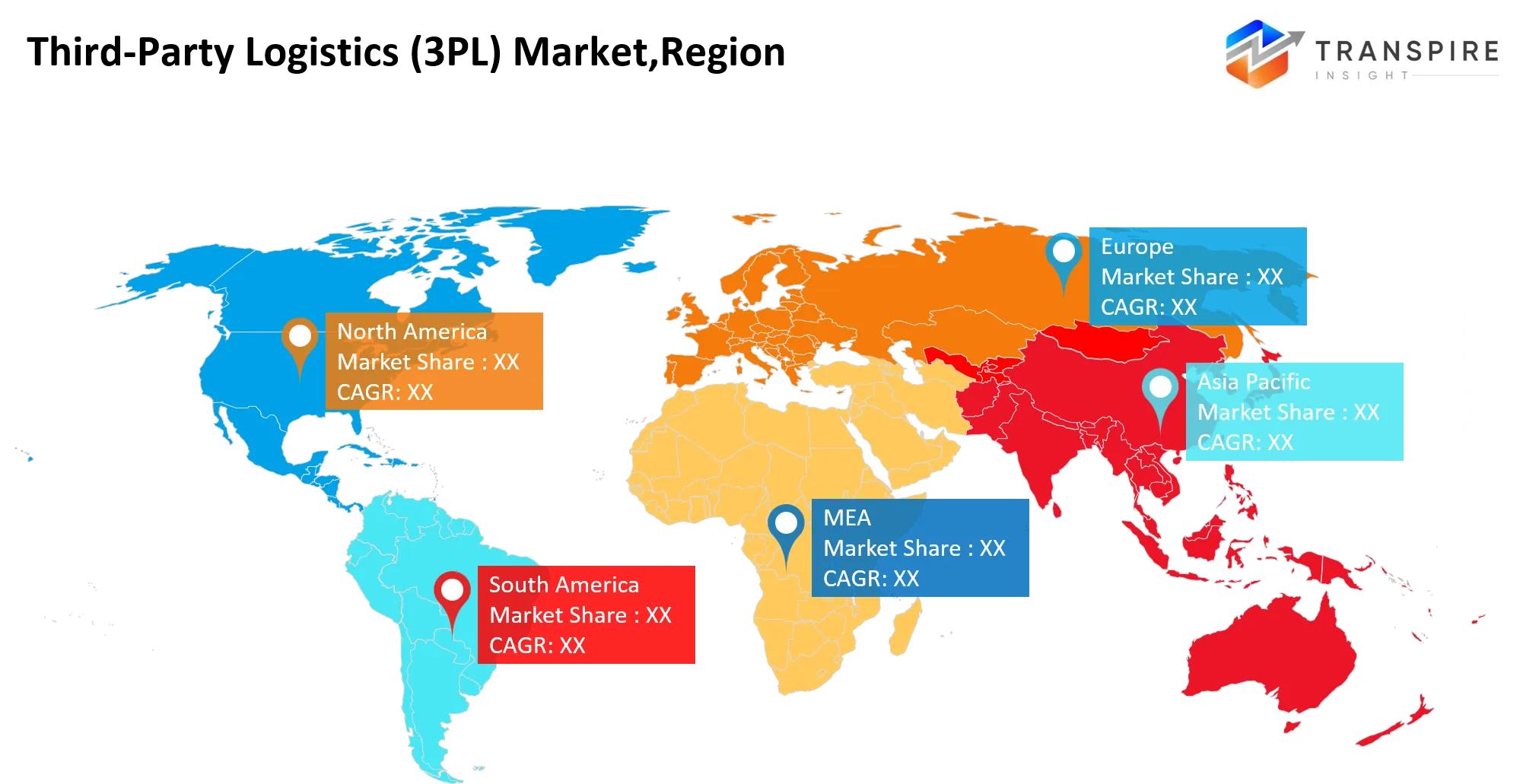
The North American region holds a 25.00% share of the third-party logistics market as per the data provided. This is made possible owing to existing freight transportation systems as well as the maturity level of the logistics services industry. This is due to the fact that the region has extensive roadways, efficient distribution centres, modern warehouses and a substantial customer base from the retail, manufacturing and e-commerce sectors. Fulfilment capabilities, freight management and return processing are some of the key areas where providers are making investments.
In January 2025, DHL Supply Chain acquired Inmar Supply Chain Solutions to improve its reverse logistics operations throughout North America. With the new acquisition, the company received 14 return facilities and about 800 workers. As a result, it increased its capability to manage product returns for retail and online commerce companies.
Europe
The Europe region accounts for 20.00% of the total market through cross-border trade, well-established manufacturing hubs and intermodal links among road, rail, sea and air transport modes. Interconnectivity among the economies of the Europe region creates a need for coordinated transport, customs processing, warehousing and distribution. Sustainability programs and attempts to improve transport efficiency are also making logistics providers consider their fleet utilisation and alternatives to freight. Logistics providers who offer regional coverage and cross-border coordination stand to gain from manufacturers and retailers looking for consistent logistics services within the Europe region.
In April 2025,CEVA Logistics announced a plan to build a new pharmaceutical logistics facility in Strasbourg, France. The new 17,000 square meter warehouse will offer temperature-controlled storage, transportation, and value-added services for international and domestic healthcare supply chains.
Asia-Pacific
The Asia-Pacific region has the highest share of the third-party logistics market at 41.02% as per the provided data set. This is attributed to high levels of manufacturing, export-focused supply chains, growing consumer markets and increasing online retail in the major economies. Development of ports, industrial zones, fulfilment centres and digital commerce is creating sophisticated needs for distribution. This region presents more opportunities for logistics providers who can link production sites with domestic markets and international shipping lanes.
In June 2026, DHL Supply Chain enhanced its data centre logistics activities in Asia-Pacific by opening and planning to open more than 160,000 square meters of special warehousing space. The new development involves new facilities in Malaysia and Thailand to meet the increasing demand for data centre infrastructure. Such an example clearly shows how 3PL companies are developing their warehousing and handling activities for technology supply chains in the region.
Who are the Key Players in the Third-Party Logistics (3PL) Marketand how do they Compete?
The competition in the third-party logistics industry depends on factors such as freight network coverage, service reliability, pricing, technology and the ability to handle complex customer requirements. Larger providers compete by means of integrated transportation and warehousing networks, while specialised providers offer services for selected industries, regions or logistics functions. The competitive issue is to keep service and capacity flexibility and not let labour, fuel, facilities and technology costs eat up their profits.DHL Group stands out with logistics coverage, contract logistics and e-commerce fulfilment. The acquisition of IDS Fulfilment DSV is characterised by integrated transportation and logistics, where network leverage and service integration benefit international customers. C.H. Robinson stands out with freight brokerage and managed transportation, while UPS has combined its transportation capabilities with specialised healthcare logistics. GXO Logistics has combined its strengths in contract logistics and warehouse operations, as evidenced by the launch of its technology-enabled GXO IQ platform.
Third-Party Logistics (3PL) Marketcompanies
- DHL Supply Chain
- Kuehne+Nagel
- C.H. Robinson
- DSV
- FedEx
- UPS
- DB Schenker
- Nippon Express
- CEVA Logistics
- J.B. Hunt
- XPO
- GXO Logistics
- Maersk Logistics
- Rhenus Group
- Expeditors International
Recent Development News
In March 2026, the deal enhanced Echo's logistics and transportation services, including its AI-powered logistics services, thus building a bigger platform to serve shippers in North America.
In June 2025 , GXO Logistics introduces their GXO IQ artificial intelligence platform. The GXO IQ platform was built utilising AI technology provided by Google Cloud and Snowflake. The platform is meant to help manage tasks related to warehouses, transport, and workforce.
What Strategic Insights Define the Future of the Third-Party Logistics (3PL) Market?
third-party logistics is transforming from independent freight to integrated services using technology in the process. Companies will have more to gain in terms of long-term business relations if they link shipment planning, warehouse management, inventory tracking and returns handling. Artificial intelligence-based solutions in the planning phase and automation and international shipment can provide more value in terms of increasing productivity. Some of the silent threats include higher costs in operations when technology investment does not give expected results because of scattered customer data, incompatible legacy systems and volatile shipment levels. Also, being too dependent on some customers, transportation partners, or certain shipping lanes creates susceptibility to disruptions. For the growth and protection of their companies, logistics businesses should focus on implementing compatible technologies, shipment information and increased productivity. Growth in terms of new products and specialised services in healthcare, manufacturing and international markets can bring additional profits to the businesses.
Service Type
- Domestic Transportation Management
- International Transportation Management
- Dedicated Contract Carriage
- Warehousing & Distribution
- Value-Added Logistics
- Freight Forwarding
- Reverse Logistics
- Others
Transport Mode
- Roadways
- Railways
- Waterways
- Airways
- Multimodal
- Intermodal
- Last-Mile
- Others
End User
- Manufacturing
- Retail & E-Commerce
- Automotive
- Healthcare
- Food & Beverage
- Technology
- Consumer Goods
- Others
Logistics Model
- Asset-Light
- Asset-Heavy
- Hybrid
- Digital 3PL
- 4PL
- Contract Logistics
- On-Demand
- Others
Technology
- TMS
- WMS
- IoT Tracking
- AI Analytics
- Robotics
- Blockchain
- Cloud Platforms
- Others
Frequently Asked Questions
Find quick answers to common questions.
The third-party logistics (3pl) market size was valued at USD 1261 billion in 2025 and is poised to reach USD 2502.2 billion by 2033, expanding at a 9.14% CAGR.
Key segments for the third-party logistics (3pl) market are Service Type (Domestic Transportation Management, International Transportation Management, Dedicated Contract Carriage, Warehousing & Distribution, Value-Added Logistics, Freight Forwarding, Reverse Logistics, Others); Transport Mode (Roadways, Railways, Waterways, Airways, Multimodal, Intermodal, Last-Mile, Others); End User (Manufacturing, Retail & E-Commerce, Automotive, Healthcare, Food & Beverage, Technology, Consumer Goods, Others); Logistics Model (Asset-Light, Asset-Heavy, Hybrid, Digital 3PL, 4PL, Contract Logistics, On-Demand, Others); Technology (TMS, WMS, IoT Tracking, AI Analytics, Robotics, Blockchain, Cloud Platforms, Others)
Growth is primarily driven by increase in international trade, the growing demand for logistics that are economical, and the use of technology in the supply chain.
The market is led by major manufacturers including DHL Supply Chain, Kuehne+Nagel, C.H. Robinson, DSV, FedEx, UPS, DB Schenker, Nippon Express, CEVA Logistics, J.B. Hunt, XPO, GXO Logistics, Maersk Logistics, Rhenus Group, and Expeditors International
The Asia-Pacific region has a share of 41.02% in the overall 3PL market due to the fast expansion of e-commerce, an increase in manufacturing operations, international trade, improved infrastructure, and the need for quality warehousing and transport services.
Commercial opportunities in the international third-party logistics (3PL) industry include the rise of e-commerce logistics services, growing requirements for cold chain logistics, use of AI and automation technology in warehouses, growth in cross-border trade logistics, and sustainability in logistics services.
- DHL Supply Chain
- Kuehne+Nagel
- C.H. Robinson
- DSV
- FedEx
- UPS
- DB Schenker
- Nippon Express
- CEVA Logistics
- J.B. Hunt
- XPO
- GXO Logistics
- Maersk Logistics
- Rhenus Group
- Expeditors International
About the Authors

Mayur Shinde
I am Mayur Shinde, a Senior Research Analyst at Transpire Insight, specializing in the Automotive & Transportation and Information & Communication Technology (ICT) Industry. My work focuses on analyzing emerging market trends, technological advancements, competitive landscapes, and industry developments to deliver accurate, data-driven insights. I am passionate about transforming complex market information into clear, actionable content that helps businesses, professionals, and decision-makers stay informed and make confident strategic decisions.

Chakradhar Khansole
Chakradhar serves as the Research Director at Transpire Insight, bringing over 8 years of experience in technology, innovation, and strategic market intelligence. He specializes in transforming complex market data into actionable business insights that enable organizations to make informed, growth-oriented decisions. Recognized for his strategic vision and analytical expertise, Chakradhar leads high-impact research initiatives, delivering comprehensive market assessments, competitive intelligence, and forward-looking industry analysis.
Recently Published Reports
-
Apr 2026
ATV & UTV Market
ATV & UTV Market Size, Share & Analysis Report By Type (ATV, and UTV), By Variants (Less Than 400 CC, 400 CC To 800 CC, and More Than 800 CC), and Geography (North America, Europe, Asia-Pacific, Middle East and Africa, South and Central America), 2021 - 2031
-
Apr 2026
Automotive Central Gateway Module Market
Automotive Central Gateway Module Market Size, Share & Analysis Report By Type (Ethernet Central Gateway Module, CAN Central Gateway Module, LIN Central Gateway Module, and FlexRay), By Application (Powertrain Control, Body Control, Infotainment System, Advanced Driver Assistance Systems (ADAS), and Others), By End User (Passenger Vehicles, and Commercial Vehicles), and Geography (North America, Europe, Asia-Pacific, Middle East and Africa, South and Central America), 2021 - 2031
-
Apr 2026
Automotive Engine Oil Filter Market
Automotive Engine Oil Filter Market Size, Share & Analysis Report By Filter Type (Fuel Filter, Engine Oil Filter, Hydraulic Oil Filter, and Others), By Filter Media (Cellulose, Synthetic, and Micro), By Sales Channel (OEMs, and Aftermarket), By Vehicle Type (Passenger Cars, Light Commercial Vehicles, Heavy Duty Trucks, Buses and Coaches, and Off-road Vehicles), and Geography (North America, Europe, Asia-Pacific, Middle East and Africa, South and Central America), 2021 - 2031
-
Apr 2026
Automotive Parts Aluminium Die Casting Market
Automotive Parts Aluminium Die Casting Market Size, Share & Analysis Report By Production Process (Pressure Die Casting, Vacuum Die Casting, Squeeze Die Casting, Gravity Die Casting), By Application (Body Parts, Engine Parts, Transmission Parts, Battery And Related Components, Other Application Types), and Geography (North America, Europe, Asia-Pacific, Middle East and Africa, South and Central America), 2021 - 2031
Our Clients