

Digital Transformation in Manufacturing Market Summary:
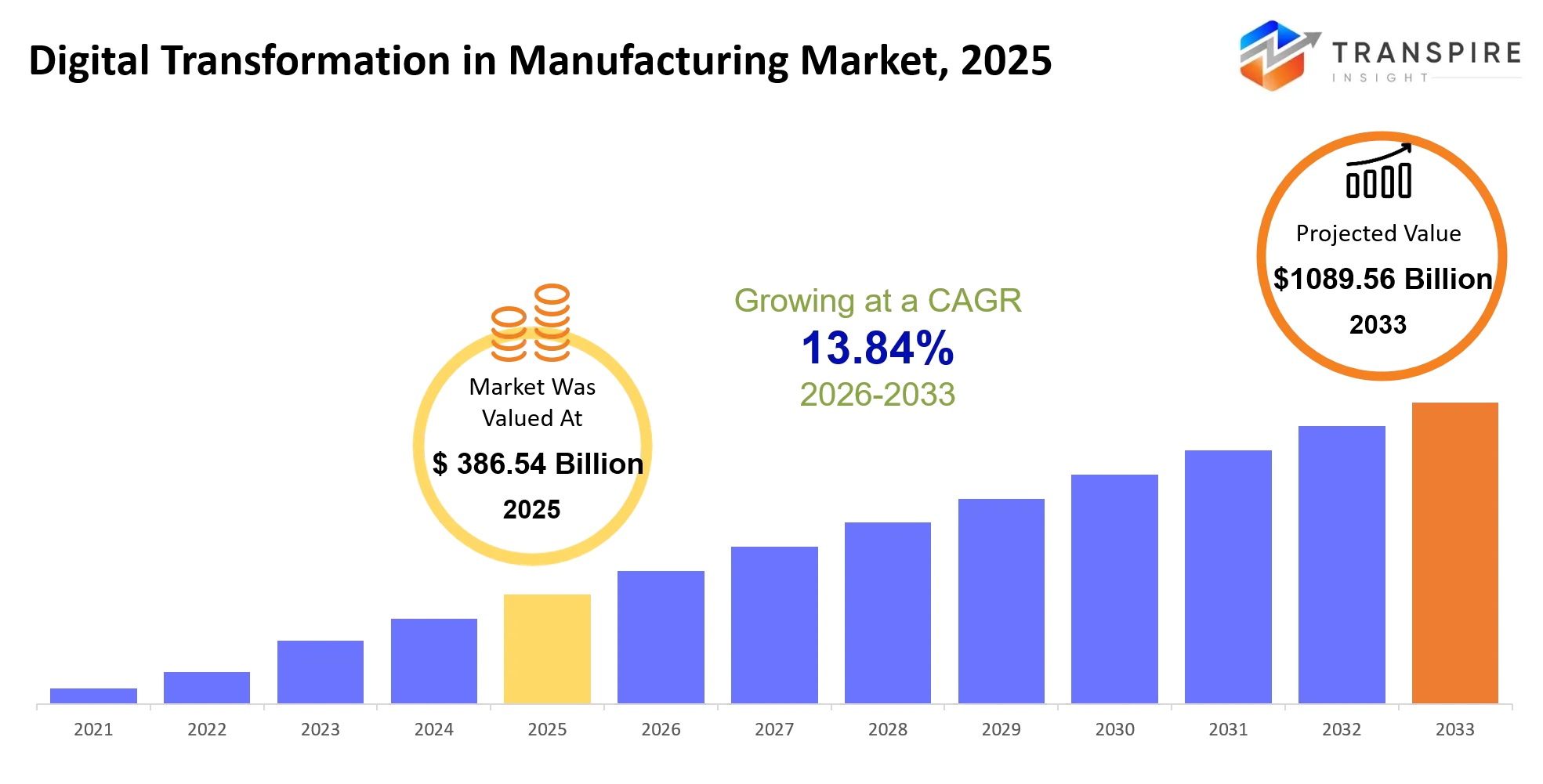
As per the Transpire Insight Analysis, The Digital Transformation in Manufacturing Market size is estimated at USD 386.54 billion in 2025 and is anticipated to reach USD 1089.56 billion by 2033, growing at a CAGR of 13.84% from 2026 to 2033.
The digital transformation in the manufacturing market is shifting factories from isolated automation projects toward connected, data-driven operating systems that link machines, engineering, production, maintenance, and supply chains. Over the past three to five years, cloud platforms, industrial IoT, digital twins, edge computing, and AI have moved from pilot programmes into production environments, with manufacturers prioritising measurable throughput, quality, energy, and downtime gains. The structural shift is the convergence of IT and OT, allowing operational data to feed enterprise and AI applications in near real time. The practical trigger has been persistent supply-chain disruption, labour shortages, and pressure to localise production, making faster decisions and flexible capacity commercially important. Growth therefore follows a clear cause-and-effect path: richer machine data improves visibility; connected analytics identify losses earlier; AI and simulation optimise responses; and validated improvements reduce waste, downtime, and capital risk. Unilever’s 2026 digital-twin expansion demonstrates this transition toward measurable factory outcomes.
Digital Transformation in Manufacturing Market Size & Forecast:
- Market Size 2025: USD 386.54 Billion
- Expected Market Value (2033): USD 1089.56 Billion
- Forecast CAGR (2026–2033): 13.84%
- Leading Region in 2025: North America
- Fastest Growing Region: Asia Pacific
- Key Company Profiles: Siemens, Schneider Electric, ABB, Honeywell, Rockwell Automation, IBM, Microsoft, SAP, PTC, Dassault Systèmes, Bosch, GE Vernova, Cisco, Oracle, Emerson.
Key Digital Transformation in Manufacturing Market Insights:
The market is moving from connectivity-based digitisation to AI-based execution, with digitisation infrastructure now being evaluated based on measurable results in the factory. Companies are thus going beyond pilots to connected workflows in the industrial domain, agentic AI, and integrated digital twins to gain better throughput, reliability, and engineering speed.
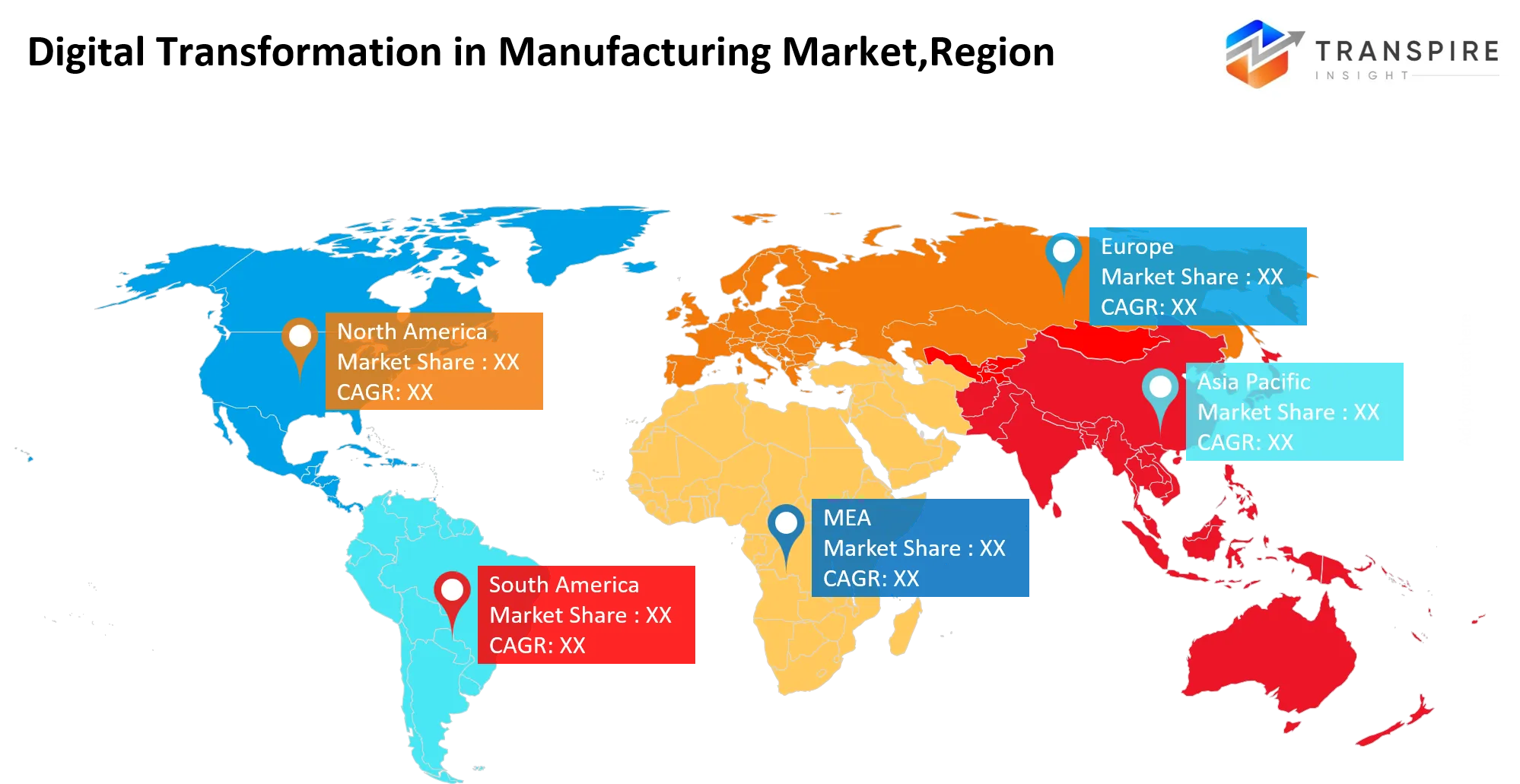
- North America is at 34.90% of the market, with industrial AI, edge analytics, and cybersecurity-driven modernisation driving early adoption.
- Europe accounts for 30.00%, with manufacturers integrating digital investments with energy efficiency, traceability, and regulatory compliance.
- Asia Pacific accounts for 27.00% and is growing at a 15.80% CAGR due to electronics, automotive, and high-volume production upgrades.
- Latin America accounts for 4.50%, and adoption is focused on large process plants that are looking for operational visibility and cost control.
- The Middle East & Africa has a growth rate of 3.60%, driven by energy, petrochemicals, and industrial-infrastructure modernisation.
- Siemens is continuing to develop the automation of artificial intelligence (AI) with the Industrial Copilot agents that can create PLC code and tune production parameters.
- Rockwell's partnership with Augury and FactoryTalk LogixAI for prediction of process quality is expanding predictive capabilities.
- ABB is growing its energy-management software offering with Sensorfact, which combines digitalisation with sustainability and operational efficiency.
- The acquisition of AspenTech bolsters Emerson's transition from process automation to enterprise-level industrial AI platforms.
- By linking ERP, MES, and PLM data, Microsoft and PTC are continuing digital threads and enabling AI-driven manufacturing workflows.
What are the Key Drivers, Restraints, and Opportunities in the Digital Transformation in Manufacturing Market?
Driver:
The strongest growth driver is the need to reduce unplanned downtime and improve asset productivity. Manufacturers have shifted from reactive repair toward predictive maintenance, using IoT sensor data and machine learning to identify abnormal vibration, temperature, energy use, or cycle-time patterns before failure occurs. Recent industry research indicates that 84% of industrial organisations plan to increase maintenance spending, with many prioritising predictive maintenance and production optimisation. This directly supports revenue growth for software, analytics, sensors, connectivity, and integration-service providers because each connected asset requires a digital foundation.
Restraint:
Legacy equipment, incompatible industrial protocols, fragmented data ownership, and limited OT cybersecurity expertise continue to slow deployment. These issues persist because factories often contain machines purchased across decades, making replacement expensive and integration technically disruptive; NIST’s 2026 smart-manufacturing roadmap specifically identifies heterogeneous sensing and control systems and complex industrial data as continuing barriers.
Opportunity:
The next major opportunity lies in edge AI combined with private 5G and digital twins. Edge computing allows quality inspection, anomaly detection, and machine control to occur close to the production line, reducing latency and dependence on central cloud systems. Private 5G can support high-bandwidth, low-latency communication across large factory campuses, enabling real-time digital-twin synchronisation and autonomous quality control. Europe is a particularly important region because the European Commission’s Apply AI strategy is promoting industrial AI adoption across advanced manufacturing and related strategic sectors.
What Has the Impact of Artificial Intelligence Been on the Digital Transformation in the Manufacturing Market?
AI is transforming digital manufacturing into decision-support platforms that increasingly push toward action. AI can analyse machinery, sensor, quality-control, production, and supply-chain data to identify anomalies, optimise schedules, spot defects, and suggest process adjustments. For predictive maintenance, it can find patterns that precede equipment breakdown, enabling maintenance to act before production is impacted.
In quality management, computer vision can reliably detect defects and generate training data to accelerate inspection-model development. With AI-enabled digital twins, we can leverage the simulation-led optimisation provided by virtual models of production systems to test production changeover scenarios before they are implemented on the shop floor. PepsiCo has reported that digital-twin adoption was accompanied by a virtual validation of production scenarios and a 20% throughput increase in an initial use case. AI can also enhance workforce decision-making by translating shop-floor data into content for technicians and supervisors. But industrial AI adoption remains slow, hampered by costs of integration, lack of well-structured industrial data, limited model explainability, and low model accuracy in safety-critical environments. Trustworthy, explainable, and reliable AI remains a challenge for industry according to the 2026 roadmap of the National Institute of Standards and Technology.
In March 2026, iBase-t received a strategic growth investment from TA Associates to accelerate AI-powered aerospace and defence digital manufacturing, improving Solumina AI capabilities and intelligent automation across MES and quality management platforms.
Key Digital Transformation in Manufacturing Market Trends:
Digital manufacturing is shifting from pilot projects to production-scale systems, with AI, edge computing, and digital twins becoming part of everyday plant operations rather than experimental tools.
- Manufacturers are moving away from rigid schedules to predictive maintenance, using sensor data and artificial intelligence to proactively address issues before they become a problem.
- AI visual inspection is spreading to fields beyond electronics and automotive, such as food, pharma, and consumer goods quality control.
- Digital twins are moving beyond the design level to become real operational tools for remote diagnostics, scenario testing, and operator training.
- Edge AI now provides real-time defect detection and machine control, which makes Cloud-only solutions less desirable.
- Private 5G networks are evolving into a layer of the factory infrastructure to enable high-bandwidth machine communication and mobile robots.
- As energy costs and sustainability goals impact investment decisions, manufacturers are turning to AI to optimise energy use.
- Regulatory frameworks like the EU Cyber Resilience Act are forcing the adoption of cybersecurity as an integral component of digital transformation, as equipment becomes increasingly connected.
- As collaborative robots and human-machine interfaces (HW) transform the role of the worker on the shop floor, workers are increasingly supervising automated systems and less likely to manually repeat tasks.
- The use of Generative AI is starting to get into engineering, maintenance documentation, and production planning workflows, but on a limited scale.
- To tackle the fragmentation of legacy systems and scale AI to move beyond pilots, manufacturers are increasingly investing in interoperable platforms and data governance.
Digital Transformation in Manufacturing Market Segmentation
Technology:
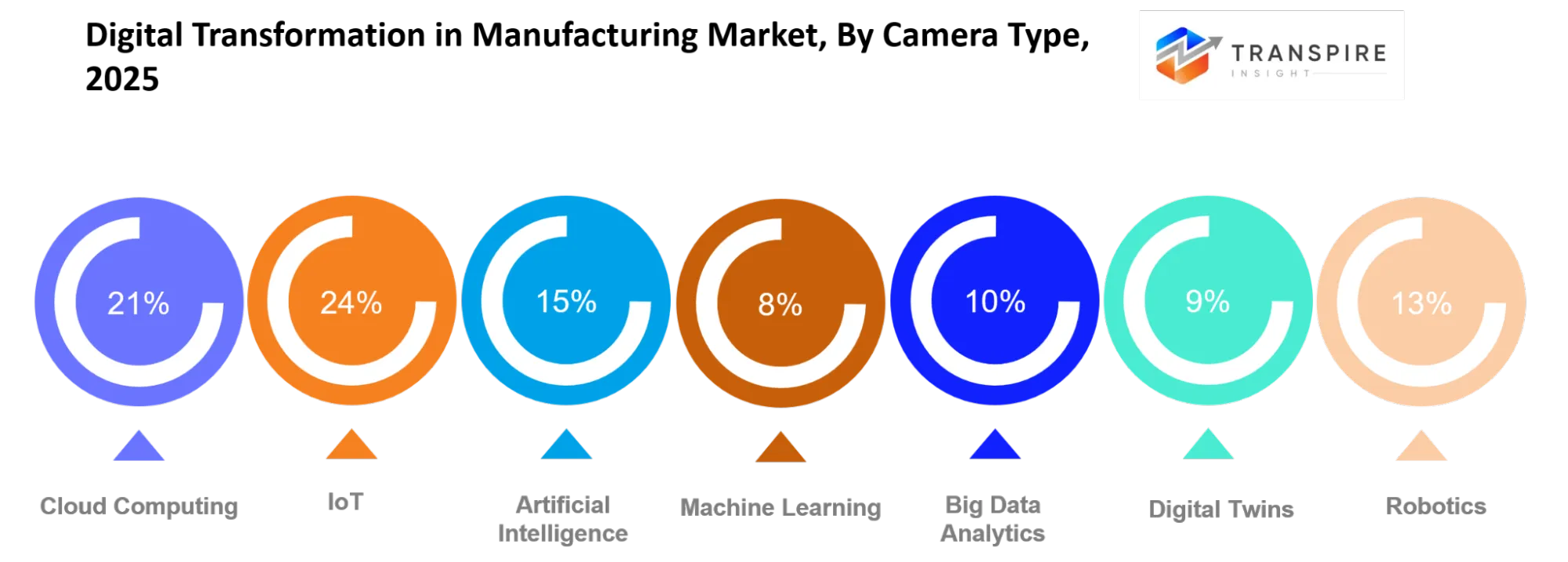
The Internet of Things (IoT) and connected manufacturing at 28.60% as the core data infrastructure for the smart factory. IoT's 24.00% growth rate is supported by sensor deployment, machine connectivity, and capability for real-time monitoring. Artificial intelligence and machine learning comprise the fastest-growing market segments at 18.20% and 15.00% CAGR, respectively, with manufacturers increasingly using AI for predictive maintenance, quality inspection, and automated decision support. Cloud computing has a 21.00% CAGR driven by data collection from a centralised data platform and remote plant visibility. It is followed by big data analytics at 10.00%, digital twins at 9.00%, robotics at 7.00%, and edge computing at 6.00% as manufacturers seek control with low latency and local AI processing for factory innovation.
Application:
Predictive maintenance, production optimisation, and quality management are primary growth areas as manufacturers focus on measurable operational gains. Predictive maintenance converts unplanned downtime into scheduled intervention, while production optimisation uses real-time production data to improve throughput, energy use, and resource allocation. Quality management increasingly uses AI-enabled inspection to identify defects earlier. Supply-chain management, asset management, workforce management, inventory management, and product lifecycle management are expanding as connected platforms provide greater visibility across procurement, production, maintenance, and delivery processes.
Deployment:
Cloud deployment leads adoption because it provides scalable computing, remote accessibility, centralised data management, and faster software updates across manufacturing networks. Hybrid and edge architectures are gaining traction where low latency, operational continuity, or data sovereignty is critical. On-premises environments remain relevant for sensitive production workloads requiring tighter control. Private, public, and multi-cloud models are increasingly selected according to cybersecurity, compliance, cost, interoperability, and workload requirements, allowing manufacturers to balance centralised analytics with plant-level responsiveness.
Manufacturing Type:
Discrete manufacturing is a major adopter because complex assemblies, traceability requirements, product variation, and stringent quality controls benefit from connected production systems. Process and continuous manufacturing use digital transformation to strengthen process stability, energy efficiency, equipment reliability, and safety. Batch manufacturing benefits from improved recipe control and scheduling, while job-shop and flexible manufacturing environments use digital tools to accelerate changeovers. Mass-production facilities increasingly combine automation, analytics, and simulation to improve throughput while maintaining consistent quality.
End User:
Automotive, electronics, aerospace and defence, pharmaceuticals, food and beverage, chemicals, industrial machinery, and consumer goods represent important adoption areas. Automotive and electronics benefit from high automation intensity, complex production networks, and rapid product cycles. Aerospace and defence emphasise traceability, precision, and digital engineering, while pharmaceuticals prioritise validation and compliance. Food and beverage and chemicals focus on process control, safety, and resource efficiency. Industrial machinery and consumer goods increasingly use connected production systems to improve flexibility, quality, and product responsiveness.
Component:
Software, platforms, analytics, and integration services form the central value-creation layer because they convert industrial data into operational decisions. Hardware, sensors, and connectivity establish the physical data infrastructure required for monitoring machines, assets, and production conditions. Analytics and AI increasingly transform raw signals into predictive and prescriptive insights, while platforms connect multiple manufacturing applications. Services support implementation, cybersecurity, workforce training, and legacy-system integration, helping manufacturers modernise existing facilities without replacing entire production infrastructures or disrupting ongoing operations.
What are the Key Use Cases Driving the Digital Transformation in the Manufacturing Market?
Predictive maintenance is the core use case, aligned with IoT and connected manufacturing because sensor data can detect equipment degradation before failures interrupt production. Automotive, electronics, pharmaceutical, and process plants gain from avoiding downtime.
Expanding applications include AI-assisted automated quality inspection, AI-assisted production scheduling, inventory optimisation, supply-chain visibility, asset performance management, and advanced workforce guidance. Digital twins strengthen these workflows by allowing teams to test process changes before committing resources.
Emerging use cases are moving toward physical AI, optimisation, and closed-loop operations. AI agents can combine machine signals, digital-twin scenarios, maintenance history, and production constraints to recommend or execute adjustments under human oversight, moving factories from predictive systems toward adaptive production.
|
Report Metrics |
Details |
|
Market size value in 2025 |
USD 386.54 Billion |
|
Market size value in 2026 |
USD 439.85 Billion |
|
Revenue forecast in 2033 |
USD 1089.56 Billion |
|
Growth rate |
CAGR of 13.84% from 2026 to 2033 |
|
Base year |
2025 |
|
Historical data |
2021 - 2024 |
|
Forecast period |
2026 - 2033 |
|
Report coverage |
Revenue forecast, competitive landscape, growth factors, and trends |
|
Regional scope |
United States; Canada; Mexico; United Kingdom; Germany; France; Italy; Spain; Denmark; Sweden; Norway; China; Japan; India; Australia; South Korea; Thailand; Brazil; Argentina; South Africa; Saudi Arabia; United Arab Emirates |
|
Key companies profiled |
Siemens, Schneider Electric, ABB, Honeywell, Rockwell Automation, IBM, Microsoft, SAP, PTC, Dassault Systèmes, Bosch, GE Vernova, Cisco, Oracle, Emerson. |
|
Customization scope |
Free report customization (country, regional & segment scope). Available customized purchase options to meet your exact research needs. |
|
Report Segmentation |
Technology (Cloud Computing, IoT, Artificial Intelligence, Machine Learning, Big Data Analytics, Digital Twins, Robotics, Edge Computing); Application (Predictive Maintenance, Supply Chain Management, Quality Management, Production Optimization, Asset Management, Workforce Management, Inventory Management, Product Lifecycle Management); Deployment (Cloud, On-Premise, Hybrid, Edge, Private Cloud, Public Cloud, Multi-Cloud); Manufacturing Type (Discrete Manufacturing, Process Manufacturing, Batch Manufacturing, Continuous Manufacturing, Job Shop Manufacturing, Mass Production, Flexible Manufacturing); End User (Automotive, Electronics, Aerospace & Defense, Food & Beverage, Pharmaceuticals, Chemicals, Industrial Machinery, Consumer Goods); Component (Software, Hardware, Services, Platforms, Sensors, Connectivity, Analytics, Integration). |
Which Regions are Driving the Digital Transformation in Manufacturing Market Growth?
North America is still the largest share at 34.90%, because manufacturers are investing in and emphasising artificial intelligence-enabled reliability, cybersecurity, and workforce productivity more than automation. The North American region has well-established cloud infrastructure, a robust industrial software ecosystem, and a high volume of investments in edge AI and private networks. Companies are also under pressure to upgrade their ageing operational technology due to policy pressure on energy efficiency and secure digital products and cyber-resilience. This makes North America focus more on predictive maintenance, quality analytics, and OT/IT Security integration.
In October 2026, Sorba AI announced a strategic partnership with industrial automation firm E Tech Group to deploy predictive maintenance, advanced process control, and closed-loop AI models directly into industrial control environments.
Europe, with a 30.00% share, competes through best-of-breed strengths in engineering and manufacturing, sustainability requirements and industrial data governance rather than just scale. European uptake is more closely connected to energy efficiency, emissions monitoring and reporting, and compliance in automotive, machinery, chemicals and pharmaceuticals. The EU's Apply AI strategy and cyber-resilience criteria provide clear policy support for long-term investment, and, as a result, Europe excels in digital twins, product life cycle management and energy-aware manufacturing.
In October 2026, Schneider Electric announced a definitive agreement to acquire industrial software company PTC in an all-cash transaction valued at approximately $22.6 billion.
https://www.se.com/ww/en/assets/pdf/Schneider-Electric-to-acquire-PTC
Asia Pacific holds a 27.00% share of the market and is the fastest-growing region with a CAGR of 15.80%. Rapid growth from electronics, electric vehicle supply chains, semiconductors, and large-scale contract manufacturing can be expected. In addition to legacy systems, this region can outperform them with cloud-native applications, low-cost sensors, and AI-based quality inspection. Governments and manufacturers are investing in smart-factory infrastructure to improve export competitiveness and supply-chain resilience, thus supporting the future demand for IoT, robotics, machine vision, and flexible production software.
In September 2026, Advanced Substrate Technologies (AST), a joint venture between TOPPAN Holdings Inc. and Broadcom Inc., completed Singapore’s first high-end Flip Chip Ball Grid Array (FC-BGA) substrate manufacturing and R&D facility.
https://www.broadcom.com/company/news/releases/ast-broadcom-toppan-open-substrate-facility
Who are the Key Players in the Digital Transformation in Manufacturing Market, and how do they compete?
Industrial automation technology and software companies compete more directly with hyperscale IT giants. Giants like Siemens, Schneider Electric, ABB, Honeywell, and Rockwell Automation have the strongest industrial domain expertise and integrate automation hardware, software, and artificial intelligence with digital twins and lifecycle services. Siemens has differentiated its offerings with its Industrial AI Operating System and Digital Twin Composer; Schneider Electric is going the open software-defined automation route with Microsoft, and Rockwell is building execution strength through industrial AI alliances.
IBM, Microsoft, SAP, Oracle, Cisco, and GE Vernova have committed to data, cloud, enterprise integration, and industrial connectivity and eschew owning the automation hardware and systems. Microsoft is focusing its AI across engineering, factories, supply chains, and worker workflows. PTC and Dassault Systèmes continue to build product lifecycle management, CAD, simulation, and asset intelligence specialities, while Bosch and Emerson build offerings based on specific industrial applications. PTC's planned AI-agent push in 2026 will extend this embedded intelligence trend to all aspects of product design and development.
Key Players are:
- Siemens
- Schneider Electric
- ABB, Honeywell
- Rockwell Automation
- IBM
- Microsoft
- SAP
- PTC
- Dassault Systèmes
- Bosch
- GE Vernova
- Cisco
- Oracle
- Emerson
Recent Development News
In September 2026, Infinite Uptime partnered with Tech Mahindra to accelerate Physical AI adoption across manufacturing and process industries. The partnership combines PlantOS industrial intelligence with IT-OT transformation capabilities to help manufacturers move from predictive equipment insights toward prescribed actions embedded in plant workflows and measurable production improvements.
In June 2026, a software platform designed to coordinate material flow and production sequences across manufacturing environments. The deployment yields immediate throughput gains and advances autonomous workflows directly on the factory floor.
https://www.nextgensupplychainconference.com/
In September 2026, Siemens introduced its "Meet at the Machine" collaborative initiative alongside partner TRAK Machine Tools. This program establishes a pre-integrated workflow that links CAM software, machine controls, and digital twins, drastically shortening the time between machine delivery and full production ramp-up for industrial operators.
What Strategic Insights Define the Future of the Digital Transformation in the Manufacturing Market?
The market is moving toward agentic AI systems- ones that not only find a problem, but also inform or direct tasks related to maintenance, quality, and scheduling-entering the second phase of digital transformation. Consequently, interoperability, data quality, and operational technology cybersecurity are becoming much more valuable than point analytics tools. A dangerous unknown is vendor lock-in-when vendors are investing in proprietary AI agents, digital twins, and manufacturing data platforms that make switching costs or integration complexity extremely high. Companies that don't standardise their data models will find it challenging to scale out their artificial intelligence investments to different plants. The rising opportunity is energy-aware manufacturing-that is, using AI to connect production data to actual electricity consumption, emissions, and asset availability. The acquisitions of Sensorfact by ABB and Schneider's EcoStruxure expansion show that energy intelligence is developing into a core monetization lever for digital transformation.
Key Segmentations are:
Technology
- Cloud Computing
- IoT
- Artificial Intelligence
- Machine Learning
- Big Data Analytics
- Digital Twins
- Robotics
- Edge Computing
Application
- Predictive Maintenance
- Supply Chain Management
- Quality Management
- Production Optimization
- Asset Management
- Workforce Management
- Inventory Management
- Product Lifecycle Management
Deployment
- Cloud
- On-Premise
- Hybrid
- Edge
- Private Cloud
- Public Cloud
- Multi-Cloud
Manufacturing Type
- Discrete Manufacturing
- Process Manufacturing
- Batch Manufacturing
- Continuous Manufacturing
- Job Shop Manufacturing
- Mass Production
- Flexible Manufacturing
End User
- Automotive
- Electronics
- Aerospace & Defense
- Food & Beverage
- Pharmaceuticals
- Chemicals
- Industrial Machinery
- Consumer Goods
Component
- Software
- Hardware
- Services
- Platforms
- Sensors
- Connectivity
- Analytics
- Integration
Frequently Asked Questions
Find quick answers to common questions.
The digital transformation in the manufacturing market size was valued at USD 386.54 billion in 2025 and is poised to reach USD 1089.56 billion by 2033, expanding at a 13.84% CAGR.
Key segments for the digital transformation in the manufacturing market are Technology (Cloud Computing, IoT, Artificial Intelligence, Machine Learning, Big Data Analytics, Digital Twins, Robotics, Edge Computing); Application (Predictive Maintenance, Supply Chain Management, Quality Management, Production Optimization, Asset Management, Workforce Management, Inventory Management, Product Lifecycle Management); Deployment (Cloud, On-Premise, Hybrid, Edge, Private Cloud, Public Cloud, Multi-Cloud); Manufacturing Type (Discrete Manufacturing, Process Manufacturing, Batch Manufacturing, Continuous Manufacturing, Job Shop Manufacturing, Mass Production, Flexible Manufacturing); End User (Automotive, Electronics, Aerospace & Defense, Food & Beverage, Pharmaceuticals, Chemicals, Industrial Machinery, Consumer Goods); Component (Software, Hardware, Services, Platforms, Sensors, Connectivity, Analytics, Integration).
Growth is primarily driven by the adoption of industrial IoT, AI and machine learning, digital twins, cloud and edge computing, predictive maintenance, smart automation, real-time production optimisation, and the need to improve operational resilience, reduce downtime, and integrate legacy manufacturing systems.
The market is led by major manufacturers, including Siemens, Schneider Electric, ABB, Honeywell, Rockwell Automation, IBM, Microsoft, SAP, PTC, Dassault Systèmes, Bosch, GE Vernova, Cisco, Oracle, and Emerson.
North America holds 34.90% of the market, supported by advanced industrial automation, strong cloud and AI infrastructure, high enterprise technology adoption, established technology providers, and continued investment in connected and software-defined manufacturing.
Commercial opportunities include AI-native digital twins, physical AI, edge intelligence, predictive-to-prescriptive maintenance, software-defined automation, and integrated industrial platforms for modernising legacy manufacturing systems.
- Siemens
- Schneider Electric
- ABB, Honeywell
- Rockwell Automation
- IBM
- Microsoft
- SAP
- PTC
- Dassault Systèmes
- Bosch
- GE Vernova
- Cisco
- Oracle
- Emerson
About the Authors

Kartik bhong
I am Kartik Bhong, a Senior Research Analyst at Transpire Insight, specializing in the Packaging, Manufacturing, and Construction industry. My work focuses on analyzing market trends, emerging technologies, industry regulations, and competitive landscapes to deliver accurate, data-driven insights. I am passionate about transforming complex industry information into clear, practical content that helps businesses, professionals, and decision-makers stay informed and make confident strategic decisions. Through continuous research and a strong commitment to accuracy, I strive to create reliable, well-researched content that reflects the latest developments across these dynamic industries and supports the vision of Transpire Insight in delivering valuable market intelligence.

Chakradhar Khansole
Chakradhar serves as the Research Director at Transpire Insight, bringing over 8 years of experience in technology, innovation, and strategic market intelligence. He specializes in transforming complex market data into actionable business insights that enable organizations to make informed, growth-oriented decisions. Recognized for his strategic vision and analytical expertise, Chakradhar leads high-impact research initiatives, delivering comprehensive market assessments, competitive intelligence, and forward-looking industry analysis.
Recently Published Reports
-
Apr 2026
Handling and Lifting Equipment Market
Handling and Lifting Equipment Market Size, Share & Analysis Report By Product (Cranes and Hoists, Forklifts, Conveyor Systems, Aerial Work Platforms, Others), By Application (E-Commerce, Automotive and Railway, Food and Beverages, Aviation, Others), and Geography (North America, Europe, Asia-Pacific, Middle East and Africa, South and Central America), 2021 - 2031
-
Apr 2026
HVAC Equipment Market
HVAC Equipment Market Size, Share & Analysis Report By Heating Equipment Type (Boilers and Furnaces, Heat Pumps, and Unitary Heaters), By Ventilation Equipment (Air Handling Units, Humidifiers and Dehumidifiers, Air Filters, and Fan Coiling Units), By Air Conditioning Equipment (Unitary Air Conditioners, Room Air Conditioners, Packaged Terminal Air Conditioners, and Chillers), By End User (Commercial, Residential, Industrial, and others), and Geography (North America, Europe, Asia-Pacific, Middle East and Africa, South and Central America), 2021 – 2031
-
Apr 2026
Refrigeration Valves Market
Refrigeration Valves Market Size, Share & Analysis Report By Type (Solenoid Valves, Expansion Valves, Check Valves, Service Valves, Others), By Application (Commercial Refrigeration, Industrial Refrigeration, Transport Refrigeration, Residential Refrigeration, Air Conditioning Systems), By End User (Food and Beverage Industry, Pharmaceutical Industry, HVAC Industry, Chemical Industry, Others), and Geography (North America, Europe, Asia-Pacific, Middle East and Africa, South and Central America), 2021 – 2031
-
Apr 2026
E-Commerce Packaging Materials Market
E-Commerce Packaging Materials Market By Material Type (Corrugated Boxes, Paper & Paperboard, Foam & Cushioning Materials, Plastic Packaging, Flexible Packaging, Protective Packaging, Others), By Product(Primary Packaging, Secondary Packaging, Tertiary Packaging), By Packaging Function (Protective Packaging, Branding & Presentation Packaging, Transit & Logistic Packaging, Sustainable Packaging, Tamper Evidence Packaging), By End-User (Retail & Consumer Goods, Electronic Appliances, Food & Beverages, Healthcare & Pharmaceutical, Fashion & Apparel, Home & Furnishing, Others); By Industry Analysis, Size, Share, Growth, Trends, and Forecasts 2021-2033