Refrigerated Trailer Market Summary:
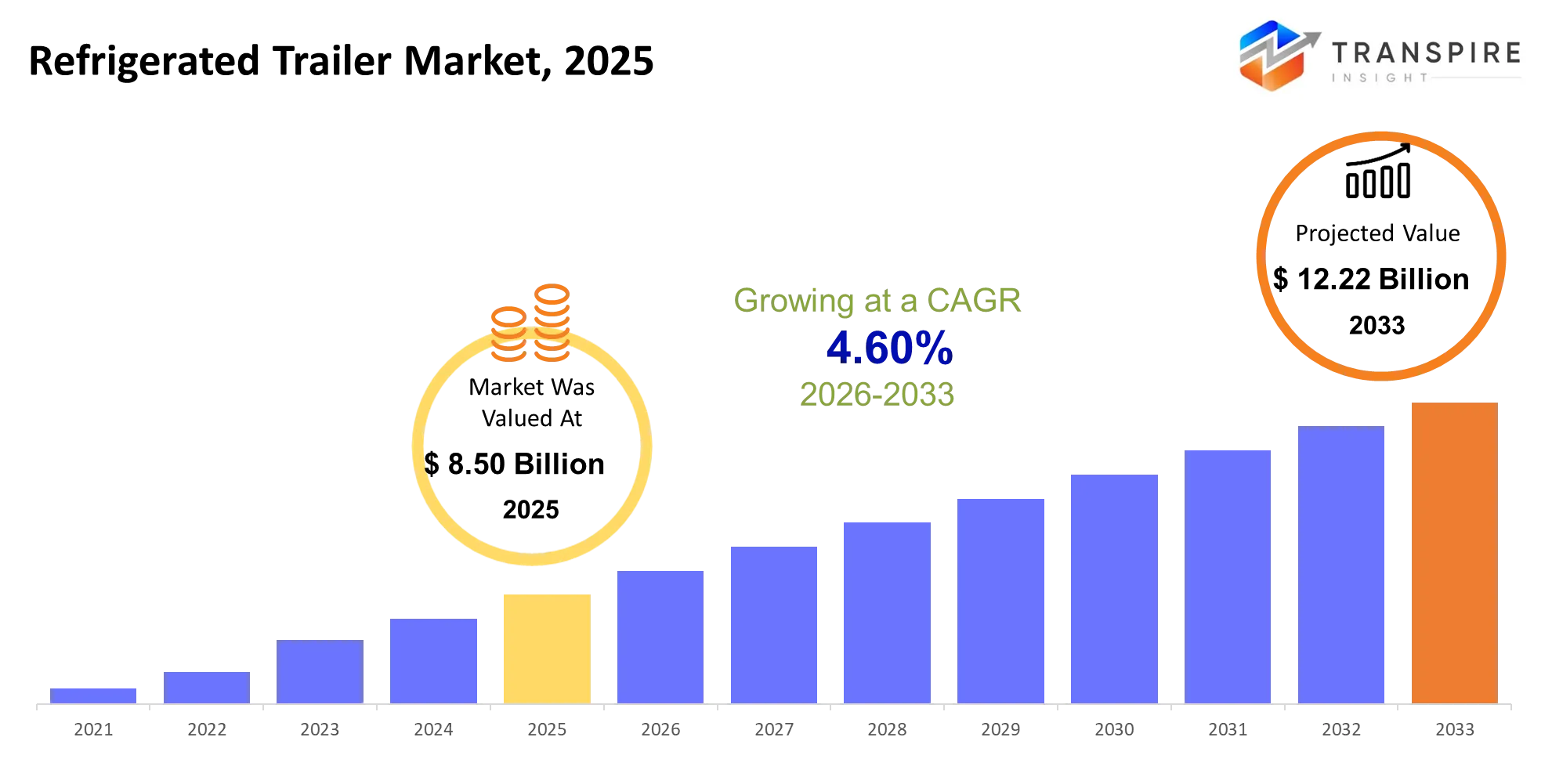
As per Transpire Insight, the Refrigerated Trailer Market size is estimated at USD 8.50 billion in 2025 and is anticipated to reach USD 12.22 billion by 2033, growing at a CAGR of 4.60% from 2026 to 2033.
The refrigerated trailer market is the vital link in the chain, transporting temperature-sensitive goods such as fresh produce, proteins, biopharmaceuticals, and more directly from processing sites to fulfillment centres. The industry has shifted from diesel-powered reefer units to all-electric, fully networked cold transport solutions in the last three years. Forcing factors such as the zero-emission TRU rules in California by CARB are driving fleet changes in a big way, and the pandemic-induced increase in grocery delivery for the last mile was the actual operational catalyst. As urbanization grows, so will the market, as a higher density of people requires a higher density of perishables, driving logistics companies to grow telematics-enabled trailer fleets with multi-zone capabilities to avoid food spoilage and meet the strict food traceability regulations.
Refrigerated Trailer Market Size & Forecast:
- Market Size 2025: USD 8.50 Billion
- Expected Market Value (2033): USD 12.22 Billion
- Forecast CAGR (2026–2033): 4.60%
- Leading Region in 2025: North America
- Fastest Growing Region: Asia Pacific
- Key Company Profiles: Utility Trailer Manufacturing, Wabash National, Great Dane, Schmitz Cargobull, Thermo King, Carrier Transicold, Daikin Industries, Mitsubishi Heavy Industries Thermal Systems, Lamberet, Krone, Kögel Trailer, Hyundai Translead, Vanguard National Trailer, Manac, Randon
Key Market Insights:
Smart connectivity is transforming cold transport assets into intelligent nodes, spurred by the requirements of regulatory traceability and fast electrification. Fleet operators are moving away from reactive mechanical maintenance and towards cloud-based predictive operational management.
- Passive haulage is becoming intelligent, dynamic cold chain assets with strict traceability compliance and fleet electrification.
- The high upfront cost of battery-electric transport refrigeration units is driving a continued upward trend of fleet leasing and subscription arrangements.
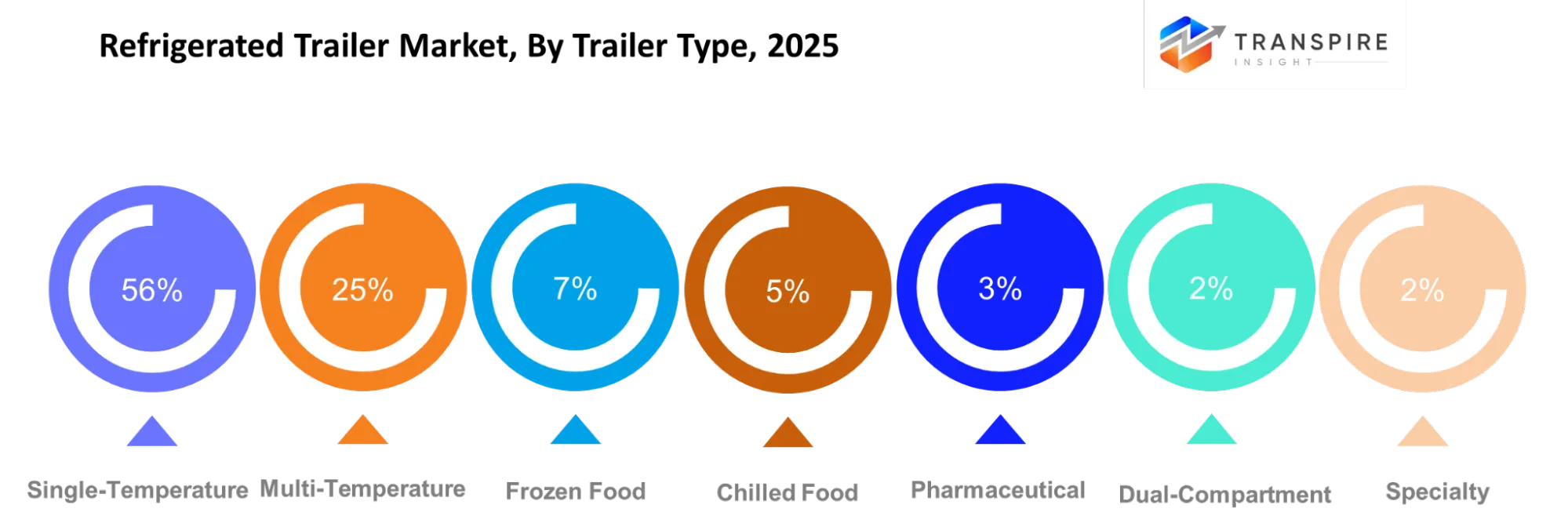
- Single-Temperature Trailers account for 56.0% of the market. To support its push toward automated continuous temperature logging, Great Dane added FleetPulse telematics as standard equipment for all single-temp units.
- Multi-Temperature Trailers account for 25.0% of the company's market share. Thermo King added to its Advancer multi-temp reefer architecture, which allows for the ability to dynamically control separate thermal zones for carrying mixed-goods groceries.
- The amount of food transported via Frozen Food Transport is 7.0%. Schmitz Cargobull used improved vapor-barrier insulation material to reduce loss of thermal energy during long transits across borders in sub-zero temperatures.
- Chilled Food Logistics is holding 5.0%. Wabash National introduced lightweight composite wall designs which offer the benefit of maximizing payload capacity, while maintaining precise above-freezing thermal stability.
- Pharmaceutical Logistics is 3.0%. Carrier Transicold built in ultra-precise sensor arrays (±0.9°F) and redundant cooling loops, ensuring strict GDP compliance for high-value biopharmaceutical payloads.
- Dual-Compartment Trailers make up 2.5%. Lamberet presented the flexible movable partition bulkheads and the smart management of the airflow to facilitate the delivery of two different climate food products.
- Specialty Transport is 1.5%. Utility Trailer Manufacturing developed custom solar-assisted refrigeration units for special off-grid hazardous/biological materials.
What are the Key Drivers, Restraints, and Opportunities in the Refrigerated Trailer Market?
Drivers:
Urbanisation and the evolution of grocery delivery e-services are rapidly driving up demand for fast, temperature-controlled logistics. The growing urbanisation rate in the world and the new grocery delivery e-services are radically increasing the demand for fast and temperature-sensitive logistics. At the same time, stringent food traceability regulations (e.g., FSMA 204 in the U.S.) require operators to keep a record of the food temperature during transport, putting pressure on fleets to constantly invest in their telematics-equipped reefer fleet to avoid spoilage and regulatory fines.
Restraints:
The initial high cost of purchase of electric transport refrigeration units (e-TRUs) and multi-temperature assets is a major hurdle to fleet replacement. Moreover, significant limitations in the charging infrastructure are found in some regions, and the cost of energy storage is also high, which makes it less attractive for smaller logistics providers to immediately phase out fleets of outdated diesel vehicles – notwithstanding the long-term cost savings.
Opportunities:
As the industry moves to a diesel-free, battery-electric reconditioning market, there are huge opportunities for the OEMs and technology suppliers. Moreover, combining AI-informed telematics and solar-powered auxiliary power systems allows fleets to reduce TCO by forecasting maintenance needs, dynamically managing zones, and ensuring seamless compliance automation in multi-stop urban fulfillment zones.
|
Driver |
Relative Impact on Growth (%) |
Geographic Relevance |
Impact Timeline |
Demand Strength |
Growth Mechanism |
Key Beneficiaries |
Major Constraint |
|
Expansion of cold-chain logistics and rising consumption of perishable food products |
28% |
North America, Asia-Pacific, Europe |
Short / Medium / Long-term |
High |
Increasing consumption of fresh produce, dairy, meat, seafood, and frozen food is driving the need for temperature-controlled transportation. Expansion of supermarkets, organized food retail, food processing, and online grocery distribution is increasing refrigerated trailer utilization and encouraging fleet operators to purchase additional units. |
Refrigerated trailer manufacturers, fleet operators, food distributors, cold-chain logistics providers, supermarkets, and food processors |
High acquisition and maintenance costs, fuel and refrigeration expenses, and inadequate cold-chain infrastructure in emerging markets. |
|
Pharmaceutical, biologics, and temperature-sensitive healthcare logistics expansion |
20% |
North America, Europe, Asia-Pacific |
Medium / Long-term |
High |
Growing distribution of vaccines, biologics, specialty medicines, and temperature-sensitive pharmaceutical products is increasing demand for trailers with precise temperature control, multi-temperature compartments, continuous monitoring, and reliable insulation. Pharmaceutical logistics operators are investing in specialized refrigerated transportation to minimize temperature excursions and product losses. |
Refrigerated trailer manufacturers, pharmaceutical logistics companies, healthcare distributors, refrigeration equipment suppliers, and telematics providers. |
High costs of specialized refrigeration systems, strict validation requirements, limited availability of qualified cold-chain operators, and uneven pharmaceutical cold-chain infrastructure. |
|
Technological advancements in electric and hybrid transport refrigeration systems |
19% |
Europe, North America, Asia-Pacific |
Short / Medium / Long-term |
High |
Development of battery-powered, electric-drive, and hybrid transport refrigeration units (TRUs) is encouraging fleet modernization. Improved insulation, energy-efficient compressors, battery management, and regenerative energy technologies can reduce fuel consumption, operating expenses, and direct emissions. These developments are accelerating the adoption of technologically advanced refrigerated trailers. |
Refrigerated trailer OEMs, TRU manufacturers, battery suppliers, electric powertrain developers, fleet operators, and refrigeration technology providers. |
High upfront investment, limited charging infrastructure, battery weight and range limitations, and uncertainty regarding lifecycle economics for long-haul operations. |
|
Stringent food safety regulations, environmental standards, and sustainability requirements |
17% |
North America, Europe |
Short / Medium / Long-term |
High |
Food transportation regulations and environmental requirements are encouraging the adoption of modern refrigerated trailers with improved insulation, temperature monitoring, leak prevention, and lower-emission refrigeration systems. Compliance with food safety requirements and refrigerant-related regulations is prompting fleet operators to replace aging equipment and invest in more efficient refrigeration technologies. |
Trailer manufacturers, refrigeration system suppliers, low-GWP refrigerant technology providers, fleet operators, food exporters, and maintenance service providers. |
Regulatory compliance costs, refrigerant transition challenges, equipment retrofitting expenses, and differences in environmental regulations across countries. |
|
Digitalization, telematics integration, and fleet modernization investments |
16% |
North America, Europe, Asia-Pacific |
Short / Medium-term |
Medium–High |
Increasing adoption of GPS tracking, real-time temperature monitoring, remote diagnostics, predictive maintenance, and cloud-based fleet management platforms is improving refrigerated trailer utilization and cargo visibility. Digital monitoring reduces spoilage risks, enables faster responses to temperature deviations, and improves fleet productivity, encouraging operators to invest in connected refrigerated trailers and upgraded equipment. |
Telematics vendors, refrigerated trailer manufacturers, fleet management companies, logistics operators, refrigeration service providers, and food distributors |
High technology integration costs, cybersecurity concerns, connectivity gaps across transport routes, and compatibility issues with legacy trailer fleets. |
|
Total |
100% |
What Has the Impact of Artificial Intelligence Been on the Refrigerated Trailer Market?
Refrigerated trailers are now a smart system thanks to Artificial Intelligence. Predictive maintenance uses AI algorithms that process real-time telematics data, incorporating ambient weather data, door opening rates, compressor vibration data, and engine stress, to perform maintenance before mechanical failures lead to cargo loss. Dynamic AI climate controls maximize evaporator duty cycles depending on route elevation and current loads, helping to reduce fuel use and battery drain. In addition, machine learning-based models can automatically detect thermal anomalies within a split second, giving the dispatchers the ability to reroute the assets or adjust the setpoints remotely to prevent product degradation.
Instance:
In February 2026, Intangles deployed AI-driven predictive fleet health solutions across reefer transport lanes, achieving a 75% reduction in breakdown events.
Key Market Trends:
Two key trends are emerging as passive reefer trailers are quickly becoming smart cold-chain equipment: fleet electrification and regulatory compliance. Despite the initial investment requirement for fleet adoption of flexible telematics leasing and dynamic thermal monitoring, the costs remain a concern.
- Quickly shifting to ZE (Zero Emission) diesel-free transport refrigeration units in ZE urban corridors.
- Common installation of smart telematics devices in key production lines of trailer OEMs.
- Move toward solar-powered auxiliary battery systems to reduce auxiliary battery idling emissions and power reefer electronics.
- Compliance with strict environmental policies through use of low-GWP (Warming Potential) natural refrigerants.
- Subscription-based "Cold-Chain-as-a-Service" solutions that include hardware, connectivity, and compliance software.
- Increasing demand for lightweight structural composite materials for maximizing net payload capacity.
- Optimized multi-temperature urban reefer units for last-mile distribution centres.
- Adoption of predictive route optimization software optimised for battery-electric trailer charging.
Refrigerated Trailer Market Segmentation
By Trailer Type:
These would include Single-Temperature, Multi-Temperature, Frozen Food, Chilled Food, Pharmaceutical, Dual-Compartment and Specialty trailers. The Single-Temperature units account for 56.0% of the segment, Multi-Temperature makes up 25.0%, Frozen Food 7.0%, Chilled Food 5.0%, Pharmaceutical 3.0%, Dual-Compartment 2.5%, and Specialty 1.5%.
By Axle Type:
There are several classifications for axles: Single Axle, Tandem Axle, Triple Axle, Quad Axle, Multi-Axle, Steerable Axle, and Other configurations. Tandem axle systems are best suited to high-volume commercial hauling applications because they provide excellent weight distribution; both single and multi-axle types provide specific load-carrying capacity and manoeuvrability for different regional transport needs.
By Power Source:
The power source segment includes Diesel ICE, Electric, Hybrid, Battery Electric, Solar-Assisted, Hydrogen and Other systems. Full-Electric Refrigeration is the fastest-growing region with an annual growth rate of 11.22% and is being fuelled by stringent emission standards, while Traditional diesel ICE continues to dominate the market share.
By End Use:
The end use segment includes Meat & Seafood, Fruits & Vegetables, Dairy, Frozen Foods, Pharmaceuticals, Beverages and Chemicals. Frozen Food Trailers is the overall dominating segment with continuous requirements of sub zero food logistics has captured 54.62% market share.
By Trailer Length:
The length of the trailer comes in a variety of categories, including Below 28 Feet, 28–35 Feet, 36–40 Feet, 41–48 Feet, Above 49 Feet, Custom Length, and Other. Units over 49 feet depend on long-haul applications for maximum load capacity, while smaller units under 28 feet are used for urban last-mile delivery needs.
By Temperature Range:
Temperature range classification includes Frozen, Chilled, Controlled Ambient, Deep Frozen, Pharmaceutical Grade, Multi-Zone, and Ultra-Low Temperature profiles. These thermal classes provide accurate atmospheric conditions for products such as high-value biopharmaceuticals, chilled dairy, fresh produce, and deep-frozen foods in long transit times along the supply chain.
What are the Key Use Cases Driving the Refrigerated Trailer Market?
The applications for the Residential HVAC industry include improving IEQ, thermal comfort, and energy efficiency in contemporary homes. The primary demand is for the replacement of old and less efficient heating and cooling systems with smart, high-SEER heat pumps and variable-speed air conditioners. Accelerating urban residential construction and smart home adoption drive the integration of zoned climate control and automated thermostats. Plus, the growing knowledge about indoor air pollutants makes whole-home filtration, energy recovery ventilators (ERVs), and dehumidification systems more in demand. Drought conditions also drive homeowners to ensure their homes are better managed year-round, which often means dual fuel systems.
|
Report Metrics |
Details |
|
Market size value in 2025 |
USD 8.50 Billion |
|
Market size value in 2026 |
USD 8.9 Billion |
|
Revenue forecast in 2033 |
USD 12.22 Billion |
|
Growth rate |
CAGR of 4.60% from 2026 to 2033 |
|
Base year |
2025 |
|
Historical data |
2021 - 2024 |
|
Forecast period |
2026 - 2033 |
|
Report coverage |
Revenue forecast, competitive landscape, growth factors, and trends |
|
Regional scope |
United States; Canada; Mexico; United Kingdom; Germany; France; Italy; Spain; Denmark; Sweden; Norway; China; Japan; India; Australia; South Korea; Thailand; Brazil; Argentina; South Africa; Saudi Arabia; United Arab Emirates |
|
Key companies profiled |
Utility Trailer Manufacturing, Wabash National, Great Dane, Schmitz Cargobull, Thermo King, Carrier Transicold, Daikin Industries, Mitsubishi Heavy Industries Thermal Systems, Lamberet, Krone, Kögel Trailer, Hyundai Translead, Vanguard National Trailer, Manac, Randon |
|
Customization scope |
Free report customization (country, regional & segment scope). Available customized purchase options to meet your exact research needs. |
|
Report Segmentation |
Trailer Type (Single-Temperature, Multi-Temperature, Frozen Food, Chilled Food, Pharmaceutical, Dual-Compartment, Specialty); Axle Type (Single Axle, Tandem Axle, Triple Axle, Quad Axle, Multi-Axle, Steerable Axle, Other); Power Source (Diesel ICE, Electric, Hybrid, Battery Electric, Solar-Assisted, Hydrogen, Other); End Use (Meat & Seafood, Fruits & Vegetables, Dairy, Frozen Foods, Pharmaceuticals, Beverages, Chemicals); Trailer Length (Below 28 Feet, 28–35 Feet, 36–40 Feet, 41–48 Feet, Above 49 Feet, Custom Length, Other); Temperature Range (Frozen, Chilled, Controlled Ambient, Deep Frozen, Pharmaceutical Grade, Multi-Zone, Ultra-Low Temperature). |
Which Regions are Driving the Refrigerated Trailer Market Growth?
North America:
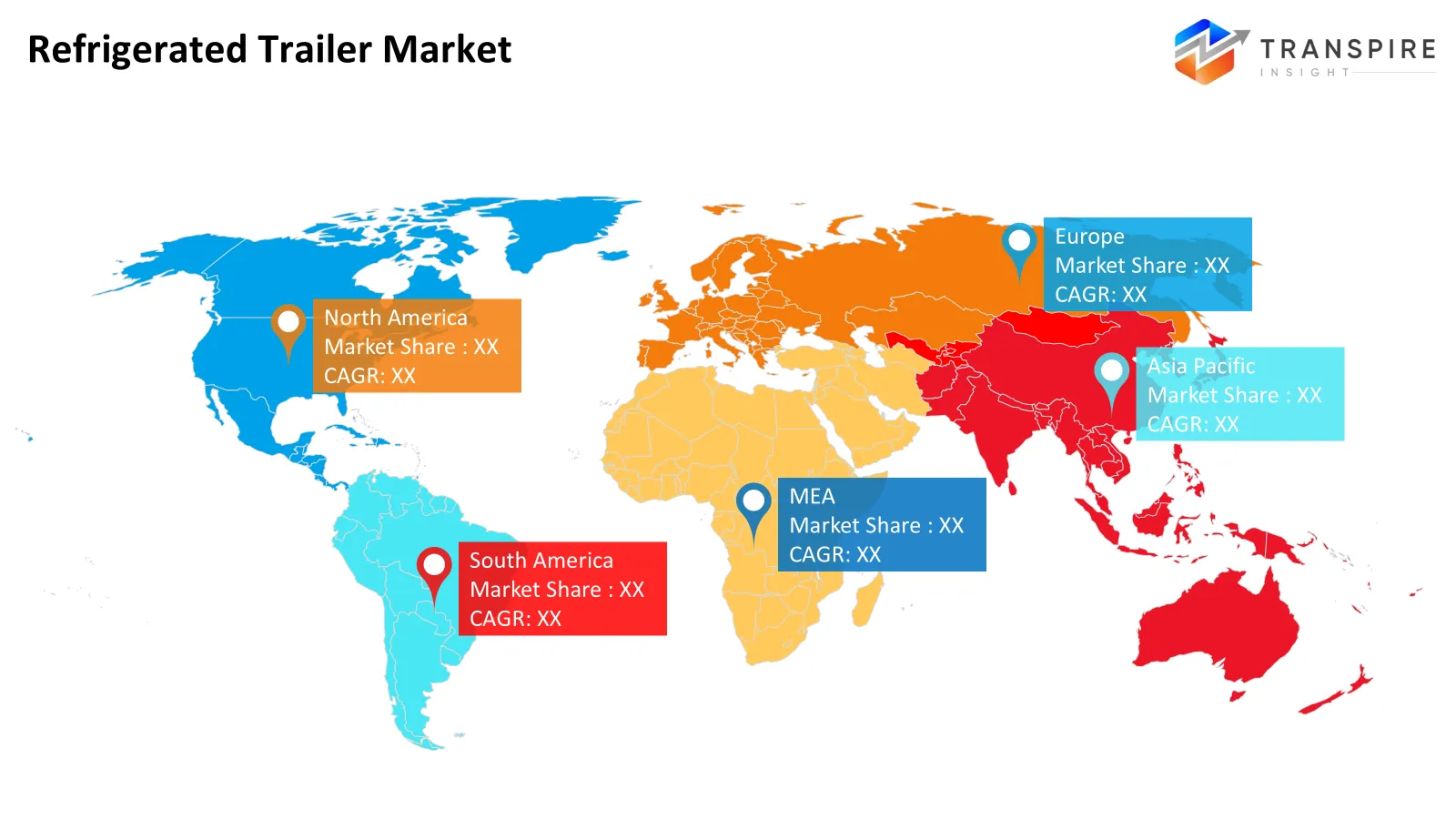
North America is the leading region for the refrigerated trailers market, accounting for 39.15% of the total market, owing to the well-established cold-chain infrastructure and robust food and pharmaceuticals logistics, as well as the increasing demand for telematics solutions in fleets. Carrier Transicold, Thermo King, Wabash National, Great Dane, and Utility Trailer Manufacturing are key players. Fleets are also prolonging the life of their trailers, ensuring the refrigeration upgrade program and replacement programs remain in place throughout the region.
In July 2026, Carrier Transicold launched its Fleet Refresh program, which lets refrigerated fleets replace aging trailer refrigeration units instead of whole trailers. It adds Lynx Fleet telematics and BluEdge service coverage and is available through its North American dealer network.
https://www.truckinginfo.com/news/carrier-transicold-extends-refrigerated-trailer-life
Asia Pacific:
Asia Pacific is the second leading region and is also the fastest-growing region with an 8.92% CAGR. Government funding for the cold chain, lower post-harvest losses, and increased demand for fresh and frozen foods are driving the uptake. Major companies involved are Thermo King, Carrier Transicold, Hwasung Thermo, Kingtec, CIMC, and Daikin Industries. There is growing acceptance of electrification and digital temperature controls, especially for urban cold-chain distribution in the region.
In September 2026, Thermo King announced the expansion of its all-electric EV series for urban cold-chain transport across Asia Pacific, with the release date in Shanghai. It includes the iTracKing II intelligent monitoring system as an option.
https://www.aap.com.au/aapreleases/cision20260909ae43464/
Who are the Key Players in the Refrigerated Trailer Market, and how do they compete?
Key players in the refrigerated trailer market include trailer manufacturers, like Utility Trailer Manufacturing, Wabash National, Great Dane, Schmitz Cargobull, Lamberet, Krone, Kögel Trailer, Hyundai Translead, Vanguard National Trailer, Manac, and Randon, alongside refrigeration unit specialists like Thermo King, Carrier Transicold, Daikin Industries, and Mitsubishi Heavy Industries Thermal Systems. The areas of competition include composite body lightweighting, multi-temperature zone configurations, advanced telematics, and electrification. Trailer OEMs distinguish themselves with their aerodynamic designs, thermal insulation, and structural durability, while cooling system manufacturers stand out for their energy efficiency, adherence to low GWP refrigerants, and their smart fleet connectivity solutions that help reduce TCO.
Refrigerated Trailer Market Companies
- Utility Trailer Manufacturing
- Wabash National
- Great Dane
- Schmitz Cargobull
- Thermo King
- Carrier Transicold
- Daikin Industries
- Mitsubishi Heavy Industries
- Thermal Systems
- Lamberet
- Krone
- Kögel Trailer
- Hyundai Translead
- Vanguard National Trailer
- Manac
- Randon
|
Company |
Est. Revenue Share Range |
Key Offerings |
Strategic Positioning |
Geographic Strength |
Technology Focus |
|
Utility Trailer Manufacturing Company |
3-5% |
3000R refrigerated trailers, hybrid refrigeration configurations, refrigerated trailer components |
Established reefer specialist with extensive dealer network |
North America |
Hybrid refrigeration and connected trailer systems |
|
Wabash National Corporation |
4-6% |
Arctic Lite refrigerated trailers, Acutherm refrigerated vans, EcoNex composite solutions |
Technology-led differentiation through lightweight composite construction |
North America |
Advanced composite panels and thermal management |
|
Great Dane LLC |
3-5% |
Everest refrigerated trailers, Alpine refrigerated trailers, refrigerated distribution trailers |
Premium positioning through thermal efficiency and durability |
North America |
ThermoGuard liners and ClimaCore insulation |
|
Schmitz Cargobull AG |
3-5% |
S.KO COOL, S.KOe COOL, S.CU refrigeration units, TrailerConnect |
Integrated refrigerated transport solutions and digital services |
Europe, Asia Pacific, Middle East |
FERROPLAST panels and digital telematics |
|
Thermo King (Trane Technologies) |
Not separately estimated |
Precedent S-Series, Advancer, electric transport refrigeration systems, telematics solutions |
Refrigeration technology leadership through integrated fleet solutions |
North America, Europe, Asia Pacific |
Electric TRUs and predictive temperature monitoring |
|
Carrier Transicold (Carrier Corporation) |
Not separately estimated |
Vector, Supra, Xarios, Lynx Fleet digital solutions |
Technology leadership in transport refrigeration equipment |
North America, Europe, Asia Pacific |
E-Drive refrigeration and connected fleet monitoring |
|
Daikin Industries, Ltd. |
Not separately estimated |
ZEAS transport refrigeration systems, refrigeration compressors, temperature-control solutions |
Diversification through advanced refrigeration engineering |
Asia Pacific, Europe |
Inverter technology and energy-efficient refrigeration |
|
Mitsubishi Heavy Industries Thermal Systems, Ltd. |
Not separately estimated |
TEU electric transport refrigeration units, refrigerated transport cooling systems |
Innovation-led differentiation through electric refrigeration technologies |
Asia Pacific, Europe |
Electric-drive TRUs and energy-efficient cooling |
|
Lamberet SAS |
1-2% |
SR2 Green Liner, SR2 Heavy Duty, SR2 PharmaSafe+, SR2 Super Duplex |
Premium specialization in pharmaceutical and food transportation |
Europe, Middle East |
Advanced insulation and multi-temperature configurations |
|
Fahrzeugwerk Bernard KRONE GmbH & Co. KG |
2-3% |
Cool Liner, pharmaceutical refrigerated trailers, multi-temperature trailers |
Product diversification through specialized refrigerated trailers |
Europe, Asia Pacific |
Multi-temperature systems and digital monitoring |
Recent Development News
- In January 2026, Schmitz Cargobull delivered its 1,000th S.KO COOL refrigerated trailer featuring multi-temperature technology to European logistics provider NORDFROST. https://www.cargobull.com/en/press/2026/nordfrost
- In September 2026, Carrier Transicold introduced its low-GWP A2L refrigerant (R454A) platform and the 38.5-kWh battery system at IAA Transportation 2026, offering zero-emission operations and enhanced Lynx Fleet telematics. https://www.carrier.com/refrigeration/en/worldwide/news/news-article/carrier-transicold-iaa-transportation-2026.html
What Strategic Insights Define the Future of the Refrigerated Trailer Market?
The refrigerated trailer market's future is molded by the demand for decarbonization and the drive for 100% all-electric transport refrigeration units (TRUs) and low GWP refrigerants. Real-time IoT telematics for continual visibility and predictive maintenance of the cold chain is now commonplace. Moreover, advanced composite insulation paneling offers fleet operators a way to reduce the weight of their structures and optimize payload while facing rising fuel costs and ever-changing regional environmental requirements.
Key Segments-
Trailer Type
- Single-Temperature
- Multi-Temperature
- Frozen Food
- Chilled Food
- Pharmaceutical
- ual-Compartment
- Specialty
Axle Type
- Single Axle
- Tandem Axle
- Triple Axle
- Quad Axle
- Multi-Axle
- Steerable Axle
- Other
Power Source
- Diesel ICE
- Electric
- Hybrid
- Battery Electric
- Solar-Assisted
- Hydrogen, Other
End Use
- Meat & Seafood
- Fruits & Vegetables
- Dairy
- Frozen Foods
- Pharmaceuticals
- Beverages
- Chemicals
Trailer Length
- Below 28 Feet
- 28–35 Feet
- 36–40 Feet
- 41–48 Feet
- Above 49 Feet
- Custom Length
- Other
Temperature Range
- Frozen
- Chilled
- Controlled Ambient
- Deep Frozen
- Pharmaceutical Grade
- Multi-Zone
- Ultra-Low Temperature
By Regional Analysis
North America
- US
- Canada
- Mexico
Europe
- Germany
- UK
- France
- Italy
- Spain
- Russia
- Rest of Europe
Asia Pacific
- China
- Japan
- India
- South Korea
- Australia
- Rest of Asia Pacific
South America
- Brazil
- Argentina
- Rest of South America
Middle East & Africa
- UAE
- Saudi Arabia
- Qatar
- South Africa
- Rest of the Middle East & Africa
Frequently Asked Questions
Find quick answers to common questions.
The refrigerated trailer market size was valued at USD 8.50 billion in 2025 and is poised to reach USD 12.22 billion by 2033, expanding at a 4.60% CAGR.
Key segments for the refrigerated trailer market are Trailer Type (Single-Temperature, Multi-Temperature, Frozen Food, Chilled Food, Pharmaceutical, Dual-Compartment, Specialty); Axle Type (Single Axle, Tandem Axle, Triple Axle, Quad Axle, Multi-Axle, Steerable Axle, Other); Power Source (Diesel ICE, Electric, Hybrid, Battery Electric, Solar-Assisted, Hydrogen, Other); End Use (Meat & Seafood, Fruits & Vegetables, Dairy, Frozen Foods, Pharmaceuticals, Beverages, Chemicals); Trailer Length (Below 28 Feet, 28–35 Feet, 36–40 Feet, 41–48 Feet, Above 49 Feet, Custom Length, Other); Temperature Range (Frozen, Chilled, Controlled Ambient, Deep Frozen, Pharmaceutical Grade, Multi-Zone, Ultra-Low Temperature).
Growth is primarily driven by expanding cold chain infrastructure, tightening food safety regulations, and rising demand for temperature-controlled pharmaceutical and perishable goods transport.
The market is led by major manufacturers, such as Utility Trailer Manufacturing, Wabash National, Great Dane, Schmitz Cargobull, Thermo King, Carrier Transicold, Daikin Industries, Mitsubishi Heavy Industries Thermal Systems, Lamberet, Krone, Kögel Trailer, Hyundai Translead, Vanguard National Trailer, Manac, Randon.
The North America region accounts for 39.15% of market share, driven by expansive cross-border food distribution networks, advanced fleet telematics adoption, and modern fleet replacement demands.
The commercial opportunities are increased interest in all-electric refrigeration units, energy-efficient multi-temp trailers, solar-assisted power systems, and integrated smart telematics for seamless real-time cold chain monitoring.
- Utility Trailer Manufacturing
- Wabash National
- Great Dane
- Schmitz Cargobull
- Thermo King
- Carrier Transicold
- Daikin Industries
- Mitsubishi Heavy Industries
- Thermal Systems
- Lamberet
- Krone
- Kögel Trailer
- Hyundai Translead
- Vanguard National Trailer
- Manac
- Randon
About the Authors

Mayur Shinde
I am Mayur Shinde, a Senior Research Analyst at Transpire Insight, specializing in the Automotive & Transportation and Information & Communication Technology (ICT) Industry. My work focuses on analyzing emerging market trends, technological advancements, competitive landscapes, and industry developments to deliver accurate, data-driven insights. I am passionate about transforming complex market information into clear, actionable content that helps businesses, professionals, and decision-makers stay informed and make confident strategic decisions.

Chakradhar Khansole
Chakradhar serves as the Research Director at Transpire Insight, bringing over 8 years of experience in technology, innovation, and strategic market intelligence. He specializes in transforming complex market data into actionable business insights that enable organizations to make informed, growth-oriented decisions. Recognized for his strategic vision and analytical expertise, Chakradhar leads high-impact research initiatives, delivering comprehensive market assessments, competitive intelligence, and forward-looking industry analysis.
Recently Published Reports
-
Apr 2026
ATV & UTV Market
ATV & UTV Market Size, Share & Analysis Report By Type (ATV, and UTV), By Variants (Less Than 400 CC, 400 CC To 800 CC, and More Than 800 CC), and Geography (North America, Europe, Asia-Pacific, Middle East and Africa, South and Central America), 2021 - 2031
-
Apr 2026
Automotive Central Gateway Module Market
Automotive Central Gateway Module Market Size, Share & Analysis Report By Type (Ethernet Central Gateway Module, CAN Central Gateway Module, LIN Central Gateway Module, and FlexRay), By Application (Powertrain Control, Body Control, Infotainment System, Advanced Driver Assistance Systems (ADAS), and Others), By End User (Passenger Vehicles, and Commercial Vehicles), and Geography (North America, Europe, Asia-Pacific, Middle East and Africa, South and Central America), 2021 - 2031
-
Apr 2026
Automotive Engine Oil Filter Market
Automotive Engine Oil Filter Market Size, Share & Analysis Report By Filter Type (Fuel Filter, Engine Oil Filter, Hydraulic Oil Filter, and Others), By Filter Media (Cellulose, Synthetic, and Micro), By Sales Channel (OEMs, and Aftermarket), By Vehicle Type (Passenger Cars, Light Commercial Vehicles, Heavy Duty Trucks, Buses and Coaches, and Off-road Vehicles), and Geography (North America, Europe, Asia-Pacific, Middle East and Africa, South and Central America), 2021 - 2031
-
Apr 2026
Automotive Parts Aluminium Die Casting Market
Automotive Parts Aluminium Die Casting Market Size, Share & Analysis Report By Production Process (Pressure Die Casting, Vacuum Die Casting, Squeeze Die Casting, Gravity Die Casting), By Application (Body Parts, Engine Parts, Transmission Parts, Battery And Related Components, Other Application Types), and Geography (North America, Europe, Asia-Pacific, Middle East and Africa, South and Central America), 2021 - 2031
Our Clients