

Europe Fruits and Vegetables Market Size & Forecast:
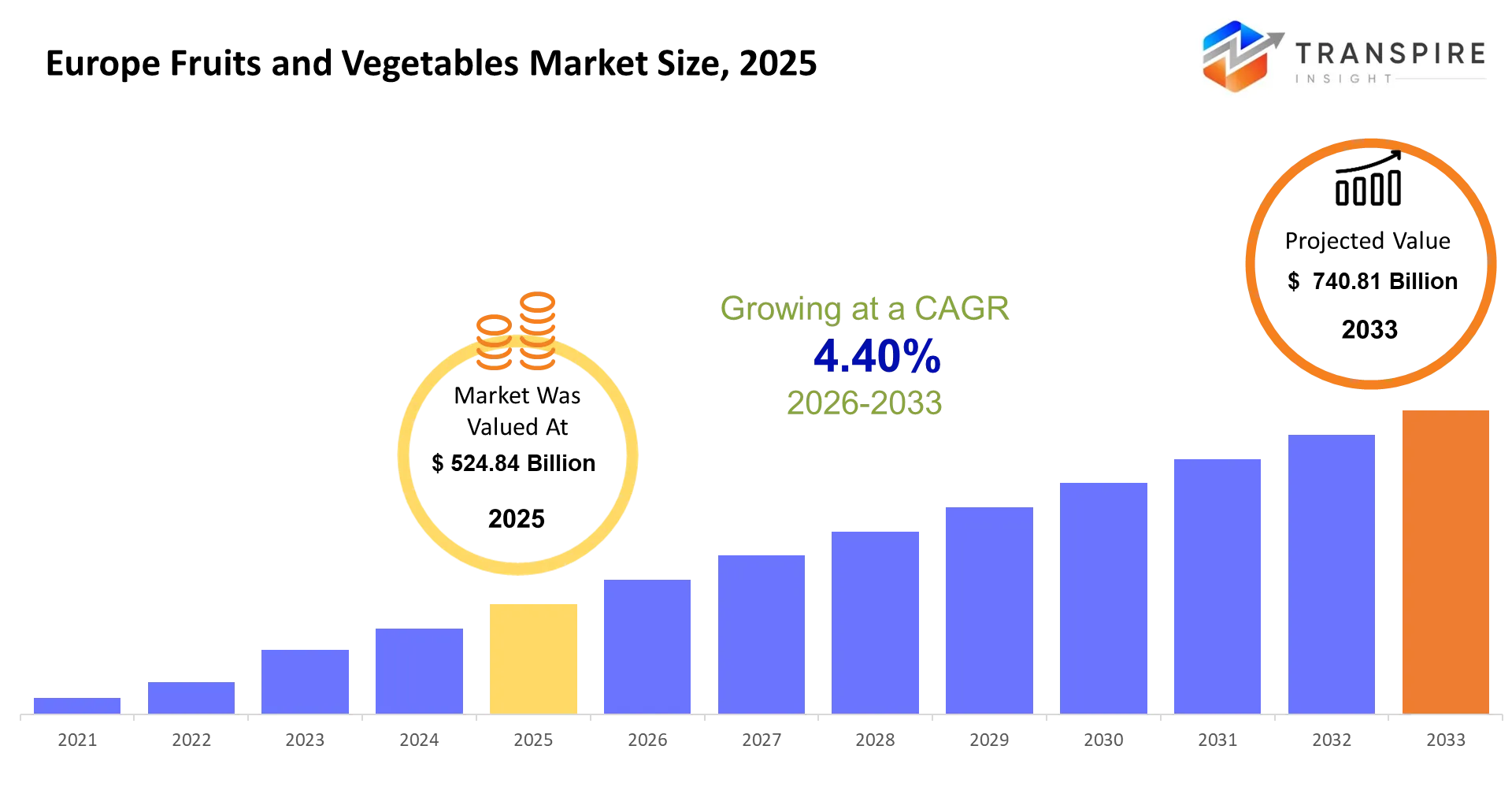
- Europe Fruits and Vegetables Market Size 2025: USD 524.84 Billion
- Europe Fruits and Vegetables Market Size 2033: USD 740.81 Billion
- Europe Fruits and Vegetables Market CAGR: 4.40%
- Europe Fruits and Vegetables Market Segments: By Type (Fresh Produce, Frozen Produce, Organic Produce, Processed Produce, Canned Produce, Others); By Application (Household Consumption, Food Processing, Food Service, Exports, Others); By End-User (Consumers, Retailers, Food Industry, Hospitality, Others); By Distribution (Supermarkets, Online, Local Markets, Wholesale, Others)
To learn more about this report,  Download Free Sample Report
Europe Fruits and Vegetables Market Summary
The Europe Fruits and Vegetables Market was valued at USD 524.84 Billion in 2025. It is forecast to reach USD 740.81 Billion by 2033. That is a CAGR of 4.40% over the period.
The Europe fruits and vegetables market supports regional food security, retail supply continuity, and industrial food processing by ensuring supermarkets and hospitality networks and manufacturing facilities always have access to fresh and frozen and processed produce. Through its various operations the market establishes equilibrium between periods of reduced agricultural output through its international trade system and its cold-storage facilities and its controlled growing technology. The industry has transitioned during the last five years from its previous system which emphasized product volume to its current operational method which uses traceable supply networks based on greenhouse farming and nearby sourcing.
This transition process received support from multiple disruptions. The COVID-19 outbreak triggered supply chain disruptions which combined with energy price increases and climate change-related agricultural instability in Southern Europe, thus demonstrating the weaknesses of traditional systems which depend on international product delivery. Retailers and processors responded to supply chain challenges by investing in local greenhouse facilities and automated storage systems and digital inventory control systems, which helped to maintain product availability while minimizing waste. The structural transformation of procurement systems throughout the value chain creates increased requirements for high-quality produce and products that undergo value-added processing and technological solutions which enhance agricultural productivity through better regulatory adherence and operational performance.
Key Market Insights
- The Europe Fruits and Vegetables Market reached its highest portion of 42% market share in 2025 because Western Europe had developed its retail systems to advanced levels.
- Between 2026 and 2033, Eastern Europe developed into the fastest-growing market when greenhouse facilities received funding and EU-supported agricultural development programs were implemented.
- Supermarkets brought about their market expansion through premium fruit and vegetable assortments which resulted in fresh produce obtaining nearly 48% industry share in 2025.
- After 2023, frozen produce demand experienced substantial growth because foodservice operators began to value products with extended shelf life which required fewer kitchen preparation time.
- The organic produce market developed into its fastest-growing product category because the EU established stricter sustainability rules which prompted farmers to obtain certified pesticide-free farming methods until 2030.
- The application market reached its highest demand when home users consumed healthy food at home and made online grocery purchases which resulted in 51% market share.
- After 2024, food processing applications saw fast growth because packaged meal producers increased their frozen berry and vegetable and concentrate needs.
- The consumer group formed the main end-user segment yet hospitality and quick-service restaurant sales growth accelerated because of tourist activities across Southern Europe.
- Supermarkets held the biggest distribution share in 2025 while online grocery channels showed the strongest predicted expansion until 2033.
- Fresh Del Monte Produce established a stronger market position through its acquisitions of avocado oil and processed produce products during the years 2025 and 2026.
What are the Key Drivers, Restraints, and Opportunities in the Europe Fruits and Vegetables Market?
The Europe fruits and vegetables market experiences its most significant growth driver through organized retail development and supply chain system development which major European countries implement. Supermarkets established permanent supply contracts with growers because their supply chain interruptions between 2021 and 2024 showed them that their current system needed improvement. The company achieved year-round product distribution and decreased product waste during shipping through their investments in refrigerated transportation systems and greenhouse operations and product tracking systems. Premium fresh produce and frozen vegetable and value-added fruit product sales grew through these changes which helped suppliers who maintained their product quality to raise their prices.
The most significant restraint remains climate-related agricultural instability, particularly across Southern Europe where drought conditions, water restrictions, and rising energy costs continue affecting crop yields. The challenge requires structural solutions because modernizing irrigation systems and building climate-resilient agricultural systems need extensive financial backing and lengthy time frames. The unpredictable harvests create supply instability which increases procurement expenses for retailers and processors while preventing small producers from growing their businesses beyond their existing capacity.
European sustainability policies support regenerative agriculture and carbon-related farming incentives which create a major business opportunity. Food retailers and ingredient manufacturers increasingly invest in low-emission sourcing partnerships and digital farm monitoring platforms that measure soil health, fertilizer efficiency, and carbon reduction outcomes.Eastern Europe has developed into a strategic investment location because greenhouse expansion and cold-storage development and EU-supported agricultural modernization initiatives create business growth possibilities for farmers and agri-tech companies and logistics service providers.
What Has the Impact of Artificial Intelligence Been on the Europe Fruits and Vegetables Market?
The development of marine emission control systems receives major advancements from artificial intelligence together with modern digital technologies which enhance automated processes and compliance tracking and operational effectiveness for commercial shipping fleets. Ship operators increasingly use AI-enabled scrubber monitoring platforms to automate exhaust gas cleaning adjustments based on fuel sulfur content engine load and regional emission regulations. Digital control systems now process real-time sensor data from washwater discharge units and pumps and emission analyzers to maintain compliance with IMO 2020 sulfur limits while reducing manual intervention onboard vessels.
Machine learning models enhance predictive maintenance capabilities for scrubber performance systems through their implementation. Operators use predictive analytics to detect corrosion risks and pump failures and nozzle blockages before equipment downtime occurs. Several shipping companies achieved measurable business improvements through AI-assisted optimization which resulted in decreased maintenance expenses and enhanced scrubber availability and better fuel efficiency from improved engine-scrubber operation. Advanced emissions forecasting tools help fleet managers create simulations of compliance exposure which enables them to predict potential penalties and operational interruptions that would happen in emission control areas.
The high costs of system integration together with poor data quality from older vessel fleets create major obstacles that prevent organizations from implementing artificial intelligence systems. The accuracy of real-time predictive models decreases during long-haul maritime operations because ships have limited onboard connectivity and their sensor systems lack proper integration.
Key Market Trends
- The European supermarkets have expanded their private-label fresh produce offerings since 2022 which creates higher pricing challenges for mid-sized regional growers and distributors.
- The Netherlands and Spain experienced an increase in greenhouse vegetable production after 2023 because of climate changes and the need for efficient water usage.
- The online grocery platforms delivered more than 20% additional fresh produce during the period from 2021 to 2025 which changed how people shop for groceries in urban areas.
- The stricter EU sustainability targets which began in 2020 made organic fruit and vegetable demand transition from niche retail channels to mainstream supermarket distribution.
- Fresh Del Monte and Greenyard increased their acquisition and partnership activities during 2025 and 2026 to establish vertically integrated sourcing networks.
- European foodservice operators adopted frozen vegetables because labor shortages created a need for pre-prepared food items which produced minimal waste.
- The retailers adopted blockchain-based traceability systems for premium produce categories after they faced multiple supply-chain transparency issues between 2023 and 2025.
- Eastern European producers accelerated their greenhouse and cold-storage investments through EU-backed agricultural modernization programs which began after 2024.
- Driscoll's and other berry suppliers established controlled-environment farming operations to create stable seasonal production which would minimize weather-related production interruptions.
- The adoption of recyclable and compostable produce packaging increased after multiple European retailers pledged to decrease their single-use plastic usage by 2030.
Europe Fruits and Vegetables Market Segmentation
By Type:
Fresh produce holds the largest market share because supermarkets, local markets, and foodservice channels show strong consumer preference for minimally processed fruits and vegetables. Product demand remains high because retailers need fresh products that can be tracked throughout the year. Western Europe maintains dependable supply for fresh produce through its advanced cold-chain infrastructure and greenhouse cultivation systems. The segment maintains its strength because more people understand health benefits and consume fresh salads and berries and citrus products.
Frozen produce continues gaining momentum because food manufacturers and hospitality operators require longer shelf life and lower wastage rates. The food industry now uses improved freezing technologies because these methods preserve food texture and nutritional value at a higher rate than previous freezing techniques. European certification standards empower organic produce to meet consumer demand for pesticide-free farming practices which premium customers prefer. The processed and canned product categories sustain continuous demand because institutional food supply contracts and export activities drive market growth while sustainable packaging and regional sourcing and automated post-harvest processing systems will determine future expansion across all market segments.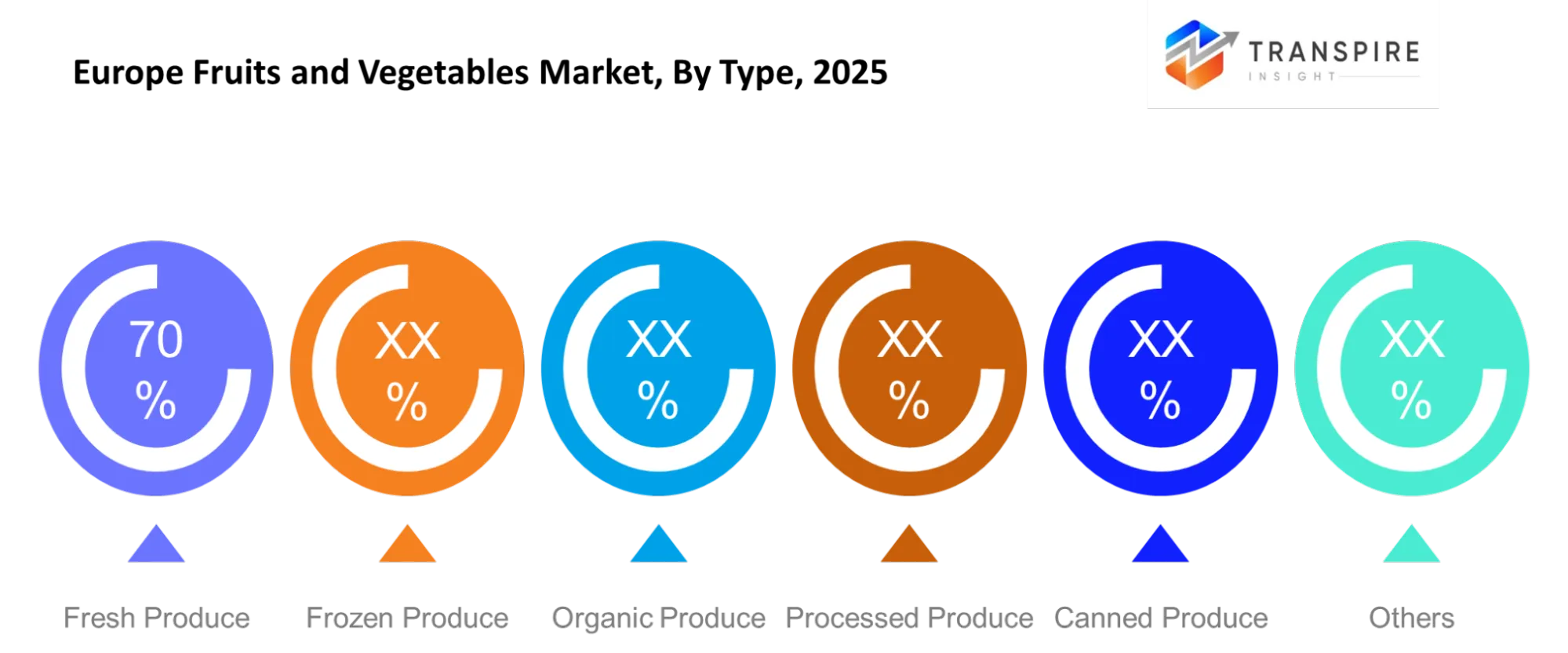
To learn more about this report, Download Free Sample Report
By Application:
The primary use case for fresh and packaged produce exists in home consumption because European dietary patterns sustain high demand for these products through retail channels. Supermarkets and online grocery platforms have expanded their product ranges because this expansion causes customers to purchase more expensive fruits and organic vegetables and products with convenient packaging. The pattern of household buying continues because seasonal sales and health-oriented eating and increased interest in plant-based foods. Retailers increase their sales through extensive development of private-label products which they use in home consumption markets.
The demand for frozen ingredients and fruit concentrates and pre-cut vegetable products used in packaged meals and restaurant operations drives steady growth for food processing and foodservice applications. The hospitality industry and catering companies and quick-service restaurants increasingly use standardized produce inputs to achieve better kitchen performance and lower food preparation expenses. Southern and Eastern European producers use export applications to establish more extensive distribution networks that connect with regional trade routes. The market will create new prospects through ingredient innovation and functional nutrition products and sustainable processing technologies that minimize waste while enhancing product shelf life. actual product recycling process.
By End-User:
The main end-user group in Europe who buys fruits and vegetables through direct retail channels represents European consumer market. The increasing awareness about nutrition and immunity protection and proper dietary balance leads to higher fresh berry and leafy vegetable and citrus product consumption. Urban people choose packaged products which offer easy use because they can quickly prepare these items while keeping their freshness. People who buy premium products tend to spend more money on organic products which come from local farms and allow customers to track their origins.
Food retailers and manufacturers use private-label products together with long-term supplier contracts to gain better control over product pricing and stock management. The hospitality industry requires restaurants to provide frozen and prepared food items which help maintain their operational workflows and consistent food offerings. Wholesale distributors play a crucial role in maintaining regional supply balance because they handle both seasonal imports and export trade activities. Digital procurement systems and predictive inventory technologies and sustainability certification programs will determine future growth in supply chain management across various business segments.
By Distribution:
Supermarkets dominate distribution because they provide multiple products and maintain their cold-storage facilities and their partnerships with local farmers and importers. The large retail chains maintain their customer base through their competitive pricing and their organic product sections and their quick-serve food items. Supermarkets use centralized procurement systems to achieve consistent supply levels while maintaining their product quality requirements across their European operations. Retailers increase their control over fresh and packaged produce sales through their strong private-label product availability.
Urban consumers drive the growth of online distribution channels because they prefer home delivery services and digital grocery shopping. Temperature-controlled logistics and rapid fulfillment networks enable businesses to deliver dependable service for their perishable items. Southern European markets sustain their current status because people still want to buy seasonal products and locally sourced items through their traditional shopping methods. The wholesale distribution system enables cross-border trade and institutional supply networks to operate, while companies that combine digital inventory control with eco-friendly transportation systems will achieve better results in upcoming market expansion across multiple channels.
What are the Key Use Cases Driving the Europe Fruits and Vegetables Market?
The European fruits and vegetables market shows its strongest demand through fresh retail consumption which uses supermarket and hypermarket distribution channels as its main distribution method. Consumers increasingly want constant access to fresh produce which they can trace through its entire journey and which has been processed into minimal form. Because of this demand, retailers need to develop new supply networks and enhance their ability to store products through cold-chain systems.
The demand for processed fruits and vegetables has grown in three main areas: foodservice, ready-to-eat meal production, and frozen food manufacturing. Quick-service restaurants and packaged food companies are increasing their purchases of pre-cut vegetables frozen berries and fruit-based ingredients because these items help them operate more efficiently while minimizing their food waste.
The development of new applications enables plant-based food manufacturers to create food products through their use of concentrated fruit and vegetable components. The market demand for natural colorants and sustainable by-product processing and fiber-rich ingredients has opened up new business opportunities for food technology companies and ingredient manufacturers throughout Europe during the forecast period.
|
Report Metrics |
Details |
|
Market size value in 2025 |
USD 524.84 Billion |
|
Market size value in 2026 |
USD 547.94 Billion |
|
Revenue forecast in 2033 |
USD 740.81 Billion |
|
Growth rate |
CAGR of 4.40% from 2026 to 2033 |
|
Base year |
2025 |
|
Historical data |
2021 - 2024 |
|
Forecast period |
2026 - 2033 |
|
Report coverage |
Revenue forecast, competitive landscape, growth factors, and trends |
|
Regional scope |
Europe (Germany, United Kingdom, France, Italy, Spain, Rest of Europe) |
|
Key company profiled |
Dole, Fresh Del Monte, Chiquita, Bonduelle, Greenyard, Total Produce, Driscoll’s, Olam, Fyffes, Sun World, Del Monte Foods, Grimmway Farms, Vegpro, Blue Skies, Sunkist |
|
Customization scope |
Free report customization (country, regional & segment scope). Avail customized purchase options to meet your exact research needs. |
|
Report Segmentation |
By Type (Fresh Produce, Frozen Produce, Organic Produce, Processed Produce, Canned Produce, Others); By Application (Household Consumption, Food Processing, Food Service, Exports, Others); By End-User (Consumers, Retailers, Food Industry, Hospitality, Others); By Distribution (Supermarkets, Online, Local Markets, Wholesale, Others) |
Which Regions are Driving the Europe Fruits and Vegetables Market Growth?
Western Europe operates as the principal area which controls the European fruit and vegetable market because the region possesses advanced retail systems and strict food safety rules and complete cold-chain transportation networks. The fresh produce distribution system across Europe operates throughout the year because Germany and France and the Netherlands maintain their major import terminals and their extensive port systems. The area establishes itself as the top destination for sustainable agricultural practices because it runs the most advanced farming standards and product traceability systems which enable retailers to trust certified products and consumers to choose certified items. Western Europe maintains its top status in fresh and packaged produce markets because it has a complete network of greenhouse businesses and food processing plants and transportation companies and grocery store chains.
Northern Europe works to establish its own economic identity through agricultural methods which produce unbroken supply chains and deliver high-quality products and establish permanent agricultural systems which endure climate changes. The Swedish and Danish and Finnish markets sustain their constant demand because customers possess strong purchasing abilities and retailers maintain long-term sourcing contracts instead of relying on domestic production. The entire region works to establish sustainable farming methods while backing controlled-environment farming systems which provide farmers with predictable business conditions. Northern Europe operates as a reliable revenue source because its stable market conditions benefit exporters and companies which produce organic products and berries and specialty vegetables.
Eastern Europe has developed into the most rapidly expanding market because both governmental bodies and private sector investors work to enhance agricultural facilities together with food distribution systems. Poland, Romania, and Hungary have started to grow their greenhouse farming operations while building new storage facilities and regional processing centers to cut back on imports and boost their export capabilities. The European Union has seen productivity improvements and increased supply chain efficiency through its agricultural development programs and digital farm technology investments. The period from 2026 to 2033 will open up substantial growth opportunities for investors and logistics companies and agricultural technology businesses according to the current market trends.
Who are the Key Players in the Europe Fruits and Vegetables Market and How Do They Compete?
The Europe fruits and vegetables market remains moderately fragmented, with multinational produce companies competing alongside regional growers, cooperatives, and private-label suppliers. The competitive landscape now depends on three factors which include supply chain management, environmental sustainability requirements, and the capacity to maintain product availability throughout the year despite climatic challenges. Established companies maintain their market position through vertical business expansion and distribution network enhancements while new agri-tech companies introduce greenhouse farming methods and product traceability systems to disrupt conventional procurement processes. Retailers still value cost efficiency but now prioritize food safety certifications, low-carbon sourcing, and dependable delivery systems for their operations throughout Europe.
Fresh Del Monte Produce differentiates itself through vertically integrated sourcing, refrigerated shipping infrastructure, and expansion into value-added fruit products such as avocado oil and prepared produce. The recent acquisitions help the company to strengthen its processing operations while decreasing its need to rely on commodity market fluctuations. Greenyard develops integrated supply partnerships with European retailers and frozen vegetable processors to enhance its ability to manage long-term purchasing and private-label distribution. The company uses strategic partnerships to strengthen its local sourcing capabilities in both France and European Union markets.
Driscoll's uses its unique strawberry genetic research together with high-quality soft fruit cultivars to build its competitive advantage in European supermarket markets. The company invested in controlled-environment agricultural systems to achieve two goals which include production stability and extended product availability throughout different seasons.Fyffes uses its banana and tropical fruit logistics network to achieve cost efficiency at European ports and wholesale distribution centers while developing new sourcing partnerships in Latin America and Africa to reduce supply chain risks.
Company List
- Dole
- Fresh Del Monte
- Chiquita
- Bonduelle
- Greenyard
- Total Produce
- Driscoll’s
- Olam
- Fyffes
- Sun World
- Del Monte Foods
- Grimmway Farms
- Vegpro
- Blue Skies
- Sunkist
Recent Development News
“In February 2026, Greenyard entered a strategic alliance with Eureden in the frozen vegetable sector in France. The partnership combined production and processing assets across four Brittany sites, reinforcing regional sourcing resilience and expanding frozen vegetable supply capacity for European retail and foodservice markets.Source (Eureden).”
In March 2025, Fresh Del Monte Produce Inc. announced acquisition of a majority stake in Avolio. The acquisition strengthened Fresh Del Monte’s specialty ingredients portfolio by expanding avocado oil production capabilities and supporting circular-economy initiatives through value-added processing of surplus avocados.Fresh Del Monte acquisition announcement (Fresh Del Monte Produce).
What Strategic Insights Define the Future of the Europe Fruits and Vegetables Market?
The Europe fruits and vegetables market is moving toward a new supply system which combines technological solutions with operational resilience because climate change and food security needs and sustainability rules will change production and distribution methods during the upcoming five to seven years. The agricultural sector will experience more growth through controlled-environment agriculture and precision farming and local sourcing methods which reduce their need for unreliable foreign products. Southern Europe faces a hidden threat which results from increased demand for water resources and farm workforce needs because this situation will make it harder to provide water and workers during times of high demand. Regenerative farming practices which operate under carbon-credit systems present a major business opportunity in Northern and Western Europe because existing policies drive their implementation. Market participants should give priority to establishing partnerships which integrate growers with logistics providers and agri-tech companies as this approach will help them maintain consistent supply and enhance product tracking and increase their market power in a business environment with growing regulatory demands.
Europe Fruits and Vegetables Market Report Segmentation
By Type
- Fresh Produce
- Frozen Produce
- Organic Produce
- Processed Produce
- Canned Produce
- Others
By Application
- Household Consumption
- Food Processing
- Food Service
- Exports
- Others
By End-User
- Consumers
- Retailers
- Food Industry
- Hospitality
- Others
By Distribution
- Supermarkets
- Online
- Local Markets
- Wholesale
- Others
Frequently Asked Questions
Find quick answers to common questions.
The Europe Fruits and Vegetables Market size is USD 740.81 Billion in 2033.
Key Segments for the Europe Fruits and Vegetables Market are By Type (Fresh Produce, Frozen Produce, Organic Produce, Processed Produce, Canned Produce, Others); By Application (Household Consumption, Food Processing, Food Service, Exports, Others); By End-User (Consumers, Retailers, Food Industry, Hospitality, Others); By Distribution (Supermarkets, Online, Local Markets, Wholesale, Others).
Major Europe Fruits and Vegetables Market Players are Dole, Fresh Del Monte, Chiquita, Bonduelle, Greenyard, Total Produce, Driscoll’s, Olam, Fyffes, Sun World, Del Monte Foods, Grimmway Farms, Vegpro, Blue Skies, Sunkist.
The current Europe Fruits and Vegetables Market size is USD 524.84 Billion in 2025.
The Europe Fruits and Vegetables Market CAGR is 4.40% from 2026 to 2033.
- Dole
- Fresh Del Monte
- Chiquita
- Bonduelle
- Greenyard
- Total Produce
- Driscoll’s
- Olam
- Fyffes
- Sun World
- Del Monte Foods
- Grimmway Farms
- Vegpro
- Blue Skies
- Sunkist
Recently Published Reports
-
Apr 2026
Baby Infant Formula Market
Baby Infant Formula Market Size, Share & Analysis Report By ype (Infant Milk, Follow On Milk, Specialty Baby Milk, Growing-Up Milk), By Ingredient (Carbohydrate, Fat, Protein, Minerals, Vitamins, and Others), By Product Form (Powder, Liquid, and Ready-to-feed), By Distribution Channels (Supermarket/Hypermarket, Specialty Store, Pharmacies, Online Retail, and Others), and Geography (North America, Europe, Asia-Pacific, Middle East and Africa, South and Central America), 2021 - 2031
-
Apr 2026
Edible Insects for Animal Feed Market
Edible Insects for Animal Feed Market Size, Share & Analysis Report By Type (Insect Powder, Insect Meal, Insect Bar, Insect Paste, Insect Oil, and Others), By Insect Type (Beetles, Cricket, Caterpillar, Hymenoptera, Orthoptera, Tree Bugs, and Others), By Application (Livestock, Pet Food, and Aquaculture), By Livestock Type (Poultry, Swine, and Others), and Geography (North America, Europe, Asia-Pacific, Middle East and Africa, South and Central America), 2021 - 2031
-
Apr 2026
Food Industry Disinfection and Bacterial Control Market
Food Industry Disinfection and Bacterial Control Market Size, Share & Analysis Report By Type (Chemical Disinfectants, Physical Disinfectants, and Biocides and Antimicrobials), By Application (Food Processing Equipment Surface Disinfection, Food Preparation Areas Surface Disinfection, Storage Areas Surface Disinfection, Anti-microbial Coatings Food Preservation, and Preservative Solutions Food Preservation), By End User (Meat and Poultry Processing, Dairy Processing, Seafood Processing, Bakery and Confectionery, Restaurants and Commercial Kitchens, and Food Service Providers), By Sales Channel (Online, Offline), and Geography (North America, Europe, Asia-Pacific, Middle East and Africa, South and Central America), 2021 - 2031
-
Apr 2026
Freeze Dried Food Market
Freeze Dried Food Market Size, Share & Analysis Report By Product Type (Fruits, Vegetables, Freeze-Dried Dairy Products, Freeze-Dried Meat and Seafood, Freeze-Dried Pet Food, and Prepared Meal), By Nature (Organic, and Conventional), By Form (Powdered, Granules, and Diced), By End Use (Breakfast Cereals, Dairy Products, Bakery & Confectionery, Nutritional Bars & Supplements, Powdered Beverages, Snacks, and Retail (Household)), and Geography (North America, Europe, Asia-Pacific, Middle East and Africa, South and Central America), 2021 - 2031