
Asia Pacific Frozen Food Market Summary
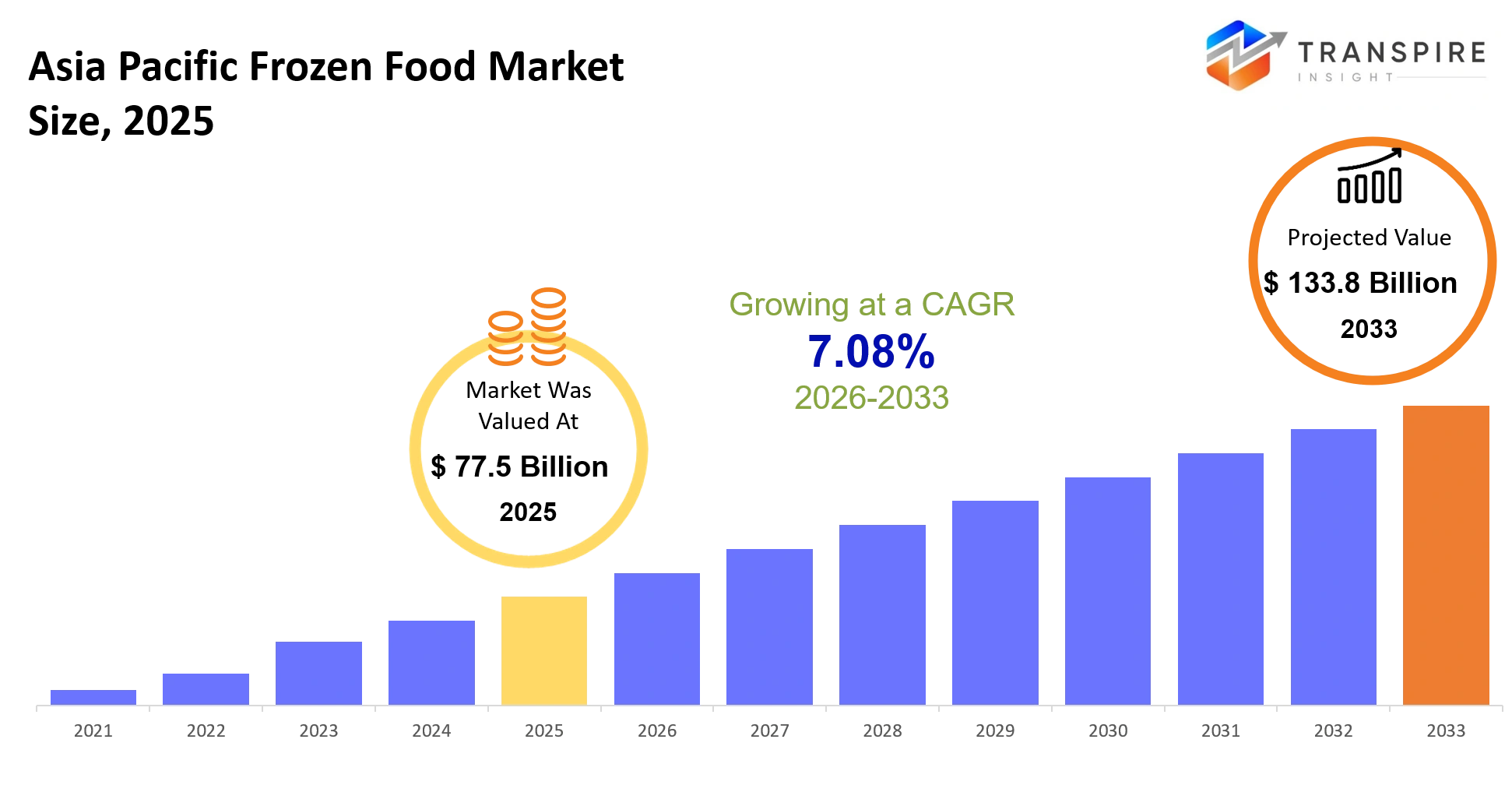
As per Transpire Insight Analysis the Asia Pacific Frozen Food Market size is estimated at USD 77.5 Billion in 2025 and is anticipated to reach USD 133.8 Billion by 2033, growing at a CAGR of 7.08% from 2026 to 2033.
In the Asia Pacific Frozen Food Market, the whole thing sort of helps food manufacturers, retailers, restaurants, and institutional kitchens deliver pretty consistent product quality, longer shelf life and dependable supply, while cutting down food waste and those annoying inventory losses . Frozen goods allow businesses to cope with seasonal swings, push distribution farther across huge geographic zones, and keep food available even in tightly packed urban markets where convenience and speed really matter.
Over the last three to five years , the market moved away from simple frozen basics toward higher value ready to cook meals and nutritionally balanced choices, and this shift came alongside improvements in cold chain logistics and digital inventory tracking. Then pandemic related supply chain issues, plus the way people eat more on the go, sped up investments in temperature controlled storage and distribution routes throughout the region.
With the cold chain ecosystem expanding and modern retail formats reaching more shoppers, frozen food companies can add wider product ranges with less risk, which helps their market penetration, boosts day to day operational efficiency, and creates steady revenue possibilities across both retail and foodservice, at the same time.
Asia Pacific Frozen Food Market Size & Forecast:
- Asia Pacific Frozen Food Market Size 2025: USD 77.5 Billion
- Expected Market Value 2033: USD 133.8 Billion
- Forecast CAGR: 7.08%
- Leading region in 2025: East Asia
- Fastest Growing region: South Asia
- Key Profile: Nestlé, Ajinomoto, McCain Foods, Conagra Brands, Tyson Foods, Nomad Foods, General Mills, ITC Limited, CJ CheilJedang, Nichirei Corporation, Maruha Nichiro, Unilever, Simplot, BRF, CP Foods
Key Market Insights
- China pretty much ran the regional market in 2025 with around 38% share , mainly because it has really advanced cold chain infrastructure, plus urban consumption is staying strong and the organized retail networks just keep widening.
- Looking at Southeast Asia it’s expected to be the fastest growing regional market over 2025 to 2032, and that’s tied to supermarket expansion , more people taking up frozen meal adoption, and also logistics investments that are quietly ramping up.
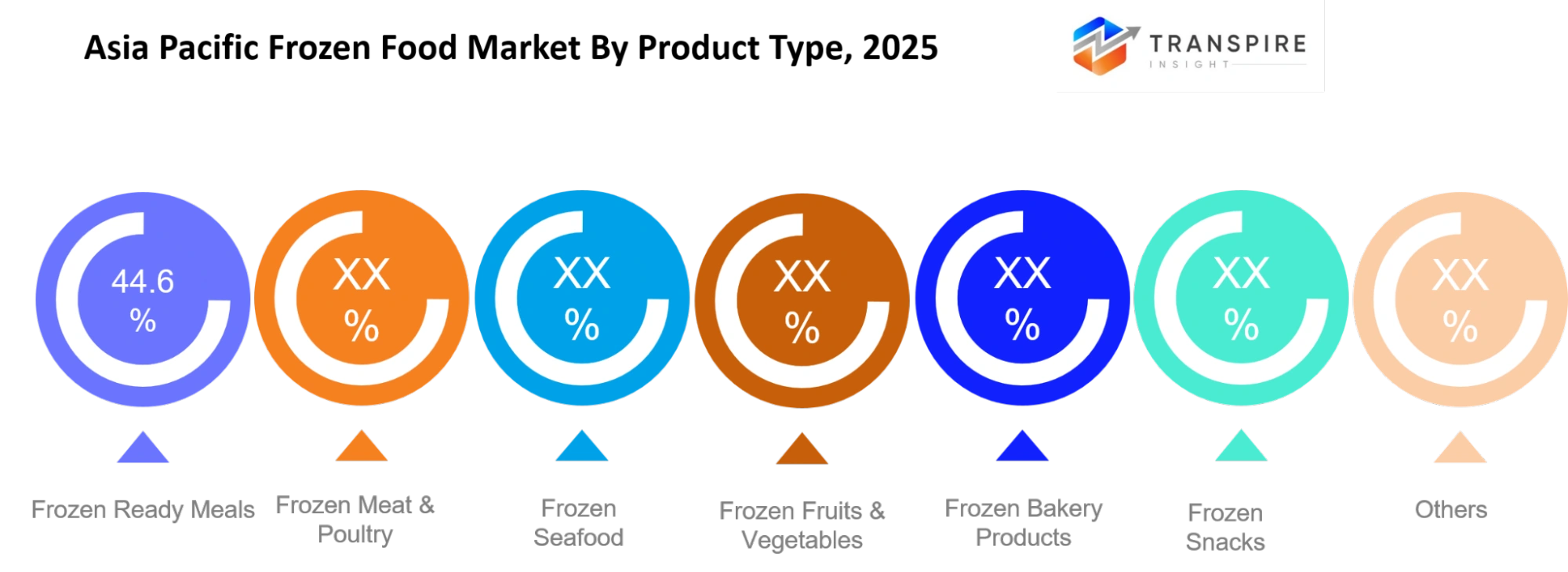
- When it comes to product type, frozen ready meals took the lead with about 31% market share in 2025. It happened because busy city life kind of pushes people toward those convenient meal solutions, you know the ones.
- Frozen seafood sits as the second largest segment too, helped by solid export processing capabilities and also growing domestic consumption across Japan, China and South Korea.
- For frozen snacks, growth should be the quickest between 2025 and 2032. Quick-service dining keeps moving forward , and home snacking habits are still evolving , so the demand looks steady.
- On distribution, retail distribution dominated applications with nearly 68% of revenue in 2025, supported by supermarkets, hypermarkets, and e-commerce making frozen products easier to find everywhere.
- Online grocery and direct-to-consumer distribution is projected to post the fastest application growth through the forecast period, mostly due to digital commerce, and faster delivery expansion that keeps improving access.
- By end user, household consumers stayed on top , with roughly 72% market share in 2025, reflecting continued demand for those convenient frozen food products.
- Meanwhile, foodservice operators are the category expected to grow fastest through 2032, as restaurant chains expand their use of frozen ingredients to keep operational quality more consistent.
What are the Key Drivers, Restraints, and Opportunities in the Asia Pacific Frozen Food Market?
One of the most powerful drivers behind the whole regional expansion story is modernization in food retail, plus cold chain infrastructure. Big money goes into refrigerated logistics, warehouse automation, and omnichannel grocery platforms. With that, product losses have gone down, while frozen food is now actually reaching secondary cities more reliably. When cold storage costs keep dropping and supermarket presence keeps growing, product accessibility gets better too. Together these changes push retail sales higher, nudge premium product launches forward , and broaden day to day consumption among working households who are basically hunting for convenient meal solutions.
Still, the biggest structural restraint shows up as uneven cold chain development across emerging economies. Rural transport gaps, refrigeration capacity that isn't stable, and electricity prices that stay high all end up limiting dependable distribution. So even if companies want speed, these issues need long term infrastructure investment. They cannot be ironed out quickly or easily. From the Transpire Insight review of regional procurement announcements, and launch schedules, supply chain concentration remains the main execution risk. In practice this often means delayed market entry, higher logistics expenses, and lower profitability for manufacturers trying to grow beyond the biggest metropolitan regions.
At the same time, there is a real opportunity in intelligent cold chain ecosystems that are built around warehouse robotics, IoT-enabled refrigeration, and more advanced demand forecasting platforms. Investments across Southeast Asia are setting up conditions that favor automated distribution centers and temperature-controlled logistics. These tools help improve inventory turnover, they reduce food waste, and they also make it easier to offer premium products more widely. That’s what could open the next phase for regional revenue expansion.
What Has the Impact of Artificial Intelligence Been on the Asia Pacific Frozen Food Market?
Artificial intelligence and digital tech are kind of reshaping frozen food manufacturing & distribution, by boosting production accuracy, making inventory easier to see, and strengthening cold chain reliability. AI powered monitoring setups constantly watch freezer temperatures, humidity, and the actual storage conditions, so processors and distributors can react before product quality starts to slide. There’s also computer vision, which helps with automated inspection of packaged goods, which supports food safety rules while cutting down on all those manual quality checks. Then machine learning looks at retail transactions, seasonal buying habits, and even weather patterns, to forecast demand with more precision. This lets manufacturers line up production plans and manage inventory allocation across several markets, with less guesswork. Those predictive features lower the chance of stockouts, reduce surplus stock, and generally make warehouse use better while also reducing food waste and overall logistics expenses.
Digital route optimization adds another layer too, it finds quicker transportation paths and can reduce refrigeration fuel consumption. On top of that, many companies use predictive maintenance to spot equipment failures ahead of time, which improves plant uptime and cuts unplanned maintenance costs. Still, take-up is uneven, because plugging AI platforms into older manufacturing systems usually needs major capital outlay. Smaller processors often run into uneven data quality, plus they have limited access to skilled digital specialists, so large scale rollout across the regional frozen foods industry gets slowed.
Key Market Trends
- From 2023 up through 2025, retailers seemed to crank up investments into automated cold warehouses, sort of cutting down on inventory losses and speeding up fulfillment across regional distribution routes, a bit more consistently than before.
- Premium frozen ready meals started getting stronger shelf visibility from 2024 on, mainly because manufacturers rolled out these healthier blends, with more protein, and less sodium content (I mean, it looked noticeable pretty quickly).
- From 2023, e-commerce grocery platforms kept stretching their temperature controlled delivery services , so frozen items became more reachable even outside the biggest metro areas, it was kinda like the reach expanded without drama.
- In 2024–2025, food manufacturers leaned harder into AI driven demand forecasting, to tune production schedules and also curb inventory waste across multiple countries, rather than waiting too long, and then reacting late.
- China , Japan, and South Korea increased investment in refrigerated logistics infrastructure between 2023 and 2025, which helped broaden the capacity for frozen food distribution, even at scale.
- McCain Foods grew more localized product portfolios to match what regional consumers actually want, and this helped reinforce its competitive stance across Asia Pacific markets, pretty steadily.
- Nestlé put additional effort into innovation for frozen convenience meals, launching nutrition centered recipes that fit shifting urban eating habits after 2024 , and that shift kind of mattered a lot.
- Processors broadened their use of recyclable lightweight packaging through 2024–2025 to lower transport costs, while at the same time improving cold chain efficiency, which sounds small but isn’t.
- Strategic partnerships between food manufacturers and online grocery platforms picked up pace after 2024, and that improved same day frozen availability across crowded high density city areas , where timing really counts.
Asia Pacific Frozen Food Market Segmentation
By Product Type :
Frozen Ready Meals kinda take the lead here because everyday fast paced city life still fuels demand for convenient meal choices, with steady flavor and stable quality. Frozen Meat & Poultry keep moving well in retail chains and foodservice venues, mainly because these groups want a longer shelf life plus dependable product availability, it’s just how it goes. Frozen seafood also benefits from strong seafood appetite in coastal economies, and not only that, exports are going up as cold storage facilities keep improving. Frozen Fruits & Vegetables are getting more notice too, modern processing helps hold onto nutrition , while also cutting down the usual issues from seasonal shortages.
Frozen Bakery Products pull in buyers from cafés , restaurants , and home kitchens, since ready-to-bake options mean less hands on prep time. Frozen Snacks keep showing healthy growth, because people eat quickly and convenience retail keeps expanding , so product consumption rises across urban areas. The Others segment covers things like frozen desserts, ready ingredients, and specialty items , which helps overall product variety and aligns with shifting consumer preferences. Ongoing product innovation plus wider retail access will keep sharpening competition across every category.
By Distribution Channel :
Supermarkets and Hypermarkets still stay the main distribution route, mostly because the big freezer space, a wide assortment of products, and sharp promotional pricing tend to push people into larger basket sizes. Convenience stores also keep growing their frozen lineup, aiming to satisfy the demand for fast meal type solutions, especially in very densely populated city areas. Online retail is picking up serious speed, since digital grocery platforms raise delivery speed and they also reinforce temperature controlled logistics, it kind of makes everything feel more stable. Specialty stores handle the consumers who are hunting for premium, imported, or health oriented frozen food, with more product differentiation than the typical aisle.
Wholesale clubs help bigger families, restaurants, and institutional buyers, they like bulk purchasing for cost effectiveness and a steady, consistent supply. The Others part includes independent shops and local grocery outlets that make it easier to get the products in smaller cities and suburban markets. Also, continuing investments in digital ordering systems and cold chain distribution will make products more available across each sales channel. When retail infrastructure gets better, customers' reach grows too, and that usually leads to stronger market penetration, even if it happens gradually.
By End User :
Households are still taking the biggest slice, not just because it’s easy to handle meal prep, but also because the longer shelf life of these frozen items kind of matches the way people now run their daily routines, a little more tightly. Hotels & Restaurants keep pushing harder into frozen ingredients so they can hold a steady quality, cut down on kitchen waste, and boost day to day operational efficiency. Catering Services often lean on frozen food products as well, mainly to manage big event numbers, while still keeping their preparation standardized and their supply dependable. Institutional Buyers, think hospitals, schools and education facilities, they buy frozen products for smoother meal planning and for inventory management that is less stressful.
The Others bucket, covers workplaces, transportation services, plus commercial food providers who basically need frozen product availability that doesn’t wobble. Product consistency, good food safety, and simplified storage are still the main reasons demand stays supported across every end user group. As organized foodservice businesses expand, more openings will show up for manufacturers supplying high-volume frozen products. And then with broader menu innovation, adoption should keep moving forward across both commercial and institutional uses.
By Packaging Type :
Bags are still pretty widely used, mostly because lightweight packaging helps cut down on transportation costs while also keeping frozen products safe during storage , and during the whole handling process. Boxes tend to give more solid product protection, and they also look nicer on shelf, especially for premium frozen meals, as well as bakery items. Trays are often chosen for ready-to-cook , and even microwave-friendly offerings, so meal preparation feels less complicated for people with packed schedules. Pouches keep picking up more fans because this flexible packaging uses less material and makes storing at home more convenient.
Cartons stay relevant for some frozen foods that really need strong structural protection the entire way through distribution and retail display. The Others group basically covers tailored packaging styles made for specialty goods and for commercial foodservice needs. Manufacturers keep working on better packaging durability so product quality holds up during the cold chain. Packaging innovation will also back sustainability, and it should improve day to day operational efficiency across distribution networks.
By Storage Type :
Deep Frozen storage happens for one main reason—very low temperatures, keep the food kind of “intact” in a way, preserving overall quality, texture, and nutritional value for long stretches of storage. Regular Frozen storage is still the norm, used a lot for everyday frozen items that move through retail shelves, and also through commercial channels too. IQF Products keep growing, because individually quick frozen technology helps prevent pieces from sticking together, while at the same time cutting down waste and making portioning more controlled. Food manufacturers also lean more toward IQF processing for things like fruits, vegetables, seafood, and other premium components that need steady, predictable quality
The Other category goes beyond that, and it covers specialized storage solutions created for selected products with their own preservation needs. Ongoing investment in refrigerated warehouses, plus upgrades to modern cold chain infrastructure, supports stronger storage performance across different regional markets. Advanced monitoring systems add another layer, they improve temperature stability and lessen losses during shipping and distribution. With better storage capabilities, the whole supply chain becomes more dependable, and that helps the industry keep expanding over the long term
What are the Key Use Cases Driving the Asia Pacific Frozen Food Market?
The biggest use case kinda comes from everyday household meals, where frozen ready meals help with dependable quality, controlled portions, and less prep time, too. Urban families, busy working professionals, and single-person households buy these things to simplify daily meal planning and at the same time keep food waste lower. Then modern retail networks and solid cold chain systems keep everything available across most major cities, pretty steady.
Hotels, restaurants, and catering companies also lean on frozen meat, seafood, and bakery items more and more. This helps them keep menu consistency even when demand goes up and down. On top of that, institutional buyers, like hospitals and schools, tend to prefer frozen ingredients as well. The reason is that standardized storage and food safety rules make large-scale meal prep more efficient, while inventory losses drop slightly.
Some newer openings are showing up in travel catering, plus automated retail setups such as smart vending systems that really need temperature-controlled food products. There’s also a growing appetite for premium frozen offerings meant for healthcare nutrition and specialized dietary programs, where strict quality requirements and traceable storage conditions matter. That creates room for more advanced frozen food manufacturers across the forecast period.
|
Report Metrics |
Details |
|
Market size value in 2025 |
USD 77.5 Billion |
|
Market size value in 2026 |
USD 82.9 Billion |
|
Revenue forecast in 2033 |
USD 133.8 Billion |
|
Growth rate |
CAGR of 7.08% from 2026 to 2033 |
|
Base year |
2025 |
|
Historical data |
2021 - 2024 |
|
Forecast period |
2026 - 2033 |
|
Report coverage |
Revenue forecast, competitive landscape, growth factors, and trends |
|
Regional scope |
Asia Pacific (India, China, Japan, Australia, South Korea, Rest of Asia Pacific) |
|
Key company profiled |
Nestlé, Ajinomoto, McCain Foods, Conagra Brands, Tyson Foods, Nomad Foods, General Mills, ITC Limited, CJ CheilJedang, Nichirei Corporation, Maruha Nichiro, Unilever, Simplot, BRF, CP Foods . |
|
Customization scope |
Free report customization (country, regional & segment scope). Avail customized purchase options to meet your exact research needs. |
|
Report Segmentation |
By Product Type (Frozen Ready Meals, Frozen Meat & Poultry, Frozen Seafood, Frozen Fruits & Vegetables, Frozen Bakery Products, Frozen Snacks, Others); By Distribution Channel (Supermarkets & Hypermarkets, Convenience Stores, Online Retail, Specialty Stores, Wholesale Clubs, Others); By End User (Households, Hotels & Restaurants, Catering Services, Institutional Buyers, Others); By Packaging Type (Bags, Boxes, Trays, Pouches, Cartons, Others); By Storage Type (Deep Frozen, Standard Frozen, IQF Products, Others) |
Which Regions are Driving the Asia Pacific Frozen Food Market Growth?
East Asia accounts for around 58% of regional revenue, so it is basically the dominant market. You can see it in how strict food safety rules work together with advanced cold chain infrastructure and also, surprisingly high supermarket penetration. Because of this, large-scale frozen food distribution works well across China, Japan , and South Korea. There are also plenty of processing facilities, integrated logistics networks, and ongoing investment—from both local and international food manufacturers—that keep supply chain efficiency strong. Add ongoing product innovation, more premium food categories, and continuing retail modernization, and the region should keep leading during the whole forecast period.
Oceania is kind of different, mainly because consumer spending stays steady, food quality regulations are consistent, and retail operations are already mature. Australia and New Zealand do well, since predictable regulatory frameworks support long-term investment in frozen food production and refrigerated logistics. Purchasing power is strong there, supermarket chains are well established, and agricultural output is reliable, so suppliers get a more dependable revenue base. Demand doesn’t really wobble too much either, because households and commercial foodservice businesses stay active, even if population growth is a bit slower.
Southeast Asia is projected to see the fastest growth somewhere between 2026 and 2033, with investments in refrigerated warehouses, organized retail , and digital grocery platforms all speeding up market expansion. At the same time rapid urban development is helping, and the cold chain infrastructure is getting better, plus supportive investment policies are really helping spread frozen food options across Indonesia, Vietnam , Thailand and the Philippines. Also more people are adopting modern retail formats, and that has opened up fresh opportunities for premium, plus those convenience-focused frozen products. This overall momentum should set up favorable conditions for manufacturers, distributors and investors who want longer term expansion, especially across developing consumer markets during the 2026–2033 window.
Who are the Key Players in the Asia Pacific Frozen Food Market and How Do They Compete?
Competition is still kind of moderately fragmented, with multinational food players competing in the same space as a few very capable regional manufacturers. In practice cost efficiency, product innovation, distribution reach, and localized product development are the main levers that shape competition. The bigger, established firms keep protecting market share via manufacturing investments and portfolio extension, but regional producers keep adding pressure by putting forward products that feel closer to local tastes, and also to local price expectations.
Ajinomoto stands out with frozen ready meals, built around regional flavor preferences, which helps with stronger customer take-up across several Asian countries. Ongoing product releases plus manufacturing investments support higher production capacity and they also tend to make distribution efficiency better. Nestlé meanwhile leans on nutrition-oriented frozen foods, backed by research and development, which makes it easier to diversify products and maintain a more credible premium position. By expanding healthier recipes along with localized offerings, Nestlé can reach a wider range of consumers across different income groups, not just one segment.
CP Foods gains an advantage thanks to integrated meat production and processing operations that improve supply reliability and cost management across frozen food categories. McCain Foods stays competitive through advanced potato processing technology, and by regularly growing its frozen snack and appetizer range, aimed at both retail customers and foodservice partners. Nippon Ham builds its market presence with high quality ready-to-cook meat products, and it continues to invest in product innovation, which supports sales expansion in both domestic channels and regional markets.
Company List
- Nestlé
- Ajinomoto
- McCain Foods
- Conagra Brands
- Tyson Foods
- Nomad Foods
- General Mills
- ITC Limited
- CJ CheilJedang
- Nichirei Corporation
- Maruha Nichiro
- Unilever
- Simplot
- BRF
- CP Foods
Recent Development News
In February 2026, McCain Foods announced a new UK Farm of the Future investment as part of its global regenerative agriculture program. The initiative strengthens sustainable potato sourcing and supports long-term resilience across the frozen potato supply chain, benefiting production serving international markets, including Asia Pacific.
Source https://www.mccain.com/
In August 2025, Ajinomoto Co., Inc. announced plans to build a new factory at Ajinomoto Philippines Corporation. The investment will expand regional manufacturing capacity, improve local supply capabilities, and support future growth of processed and frozen food products across Southeast Asia. Source https://www.ajinomoto.com/
What Strategic Insights Define the Future of the Asia Pacific Frozen Food Market?
Over the next five to seven years, the Asia Pacific Frozen Food Market seems to be drifting toward a more technology focused and regionally linked supply web, not just the usual logistics shuffle. Growth, will rely less on having the product “somehow available” and more on smart cold chain oversight, local production set ups, and digital retail ecosystems , that help inventories run smoother and keep distribution losses down.
There is also one kind of less obvious danger, in that refrigerated logistics and cold storage capacity are becoming more concentrated with just a few operators. That situation can quietly push manufacturers toward higher operating expenses, and during sudden capacity squeezes it can also trigger supply disruptions.
Still, a real opening is taking shape in Southeast Asia, where money is going into automated cold warehouses and temperature monitoring tools. These moves are setting up conditions that look good for premium frozen offerings, even outside the biggest city centers .
Firms that diversify sourcing, build regional production hubs , and start early with AI supported inventory planning plus end to end cold chain visibility will likely hold a stronger long term edge, compared with others that wait.
Asia Pacific Frozen Food Market Report Segmentation
By Product Type
- Frozen Ready Meals
- Frozen Meat & Poultry
- Frozen Seafood
- Frozen Fruits & Vegetables
- Frozen Bakery Products
- Frozen Snacks
By Distribution Channel
- Supermarkets & Hypermarkets
- Convenience Stores
- Online Retail
- Specialty Stores
- Wholesale Clubs
By End User
- Households
- Hotels & Restaurants
- Catering Services
- Institutional Buyers
By Packaging Type
- Bags
- Boxes
- Trays
- Pouches
- Cartons
By Storage Type
- Deep Frozen
- Standard Frozen
- IQF Products
Frequently Asked Questions
Find quick answers to common questions.
The expected Asia Pacific Frozen Food Market size for the market will be USD 133.8 Billion in 2033.
Key segments for the Asia Pacific Frozen Food Market are By Product Type (Frozen Ready Meals, Frozen Meat & Poultry, Frozen Seafood, Frozen Fruits & Vegetables, Frozen Bakery Products, Frozen Snacks, Others); By Distribution Channel (Supermarkets & Hypermarkets, Convenience Stores, Online Retail, Specialty Stores, Wholesale Clubs, Others); By End User (Households, Hotels & Restaurants, Catering Services, Institutional Buyers, Others); By Packaging Type (Bags, Boxes, Trays, Pouches, Cartons, Others); By Storage Type (Deep Frozen, Standard Frozen, IQF Products, Others).
Major Asia Pacific Frozen Food Market players are Nestlé, Ajinomoto, McCain Foods, Conagra Brands, Tyson Foods, Nomad Foods, General Mills, ITC Limited, CJ CheilJedang, Nichirei Corporation, Maruha Nichiro, Unilever, Simplot, BRF, CP Foods.
The Asia Pacific Frozen Food Market size is USD 77.5 Billion in 2025.
The Asia Pacific Frozen Food Market CAGR is 7.08% from 2026 to 2033.
- Nestlé
- Ajinomoto
- McCain Foods
- Conagra Brands
- Tyson Foods
- Nomad Foods
- General Mills
- ITC Limited
- CJ CheilJedang
- Nichirei Corporation
- Maruha Nichiro
- Unilever
- Simplot
- BRF
- CP Foods
About the Authors

Chetan Dhatrak
I’m Chetan Dhatrak, a Senior Research Analyst at Transpire Insight, specializing in the Consumer Goods, Foods and Beverages industry. I focus on analyzing market trends, consumer behavior, competitive landscapes, and industry developments to deliver accurate, data-driven insights. My research at Transpire Insight is built on credible sources and in-depth analysis, helping businesses and readers better understand market dynamics, emerging opportunities, and evolving consumer preferences. I’m committed to creating reliable, well-researched content that supports informed decision-making and reflects the latest developments in the consumer goods and food & beverage sectors.

Chakradhar Khansole
Chakradhar serves as the Research Director at Transpire Insight, bringing over 8 years of experience in technology, innovation, and strategic market intelligence. He specializes in transforming complex market data into actionable business insights that enable organizations to make informed, growth-oriented decisions. Recognized for his strategic vision and analytical expertise, Chakradhar leads high-impact research initiatives, delivering comprehensive market assessments, competitive intelligence, and forward-looking industry analysis.
Recently Published Reports
-
Apr 2026
Baby Infant Formula Market
Baby Infant Formula Market Size, Share & Analysis Report By ype (Infant Milk, Follow On Milk, Specialty Baby Milk, Growing-Up Milk), By Ingredient (Carbohydrate, Fat, Protein, Minerals, Vitamins, and Others), By Product Form (Powder, Liquid, and Ready-to-feed), By Distribution Channels (Supermarket/Hypermarket, Specialty Store, Pharmacies, Online Retail, and Others), and Geography (North America, Europe, Asia-Pacific, Middle East and Africa, South and Central America), 2021 - 2031
-
Apr 2026
Edible Insects for Animal Feed Market
Edible Insects for Animal Feed Market Size, Share & Analysis Report By Type (Insect Powder, Insect Meal, Insect Bar, Insect Paste, Insect Oil, and Others), By Insect Type (Beetles, Cricket, Caterpillar, Hymenoptera, Orthoptera, Tree Bugs, and Others), By Application (Livestock, Pet Food, and Aquaculture), By Livestock Type (Poultry, Swine, and Others), and Geography (North America, Europe, Asia-Pacific, Middle East and Africa, South and Central America), 2021 - 2031
-
Apr 2026
Food Industry Disinfection and Bacterial Control Market
Food Industry Disinfection and Bacterial Control Market Size, Share & Analysis Report By Type (Chemical Disinfectants, Physical Disinfectants, and Biocides and Antimicrobials), By Application (Food Processing Equipment Surface Disinfection, Food Preparation Areas Surface Disinfection, Storage Areas Surface Disinfection, Anti-microbial Coatings Food Preservation, and Preservative Solutions Food Preservation), By End User (Meat and Poultry Processing, Dairy Processing, Seafood Processing, Bakery and Confectionery, Restaurants and Commercial Kitchens, and Food Service Providers), By Sales Channel (Online, Offline), and Geography (North America, Europe, Asia-Pacific, Middle East and Africa, South and Central America), 2021 - 2031
-
May 2026
Freeze Dried Food Market
Freeze Dried Food Market Size, Share & Analysis Report By Product Type (Fruits, Vegetables, Freeze-Dried Dairy Products, Freeze-Dried Meat and Seafood, Freeze-Dried Pet Food, and Prepared Meal), By Nature (Organic, and Conventional), By Form (Powdered, Granules, and Diced), By End Use (Breakfast Cereals, Dairy Products, Bakery & Confectionery, Nutritional Bars & Supplements, Powdered Beverages, Snacks, and Retail (Household)), and Geography (North America, Europe, Asia-Pacific, Middle East and Africa, South and Central America), 2021 - 2031