

Toilet Care Products Market Summary:
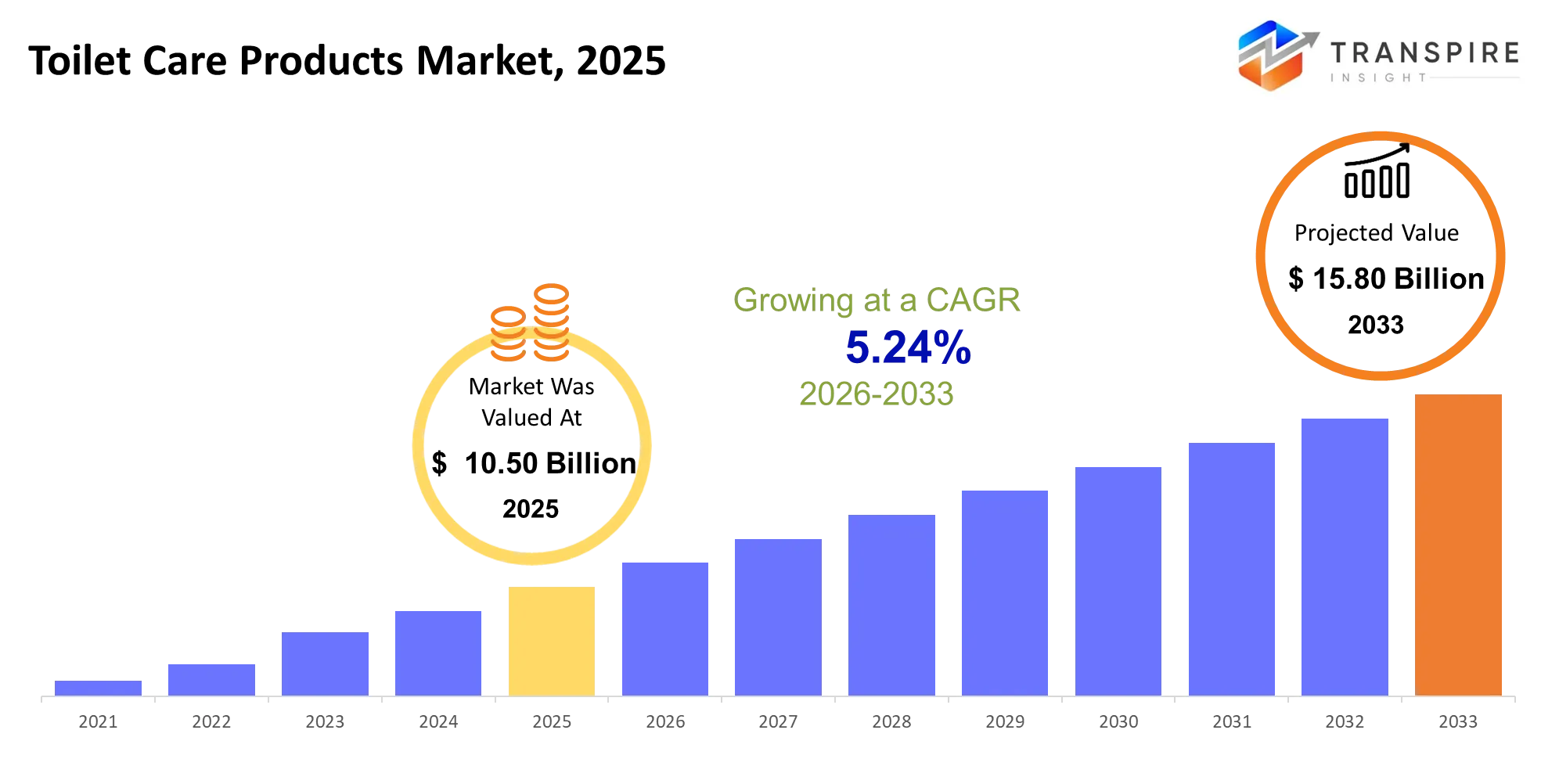
As per Transpire Insight Analysis, the Toilet Care Products Market size is estimated at USD 10.50 billion in 2025 and is anticipated to reach USD 15.80 billion by 2033, growing at a CAGR of 5.24% from 2026 to 2033.
The toilet care products market provides products for homes, businesses and places like schools and hospitals. These products are made to get rid of stains, stop smells and keep bathrooms clean. Toilet cleaners are the type of product but there are other options like tablets, rim blocks and sprays that make cleaning easier for people who want a simpler way to keep things clean. In the three to five years the market has been moving more towards products that don't need as much scrubbing that keep things fresh longer and that are easier to use. Companies are also looking into formulas and containers that can be refilled and ingredients made from plants to help the environment without making the products less effective. New products like Kaos Magiclean Toilet Bubble Pack Spray, which came out, show that there is a move toward using foam for cleaning and reducing the work people have to do. This change is helping products stand out and encouraging people to buy them. Online shopping is also making it easier for people to find high-quality toilet care items. Future growth will rely on finding the balance between how well the products work how much they cost, how easy they are to use and how good they are for the planet.
Toilet Care Products Market Size & Forecast:
- Market Size 2025: USD 10.50 Billion
- Expected Market Value (2033): USD 15.80 Billion
- Forecast CAGR (2026-2033): 5.24%
- Leading Region in 2025: Asia Pacific
- Fastest Growing Region: Middle East & Africa
- Key Company Profiles: Reckitt, Procter & Gamble, Unilever, SC Johnson, Henkel, Colgate-Palmolive, Church & Dwight, Clorox, Kao Corporation, Ecolab, Diversey, Kimberly-Clark, Dabur, Jyothy Labs, Godrej Consumer Products
Key Market Insights
The market is characterised by traditional toilet cleaning products, but innovation is leading to opportunities in automatic cleaning, convenient products, and environmentally friendly formulations.
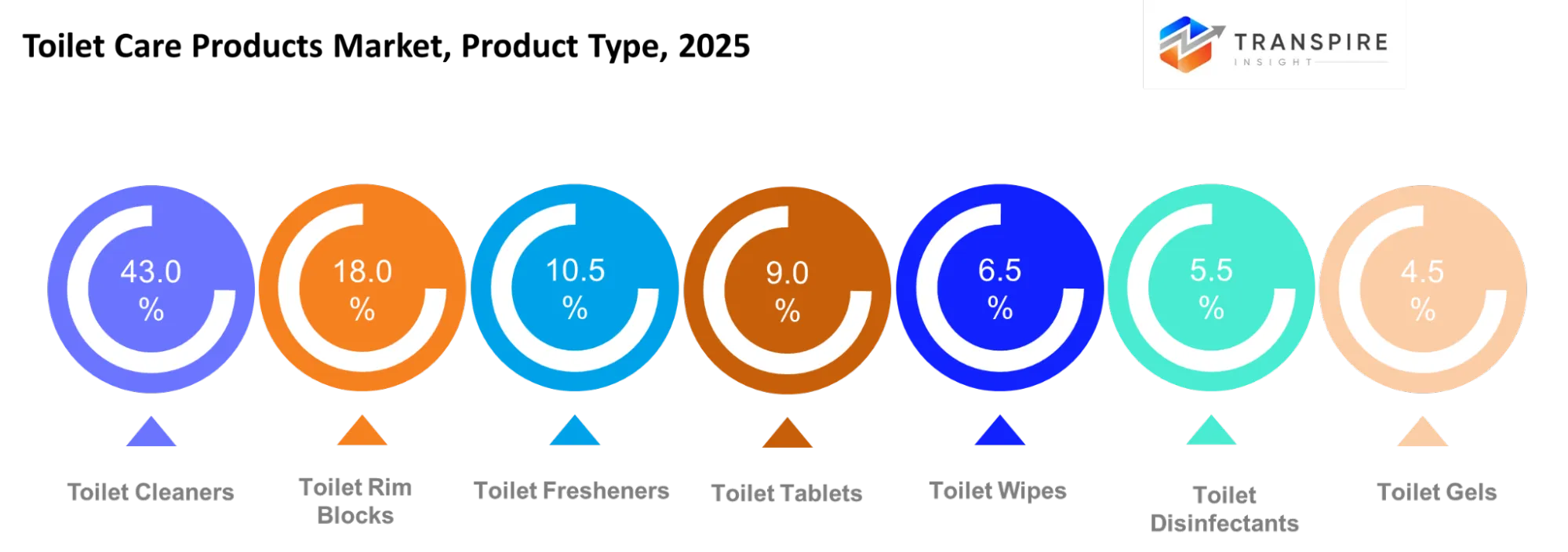
- Toilet cleaners account for 43.0% of the market, owing to the significance of these products in the removal of stains and maintaining the washroom.
- Toilet rim blocks constitute 18.0% of the market, meeting the demands for products that continuously keep the toilets fresh even without cleaning.
- Toilet fresheners make up 10.5%, emphasising the significance of odour control in addition to basic toilet hygiene.
- Toilet tablets make up 9.0%, but the projected 7.9% CAGR indicates that they are the fastest-growing product segment in the supplied market forecast.
- Toilet wipes constitute 6.5%, catering to consumers who require convenience when cleaning toilet surfaces and surroundings.
- Toilet disinfectants make up 5.5% of the market, addressing the needs of consumers who care about hygiene and the elimination of microbes.
- Toilet gels hold 4.5%, and they offer a different method of application by consumers.
What are the Key Drivers, Restraints, and Opportunities in the Toilet Care Products Market?
Drivers
Improved household hygiene, as a result of more emphasis on cleaning households and keeping shared restrooms clean, is helping to drive sales of toilet cleansers, disinfectants and odour eliminators. Time-saving solutions are also appealing to busy households and public facilities managers - prompting innovations such as thick foams, targeted sprays, automatic toilet care and longer-lasting formulas. Innovation launches from Kao and Lion in 2025 demonstrate how a convenience message can set products apart.
Restraints
Cost can be an issue with certain consumer segments in certain regions because they have the choice to continue using more traditional brands and local manufacturers, as well as less expensive products. The cost variation of chemical components, packaging and logistics can affect profit margins. Environmental problems related to certain chemical components, packaging and disposable wipes can cause additional costs for reformulation, testing and information.
Opportunities
Toilet tabs, concentrates, refills and natural cleaning components are all opportunities for differentiating one's products. Companies can grow through access to online channels, subscription services and hotel/hospital and commercial cleaning contractors. There are opportunities in Asia Pacific through increased retail distribution and development of affordable products for emerging urban consumers. Effective cleaning performance, ingredient transparency and reduced packaging waste can also help companies premiumize their product range and earn customer loyalty.
|
Driver |
Relative Impact on Growth (%) |
Geographic Relevance |
Impact Timeline |
Demand Strength |
Growth Mechanism (5-10 words) |
Key Beneficiaries (5-10 words) |
Major Constraint (5-10 words) |
|
Rising hygiene awareness and sanitation consciousness |
28% |
Asia Pacific, North America, Europe |
Short-term |
High |
Increases regular toilet cleaning and disinfection frequency |
Household cleaners, disinfectant brands, and retail distributors |
Price sensitivity limits premium product adoption |
|
Growing demand for convenient and multifunctional cleaning products |
23% |
North America, Europe, Asia Pacific |
Short-term |
High |
Encourages adoption of gels, tablets, wipes, and rim blocks |
Consumer brands, product formulators, and e-commerce retailers |
Performance concerns and recurring purchase costs |
|
Urbanization and expanding residential and commercial infrastructure |
19% |
Asia Pacific, Middle East and Africa |
Long-term |
High |
Expands installed sanitation facilities and recurring cleaning needs |
Cleaning product manufacturers, facility managers, and distributors |
Uneven sanitation infrastructure and household purchasing power |
|
Rising preference for sustainable and safer toilet care formulations |
16% |
Europe, North America, Asia Pacific |
Medium-term |
Medium |
Drives demand for biodegradable ingredients and refillable packaging |
Green chemistry suppliers, sustainable brands, and packaging manufacturers |
Higher formulation costs and limited consumer willingness to pay |
|
Product innovation and expansion of digital retail channels |
14% |
North America, Asia Pacific, Europe |
Medium-term |
High |
Improves product differentiation, accessibility, and repeat purchases |
Consumer goods companies, technology vendors, and online retailers |
Intense competition and limited product differentiation |
|
Total |
100% |
— |
— |
— |
— |
— |
What Has the Impact of Artificial Intelligence Been on the Toilet Care Products Market?
The implementation of AI technologies at this moment is not fully a proven method of market development in the field of toilet care products.there is room for the possible use of AI technology to enhance the processes of manufacturing, distribution, and commercial planning. AI technologies can be used to predict purchases and seasonality and to avoid unnecessary inventory. Production facilities can employ machine learning to monitor equipment behaviour, plan maintenance work, and minimise unplanned downtime. Another possible application is related to quality control that can be done by machine vision sensors and other equipment. Packaging defects, inconsistent fill levels, and labelling mistakes can be detected during the production process. In sales and distribution, the predictive analytics can help to detect products that will have increased sales to distribute them to retailers, supermarkets and e-commerce websites. Those applications cannot be confused with the widespread use of AI technologies for toilet cleaner products. The biggest issue is connected to the needed investments to develop data systems, integrate them with equipment and train staff. Inconsistent historical data can make forecasts less accurate. For manufacturers, the most immediate application of AI is connected to operational efficiency and inventory while competing through cleaning results.
Instance
In August 2025, Primech AI introduced an advanced HYTRON autonomous bathroom-cleaning robot with AI-driven navigation, obstacle detection, and optimised cleaning routines. This innovation emphasises the ability of AI-powered automation to enhance hygiene, cleanliness, and sanitation in restrooms in commercial premises.https://primech.ai/primech-ai-unveils-the-all-new-hytron-next-generation-ai-powered-autonomous-bathroom-cleaning-robot-features-revolutionary-engineering-and-enhanced-performance/
Key Market Trends:
The market is moving away from simple toilet bowl cleaning products to convenient, target-oriented, and experience-oriented solutions. Distinction among products is made on the basis of application, scent, formula, and packaging.
- The cleaning products have moved from liquid cleaning agents to thick foam and spray-based cleaners, which can easily access the areas under the toilet bowl rim.
- Periodic and automatic types of cleaning are emerging as there is increased demand for products that ensure freshness between manual cleaning intervals.
- The development of the product is now based on easy and quick application, and reduction in scrubbing efforts.
- Sustainable development concerns are leading to increased demand for products in refills, concentrated forms, and natural ingredient formulas.
- E-commerce websites are bringing niche toilet cleaners into greater public awareness.
- Consumer feedback is being used by the manufacturers to enhance the functionality and packaging of their products.
- There is growing commercial demand for cleaners that provide consistent performance in frequently cleaned washrooms.
Toilet Care Products Market Segmentation
By product types
toilet cleaners have a leading position of 43.0% due to their necessity for stain removal, deposits, and general dirt. Rim blocks constitute 18.0% and target consumers who want to maintain freshness between cleanings. Toilet fresheners make up 10.5%, whereas toilet tablets make up 9.0% and are expected to register 7.9% CAGR. Other types of products include toilet wipes that account for 6.5%, toilet disinfectants at 5.5%, toilet gels at 4.5%, and other products at 3.0%.
By form
The market comprises liquid, gel, tablet, powder, block, spray, foam and other formats. Liquids follow familiar application routes, while gels and foam application contribute to adhesion to surfaces. Tablets and blocks lend themselves to applications where dosing or sustained release are important. Powders and sprays are useful in particular cleaning applications. Future product development will probably be driven by simplicity of use, storage and formulation efficiency.
By application
Residential applications are most often associated with regular household cleaning, but commercial and institutional locations will need products that provide consistency in cleaning shared washrooms. Consumer service providers such as hospitality will need products that satisfy guest needs or eliminate odours, while healthcare providers will focus on the proper application of hygiene. Industrial sites and public services are likely to need heavy-duty products with known cleaning regimens.
By distribution channel
Supermarkets offer visibility and support from well-known brands. Convenience stores provide immediate purchasing ability. Speciality stores cater to the needs of individual consumers. E-commerce offers a direct-to-consumer distribution channel where consumers have the option to compare and contrast the products available and home delivery. Wholesale and direct sales are also relevant for business customers who buy in bulk quantities.
By nature
The traditional items continue to attract consumers who demand functionality without surprises and at a fair price. Organic, natural, eco-friendly, biodegradable, plant-based and chemical-free positioning creates points of differentiation among consumers who are ingredient-conscious as well as environmentally-conscious. These are not interchangeable.
By end user
Houses are one such consumer group that is important owing to the fact that toilet cleaning is a routine activity in any house. Hotels and restaurants will require reliable products to be used for maintaining guest toilets and customer toilets, whereas offices, hospitals, and schools will need products that suit public places. This opens up avenues for companies offering such products.
What are the Key Use Cases Driving the Toilet Care Products Market?
Cleaning of toilet bowls remains the use case for this market thanks to toilet cleaners. The items allow for eliminating any visible stains, deposits of minerals and other dirt from bathrooms at private homes and community buildings. Other applications include hotels, restaurants, office buildings, schools and all other public facilities where regular cleaning and elimination of smells impact the experience of using these places. Each item may have various functions starting from keeping the smells until the next cleaning process and up to being part of the hygiene routine. There are some new use cases that include reducing the amount of work and doing something more than just clean the bowl. Such alternatives may include foam sprays, tablets and room air fresheners that can help people to make their life easier.
|
Report Metrics |
Details |
|
Market size value in 2025 |
USD 10.50 Billion |
|
Market size value in 2026 |
USD 11.05 Billion |
|
Revenue forecast in 2033 |
USD 15.80 Billion |
|
Growth rate |
CAGR of 5.24% from 2026 to 2033 |
|
Base year |
2025 |
|
Historical data |
2021 - 2024 |
|
Forecast period |
2026 - 2033 |
|
Report coverage |
Revenue forecast, competitive landscape, growth factors, and trends |
|
Regional scope |
United States; Canada; Mexico; United Kingdom; Germany; France; Italy; Spain; Denmark; Sweden; Norway; China; Japan; India; Australia; South Korea; Thailand; Brazil; Argentina; South Africa; Saudi Arabia; United Arab Emirates |
|
Key company profiled |
Reckitt, Procter & Gamble, Unilever, SC Johnson, Henkel, Colgate-Palmolive, Church & Dwight, Clorox, Kao Corporation, Ecolab, Diversey, Kimberly-Clark, Dabur, Jyothy Labs, Godrej Consumer Products |
|
Customization scope |
Free report customization (country, regional & segment scope). Avail customized purchase options to meet your exact research needs. |
|
Report Segmentation |
Product Type (Toilet Cleaners, Toilet Rim Blocks, Toilet Fresheners, Toilet Tablets, Toilet Wipes, Toilet Disinfectants, Toilet Gels, Others)Form (Liquid, Gel, Tablet, Powder, Block, Spray, Foam, Others)Application (Residential, Commercial, Institutional, Hospitality, Healthcare, Industrial, Public Facilities, Others)Distribution Channel (Supermarkets, Hypermarkets, Convenience Stores, Specialty Stores, E-commerce, Wholesale, Direct Sales, Others)Nature (Conventional, Organic, Natural, Eco-Friendly, Biodegradable, Plant-Based, Chemical-Free, Others)End User (Households, Hotels, Restaurants, Offices, Hospitals, Schools, Retail Facilities, Industrial Facilities) |
Which Regions are Driving the Toilet Care Products Market Growth?
North America
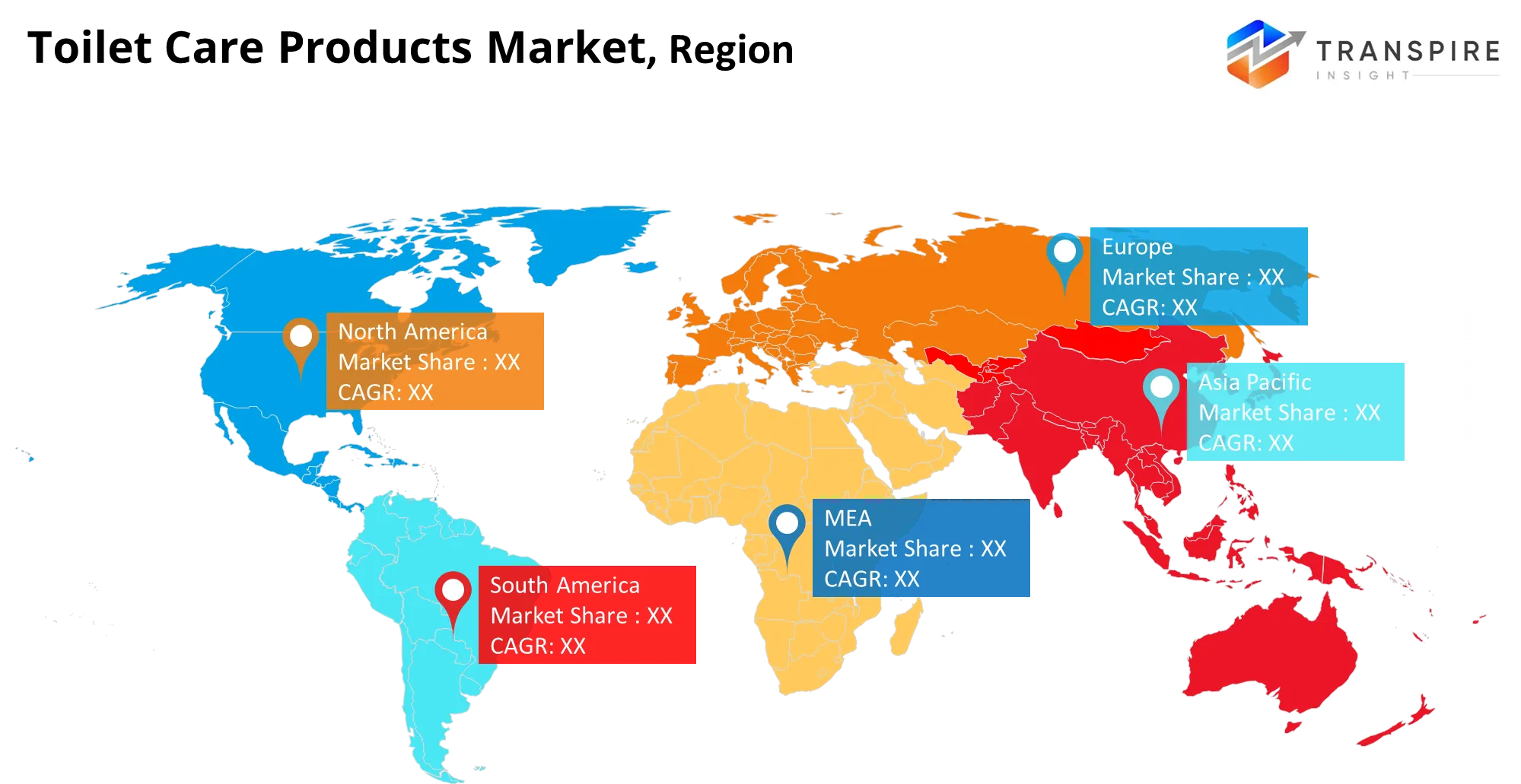
The North American region constitutes 24.0% of the total market for toilet care products, owing to the presence of well-established home cleaning practices and convenience-based hygiene requirements. The product can be accessed through supermarkets, hypermarkets and e-retailers. Washroom cleaning is also required in commercial, hospitality and institutional establishments. Easy-to-use, fragranced and efficient cleaning products are some of the ways in which differentiation can be achieved.
In October 2025, MG Inventions Canada Inc. released the Automatic Toilet Cleaning System in the United States via Green Distribution LLC due to the need for efficient toilet cleaning methods. https://natlawreview.com/press-releases/atcs-innovative-automatic-toilet-bowl-cleaner-launches-us-green-distribution
Europe
Europe accounts for 26.1% of the market, thanks to well-established distribution channels, mature home care categories and demand for effective cleaning products. Consumers have a choice of conventional products, fragranced products and eco-friendly products. Availability and brand name are key factors that enable repeat purchase. Manufacturers who manage to combine cleaning effectiveness with ingredient information and packaging innovations could benefit from this market.
March 2025, Reckitt has made some achievements in sustainable Harpic packaging with the use of 75% post-consumer recycled plastic in Europe. https://www.reckitt.com/media/vudpe3c0/19-03-25_2_reckitt_sustainability-report-2024-1.pdf
Asia Pacific
Asia Pacific holds the leading position among the supplied regional estimates and has a 35.9% market share due to its large population of consumers, developed cities, and wider availability of packages of cleaning products. The growing distribution system of modern retailers and online shops is ensuring wider availability both in cities and emerging markets. There remains a need for affordable products, as well as more specialised formats for more convenient product delivery.
July 2025, The Kao Malaysia Company launched the Magiclean Toilet Bubble Pack Spray, which is meant to make toilet bowl cleaning easier. https://www.kao.com/my/news/2025/20250731-001/
Who are the Key Players in the Toilet Care Products Market and how do they Compete?
Competition in the toilet care products market is based on brand recognition, effectiveness of the product, price, availability, and making the process of routine cleaning easier. Some of the main players in the market are Reckitt, Procter & Gamble, The Clorox Company, Henkel, Kao Corporation, SC Johnson, Church & Dwight and Lion Corporation. Their competitive positions depend on the country, their product range, and distribution. Well-known brands have advantages because of the familiarity of consumers, whereas smaller and specialized companies can compete due to their unique formulas, alternative ingredients and e-commerce. Reckitt is competing in the market through its Harpic brand by providing products for general toilet cleaning purposes via a wide network of retailers and established brands.Kao differentiates its Magiclean product range through convenient application methods and foam cleaning technology. The Clorox Company competes through its innovative ToiletWand cleaning system and development of its products. In August 2026, it made a statement about further improvements in usability, packaging and availability of its products. Some of the strategies used by companies in order to grow are improving their online presence, widening their product range, and addressing commercial customers.
Toilet Care Products Market companies
- Reckitt
- Procter & Gamble
- Unilever
- SC Johnson
- Henkel
- Colgate-Palmolive
- Church & Dwight
- Clorox
- Kao Corporation
- Ecolab
- Diversey
- Kimberly-Clark
- Dabur
- Jyothy Labs
- Godrej Consumer Products
|
Company |
Est. Revenue Share Range |
Key Offerings |
Strategic Positioning |
Geographic Strength |
Technology Focus |
|
Reckitt |
Estimated 8-14% |
Harpic toilet cleaners, toilet blocks, rim blocks, disinfecting gels |
leadership through hygiene-focused innovation |
Europe, Asia Pacific, North America |
Advanced disinfectant formulations and lasting fragrance |
|
Procter & Gamble |
Estimated 5-10% |
Toilet cleaners, bathroom cleaning products, antimicrobial cleaning solutions |
Brand-led differentiation and extensive retail distribution |
North America, Europe, Asia Pacific |
Advanced cleaning chemistry and consumer-driven innovation |
|
Henkel AG & Co. KGaA |
Estimated 5-9% |
Bref toilet blocks, toilet gels, rim cleaners, automatic fresheners |
Specialized toilet hygiene portfolio and product diversification |
Europe, Asia Pacific |
Continuous-release fragrance and targeted cleaning formulations |
|
The Clorox Company |
Estimated 5-9% |
Clorox toilet bowl cleaners, bleach-based cleaners, disinfecting products |
Disinfection-led differentiation and established retail presence |
North America, Latin America |
Bleach chemistry and germ-killing formulations |
|
S. C. Johnson & Son |
Estimated 4-8% |
Scrubbing Bubbles toilet cleaners, Duck toilet products, cleaning gels |
Convenience-focused products and established household brands |
North America, Europe, Asia Pacific |
Adhesive toilet gels and sustained fragrance delivery |
|
Unilever |
Estimated 3-7% |
Domestos toilet cleaners, toilet gels, bleach-based hygiene products |
Affordable hygiene solutions and emerging-market penetration |
Europe, Asia Pacific, Latin America |
Disinfectant chemistry and concentrated cleaning formulations |
|
Church & Dwight Co., Inc. |
Estimated 2-5% |
Kaboom bathroom cleaners, toilet cleaning products, household cleaning solutions |
Value-oriented competition and targeted household cleaning |
North America |
Surface-cleaning chemistry and convenient application formats |
|
Kao Corporation |
Estimated 1-4% |
Toilet Magiclean cleaners, toilet cleaning liquids, bathroom hygiene products |
Regional brand strength and formulation-led differentiation |
Asia Pacific, particularly Japan |
Specialized cleaning formulations and user-friendly packaging |
|
Dabur India Ltd. |
Estimated 1-3% |
Sanifresh toilet cleaners, toilet cleaning liquids, household hygiene products |
Value-based competition and distribution-led expansion |
Asia Pacific, particularly India |
Cost-efficient formulations and accessible product formats |
|
Werner & Mertz GmbH |
Estimated 0.5-2% |
Frosch toilet cleaners, acidic toilet gels, eco-friendly hygiene products |
Sustainability-led differentiation and environmentally conscious positioning |
Europe |
Biodegradable formulations and environmentally considerate packaging |
Recent Development News
In July 2025, Kao Malaysia launched the Magiclean Toilet Bubble Pack Spray. This is a spray that comes with a foam application that goes under the toilet rim. The product launch is an example of how manufacturers have been trying to differentiate their toilet care products by offering convenience-based formats.https://www.kao.com/my/news/2025/20250731-001/
In February 2026, Poo~Pourri launches its Flushable Wipes, which it markets based on convenience and flushability criteria. The product launch demonstrates possibilities in the area of bathroom hygiene and personal care routines.https://www.prnewswire.com/news-releases/poopourri-gets-cheeky-again-with-the-launch-of-flushable-wipes-302693890.html
What Strategic Insights Define the Future of the Toilet Care Products Market?
The market for toilet care products is increasingly driven by innovations that provide effective cleaning along with convenience, freshness, and better-formulated products. While conventional toilet cleaners dominate the supplied market estimate, the prospects of toilet tablets indicate that there is a need to give due consideration to other forms of packaging. Another important risk is that companies may develop products based on premium formulas and sustainability claims without making sure that customers are willing to pay extra. Volatility of raw materials, intense price competition, and product claims are some factors that can reduce margins even further. Hence, before starting the production process, it is imperative for manufacturers to test new products in the market. One of the opportunities is to develop affordable and convenient products for underpenetrated markets while increasing distribution online and through refills. Asia Pacific offers a good base for such an opportunity, while the supplied growth estimate in the Middle East and Africa region makes it possible to expand selectively.
Product Type
- Toilet Cleaners
- Toilet Rim Blocks
- Toilet Fresheners
- Toilet Tablets
- Toilet Wipes
- Toilet Disinfectants
- Toilet Gels
- Others
Form
- Liquid
- Gel
- Tablet
- Powder
- Block
- Spray
- Foam
- Others
Application
- Residential
- Commercial
- Institutional
- Hospitality
- Healthcare
- Industrial
- Public Facilities
- Others
Distribution Channel
- Supermarkets
- Hypermarkets
- Convenience Stores
- Specialty Stores
- E-commerce
- Wholesale
- Direct Sales
- Others
Nature
- Conventional
- Organic
- Natural
- Eco-Friendly
- Biodegradable
- Plant-Based
- Chemical-Free
- Others
End User
- Households
- Hotels
- Restaurants
- Offices
- Hospitals
- Schools
- Retail Facilities
- Industrial Facilities
By Regional Analysis
North America
- US
- Canada
- Mexico
Europe
- Germany
- UK
- France
- Italy
- Spain
- Russia
- Rest of Europe
Asia Pacific
- China
- Japan
- India
- South Korea
- Australia
- Rest of Asia Pacific
South America
- Brazil
- Argentina
- Rest of South America
Middle East & Africa
- UAE
- Saudi Arabia
- Qatar
- South Africa
- Rest of the Middle East & Africa
Frequently Asked Questions
Find quick answers to common questions.
The toilet care products market size was valued at USD 10.50 Billion in 2025 and is poised to reach USD 15.80 billion by 2033, expanding at a 5.24% CAGR.
Key segments for the toilet care products market are Product Type (Toilet Cleaners, Toilet Rim Blocks, Toilet Fresheners, Toilet Tablets, Toilet Wipes, Toilet Disinfectants, Toilet Gels, Others)Form (Liquid, Gel, Tablet, Powder, Block, Spray, Foam, Others)Application (Residential, Commercial, Institutional, Hospitality, Healthcare, Industrial, Public Facilities, Others)Distribution Channel (Supermarkets, Hypermarkets, Convenience Stores, Specialty Stores, E-commerce, Wholesale, Direct Sales, Others)Nature (Conventional, Organic, Natural, Eco-Friendly, Biodegradable, Plant-Based, Chemical-Free, Others)End User (Households, Hotels, Restaurants, Offices, Hospitals, Schools, Retail Facilities, Industrial Facilities)
Growth is primarily driven by increasing demand for effective cleaning and disinfection solutions, rapid urbanization, growing disposable incomes, product innovation, and the rising preference for convenient and eco-friendly toilet care products
The market is led by major manufacturers including Reckitt, Procter & Gamble, Unilever, SC Johnson, Henkel, Colgate-Palmolive, Church & Dwight, Clorox, Kao Corporation, Ecolab, Diversey, Kimberly-Clark, Dabur, Jyothy Labs, Godrej Consumer Products
The market share of the Asia Pacific region in toilet care products is 35.9%, due to factors such as fast-paced urbanization, increased hygiene concerns, rising disposable income levels, an increase in middle-class population, and need for easy-to-use toilet cleaning products.
Opportunities within the toilet care products market are the growth in demand for environment-friendly cleaning products, increased usage of high-end toilet care products, increased growth through electronic commerce, innovation in toilet cleaning formulations, and the increasing demand in developing countries because of increased awareness regarding hygiene issues.
- Reckitt
- Procter & Gamble
- Unilever
- SC Johnson
- Henkel
- Colgate-Palmolive
- Church & Dwight
- Clorox
- Kao Corporation
- Ecolab
- Diversey
- Kimberly-Clark
- Dabur
- Jyothy Labs
- Godrej Consumer Products
About the Authors

Chetan Dhatrak
I’m Chetan Dhatrak, a Senior Research Analyst at Transpire Insight, specializing in the Consumer Goods, Foods and Beverages industry. I focus on analyzing market trends, consumer behavior, competitive landscapes, and industry developments to deliver accurate, data-driven insights. My research at Transpire Insight is built on credible sources and in-depth analysis, helping businesses and readers better understand market dynamics, emerging opportunities, and evolving consumer preferences. I’m committed to creating reliable, well-researched content that supports informed decision-making and reflects the latest developments in the consumer goods and food & beverage sectors.

Chakradhar Khansole
Chakradhar serves as the Research Director at Transpire Insight, bringing over 8 years of experience in technology, innovation, and strategic market intelligence. He specializes in transforming complex market data into actionable business insights that enable organizations to make informed, growth-oriented decisions. Recognized for his strategic vision and analytical expertise, Chakradhar leads high-impact research initiatives, delivering comprehensive market assessments, competitive intelligence, and forward-looking industry analysis.
Recently Published Reports
-
Apr 2026
Bottled Water Market
Bottled Water Market Size, Share & Analysis Report By Product Type (Still Bottled Water, Carbonated Bottled Water, Functional Bottled Water, and Others), By Packaging (PET, Cans, and Others), By Sales Channel (Supermarkets/Hypermarkets, Convenience Stores/Drug Stores, Grocery Stores/Club Stores, Foodservice, and Others) and Geography (North America, Europe, Asia-Pacific, Middle East and Africa, South and Central America), 2021 - 2032
-
Apr 2026
Color Cosmetic Packaging Market
Color Cosmetic Packaging Market Size, Share & Analysis Report By Application (Mascara Packaging, Liquid Packaging, and Liquid Face), By Type (Tubes & Bottles, Pens & Markers, Compacts & Containers, and Droppers & Pumps), and Geography (North America, Europe, Asia-Pacific, Middle East and Africa, South and Central America), 2021 - 2031
-
Apr 2026
External Microphone For Camera Market
External Microphone For Camera Market Size, Share & Analysis Report By Type (Shotgun Microphone, Lavalier Microphone, and Others), By Application (Digital Camera, Professional Video Camera, and Others), and Geography (North America, Europe, Asia-Pacific, Middle East and Africa, South and Central America), 2021 - 2031
-
Apr 2026
Foot Orthotic Insoles Market
Foot Orthotic Insoles Market Size, Share & Analysis Report By Type (Pre-fabricated, and Custom-made), By Material (Thermoplastic, Composite Carbon Fiber, and Others), By Distribution Channel (Drug Stores, Hospitals & Clinics, and Others), and Geography (North America, Europe, Asia-Pacific, Middle East and Africa, South and Central America), 2021 - 2031