Healthcare Payment Integrity Market Summary:
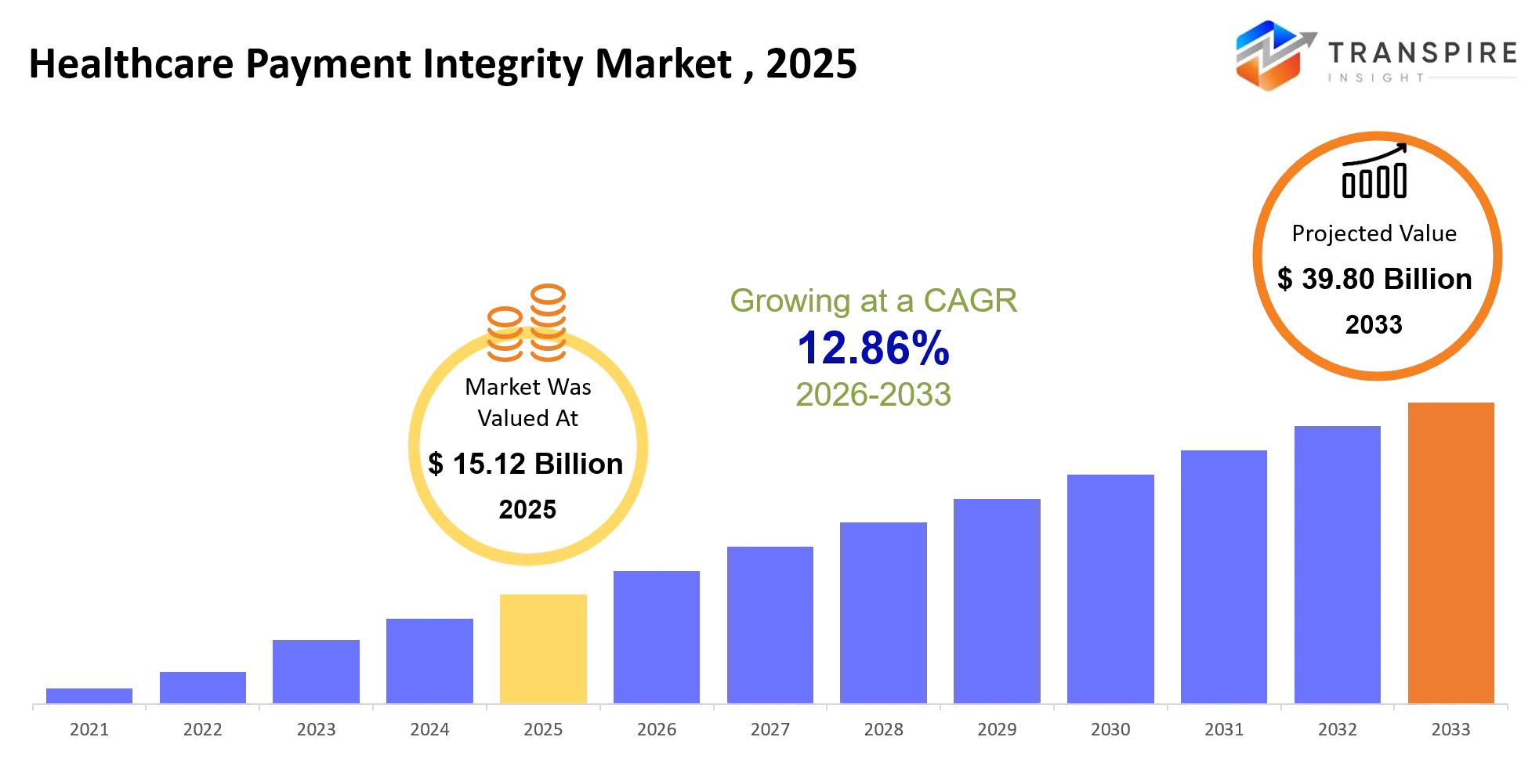
As per the Transpire Insight Analysis, The Healthcare Payment Integrity Market size is estimated at USD 15.12 billion in 2025 and is anticipated to reach USD 39.80 billion by 2033, growing at a CAGR of 12.86% from 2026 to 2033.
The healthcare payment integrity market helps payers, government healthcare programs, and employers confirm the payment of accurate health bills, ensure contractual compliance, and detect unwarranted or fraudulent spending. The last three to five years have seen a move away from retrospective audits towards end-to-end controls that capture high-quality claims data before, during, and post-authorisation. This vital change in market structure has been driven largely by the advent of 'cloud analytics' and AI- assisted claim review, which has helped payers to analyse increased quantities of clinical, billing and provider data. The opening up of complex, sequential treatment pathways, speciality medicines and value-based reimbursement models has reduced the viability of manual validation. Stringent state and federal oversight of wrong payments, alongside the demand to contain healthcare spending, has driven further investment. Increasing numbers of claims and billing complexity result in money left on the table through wrong payments – automating detection, setting up follow-up case investigations, and faster recoveries make economic sense for payers.
Healthcare Payment Integrity Market Size & Forecast:
- Market Size 2025: USD 15.12 Billion
- Expected Market Value (2033): USD 39.80 Billion
- Forecast CAGR (2026–2033): 12.86%
- Leading Region in 2025: North America
- Fastest Growing Region: Asia Pacific
- Key Company Profiles: Cotiviti; Optum; Zelis; Conduent Inc.; EXL Service; SAS Institute; HealthEdge; Apixio; Gainwell Technologies; NTT DATA; ClarisHealth; LexisNexis Risk Solutions; Machinify; Waystar; Edifecs.
Key Healthcare Payment Integrity Market Insights:
Payment integrity is moving from single fraud detection to enterprise-wide payment accuracy platforms powered by AI to stop payment leakage before claims are paid. Vendors are going beyond claims editing to differentiate with clinical intelligence, configurable workflows, and end-to-end program management.
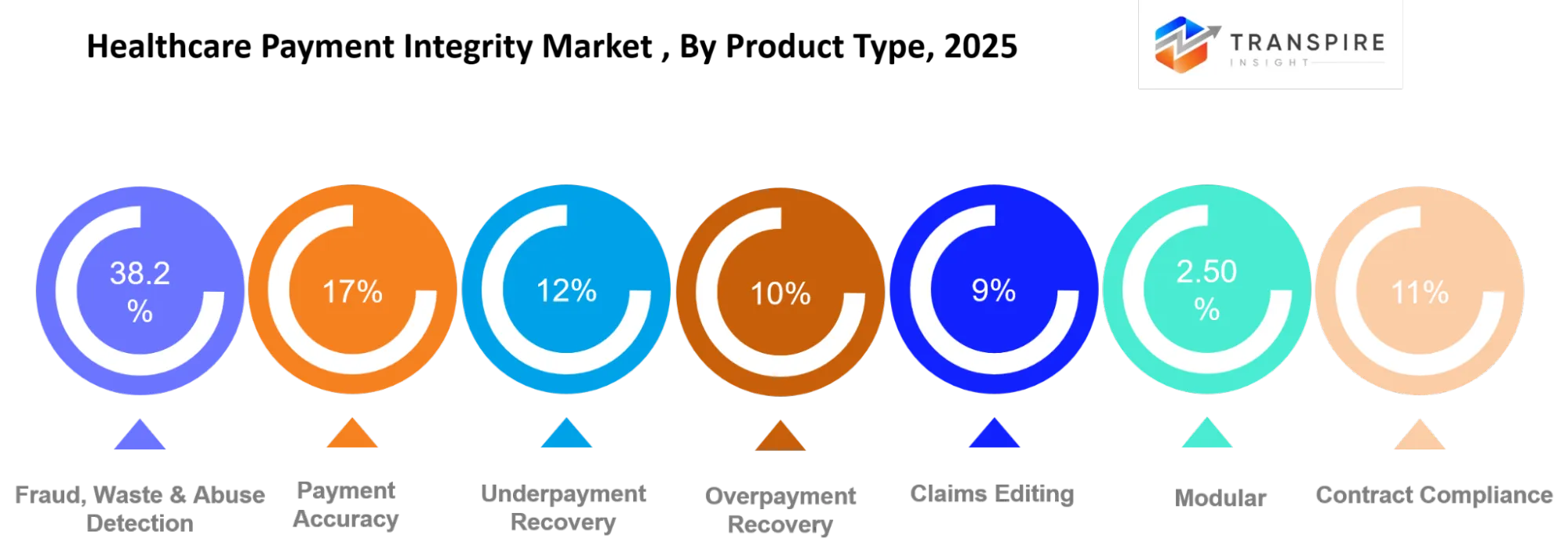
- Fraud, waste, and abuse detection accounts for 38.22% of the market, and today, Machinify is supporting more than 60 health plans that cover more than 160 million lives.
- ClarisHealth's Pareo platform will drive payment accuracy to increase by 17.00%, as it integrates pre-pay, post-pay, analytics, recovery, and vendor activity.
- Underpayment recovery, which experienced a 12.00% growth, is progressing with AI-powered tools that enable payers to match paid claims with contract terms and identify missed reimbursement.
- The overpayment recovery rate of 10.00% is increasingly focused, with predictive claim selection prioritising high-value audit cases.
- Claims editing, at 9.00%, is moving from static rules to machine-learning models that detect coding anomalies and duplicate services.
- Contract compliance, at 6.00%, is gaining importance as payers seek automated verification of negotiated rates across complex provider networks.
- At 5.00%, clinical appropriateness is growing as AI assesses medical necessity, especially in speciality and genetic-testing claims.
- Coordination of benefits is being modernized with cross-payer data matching and automated identification of overlapping coverage, which are at 2.78%.
- Cloud-based deployment accounted for 58.2% of transaction volume in 2025, driven by payers' preference for scalable, up-to-the-minute analytics.
What are the Key Drivers, Restraints, and Opportunities in the Healthcare Payment Integrity Market?
Driver:
Stricter oversight of public healthcare spending and persistent documentation errors are pushing insurers to invest in systematic claims validation. In January 2026, the Centers for Medicare & Medicaid Services (CMS) reported estimated fiscal-year 2025 improper payments of $28.83 billion in Medicare Fee-for-Service and $37.39 billion in Medicaid. These estimates include documentation and administrative errors, not just fraud. The financial exposure encourages payers to identify unsupported diagnoses, duplicate billing, and coding inconsistencies earlier, improving adoption of automated payment integrity systems.
Restraint:
Integration complexity limits adoption. Payment-integrity platforms must connect with legacy claims adjudication systems, provider contracts, clinical documentation, pharmacy data, and state-specific Medicaid rules. The problem persists because payer IT environments are fragmented and rules change frequently, making false positives, provider friction, and long implementation cycles difficult to eliminate.
Opportunity:
AI-assisted prepayment review, cloud analytics, and interoperable healthcare data create opportunities to prevent losses before funds leave payer systems. CMS launched its six-year Wasteful and Inappropriate Service Reduction (WISeR) Model in January 2026 across six states, combining advanced technology with human clinical review for selected Medicare services. This creates a practical pathway for vendors offering explainable risk scoring, clinical documentation checks, and auditable decision workflows. Providers and payers that combine preventive controls with post-payment recovery can improve financial accuracy without relying exclusively on retrospective audits.
What Has the Impact of Artificial Intelligence Been on the Healthcare Payment Integrity Market?
AI on top of the claim provides continuous risk management, as opposed to rule-based claim rules that rely on 100% coverage. ML is used to identify outlier billing patterns, duplicate services, upcoding, provider-level outliers, and coordination-of-benefits challenges across thousands of claims. Natural-language processing (NLP) is used to automate reviews of free-text clinical documentation and operative reports for medical necessity and appeals determination.
AI automates operational tasks such as claims editing, eligibility checks, coding validation, pre-payment review, and recovery workflows. This allows payers to automate processes with high accuracy without overburdening their investigators. Payers also leverage predictive models to proactively identify a small set of claims likely to contain waste, fraud, or underpayment, reducing investigators' workload and the number of false positives while increasing payment accuracy. The biggest challenge is implementation risk, as models depend on historical clean claims data, legacy adjudication system integration, and clinical validation to prevent false positives from delaying healthcare provider payments and inflating appeals. Providers have also deployed NLP models to automate documentation and coding, meaning model sets must constantly adapt to new provider behaviours.
In March 2026, Optum Real partnered with Microsoft to merge real-time claims processing infrastructure with advanced cloud and AI solutions, including Microsoft Azure and Dragon Copilot. This collaboration accelerates the claims and reimbursement lifecycle by instantly connecting payers and providers, drastically lowering the administrative burden and processing errors historically tied to manual claims adjudication.
https://www.healthcarefinancenews.com/news/optum-real-microsoft-partner-ai-claims-and-reimbursement
Key Healthcare Payment Integrity Market Trends:
Payment integrity is no longer about recouping the wrong payment; it's about preventing it from ever being made. Combining automation, clinical evidence and continuous monitoring, payers are looking to safeguard margins and reduce unnecessary administrative tasks.
- Payers are shifting from post-payment to pre-payment and concurrent review, minimising disputes and recovery expenses.
- Static billing rules for fraud, waste, and abuse detection are being replaced by AI-based anomaly detection.
- Payers demand scalable claims analytics without significant on-premises infrastructure, which is driving the growth of cloud and SaaS deployment.
- CMS has broadened its oversight of Medicare Advantage, such as by pledging to audit every Medicare Advantage contract annually, which has raised the demand for audit-ready platforms.
- Payment integrity is becoming a part of revenue-cycle management, allowing for both payer-provider transparency and insight into denials, underpayments, and contract performance.
- Payers are increasingly turning to clinical evidence and NLP to evaluate medical necessity beyond coding mistakes, and the number of clinical appropriateness reviews is also on the rise.
- As high-cost drug and behavioural-care use continues to grow, the claims are getting special attention for their integrity.
- Managed and BPO services are becoming more popular as payers continue to delegate more complex audit, appeal, and recovery work.
- AI is increasingly being used for documentation and appeals, while payers are increasingly being moved toward more advanced and explainable detection models.
Healthcare Payment Integrity Market Segmentation
Solution Type:
Fraud, waste, and abuse detection leads with a 38.22% share because it addresses the highest-risk payment leakage across medical, pharmacy, and speciality claims. Payment accuracy and underpayment recovery are the fastest-growing areas, with payment accuracy projected at 17.00% growth and underpayment recovery at 12.00%, as payers and providers seek contract-level reimbursement accuracy. Overpayment recovery, at 10.00%, remains essential for duplicate-claim and erroneous-payment recovery, while claims editing grows at 9.00% through automated coding and billing-rule validation. Contract compliance, at 6.00%, is expanding as payers audit claims against negotiated provider terms. Clinical appropriateness, at 5.00%, is rising with AI-supported medical-necessity review, while coordination of benefits, at 2.78%, remains a specialized but important control for multi-insurer claims.
Service Stage:
Pre-payment review helps prevent unsupported claims from being paid, while post-payment review identifies errors that escape initial controls. Concurrent review supports real-time intervention, and claims adjudication validates eligibility, coding, and reimbursement rules before settlement. Recovery and audit functions address incorrect payments, while appeals provide mechanisms for resolving disputed findings. Continuous monitoring enables payers to detect recurring billing anomalies and emerging risk patterns. Together, these service stages support stronger financial controls, faster claim resolution, and reduced administrative losses across the reimbursement lifecycle.
Component:
Software and analytics enable automated claim screening, anomaly detection, and risk prioritisation, helping payers review large claim volumes more efficiently. Consulting and implementation services support the integration of payment integrity tools with legacy claims platforms and reimbursement systems. Managed services and business process outsourcing provide additional operational capacity when internal teams face complex investigations or resource constraints. Audit services help validate findings, while support and maintenance keep systems aligned with changing coding rules, payer policies, and regulatory requirements.
Claim Type:
Medical and hospital claims require detailed checks of clinical documentation, treatment codes, and medical necessity because complex admissions can generate substantial reimbursement discrepancies. Dental and vision claims involve specialised procedure codes and benefit limits, while pharmacy claims require prescription, eligibility and dispensing validation. Behavioural health claims introduce challenges involving service documentation and treatment frequency. Speciality, professional, and other claims benefit from targeted analytical checks that reflect their distinct billing structures. As treatment complexity rises, evidence-based validation can improve payment accuracy.
Deployment:
Cloud and software-as-a-service (SaaS) deployments enable scalable claims analysis, faster updates, and centralised monitoring without extensive local infrastructure. Public cloud environments offer flexible computing capacity, whereas private cloud and on-premises models provide greater control over sensitive data and internal security requirements. Hybrid architectures allow payers to combine cloud analytics with established claims systems. Hosted and managed deployment models reduce internal technical workloads. Selection depends on data governance, integration complexity, operating budgets, and security requirements, with interoperability remaining essential for effective implementation.
End User:
Health insurers are major users of payment integrity solutions because they manage reimbursement accuracy, claims expenditure, and contractual obligations. Healthcare providers use these tools to identify underpayments, improve coding quality, and resolve disputed deductions. Government agencies apply payment controls to protect public healthcare budgets, while employers seek greater transparency in health-benefit spending. Third-party administrators (TPAs) and pharmacy benefit managers (PBMs) use analytics to validate claims and improve operational efficiency. Healthcare networks and other payers can strengthen accountability through shared data, coordinated reviews, and consistent payment policies.
What are the Key Use Cases Driving the Healthcare Payment Integrity Market?
The leading use case is fraud, waste, and abuse detection, which aligns with the segment’s 38.22% market position. Health insurers and government payers use AI models, claims editing, and provider-behaviour analytics to identify duplicate billing, upcoding, medically unnecessary services, and suspicious utilisation before payment.
Expanding applications include payment accuracy, underpayment recovery, and contract compliance. Providers and payers now use analytics to compare paid amounts against negotiated rates, identify missed reimbursements, and resolve claim-level discrepancies, particularly in hospital, professional, and speciality claims.
Emerging use cases focus on continuous monitoring and affordability. Payers are applying predictive models to pharmacy, behavioural-health, and high-cost speciality claims, while integrating payment integrity with revenue-cycle systems to anticipate denials, prevent avoidable spend, and support value-based care.
|
Report Metrics |
Details |
|
Market size value in 2025 |
USD 15.12 Billion |
|
Market size value in 2026 |
USD 17.06 Billion |
|
Revenue forecast in 2033 |
USD 39.80 Billion |
|
Growth rate |
CAGR of 12.86% from 2026 to 2033 |
|
Base year |
2025 |
|
Historical data |
2021 - 2024 |
|
Forecast period |
2026 - 2033 |
|
Report coverage |
Revenue forecast, competitive landscape, growth factors, and trends |
|
Regional scope |
United States; Canada; Mexico; United Kingdom; Germany; France; Italy; Spain; Denmark; Sweden; Norway; China; Japan; India; Australia; South Korea; Thailand; Brazil; Argentina; South Africa; Saudi Arabia; United Arab Emirates |
|
Key companies profiled |
Cotiviti; Optum; Zelis; Conduent Inc.; EXL Service; SAS Institute; HealthEdge; Apixio; Gainwell Technologies; NTT DATA; ClarisHealth; LexisNexis Risk Solutions; Machinify; Waystar; Edifecs. |
|
Customization scope |
Free report customization (country, regional & segment scope). Available customized purchase options to meet your exact research needs. |
|
Report Segmentation |
Solution Type (Fraud, Waste & Abuse Detection, Payment Accuracy, Underpayment Recovery, Overpayment Recovery, Claims Editing, Contract Compliance, Clinical Appropriateness); Service Stage (Pre-Payment Review, Post-Payment Review, Concurrent Review, Claims Adjudication, Recovery, Audit, Appeals, Continuous Monitoring); Component (Software, Consulting, Implementation, Managed Services, Analytics, BPO, Audit Services, Support & Maintenance); Claim Type (Medical, Dental, Vision, Pharmacy, Behavioral Health, Specialty, Hospital, Professional Claims); Deployment (Cloud, On-Premises, Hybrid, SaaS, Private Cloud, Public Cloud, Hosted, Managed Deployment); End User (Providers, Health Insurers, Government Agencies, Employers, TPAs, PBMs, Healthcare Networks, Other Payers) |
Which Regions are Driving the Healthcare Payment Integrity Market Growth?
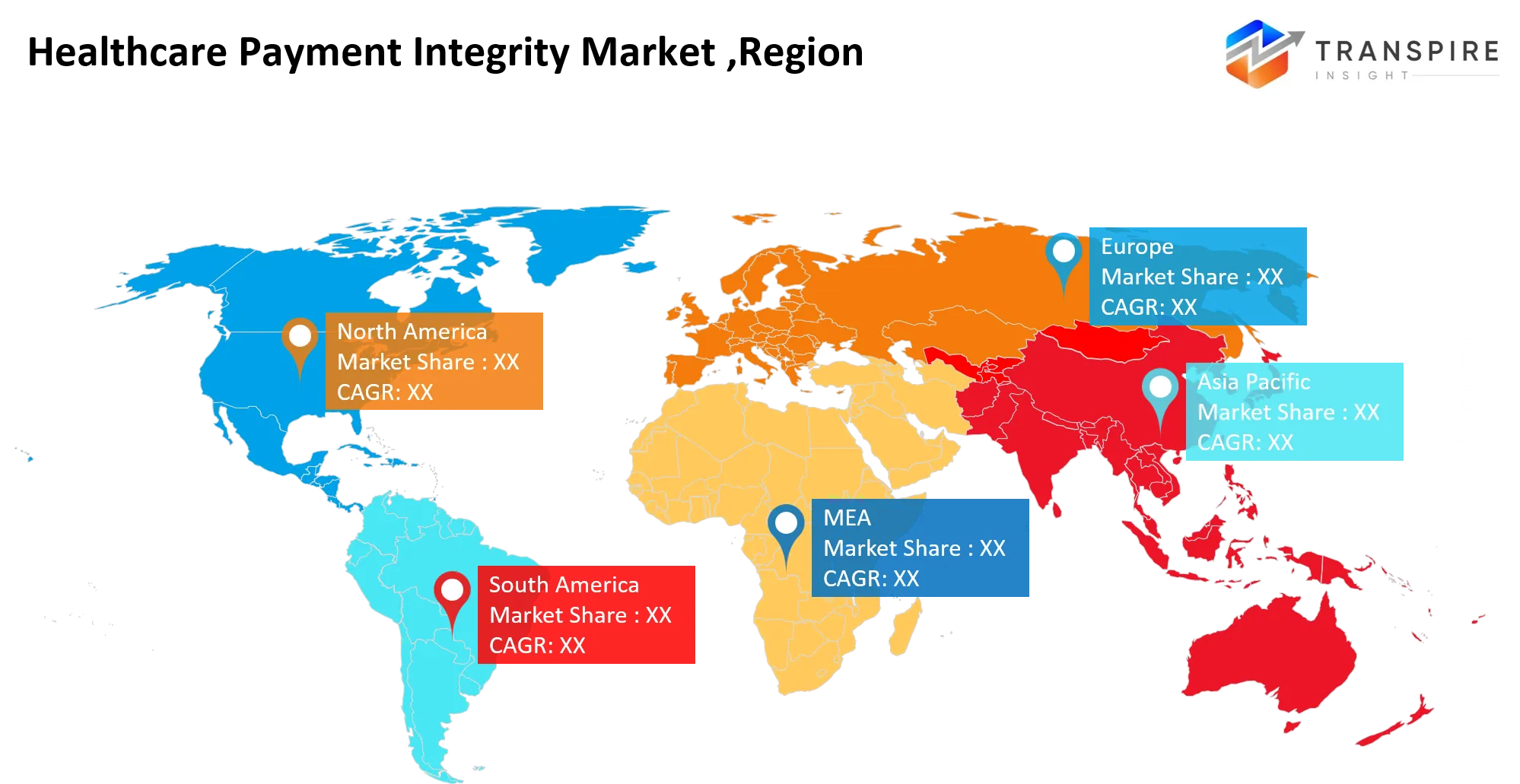
North America holds 42.10% of the market share and is driven by a multi-payer environment with high claims volumes and continued investment in controls for fraud, waste, and abuse. North America is a mature payer market with stringent CMS audit requirements, a vibrant ecosystem of payment integrity technology and managed service providers, and exposure to federal improper payments and Medicare Advantage oversight, which drive insurers and government payers to utilise prepayment analytics.
In June 2026, tech-enabled healthcare operations firm Sagility acquired CareSeed, a specialised healthcare analytics company.
Europe accounts for 26.00% of the market. European growth is described as growth in speed, stability, and compliance. Whereas the main focus in North America is on cost containment and fraud prevention, European adoption is driven by data residency policies, public payer systems, and national healthcare digitalisation initiatives. EU's remaining ramp-up in payment integrity capabilities through 2028 is estimated to drive demand for a secure, interoperable audit and claims review platform.
In September 2026, Tandem Health secured $100 million in Series B funding to scale its clinical workflow and administrative AI platform across European healthcare networks.
The Asia-Pacific Region accounts for 23.00% of the market and is expected to be the fastest-growing segment at a 14.12% compound annual growth rate. Increasing private coverage, digital health infrastructure, and processing of claims are encouraging insurers to automate verification procedures. Areas where demand is high, as health services are used at a rapid pace compared to what audit capabilities can support, hold promising growth opportunities. Regions like Latin America, with 4.50%, and the Middle East and Africa, with 4.40%, will likely see future adoption through payer investments and digital maturity of the local reimbursement ecosystem. Latin America, with 4.50%, and the Middle East and Africa, with 4.40%, remain early-stage markets where growth depends on insurance penetration, claims digitization, and public-sector modernization rather than mature fraud-analytics ecosystems.
In July 2026, Medi Assist launched its new Aadhaar Offline Verification capability to strengthen digital health insurance infrastructure and automate identity checks. This real-time, consent-based digital identity verification solution eliminates the need for physical paperwork and utilises location data to confirm that healthcare utilisation interactions are genuine.
Who are the Key Players in the Healthcare Payment Integrity Market, and how do they compete?
The marketplace focuses on detection accuracy, recoverable savings, implementation costs, and claims system integration. Market differentiation varies with prepayment editing, postpayment audit, clinical intelligence, analytics, and managed services. Buyers are putting a premium on quantifiable financial results and seeking to eliminate redundant provider payments. Cotiviti combines payment accuracy, clinical analytics and audit experience with proactive coordination-of-benefits capabilities for early error detection and prevention; Optum leverages payer and provider data and payer-service capabilities; Zelis marries claims editing with payer-pricing and payment-cost management; Conduent and Gainwell Technologies leverage scale and configurable solutions for insurers and public-sector healthcare programs; EXL Service infuses analytics into outsourced operations, while NTT DATA brings payer systems modernization and integration experience; Claris Health deploys expertise in the complexities of payment integrity workflows; Apixio brings clinical data intelligence to payers; Health Edge focuses on payer administration systems; Lexis Nexis Risk Solutions markets identity and risk intelligence; Machinify applies AI to payment intelligence; Waystar provides automation for revenue-cycle management; and Edifecs emphasizes payer interoperability systems. Buyers' platform and automation focus is growing, with an emphasis on more specialised analytics and further automation.
Key Players are:
- Cotiviti
- Optum
- Zelis
- Conduent Inc.
- EXL Service
- SAS Institute
- HealthEdge
- Apixio
- Gainwell Technologies
- NTT DATA
- ClarisHealth
- LexisNexis Risk Solutions
- Machinify
- Waystar
- Edifecs
Recent Development News
In August 2026, Abacus Insights launched its Payment Integrity Suite, featuring a unified data foundation, transparent claims editing, and AI-powered complex claims auditing. The launch enables health plans to improve payment accuracy, strengthen oversight of external vendors, and identify reimbursement discrepancies through integrated data management.
In June 2026, Star Health and Allied Insurance partnered with Amplify Health through a three-year strategic agreement to deploy AI-led claims intelligence and healthcare analytics across its insurance operations. The partnership is designed to strengthen claims governance, detect potential misuse, improve claims quality, and support more accurate payment decisions.
In August 2026,Cotiviti launched Proactive COB. This AI-enabled coordination-of-benefits capability checks secondary health insurance details directly at enrollment before claims are submitted, allowing health plans to proactively prevent improper payments and reduce administrative friction downstream.
What Strategic Insights Define the Future of the Healthcare Payment Integrity Market?
The industry is shifting towards preventive, enterprise-wide payment intelligence that anticipates risks pre-adjudication and treats payment integrity as a key aspect of affordability management. The hidden gotcha in this shift is model drift: as more providers recognise AI coding and documentation auto-adjudication, payer detection models will generate more false positives that in turn increase appeals and potentially alienate providers. There is an emerging opportunity for clinical-AI-led payment integrity, especially in the complex areas of genetic testing, speciality drugs, behavioural health and hospital-driven high-cost claims where billing is more difficult than traditional rules-based controls. Vendors who can make an incremental step forward by combining predictive analytics with transparent clinical support evidence will be better positioned to reduce demand for appeals. Providers should instead pursue interoperable, cloud-native platforms that are able to access payer, provider, clinical, and contractual data. The winning model won't be the one with the biggest rules library but the ability to prevent leakage while protecting trust and being audit-ready.
Key Segmentations are:
Solution Type
- Fraud
- Waste & Abuse Detection
- Payment Accuracy
- Underpayment Recovery
- Overpayment Recovery
- Claims Editing
- Contract Compliance
- Clinical Appropriateness
Service Stage
- Pre-Payment Review
- Post-Payment Review
- Concurrent Review
- Claims Adjudication
- Recovery
- Audit
- Appeals
- Continuous Monitoring
Component
- Software
- Consulting
- Implementation
- Managed Services
- Analytics
- BPO
- Audit Services
- Support & Maintenance
Claim Type
- Medical
- Dental
- Vision
- Pharmacy
- Behavioral Health
- Speciality
- Hospital
- Professional Claims
Deployment
- Cloud
- On-Premises
- Hybrid
- SaaS
- Private Cloud
- Public Cloud
- Hosted
- Managed Deployment
End User
- Providers
- Health Insurers
- Government Agencies
- Employers
- TPAs
- PBMs
- Healthcare Networks
- Other Payers
Frequently Asked Questions
Find quick answers to common questions.
The healthcare payment integrity market size was valued at USD 15.12 billion in 2025 and is poised to reach USD 39.80 billion by 2033, expanding at a 12.86% CAGR
Key segments for the healthcare payment integrity market are Solution Type (Fraud, Waste & Abuse Detection, Payment Accuracy, Underpayment Recovery, Overpayment Recovery, Claims Editing, Contract Compliance, Clinical Appropriateness); Service Stage (Pre-Payment Review, Post-Payment Review, Concurrent Review, Claims Adjudication, Recovery, Audit, Appeals, Continuous Monitoring); Component (Software, Consulting, Implementation, Managed Services, Analytics, BPO, Audit Services, Support & Maintenance); Claim Type (Medical, Dental, Vision, Pharmacy, Behavioral Health, Specialty, Hospital, Professional Claims); Deployment (Cloud, On-Premises, Hybrid, SaaS, Private Cloud, Public Cloud, Hosted, Managed Deployment); End User (Providers, Health Insurers, Government Agencies, Employers, TPAs, PBMs, Healthcare Networks, Other Payers).
Growth is primarily driven by rising healthcare expenditure, complex medical billing and reimbursement rules, persistent fraud, waste, and abuse, stricter regulatory oversight, and the adoption of AI-powered claims analytics to improve payment accuracy and reduce financial losses.
The healthcare payment integrity market is led by major manufacturers, including Cotiviti; Optum; Zelis; Conduent Inc.; EXL Service; SAS Institute; HealthEdge; Apixio; Gainwell Technologies; NTT DATA; ClarisHealth; LexisNexis Risk Solutions; Machinify; Waystar; Edifecs.
North America holds a 42.10% market share, supported by extensive health insurance networks, substantial healthcare spending, established claims analytics infrastructure, regulatory oversight, and strong investment in automated payment accuracy solutions.
Opportunities include AI-powered prepayment screening, cloud-based claims analytics, automated underpayment recovery, clinical documentation validation, and expansion across Asia-Pacific healthcare insurance markets.
- Cotiviti
- Optum
- Zelis
- Conduent Inc.
- EXL Service
- SAS Institute
- HealthEdge
- Apixio
- Gainwell Technologies
- NTT DATA
- ClarisHealth
- LexisNexis Risk Solutions
- Machinify
- Waystar
- Edifecs
About the Authors

Pankaj Ghogare Patil
I am Pankaj Ghogare Patil, a Senior Research Analyst at Transpire Insight, specializing in the Pharmaceutical, Chemicals & Materials, Healthcare IT, and Biotechnology industry. My expertise lies in conducting comprehensive market research, analyzing industry trends, evaluating competitive landscapes, and translating complex data into actionable insights. At Transpire Insight, I closely follow emerging technologies, regulatory developments, and market innovations to create accurate, well-researched, and informative content that helps businesses and professionals make informed decisions. I am committed to producing credible, evidence-based articles that reflect industry best practices while making technical topics accessible and valuable for a broad audience.

Chakradhar Khansole
Chakradhar serves as the Research Director at Transpire Insight, bringing over 8 years of experience in technology, innovation, and strategic market intelligence. He specializes in transforming complex market data into actionable business insights that enable organizations to make informed, growth-oriented decisions. Recognized for his strategic vision and analytical expertise, Chakradhar leads high-impact research initiatives, delivering comprehensive market assessments, competitive intelligence, and forward-looking industry analysis.
Recently Published Reports
-
Apr 2026
AI in Diabetic Retinopathy Market
AI in Diabetic Retinopathy Market Size, Share & Analysis Report By Type (Screening AI Systems, Diagnostic AI Systems, and Predictive AI Models), By Application Segment (Hospitals, Ophthalmology Clinics, Diagnostic Centers, and Research and Development), and Geography (North America, Europe, Asia-Pacific, Middle East and Africa, South and Central America), 2021 - 2031
-
Apr 2026
Psychometric Tests Market
Psychometric Tests Market Size, Share & Analysis Report By Type (Personality Tests, Ability/Aptitude Tests, Skill/Knowledge Tests, and Others), By Application (Talent Acquisition and Talent Management), and Geography (North America, Europe, Asia-Pacific, Middle East and Africa, South and Central America), 2021 – 2031
-
Apr 2026
Rare Biological Sample Collection Market
Rare Biological Sample Collection Market Size, Share & Analysis Report By Type (Isolation Kits & Reagent, Blood Collection Tubes, and Others), By Application (Oncology, Transcriptomics, Pharmacogenomics, and Others), and Geography (North America, Europe, Asia-Pacific, Middle East and Africa, South and Central America), 2021 – 2031
-
Jul 2026
Diabetic Retinopathy Market
Diabetic Retinopathy Market Size, Share & Analysis Report By Type (Proliferative Diabetic Retinopathy, and Diabetic Macular Edema (DME)), By Treatment Type (Anti VEGF Drug, Steroid Implants, Laser Surgeries, and Vitrectomy), and Geography (North America, Europe, Asia-Pacific, Middle East and Africa, South and Central America), 2021 – 2031
Our Clients