

Skincare Products Market Summary:
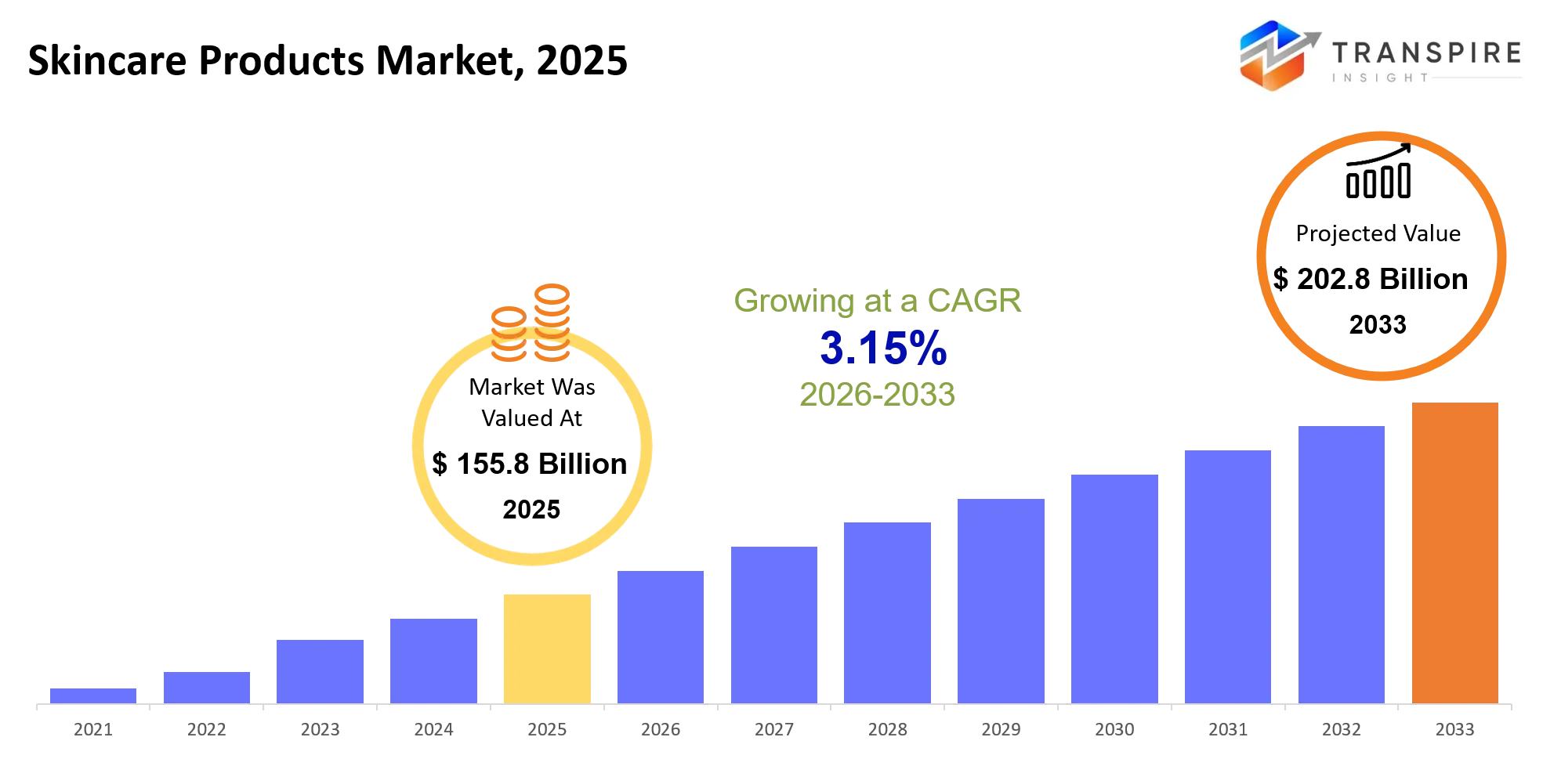
As per the Transpire Insight Analysis, The Skincare Products Market size is estimated at USD 155.8 billion in 2025 and is anticipated to reach USD 202.8 billion by 2033, growing at a CAGR of 3.15% from 2026 to 2033.
The skincare products market enables consumers to care for the skin against dryness, sensitivity, acne, pigmentation, sun exposure, and visible signs of ageing with daily products or specific treatments. Over the past three to five years, consumers have begun to shift from a simple moisturiser-centric routine to treatment-driven and ingredient-centred routines, recommendation-driven, doctor-prescribed, and tailored formulations. The evolution of social commerce and online consultation has shortened the time for the triggering factor to translate into purchase. A structural change is the ongoing convergence of cosmetic science, skin-barrier research, and digital diagnostics in new product development and communications. A societal change is the rising awareness of photoprotection and skin health that has consumers and consumers' key drivers looking to pair moisturiser, serum, and sunscreen instead of using single-function products. This transition will help support premiumization, frequent purchase, and special formulas. Brands that can position product efficacy, educate on ingredients, and make them fit multiple skin types will succeed in converting interest to revenue.
Skincare Products Market Size & Forecast:
- Market Size 2025: USD 155.8 Billion
- Expected Market Value (2033): USD 202.8 Billion
- Forecast CAGR (2026–2033): 3.15%
- Leading Region in 2025: Asia Pacific
- Fastest Growing Region: Middle East and Africa
- Key Company Profiles: L'Oréal, Unilever, Procter & Gamble, Estée Lauder, Shiseido, Beiersdorf, Kao Corporation, Amorepacific, Johnson & Johnson, Coty, Natura &Co, Puig, Colgate-Palmolive, Revlon, Avon.
Key Skincare Products Market Insights:
The market is moving towards clinically proven routines and towards preventive skincare and personalised product discovery. The ability to connect formulation science with accessible pricing, credible claims, and digital retail execution is the key to competitive advantage these days.
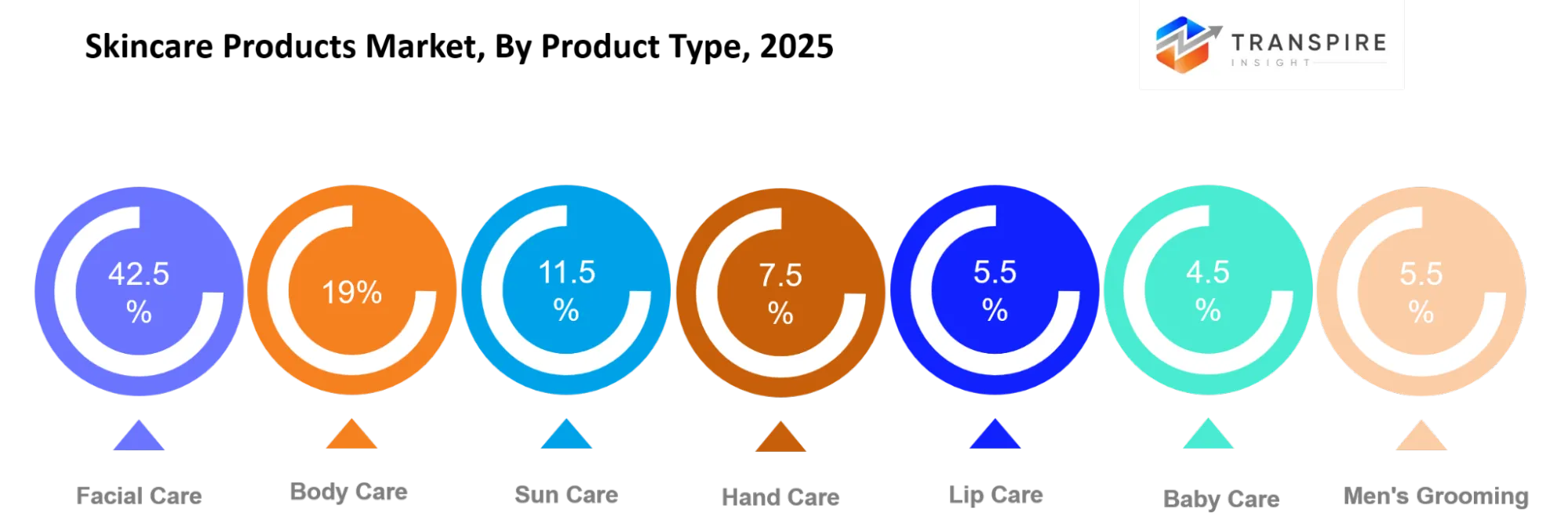
- Facial care is the clear leader with 42.5%, and L'Oréal is continuing to apply AI and formulation science with partnerships with NVIDIA and OpenAI.
- Consumer preference for concentrated, clinically positioned actives is driving the growth of serums, the fastest-moving product form, at an 8.9% CAGR.
- K-beauty and J-beauty innovation, digital commerce and fast premiumisation are driving demand in Asia Pacific, which makes up 38.2% of the world market.
- North America has 25.8%, with dermatologist-backed brands and skin care products linked to telehealth driving skincare purchases.
- Europe accounts for 24.1%, while stricter European ingredient and claims regulation is driving companies to compliant and transparent formulations.
- Local brands in Latin America compete on price with natural formulations and social commerce to target younger audiences.
- Modern retail, halal-certified products, and premium beauty access are improving in the Middle East and Africa, which is driving a 7.8% CAGR at 4.8%.
- Body care accounts for 19.0%, and brands like Unilever and Beiersdorf have taken their understanding of dermato-science into skin and body care products for everyday use.
- Sun care, at 11.5%, is becoming more of a permanent habit as consumers increasingly use products for daily photoprotection and hybrid skincare-sunscreen formulations.
- Grooming and hand care for men are becoming a habit and not an occasional purchase at 5.5% and 7.5%, respectively.
What are the Key Drivers, Restraints, and Opportunities in the Skincare Products Market?
Driver:
Growth is being driven by the shift from generic skincare to evidence-led, personalised routines. AI skin analysis, smartphone-based diagnostics, and virtual try-on tools allow brands to identify concerns such as acne, pigmentation, barrier damage, or early ageing and recommend targeted products. This changes purchasing behaviour from impulse buying to solution-based repeat purchasing, supporting higher-value serums, dermatological ranges, and subscription replenishment. The trigger has been improved smartphone imaging, lower cloud-computing costs, and consumer familiarity with digital consultations.
Restraint:
Regulatory and compliance complexity remains a structural limit. In the United States, MoCRA has added facility registration, product listing, safety substantiation, adverse-event reporting, and record-access obligations. In Europe, updated ingredient restrictions and tighter scrutiny of claims extend development timelines and raise costs, especially for smaller brands. These requirements persist because skincare products sit at the intersection of cosmetics, health claims, chemical safety, and environmental policy.
Opportunity:
Personalised skincare offers a route to higher-value growth through skin-analysis tools, tailored routines and refill-based purchasing. For example, brands can combine digital consultations with product recommendations based on skin concerns, climate and established ingredient sensitivities. In Asia-Pacific, mobile-first retail and localised formulations create scope to serve consumers seeking lightweight textures and protection against humidity or strong sunlight. Investment in refillable packaging, traceable ingredients and dermatologist-supported product development can further differentiate brands. Companies that connect credible product performance with accessible pricing and convenient replenishment are better placed to improve customer retention and lifetime value.
Driver Impact Analysis – Skincare Products Market
|
Driver |
Relative Impact on Growth (%) |
Geographic Relevance |
Impact Timeline |
Demand Strength |
Growth Mechanism |
Key Beneficiaries |
Major Constraint |
|
Rising skin health awareness and demand for science-backed formulations |
28% |
North America, Europe, Asia Pacific |
Short-term (≤2 years) |
High |
Increases routine adoption through clinically supported skincare benefits |
Dermocosmetic brands, ingredient suppliers, dermatology-led manufacturers |
Clinical validation costs and consumer skepticism |
|
Anti-aging, preventive skincare and premium product adoption |
23% |
North America, Europe, Japan, South Korea |
Medium-term (2–4 years) |
High |
Drives premium purchases through visible results and preventive care |
Premium skincare brands, peptide suppliers, dermatology clinics |
Price sensitivity and inconsistent product efficacy |
|
E-commerce, social commerce and AI-powered product discovery |
21% |
China, United States, India, South Korea |
Short-term (≤2 years) |
High |
Expands reach through personalised recommendations and digital conversions |
Direct-to-consumer brands, online retailers, beauty technology vendors |
Intense online competition and customer acquisition costs |
|
Demand for clean beauty, sustainable packaging and bio-based ingredients |
15% |
Europe, North America, Asia Pacific |
Medium-term (2–4 years) |
Medium |
Supports repeat purchases through ingredient transparency and sustainable positioning |
Sustainable ingredient producers, packaging innovators, clean beauty brands |
Higher sourcing costs and greenwashing concerns |
|
Expanding male grooming, emerging-market consumption and personalised skincare |
13% |
Asia Pacific, Latin America, Middle East |
Long-term (≥4 years) |
High |
Converts new consumers through accessible, targeted skincare ranges |
Mass-market manufacturers, regional brands, personalised skincare providers |
Affordability barriers and limited consumer education |
|
Total |
100% |
Global |
— |
— |
— |
— |
— |
What Has the Impact of Artificial Intelligence Been on the Skincare Products Market?
Artificial intelligence (AI) is helping to reshape the skincare industry into a personal-care service rather than a commodity by category. Computer vision and smartphone cameras enable brands to analyse skin for texture, redness, pores, hydration signals, and visible signs of ageing, and then match consumers with cleansers, serums, or treatments. AI can also support formulation optimisation by evaluating ingredient synergies, stability data, feedback, and clinical data before the products reach the market. In terms of operations, demand prediction and planning, inventory planning, and replenishment can be further optimised for both retailers and D2C brands. Virtual try-on, augmented-reality assistance, and chatbot guidance can help address purchase uncertainty for online consumers, and predictive analytics can suggest topical or other emerging concern trends, resulting in faster product development. The biggest challenge comes down to accuracy and usability. Camera-based evaluation may be confounded by differences in light, skin tone, image quality, and device variation. AI recommendations need clinical validation to prevent misconceptions and misbranding. Smaller brands face prohibitively high costs to integrate AI into their e-commerce, formulation, regulatory, and customer-data streams.
In March 2026, L'Oréal expanded its artificial intelligence partnership with NVIDIA by integrating the NVIDIA ALCHEMI machine learning framework into its Research and Innovation ecosystem. This deployment establishes a predictive beauty and skincare AI engine that accelerates breakthroughs in new product formulation by evaluating how molecules perform and interact at an atomic scale.
Key Skincare Products Market Trends:
The beauty market is shifting from a broad positioning to evidence-based and concern-specific skin care. Brands are competing on formulation credibility, convenient routines, personalised discovery, and more measurable product performance.
- Consumers are becoming more demanding of clinical evidence, shifting brands from ingredient claims to dermatologist-tested and efficacy-proven products.
- AI skin diagnostics is making its way to the front of the retail store, transforming product discovery into personalised routine recommendations.
- As consumers simplify their complex skin care routines, barrier repair, sensitive-skin care, and “skin minimalism” are becoming more popular.
- Consumers are looking for skincare products with a medical feel to them, and Dermo-cosmetic and pharmacy-led skincare are growing as a result.
- Males are moving from simple grooming to specific facial care, sun protection and anti-ageing products.
- Refillable formats, concentrated formulations and recyclable packaging are becoming competitive and not optional requirements for sustainability.
- The journey from education to purchase is being shortened, particularly for serums and treatment products, with the help of e-commerce and social commerce.
- The pressure from regulation on the safety of ingredients, claims, and disclosure is pushing compliance planning and labelling to be more transparent and earlier.
- Premiumisation is getting more discriminatory, with people switching to less premium in basic categories but paying more for proven actives and personalised solutions.
Skincare Products Market Segmentation
Product Type:
Facial care leads at 42.5% share, thanks to face focus in everyday life, visible ageing concern and treatment-driven buying. Driven by serums, moisturisers, cleansers, and sun protection, this segment grows on account of serums having a compound annual growth rate of 8.9% by active ingredient concentrations of vitamin C, retinoids, niacinamide, and peptides. Body care represents a 19.0% share on account of hygiene, moisturisation and the level-wise segmentation of premium body-care practices. Sun care makes up an 11.5% share on account of photoaging concerns and skin cancer, as well as awareness-driven consumption. Hand care accounts for 7.5%, lip care 5.5%, baby care 4.5%, men's grooming 5.5% and others 4.0%, contributing to general hand, mouth and overall care.
Form:
Creams and lotions remain essential formats for daily moisturisation, skin-barrier support and long-lasting hydration. Gels appeal to consumers seeking lightweight textures, particularly in humid climates or for oily skin. Serums support targeted applications addressing pigmentation, acne and visible ageing, while their specialised formulations encourage premium purchases. Oils and balms serve intensive nourishment and protective care needs, whereas masks offer concentrated, occasional treatments. Other formats provide flexibility for different skin types, application preferences and evolving skincare routines, encouraging brands to diversify product portfolios.
Distribution Channel:
Supermarkets and convenience stores support frequent purchases of everyday skincare essentials through accessibility and competitive pricing. Speciality stores and department stores encourage product discovery through curated assortments, demonstrations, and premium brand experiences. Pharmacies provide trusted access to dermatologically positioned products, particularly for sensitive skin and specific concerns. Beauty salons influence purchases through professional recommendations and treatment-linked products. E-commerce enables consumers to compare ingredients, prices, and reviews while accessing specialised brands. Subscription services, digital consultations and targeted promotions can improve replenishment and customer retention.
Consumer Group:
Women represent an important consumer group, supported by established facial-care routines and broad product availability. Men's grooming is expanding beyond basic cleansing into moisturisers, serums and sun protection. Teenagers create opportunities for acne-focused products and simplified routines, while unisex formulations appeal to consumers prioritising functionality over gender-specific branding. Baby and children's skincare emphasises gentle formulations and caregiver confidence. Seniors require products addressing dryness, reduced skin elasticity and visible ageing. Other consumer groups allow brands to develop specialised solutions for distinct preferences and life stages.
Ingredient Type:
Natural, organic, herbal and botanical ingredients appeal to consumers seeking plant-derived formulations and greater ingredient transparency. However, perceived naturalness does not automatically establish safety or superior performance, making substantiated claims important. Synthetic ingredients remain essential for formulation stability, preservation, and consistent product performance. Vegan products address preferences concerning animal-derived ingredients, while mineral-based formulations serve particular skincare and sun-protection applications. Brands increasingly combine ingredient research with compatibility testing to balance efficacy, tolerability and shelf life. Traceability, transparent labelling and regulatory compliance can strengthen consumer confidence and support product differentiation.
Price Range:
Economy and mass-market skincare products serve budget-conscious consumers through accessible pricing and everyday essentials. Mid-range products balance affordability with specialised ingredients and enhanced product performance. Premium and luxury offerings compete through proprietary formulations, brand heritage, packaging, and differentiated consumer experiences. Professional products target salon treatments and expert-guided routines, while dermatological ranges address specific skin concerns through evidence-led positioning. Other price tiers accommodate varied purchasing power and specialist requirements. Brands can strengthen competitiveness by maintaining clear value propositions, offering suitable product sizes and matching formulation benefits with consumers' willingness to pay.
What are the Key Use Cases Driving the Skincare Products Market?
The core use case is daily facial care, linked to the segment’s 42.5% share. Consumers use cleansers, moisturisers, serums, and sun protection to manage hydration, acne, pigmentation, sensitivity, and visible ageing, with serums growing at an 8.9% CAGR as users adopt concentrated, results-oriented products.
Expanding applications include body care, sun care, and hand care, where consumers increasingly treat skincare as preventive health rather than occasional grooming. Pharmacies, dermatology clinics, and salons also use professional and dermatological products for post-procedure care, acne management, and barrier repair.
Emerging use cases include AI-guided routine building, personalised serum subscriptions, refillable skincare, and men’s targeted grooming. These applications connect product development with digital health, beauty retail, and sustainability-led packaging models.
|
Report Metrics |
Details |
|
Market size value in 2025 |
USD 155.8 Billion |
|
Market size value in 2026 |
USD 163.2 Billion |
|
Revenue forecast in 2033 |
USD 202.8 Billion |
|
Growth rate |
CAGR of 3.15% from 2026 to 2033 |
|
Base year |
2025 |
|
Historical data |
2021 - 2024 |
|
Forecast period |
2026 - 2033 |
|
Report coverage |
Revenue forecast, competitive landscape, growth factors, and trends |
|
Regional scope |
United States; Canada; Mexico; United Kingdom; Germany; France; Italy; Spain; Denmark; Sweden; Norway; China; Japan; India; Australia; South Korea; Thailand; Brazil; Argentina; South Africa; Saudi Arabia; United Arab Emirates |
|
Key companies profiled |
L'Oréal, Unilever, Procter & Gamble, Estée Lauder, Shiseido, Beiersdorf, Kao Corporation, Amorepacific, Johnson & Johnson, Coty, Natura &Co, Puig, Colgate-Palmolive, Revlon, Avon. |
|
Customization scope |
Free report customization (country, regional & segment scope). Available customized purchase options to meet your exact research needs. |
|
Report Segmentation |
Product Type (Facial Care, Body Care, Hand Care, Lip Care, Sun Care, Baby Care, Men's Grooming, Others)Form (Creams, Lotions, Gels, Serums, Oils, Balms, Masks, Others)Distribution Channel (Supermarkets, Specialty Stores, Pharmacies, Department Stores, Convenience Stores, E-commerce, Beauty Salons, Others)Consumer Group (Women, Men, Children, Unisex, Babies, Teenagers, Seniors, Others)Ingredient Type (Natural, Organic, Synthetic, Herbal, Botanical, Vegan, Mineral-Based, Others)Price Range (Mass, Mid-range, Premium, Luxury, Professional, Dermatological, Economy, Others) |
Which Regions are Driving the Skincare Products Market Growth?
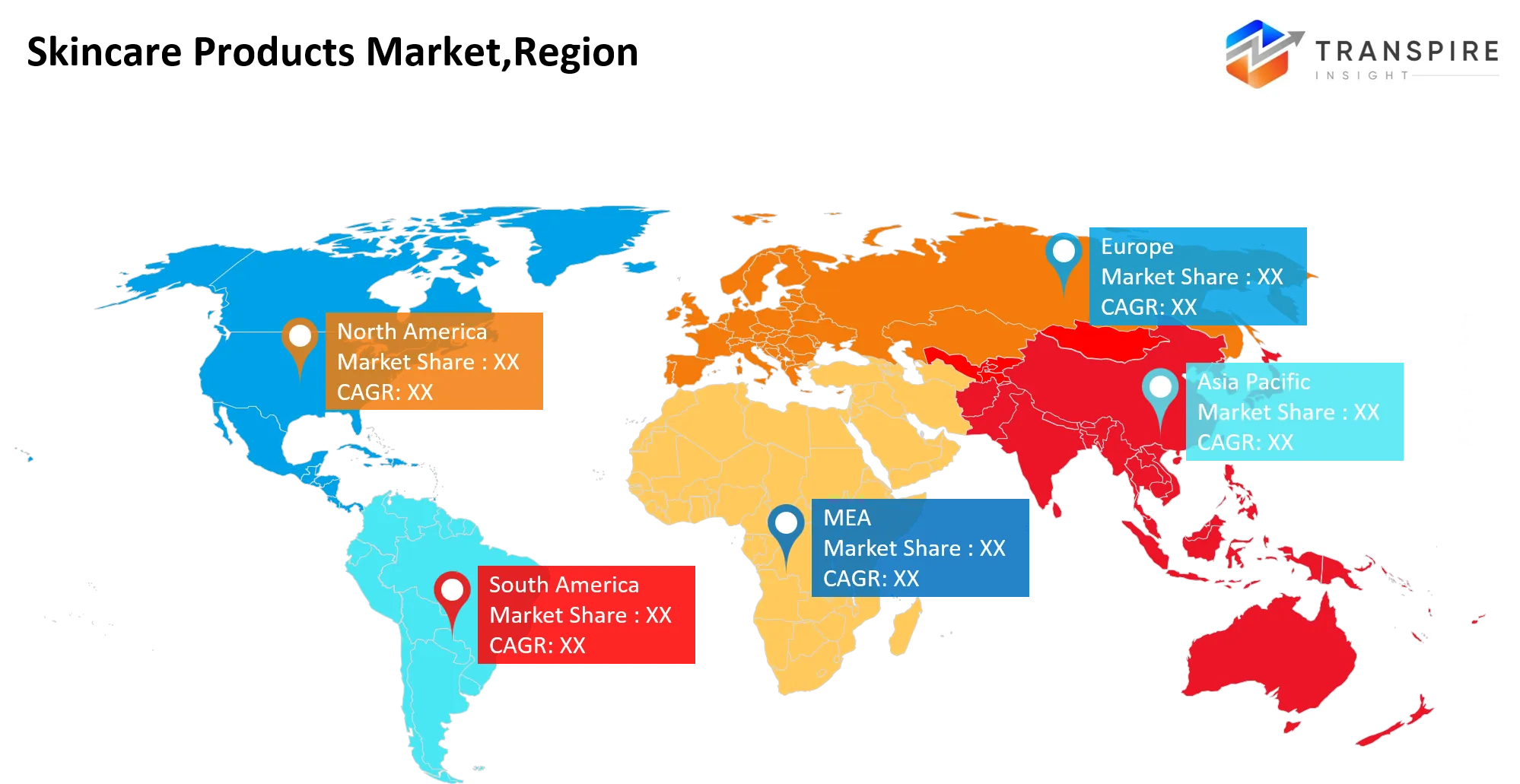
Asia Pacific holds the world's largest share of the market of skincare products at 38.2%. The region's expansive urban population, a strong beauty culture, and high digital penetration are its key drivers. It has strong manufacturing capabilities in South Korea, China, and Japan, and fast-growing social-commerce ecosystems. The presence of government-approved standards for cosmetics and mature K-beauty and J-beauty exports makes product innovation and cross-border selling feasible. Rising disposable incomes are shifting simple cleansing to multi-step facial care, sun care and premium anti-ageing routines.
In September 2026, Amorepacific Corporation partnered with biotechnology company Junevity to develop next-generation anti-ageing and skin-rejuvenating cosmetics utilising Junevity's RESET Platform, accompanied by a strategic investment through Amorepacific Ventures.
Europe, with a 24.1% share, is an established yet steady market combining regulated credibility, pharmacy ownership of dermocosmetics, and strong premium brands. Europe offers competitive advantage through safety assurance, clinical claim support, sustainability, and dermatologist support. The strict ingredients review process in the EU leads to higher compliance costs, but instils consumer confidence in domestically manufactured products. Growth continues thanks to stable demand from ageing consumers, sensitive skin consumers and premium skincare consumers.
In October 2026, Galderma agreed to acquire ZO Skin Health for $1.5 billion. This acquisition deepens the Swiss-headquartered company's premium dermatological skin care footprint, leveraging cash reserves and bank financing to integrate clinically validated skincare solutions directly into its therapeutic portfolio.
https://www.happi.com/dermocosmetics-tiktok-longevity-are-reshaping-europes-beauty-market/
The Middle East/Africa is the fastest-growing region with an annual compound growth rate of 7.8%, though it represents a small 4.8% of demand. Growth has emerged through the emergence of modern retail, the growing beauty consciousness among the youth segment, and increased access to premium and halal skincare products. The hot climate continues to fuel demand for hydration, sun protection, and barrier-repair products. Demand will soon grow through the combination of mass-market value offerings and premium, climate-specific, digitally distributed skincare serving a potentially large consumer base.
In June 2026, L’Oréal Middle East signed the UAE Climate-Responsible Companies Pledge with the Ministry of Climate Change and Environment. This action directly aligns with the region's climate challenges by actively expanding refillable beauty packaging across premium dermatological brands like Kiehl's and La Roche-Posay to support high-velocity, climate-specific skincare demands.
https://cosmeticsbusiness.com/l-or%C3%A9al-expands-refillable-beauty-initiative
Who are the Key Players in the Skincare Products Market, and how do they compete?
Competition from a breadth brand set is shifting to players that offer scientific expertise, digital personalisation and channel control. Financially scaled and complementary players acquire, partner with dermatologist brands, use AI-enabled technology and value innovation and premium positioning to defend share; locally scaled players innovate on local ingredients, centre on affordability and optimise social commerce.
L'Oréal targets innovation through asset biotechnologies, AI-driven diagnostics and refillable luxury packaging; expands through premium, dermatologist and emerging-market channels. Unilever targets scale and access through affordable brands with science-backed propositions such as Dove and Vaseline; expands in e-commerce and sustainability-led packaging. P&G targets efficiency with mass-market brands with dermatologist positioning, using retail channels' distribution strength to accelerate growth. Estée Lauder targets a premium-niche proposition of advanced anti-ageing formulations and hyper-personalised omnichannel experiences. Shiseido leverages Japanese skin-science innovation and Asian market depth. Beiersdorf aims for credibility with dermocosmetics such as Eucerin and NIVEA. Kao and Amorepacific rely on regional beauty knowledge, research into ingredients, and digital-first engagement. Johnson & Johnson, Coty, Natura &Co, Puig, Colgate-Palmolive, Revlon and Avon compete on their portfolios, value positioning, natural positioning, fragrance-linked skin-care, or their direct-selling and social commerce model.
Key Players are:
- L'Oréal
- Unilever
- Procter & Gamble
- Estée Lauder
- Shiseido
- Beiersdorf
- Kao Corporation
- Amorepacific
- Johnson & Johnson
- Coty
- Natura &Co
- Puig
- Colgate-Palmolive
- Revlon
- Avon
Skincare Products Market — Enhanced Competitive Benchmarking
Company |
Est. Revenue Share Range |
Key Offerings |
Strategic Positioning |
Geographic Strength |
Technology Focus |
L’Oréal |
8–12% |
La Roche-Posay, CeraVe, Vichy, SkinCeuticals |
leadership through science-backed portfolio diversification |
North America, Europe, Asia Pacific |
Advanced formulation science and AI-enabled Beauty Tech |
Unilever |
5–8% |
Vaseline, Pond’s, Dove skincare, Dermalogica, Paula’s Choice |
Mass-market scale combined with premium skincare expansion |
Asia Pacific, North America, Europe |
Active ingredient innovation and digital consumer analytics |
Procter & Gamble |
3–5% |
Olay, SK-II, premium facial treatments, moisturisers |
Mass-premium leadership through brand equity and efficacy |
North America, Asia Pacific, Europe |
Peptide research, skin biology and advanced formulations |
Estée Lauder Companies |
3–5% |
Estée Lauder skincare, La Mer, Clinique, Origins |
Prestige differentiation through luxury and high-performance skincare |
North America, Asia Pacific, Europe |
Bioactive ingredients and luxury skincare formulation science |
Beiersdorf |
2–4% |
NIVEA, Eucerin, Aquaphor, La Prairie |
Broad market coverage spanning mass, dermocosmetic and luxury skincare |
Europe, North America, Latin America |
Epigenetics research and patented skin-active ingredients |
Shiseido |
2–3% |
Shiseido, Anessa, Elixir, Drunk Elephant |
Premium beauty leadership rooted in Japanese skincare expertise |
Asia Pacific, North America, Europe |
Skin science, UV protection and advanced delivery systems |
Kenvue |
2–4% |
Neutrogena, Aveeno, facial cleansers, moisturisers |
Dermatology-informed mass skincare and accessible science |
North America, Europe, Asia Pacific |
Skin-barrier science and clinically evaluated formulations |
Kao Corporation |
1–3% |
Bioré, Curél, Kao facial care, sunscreen products |
Regional strength through Japanese skincare and cleansing expertise |
Asia Pacific, North America |
Sebum science, skin-barrier research and UV technologies |
Amorepacific |
1–2% |
Laneige, Sulwhasoo, Innisfree, Aestura |
K-beauty differentiation through premiumisation and regional trends |
Asia Pacific, North America |
Korean botanical science, hydration and skin-barrier technology |
LVMH |
1–3% |
Dior skincare, Guerlain skincare, Fresh |
Luxury skincare differentiation through prestige and experiential branding |
Europe, Asia Pacific, North America |
Luxury active ingredients and advanced cosmetic formulations |
Recent Development News
In September 2026, Kao Corporation announced the Nordic launch of its Curél skincare range. The expansion into Sweden, Norway, Denmark, and Finland is expected to broaden the brand’s European reach by addressing demand for science-backed products designed for dry and sensitive skin.
https://www.kao.com/global/en/newsroom/news/release/2026/20260825-001
In September 2026, SkinMedica introduced its Barrier Calming Cream and HA⁵ Hydra Collagen Facial Mist. The launches expand its regenerative skincare portfolio with products focused on skin-barrier support, soothing care, and hydration, aligning product innovation with consumers’ growing interest in clinically supported skincare solutions.
In July 2026, SkinCeuticals launched, an advanced peptide-powered anti-ageing serum engineered to mimic injectable-adjacent results. This product introduction addresses the shifting consumer preference toward high-performance, non-invasive clinical formulations designed to target fine lines and improve skin texture by utilising next-generation peptide delivery systems.
https://www.whowhatwear.com/uk/best-new-beauty-products
What Strategic Insights Define the Future of the Skincare Products Market?
Face care now accounts for 42.5% of the overall skincare market, and is moving in the direction of clinically tested personalisation. This will draw on innovations such as AI-driven diagnostics, microbiome research, and recommendations from board-certified doctors and clinicians. The concealed danger lies in counterfeit and grey market stock online, which could erode trust in a brand or, worse, pose a risk to consumers because of the formulations. The nascent opportunities are AI/ refillable skincare/ destocked dose systems based on device-tracked skin analysis and personalised serum recommendations, potentially improving repeat purchase rates and reducing waste via replenishment. From a strategic perspective, if this experience is leveraged into authentic digital channels and substantiated, claim-led claims, it should avoid being yet another undifferentiated SKU offering. Those that transform diagnostic insights into safe, compliant, measurable skin health solutions will be market winners.
Key Segmentations are:
Product Type
- Facial Care
- Body Care
- Hand Care
- Lip Care
- Sun Care
- Baby Care
- Men's Grooming
- Others
Form
- Creams
- Lotions
- Gels
- Serums
- Oils
- Balms
- Masks
- Others
Distribution Channel
- Supermarkets
- Speciality Stores
- Pharmacies
- Department Stores
- Convenience Stores
- E-commerce
- Beauty Salons
- Others
Consumer Group
- Women
- Men
- Children
- Unisex
- Babies
- Teenagers
- Seniors
- Others
Ingredient Type
- Natural
- Organic
- Synthetic
- Herbal
- Botanical
- Vegan
- Mineral-Based
- Others
Price Range
- Mass
- Mid-range
- Premium
- Luxury
- Professional
- Dermatological
- Economy
- Others
Frequently Asked Questions
Find quick answers to common questions.
The skincare products market size was valued at USD 155.8 billion in 2025 and is poised to reach USD 202.8 billion by 2033, expanding at a 3.15% CAGR.
Key segments for the skincare products market are Product Type (Facial Care, Body Care, Hand Care, Lip Care, Sun Care, Baby Care, Men's Grooming, Others)Form (Creams, Lotions, Gels, Serums, Oils, Balms, Masks, Others)Distribution Channel (Supermarkets, Specialty Stores, Pharmacies, Department Stores, Convenience Stores, E-commerce, Beauty Salons, Others)Consumer Group (Women, Men, Children, Unisex, Babies, Teenagers, Seniors, Others)Ingredient Type (Natural, Organic, Synthetic, Herbal, Botanical, Vegan, Mineral-Based, Others)Price Range (Mass, Mid-range, Premium, Luxury, Professional, Dermatological, Economy, Others)
Growth is primarily driven by rising skincare awareness, demand for targeted formulations, preventive sun protection, dermatological product innovation, personalised skincare technologies, and expanding e-commerce channels.
The skincare products market is led by major manufacturers, including L'Oréal, Unilever, Procter & Gamble, Estée Lauder, Shiseido, Beiersdorf, Kao Corporation, Amorepacific, Johnson & Johnson, Coty, Natura &Co, Puig, Colgate-Palmolive, Revlon, and Avon.
Asia-Pacific dominates with a 38.2% market share, supported by established beauty manufacturing, Korean and Japanese skincare innovation, expanding digital commerce, and strong demand for specialised formulations.
Key opportunities include AI-enabled personalised skincare, targeted serum development, climate-adapted formulations, sustainable packaging, dermatological product innovation, and expansion through digital retail channels.
- L'Oréal
- Unilever
- Procter & Gamble
- Estée Lauder
- Shiseido
- Beiersdorf
- Kao Corporation
- Amorepacific
- Johnson & Johnson
- Coty
- Natura &Co
- Puig
- Colgate-Palmolive
- Revlon
- Avon
About the Authors

Chetan Dhatrak
I’m Chetan Dhatrak, a Senior Research Analyst at Transpire Insight, specializing in the Consumer Goods, Foods and Beverages industry. I focus on analyzing market trends, consumer behavior, competitive landscapes, and industry developments to deliver accurate, data-driven insights. My research at Transpire Insight is built on credible sources and in-depth analysis, helping businesses and readers better understand market dynamics, emerging opportunities, and evolving consumer preferences. I’m committed to creating reliable, well-researched content that supports informed decision-making and reflects the latest developments in the consumer goods and food & beverage sectors.

Chakradhar Khansole
Chakradhar serves as the Research Director at Transpire Insight, bringing over 8 years of experience in technology, innovation, and strategic market intelligence. He specializes in transforming complex market data into actionable business insights that enable organizations to make informed, growth-oriented decisions. Recognized for his strategic vision and analytical expertise, Chakradhar leads high-impact research initiatives, delivering comprehensive market assessments, competitive intelligence, and forward-looking industry analysis.
Recently Published Reports
-
Apr 2026
Bottled Water Market
Bottled Water Market Size, Share & Analysis Report By Product Type (Still Bottled Water, Carbonated Bottled Water, Functional Bottled Water, and Others), By Packaging (PET, Cans, and Others), By Sales Channel (Supermarkets/Hypermarkets, Convenience Stores/Drug Stores, Grocery Stores/Club Stores, Foodservice, and Others) and Geography (North America, Europe, Asia-Pacific, Middle East and Africa, South and Central America), 2021 - 2032
-
Apr 2026
Color Cosmetic Packaging Market
Color Cosmetic Packaging Market Size, Share & Analysis Report By Application (Mascara Packaging, Liquid Packaging, and Liquid Face), By Type (Tubes & Bottles, Pens & Markers, Compacts & Containers, and Droppers & Pumps), and Geography (North America, Europe, Asia-Pacific, Middle East and Africa, South and Central America), 2021 - 2031
-
Apr 2026
External Microphone For Camera Market
External Microphone For Camera Market Size, Share & Analysis Report By Type (Shotgun Microphone, Lavalier Microphone, and Others), By Application (Digital Camera, Professional Video Camera, and Others), and Geography (North America, Europe, Asia-Pacific, Middle East and Africa, South and Central America), 2021 - 2031
-
Apr 2026
Foot Orthotic Insoles Market
Foot Orthotic Insoles Market Size, Share & Analysis Report By Type (Pre-fabricated, and Custom-made), By Material (Thermoplastic, Composite Carbon Fiber, and Others), By Distribution Channel (Drug Stores, Hospitals & Clinics, and Others), and Geography (North America, Europe, Asia-Pacific, Middle East and Africa, South and Central America), 2021 - 2031