

South Korea Natural Cosmetics Market Summary:
According to Transpire Insight, a detailed research report on the South Korea Natural Cosmetics Market reflects that botanical skincare and naturally derived cosmetic formulations represent key areas of market demand, supported by increasing consumer preference for clean beauty, ingredient transparency, and skin-friendly products. Amorepacific Corporation leads the market with an estimated 8–15% market revenue share, making it a leading contributor to South Korea’s natural cosmetics market development, innovation, advanced botanical skincare production, expanding manufacturing capabilities, and growth dynamics.
Market Snapshot
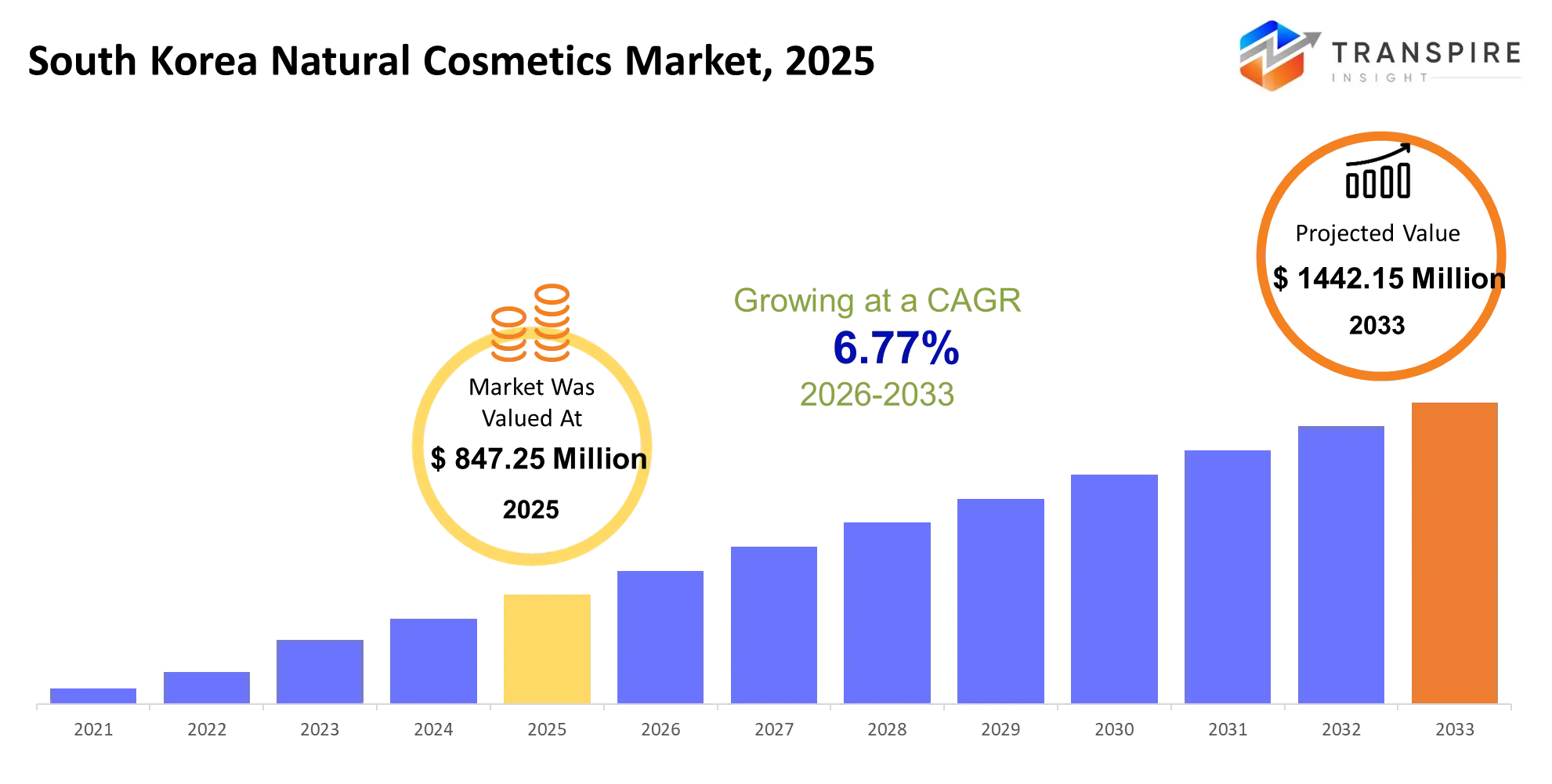
- Market Value (2025): USD 847.25 Million.
- Expected Market Value (2026): USD 904.59 Million.
- Estimated Market Value (2033): USD 1442.15 Million.
- Forecast CAGR (2026–2033): 6.77%.
Introduction
The Natural Cosmetics Market in South Korea is gaining traction owing to the rising consumer preference for clean beauty, plant-based ingredients and sustainable skincare solutions. The market includes skin care, color cosmetics, hair care and hybrid beauty products created with naturally derived ingredients and marketed on the basis of ingredient transparency and skin compatibility. South Korea’s matured K-beauty ecosystem, sophisticated cosmetic R&D expertise and robust manufacturing infrastructure enable product innovation and growth in international markets. Consumers are seeking botanical formulations, ethical sourcing, eco-conscious packaging and science-backed performance. Domestic brands and contract manufacturers are responding with ingredient innovation, formulation development and diversified product portfolios. These trends are fueling competition and creating opportunity across South Korea’s natural cosmetics value chain.
Key Market Highlights: -
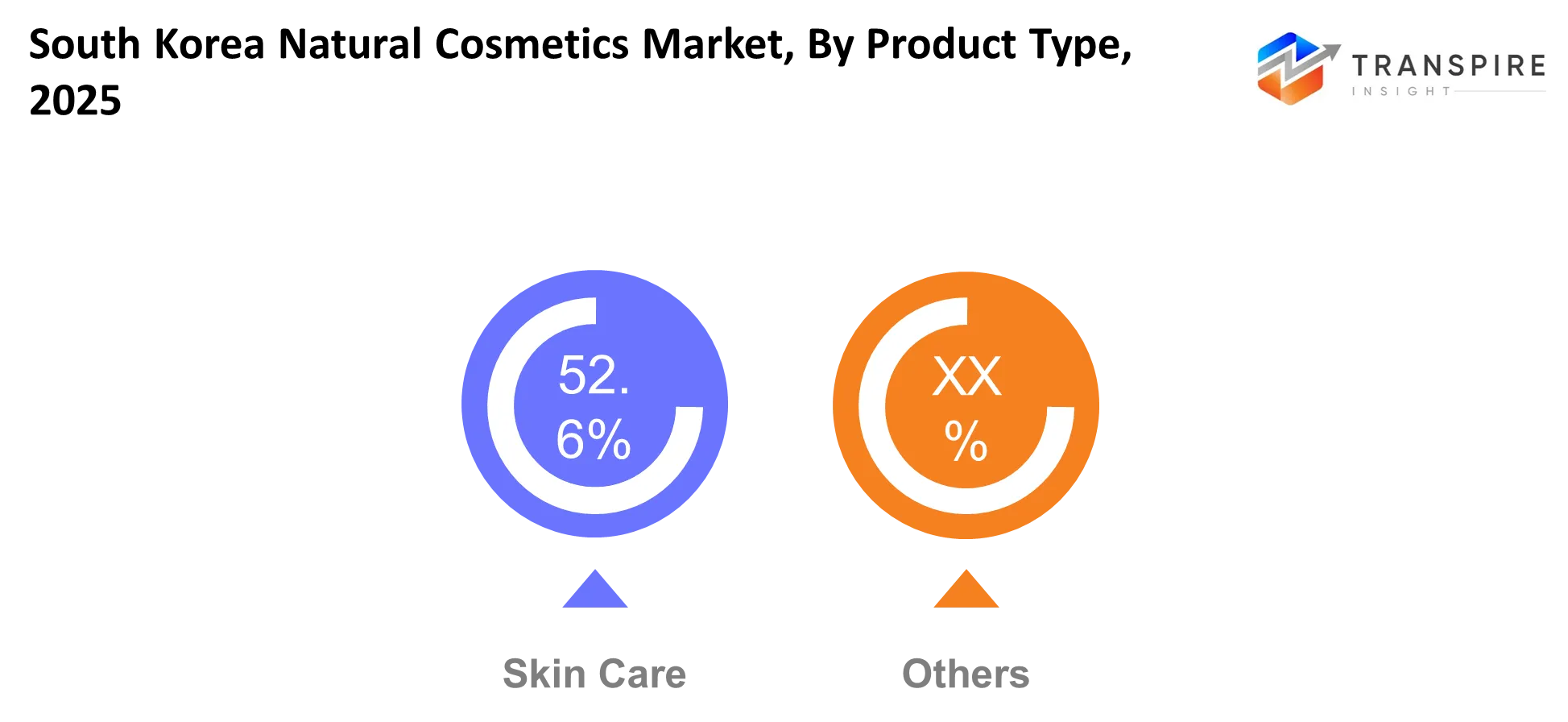
- By Product Type, the Skin care dominated the market and holds approximately 41% share in 2025 and is projected to grow at a substantial CAGR during the forecast period.
- By Ingredient, the PLANT-BASED INGREDIENTS dominated the market and holds approximately 68% share in 2025 and is projected to grow at a substantial CAGR during the forecast period.
- By Sample Type, the Supermarkets & Hypermarkets Manufacturers segment dominated the market and holds approximately 37% share in 2025 and is projected to grow at a substantial CAGR during the forecast period.
- The government of South Korea’s backing of cosmetic research, innovation, export development of SMEs, and regulatory entry to the international market helps to boost the natural cosmetic industry.
How is Technology Driving Growth in the South Korea Natural Cosmetics Market?
The South Korea Natural Cosmetics Market is driven by the innovation of botanical ingredients, personalized skincare, and advanced manufacturing. Bio-fermentation, microencapsulation and green extraction methods help in the formulation of stable, efficient, natural cosmetic formulations. Biotechnology supports sustainable ingredient development, and AI-powered skin analysis and digital consultations enhance product recommendations and consumer engagement. Automation of manufacturing and digital quality-control systems increases the efficiency, consistency and scalability of production. Additionally, ingredient traceability and smart supply-chain technologies increase transparency and foster consumer confidence. These innovations allow Korean cosmetics companies to stand out with natural beauty products, improve operational performance and adapt to evolving clean beauty preferences.
Market Drivers
The South Korea Natural Cosmetics Market operates on the back of increased consumer knowledge regarding the safety and skin suitability of the skincare ingredients contained in products. Environmental awareness is increasing the popularity of responsible sourcing, packaging, and animal testing-free cosmetics products. The South Korea Ministry of Food and Drug Safety (MFDS) regulatory supervision makes the products safer and ensures transparent labeling and marketing of the cosmetics. Besides, the increased usage of e-commerce, social media, and live commerce platforms increases access and enhances market reach for the natural cosmetics manufacturers.
Restrain
Natural Cosmetics Market in South Korea is facing issues related to cost associated with regulatory compliance, price volatility of imported botanic raw materials, and stiff competition among existing K-beauty products. Skepticism among consumers about unsubstantiated claims regarding natural and environmental friendly products may impact the brand image and acceptance of products. Further, formulating stable and safe products without affecting their positioning as natural products may not be easy.
|
Driver |
Relative Impact on Growth (%) |
Geographic Relevance |
Impact Timeline |
Demand Strength |
Growth Mechanism (5–10 words) |
Key Beneficiaries (5–10 words) |
Major Constraint (5–10 words) |
|
1. Rising demand for clean-label and skin-friendly formulations |
28% |
Seoul, Gyeonggi-do, Busan |
Short-term (≤2 years) |
High |
Growing ingredient awareness drives natural skincare product adoption. |
Natural cosmetics brands, botanical ingredient suppliers, skincare consumers. |
Higher formulation costs and inconsistent natural ingredient efficacy. |
|
2. Global K-beauty expansion and international demand |
24% |
Seoul, Incheon, Gyeonggi-do; export markets |
Medium-term (2–4 years) |
High |
Global K-beauty popularity expands natural product exports. |
Export-oriented manufacturers, beauty brands, distributors, logistics providers. |
International competition and varying overseas regulatory requirements. |
|
3. Innovation in botanical ingredients and advanced formulations |
19% |
Seoul, Osong, Jeju, Chungcheongbuk-do |
Medium-term (2–4 years) |
High |
Advanced extraction improves botanical efficacy and formulation stability. |
Ingredient researchers, cosmetic manufacturers, biotechnology firms, consumers. |
Limited clinical validation and ingredient standardization challenges. |
|
4. Sustainability, ethical sourcing, and eco-friendly packaging |
16% |
Seoul, Gyeonggi-do, Jeju |
Medium-term (2–4 years) |
Medium |
Sustainable sourcing and packaging attract environmentally conscious consumers. |
Sustainable packaging suppliers, certified brands, ethical ingredient producers. |
Higher sustainable material costs and supply-chain complexity. |
|
5. Regulatory transparency and government-backed industry development |
13% |
Nationwide; Namwon, Osong, Seoul |
Long-term (≥4 years) |
Medium |
Safety oversight and testing infrastructure strengthen consumer confidence. |
Compliant manufacturers, testing laboratories, certification providers, consumers. |
Compliance expenses and evolving natural cosmetics qualification requirements. |
|
Total |
100% |
— |
— |
— |
— |
— |
— |
Analysis of Prices and Consumer Behaviour
Market dynamics of South Korea natural cosmetics market include skincare products (largest application segment; mainly because of demand for botanical skincare, clean beauty, and natural products). Premium natural cosmetics with quality botanical ingredients would have a relatively higher cost compared to the conventional ones since such products might have complex extraction processes, quality tests, and formulation stability tests. Skincare would constitute a large portion of the demand of natural cosmetics. Demand for natural cosmetic products is fueled by their versatility in terms of products in facial care, moisturizers, and sun protection, among other factors. Skincare and personal care industries form a major portion of the demand for natural cosmetics ingredients. Consumer trends include consideration of ingredient and product safety and effectiveness. Other factors include sustainability in packaging and sourcing. Retailers and manufacturers consider bulk buying and long-term relationships with suppliers of natural cosmetics ingredients to minimize cost and secure supplies.
|
Company |
Est. Revenue Share Range |
Key Offerings |
Strategic Positioning |
Geographic Strength |
Technology Focus |
|
1. Amorepacific Corporation |
Estimated 8–15% |
INNISFREE, Primera, HANYUL, botanical skincare |
Multi-brand leadership across natural-inspired skincare |
South Korea, Asia Pacific, North America |
Botanical actives, fermentation, skin-delivery systems |
|
2. LG Household & Health Care |
Estimated 4–9% |
The Face Shop, Beyond, selected botanical skincare |
Diversified beauty portfolio with natural ingredient positioning |
South Korea, Asia Pacific |
Herbal formulations, fermentation, ingredient science |
|
3. COSMAX Inc. |
Estimated 3–7%* |
Natural skincare OEM/ODM, botanical creams, serums, masks |
Large-scale formulation and contract manufacturing |
South Korea, Asia Pacific, North America |
Green formulation, encapsulation, automated manufacturing |
|
4. Kolmar Korea |
Estimated 2–6%* |
Botanical skincare, natural-origin sunscreens, creams, serums |
R&D-led ODM and customized formulation services |
South Korea, North America, Asia Pacific |
Formulation science, stability testing, manufacturing automation |
|
5. CJ Olive Young |
Estimated 2–5%* |
Bringgreen, Round A’round, natural skincare retail assortment |
Omnichannel retail and private-label development |
South Korea |
Consumer-data analytics, digital merchandising, product development |
|
6. Goodai Global |
Estimated 1–4% |
Beauty of Joseon, SKIN1004, Anua |
Export-oriented brands emphasizing botanical and heritage ingredients |
South Korea, North America, Europe, Asia Pacific |
Ingredient-led product development, digital commerce |
|
7. Nature Republic |
Estimated 1–3% |
Aloe Vera skincare, botanical gels, natural extracts |
Accessible pricing and ingredient-focused mass-market beauty |
South Korea, Asia Pacific, North America |
Botanical extraction, gel formulation, product stability |
|
8. TonyMoly |
Estimated 1–3% |
Green tea skincare, botanical cleansers, natural-inspired masks |
Youth-focused beauty with accessible botanical skincare |
South Korea, Asia Pacific |
Botanical formulation, product-format innovation |
|
9. Clio Cosmetics |
Estimated 1–3% |
Goodal green tangerine skincare, Dermatory skincare |
Targeted skincare brands supported by multi-brand distribution |
South Korea, Asia Pacific, North America |
Active ingredient formulation, digital consumer engagement |
|
10. d’Alba Global |
Estimated 1–3% |
White truffle skincare, botanical-inspired serums, facial mists |
Premium positioning through signature ingredients |
South Korea, North America, Asia Pacific |
Emulsion technology, active-ingredient formulation |
Who are the Key Players in the South Korea Natural Cosmetics Market and how do they compete?
The competitiveness of the South Korea Natural Cosmetics Market is influenced by firms which focus on innovation in ingredients, development of natural formulae, and building of distribution networks both domestically and internationally. Being competitive not only in price but also through the use of botanical ingredients, advanced formulas, sustainable solutions, and digital integration, this strategy for competitiveness stimulates constant product development while contributing to brand differentiation and customer engagement.
Through the development of botanical skincare, natural formulae, and ingredient-based beauty products, Amorepacific becomes competitive in the market. Through diversified beauty products, herbal skincare, and natural formulae, LG Household & Health Care differentiates itself from other players. Through plant-based skincare, green tea formulae, and nature-inspired beauty products, Innisfree builds its competitiveness and helps customers to satisfy their skincare needs through the use of ingredient-based cosmetics solutions.
Top Companies in the South Korea Natural Cosmetics Market
- Amorepacific
- LG Household & Health Care
- Innisfree
- The Face Shop
- COSRX
- Dr.Jart+
- Laneige
- Sulwhasoo
- Nature Republic
- Missha
- Etude
- Klairs
- Round Lab
- Beauty of Joseon
- SKIN1004
South Korea Natural Cosmetics Market Segmentation
The South Korea Natural Cosmetics Market share is divided into five categories: By Product Type, By Ingredient, By Distribution Channel, By End User, By Product Form.
The South Korea Natural Cosmetics Market share is divided into six categories: By Product Type, By Ingredient,
The Skin care dominated the market, accounting for nearly 41% in 2025 and is expected to rise at a significant CAGR during the forecast period.
The South Korea Natural Cosmetics Market is segmented by product type into skin care, hair care, body care, makeup, fragrances, oral care, baby care, men’s grooming, sun care, others. Among these, the Skin care segment dominated the market, accounting for nearly 41% in 2025 and expected to increase at a significant CAGR during the forecast period. The skin care category comes first because of the increased need for botanical-based products, clean beauty, skin-friendly ingredients, and multi-use skin care products.
The plant-based ingredients dominated the market, accounting for nearly 68% in 2025, and is expected to rise at a significant CAGR during the forecast period.
The South Korea Natural Cosmetics Market is segmented by ingredient into plant-based, herbal, botanical extracts, essential oils, organic ingredients, mineral-based, fermented ingredients, marine ingredients, others. Among these, the PLANT-BASED INGREDIENTS dominated the market, accounting for nearly 68% in 2025 and expected to increase at a significant CAGR during the forecast period. Natural ingredients prevail because of the increased preference by consumers for botanical-based products, clean beauty products, natural skin care, and sustainable cosmetics ingredients.
The Supermarkets & Hypermarkets dominated the market, accounting for nearly 37% in 2025 and is expected to rise at a significant CAGR during the forecast period.
The South Korea Natural Cosmetics Market is segmentedby distribution channel into online retail, specialty stores, department stores, supermarkets & hypermarkets, pharmacies, brand stores, e-commerce platforms, others. Among these, the Supermarkets & Hypermarkets dominated the market, accounting for nearly 37% in 2025 and expected to increase at a significant CAGR during the forecast period. Supermarkets and hypermarkets prevail owing to wide range of products, easy availability in stores, competitive prices, offers, and consumer accessibility to cosmetic and personal care products.
Future Market Trends for the South Korea Natural Cosmetics Market: -
- Innovation in Formulation through Biotechnology: Through biotechnology, sustainable production of active agents and fermentation techniques are providing an opportunity for South Korean natural cosmetics brands to develop formulations.
- Environmentally Friendly Packaging Options: Environmental consciousness is prompting natural cosmetics companies to look at ways of using environmentally friendly packaging such as recycleable and reusable options.
- AI Technology for Personalized Skin Products: AI technology will play a major role in formulating products based on skin analysis, and consumers will expect substantiated claims about their efficacy.
Recent Development
- In March 19, 2026 - Launch of Bioré South Korea by Kao Corporation: The Kao Corporation introduced Bioré in South Korea, thereby making available skincare products with improved formulas that cater to the needs of South Korean consumers.
- In July 3, 2026 – Showcase of Ingredients at COEX: Exhibitors of personal care ingredients in Seoul displayed innovations in cosmetics, which included use of active ingredients and formulating technologies from biotechnology and sustainability perspectives.
Market Segmentation
This study forecasts revenue at Japan, regional and country levels from 2020 to 2033. Transpire Insight has segmented the South Korea Natural Cosmetics Market based on the below-mentioned segments:
South Korea Natural Cosmetics Market, By Product Type
- Skin Care
- Hair Care
- Body Care
- Makeup
- Fragrances
- Oral Care
- Baby Care
- Men’s Grooming
- Sun Care
- Others
South Korea Natural Cosmetics Market, By Ingredient
- Plant-Based
- Herbal
- Botanical Extracts
- Essential Oils
- Organic Ingredients
- Mineral-Based
- Fermented Ingredients
- Marine Ingredients
- Others
South Korea Natural Cosmetics Market, By Distribution Channel
- Online Retail
- Specialty Stores
- Department Stores
- Supermarkets & Hypermarkets
- Pharmacies
- Brand Stores
- E-commerce Platforms
- Others
South Korea Natural Cosmetics Market, By End User
- Women
- Men
- Children
- Teenagers
- Elderly
- Beauty Professionals
- Others
South Korea Natural Cosmetics Market, By Product Form
- Creams
- Lotions
- Serums
- Oils
- Gels
- Masks
- Powders
- Sprays
- Others
Frequently Asked Questions
Find quick answers to common questions.
The market is projected to reach USD 1,442.15 million by 2033, reflecting growing demand for natural beauty and skincare products.
Growth is driven by clean beauty preferences, ingredient transparency, sustainable packaging, botanical formulations, and expanding online beauty retail channels.
Skin care leads the market, accounting for nearly 41% in 2025, supported by demand for botanical, skin-friendly, and multifunctional products.
Plant-based ingredients appeal to consumers seeking botanical formulations, clean beauty products, natural skincare, ingredient transparency, and sustainably sourced materials.
Biotechnology, fermentation, AI-powered skin analysis, and digital quality-control systems support ingredient innovation, personalized skincare, product consistency, and consumer confidence.
- Amorepacific
- LG Household & Health Care
- Innisfree
- The Face Shop
- COSRX
- Dr.Jart+
- Laneige
- Sulwhasoo
- Nature Republic
- Missha
- Etude
- Klairs
- Round Lab
- Beauty of Joseon
- SKIN1004
About the Authors

Chetan Dhatrak
I’m Chetan Dhatrak, a Senior Research Analyst at Transpire Insight, specializing in the Consumer Goods, Foods and Beverages industry. I focus on analyzing market trends, consumer behavior, competitive landscapes, and industry developments to deliver accurate, data-driven insights. My research at Transpire Insight is built on credible sources and in-depth analysis, helping businesses and readers better understand market dynamics, emerging opportunities, and evolving consumer preferences. I’m committed to creating reliable, well-researched content that supports informed decision-making and reflects the latest developments in the consumer goods and food & beverage sectors.

Chakradhar Khansole
Chakradhar serves as the Research Director at Transpire Insight, bringing over 8 years of experience in technology, innovation, and strategic market intelligence. He specializes in transforming complex market data into actionable business insights that enable organizations to make informed, growth-oriented decisions. Recognized for his strategic vision and analytical expertise, Chakradhar leads high-impact research initiatives, delivering comprehensive market assessments, competitive intelligence, and forward-looking industry analysis.
Recently Published Reports
-
Apr 2026
Bottled Water Market
Bottled Water Market Size, Share & Analysis Report By Product Type (Still Bottled Water, Carbonated Bottled Water, Functional Bottled Water, and Others), By Packaging (PET, Cans, and Others), By Sales Channel (Supermarkets/Hypermarkets, Convenience Stores/Drug Stores, Grocery Stores/Club Stores, Foodservice, and Others) and Geography (North America, Europe, Asia-Pacific, Middle East and Africa, South and Central America), 2021 - 2032
-
Apr 2026
Color Cosmetic Packaging Market
Color Cosmetic Packaging Market Size, Share & Analysis Report By Application (Mascara Packaging, Liquid Packaging, and Liquid Face), By Type (Tubes & Bottles, Pens & Markers, Compacts & Containers, and Droppers & Pumps), and Geography (North America, Europe, Asia-Pacific, Middle East and Africa, South and Central America), 2021 - 2031
-
Apr 2026
External Microphone For Camera Market
External Microphone For Camera Market Size, Share & Analysis Report By Type (Shotgun Microphone, Lavalier Microphone, and Others), By Application (Digital Camera, Professional Video Camera, and Others), and Geography (North America, Europe, Asia-Pacific, Middle East and Africa, South and Central America), 2021 - 2031
-
Apr 2026
Foot Orthotic Insoles Market
Foot Orthotic Insoles Market Size, Share & Analysis Report By Type (Pre-fabricated, and Custom-made), By Material (Thermoplastic, Composite Carbon Fiber, and Others), By Distribution Channel (Drug Stores, Hospitals & Clinics, and Others), and Geography (North America, Europe, Asia-Pacific, Middle East and Africa, South and Central America), 2021 - 2031