

South Korea Zinc Sulphate Market Size & Forecast:
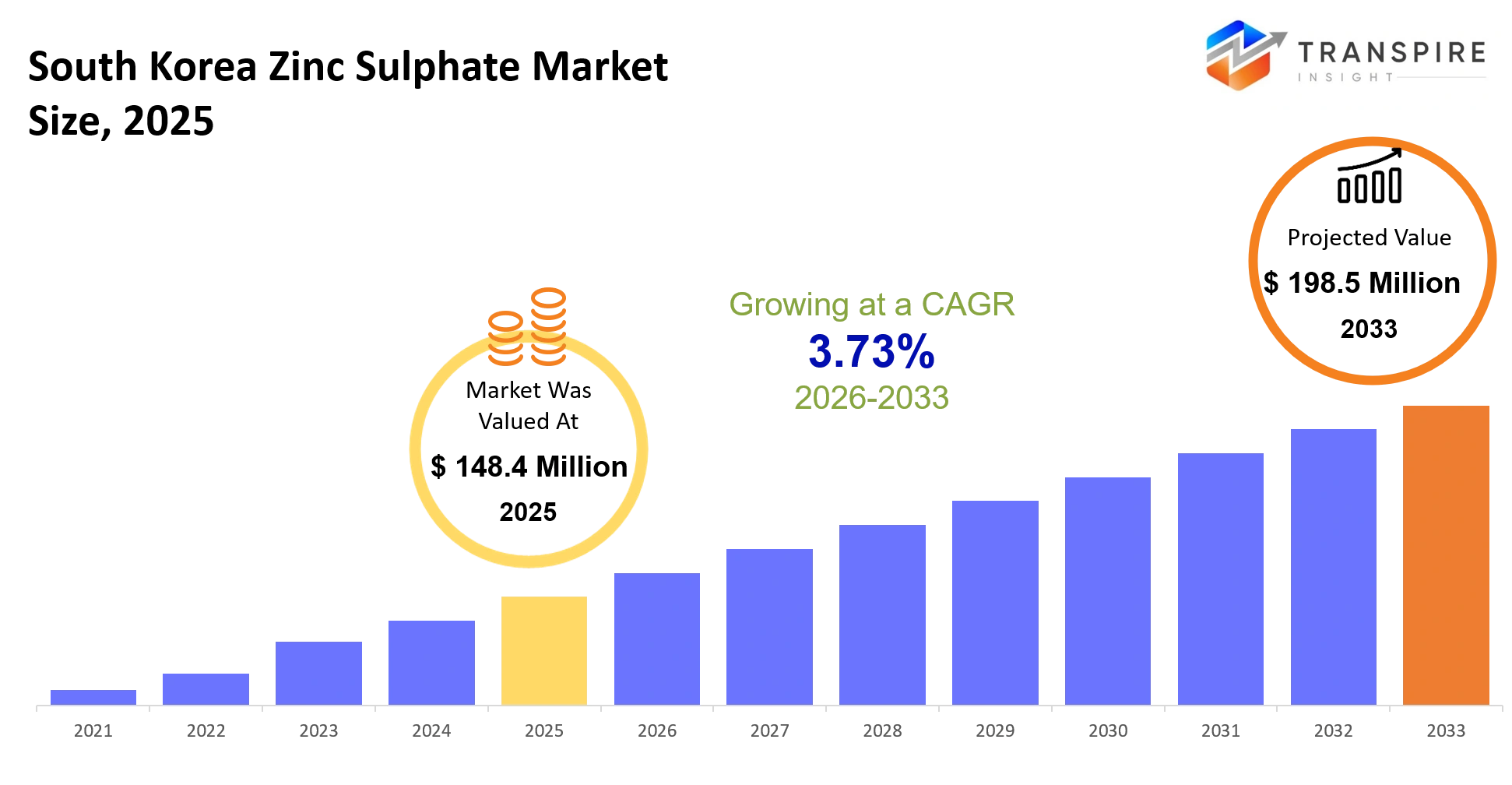
- South Korea Zinc Sulphate Market Size 2025: USD 148.4 Million
- South Korea Zinc Sulphate Market Size 2033: USD 198.5 Million
- South Korea Zinc Sulphate Market CAGR: 3.73%
- South Korea Zinc Sulphate Market Segments: By Type (Monohydrate, Heptahydrate, Others); By Application (Agriculture, Pharmaceuticals, Chemicals, Water Treatment, Others); By End User (Agriculture, Healthcare, Industrial, Others); By Grade (Technical Grade, Feed Grade, Pharma Grade, Others)
South Korea Zinc Sulphate Market Summary
To learn more about this report,  Download Free Sample Report
The South Korea Zinc Sulphate Market was valued at USD 148.4 Million in 2025. It is forecast to reach USD 198.5 Million by 2033. That is a CAGR of 3.73% over the period.
In South Korea, the zinc sulphate market kind of plays a dual role it’s not just some standalone commodity, it helps with soil nutrition correction, livestock health supplementation and even a few industrial lines like electroplating, so it ends up having a direct influence on crop output and feed efficiency rather than sitting quietly as a simple input. Over the last few years, things have been moving away from bulk, low-grade fertilizer type usage, toward higher-purity feed and specialty micronutrient formulations. This is mainly because farms and feed producers are now leaning into precision nutrient management, plus tighter quality controls, so demand favors cleaner products.
One big structural change is the push toward standardized, high-grade formulations that match feed safety and traceability rules, and honestly buyers seem to want that more and more. A big trigger was the pandemic-era disruption, especially when Chinese chemical exports got uneven and freight bottlenecks showed up, it basically highlighted import dependence. That exposure then encouraged buyers to diversify sourcing, and lock in longer-term supply contracts. Because of that, procurement has been sliding toward certified, consistent-grade zinc compounds, which then supports value-added blending and some local formulation activity.
Overall, the change has improved pricing resilience and raised the revenue share from premium grades, even if overall consumption growth stays moderate.
Key Market Insights
- Gyeonggi Province kind of dominates the South Korea Zinc Sulphate Market, with nearly 32% share, largely because agrochemical and industrial activity is pretty concentrated there in 2025.
- In comparison, the Southeast regions are the fastest-growing part, helped along by aquaculture expansion and also fertilizer distribution networks through to 2032.
- Seoul and the areas around it, mainly the industrial belts, add solid demand from chemical processing and specialty use cases.
- For product form, zinc sulphate heptahydrate takes the lead in the South Korea Zinc Sulphate Market with roughly 55% share, mainly due to broad agricultural application across the country.
- Meanwhile, the monohydrate segment is sitting as the second-largest, and it is supported by industrial-grade uses plus the stronger need for higher purity.
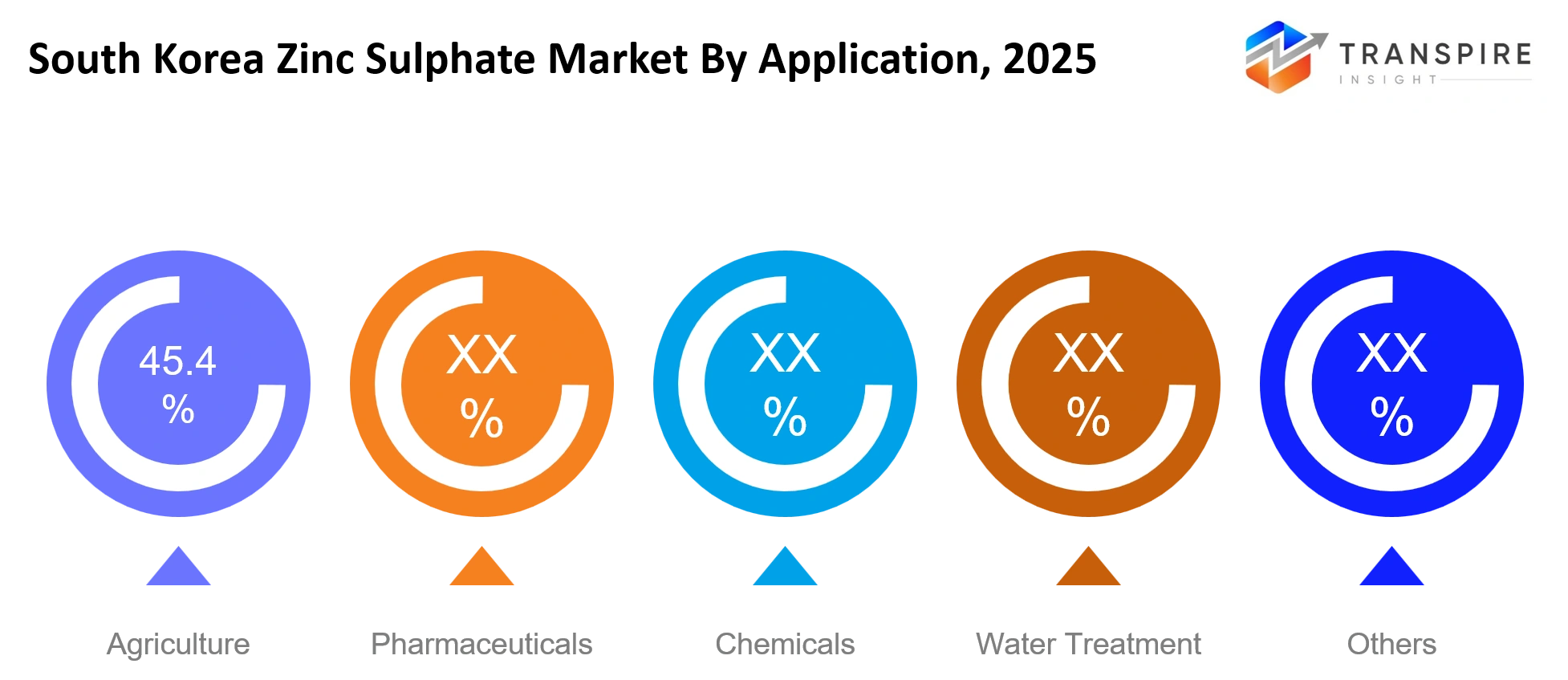
- In South Korea, Zinc Sulphate market demand is mostly driven by Agriculture fertilizers, these products pretty much take the lead with around 48% share, mainly because of micronutrient soil shortages and uneven nutrient balance.
- Animal feed additives are seeing the quickest uptick, yes, largely from improving livestock output along with mineral fortification demand, which is getting stronger year over year, despite some market pauses.
- On the industrial side, growth stays rather steady across chemical processing, and also in water treatment, where zinc salts remain pretty useful for process control.
- Looking at end users, the agricultural sector still sits on top, with roughly 50% share in the South Korea Zinc Sulphate Market in 2025, no surprise there.
- Livestock and poultry feed makers are the fastest-growing end-user group, because protein consumption trends keep moving upward, and that pushes mineral inclusion higher.
What are the Key Drivers, Restraints, and Opportunities in the South Korea Zinc Sulphate Market?
The main growth driver is the tightening of agricultural micronutrient regulations under South Korea’s fertilizer quality standardization framework, which has pushed farmers toward certified zinc based inputs and such. This regulatory shift has made the adoption of zinc sulphate rise inside precision agriculture programs, especially for rice and horticulture crops, where soil zinc deficiency has been scientifically documented. So yeah, fertilizer manufacturers are expanding production capacity and that is directly translating into higher volume led revenue growth across the South Korea Zinc Sulphate Market.
One important structural restraint is dependency on imported zinc concentrates, which basically exposes domestic producers to volatile global metal pricing cycles. And that kind of cost volatility can’t really be mitigated fast because South Korea doesn’t have large scale zinc ore reserves, so it stays a persistent supply side constraint. As a consequence, price instability suppresses procurement decisions among small scale agricultural distributors, and it ends up delaying adoption, while also limiting consistent market expansion even if end use demand looks stable.
A forward-looking opportunity is the integration of biofortified fertilizer technologies, especially controlled release zinc sulphate formulations that are being tested in smart farming pilot projects in the Jeolla region. Early investments by agrochemical firms in precision nutrient delivery systems are expected to unlock higher application efficiency. That should enable premium pricing, and it may expand value-added product segments within the South Korea Zinc Sulphate Market ecosystem as well.
What Has the Impact of Artificial Intelligence Been on the South Korea Zinc Sulphate Market?
Artificial intelligence, plus more advanced digital technologies, are playing a bigger role in operational efficiency and the compliance side of the South Korea Zinc Sulphate market. This is especially clear in the downstream maritime and industrial zinc chemical uses that sit alongside emission control systems, so everything sort of starts to move together, in a way that is harder to separate.
On the automation and optimization front, AI based control platforms are now being plugged into exhaust gas cleaning technology. Sensor driven scrubber monitoring setups continuously tweak slurry circulation, manage the pH balance, and shift flow rates in real time. That cuts down on the need for constant manual involvement, and it also supports steadier use of zinc based scrubbing media. This matters in bigger shipping operations and in coastal industrial facilities, where supply chains connect back into the wider South Korea Zinc Sulphate market ecosystem.
For predictive tasks, machine learning models are leveraged to anticipate equipment wear, plus fouling tendencies in scrubber performance systems. They look at vibration signals, corrosion rate indicators, and changes in particulate loads. Then they help teams line up predictive maintenance, before efficiency drops show up. Meanwhile, emissions forecasting algorithms assist operators with regulatory compliance, basically by simulating sulfur output across different fuel loads, and operating scenarios so compliance becomes less of a guess.
All these upgrades are showing measurable outcomes. Some early deployments report roughly 10–15% less maintenance downtime, and as much as 8% better fuel efficiency, mostly when combustion and scrubbing balance are dialed in properly. Compliance accuracy is also reported to be improved, which lowers the chance of regulatory breaches among industrial users.
However, a real limitation stays, the integration price is pretty high and the data quality is a bit inconsistent in the ocean setting. In particular, sensor drift and those connectivity gaps kind of bring down the model accuracy, plus it also slows down large scale AI rollout across emission control systems, which is kind of frustrating.
Key Market Trends
- In 2025, the tightening of regulations pushed fertilizer producers to drift away from bulk zinc compounds toward certified, high purity zinc sulphate formulations.
- From 2024 to 2026, a lot of agricultural buyers started swapping generic micronutrient blends for more targeted zinc sulphate soil correction programs, gradually.
- In 2025, domestic manufacturers expanded automated production lines with the idea to cut contamination variability , and also to satisfy tougher quality compliance rules that came up.
- When it came to raw materials that rely on imports, sourcing strategies shifted in 2024—procurement leaned more heavily on long term supply contracts with global zinc refiners.
- By 2026, precision agriculture adoption grew noticeably. Farms began folding soil testing data into zinc sulphate application schedules, aiming for yield optimization.
- Meanwhile, players in the feed industry moved from conventional mineral mixes to zinc-enriched formulations after livestock productivity studies were published in 2025.
- During 2025 as well, digital traceability systems were deployed more and more, which made batch level tracking possible across fertilizer supply chains for zinc sulphate distribution.
- Competitive behavior also changed in 2026: mid-sized chemical firms invested in specialty grade production rather than relying on commodity pricing only, for sure.
- And for industrial users, efficiency optimization kicked in during 2024, mostly by dialing back over-application of zinc compounds through better dosing technologies.
South Korea Zinc Sulphate Market Segmentation
By Type :
Monohydrate type still holds strong demand for industrial usage because the composition feels steady and it fits pretty well for high precision applications. More and more adoption in chemical processing keeps consumption moving, across fertilizer blending , and also specialty formulations, sort of in a consistent way. From 2024 onward , manufacturing upgrades are helping push purity levels higher, so production facilities can deliver output that stays consistent.
Heptahydrate type keeps the largest share, mostly because it is broadly used in agriculture and it is kind of cost effective for nutrient delivery. Soil deficiency correction programs are expanding across South Korea, that part is also reinforcing demand for this particular form. Fertilizer manufacturers keep scaling their production capacity so they can cover bulk agricultural distribution networks without too much friction.
The other zinc sulphate variants, the ones outside those main categories, get used for niche requirements in pharmaceuticals and specialty chemical uses. Demand growth stays moderate but it does not really dip because customized formulation needs keep showing up. Smaller producers tend to focus on product differentiation to stay relevant in premium lines and in export oriented supply channels.
By Application :
Agriculture is still the leading use case, mostly because these micronutrient correction programs keep growing, and also soil health improvement initiatives sort of keep getting pushed along. Zinc sulphate use keeps expanding in crop yield programs , particularly with rice and horticulture farming systems. There are structured fertilizer policies too, and they help keep consumption growth steady across rural regions, so it doesn’t really wobble.
On the pharmaceutical side, growth happens more gradually. That is tied to higher demand for zinc-based supplements, plus trace element formulations. In chemical applications, the industrial usage stays fairly steady, mainly during formulation processes. Water treatment usage also rises as stricter quality standards get applied to industrial wastewater systems.
Then you have other applications , like niche industrial processes that need zinc enrichment or stabilization functions. Adoption stays limited , but it’s stable enough. Overall demand patterns show slow diversification, so it gradually moves beyond the old traditional agriculture consumption channels.
To learn more about this report, Download Free Sample Report
By End User :
Agriculture end users really dominate consumption, mostly because of extensive fertilizer usage and ongoing soil correction programs , so the whole thing kind of spreads out. At the farm level, adoption tends to increase when precision nutrient management practices are rolled out across different cultivation zones. Meanwhile, supply chains get stronger, because distribution efficiency improves from manufacturers all the way into rural agricultural networks.
Healthcare end users are also showing rising consumption, tied to the growing need for micronutrient supplementation. Pharmaceutical companies then fold zinc sulphate into trace element formulations. In parallel, industrial end users rely on zinc compounds for chemical processing, and for manufacturing applications that need controlled mineral inputs in a fairly repeatable way.
There are other end users too, like small scale specialty industries that need customized zinc based inputs . Overall demand stays steady, with limited but still consistent procurement cycles across those niche applications.
By Grade :
Technical grade zinc sulphate is seeing major demand because it gets used a lot in industrial and chemical processing areas. During manufacturing, more process improvements help keep things consistent and also cut down impurity levels , which makes buyers more confident for large-scale plant use. So in practice, the demand is kind of moving in parallel with broader industrial modernization, you know.
Feed grade zinc sulphate is also expanding fast, mainly due to the growing needs for livestock nutrition and better animal productivity targets. Feed makers are starting to blend zinc enrichment right into mineral premixes, so it becomes part of the balanced ration strategy. And because regulators are paying more attention to animal health , procurement keeps moving steadily across feed production setups.
For pharma grade zinc sulphate, demand is rising too, partly from wider use inside pharmaceutical formulations and in dietary supplements. Companies maintain strict quality requirements, so production stays controlled and monitored. Meanwhile, other grades still exist for specialized jobs with a smaller but steady customer base, mostly in customized industrial uses.
What are the Key Use Cases Driving the South Korea Zinc Sulphate Market?
Agriculture still feels like the main use case pushing the South Korea Zinc Sulphate Market , because zinc sulphate is broadly used to correct that soil zinc shortage and sort of boost crop productivity in everyday farming systems like rice and vegetables. The demand tends to get really strong in areas where nutrient-depleted soils start lowering yield quality , so farmers end up leaning on focused micronutrient solutions for steadier results or more consistent output .
Beyond that, the range is widening into animal feed blending and even pharmaceutical-grade supplementation. Livestock producers are more often choosing zinc-enriched feed additives, meant to support immunity and also growth performance , while healthcare manufacturers plug zinc compounds into trace mineral supplements. In practice , these activities are growing at a measured pace inside managed feed production and regulated healthcare manufacturing spaces.
There are also newer things showing up, like water treatment chemicals and precision, controlled fertilizer technologies. Industrial wastewater plants are starting to apply zinc-based materials for trace metal balancing, and smart farming systems are trialing controlled-release zinc sulphate to lift nutrient efficiency . This all is still somewhat early, but it is getting notice as environmental limits tighten and production has to become more efficiency driven.
|
Report Metrics |
Details |
|
Market size value in 2025 |
USD 148.4 Million |
|
Market size value in 2026 |
USD 153.6 Million |
|
Revenue forecast in 2033 |
USD 198.5 Million |
|
Growth rate |
CAGR of 3.73% from 2026 to 2033 |
|
Base year |
2025 |
|
Historical data |
2021 - 2024 |
|
Forecast period |
2026 - 2033 |
|
Report coverage |
Revenue forecast, competitive landscape, growth factors, and trends |
|
Country scope |
South Korea |
|
Key company profiled |
Old Bridge Chemicals, Zinc Nacional, Sulfozyme, Rech Chemical, Changsha Haolin, Balaji Industries, Ravi Chem, Tianjin Topfert, Redox, Lantian Chemical, Gosalon, EverZinc, Umicore, Nyrstar, Hindustan Zinc |
|
Customization scope |
Free report customization (country, regional & segment scope). Avail customized purchase options to meet your exact research needs. |
|
Report Segmentation |
By Type (Monohydrate, Heptahydrate, Others); By Application (Agriculture, Pharmaceuticals, Chemicals, Water Treatment, Others); By End User (Agriculture, Healthcare, Industrial, Others); By Grade (Technical Grade, Feed Grade, Pharma Grade, Others) |
Which Regions are Driving the South Korea Zinc Sulphate Market Growth?
Gyeonggi Province kind of leads the South Korea Zinc Sulphate Market, mostly because it has a strong industrial base and it sits close to major chemical manufacturing clusters. People there also get to lean on well-developed logistics routes and the easy access to import channels through nearby ports. On top of that, strict enforcement of fertilizer quality standards helps adoption of refined zinc sulphate products, which is, you know, a big deal. There’s also this rather dense ecosystem of agrochemical producers and blending facilities, and it keeps a kind of continuous demand supply connection going, without much interruption.
Then the Busan region plays a more steady, almost secondary role, but it still matters a lot. This is backed by strong port infrastructure and maritime-linked industrial activity. Compared with the more inland industrial focus in Gyeonggi, Busan benefits from a reliable import flow stability and long-standing shipowner and bulk chemical trader relationships. The area shows steady procurement patterns, driven by predictable trade volumes instead of sudden expansion cycles. Its resilience comes from diversified industrial demand too, including chemical handling and export-oriented distribution networks, so it doesn’t swing so wildly.
Jeolla region, meanwhile, is the fastest-growing area, largely because of recent investments in smart agriculture infrastructure and the expanded fertilizer distribution programs that rolled out after 2024. Government-backed rural modernization initiatives have pushed more micronutrient-based soil treatment solutions into everyday use. With improved irrigation systems and precision farming pilots, zinc sulphate usage has picked up across commercial farms. For investors and market entrants this region feels like a clear signal of strong long-term growth potential between 2026 and 2033, especially when you look at value-added agricultural input supply chains and related services.
Who are the Key Players in the South Korea Zinc Sulphate Market and How Do They Compete?
Competition in the South Korea Zinc Sulphate Market is still kinda moderately consolidated at the upstream production level but it gets way more fragmented when you move into downstream blending and distribution. On one side, a small set of global zinc producers basically controls how raw material shows up, while on the other, lots of fertilizer and chemical formulators work locally. In the end, the fight mostly boils down to access to stable zinc feedstock , the ability to manage purity properly, and also long-term supply contracts, not so much branding or anything really customer-facing that feels differentiated. Pricing efficiency and regulatory compliance really push market positioning, and it’s noticeable.
Korea Zinc is centered on high-purity zinc output , paired with refining processes that help keep feedstock quality steady for domestic fertilizer manufacturers. Hindustan Zinc leans on large-scale production capacity to hold cost advantages and then it uses flexible export pricing across Asian chemical supply chains. Nyrstar instead stands out via recycling integration and circular zinc sourcing, which in turn strengthens partnerships with feed-grade and industrial processors that want more sustainable inputs.
Teck Resources builds its competitiveness using diversified mining assets plus long-term offtake agreements, that kind of locks zinc concentrate flows in place for downstream conversion markets. Glencore taps into its global trading network to fine-tune zinc redistribution and secure flexible pricing setups for South Korean industrial buyers. Overall these players gain influence by putting supply security first, linking logistics properly, and sticking to contractual stability, rather than going hard on direct product branding strategies, which honestly feels less important here.
Company List
- Old Bridge Chemicals
- Zinc Nacional
- Sulfozyme
- Rech Chemical
- Changsha Haolin
- Balaji Industries
- Ravi Chem
- Tianjin Topfert
- Redox
- Lantian Chemical
- Gosalon
- EverZinc
- Umicore
- Nyrstar
- Hindustan Zinc
Recent Development News
In November 2025, Korea Zinc entered a strategic memorandum of understanding with HK Materials to strengthen the germanium and critical minerals supply chain through zinc smelting by-products. The collaboration enhances downstream refining integration that supports intermediate zinc chemical production, including sulfate-based derivatives used in industrial applications. Source https://en.yna.co.kr/
In December 2025, Korea Zinc completed a 2.85 trillion won new share issuance to finance a U.S.-linked critical minerals smelter project, expanding its non-ferrous metals processing capacity. The investment strengthens upstream zinc refining and is expected to improve availability of intermediate compounds used in zinc-based chemical markets, including zinc sulphate supply chains. Source https://www.reuters.com/
What Strategic Insights Define the Future of the South Korea Zinc Sulphate Market?
The South Korea Zinc Sulphate Market is slowly but clearly shifting toward higher-value, precision-led use cases during the next 5 to 7 years, with extra momentum from stricter agricultural nutrient rules and growing demand for ingredients that are easy to trace and also high purity. In other words, growth should lean more on formulation craftsmanship and application efficiency, not just raw volume adding, as both farms and industrial buyers move toward data-guided nutrient management and more controlled dosing habits. Even the “how” matters a lot now, not only the “how much”.
There’s also a quieter concern that doesn’t always get attention: a rising dependence on imported zinc feedstock, so prices can stay volatile for longer stretches and supply could tighten if global mining disruptions drag on. This pressure might compress margins quietly, even when end-use demand looks strong on paper, and especially for smaller domestic processors that do not have reliable long-term sourcing agreements lined up.
At the same time, a real chance is forming around smart farming adoption in Jeolla and other agricultural centers, where sensor-led soil diagnostics are starting to steer micronutrient delivery including zinc sulphate. That opens a lane for premium, precision-grade products made for digital agriculture setups. For market players, it will probably pay off to pursue backward integration, or at least lock in long-term raw material supply, while also investing in high-purity, application-specific formulations, so they can capture value in the changing South Korea Zinc Sulphate Market landscape, before competitors do it first.
South Korea Zinc Sulphate Market Report Segmentation
By Type
- Monohydrate
- Heptahydrate
By Application
- Agriculture
- Pharmaceuticals
- Chemicals
- Water Treatment
By End User
- Agriculture
- Healthcare
- Industrial
By Grade
- Technical Grade
- Feed Grade
- Pharma Grade
Frequently Asked Questions
Find quick answers to common questions.
The expected South Korea Zinc Sulphate Market size is USD 198.5 Million in 2033.
Key segments for the South Korea Zinc Sulphate Market are By Type (Monohydrate, Heptahydrate, Others); By Application (Agriculture, Pharmaceuticals, Chemicals, Water Treatment, Others); By End User (Agriculture, Healthcare, Industrial, Others); By Grade (Technical Grade, Feed Grade, Pharma Grade, Others).
Major South Korea Zinc Sulphate Market players are Old Bridge Chemicals, Zinc Nacional, Sulfozyme, Rech Chemical, Changsha Haolin, Balaji Industries, Ravi Chem, Tianjin Topfert, Redox, Lantian Chemical, Gosalon, EverZinc, Umicore, Nyrstar, Hindustan Zinc.
The South Korea Zinc Sulphate Market size is USD 148.4 Million in 2025.
The South Korea Zinc Sulphate Market CAGR is 3.73% from 2026 to 2033.
- Old Bridge Chemicals
- Zinc Nacional
- Sulfozyme
- Rech Chemical
- Changsha Haolin
- Balaji Industries
- Ravi Chem
- Tianjin Topfert
- Redox
- Lantian Chemical
- Gosalon
- EverZinc
- Umicore
- Nyrstar
- Hindustan Zinc
About the Authors

Pankaj Ghogare Patil
I am Pankaj Ghogare Patil, a Senior Research Analyst at Transpire Insight, specializing in the Pharmaceutical, Chemicals & Materials, Healthcare IT, and Biotechnology industry. My expertise lies in conducting comprehensive market research, analyzing industry trends, evaluating competitive landscapes, and translating complex data into actionable insights. At Transpire Insight, I closely follow emerging technologies, regulatory developments, and market innovations to create accurate, well-researched, and informative content that helps businesses and professionals make informed decisions. I am committed to producing credible, evidence-based articles that reflect industry best practices while making technical topics accessible and valuable for a broad audience.

Chakradhar Khansole
Chakradhar serves as the Research Director at Transpire Insight, bringing over 8 years of experience in technology, innovation, and strategic market intelligence. He specializes in transforming complex market data into actionable business insights that enable organizations to make informed, growth-oriented decisions. Recognized for his strategic vision and analytical expertise, Chakradhar leads high-impact research initiatives, delivering comprehensive market assessments, competitive intelligence, and forward-looking industry analysis.
Recently Published Reports
-
May 2026
Healthcare Polymer Packaging Market
Healthcare Polymer Packaging Market Size, Share & Analysis Report By Packaging Type (Syringes, IV Bottles and Pouches, Clamshells, Blisters, Bottles & Jars, Containers, Tubes, IV Parental Packaging, Others), By Type (Regulated, Non-regulated), By Polymer Type (LDPE (Low-Density Polyethylene), HDPE (High-Density Polyethylene), Homo-polymer (Homo), Random Copolymer (Random), Block Copolymer (Block), PET, Polystyrene, Polyvinyl Chloride, Polyamide/EVOH, Others), and Geography (North America, Europe, Asia-Pacific, Middle East and Africa, South and Central America), 2021 - 2031
-
Apr 2026
Hydrophilic Tape (Waterstop) Market
Hydrophilic Tape (Waterstop) Market Size, Share & Analysis Report By Type (Bentonite-Based Hydrophilic Tape, Rubber-Based Hydrophilic Tape), By Application (Residential Buildings, Commercial Buildings, Infrastructure Projects), and Geography (North America, Europe, Asia-Pacific, Middle East and Africa, South and Central America), 2021 - 2031
-
Apr 2026
Metalens Market
Metalens Market Size, Share & Analysis Report By Type (Visible Light Metalens, and Infrared Metalens), By Application (Consumer Electronics, Automotive Electronics, Industrial, Medical, and Others), and Geography (North America, Europe, Asia-Pacific, Middle East and Africa, South and Central America), 2021 - 2031
-
Apr 2026
PBT Resin Market
PBT Resin Market Size, Share & Analysis Report By Type (Reinforced PBT Resin, Unreinforced PBT Resin), By Processing Method (Injection Molding, Extrusion, Blow Molding, Others), By End-User (Automotive, Electrical & Electronics, Consumer Appliances, Industrial Machinery, Medical Devices, Packaging, Others), and Geography (North America, Europe, Asia-Pacific, Middle East and Africa, South and Central America), 2021 - 2031