

Middle East and Africa Industrial And Institutional Cleaning Chemicals Market Size & Forecast:
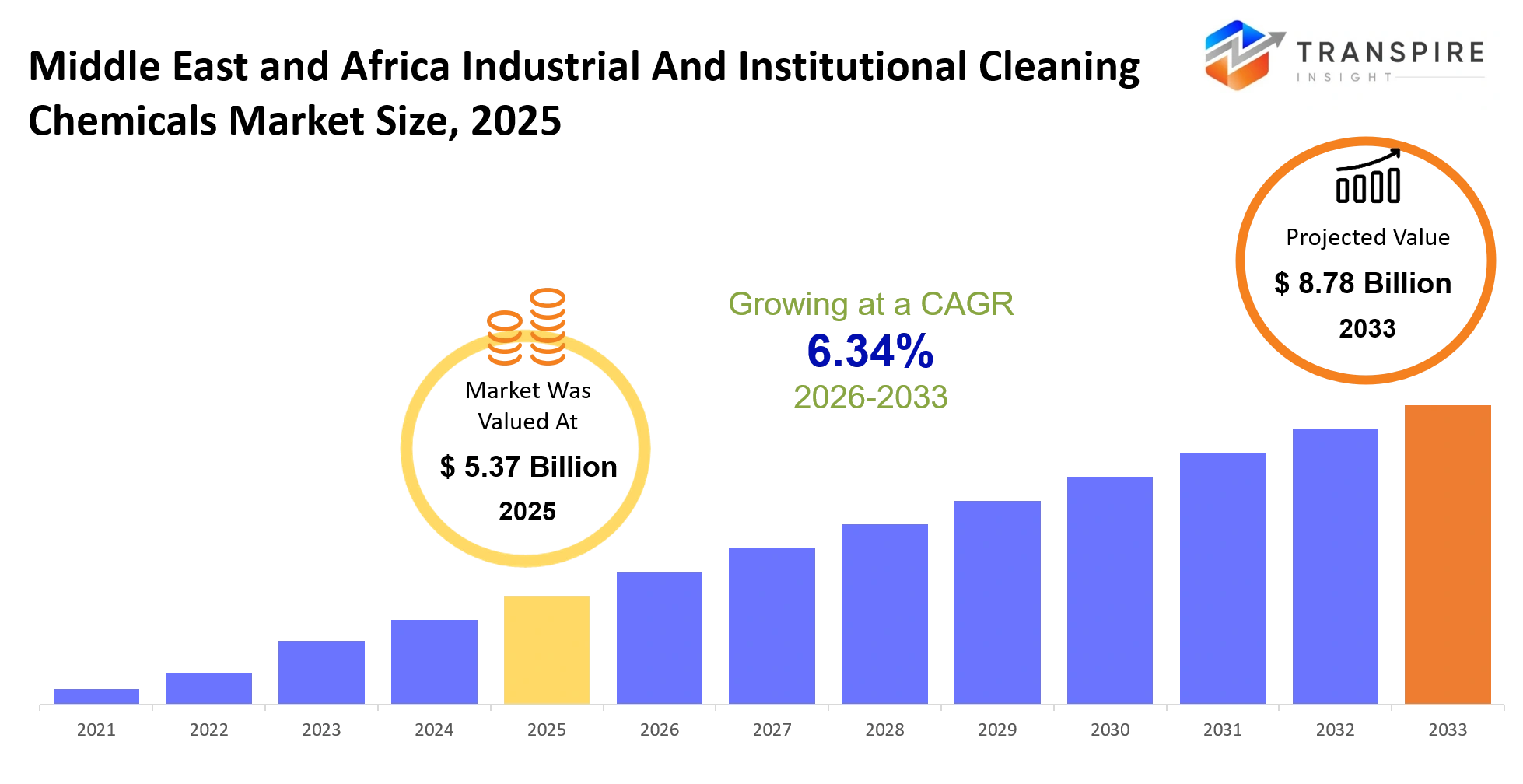
- Middle East and Africa Industrial And Institutional Cleaning Chemicals Market Size 2025: USD 5.37 Billion
- Middle East and Africa Industrial And Institutional Cleaning Chemicals Market Size 2033: USD 8.78 Billion
- Middle East and Africa Industrial And Institutional Cleaning Chemicals Market CAGR: 6.34%
- Middle East and Africa Industrial And Institutional Cleaning Chemicals Market Segments: By Product Type (Disinfectants, Degreasers, Detergents, Sanitizers, Glass Cleaners, Floor Care Chemicals, Surface Cleaners, Others); By Form (Liquid, Powder, Spray, Gel, Foam-Based, Others); By Application (Healthcare Facilities, Food Processing, Hospitality, Manufacturing Plants, Educational Institutions, Others); By End User (Commercial Buildings, Industrial Facilities, Hospitals, Hotels & Restaurants, Others).
To learn more about this report,  Download Free Sample Report
Middle East and Africa Industrial And Institutional Cleaning Chemicals Market Summary
The Middle East and Africa Industrial And Institutional Cleaning Chemicals Market was valued at USD 5.37 Billion in 2025. It is forecast to reach USD 8.78 Billion by 2033. That is a CAGR of 6.34%over the period.
The Middle East and Africa Industrial and Institutional Cleaning Chemicals Market kind of plays a key part in keeping hygiene up, supporting operational safety, and meeting regulatory requirements across hospitals, hotels, food processing units, manufacturing facilities, schools and universities, and various commercial buildings. In practice these chemicals assist organizations with controlling contamination, discouraging equipment fouling, lowering infection risks and, keeping workplace standards where it matters most for day to day productivity and the level of customer confidence.
In the last five years the market has shifted away from plain bulk cleaning products, and more toward concentrated mixes, automated dosing systems, and hygiene programs that are digitally monitored. One big driver behind this change was the continuing impact of the COVID-19 pandemic, which effectively locked in higher hygiene protocols across healthcare, hospitality, and public infrastructure. Also, more demanding food safety and workplace sanitation regulations in several Gulf countries pushed budgets toward newer, more advanced cleaning approaches. So as industries modernize premises and keep expanding service networks, spending is moving toward higher performance chemicals plus integrated hygiene platforms which then tends to generate stronger recurring revenue for manufacturers and cleaning service providers too .
Key Market Insights
- So the Middle East and Africa Industrial And Institutional Cleaning Chemicals Market is forecast to bring in something like over USD 3.4 billion in new revenue from 2025 up through 2033, give or take a bit.
- In the GCC countries, nearly 45% of the regional market revenue is basically coming from there, with healthcare growth and hospitality projects helping pull it along.
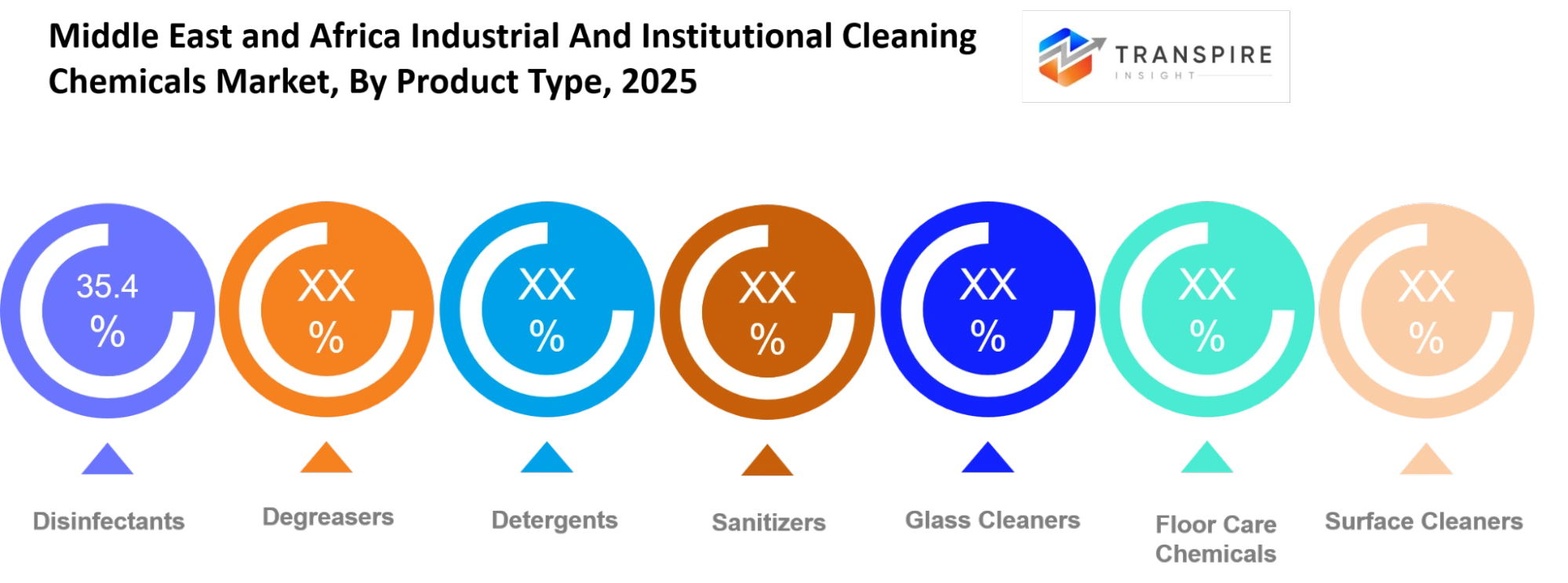
- When it comes to product types, institutional disinfectants are still out front, holding an estimated 30%+ share in 2025, and it’s not really close.
- After that, general-purpose cleaners sit as the second-biggest segment because they get used everywhere, across commercial sites and industrial locations too.
- Looking ahead, enzyme based cleaners and low-residue specialty cleaner lines are expected to grow the fastest through 2033, kind of a steady ramp rather than a sudden spike.
- For applications, healthcare use brings in about 28% of total demand, mainly because infection-control standards are still getting tighter.
- Meanwhile food processing, and beverage manufacturing are showing up as faster-growing uses, largely due to stricter sanitation audits and export expectations.
- Hospitals and healthcare facilities stay as the top end-user group, accounting for nearly one-third of regional consumption.
- Hospitality, plus facility management providers are also among the quickest-growing customer sets, since tourism investment keeps accelerating across Gulf markets.
- And major companies like Ecolab, Diversey, BASF, Solenis, Henkel, and 3M are working to strengthen their positions via digital dosing systems, more sustainable formulations,and regional manufacturing investments.
What are the Key Drivers, Restraints, and Opportunities in the Middle East and Africa Industrial And Institutional Cleaning Chemicals Market?
The strongest growth driver i guess comes from the whole institutional hygiene compliance angle, across healthcare, food processing, hospitality, and even public infrastructure. Governments in Gulf Cooperation Council countries have tightened sanitation protocols after the pandemic, and they’ve also expanded inspection programs in hospitals, food service establishments, and manufacturing facilities. Because of that, organizations often prefer to replace commodity cleaning products with more specialized disinfectants, automated dispensing systems and audit-ready hygiene programs. So suppliers end up generating stronger repeat income from longer-term service contracts and replenishment agreements, instead of only getting one time product sales.
Still, volatility in raw material costs stays the biggest structural problem. A lot of surfactants, specialty solvents, packaging materials and chemical intermediates are tied to global petrochemical supply chains. Many regional manufacturers rely on imported ingredients which makes production costs sensitive to shipping disruptions, currency movements, and energy price swings. And since institutional customers frequently run under fixed procurement contracts, suppliers can’t always shift those higher costs to customers right away, which ends up squeezing margins and also reducing how much they can invest.
On the opportunity side, smart hygiene management systems look really promising when they’re integrated with Internet of Things sensors, plus digital monitoring platforms. Big hospitals, airports, hotels, and commercial facilities are increasingly asking for measurable cleaning performance, not only product-only procurement. In Gulf countries, especially Saudi Arabia and the UAE, they are putting substantial money into smart city infrastructure and digitally managed public facilities.
What Has the Impact of Artificial Intelligence Been on the Middle East and Africa Industrial And Institutional Cleaning Chemicals Market?
Artificial intelligence is, kind of slowly, changing the way industrial and institutional cleaning programs get managed across parts of the Middle East and Africa. Big healthcare facilities, airports, hotels, and food processing plants increasingly rely on AI-enabled platforms to keep an eye on chemical usage, cleaning timetables, equipment condition, and sanitation compliance in real time
Machine learning models also let facility teams foresee maintenance needs for dosing systems, dispensing units, and automated cleaning equipment before failures show up. With this sort of foresight the downtime that usually comes “out of nowhere” tends to drop, and operational flow stays steadier. AI-based analytics further help tune the chemical concentration levels, so facilities can cut back on waste while still meeting the hygiene requirements that are expected. In major commercial buildings, digital cleaning platforms can even interpret occupancy patterns, then adjust cleaning frequency according to actual footfall, which in turn supports better labor output and more sensible use of resources
Then there are the advanced monitoring systems. They help with regulatory compliance by creating digital audit trails, and pointing out any odd deviations from the hygiene procedures. Organizations using automated dosing along with AI-assisted monitoring often say they get lower chemical consumption, more steady equipment uptime, and better compliance outcomes
Still, uptake is not fully smooth, mostly because the integration costs can be high and the data availability is kind of uneven. A lot of facilities keep older, patchwork systems in place, with only limited sensor coverage,so gathering the kind of high-quality operational information that dependable AI-driven calls require becomes hard
Key Market Trends
- Since 2021, automated dosing systems have been picked up pretty fast, and they can cut chemical overuse by as much as 20% in bigger facilities, honestly.
- Healthcare operators now, more and more, ask for hospital-grade disinfectants that actually line up with stricter infection control rules that came in after the pandemic period.
- Between 2022 and 2025, demand for concentrated cleaning formulations climbed a lot, mainly because organizations wanted reduced transport and storage spend at the same time.
- Hospitality players across Gulf countries also started expanding hygiene certification programs, in order to reinforce guest assurance and help brand positioning hold steady.
- Digital compliance monitoring platforms have shown up more often in airports, hospitals, and food processing plants since 2023, it seems.
- Meanwhile manufacturers are leaning harder into biodegradable surfactants, and they also push for lower-VOC formulations to satisfy those sustainability procurement demands.
- Regional buyers are moving away from single-off purchases and they’re more into multi-year hygiene service agreements that bundle chemicals plus technical support, all together.
- Food exporters further increased sanitation spend after global food safety audits got tougher across international supply chains.
- Companies like Ecolab, Diversey, and Solenis have been growing connected hygiene technologies. Those tools make operational visibility easier and improve chemical efficiency at once.
- Local distributors too, keep teaming up with multinational suppliers, mostly to strengthen technical service know-how and improve penetration in the regional market.
Middle East and Africa Industrial And Institutional Cleaning Chemicals Market Segmentation
By Product Type
The product type segment kinda mirrors the broad range of cleaning chemicals people use to keep hygiene, cleanliness, and day to day operational efficiency on track across commercial and industrial spaces. Disinfectants end up holding a big place here, since healthcare facilities, food production sites, and public institutions really need dependable microbial control, just to satisfy those sanitation benchmarks. Degreasers help with cleaning chores in manufacturing areas and maintenance locations, where oil, grease, and heavy residues often build up on equipment, and work surfaces. Detergents are still very common for routine cleaning stuff, mainly because they stay compatible with different surfaces, and they can meet various cleaning needs. Sanitizers, meanwhile, are a big deal for lowering contamination risk in high contact zones, like food handling areas. Glass cleaners help with visibility and overall appearance expectations in commercial buildings, hospitality venues, and institutional spaces.
Floor care chemicals support durability, cleanliness, and general safety across large floor areas that get constant traffic, day after day. Surface cleaners cover the daily cleaning demands you usually see in offices, schools, healthcare facilities, and industrial settings too. Other categories include niche formulas built for specific cleaning hurdles, plus regulatory limits, and maintenance requirements tied to particular industries, not just generic use. Sometimes these are basically “only for that situation” types.
To learn more about this report, Download Free Sample Report
By Form
The way this form segment works sort of shows how cleaning chemicals get supplied so they can meet different operational needs, plus different ways of applying, and honestly even user preferences. Liquid products take up a pretty big portion, since liquid formulations make them easier to manage, allow quick dilution, and they stay compatible with automated dispensing systems. A lot of industrial and institutional facilities tend to lean toward liquid solutions for large scale cleaning efforts and regular maintenance routines. When performance is steady and the application options stay flexible, it helps adoption spread across multiple sectors, not just one.
Powder formulations still matter a lot, especially when the goal is longer shelf life, cheaper transport, and concentrated cleaning power. Spray products are useful for targeted cleaning, and they go on fast over high touch surfaces, workstations, and shared spaces. Gel formulations tend to give a longer contact time on the surface, so the cleaning process ends up being more effective in chosen scenarios. Foam based products keep getting more traction too, because the foam coverage improves visibility while cleaning and can help cut down chemical waste. Others include different delivery formats, kind of designed to handle specialized operational needs and odd cleaning environments, where the usual approach just doesn’t fit.
By Application
The application segment shows, kind of, how cleaning chemicals support hygiene safety, and day to day operational standards across multiple industries. Healthcare Facilities are a big application area too, since infection prevention, patient safety, and regulatory compliance basically lean on effective cleaning along with disinfection methods. Food Processing facilities also need strict sanitation programs to keep product quality steady, help meet export expectations, and cut down contamination exposure during production activity. When regular cleaning is actually followed, it supports operational continuity and helps maintain regulatory performance.
Hospitality establishments use cleaning chemicals to keep guest satisfaction high, preserve property appearance, and protect service quality across both accommodation and dining spaces. Manufacturing Plants rely on specialized cleaning solutions so equipment performance stays reliable, workplace safety is addressed, and production efficiency keeps moving. Educational Institutions use cleaning products to encourage a healthier learning environment, while also maintaining cleanliness across classrooms, laboratories, and shared public zones. Other sectors include transportation facilities, government buildings and specialized institutions, all of which need tailored cleaning programs depending on specific operational needs.
By End User
The end user segment shows which organizations actually use industrial and institutional cleaning chemicals so they can keep hygiene at a solid level, keep operations running smoothly, and stay in line with regulatory requirements. Commercial Buildings take a large slice here, simply because office complexes, retail centers, and mixed use properties need steady cleaning work across those high traffic zones. Industrial Facilities lean on specialized products to lift contaminants, keep machinery working properly, and help sustain safer working conditions during the whole production period. When cleaning stays consistent it lowers the chance of operational interruptions, and it helps productivity goals too.
Hospitals need heavy use of cleaning and disinfection products, mostly to back infection control initiatives and to uphold strict health care hygiene rules. Hotels & Restaurants depend on all around cleaning solutions in order to build customer confidence, protect food safety, and keep the building looking good. Ongoing sanitation efforts also reinforce service quality, and they align with industry requirements, on time. Others may include public institutions, transport hubs, and specialized facilities, where cleaning plans are shaped by different operational realities and specific regulatory needs.
What are the Key Use Cases Driving the Middle East and Africa Industrial And Institutional Cleaning Chemicals Market?
Healthcare facilities are pretty much the biggest use case for industrial and institutional cleaning chemicals. Like hospitals, clinics, labs and also long-term care centers, all need ongoing disinfection routines to keep pathogens under control, follow healthcare rules, and generally reduce healthcare-associated infection risks. In these settings, they go through huge amounts of disinfectants, surface cleaners, and those specialized sanitation products, every single day.
Then there are food processing plants and hospitality businesses, which have been getting more and more attention as real application spaces. Food producers use cleaning chemicals to keep production hygiene steady, hit export expectations, and stop contamination before it starts. Hotels, resorts, and commercial kitchens lean on sanitation and cleaning programs so service stays consistent, and so they remain in line with regulations, even when it gets busy.
On top of that, newer applications are showing up too, like smart commercial buildings, bigger transportation hubs, and data centers. These places are rolling out hygiene programs that are monitored digitally, and that helps tune chemical use, boost day to day operational efficiency, and create documented compliance records. That ends up helping both facility operators and regulators, and well, it’s kind of the whole point.
|
Report Metrics |
Details |
|
Market size value in 2025 |
USD 5.37 Billion |
|
Market size value in 2026 |
USD 5.71 Billion |
|
Revenue forecast in 2033 |
USD 8.78 Billion |
|
Growth rate |
CAGR of 6.34%from 2026 to 2033 |
|
Base year |
2025 |
|
Historical data |
2021 - 2024 |
|
Forecast period |
2026 - 2033 |
|
Report coverage |
Revenue forecast, competitive landscape, growth factors, and trends |
|
Regional scope |
Middle East and Africa (Saudi Arabia, United Arab Emirates, South Africa, Rest of Middle East and Africa) |
|
Key company profiled |
Ecolab, Diversey, Clorox, Reckitt, Procter & Gamble, Unilever, BASF, Solenis, 3M, Spartan Chemical, Betco, GOJO Industries, Zep Inc., Henkel, Kimberly-Clark. |
|
Customization scope |
Free report customization (country, regional & segment scope). Avail customized purchase options to meet your exact research needs. |
|
Report Segmentation |
By Product Type (Disinfectants, Degreasers, Detergents, Sanitizers, Glass Cleaners, Floor Care Chemicals, Surface Cleaners, Others); By Form (Liquid, Powder, Spray, Gel, Foam-Based, Others); By Application (Healthcare Facilities, Food Processing, Hospitality, Manufacturing Plants, Educational Institutions, Others); By End User (Commercial Buildings, Industrial Facilities, Hospitals, Hotels & Restaurants, Others). |
Which Regions are Driving the Middle East and Africa Industrial And Institutional Cleaning Chemicals Market Growth?
The Gulf region, still seems to be the big driver of market revenue. Places like Saudi Arabia and United Arab Emirates get major advantages from deep healthcare infrastructure, top-tier hospitality assets, large commercial developments, and very strict hygiene rules. With government spending on tourism, healthcare modernization and public infrastructure still moving forward, consumption of modern cleaning products keeps getting supported in a steady kind of way. Also a solid distribution network, plus multinational suppliers already operating there, ends up reinforcing why the region stays out front.
South Africa is likely number two, in terms of regional contribution. But unlike the Gulf, growth here is more about an established industrial base, fairly developed commercial infrastructure, and more or less stable institutional demand. Sectors such as manufacturing, mining, healthcare, and food processing work together to form a varied customer group, which in turn creates reliable revenue prospects. There’s also the matter of long-time supplier ties and procurement systems that are already well organized.
As for the rest of Africa, it is expected to show the fastest growth through 2033. Healthcare capacity upgrades, urban infrastructure programs, hospitality expansions, and newer retail formats have been ramping up across countries including Kenya, Nigeria and Egypt. As more people move into cities, and as regulatory structures keep getting better, sanitation requirements rise across both public and private environments. For investors and people entering the market, these areas can make it easier to set early footholds, before industry consolidation really kicks in.
Who are the Key Players in the Middle East and Africa Industrial And Institutional Cleaning Chemicals Market and How Do They Compete?
Competition is still kinda moderately fragmented, you know, with global manufacturers running head to head alongside regional distributors and specialty chemical suppliers. Most companies try to stand apart via formulation performance and know how on regulatory compliance, plus service support and even digital hygiene technologies. It’s not really just about price anymore. Also, big institutional buyers are lately judging suppliers on measurable outcomes, like chemical efficiency, compliance paperwork, and operational backing, more than before.
Ecolab plays it with integrated hygiene management platforms, where chemicals are tied in with digital monitoring, water treatment know how, and technical services. This way customers can lower resource consumption while still holding sanitation standards. Diversey leans toward infection prevention, automated dispensing tech, and cleaning programs that are tuned to a specific facility, so differentiation comes from operational efficiency and compliance assistance. Solenis keeps pushing its hygiene catalog through acquisitions and technology blending, which helps it reach farther in the institutional arena.
BASF relies on formulation expertise and specialty ingredient capabilities that enable more advanced cleaning product development. Henkel leans into sustainable chemistry and industrial cleaning innovations that match up with broader sustainability targets. And 3M differentiates by offering specialized cleaning systems, surface care technologies, and professional facility maintenance solutions. Together these moves help firms keep customers longer and slide into higher-value service segments.
Company List
- Ecolab
- Diversey
- Clorox
- Reckitt
- Procter & Gamble
- Unilever
- BASF
- Solenis
- 3M
- Spartan Chemical
- Betco
- GOJO Industries
- Zep Inc.
- Henkel
- Kimberly-Clark
Recent Development News
In April 2026, Ecolab launched Water Navigator IQ, an AI-enabled water intelligence platform. The solution provides enterprise-wide visibility into water performance and supports data-driven optimization, strengthening digital service offerings across industrial and institutional facilities.
Source: https://www.ecolab.com
In June 2025, Diversey launched the LESSEAU Manual dispenser and solid hand wash system worldwide. The innovation introduced plastic-free solid hand wash technology for institutional environments, supporting sustainability and operational efficiency objectives.
Source: https://www.solenis.com/
What Strategic Insights Define the Future of the Middle East and Africa Industrial And Institutional Cleaning Chemicals Market?
Over the next five to seven years, the market is likely to drift toward outcome-based hygiene management rather than standalone chemical sales, and it kinda feels like that direction is getting louder. Digital monitoring, automated dispensing systems, and compliance-driven service models will increasingly nudge purchasing decisions, specially as large institutions look for something measurable in daily operations. The real, underlying push behind this change is the growing need to document hygiene outcomes rather than just show that a product got used.
One somewhat hidden risk is dependence on imported specialty chemical ingredients. If supply chains keep getting disrupted or if petrochemical price volatility ramps up, margins can get squeezed and pricing flexibility across the whole value chain can shrink, not great. At the same time, smart facility management platforms are turning into an actual opening. As hospitals, airports, and commercial complexes adopt connected infrastructure, suppliers that can pair chemical solutions with digital monitoring, will end up having a competitive edge, you can see it coming.
Market participants should really prioritize investment in data-enabled hygiene solutions and regional distribution reach. Firms that blend chemical know-how with measurable operational outcomes will probably be better placed to win long-term institutional contracts, and also defend their market share more firmly.
Middle East and Africa Industrial And Institutional Cleaning Chemicals Market Report Segmentation
By Product Type
- Disinfectants
- Degreasers
- Detergents
- Sanitizers
- Glass Cleaners
- Floor Care Chemicals
- Surface Cleaners
- Others
By Form
- Liquid
- Powder
- Spray
- Gel
- Foam-Based
- Others
By Application
- Healthcare Facilities
- Food Processing
- Hospitality
- Manufacturing Plants
- Educational Institutions
- Others
By End User
- Commercial Buildings
- Industrial Facilities
- Hospitals
- Hotels & Restaurants
- Others
Frequently Asked Questions
Find quick answers to common questions.
The expected Middle East and Africa Industrial And Institutional Cleaning Chemicals Market size for the market will be USD 8.78 Billion in 2033.
Key segments for the Middle East and Africa Industrial And Institutional Cleaning Chemicals Market are By Product Type (Disinfectants, Degreasers, Detergents, Sanitizers, Glass Cleaners, Floor Care Chemicals, Surface Cleaners, Others); By Form (Liquid, Powder, Spray, Gel, Foam-Based, Others); By Application (Healthcare Facilities, Food Processing, Hospitality, Manufacturing Plants, Educational Institutions, Others); By End User (Commercial Buildings, Industrial Facilities, Hospitals, Hotels & Restaurants, Others).
Major Middle East and Africa Industrial And Institutional Cleaning Chemicals Market players are Ecolab, Diversey, Clorox, Reckitt, Procter & Gamble, Unilever, BASF, Solenis, 3M, Spartan Chemical, Betco, GOJO Industries, Zep Inc., Henkel, Kimberly-Clark.
The Middle East and Africa Industrial And Institutional Cleaning Chemicals Market size is USD 5.37 Billion in 2025.
The Middle East and Africa Industrial And Institutional Cleaning Chemicals Market CAGR is 6.34% from 2026 to 2033.
- Ecolab
- Diversey
- Clorox
- Reckitt
- Procter & Gamble
- Unilever
- BASF
- Solenis
- 3M
- Spartan Chemical
- Betco
- GOJO Industries
- Zep Inc.
- Henkel
- Kimberly-Clark
About the Authors

Pankaj Ghogare Patil
I am Pankaj Ghogare Patil, a Senior Research Analyst at Transpire Insight, specializing in the Pharmaceutical, Chemicals & Materials, Healthcare IT, and Biotechnology industry. My expertise lies in conducting comprehensive market research, analyzing industry trends, evaluating competitive landscapes, and translating complex data into actionable insights. At Transpire Insight, I closely follow emerging technologies, regulatory developments, and market innovations to create accurate, well-researched, and informative content that helps businesses and professionals make informed decisions. I am committed to producing credible, evidence-based articles that reflect industry best practices while making technical topics accessible and valuable for a broad audience.

Chakradhar Khansole
Chakradhar serves as the Research Director at Transpire Insight, bringing over 8 years of experience in technology, innovation, and strategic market intelligence. He specializes in transforming complex market data into actionable business insights that enable organizations to make informed, growth-oriented decisions. Recognized for his strategic vision and analytical expertise, Chakradhar leads high-impact research initiatives, delivering comprehensive market assessments, competitive intelligence, and forward-looking industry analysis.
Recently Published Reports
-
May 2026
Healthcare Polymer Packaging Market
Healthcare Polymer Packaging Market Size, Share & Analysis Report By Packaging Type (Syringes, IV Bottles and Pouches, Clamshells, Blisters, Bottles & Jars, Containers, Tubes, IV Parental Packaging, Others), By Type (Regulated, Non-regulated), By Polymer Type (LDPE (Low-Density Polyethylene), HDPE (High-Density Polyethylene), Homo-polymer (Homo), Random Copolymer (Random), Block Copolymer (Block), PET, Polystyrene, Polyvinyl Chloride, Polyamide/EVOH, Others), and Geography (North America, Europe, Asia-Pacific, Middle East and Africa, South and Central America), 2021 - 2031
-
Apr 2026
Hydrophilic Tape (Waterstop) Market
Hydrophilic Tape (Waterstop) Market Size, Share & Analysis Report By Type (Bentonite-Based Hydrophilic Tape, Rubber-Based Hydrophilic Tape), By Application (Residential Buildings, Commercial Buildings, Infrastructure Projects), and Geography (North America, Europe, Asia-Pacific, Middle East and Africa, South and Central America), 2021 - 2031
-
Apr 2026
Metalens Market
Metalens Market Size, Share & Analysis Report By Type (Visible Light Metalens, and Infrared Metalens), By Application (Consumer Electronics, Automotive Electronics, Industrial, Medical, and Others), and Geography (North America, Europe, Asia-Pacific, Middle East and Africa, South and Central America), 2021 - 2031
-
Apr 2026
PBT Resin Market
PBT Resin Market Size, Share & Analysis Report By Type (Reinforced PBT Resin, Unreinforced PBT Resin), By Processing Method (Injection Molding, Extrusion, Blow Molding, Others), By End-User (Automotive, Electrical & Electronics, Consumer Appliances, Industrial Machinery, Medical Devices, Packaging, Others), and Geography (North America, Europe, Asia-Pacific, Middle East and Africa, South and Central America), 2021 - 2031