
South Korea Virtual Fitting Room Market Size & Forecast:
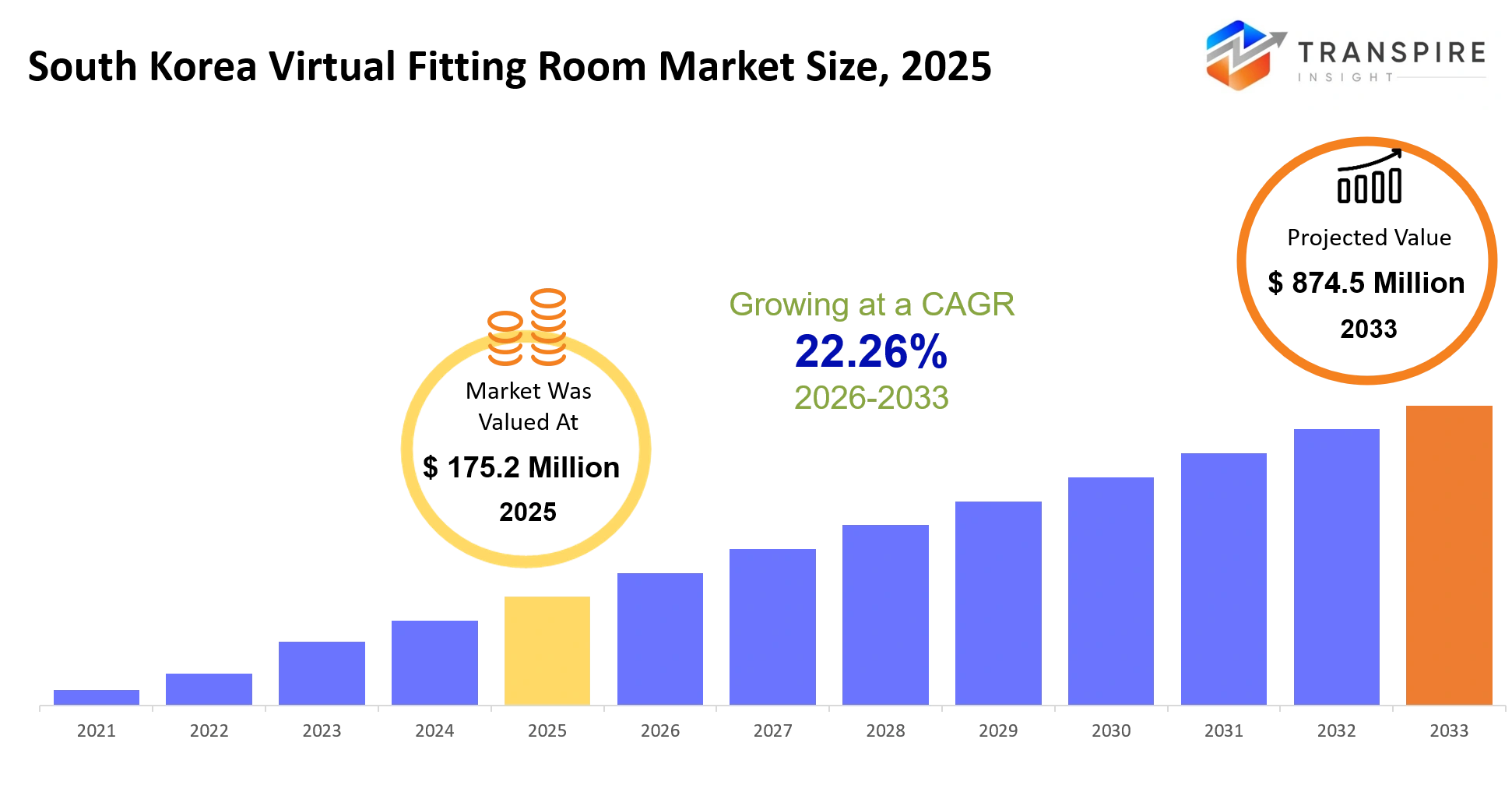
- South Korea Virtual Fitting Room Market Size 2025: USD 175.2 Million
- South Korea Virtual Fitting Room Market Size 2033: USD 874.5 Million
- South Korea Virtual Fitting Room Market CAGR: 22.26%
- South Korea Virtual Fitting Room Market Segments: By Technology (AR-Based, AI-Based, 3D Modeling, Body Scanning, Virtual Mirrors, Mobile Fitting, Web-Based Fitting, Others); By Application (Apparel, Eyewear, Footwear, Jewelry, Cosmetics, Luxury Goods, Sportswear, Others); By End User (Retailers, E-commerce Platforms, Fashion Brands, Optical Stores, Cosmetic Brands, Department Stores, Consumers, Others).
South Korea Virtual Fitting Room Market Summary
The South Korea Virtual Fitting Room Market was valued at USD 175.2 Million in 2025. It is forecast to reach USD 874.5 Million by 2033. That is a CAGR of 22.26% over the period.
In South Korea, virtual fitting room platforms are used by online apparel retailers and marketplaces to help shoppers “map” body measurements or avatar models onto garments, which sorta reduces uncertainty about fit and also lowers the costly return cycles. Instead of only leaning on static size charts, brands now simulate how fabric drapes and stretches across digital bodies, so customers can decide to buy with more confidence, more or less. Over the last 3–5 years, the market has changed in a more structural way, like moving away from simple 3D visualization tools, toward AI-driven body scanning and mobile-first AR, and it’s now getting embedded directly into e-commerce checkout flows. One big trigger was the COVID-19 pandemic, which pushed contactless shopping forward and revealed some inefficiencies in reverse logistics, because return volumes jumped up. All together, this has made retailers invest more in fit accuracy technologies, which improves conversion rates while also trimming fulfillment losses tied to sizing errors, kinda.
Key Market Insights
- Seoul takes hold of the South Korea Virtual Fitting Room Market by controlling near 55% share owing to concentrated e-commerce and fashion tech ecosystems.
- Digital commerce centers in the southern regions witnessed robust growth and are expected to see rapid expansion through 2024-2030.
- The Software-as-a-service platform secured the largest share of 48% owing to the integration across online retail networks that aids in easy scaling.
- The 3D Scanning based Hardware solution stands second by adoption and is prevalent across the luxury clothing segment and O2O hybrid format of shopping.
- The AI Powered Augmented Reality (AR) Try-on Applications hold a burgeoning position, likely growing at the fastest pace due to more than 70% adoption by mobile commerce users.
- In the South Korea Virtual Fitting Room Market, apparel and fashion retail account for nearly 60% share due to extreme sensitivity to the returns cost.
- The highest paced growing application is that of the footwear try-on solution as clothing labels leverage the increased measurement preciseness in their export ventures.
- Fast fashion brands account for a major share at nearly 52% of end-users in the South Korea Virtual Fitting Room Market space.
- Luxury retail brands are emerging fastest among end-users as they leverage high end personalized fitting solutions on their online platforms.
- ZEPETO, CLO Virtual Fashion, Fit Analytics, True Fit, Wannaby are some of the leading players, building extended AR powered try on ecosystems through AI implementation.
What are the Key Drivers, Restraints, and Opportunities in the South Korea Virtual Fitting Room Market?
In South Korea, the Virtual Fitting Room Market is mostly pushed by more and more people using e-commerce, plus that annoying persistent sizing mismatch cost in apparel stores. Retailers started taking AI based fitting systems more seriously after return logistics costs went above 20% of online apparel revenue in a few big chains , so they felt kinda forced to invest in digital try-on solutions. And yeah, this has helped conversion rates, while also trimming operational losses. So monetization across fashion platforms got a stronger footing.
One big restraint though is the high integration complexity of 3D body scanning systems with older e-commerce infrastructure. A lot of mid sized retailers run into trouble with data standardization across their product catalogs. That slows things down , and it also caps scalability. Basically this kind of structural wall makes full digital transformation take longer, so the near term revenue outlook for solution providers stays lower than expected.
A major opportunity is expanding hyper personalized avatar based shopping ecosystems that connect to mobile-first commerce. Firms like CLO Virtual Fashion are already working on interoperable digital garment libraries for global fashion brands. And since cross border e-commerce keeps growing , South Korea could position itself to export virtual fitting infrastructure into Southeast Asia. That would open extra revenue streams beyond just domestic retail, which sounds pretty practical for providers.
What Has the Impact of Artificial Intelligence Been on the South Korea Virtual Fitting Room Market?
Artificial intelligence is, kind of, reshaping the South Korea Virtual Fitting Room market. It helps pull out precise body measurements, it does fabric simulation, and it feeds automated size recommendation systems. With AI powered computer vision, teams are now looking at a user image or using 3D scans to build very accurate digital avatars, that cuts down the usual manual fitting blunders , and it boosts online apparel conversion on the big retail platforms.
On the day to day side of operations, AI supports quicker garment visualization, and it also aligns inventory records with the digital try on outcomes. This lets retailers lower return related logistics costs in a noticeable way. At the same time predictive machine learning models can flag size-demand mismatches early, and then they steer stock allocation in a more careful manner. Resulting in better inventory turnover, and fewer markdown losses.
Operational performance is improving too, some leading platforms mention around a 30% drop in return rates and they report measurable improvements in customer retention, mostly because the fit accuracy is better. Still , there’s a sticking point: the real time 3D rendering needs heavy computation, plus user input data can be inconsistent in the first place. That combo can create accuracy gaps, especially on mobile devices, where sensor precision is often limited. So, adoption slows down for smaller retailers, even when the idea sounds simple.
Key Market Trends
- Between 2020 and 2025 retailers kind of moved away from fixed size charts and toward AI body-scan systems, and it noticeably improved sizing accuracy, a lot more than before.
- AR enabled mobile try on tools also started replacing desktop only experiences, so it’s basically easier for shoppers and mobile commerce went up across fashion platforms over 70%.
- CLO Virtual Fashion expanded its digital garment simulation collaborations with global brands, which strengthened ecosystem interoperability in 2022, or around then.
- Meanwhile Fit Analytics together with True Fit made more use of integrations, raising automated size suggestion accuracy across Korean e-commerce platforms, not just slightly but clearly.
- Luxury fashion brands began using virtual avatars after 2023, and that reduced high value product returns substantially in premium segments.
- Footwear brands rolled out 3D foot scanning pilots in 2024, targeting the long lasting cross brand sizing inconsistencies that people kept running into.
- Retailers also shifted from standalone apps to embedded e-commerce plugins, and that helped conversion rates and kept checkout continuity smoother.
- AI driven recommendation engines replaced the older rule based sizing tools, so personalization became more dynamic, based on behavioral data and all that.
- Cross border fashion retailers leaned into virtual fitting tools to standardize sizing across both Asian and Western markets, even when sizes used to drift.
- And even government supported digital commerce initiatives indirectly sped up adoption of immersive retail technologies in Seoul ecosystems, kind of like a ripple effect, around the same timeframe.
South Korea Virtual Fitting Room Market Segmentation
By Technology :
AR-based technology lets digital garments, accessories, or other products seem to show up on a customer’s photo, or even in a live camera view. In practice, it gives shoppers a better sense of how something will sit and look before they actually buy. Over time adoption has gone up, because retailers want to cut down return rates and make online shopping feel more intuitive, and less uncertain.
AI-based solutions, on the other hand, look at body measurements, customer shopping patterns, and product specs, then they suggest a better size and more tailored fitting ideas. 3D modeling builds very lifelike digital versions of products as well as customer body shapes, while body scanning takes physical measurements with more precision than older methods. Together these approaches help raise fit accuracy, and they also boost customer confidence in a way that feels practical.
Then there are virtual mirrors, which create an interactive fitting moment inside real stores, or shopping centers. Mobile fitting tools bring virtual try-on right onto smartphones and tablets, and web-based fitting systems are folded into the online retail experience itself. Beyond that, advanced visualization tools and mixed reality applications also play a role, making the shopping journey feel more engaging across the South Korea Virtual Fitting Room Market.
By Application :
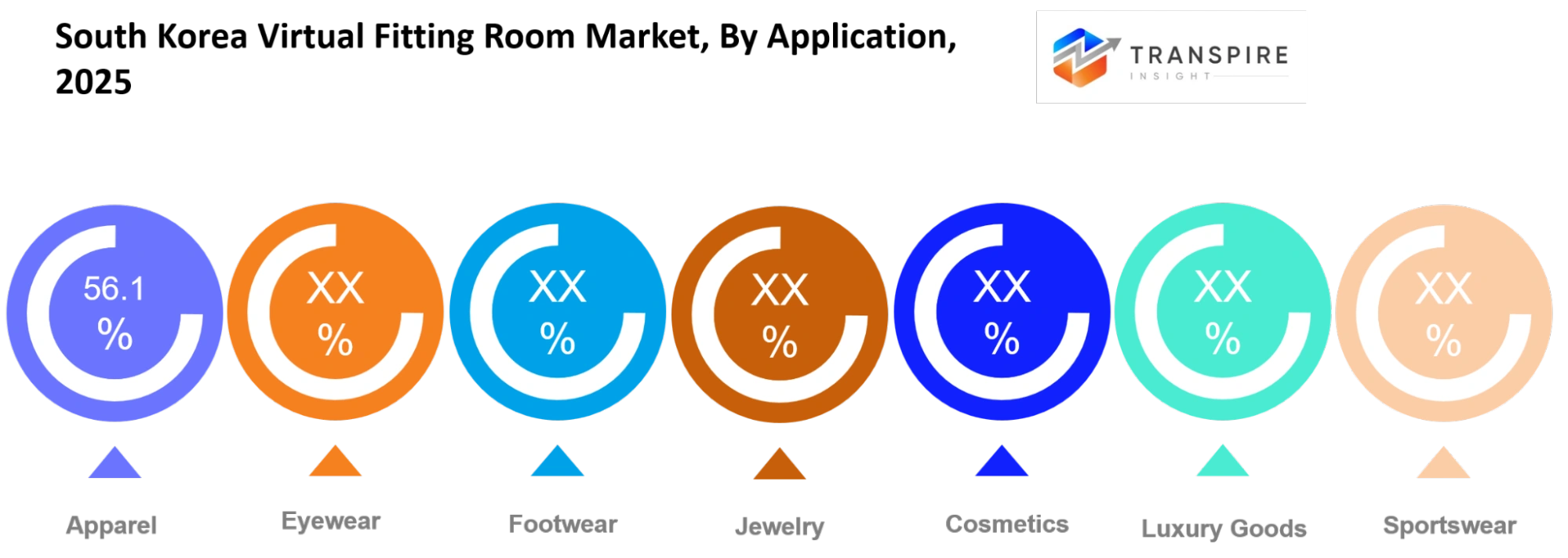
Apparel still shows up as the biggest application segment, mainly because clothing purchases often come with sizing concerns and fit related uncertainty, you know. Virtual fitting solutions allow shoppers to picture garments, compare sizes, and generally make a better decision without having to drop by a physical store.
For Eyewear apps, people can sort of try on different frame styles and shapes in a digital way. Footwear solutions tend to concentrate on size matching and comfort assessment, while jewelry applications let customers see accessories placed on their digital images first, before actually buying. Cosmetic applications back virtual makeup testing too, so customers can explore products without needing physical samples.
On the other hand, Luxury goods and sportswear applications are also growing. Premium brands are investing in personalized shopping experiences, which is helping adoption. Luxury retailers use virtual fitting tech to boost customer engagement, while sportswear companies lean on these tools to refine product recommendations. Other application types include accessories and more specialized fashion categories, all of which gain from digital visualization tools.
By End User :
Retailers are a big end-user group , because virtual fitting solutions help boost customer satisfaction and lower product returns . These companies blend fitting technologies into both online and offline selling channels, to make shopping feel smoother and also to reinforce customer retention, kind of steadily.
E-commerce platforms use virtual fitting tools to tackle one of the hardest parts of online shopping, namely the uncertainty about how something will actually fit. Fashion brands roll out these options to increase brand perceived value and to personalize the customer conversations. Optical stores lean on virtual try-on setups for picking eyewear, while cosmetic brands use digital testing tools to make product discovery easier and to back purchasing choices.
Department stores are also bringing virtual fitting tech into more than one product category, which just improves overall convenience . Shoppers, in practice, gain from better product visualization , more tailored recommendations , and less worry when buying . In addition , other end users include specialty stores and smaller retailers that use digital fitting solutions to raise customer engagement and push sales momentum within the South Korea Virtual Fitting Room Market .
What are the Key Use Cases Driving the South Korea Virtual Fitting Room Market?
In South Korea, apparel retail is still the main use case for the Virtual Fitting Room Market, mostly because sizing uncertainty keeps being a big driver behind product returns. These virtual try-on tools let shoppers sort of “see it on” before buying, so they can gauge the garment better, compare the fit, and end up deciding with more confidence. For retailers, this tends to mean better conversion results and fewer headaches with return processing, so demand stays strong and steady.
After that, eyewear and cosmetics applications are starting to pick up momentum too, mainly since optical shops and beauty brands are adopting digital fitting assistance to raise customer engagement. With virtual frame selection and makeup testing, people can try combinations remotely, which helps both e-commerce sales and omnichannel retail programs, even when store traffic changes.
There are also newer directions coming in, like digital fashion for virtual avatars and personalized styling that’s powered by artificial intelligence. Fashion labels are checking these options to build more immersive shopping experiences, and to connect with younger consumers, who often care a lot about interactive, technology-forward retail settings.
|
Report Metrics |
Details |
|
Market size value in 2025 |
USD 175.2 Million |
|
Market size value in 2026 |
USD 214.2 Million |
|
Revenue forecast in 2033 |
USD 874.5 Million |
|
Growth rate |
CAGR of 22.26% from 2026 to 2033 |
|
Base year |
2025 |
|
Historical data |
2021 - 2024 |
|
Forecast period |
2026 - 2033 |
|
Report coverage |
Revenue forecast, competitive landscape, growth factors, and trends |
|
Country scope |
South Korea |
|
Key company profiled |
Zugara, FXGear, Reactive Reality, Perfect Corp, Style.me, Wannaby, Fit Analytics, True Fit, Snap, Google, Meta, Amazon, Samsung, Naver, Kakao. |
|
Customization scope |
Free report customization (country, regional & segment scope). Avail customized purchase options to meet your exact research needs. |
|
Report Segmentation |
By Technology (AR-Based, AI-Based, 3D Modeling, Body Scanning, Virtual Mirrors, Mobile Fitting, Web-Based Fitting, Others); By Application (Apparel, Eyewear, Footwear, Jewelry, Cosmetics, Luxury Goods, Sportswear, Others); By End User (Retailers, E-commerce Platforms, Fashion Brands, Optical Stores, Cosmetic Brands, Department Stores, Consumers, Others). |
Which Regions are Driving the South Korea Virtual Fitting Room Market Growth?
North America is still sort of the leading region in the South Korea Virtual Fitting Room Market, mostly because big fashion retailers and e-commerce firms moved on digital fitting tools earlier than many other areas. There’s also strong investment in artificial intelligence, augmented reality, and retail technology , and that ends up building a kind of supportive ecosystem that keeps enabling continuous invention. People in the United States and Canada already seem comfortable with online shopping, plus they like personalized digital experiences, so it naturally pushes more adoption of virtual fitting options. Tech companies, fashion brands, and software developers keep teaming up, so the region's dominant position stays pretty stable.
Europe sits as the second-largest region, but the whole growth feels different. Across countries like Germany, France, and the United Kingdom, fashion houses and retailers tend to concentrate on improving customer experience, and they want to lower product return expenses by using precise sizing technologies. Economic conditions are comparatively stable, and the digital retail infrastructure investments are consistent, so long-term uptake keeps looking realistic. In general, regional businesses prefer tools that can plug in smoothly with their current e-commerce platforms , so Europe becomes a reliable contributor to market revenue over time.
Asia Pacific still looks like the fastest-growth region, as mobile commerce and digital fashion trends start reshaping how people shop , kind of quickly. The spread of online retail in South Korea, China and Southeast Asian nations has raised the need for virtual try-on tools across apparel, cosmetics and eyewear. Over the last few years, funding for artificial intelligence, 3D visualization, and immersive retail moments has basically pushed market expansion forward. With all of that, the period 2026–2033 should bring very appealing chances for technology providers and investors, especially those who are trying to build fresh partnerships or plan a new market entry path, sooner rather than later.
Who are the Key Players in the South Korea Virtual Fitting Room Market and How Do They Compete?
Competition in the South Korea Virtual Fitting Room Market is sort of moderately fragmented, and tech innovation is what mostly drives who sits where in the market. You’ll see long-running software providers going head to head with newer fashion technology outfits, these tend to focus on artificial intelligence plus augmented reality and also digital garment simulation, that kind of thing. Most players spend time on tuning fit precision, making the customer journey smoother and then, yes, weaving their solutions straight into e-commerce platforms. Ongoing product upgrades and strategic cooperation deals are basically keeping the whole space moving, a bit restless.
CLO Virtual Fashion competes by using more advanced 3D garment simulation tech, which lets brands plan and view clothing digitally before it ever goes to production. They also build strong ties with well known fashion companies, and the investments they make into wider digital fashion ecosystems help them extend their commercial reach. True Fit, on the other hand, differentiates via a data driven size recommendation approach, it scans body shape patterns, brand sizing behavior, and consumer preferences so shoppers feel more certain during checkout. Their growth effort leans into partnerships with retailers that want to lower return rates and raise online conversion.
Fit Analytics specializes in artificial intelligence sizing approaches, designed so retailers can personalize shopping across many apparel categories. Its edge comes from the advanced analytics work and how well it integrates, especially inside big retail environments. Wannaby leans more toward augmented reality try on sessions for footwear and accessories, while ZEPETO builds avatar centered virtual fashion experiences that link digital identity to online shopping. Both firms keep expanding through collaborations with fashion brands, plus they keep putting money into immersive retail technologies, and that continues to shape how fast they can scale.
Company List
- Zugara
- FXGear
- Reactive Reality
- Perfect Corp
- Style.me
- Wannaby
- Fit Analytics
- True Fit
- Snap
- Meta
- Amazon
- Samsung
- Naver
- Kakao
Recent Development News
In March 2026, CLO Virtual Fashion entered a technology partnership with Vizoo and launched a plug-in for seamless U3M material integration in CLO. The integration allows fashion companies to import photorealistic digital materials directly into garment simulations, accelerating digital product creation and strengthening virtual fitting workflows across apparel brands.
Source: https://www.theinterline.com/
In May 2026, CLO Virtual Fashion expanded its digital fashion ecosystem through new community and creator initiatives showcased across global and Korean markets. The expansion supports wider adoption of 3D garment simulation and virtual fitting technologies, helping brands scale digital design and customer engagement capabilities.
Source: https://www.clovirtualfashion.com/
What Strategic Insights Define the Future of the South Korea Virtual Fitting Room Market?
The South Korea Virtual Fitting Room Market is kind of moving toward more fully personalized and connected digital shopping ecosystems in the next five to seven years, it seems. Overall growth will increasingly ride on advances in artificial intelligence, real-time 3D rendering, and digital identity platforms so consumers can keep their sizing profiles across many brands and retail channels. Virtual fitting will gradually stop being just a value added idea and turn into a standard component of online fashion and beauty commerce.
There is also a more quiet risk, and it is about market concentration around a small set of software ecosystems and data platforms. If the market leans too much on just a few technology providers, integration costs can rise, and the space for new ideas can get smaller, especially for smaller retailers that need flexible solutions, not locked in ones.
On the upside, an emerging opportunity sits in digital fashion tied to virtual avatars and gaming worlds. Firms that start early with interoperable platforms and strategic partnerships with fashion brands, content creators, and metaverse applications will be in a better place to win long run value and also build durable competitive advantages.
South Korea Virtual Fitting Room Market Report Segmentation
By Technology
- AR-Based
- AI-Based
- 3D Modeling
- Body Scanning
- Virtual Mirrors
- Mobile Fitting
- Web-Based Fitting
By Application
- Apparel
- Eyewear
- Footwear
- Jewelry
- Cosmetics
- Luxury Goods
- Sportswear
By End User
- Retailers
- E-commerce Platforms
- Fashion Brands
- Optical Stores
- Cosmetic Brands
- Department Stores
- Consumers
Frequently Asked Questions
Find quick answers to common questions.
The South Korea Virtual Fitting Room Market size is USD 874.5 Million in 2033.
Key segments for the South Korea Virtual Fitting Room Market are By Technology (AR-Based, AI-Based, 3D Modeling, Body Scanning, Virtual Mirrors, Mobile Fitting, Web-Based Fitting, Others); By Application (Apparel, Eyewear, Footwear, Jewelry, Cosmetics, Luxury Goods, Sportswear, Others); By End User (Retailers, E-commerce Platforms, Fashion Brands, Optical Stores, Cosmetic Brands, Department Stores, Consumers, Others).
Major South Korea Virtual Fitting Room Market players are Zugara, FXGear, Reactive Reality, Perfect Corp, Style.me, Wannaby, Fit Analytics, True Fit, Snap, Google, Meta, Amazon, Samsung, Naver, Kakao.
The South Korea Virtual Fitting Room Market size is USD 175.2 Million in 2025.
The South Korea Virtual Fitting Room Market CAGR is 22.26% from 2026 to 2033.
- Zugara
- FXGear
- Reactive Reality
- Perfect Corp
- Style.me
- Wannaby
- Fit Analytics
- True Fit
- Snap
- Meta
- Amazon
- Samsung
- Naver
- Kakao
About the Authors

Mayur Shinde
I am Mayur Shinde, a Senior Research Analyst at Transpire Insight, specializing in the Automotive & Transportation and Information & Communication Technology (ICT) Industry. My work focuses on analyzing emerging market trends, technological advancements, competitive landscapes, and industry developments to deliver accurate, data-driven insights. I am passionate about transforming complex market information into clear, actionable content that helps businesses, professionals, and decision-makers stay informed and make confident strategic decisions.

Chakradhar Khansole
Chakradhar serves as the Research Director at Transpire Insight, bringing over 8 years of experience in technology, innovation, and strategic market intelligence. He specializes in transforming complex market data into actionable business insights that enable organizations to make informed, growth-oriented decisions. Recognized for his strategic vision and analytical expertise, Chakradhar leads high-impact research initiatives, delivering comprehensive market assessments, competitive intelligence, and forward-looking industry analysis.
Recently Published Reports
-
Apr 2026
3D Optical Profiler Market
3D Optical Profiler Market Size, Share & Analysis Report By Type (Desktop 3D Optical Profiler, and Portable 3D Optical Profiler), By Technology (Confocal Technology, and White Light Interference), By End-Use Industry (Manufacturing, Research Institutions, Automotive, Aerospace and Defense, Medical Devices, and Other), and Geography (North America, Europe, Asia-Pacific, Middle East and Africa, South and Central America), 2021 - 2031
-
Apr 2026
Depth Sensor Market
Depth Sensor Market Size, Share & Analysis Report By Type (Infrared Depth Sensors, Time-of-Flight (ToF) Sensors, Stereo Vision Sensors, Structured Light Sensors, Ultrasonic Depth Sensors), By Application (Automotive, Robotics, Gaming, Consumer Electronics, Industrial Automation, Healthcare, Security & Surveillance, Others), By End Users (Automotive Manufacturers, Consumer Electronics Companies, Healthcare Providers, Industrial Companies, Security Agencies, Gaming Companies, Robotics Companies, Others), and Geography (North America, Europe, Asia-Pacific, Middle East and Africa, South and Central America), 2021 – 2031
-
Apr 2026
Digital Manufacturing Market
Digital Manufacturing Market Size, Share & Analysis Report By Component (Hardware, Software, and Services), By Technology (Robotics, 3D Printing, Internet of Things (IoT), and Others), By Application (Automotive and Transportation, Aerospace and Defense, Consumer Electronics, Industrial Machinery, and Others), By Process Type (Computer-Based Designing, Computer-Based Simulation, Computer 3D Visualization, Analytics, and Others), and Geography (North America, Europe, Asia-Pacific, Middle East and Africa, South and Central America), 2021 – 2031
-
Apr 2026
Digital Visa Services Market
Digital Visa Services Market Size, Share & Analysis Report By Type (Individual Travelers, Group Travelers), By Application (Tourism, Business Travel, Others), and Geography (North America, Europe, Asia-Pacific, Middle East and Africa, South and Central America), 2021 – 2031