

South Korea Tungsten Carbide Market Summary
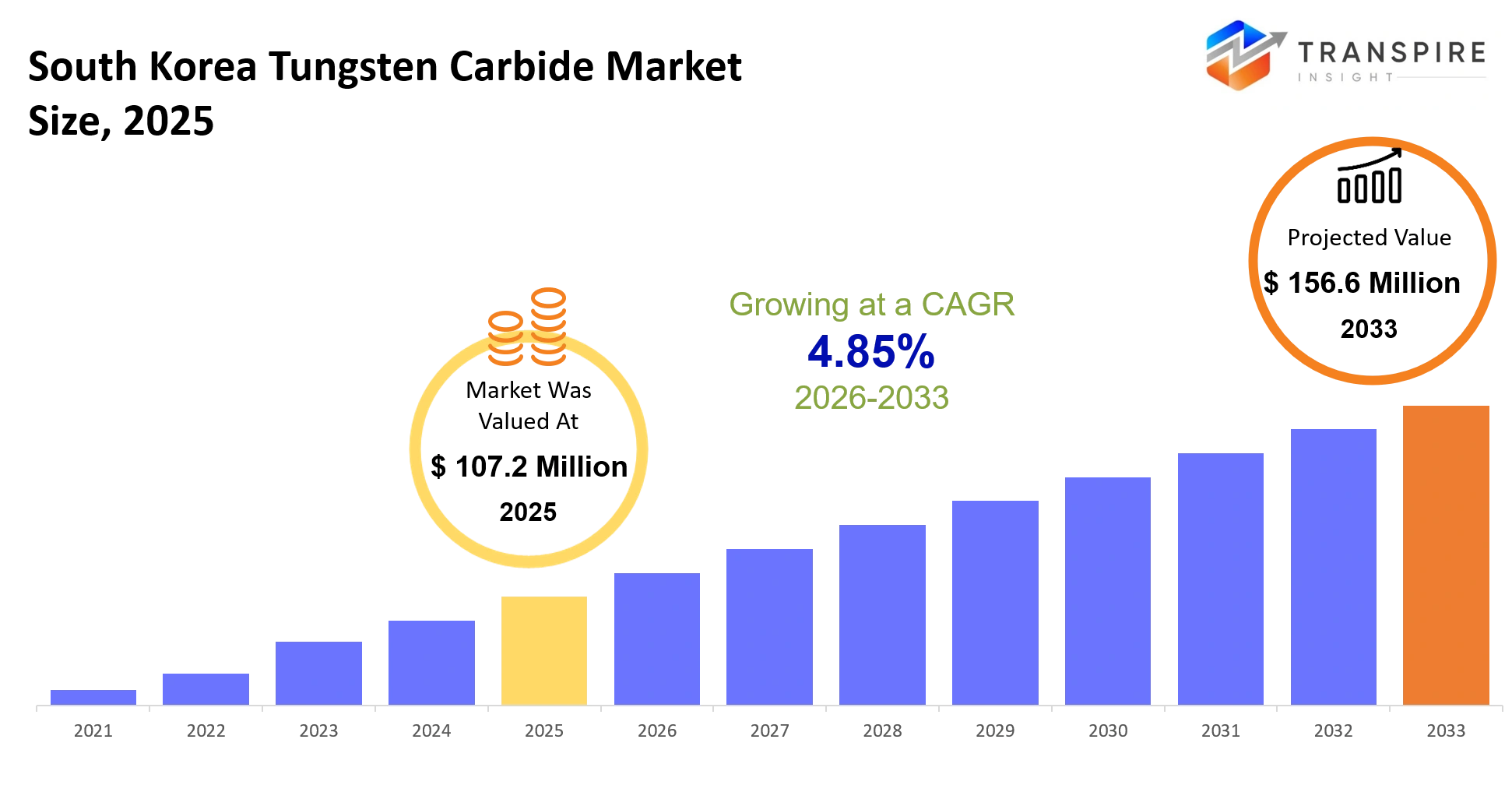
As per Transpire Insight Analysis, the South Korea Tungsten Carbide Market size is estimated at USD 107.2 Million in 2025 and is anticipated to reach USD 156.6 Million by 2033, growing at a CAGR of 4.85% from 2026 to 2033.
Tungsten carbide provides South Korean manufacturers with a very hard, extremely wear-resistant material - one that retains its edge even under heavy cutting loads and sustained mechanical stress. It really holds its own in metalworking, mining, and high-precision toolmaking, where downtime would be very costly indeed - and tool longevity counts for so much. Over recent years, the market has gradually moved towards finer-grained structures that offer greater hardness without diminishing toughness, and this has created new opportunities for high-speed machining. The country's large automotive and shipbuilding sectors continually demand it, while semiconductor equipment manufacturing directs the call for even more specialized types of carbide. Even when raw materials fluctuate in price, local toolmakers continue to invest heavily in coating technology and refining grains, and that helps keep our domestic supply chain quite robust indeed.
Government-backed manufacturing modernization initiatives and a drive towards 'smart' factories really encourage tool producers to take up digital quality control processes - which in turn further supports a more stable demand for carbide products all over our heavy-industry hubs.
South Korea Tungsten Carbide Market Size & Forecast:
- South Korea Tungsten Carbide Market Size 2025: USD 107.2 Million
- Expected Market Value 2033: USD 156.6 Million
- Forecast CAGR: 4.85%
- Leading application in 2025: Cutting Tools
- Fastest Growing application: Dies & Punches
- Key Profile: Kennametal, Sandvik, Ceratizit, Mitsubishi Materials, Sumitomo Electric, IMC, OSG, Guhring, Kyocera, Zhuzhou Carbide, Walter, Seco, Dormer, Hyperion, Tungaloy
Key Market Insights
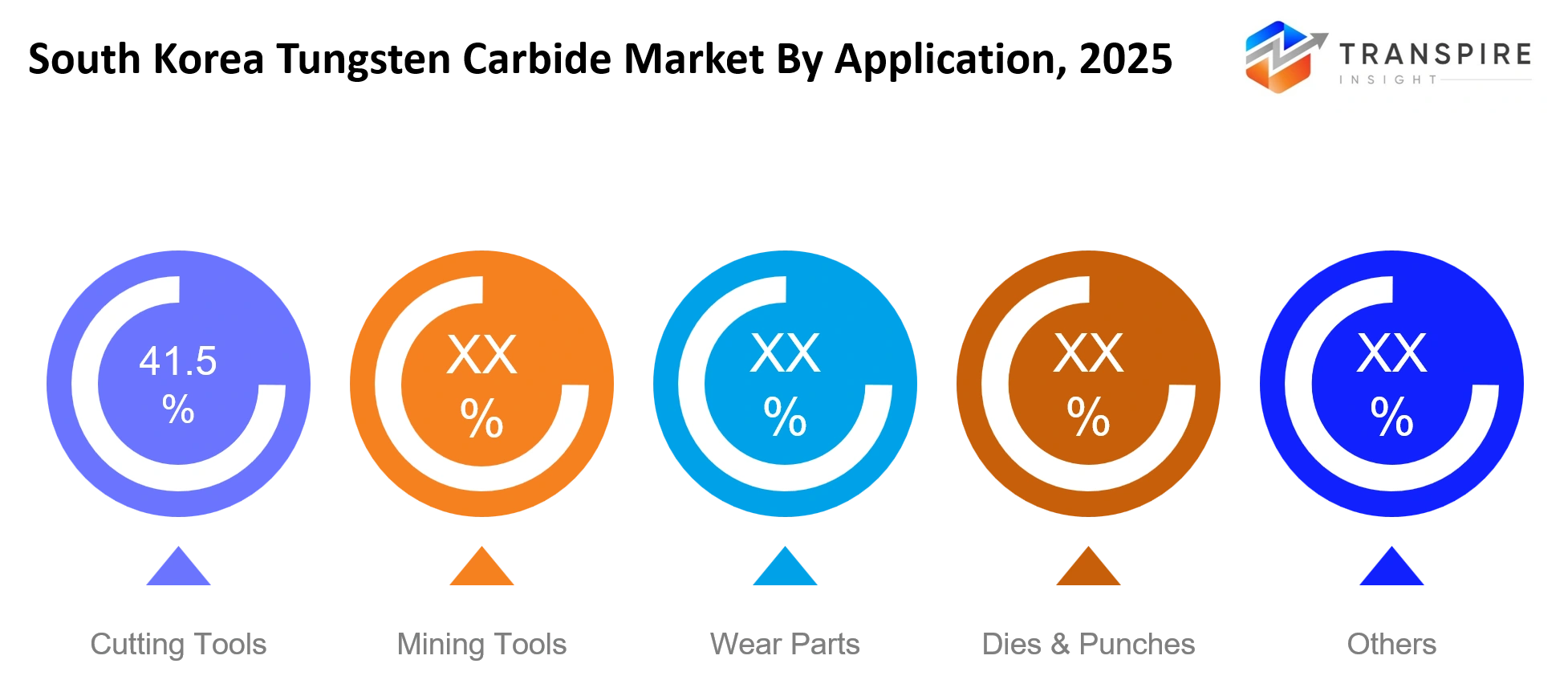
- Cutting tools will be at the forefront of application segments - they are predicted to make up nearly 41. 5% of the market share in 2025 because metalworking and very precise machining continue to rely heavily on carbide inserts for much longer tool life.
- Mining tools will hold a relatively stable second position - this is due to ongoing demand for quarrying and construction equipment all over the country.
- Dies and punches are expected to see the greatest increase up to 2033, as car stamping and electronics component shaping continue to expand significantly.
- Fine grain carbide leads the way in terms of grade, because it provides just the right amount of hardness and edge retention that high-speed cutting applications really need.
- Medium grain grades still have their place in general-purpose tooling - here a perfect balance of toughness and wear resistance is much more important than extremely high hardness itself.
- Coarse grain carbide is projected to grow the fastest among the grades - mainly because mining and wear parts applications greatly value impact resistance over very sharp edges themselves.
- Homegrown tool manufacturers continue to invest in coating technology - and that's finally starting to lift average product value right across the market.
What are the Key Drivers, Restraints, and Opportunities in the South Korea Tungsten Carbide Market?
South Korea's tungsten carbide market is growing largely due to the strength of its automotive, shipbuilding, and semiconductor equipment industries. These sectors really require cutting tools, dies, and wear-resistant components that can handle extremely precise work, repeated use, and very tight tolerances. As manufacturers try to speed up their production cycles even further, the length of time a tool lasts really matters - and that drives buyers towards the highest-quality carbide grades. Local tool producers have responded by further refining the grain structure and enhancing coatings, which greatly increases tool life and decreases the need for replacements. This steady cycle of replacing tools, combined with an increase in precision manufacturing, continues to support ongoing carbide demand across all major industrial areas.
The greatest restriction remains linked to tungsten raw material sourcing, because South Korea imports most of its tungsten concentrate. Fluctuations in global tungsten market prices, plus export restrictions from a few dominant producing countries, can rapidly reduce the profit margins for local tool makers. Processing costs also go up when ore grades change, and that adds uncertainty to our production plans. Due to this reason, smaller tool manufacturers sometimes have difficulty maintaining consistent pricing - which can actually delay order commitments from very cost-conscious industrial buyers.
Looking forward, the recovery of tungsten scrap offers a very real opportunity since it reduces our reliance on imported ore while promoting a more closed-loop supply chain. An increase in electric vehicle component production and semiconductor fabrication equipment also opens up new opportunities for specialized carbide grades. Companies that invest in recycling facilities and grain refinement research will likely be much better prepared as these new applications grow even larger.
What Has the Impact of Artificial Intelligence Been on the South Korea Tungsten Carbide Market?
Artificial intelligence is gradually finding its way into tungsten carbide production throughout South Korea - mainly by improving process control and carrying out predictive maintenance more effectively. Sintering operations - very sensitive indeed to changes in temperature and pressure - now profit from machine learning algorithms that identify anomalies even before they affect grain uniformity itself. This really helps producers meet much tighter specifications whilst significantly decreasing waste products.
As for tool design, AI-assisted simulations enable engineers to forecast wear patterns and find the optimal coating thickness for certain cutting operations - all of which shortens the development period for novel carbide types. Manufacturers also use predictive analysis to determine their raw material purchases, because tungsten prices can be highly unstable and a better forecast greatly lessens the chance of costly overstocking or stockouts.
Still, adoption is progressing fairly slowly rather than very rapidly all at once. Many smaller tool-making facilities frequently don't have the necessary funds for advanced automation systems, and incorporating AI tools into existing sintering equipment demands a lot of time and specialized knowledge. Standardizing data formats across various production lines is an additional obstacle, since inconsistent sensor information really limits just how accurately predictive models will actually work in everyday life itself.
Key Market Trends
- Domestic toolmakers really focused on developing fine-grain carbide since 2023 - aiming for better results in high-speed machining applications.
- Recycling of tungsten scrap got much more attention after 2022, as producers tried to reduce their dependence on imported concentrate even further.
- Investment in coating technologies picked up in 2024 and 2025, significantly extending tool life for both cutting and forming tasks.
- Manufacturing semiconductor equipment has become a more significant demand driver for highly precise carbide parts since 2023 - almost under the radar.
- Automotive stamping and electric vehicle (EV) component forming really drove up demand for dies and punches throughout 2023 to 2025.
- Government-backed initiatives for smart manufacturing really encouraged tool producers to adopt digital quality monitoring much more widely.
South Korea Tungsten Carbide Market Segmentation
By Grade:
Fine grain carbide leads this segment, since its tighter microstructure gives cutting tools sharper edges and better wear resistance under high speed conditions. Machine shops serving automotive and precision component manufacturing keep favoring this grade because it holds tolerances well over repeated use. Medium grain carbide follows close behind, valued for its balance of hardness and toughness in general purpose tooling.
Coarse grain carbide serves applications where impact resistance matters more than a sharp edge, such as mining tools and heavy wear parts. Other grain variations continue to find niche uses as manufacturers experiment with hybrid structures for specialized tooling needs.
By Application:
Cutting tools dominate the application landscape, holding close to 41.5% share in 2025, largely because metalworking and precision machining industries depend on carbide inserts for consistent, long lasting performance. Mining tools remain a steady contributor, supported by ongoing quarrying, tunneling, and construction equipment needs across the country.
Wear parts continue growing as manufacturers look for components that survive abrasive industrial environments without frequent replacement. Dies and punches are expected to grow fastest, pushed by automotive stamping and electronics forming needs. Other applications keep expanding gradually as new industrial uses for carbide continue to emerge.
|
Report Metrics |
Details |
|
Market size value in 2025 |
USD 107.2 Mn |
|
Market size value in 2026 |
USD 112.4 Mn |
|
Revenue forecast in 2033 |
USD 156.6 Mn |
|
Growth rate |
CAGR of 4.85% from 2026 to 2033 |
|
Base year |
2025 |
|
Historical data |
2021 - 2024 |
|
Forecast period |
2026 - 2033 |
|
Report coverage |
Revenue forecast, competitive landscape, growth factors, and trends |
|
Regional scope |
South Korea (Gyeongsang Region, Chungcheong Region, Gyeonggi Region, Jeolla Region, Others) |
|
Key company profiled |
Kennametal, Sandvik, Ceratizit, Mitsubishi Materials, Sumitomo Electric, IMC, OSG, Guhring, Kyocera, Zhuzhou Carbide, Walter, Seco, Dormer, Hyperion, Tungaloy |
|
Customization scope |
Free report customization (region & segment scope). Avail customized purchase options to meet your exact research needs. |
|
Report Segmentation |
By Grade (Fine Grain, Medium Grain, Coarse Grain, Others); By Application (Cutting Tools, Mining Tools, Wear Parts, Dies & Punches, Others) |
What are the Key Use Cases Driving the South Korea Tungsten Carbide Market?
Cutting tool manufacturing remains the leading use case, since automotive, shipbuilding, and general machining industries depend on carbide inserts that hold an edge through long production runs. Tool wear directly affects production costs, so buyers keep favoring higher grade carbide even when it costs more upfront.
Mining and construction equipment also rely heavily on carbide wear parts, since these components face constant abrasion in quarrying and excavation work. Semiconductor equipment manufacturing is an emerging use case too, where precision carbide components support wafer handling and processing tools that need extremely tight tolerances.
Looking forward, EV component forming and recycling driven carbide production stand out as growth areas. As battery and motor part manufacturing scales up domestically, dies and punches applications should keep pulling in more carbide demand.
Which Regions are Driving the South Korea Tungsten Carbide Market Growth?
The Gyeongsang region, home to South Korea's shipbuilding and heavy machinery clusters around Ulsan and Changwon, leads domestic tungsten carbide consumption. Dense concentrations of metalworking and tool manufacturing facilities keep demand steady, and ongoing investment in precision machining equipment reinforces this lead.
The Chungcheong region is forecast to grow fastest through 2033, largely because semiconductor and electronics manufacturing keep expanding there, pulling in demand for specialized carbide tooling and wear components used in fabrication equipment.
Who are the Key Players in the South Korea Tungsten Carbide Market and How Do They Compete?
Competition in South Korea's tungsten carbide market sits between global tool manufacturers and established domestic producers. Global players bring scale and advanced coating technology, while local manufacturers compete on cost, delivery speed, and close customer relationships with domestic automotive and shipbuilding clients.
Kennametal and Sandvik both push forward with advanced grain refinement and coating innovation aimed at high speed machining applications. Mitsubishi Materials and Sumitomo Electric bring strong regional manufacturing presence, supporting quicker delivery for Korean industrial buyers. Kyocera and Tungaloy continue expanding their precision tooling portfolios, while Zhuzhou Carbide competes largely on cost efficiency for standard grade products.
Company List
- Kennametal
- Sandvik
- Ceratizit
- Mitsubishi Materials
- Sumitomo Electric
- IMC
- OSG
- Guhring
- Kyocera
- Zhuzhou Carbide
- Walter
- Seco
- Dormer
- Hyperion
- Tungaloy
Recent Development News
In March 2026, Sandvik announced an expansion of its carbide tooling production capacity in Asia, aiming to shorten delivery times for precision machining customers across the region, including South Korea. Source https://www.sandvik.com/
In November 2025, Kyocera introduced a new fine grain carbide grade designed for high speed automotive component machining, strengthening its cutting tool portfolio for domestic manufacturers. Source https://global.kyocera.com/
What Strategic Insights Define the Future of the South Korea Tungsten Carbide Market?
Over the coming years, South Korea's tungsten carbide market should lean further into precision grain engineering, supported by growing semiconductor and EV component manufacturing needs. This shift should favor producers who invest early in fine grain and hybrid carbide research.
A less visible risk sits with tungsten raw material dependence, since South Korea imports most of its concentrate. Supply disruptions or export restrictions from dominant producing countries could squeeze margins even when domestic demand holds steady.
An important opportunity is forming around tungsten recycling infrastructure, which can reduce import dependence while supporting steadier raw material costs. Companies that build recycling capacity alongside coating and grain innovation should strengthen their competitive position through the forecast period.
South Korea Tungsten Carbide Market Report Segmentation
By Grade
- Fine Grain
- Medium Grain
- Coarse Grain
By Application
- Cutting Tools
- Mining Tools
- Wear Parts
- Dies & Punches
Frequently Asked Questions
Find quick answers to common questions.
The expected South Korea Tungsten Carbide Market size for the market will be USD 156.6 Mn in 2033.
Key segments for the South Korea Tungsten Carbide Market are By Grade (Fine Grain, Medium Grain, Coarse Grain, Others); By Application (Cutting Tools, Mining Tools, Wear Parts, Dies & Punches, Others).
Major South Korea Tungsten Carbide Market players are Kennametal, Sandvik, Ceratizit, Mitsubishi Materials, Sumitomo Electric, IMC, OSG, Guhring, Kyocera, Zhuzhou Carbide, Walter, Seco, Dormer, Hyperion, Tungaloy.
The South Korea Tungsten Carbide Market size is USD 107.2 Mn in 2025.
The South Korea Tungsten Carbide Market CAGR is 4.85% from 2026 to 2033.
- Kennametal
- Sandvik
- Ceratizit
- Mitsubishi Materials
- Sumitomo Electric
- IMC
- OSG
- Guhring
- Kyocera
- Zhuzhou Carbide
- Walter
- Seco
- Dormer
- Hyperion
- Tungaloy
About the Authors

Avinash Kumar
I’m Avinash Kumar, a Senior Research Analyst at Transpire Insight, with expertise in the Electronics and Semiconductor and Energy & Power industry. My work focuses on analyzing emerging technologies, market trends, industry developments, and innovation across these sectors. I specialize in transforming complex technical and market insights into clear, research-backed content that helps professionals, businesses, and decision-makers stay informed. Through continuous industry research and data-driven analysis, I strive to deliver accurate, reliable, and practical perspectives on the latest advancements shaping the semiconductor and energy landscape.

Chakradhar Khansole
Chakradhar serves as the Research Director at Transpire Insight, bringing over 8 years of experience in technology, innovation, and strategic market intelligence. He specializes in transforming complex market data into actionable business insights that enable organizations to make informed, growth-oriented decisions. Recognized for his strategic vision and analytical expertise, Chakradhar leads high-impact research initiatives, delivering comprehensive market assessments, competitive intelligence, and forward-looking industry analysis.
Recently Published Reports
-
Apr 2026
Active Power Filter Market
Active Power Filter Market Size, Share & Analysis Report By Type (Shunt Active Power Filters, Series Active Power Filter, Hybrid Active Power Filter), By Application (Harmonics Mitigation, Reactive Power Compensation, Voltage Regulation, Power Factor Correction), By Phase (Single Phase, Three Phase), By End-User Industry (Manufacturing, Healthcare, Commercial, Automotive, Oil and Gas, Others), and Geography (North America, Europe, Asia-Pacific, Middle East and Africa, South and Central America), 2021 - 2031
-
Apr 2026
Electrical Transformer Market
Electrical Transformer Market Size, Share & Analysis Report By Core (Closed, Shell, and Berry), By Insulation (Gas, Oil, Solid, Air, and Other), By Phase (Single, and Three), By Rating (100 MVA to 500 MVA, 501 MVA to 800 MVA, and 801 MVA to 1200 MVA), and Geography (North America, Europe, Asia-Pacific, Middle East and Africa, South and Central America), 2021 – 2031
-
Apr 2026
Hydraulic Piston Pumps Market
Hydraulic Piston Pumps Market Size, Share & Analysis Report By Type (Axial Piston Pumps, Radial Piston Pumps), By Operating Pressure (Low Pressure, Medium Pressure, High Pressure), By Application (Construction, Mining, Agriculture, Automotive, Oil & Gas, Industrial Machinery, Others), By End-User (OEMs, Aftermarket), and Geography (North America, Europe, Asia-Pacific, Middle East and Africa, South and Central America), 2021 – 2031
-
Apr 2026
Laboratory Gas Generators Market
Laboratory Gas Generators Market Size, Share & Analysis Report By Product (Nitrogen Gas Generator, Hydrogen Gas Generator, Zero Air Gas Generator, Purge Gas Generator, TOC Gas Generators, Others), By Application (Gas Chromatography, Liquid Chromatography-mass Spectrometry (LC-MS), Gas Analyzers, Others), By End-user (Life Science, Chemical & Petrochemical, Food & Beverage, Others), and Geography (North America, Europe, Asia-Pacific, Middle East and Africa, South and Central America), 2021 – 2031