
South Korea Tantalum Capacitors Market Size & Forecast:
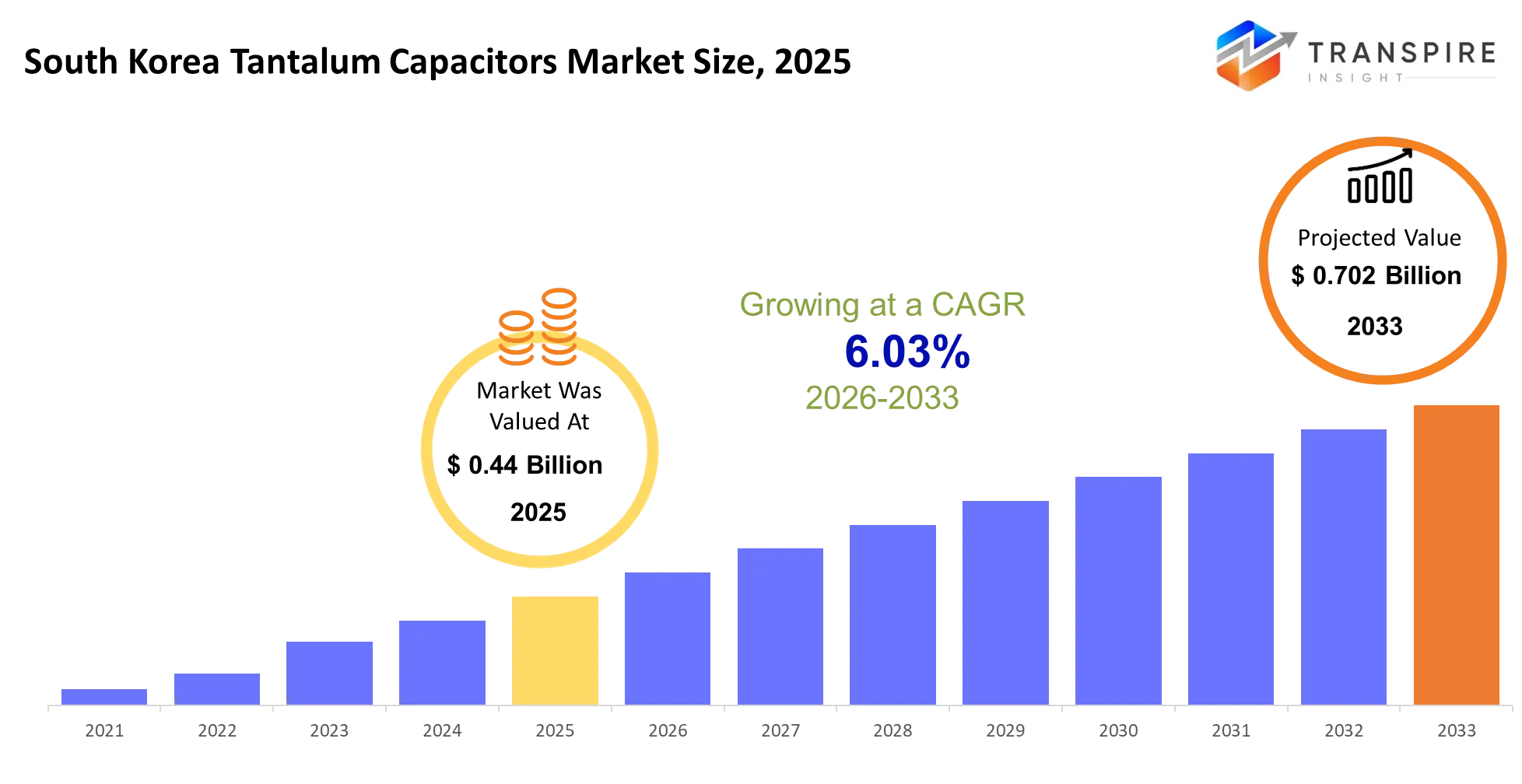
- South Korea Tantalum Capacitors Market Size 2025: USD 0.44 Billion
- South Korea Tantalum Capacitors Market Size 2033: USD 0.702 Billion
- South Korea Tantalum Capacitors Market CAGR: 6.03%
- South Korea Tantalum Capacitors Market Segments: By Capacitor Type (Solid Tantalum Capacitors, Wet Tantalum Capacitors, Polymer Tantalum Capacitors, Others); By Application (Consumer Electronics, Automotive Electronics, Industrial Equipment, Aerospace & Defense, Others); By Mounting Type (Surface Mount Capacitors, Through-hole Capacitors, Others); By Voltage Range (Low Voltage Capacitors, Medium Voltage Capacitors, High Voltage Capacitors, Others); By End User (Electronics Manufacturers, Automotive OEMs, Industrial Companies, Others)
To learn more about this report,  Download Free Sample Report
South Korea Tantalum Capacitors Market Summary
The South Korea Tantalum Capacitors Market was valued at USD 0.44 Billion in 2025. It is forecast to reach USD 0.702 Billion by 2033. That is a CAGR of 6.03% over the period.
The South Korea Tantalum Capacitors Market sort of plays a big role in keeping power delivery steady inside those compact electronics boxes where heat tolerance , voltage dependability, and space efficiency really decide how well the device behaves. You can see these capacitors being used a lot in 5G infrastructure, automotive electronics, semiconductor fabrication machinery, industrial control systems and also in newer consumer gadgets that need dependable current flow even when the operating conditions start shifting around. Over the last five years , the whole market moved away from older wet electrolytic parts toward conductive polymer tantalum capacitors. Those usually come with lower equivalent series resistance and better thermal steadiness, which sounds simple but really matters. Also the global semiconductor shortage plus geopolitical disturbances in critical mineral supply chains pushed many firms to diversify their purchasing and to lean more into local sourcing. In South Korea that meant electronics manufacturers were more aggressive about where they buy from, and they adjusted procurement plans. Because of this , OEMs ended up chasing higher performance passive components that can keep up with AI processors , EV power modules, and compact computing equipment. And as everything gets smaller faster, capacitor suppliers kind of got more leverage on pricing due to specialized high-reliability models, and that helped them grow revenue over the long run across both industrial and automotive uses.
Key Market Insights
- In 2025 Seoul metropolitan manufacturing clusters accounted for over 45% of South Korea’s tantalum capacitor industry demand, mainly because of semiconductor and electronics concentration that just keeps on happening.
- Not sure why but Gyeonggi Province kind of stood out too, it became the fastest-growing regional hub on the back of AI server expansion, and also automotive electronics manufacturing investments running through 2024–2026.
- From the component side, conductive polymer tantalum capacitors were the clear leader, taking nearly 52% of the market share in 2025.
- This was tied to lower ESR and better thermal stability, which sounds simple but matters a lot. Solid tantalum capacitors stayed in the second-place slot as industrial automation systems continued to favor long service lifecycles, plus voltage reliability.
- When looking ahead, automotive-grade tantalum capacitors are expected to post the fastest forecast growth through 2033, mostly because EV battery management systems are pushing higher passive component density, faster than before.
- Meanwhile consumer electronics still brought in over 38% of application revenue in 2025 , helped by compact smartphones, tablets and wearable device integration.
- For applications, AI server infrastructure and edge computing systems became the fastest-growing category after hyperscale data center investments picked up speed in 2024, and it sort of snowballed.
- Electronics manufacturing companies remained the leading end-user group, supported by South Korea’s semiconductor packaging capability and the broader advanced PCB ecosystem, too.
- EV and industrial robotics manufacturers expanded quickly as domestic automation spending increased across smart factory projects during 2024 and 2025.
- Finally, Panasonic , Samsung Electro-Mechanics, Murata Manufacturing , Vishay Intertechnology, and Yageo Corporation widened their low-profile, high-temperature capacitor lineups for automotive and AI computing platforms.
What are the Key Drivers, Restraints, and Opportunities in the South Korea Tantalum Capacitors Market?
The most forceful driver pushing South Korea tantalum capacitors forward is the quick swell in high-density electronics, especially for electric vehicles, AI computing boxes, and 5G links. South Korean makers are working on power management layouts that are smaller, but they still need to handle heavier thermal stress and voltages that can swing around. This shift basically nudged OEMs toward conductive polymer tantalum capacitors because they keep ESR lower, support steadier frequency behavior, and give more dependable service life compared with a bunch of older choices. On top of that, the growth of local semiconductor fabs and AI data center buildouts since 2023 also pulled in more purchases for high performance passive components, so procurement volumes have kept moving up.
The biggest drag on the market still comes from the way tantalum raw material supply chains are tied to mining areas that are politically touchy. Tantalum refining, plus the whole ethical sourcing certification process, tends to drag on with long lead times and higher compliance expenses, and those issues don’t really get fixed fast by simply tweaking short term manufacturing. Because of this, capacitor producers get exposed to price swings and occasional supply interruptions. That makes output planning harder, and it also slows down how quickly electronics assemblers can lock in procurement agreements.
Meanwhile, a notable opening is showing up in automotive-grade power electronics, along with advanced server equipment. South Korea’s spending on AI accelerators, EV battery systems, and autonomous mobility platforms is lifting the call for compact capacitors that can survive at elevated temperatures, with higher ripple current levels too. Vendors who are developing ultra slim polymer tantalum capacitors for the next generation power modules are likely to grab better profit margins as local OEMs chase smaller form factors and more energy efficient electronic systems, overall rather than just raw spec sheets and theoretical performance
What Has the Impact of Artificial Intelligence Been on the South Korea Tantalum Capacitors Market?
Artificial intelligence, and advanced digital manufacturing systems, are quietly but really reshaping capacitor production, testing, and lifecycle management all across South Korea’s electronics supply chain. Semiconductor and passive component manufacturers increasingly roll out AI driven inspection systems, to find microscopic surface defects, electrode mismatches and dielectric irregularities while everything runs at high speed. Then machine learning models start tweaking powder molding, thermal curing, and impedance testing, which ends up making production yield more steady for conductive polymer tantalum capacitors, too.
In industrial electronics and automotive use cases, predictive analytics platforms track how capacitors degrade when voltage and temperature swing around. Manufacturers even plug AI reliability simulations into their design workflows, so they can estimate lifespan performance before anything hits the commercial market. The result tends to be fewer field failures and better uptime, especially for EV battery management systems, AI server racks, and telecommunications equipment. Some electronics assemblers mentioned shorter validation cycles. and noticeably faster production efficiency once they adopted automated quality control, powered by computer vision algorithms.
AI adoption also helps with inventory forecasting and procurement optimization during raw material volatility. Still, the integration cost stays a major bottleneck, especially for mid-sized component manufacturers that don't have advanced semiconductor grade digital infrastructure. Training solid predictive models can take years of operational reliability records, and inconsistent data sets across suppliers keep showing up, which makes full scale AI deployment harder in real capacitor manufacturing environments.
Key Market Trends
- In 2023, South Korean electronics firms started using polymer tantalum capacitors for AI servers more often, aiming for lower thermal instability when the computation gets really heavy, almost like the heat spikes were the main boss.
- After 2024, automotive OEMs also went for higher-temperature capacitor architectures because EV battery management systems basically required longer, more dependable operation… like reliability on paper, and in practice too.
- Meanwhile, semiconductor packaging facilities expanded local sourcing for passive components, so they could cut down exposure to overseas tantalum material disruptions after the recent geopolitical tensions, even if the details shift day to day.
- Panasonic Industry introduced lower profile POSCAP capacitor designs that back USB-PD 3.1 high output electronics in 2025, and that change quietly matters in compact power paths.
- AI infrastructure deployments kept growing, so demand rose for low impedance capacitors that can stabilize high frequency power fluctuations inside accelerator modules, during 2024–2026, not just in labs but in real runs.
- Electronics manufacturers moved away from traditional wet electrolytic capacitors, since polymer variants were delivering better ripple current performance, and they also stayed smaller in footprint, which is kind of the point.
- South Korean smart factory projects sped up industrial automation equipment purchases, and that raised the need for vibration resistant passive electronic components after 2024, especially for equipment that never truly rests.
- Consumer device manufacturers then redesigned compact motherboards around thinner capacitor geometries to support foldable devices, and lighter computing hardware in general, even when space is tight.
- Suppliers also expanded automotive grade certification programs, because EV production platforms asked for stricter thermal endurance and lifecycle reliability validation standards, which sounds boring but it isn’t.
- Lastly, competition between Japanese, Taiwanese, and Korean manufacturers intensified, as OEMs prioritized secure supply agreements, and localized technical support capabilities, with less tolerance for delays.
South Korea Tantalum Capacitors Market Segmentation
By Capacitor Type
Solid Tantalum Capacitors keep the top spot, mostly because those compact consumer devices plus industrial setups kinda need stable capacitance, long service life, and dependable voltage behavior. You can see it with smartphone makers, semiconductor packaging organizations, and networking equipment vendors who keep dropping these capacitors into smaller and smaller circuit layouts where saving space actually changes overall efficiency. Also, strong thermal resistance and low leakage current, they help a lot with adoption in high-density electronics production facilities. When they are used consistently in mass produced electronics, it tends to keep procurement pretty steady, both for domestic routes and for export focused supply chains too.
Polymer Tantalum Capacitors are starting to move faster now because AI servers, automotive electronics, and advanced computing systems want lower equivalent series resistance and better ripple current tolerance. Meanwhile Wet Tantalum Capacitors still matter in aerospace and defense applications where high capacitance stability during harsh operating conditions stays non-negotiable for mission critical electronics. There are also other types, like specialty capacitor variants aimed at niche industrial, and medical device workloads. Across the forecast period, the polymer based lineup is expected to show the quickest growth rate, since manufacturers really prioritize compact power management designs and higher thermal durability in the next generation electronic platforms.
By Application
Consumer Electronics ends up with the biggest slice of the market because smartphones, tablets, laptops, gaming systems, and wearable devices need compact yet very dependable passive components, so yeah it all adds up. With high production runs across semiconductor assembly, and electronic device manufacturing still going strong, capacitor demand keeps getting pulled in across most of South Korea’s tech ecosystem. Also, device miniaturization plus fast-charging features make it harder, meaning stable voltage regulation is now more important even within tiny circuit footprints. And since products get replaced pretty often, procurement stays pretty steady for this area too.
Automotive Electronics is moving forward quickly too, driven by electric vehicles, battery management systems, infotainment platforms, and advanced driver assistance tech, which all ask for durable capacitor solutions when temperatures run higher. Industrial Equipment meanwhile keeps fairly stable demand, supported by robotics, automation setups, and power control units that operate in smart manufacturing spaces. Aerospace & Defense, for its part, really cares about high-reliability capacitor performance for radar systems, avionics, and secure communication hardware. Meanwhile Others include healthcare electronics, and renewable energy equipment. Over the forecast, automotive electronics is expected to pull in more investment as electrification and autonomous mobility systems speed up across global supply chains, and that momentum likely keeps building.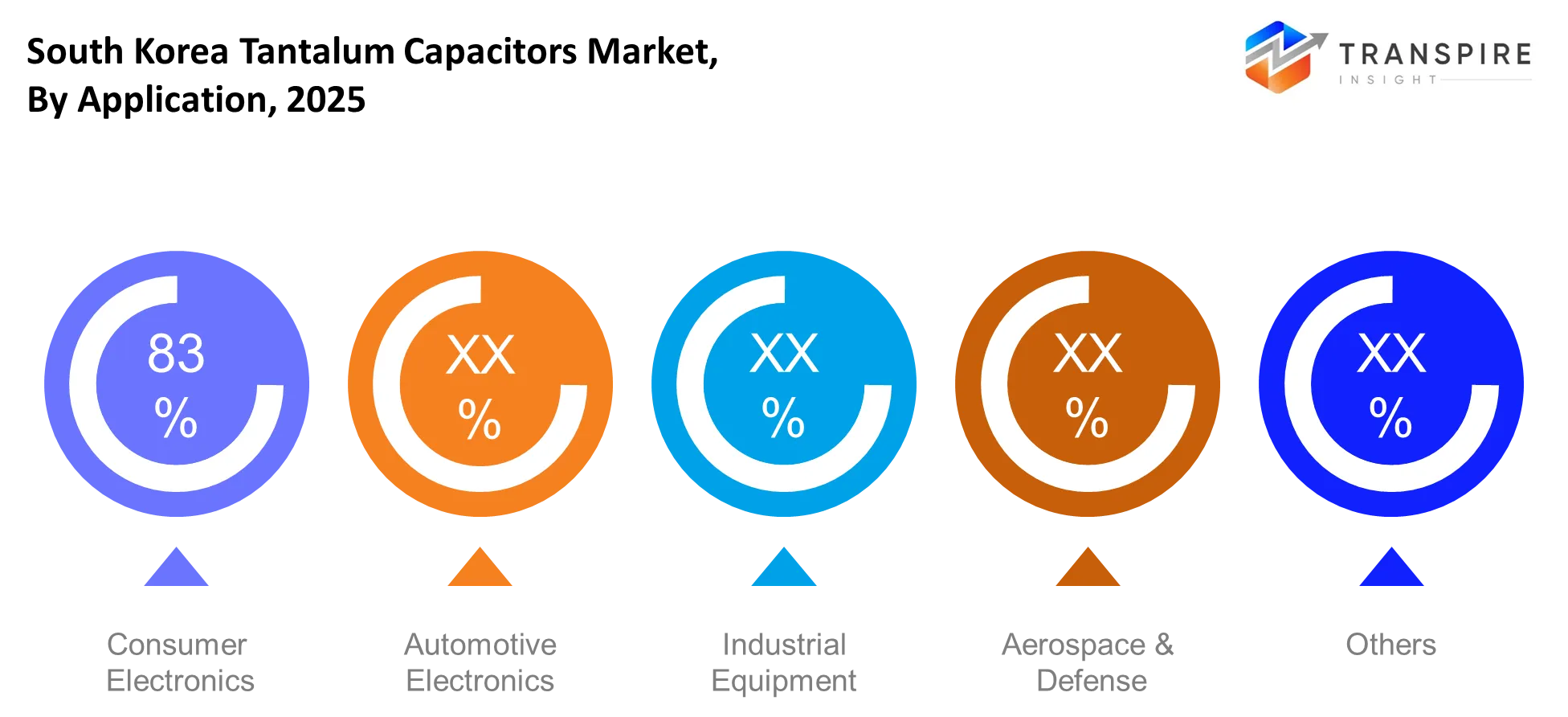
To learn more about this report, Download Free Sample Report
By Mounting Type
Surface Mount Capacitors kind of dominate the market because compact PCB layouts and automated assembly workflows basically push manufacturers toward smaller electronic parts, with higher placement efficiency. In consumer electronics, makers are leaning more and more on surface mount technology to keep devices lightweight while also improving production throughput. And then the advanced semiconductor packaging plus AI computing hardware really helps solidify the position, since high density circuit boards need tight space utilization and dependable electrical output, you know . Manufacturing compatibility in automation also chops down labor dependency and boosts scalability.
Meanwhile Through-hole Capacitors still keep a steady presence in industrial systems, aerospace electronics, and heavy duty power equipment, mainly because stronger mechanical bonding and durability stay non negotiable there. Other options include hybrid mounting setups used in specialized industrial or military-grade environments where a customized integration approach is required . Over the forecast timeline, surface mount products are expected to keep strengthening their leadership, as electronic systems continue moving toward compact multilayer PCB architectures. Product developers and component suppliers are likely to focus on ultra-miniaturized capacitor designs that are tuned for automated fast assembly operations and not just manual work.
By Voltage Range
Low Voltage Capacitors are still kinda leading the market, mainly because phones, laptops, solid state drives, networking equipment and wearable tech mostly live in lower voltage zones. Semiconductor makers plus consumer electronics assemblers keep buying these capacitors in big amounts, largely because device design stays compact and the power management has to react really quickly. There’s also steady momentum from AI processors and portable gadgets, which basically keeps the production appetite high. Even the replacement routines for personal electronics are fairly steady, so revenue in this space tends to look consistent too, not too shaky.
Medium Voltage Capacitors are starting to look more attractive, especially for automotive electronics, industrial automation setups and telecommunications infrastructure, where regulating power needs go beyond what you’d normally see in everyday consumer devices. High Voltage Capacitors have a smaller footprint though, yet they remain important on purpose, showing up in aerospace systems, defense electronics and certain specialized industrial machines that run under stronger electrical stress conditions. Other types include custom voltage setups, built for specific engineering needs. Through the forecast period, medium voltage models should grow quicker, since EV platforms, smart factories, and AI infrastructure projects keep pushing demand toward higher performance power control solutions.
By End User
Electronics Manufacturers end up as that top end-user crowd, not just because they buy a little, but because semiconductor packaging facilities, PCB assemblers, and consumer device producers keep needing big- scale capacitor sourcing for high-volume electronics output. In South Korea, the semiconductor ecosystem stays unusually solid and the export-driven electronics manufacturing engine keeps component demand feeling steady across several product classes. On top of that, compact design expectations and high-frequency processing setups bump up reliance on advanced tantalum capacitor offerings. Also, long-running supplier agreements— kind of like a safety net— keep procurement consistency intact across this whole segment.
Then you have Automotive OEMs showing up as a fast-rising growth factor, driven by electrification momentum and the wider roll-out of intelligent vehicle features. Industrial Companies, meanwhile, continue to adopt reliably via automation equipment, robotics, and smart factory infrastructure, all of which ask for steady power regulation along with operational durability. Other buyers include aerospace contractors, medical device producers, and defense electronics suppliers, with specialized reliability expectations tied to their missions. Over the forecast period, automotive OEM demand is projected to climb quicker since EV output keeps ramping, and vehicle architectures keep folding in even more advanced electronic control systems.
What are the Key Use Cases Driving the South Korea Tantalum Capacitors Market?
The main thing people still use it for is power control inside consumer gadgets and semiconductor devices. Like , in phones and tablets, plus AI processors, SSDs, and these advanced memory modules, tantalum capacitors just help keep the voltage steady in tight arrangements. Thermal efficiency and how much space you can save, they really do swing the final performance, so that part matters.
Right next to that, the nearby use cases are growing fast, especially in electric vehicles and industrial automation. The battery management units in EVs, ADAS systems, and smart factory robotics are leaning on conductive polymer tantalum capacitors because they can take higher temperatures and still hold electrical stability even during long continuous workloads. At the same time, telecom infrastructure, including 5G base stations, has also picked up more dependable capacitor systems for upgrading network equipment.
And then there are newer and more niche applications, like AI accelerator servers, edge computing devices, and aerospace-grade electronics. Those setups demand ultra-low ESR components, able to survive heavy power demands and fast switching cycles. With South Korea pushing harder on domestic semiconductor production and defense-related electronics spending, it looks like adding these advanced tantalum capacitors will speed up over the forecast period.
|
Report Metrics |
Details |
|
Market size value in 2025 |
USD 0.44 Billion |
|
Market size value in 2026 |
USD 0.466 Billion |
|
Revenue forecast in 2033 |
USD 0.702 Billion |
|
Growth rate |
CAGR of 6.03% from 2026 to 2033 |
|
Base year |
2025 |
|
Historical data |
2021 - 2024 |
|
Forecast period |
2026 - 2033 |
|
Report coverage |
Revenue forecast, competitive landscape, growth factors, and trends |
|
Regional scope |
South Korea |
|
Key company profiled |
KEMET, AVX Corporation, Vishay Intertechnology, Kyocera AVX, Panasonic, Samsung Electro-Mechanics, Murata Manufacturing, Yageo Corporation, TDK Corporation, Nichicon, Rohm Semiconductor, Taiyo Yuden, Nippon Chemi-Con, Cornell Dubilier, Exxelia |
|
Customization scope |
Free report customization (country, regional & segment scope). Avail customized purchase options to meet your exact research needs. |
|
Report Segmentation |
By Capacitor Type (Solid Tantalum Capacitors, Wet Tantalum Capacitors, Polymer Tantalum Capacitors, Others); By Application (Consumer Electronics, Automotive Electronics, Industrial Equipment, Aerospace & Defense, Others); By Mounting Type (Surface Mount Capacitors, Through-hole Capacitors, Others); By Voltage Range (Low Voltage Capacitors, Medium Voltage Capacitors, High Voltage Capacitors, Others); By End User (Electronics Manufacturers, Automotive OEMs, Industrial Companies, Others) |
Which Regions are Driving the South Korea Tantalum Capacitors Market Growth?
Asia-Pacific stays kinda dominant in the regional market, because it bundles together semiconductor manufacturing concentration, more capable electronics exports, and huge scale auto production. South Korea, Japan, Taiwan, and China together keep up solid procurement volumes for tantalum capacitors that go into AI hardware, EV systems, and everyday consumer electronics. On top of that, government-backed semiconductor investment programs and localized supply-chain approaches helped the region keep its manufacturing resilience steady after the more recent worldwide component shortages. There’s also this extra advantage from dense PCB assembly ecosystems and passive component supplier networks that let production ramp up quickly, almost like on short notice.
North America is a bit different, since its growth is pulled more by hyperscale data centers, aerospace electronics, and defense-grade computing infrastructure. If you compare it to Asia-Pacific’s manufacturing-led ecosystem, the demand side in North America gets shaped by longer-term infrastructure modernization efforts and enterprise AI rollouts. U.S. investment in AI accelerators and high performance server platforms pushed procurement of low-ESR polymer tantalum capacitors during 2024, and 2025. Meanwhile stable enterprise spend, plus ongoing defense electronics contracts, keeps supporting dependable long-term revenue across much of the region.
Europe, however, is showing the fastest growth, largely because EV electrification policies are ramping up and industrial automation investment is increasing. Tighter automotive safety rules, and power-efficiency standards, encouraged European OEMs to move toward advanced capacitor technologies able to survive higher thermal and voltage stress. Germany and France expanded EV power electronics manufacturing capacity after 2024, and that basically opened up new sourcing pathways for capacitor suppliers.
Who are the Key Players in the South Korea Tantalum Capacitors Market and How Do They Compete?
Competition in the South Korea tantalum capacitors industry is still, kinda moderately consolidated, because technical reliability, manufacturing precision, and those qualification certifications really do make the entry path pretty tough for new players. Most firms end up battling with low-ESR performance, thermal endurance, miniaturization capability and long-run supply reliability, not only pricing deals that are easy to copy. Automotive and semiconductor buyers are leaning more and more toward suppliers who can offer customized capacitor solutions, plus stable procurement arrangements during raw material volatility, you know.
Samsung Electro-Mechanics leans on its tight tie-in with South Korea’s semiconductor and smartphone ecosystem, to push higher-density capacitor deployment across consumer electronics and also automotive platforms. Murata Manufacturing stands out via ultra-compact passive component engineering and multilayer integration capabilities, built for AI servers and communications infrastructure, in particular. Panasonic Industry keeps emphasis on conductive polymer tantalum capacitor innovation, including low-profile POSCAP architectures that are tuned for high-output USB-PD and compact computing devices.
Vishay Intertechnology competes with high-reliability industrial and automotive-grade capacitor lineups, and strong endurance traits when the operating conditions are brutal. Yageo Corporation grows by expanding diversified passive component manufacturing, plus deliberate product placement for industrial automation and EV electronics customers. Overall, these players are investing more into localized technical support, AI-assisted manufacturing inspection systems, and advanced polymer formulations, so they can lock in long-term OEM agreements.
Company List
- KEMET
- AVX Corporation
- Vishay Intertechnology
- Kyocera AVX
- Panasonic
- Samsung Electro-Mechanics
- Murata Manufacturing
- Yageo Corporation
- TDK Corporation
- Nichicon
- Rohm Semiconductor
- Taiyo Yuden
- Nippon Chemi-Con
- Cornell Dubilier
- Exxelia
Recent Development News
In September 2025, Panasonic Industry launched new conductive polymer tantalum solid capacitors compatible with USB Power Delivery 3.1. The development introduced industry-low 3 mm profile designs supporting high-output power delivery and compact electronics miniaturization.https://news.panasonic.com/global/press/en250918-2 (Panasonic Newsroom Global).
In September 2025, Panasonic Industry announced mass production plans for 50V and 63V POSCAP tantalum capacitors. The expansion strengthened the company’s position in high-performance computing and advanced communication equipment applications.https://industrial.panasonic.com/ww/ds/ss/technical/pr2 (Panasonic Industry).
In February 2024, Panasonic Industry commercialized high-capacitance conductive polymer hybrid capacitors for automotive electronics. The launch improved thermal endurance for compact ECU systems and reinforced demand for advanced passive components in EV architectures.https://news.panasonic.com/global/press/en240228-2 (Panasonic Newsroom Global).
What Strategic Insights Define the Future of the South Korea Tantalum Capacitors Market?
South Korea's tantalum capacitors industry is kinda moving, more and more toward niche high reliability uses, tied to AI computing, EV electrification, advanced semiconductor packaging, plus industrial automation systems. The main reason behind this shift is that people keep needing compact passive parts that can actually handle higher power density and pretty nasty thermal stress conditions. But there is this less obvious risk still sitting underneath it all, like the way tantalum raw material is concentrated in a few places, and the geopolitical supply chain exposure that comes with it, which can mess with production economics even while downstream demand looks strong. Then there is another emerging wrinkle, potential substitution where advanced ceramic capacitor technologies start taking over some low voltage roles.
There is also a big future opening, especially in automotive AI hardware and edge computing infrastructure, where ultra low ESR polymer tantalum capacitors can give premium performance advantages, you know better stability under load and all that. The firms that manage to lock in long term tantalum sourcing agreements and also grow localized production partnerships, will end up with stronger pricing stability. Market participants should put emphasis on R and D spending for high temperature polymer architectures and work straight with semiconductor and EV platform developers, so they can secure next generation design wins before competitive saturation ramps up too hard.
South Korea Tantalum Capacitors Market Report Segmentation
By Capacitor Type
- Solid Tantalum Capacitors
- Wet Tantalum Capacitors
- Polymer Tantalum Capacitors
- Others
By Application
- Consumer Electronics
- Automotive Electronics
- Industrial Equipment
- Aerospace & Defense
- Others
By Mounting Type
- Surface Mount Capacitors
- Through-hole Capacitors
- Others
By Voltage Range
- Low Voltage Capacitors
- Medium Voltage Capacitors
- High Voltage Capacitors
- Others
By End User
- Electronics Manufacturers
- Automotive OEMs
- Industrial Companies
- Others
Frequently Asked Questions
Find quick answers to common questions.
The Estimated South Korea Tantalum Capacitors Market size for the Market will be USD 0.702 Billion in 2033.
Key Segments for the South Korea Tantalum Capacitors Market are By Capacitor Type (Solid Tantalum Capacitors, Wet Tantalum Capacitors, Polymer Tantalum Capacitors, Others); By Application (Consumer Electronics, Automotive Electronics, Industrial Equipment, Aerospace & Defense, Others); By Mounting Type (Surface Mount Capacitors, Through-hole Capacitors, Others); By Voltage Range (Low Voltage Capacitors, Medium Voltage Capacitors, High Voltage Capacitors, Others); By End User (Electronics Manufacturers, Automotive OEMs, Industrial Companies, Others).
Major South Korea Tantalum Capacitors Market Players are KEMET, AVX Corporation, Vishay Intertechnology, Kyocera AVX, Panasonic, Samsung Electro-Mechanics, Murata Manufacturing, Yageo Corporation, TDK Corporation, Nichicon, Rohm Semiconductor, Taiyo Yuden, Nippon Chemi-Con, Cornell Dubilier, Exxelia.
The Current South Korea Tantalum Capacitors Market size is USD 0.44 Billion in 2025.
The South Korea Tantalum Capacitors Market CAGR is 6.03% from 2026 to 2033.
- KEMET
- AVX Corporation
- Vishay Intertechnology
- Kyocera AVX
- Panasonic
- Samsung Electro-Mechanics
- Murata Manufacturing
- Yageo Corporation
- TDK Corporation
- Nichicon
- Rohm Semiconductor
- Taiyo Yuden
- Nippon Chemi-Con
- Cornell Dubilier
- Exxelia
Recently Published Reports
-
Apr 2026
Fiber Optic Faceplates Market
Fiber Optic Faceplates Market Size, Share & Analysis Report By Type (< 300 mm2, 300-350 mm2, and > 350 mm2, By Application (Night Vision, Holographic Imaging, Medical, and Others), and Geography (North America, Europe, Asia-Pacific, Middle East and Africa, South and Central America), 2021 - 2031
-
Apr 2026
High Temperature Superconductors Market
High Temperature Superconductors Market Size, Share & Analysis Report By Type (1G HTS, and 2G HTS), By Application (Power Cable, Fault Current Limiter, and Transformer), and Geography (North America, Europe, Asia-Pacific, Middle East and Africa, South and Central America), 2021 - 2031
-
Apr 2026
Industrial Plugs and Socket Market
Industrial Plugs and Socket Market Size, Share & Analysis Report By Type (Industrial Plugs, Industrial Sockets), By Current (Up to 32 A, 32 to 125 A, Above 125 A), By Protection (Dustproof and Splash Proof, Waterproof, Explosion Proof), By End User (Heavy Industries, Oil and Gas, Chemicals and Pharmaceuticals, Power Generation, Others), and Geography (North America, Europe, Asia-Pacific, Middle East and Africa, South and Central America), 2021 - 2031
-
Apr 2026
InGaAs Avalanche Photodiodes Market
InGaAs Avalanche Photodiodes Market Size, Share & Analysis Report By Type (1100 - 1700 nm, and 1000 - 1600 nm), By Application (Missile Warning System, Muzzle Flash Detection, Wafer Defect Inspection, Laser Rangefinders, and Others), and Geography (North America, Europe, Asia-Pacific, Middle East and Africa, South and Central America), 2021 - 2031