

South Korea SWIR Camera Market Size & Forecast:
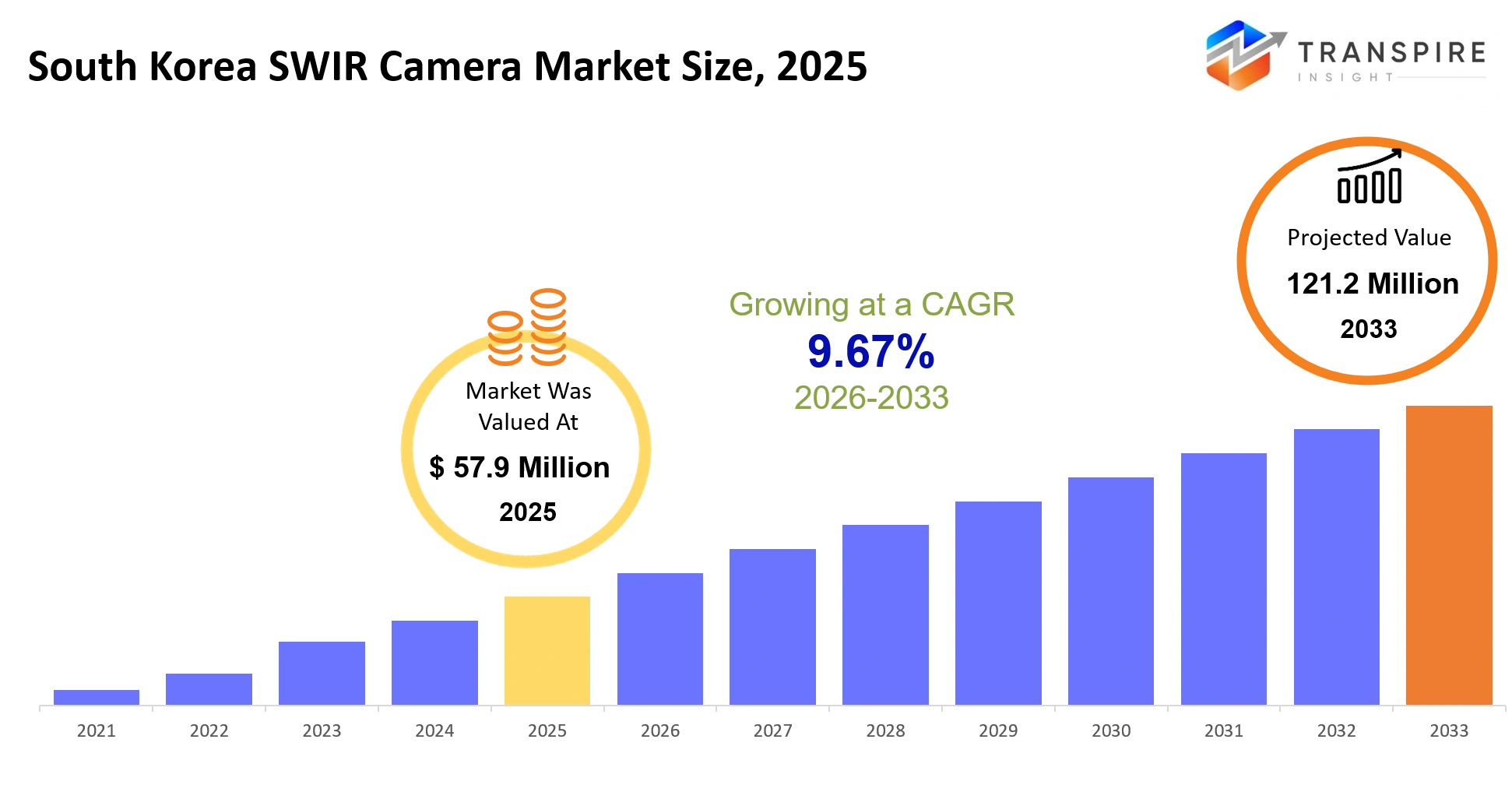
- South Korea SWIR Camera Market Size 2025: USD 57.9 Million
- South Korea SWIR Camera Market Size 2033: USD 121.2 Million
- South Korea SWIR Camera Market CAGR: 9.67%
- South Korea SWIR Camera Market Segments: By Camera Type (Area Scan Cameras, Line Scan Cameras, Thermal SWIR Cameras, Scientific Cameras, Industrial Cameras, Hyperspectral Cameras, Cooled Cameras, Others); By Application (Industrial Inspection, Defense & Surveillance, Semiconductor Inspection, Machine Vision, Scientific Research, Agriculture Monitoring, Medical Imaging, Others); By Technology (InGaAs Sensors, CMOS Sensors, CCD Sensors, Uncooled Sensors, Cooled Sensors, Multispectral Systems, Imaging Modules, Others); By End User (Defense Agencies, Semiconductor Companies, Manufacturers, Research Institutes, Healthcare Providers, Agricultural Firms, Security Agencies, Others).
South Korea SWIR Camera Market Summary
The South Korea SWIR Camera Market was valued at USD 57.9 Million in 2025. It is forecast to reach USD 121.2 Million by 2033. That is a CAGR of 9.67% over the period.
The SWIR camera market in South Korea supports applications where seeing beyond the visible is important. Semiconductor and battery manufacturers benefit from SWIR imaging for inspection, and defense and maritime users find it indispensable for viewing targets in smoke, haze, and darkness. It addresses an essential need by being able to visualise flaws and objects in the dark and under cover that can't be seen with their eyes alone.
Over the last five years, the market has moved from small niche defense applications into broader industrial markets. This is primarily due to Korea developing high-volume casting, advanced packaging and electric vehicle battery manufacturing capabilities with its more demanding quality control needed to utilize the longer wavelength, higher efficiency devices. During this time, the recent pandemic supply chain shock revealed global flaws in high-value manufacturing putting the attention on automation and in-line optical inspection. Now as SWIR sensors become smaller and cheaper due to array innovations, adoption will spread beyond flagship facilities pushing recurring revenue streams as the equipment is refitted, maintained and driven by software imaging solutions.
Key Market Insights
- South Korea SWIR Camera Market Since the South Korean government supports the semiconductor and battery investments, there are long-term revenue potentials in the industrial inspection and machine vision application.
- Market dominated by Industrial manufacturing with a share of nearly 45% in 2025 due to increasing need for advanced wafer inspection and defect detection.
- Seoul metropolitan area makes up roughly 55% of industry sales – Many semiconductor fabs, electronics plants, and R&D centers are located.
- Southeastern South Korea: fastest growing regional market in the 0-32 period. Driven by manufacturing of batteries and investments into automotive electronics.
- Cooled SWIR cameras gained the majority of the product segment at about 52% market share, due to their enhanced sensitivity and imaging performance.
- Uncooled SWIR cameras account for the next largest market section as the decrease in cost allows for increased purchasing in commercial & industrial installations.
- The fastest growing product segment during 2025 to 2032 is the compact SWIR modules, as OEms add imaging to their automation systems.
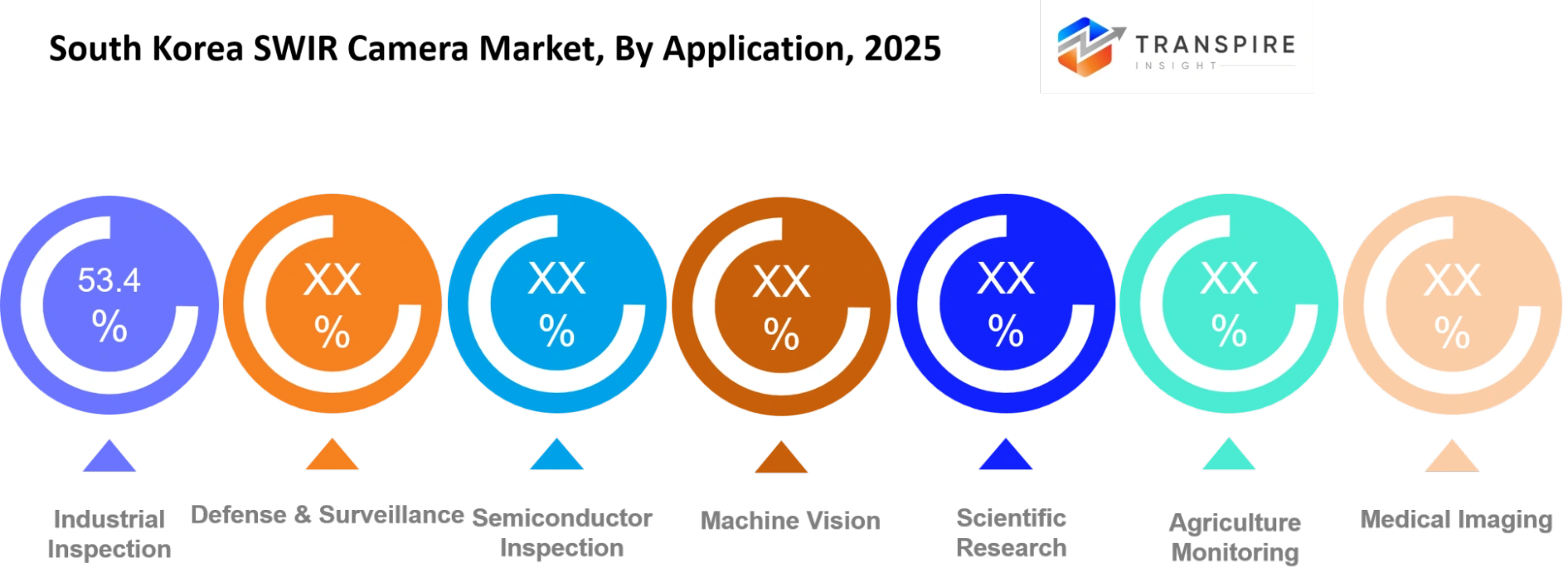
- Industrial inspection stays the most popular application, to which nearly 40% of the sales. This field is mainly focused on the optimization of the semiconductor yield and on the batteries quality control.
- Performing the most rapidly spreading technological developments are the surveillance and security applications which present operators the required high-performance imaging systems in smoke, fog and darkness.
- Electronics and semiconductor manufacturers (excl. Assembly and packaging) is the largest customer group, representing over 48% of end user revenues.
What are the Key Drivers, Restraints, and Opportunities in the South Korea SWIR Camera Market?
Country's focus on semiconductors & batteries driving SA SWIR market The country's heavy investment in the semiconductor fabrication and advanced battery manufacturing industry are the main drivers of South Korea SWIR Camera market. Recent years have seen significant increases in the stringent quality control requirements from chipset and battery producers due to miniaturizing and complexity in architectures of electronic devices. The limitation of visible light cameras to detect subsurface defects,contamination and material quality issues has compelled manufacturing facilities to transition to the usage of SWIR imaging systems. This has a direct correlation with equipment investment in SWIR camera sales and recurring revenue generation from the software update, service contract, and imaging services.
High systems cost a hurdle The most formidable structural challenge limiting growth in the SWIR Camera market in the South Korea region. The reliance on exotic InGaAs sensors and sophisticated cooling systems for SWIR cameras makes its production more labor and supply chain intensive, leading to elevated costs. Hence, it hinders its adoption in SMB sector & the application area restricted whereROI is easily quantifiable hence; sales is mostly among larger industries or defence companies. Integration with artificial intelligence the next evolutionary stage The future of the market lies in smart cameras integrating artificial intelligence with the compact SWIR modules.
Industries now look towards automated inspection and defect detection equipment that perform real-time defective classification and future prediction of quality using machine learning and Artificial Intelligence technologies. This fits well within South Korea’s smart factory and next-generation electronic manufacturing goals and allows the vendors beyond hardware sales.
What Has the Impact of Artificial Intelligence Been on the South Korea SWIR Camera Market?
Intelligence & Decision Making Automation The image and data acquisition functions are being further enhanced with Artificial Intelligence (AI) in South Korea SWIR camera Market. AI enables the imaging systems to develop decision-making capabilities and transform into an intelligent inspecting process by the end-users. In the Semiconductor and Battery sector, AI algorithms have a capability to assess different defect patterns, micro-cracks, and foreign particles on the inspected surface which conventional inspection processes tend to fail.
Automating these inspection tasks through AI saves time by eliminating the need for Manual Inspection, increases throughput, and improves product yield by maintaining higher standards of quality in their production. AI for predictive maintenance of imaging instruments and manufacturing units is being gradually adopted in industries. Machine learning models using acquired imaging data can monitor performance trends (e.g. Image quality, temperature, sensor integrity), enabling proactive prediction of any potential equipment degradation. Such analysis enables companies to enjoy better uptime, reduced maintenance costs, and higher product quality.
Further,AI in image enhancement allows better detectability in non-ideal conditions, such as in very dim industrial lightings and outdoor haze. Future trends such as Edge computing and IoT in industrial applications are expected to facilitate in further efficiency with real-time analysis and control imaging systems remotely,but the integration of AI systems with legacy machinery demands high capital investment while a sufficient training dataset is mandatory for the formation of dependable models and can hence act as a hurdle in early adoption among Small and Medium enterprises.
Key Market Trends
- Semiconductor manufacturers have moved from using visible-light inspection to SWIR imaging since 2020, when geometries in chips became extremely sensitive.
- Since 2021, battery manufacturers have turned to SWIR cameras to help detect moisture intrusion or inconsistencies in materials. This application helps to reduce scrap rates during production.
- Camera manufacturers have been challenged to make the cameras leaner and compact uncooled cameras are favored than large form systems. Camera size has been cut down by close to 30% in the last five years.
- AI-powered image analysis played a significant role in differentiating vendors post 2022. Automated defect classification and predictive quality monitoring functionalities were observed.
- The supply chain shocks in 2020 and 2021 motivated Korean companies to explore alternative sources for sensors and to build closer relationships with international imaging suppliers.
- Security is falling further and further down the list of defense procurement priorities. More and more SWIR systems are being purchased for maritime security and low-vis reconnaissance missions.
- The emphasis has moved from hardware specs to integrated solutions, as companies such as FLIR Systems, Hamamatsu Photonics and Xenics have signed up for software ecosystems.
- A growing number of users are working together with equipment manufacturers, reducing deployment cycles, and thus providing more-tailored imaging solutions for niche industrial markets.
- RTD investments in InGaAs sensor technology increased after 2021 up to provide improved sensitivity at reduced cost of production and increased commercialization potential.
South Korea SWIR Camera Market Segmentation
By Camera Type:
Area Scan cameras capture full-scene images in one frame for rapid inspection. Line Scan cameras record imagery line by line during the course of a continuous production. Thermal SWIR cameras observe thermal fluctuations. Scientific cameras facilitate lab research and scientific precision analysis.
Industrial cameras facilitate reliable manufacturing images. Hyperspectral cameras examine specific spectral features for material identification. Cooled cameras boost sensitivity under adverse operating conditions. Others encompass a wide range of other niche and specialty industrial imaging.
By Application:
Industrial Inspection assists the evaluation of product quality and discovery of product defects. Defense & Surveillance enables low-visibility monitoring for safety and security applications. Semiconductor Inspection provides SWIR viewing for wafers during chip manufacturing. Machine vision enhancements boost productivity, improve accuracy and reduce production errors.
Scientific Research enables high-performance imaging for sophisticated experiments in research institutions. Agriculture Monitoring provides tools for identifying healthy plants, assessing crop growth, and monitoring soil conditions. Medical Imaging provides high quality imagery that assists diagnostics, while Others offer solutions for such areas as environmental monitoring, logistics, and diverse industrial specialties.
By Technology:
InGaAs Sensors deliver sensitivity across short wave infrared wavelengths and continue to be a key sensor in sophisticated imaging solutions. CMOS Sensors provide efficient image processing with improved power efficiency; whereas CCD Sensors facilitate enhanced image quality and performance stability across diverse operating conditions.
Uncooled Sensors simplify operation and enable compact size. Cooled Sensors offer enhanced sensitivity for rigorous tasks. Multispectral Systems enable imaging in multiple wave bands. Imaging Modules and Others allow for adaptable integration within industrial and research equipment.
By End User:
Defense Agencies leverage SWIR cameras for the purposes of security and observation. Semiconductor Companies integrate advanced imaging solutions for automated quality control in the fabrication process. Manufacturers employ imaging for automation; and Research Institutes apply them to material science and research applications.
Healthcare facilities use imaging solutions for diagnostic purposes. Farmers and Agriculture Companies employ SWIR to manage and monitor crops; security Agencies use it for security and surveillance; and Other organizations, particularly commercial businesses, integrate imaging technologies to improve operations.
What are the Key Use Cases Driving the South Korea SWIR Camera Market?
The SoK's largest application for the use of SWIR cameras is in industrial inspection. These detectors are employed by semicon manufacturers to identify hidden defects, moisture contamination, surface irregularities, and wafer hybridization issues that are untraceable by visible-light cameras. With quality assurances present at every stage and in every product in this industry, SWIR imaging plays a big part across a host of fabs in SoK.
Security and surveillance-related systems are firmly established and expanding steadily as security agencies seek ever more dependable imaging in fog, smoke and other low light scenarios. Machine vision systems are gaining ground in electronics manufacturing, such as for automated inspection, where they increase throughput and cut quality-related losses.
New avenues are opening up in the fields of medical imaging and agricultural monitoring. Healthcare researchers are working on SWIR-based non-intrusive diagnoses, and agricultural companies are developing applications for crop health and water stress monitoring. In both cases, this is very early days and the potential outlook is good for the longer term, as the cost of imaging reduces.
|
Report Metrics |
Details |
|
Market size value in 2025 |
USD 57.9 Million |
|
Market size value in 2026 |
USD 63.5 Million |
|
Revenue forecast in 2033 |
USD 121.2 Million |
|
Growth rate |
CAGR of 9.67% from 2026 to 2033 |
|
Base year |
2025 |
|
Historical data |
2021 - 2024 |
|
Forecast period |
2026 - 2033 |
|
Report coverage |
Revenue forecast, competitive landscape, growth factors, and trends |
|
Country scope |
South Korea |
|
Key company profiled |
Teledyne FLIR, Hamamatsu Photonics, Sony, Allied Vision, Xenics, New Imaging Technologies, Raptor Photonics, Sensors Unlimited, Leonardo DRS, Hikmicro, Basler, Omron, JAI, LUCID Vision Labs, Hanwha Vision. |
|
Customization scope |
Free report customization (country, regional & segment scope). Avail customized purchase options to meet your exact research needs. |
|
Report Segmentation |
By Camera Type (Area Scan Cameras, Line Scan Cameras, Thermal SWIR Cameras, Scientific Cameras, Industrial Cameras, Hyperspectral Cameras, Cooled Cameras, Others); By Application (Industrial Inspection, Defense & Surveillance, Semiconductor Inspection, Machine Vision, Scientific Research, Agriculture Monitoring, Medical Imaging, Others); By Technology (InGaAs Sensors, CMOS Sensors, CCD Sensors, Uncooled Sensors, Cooled Sensors, Multispectral Systems, Imaging Modules, Others); By End User (Defense Agencies, Semiconductor Companies, Manufacturers, Research Institutes, Healthcare Providers, Agricultural Firms, Security Agencies, Others). |
Which Regions are Driving the South Korea SWIR Camera Market Growth?
Region Market size Growth Driver The Greater Seoul Area, Gyeonggi Seoul is home to the majority of South Korea’s semiconductor fabricating facilities and electronics manufacturing centers along with key research and development institutes; as such, it has a well-established, consistent demand for sophisticated imaging technologies. Government support for the domestic self-sufficiency of semiconductors and the enhancement of smart factories continues to fuel investment in precision inspection technologies. Furthermore, a robust equipment, software, and component ecosystem enables the seamless implementation and upgrading of SWIR solutions.
Southeastern Region Busan, Ulsan, Changwon This region represents the second most significant SWIR camera market, driven by demand for applications in the automotive electronics, battery, and industrial machinery industries, in contrast to the semiconductor fabricating cluster in Seoul. Stable industrial output coupled with steady investments in automation and process improvement facilitates the use of SWIR cameras in quality control to ensure production precision and minimize material waste. Central and Southwestern Region Changzhou, Suwon, and the broader region South Korea's central and southwestern regions are quickly becoming the most rapidly growing markets for SWIR cameras.
Recent developments, such as recent investments in battery plants, research centers, and regional innovation centers have opened avenues for the adoption of these advanced imaging solutions beyond the traditional industrial powerhouses. Moreover, government funding for digital manufacturing and research in advanced materials will undoubtedly create attractive opportunities for system vendors and component providers alike throughout the projection period of 2026-2033.
Who are the Key Players in the South Korea SWIR Camera Market and How Do They Compete?
The South Korea SWIR camera market is fragmented with a moderate level of supply concentration, and technology capability as the primary competitive dimension. Global imaging companies compete on sensor performance, image quality, and application-specific solutions and not by price as they have in the past. North American and European suppliers gain market share by leveraging their longstanding relationships with semiconductor and defense customers while emerging Japanese companies pursue more niche markets such as machine vision and scientific imaging.
FLIR Systems gains market share with rugged camera platforms and Image Processing software that functions in industrial and defense settings. Its strength lies in expanding its range through integrated imaging solutions and automating equipment partnerships. Hamamatsu Photonics specializes in high-end InGaAs technology and scientific camera systems, which reinforces its occupancy in labs and semiconductor testing.
Xenics has found its niche by focusing on short-wave infrared and providing customizable camera platforms for industrial and security markets. Touts' strength is its high-resolution imaging and wide integration system capabilities for combining SWIR cameras with machine vision and automation platforms. Both companies continue to develop compact camera designs with software-defined imaging functionalities to competitiveness of a growing industrial imaging market in South Korea.
Company List
- Teledyne FLIR
- Hamamatsu Photonics
- Sony
- Allied Vision
- Xenics
- New Imaging Technologies
- Raptor Photonics
- Sensors Unlimited
- Leonardo DRS
- Hikmicro
- Basler
- Omron
- JAI
- LUCID Vision Labs
- Hanwha Vision
Recent Development News
In January 2025, Raptor Photonics launched the Owl 2560 Vis-SWIR camera at Photonics West 2025. The new 5.2 MP back-illuminated InGaAs camera expanded high-resolution SWIR imaging options for industrial inspection, aerospace, and defense applications, increasing competitive pressure across Asia including South Korea.
Source: https://www.raptorphotonics.com/
In August 2025, Hamamatsu Photonics launched the G1682x Series InGaAs linear image sensors for near-infrared multi-channel spectrophotometry. The compact sensors improved sensitivity and real-time performance, supporting wider adoption of SWIR imaging in semiconductor inspection and industrial automation markets.
Source: https://mvpromedia.com/
What Strategic Insights Define the Future of the South Korea SWIR Camera Market?
Overall The South Korea SWIR Camera Market is evolving into intelligent, highly specialized imaging systems, utilizing high-end sensors in conjunction with Artificial Intelligence (AI) and edge computing. In the coming 5–7 years, value creation will transition from sales of hardware to solution-based offerings targeted at the semiconductor fabrication, battery manufacturing and automated inspection industries, driven by South Korea’s efforts to foster its domestic high-tech manufacturing industry and drive greater efficiencies in key industries.
A less obvious risk is related to the reliance on InGaAs sensor material and narrow, centralized supply base. Any shortages in raw material supply or export restrictions will increase pricing and extend equipment delivery schedules, despite solid end-user demand. One obvious opportunity will arise from the increased utilization of SWIR-enabled medical diagnostics and precision agriculture, as space is the key for these types of applications and SWIR modules are already moving from research centers towards commercial solutions. Early Software investment and strong partnerships with specific industries will be key for success as the purchasing criteria moves away from isolated camera components to total imaging ecosystems.
South Korea SWIR Camera Market Report Segmentation
By Camera Type
- Area Scan Cameras
- Line Scan Cameras
- Thermal SWIR Cameras
- Scientific Cameras
- Industrial Cameras
- Hyperspectral Cameras
- Cooled Cameras
By Application
- Industrial Inspection
- Defense & Surveillance
- Semiconductor Inspection
- Machine Vision
- Scientific Research
- Agriculture Monitoring
- Medical Imaging
By Technology
- InGaAs Sensors
- CMOS Sensors
- CCD Sensors
- Uncooled Sensors
- Cooled Sensors
- Multispectral Systems
- Imaging Modules
By End User
- Defense Agencies
- Semiconductor Companies
- Manufacturers
- Research Institutes
- Healthcare Providers
- Agricultural Firms
- Security Agencies
Frequently Asked Questions
Find quick answers to common questions.
The South Korea SWIR Camera Market size is USD 121.2 Million in 2033.
Key segments for the South Korea SWIR Camera Market are By Camera Type (Area Scan Cameras, Line Scan Cameras, Thermal SWIR Cameras, Scientific Cameras, Industrial Cameras, Hyperspectral Cameras, Cooled Cameras, Others); By Application (Industrial Inspection, Defense & Surveillance, Semiconductor Inspection, Machine Vision, Scientific Research, Agriculture Monitoring, Medical Imaging, Others); By Technology (InGaAs Sensors, CMOS Sensors, CCD Sensors, Uncooled Sensors, Cooled Sensors, Multispectral Systems, Imaging Modules, Others); By End User (Defense Agencies, Semiconductor Companies, Manufacturers, Research Institutes, Healthcare Providers, Agricultural Firms, Security Agencies, Others).
Major South Korea SWIR Camera Market players are Teledyne FLIR, Hamamatsu Photonics, Sony, Allied Vision, Xenics, New Imaging Technologies, Raptor Photonics, Sensors Unlimited, Leonardo DRS, Hikmicro, Basler, Omron, JAI, LUCID Vision Labs, Hanwha Vision.
The South Korea SWIR Camera Market size is USD 57.9 Million in 2025.
The South Korea SWIR Camera Market CAGR is 9.67% from 2026 to 2033.
- Teledyne FLIR
- Hamamatsu Photonics
- Sony
- Allied Vision
- Xenics
- New Imaging Technologies
- Raptor Photonics
- Sensors Unlimited
- Leonardo DRS
- Hikmicro
- Basler
- Omron
- JAI
- LUCID Vision Labs
- Hanwha Vision
About the Authors

Avinash Kumar
I’m Avinash Kumar, a Senior Research Analyst at Transpire Insight, with expertise in the Electronics and Semiconductor and Energy & Power industry. My work focuses on analyzing emerging technologies, market trends, industry developments, and innovation across these sectors. I specialize in transforming complex technical and market insights into clear, research-backed content that helps professionals, businesses, and decision-makers stay informed. Through continuous industry research and data-driven analysis, I strive to deliver accurate, reliable, and practical perspectives on the latest advancements shaping the semiconductor and energy landscape.

Chakradhar Khansole
Chakradhar serves as the Research Director at Transpire Insight, bringing over 8 years of experience in technology, innovation, and strategic market intelligence. He specializes in transforming complex market data into actionable business insights that enable organizations to make informed, growth-oriented decisions. Recognized for his strategic vision and analytical expertise, Chakradhar leads high-impact research initiatives, delivering comprehensive market assessments, competitive intelligence, and forward-looking industry analysis.
Recently Published Reports
-
Apr 2026
Fiber Optic Faceplates Market
Fiber Optic Faceplates Market Size, Share & Analysis Report By Type (< 300 mm2, 300-350 mm2, and > 350 mm2, By Application (Night Vision, Holographic Imaging, Medical, and Others), and Geography (North America, Europe, Asia-Pacific, Middle East and Africa, South and Central America), 2021 - 2031
-
Apr 2026
High Temperature Superconductors Market
High Temperature Superconductors Market Size, Share & Analysis Report By Type (1G HTS, and 2G HTS), By Application (Power Cable, Fault Current Limiter, and Transformer), and Geography (North America, Europe, Asia-Pacific, Middle East and Africa, South and Central America), 2021 - 2031
-
Apr 2026
Industrial Plugs and Socket Market
Industrial Plugs and Socket Market Size, Share & Analysis Report By Type (Industrial Plugs, Industrial Sockets), By Current (Up to 32 A, 32 to 125 A, Above 125 A), By Protection (Dustproof and Splash Proof, Waterproof, Explosion Proof), By End User (Heavy Industries, Oil and Gas, Chemicals and Pharmaceuticals, Power Generation, Others), and Geography (North America, Europe, Asia-Pacific, Middle East and Africa, South and Central America), 2021 - 2031
-
Apr 2026
InGaAs Avalanche Photodiodes Market
InGaAs Avalanche Photodiodes Market Size, Share & Analysis Report By Type (1100 - 1700 nm, and 1000 - 1600 nm), By Application (Missile Warning System, Muzzle Flash Detection, Wafer Defect Inspection, Laser Rangefinders, and Others), and Geography (North America, Europe, Asia-Pacific, Middle East and Africa, South and Central America), 2021 - 2031