

United States Short Wave Infrared (SWIR) Imaging Market Size & Forecast:
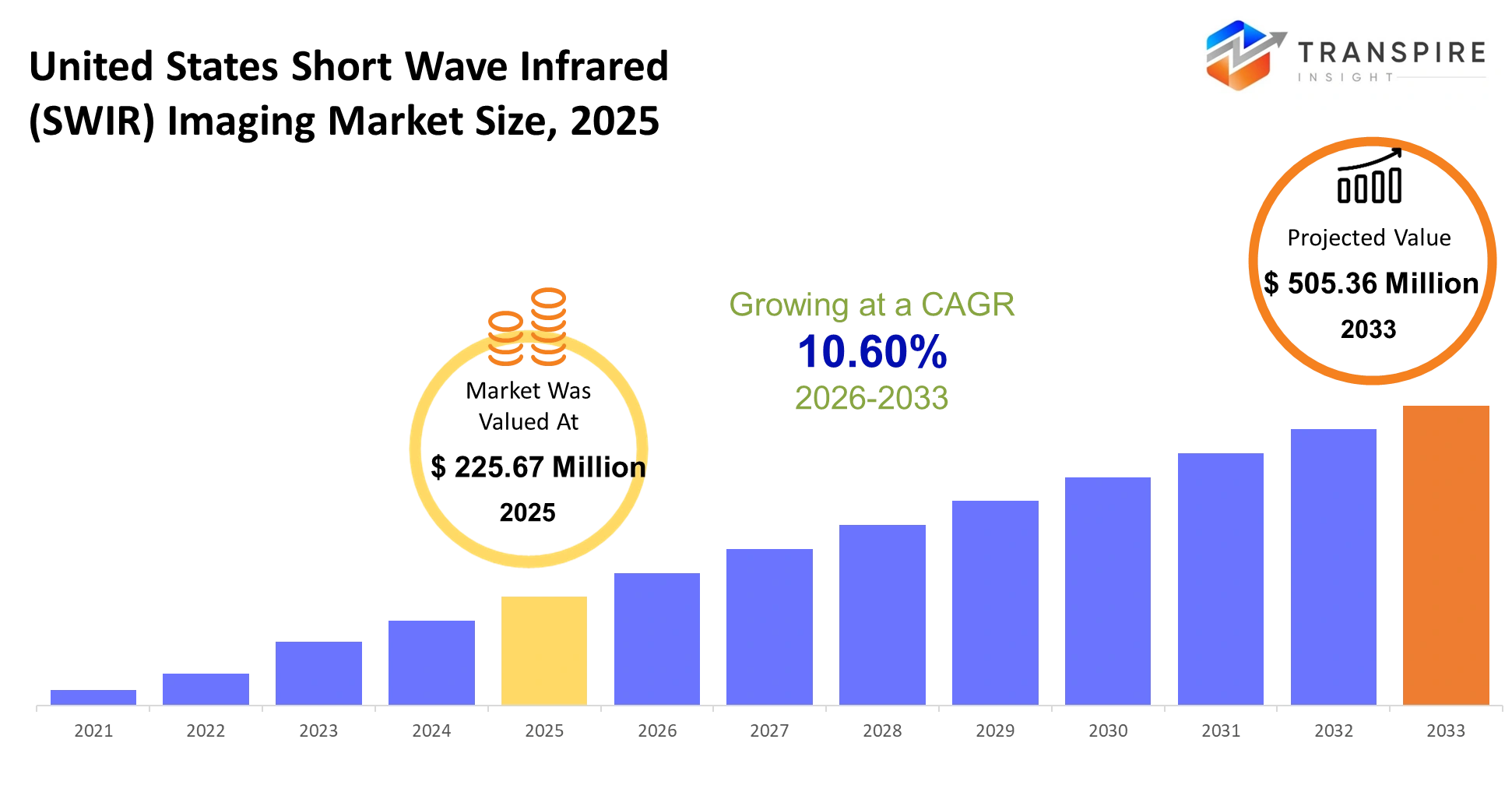
- United States Short Wave Infrared (SWIR) Imaging Market Size 2025: USD 225.67 Million
- United States Short Wave Infrared (SWIR) Imaging Market Size 2033: USD 505.36 Million
- United States Short Wave Infrared (SWIR) Imaging Market CAGR: 10.60%
- United States Short Wave Infrared (SWIR) Imaging Market Segments: By Component (SWIR Cameras, SWIR Sensors, SWIR Lenses, Frame Grabbers, Illumination Systems, Software Solutions, Accessories), By Technology (Cooled SWIR, Uncooled SWIR, InGaAs Technology, Mercury Cadmium Telluride, Quantum Dot Sensors, CMOS-based SWIR, Hyperspectral Imaging), By Application (Industrial Inspection, Surveillance & Security, Military & Defense, Medical Imaging, Semiconductor Inspection, Automotive ADAS, Scientific Research).
To learn more about this report,  Download Free Sample Report
United States Short Wave Infrared (SWIR) Imaging Market Summary:
The United States Short Wave Infrared (SWIR) Imaging Market size is estimated at USD 225.67 Million in 2025 and is anticipated to reach USD 505.36 Million by 2033, growing at a CAGR of 10.60% from 2026 to 2033. The United States Short Wave Infrared (SWIR) Imaging Market kind of moved past that old niche defense optics phase, and now it looks like a usable industrial visibility tool that helps operators spot heat signatures, inspect semiconductor wafers, detect moisture intrusion, and track defects that just don’t show up on conventional machine vision systems. In real manufacturing and critical infrastructure settings, SWIR cameras are getting used more and more to raise inspection accuracy when it’s low light , smoke , haze , or just high speed production, where normal imaging approaches tend to fail.
Over the last five years, the whole market has shifted in a more structural way, from military-led procurement toward commercial, industrial deployment. Costs for sensors came down, InGaAs detector performance improved, and SWIR is now being integrated with AI enabled machine vision platforms, so adoption widened across electronics , food inspection, automotive battery manufacturing, and autonomous systems too. Also, the semiconductor supply chain disruptions during and right after the COVID-19 period helped push domestic investment in advanced wafer inspection and process control tech. That part ended up directly helping SWIR imaging vendors. And as U.S. manufacturers chase higher automation precision and fewer defect rates, SWIR systems are being treated more like productivity infrastructure, not just specialty imaging equipment, which means there’s longer term recurring demand for integrated vision platforms plus analytics software.
Key Market Insights
- In 2025, the Western United States really kind of dominated the United States Short Wave Infrared , SWIR Imaging Market , holding almost 38% market share. This was largely fueled by semiconductor fabrication clusters and aerospace spending too, you know the usual kind of linkage.
- For the Southern United States, the outlook is projected as the fastest-growing regional market through 2032 . The main drivers are expanding electronics manufacturing, plus defense modernization programs that keep getting upgraded.
- SWIR cameras actually took more than 46% of the industry share in 2025, mainly because industrial inspection systems are needing greater imaging precision, especially when the lighting conditions get rough and uncooperative.
- Meanwhile, SWIR line scan imaging systems showed up as the second-largest segment, with momentum from broader deployment across high-speed packaging sites and food sorting facilities, kind of like a quietly accelerating workflow.
- AI-integrated SWIR imaging platforms are being viewed as the fastest-growing product category between 2026 and 2032. Manufacturers are prioritizing automated defect recognition, along with predictive analytics, so it’s not just capture its also interpretation.
- On the application side, semiconductor inspection led demand, representing around 34% revenue share in 2025. That performance tracks domestic wafer fabrication expansion and further advanced chip packaging investments.
- Defense and border surveillance applications are recording the fastest forecast growth, since SWIR sensors keep improving visibility in smoke, fog, and low-light operational settings, which is important in real field conditions.
- For end users, industrial manufacturing stayed in the lead, nearly 41% market share. This happens because more automated production lines are adopting machine vision systems at scale.
- Lastly, healthcare and biomedical imaging applications are starting to gain traction. SWIR technology is improving tissue visualization, and also supporting more non-invasive diagnostic imaging accuracy, which people seem to like a lot.
What are the Key Drivers, Restraints, and Opportunities in the United States Short Wave Infrared (SWIR) Imaging Market?
The most powerful thing pushing the United States Short Wave Infrared (SWIR) Imaging Market forward is the fast growth of homegrown semiconductor manufacturing combined with more advanced industrial automation. The CHIPS and Science Act basically kicked off a rush of capital being funneled into wafer fabrication sites, advanced packaging buildings, and precision inspection infrastructure in places like Arizona, Texas and New York. SWIR imaging systems started getting real attention because they can spot microcracks, moisture contamination, and silicon defects that ordinary visible light cameras just cannot catch in a consistent way. In practice, this helps boost production yield and it also cuts down scrap losses, especially when the product is high-value and every miss is expensive. So as companies lean hard into process accuracy and real-time anomaly detection, SWIR imaging kind of moved from a niche, specialized inspection gadget to a day to day operational must-have. That shift grows both equipment sales, and it tends to lift long-term revenue from software integration too.
Still, the biggest structural roadblock the market keeps running into is high sensor, material costs and such. A lot of SWIR systems rely on indium gallium arsenide sensors, and those end up needing complicated fabrication steps, plus they lean on specialized supply corridors.These issues cannot be fixed quickly, because global output capacity for these advanced detector materials remains pretty limited. Because of that, some mid-sized manufacturers choose to postpone adoption, even when the performance payoff looks obvious. This hesitation ends up narrowing commercialization in cost sensitive industrial areas.
Autonomous mobility and intelligent defense surveillance are kind of showing up as the next big growth chance, even though it feels a little early to say it that way. SWIR sensors do a solid job in fog, smoke, and low visibility situations , where the usual camera based systems start losing reliability, or just getting inconsistent. There are investments going into unmanned aerial systems, autonomous navigation platforms, and these smart border monitoring programs too , and that mix is building a scalable commercial route for compact, AI integrated SWIR imaging modules.
What Has the Impact of Artificial Intelligence Been on the United States Short Wave Infrared (SWIR) Imaging Market?
Artificial intelligence plus advanced digital technologies are sort of reshaping the United States Short Wave Infrared (SWIR) Imaging Market, in a way that turns imaging systems from passive inspection tools into more automated decision making platforms. Like, in semiconductor manufacturing AI enabled SWIR cameras now help automate wafer inspection by spotting micro defects, contamination patterns and thermal oddities in real time. This cuts back on manual recheck work, and it also speeds up production throughput, a lot more than before. And then, industrial automation firms are rolling SWIR sensors into edge computing platforms, which helps robotic sorting, battery inspection and even predictive quality control across those high speed production lines, without too much fuss.
Machine learning models are being used more often to predict equipment failures, and to tune imaging performance when operating conditions keep changing. In aerospace and defense, AI assisted SWIR systems can parse low visibility surveillance data. That improves target recognition accuracy, while also dialing down false alarms. A number of manufacturers that deploy AI integrated vision systems often talk about measurable operational wins, such as lower defect escape rates, less downtime, and more steady yield consistency in advanced electronics production. Some plants have even reported double digit reductions in inspection related waste, after swapping conventional visible light imaging systems for AI enhanced SWIR platforms.
Still, AI adoption has a big kind of snag, mostly tied to training data availability and the integration complexity involved. SWIR imaging produces highly specialized datasets that differ across materials, lighting conditions, and industrial environments. So model calibration becomes expensive and very time intensive for many mid sized manufacturers, even when the goal looks simple at first.
Key Market Trends
- Since 2021, semiconductor makers kept ramping up SWIR wafer inspection spending after defect- linked yield losses climbed, across advanced packaging and chip fabrication, sites.
- AI enabled SWIR imaging systems started replacing the old manual inspection routines in electronics manufacturing , which in turn lowered defect escape rates and boosted real time process correctness by 15% to 20%.
- From 2022 through 2025, defense buyers leaned more heavily on compact SWIR sensor builds, because unmanned systems needed lightweight low visibility imaging capabilities.
- Domestic sourcing efforts accelerated when worldwide semiconductor disruptions revealed how much supply chains rely on imported indium gallium arsenide detector pieces, plus special optical materials.
- Firms like Teledyne Technologies and Hamamatsu Photonics increased AI integrated releases to support industrial automation, and also broaden aerospace imaging lineups.
- In food processing, more companies started using SWIR sorting systems, after labor shortages nudged operators toward automated contamination finding and moisture characterization tools.
- Starting in 2023, automotive battery manufacturers scaled SWIR inspection deployments to catch electrode defects, and also thermal irregularities during lithium ion cell production.
- Machine vision integrators moved away from selling standalone cameras, toward bundled analytics platforms that pair SWIR sensors with AI software and predictive maintenance features.
- Healthcare imaging research picked up speed as universities and medical device teams improved SWIR based tissue visualization, for noninvasive diagnostic use cases.
United States Short Wave Infrared (SWIR) Imaging Market Segmentation
By Component
On a Component level, SWIR cameras kinda hold the lead in the market because industrial automation systems, defense platforms , and semiconductor inspection lines really lean on high resolution imaging hardware so the defect detection stays accurate. SWIR sensors keep a solid slice too, mostly since demand stays strong for indium gallium arsenide detector performance in low light spots and other thermal sensitive environments. The software side picked up speed over the last three years, when manufacturers started weaving artificial intelligence with predictive analytics into their machine vision workflows, you know, in practice not just in demos. Illumination systems and specialized lenses are still crucial for fast inspection accuracy, especially in electronics and food processing facilities.
Frame grabbers , along with the accessories, keep helping with steady data transmission and overall system compatibility inside these newer production setups. Cost pressure still shows up as a big challenge for smaller manufacturers, because advanced optical components need specialized fabrication and calibration, not something you just do casually. Going forward, growth will more and more favor firms that can provide an integrated imaging ecosystem, basically where the hardware , the analytics software, and automated process optimization all sit within one industrial platform.
By Technology
By technology, InGaAs-based imaging systems sort of dominate the industry adoption, mostly because semiconductor fabrication, aerospace monitoring, and defense surveillance kinda need high sensitivity across short-wave infrared wavelengths. The cooled SWIR side keeps leading in military and scientific work, where long-range detection accuracy, and thermal stability still are key, real operational requirements. But uncooled SWIR systems got more commercial pull after sensor miniaturization , and manufacturing improvements made deployment costs feel lower for industrial automation and automotive inspection.
CMOS-based SWIR imaging meanwhile emerged as a fast-growing segment because makers aim for lower power draw, and simpler integration with the existing machine vision architectures. Hyperspectral imaging also expanded into pharmaceutical sorting, agricultural monitoring, and chemical analysis, as buyers started valuing material identification accuracy more than typical visual inspection. Quantum dot sensors and mercury cadmium telluride technologies remain more niche , because production complexity and pricing constraints limit broad scale commercialization. In the end, the tech competition will probably keep focusing on that tricky balance between imaging performance, affordability, and artificial intelligence compatibility across industrial as well as defense settings.
By Application
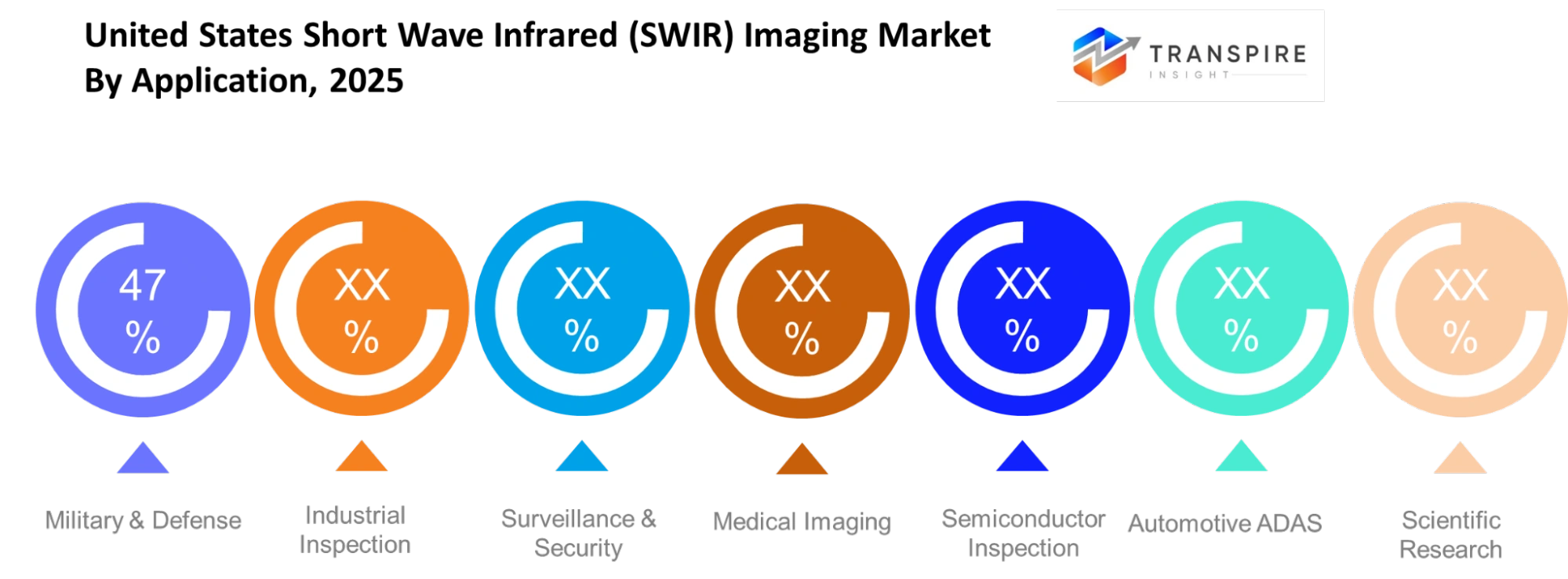
Application wise , semiconductor inspection still kind of owns the revenue stream, mainly because advanced wafer fabrication plus chip packaging setups need really precise imaging so microscopic defect rates stay low. Industrial inspection holds a solid market share too , since many manufacturers are pushing automation for quality control across battery production , electronics assembly, and even food processing tasks. Surveillance and security kept climbing as defense agencies put more money into low visibility imaging systems, for border monitoring , unmanned aerial platforms, and nighttime reconnaissance . Medical imaging has gained momentum through research funding aimed at non invasive tissue visualization and diagnostic imaging methods.
Automotive ADAS moved faster when electric vehicle makers adopted SWIR imaging for pedestrian detection, and for better visibility when it’s foggy, smoky, or just low light. On the research side, scientific institutions keep the demand steady with spectroscopy and materials analysis programs. Looking ahead, growth will probably drift toward multi industry deployment models where one imaging platform kind of does industrial automation, predictive maintenance, autonomous navigation, and advanced analytics all at once .
To learn more about this report, Download Free Sample Report
What are the Key Use Cases Driving the United States Short Wave Infrared (SWIR) Imaging Market?
Semiconductor inspection still seems like the main thing that drives adoption, because SWIR imaging kinda pinpoints microcracks, grime or contamination, plus wafer defects that visible-light setups often miss , or at least do not catch well enough. More and more domestic chip fabrication lines are leaning on SWIR platforms to tighten yield consistency and lower production scrap especially across advanced packaging workflows.
On another front industrial automation and defense surveillance are slowly gaining steam in electronics manufacturing and aerospace. Battery makers, like companies using SWIR setups, do this to catch thermal anomalies while they’re still doing lithium-ion cell production. Meanwhile, defense agencies deploy low-visibility imaging, for border monitoring along with unmanned aerial surveillance duties, where there’s a need for better detection at range .
Then there are the newer directions, like medical diagnostics and autonomous mobility. Research institutions are looking at SWIR imaging for non invasive tissue visualization, and automotive engineers are testing SWIR-enabled driver assistance, mainly for safer navigation in fog, smoke, and night-time driving.
|
Report Metrics |
Details |
|
Market size value in 2025 |
USD 225.67 Million |
|
Market size value in 2026 |
USD 249.59 Million |
|
Revenue forecast in 2033 |
USD 505.36 Million |
|
Growth rate |
CAGR of 10.60% from 2026 to 2033 |
|
Base year |
2025 |
|
Historical data |
2021 - 2024 |
|
Forecast period |
2026 - 2033 |
|
Report coverage |
Revenue forecast, competitive landscape, growth factors, and trends |
|
Geographic scope |
United States of America |
|
Key company profiled |
Teledyne FLIR, Hamamatsu Photonics, Collins Aerospace, Leonardo DRS, Allied Vision, Sensors Unlimited, New Imaging Technologies |
|
Customization scope |
Free report customization (country, regional & segment scope). Avail customized purchase options to meet your exact research needs. |
|
Report Segmentation |
By Component (SWIR Cameras, SWIR Sensors, SWIR Lenses, Frame Grabbers, Illumination Systems, Software Solutions, Accessories), By Technology (Cooled SWIR, Uncooled SWIR, InGaAs Technology, Mercury Cadmium Telluride, Quantum Dot Sensors, CMOS-based SWIR, Hyperspectral Imaging), By Application (Industrial Inspection, Surveillance & Security, Military & Defense, Medical Imaging, Semiconductor Inspection, Automotive ADAS, Scientific Research) |
Which Regions are Driving the United States Short Wave Infrared (SWIR) Imaging Market Growth?
The Western United States kind of leads the SWIR imaging market, because the region blends semiconductor manufacturing density, aerospace and defense spending, and more advanced research infrastructure within the same industrial corridor, kind of all together. States like California and Arizona have major wafer fabrication sites, people who develop optical technologies, and defense contractors that keep putting money into high precision inspection systems. After 2022, federal semiconductor incentives and military modernization programs made regional procurement activity stronger, you could say. There is also this maturing ecosystem of photonics suppliers, AI software developers, and automation integrators that keeps the long run leadership going, and it also helps speed up commercialization of the next generation imaging technologies.
The Northeastern United States brings in fairly stable market revenue thanks to strong research funding, medical imaging development, and well established industrial automation networks. Compared with the Western area, the Northeast growth depends less on large scale chip fabrication and more on scientific instrumentation, defense laboratories, and healthcare innovation programs. Universities, defense agencies, and advanced manufacturing firms keep investment cycles going in a consistent way. That reduces the exposure to short term industrial volatility, which helps a lot. As a result, SWIR systems are getting purchased pretty steadily for biomed imaging, spectroscopy, and those sort of precision measurement uses.
The Southern United States has the strongest growth momentum , kind of, from a mix of expanding electronics manufacturing , automotive battery investments, and upgrades to regional defense infrastructure. Texas along with nearby states pulled in major production facilities after supply chain disruptions pushed firms toward domestic industrial reshoring and broader logistics diversification. On top of that, state-level incentives plus lower operating costs helped speed up factory construction, and also machine vision deployment during 2023 to 2025. This regional expansion is making real opportunities for imaging suppliers, AI integration companies, and component manufacturers that want stable industrial contracts across the 2026–2033 window.
Who are the Key Players in the United States Short Wave Infrared (SWIR) Imaging Market and How Do They Compete?
The competitive landscape in the United States Short Wave Infrared (SWIR) Imaging Market still looks kind of moderately consolidated, but the competition isn’t really just “who’s cheaper,” it’s more like sensor performance, how well the AI is actually integrated, and how much application specific customization can be done, even when budgets get tight. Big established photonics and defense technology firms keep holding on to their market share through long term government contracts, proprietary detector technologies, and vertically integrated manufacturing yes, that combo again and again. Meanwhile some specialized imaging startups and also machine vision software companies are nudging into parts of the industrial inspection segment, by shipping compact lower-cost SWIR platforms made for automation environments. And buyers, they keep getting pickier, they increasingly judge vendors by software interoperability, real-time analytics, and integration support rather than just staring at standalone imaging hardware specs.
Teledyne Technologies stands out, mostly because it leans on high-performance InGaAs sensor engineering, plus integrated machine vision solutions that are tailored for semiconductor and aerospace inspection use cases. They keep pushing forward with acquisitions and AI enabled imaging software work, which helps strengthen automated defect analysis capabilities, in a way that’s easy to deploy and measure. Hamamatsu Photonics competes with detector sensitivity and precision photonics know-how, especially for scientific imaging and medical research applications where low-noise accuracy is basically non negotiable.They also bank on strategic partnerships with research institutions, and semiconductor equipment manufacturers so they can more deeply get into advanced lab setups, and wafer inspection environments sometimes.
Leonardo DRS concentrates on military-grade SWIR imaging setups, tuned for surveillance, aiming, and low visibility recon missions, kind of like that. Their defense certification background, plus the ability to integrate across airframes as well as unmanned platforms gives them a pretty clear advantage during government procurement cycles. Allied Vision Technologies instead leans on industrial automation, providing compact SWIR cameras that fit well with AI oriented inspection workflows and the broader factory automation networks, yes. Meanwhile Sensors Unlimited keeps a tight specialization in ruggedized imaging systems for rough operational situations. That matters especially across aerospace and defense monitoring spaces, where dependability in extreme visibility constraints stays essential, even when it gets messy.
Company List
- Teledyne FLIR
- Hamamatsu Photonics
- Collins Aerospace
- Leonardo DRS
- Allied Vision
- Sensors Unlimited
- New Imaging Technologies
Recent Development News
In February 2026, Specim Unveils FX19 NIR-SWIR Hyperspectral Camera for Machine Vision: Specim, a Konica Minolta company, launched the FX19 hyperspectral camera operating in the NIR-SWIR range for industrial inspection and machine-vision applications. The product expansion reflects rising demand in the United States for faster material identification and automated quality-control systems.
Source: https://metrology.news
In January 2026, New Imaging Technologies Introduces LiSa SWIR 2048R Camera at Photonics West 2026: New Imaging Technologies announced the LiSa SWIR 2048R M-STE2 rectangular-pixel SWIR camera during SPIE Photonics West 2026 in San Francisco. The launch demonstrates continued innovation in high-resolution SWIR imaging systems targeting U.S. industrial and defense applications.
Source: https://new-imaging-technologies.com
What Strategic Insights Define the Future of the United States Short Wave Infrared (SWIR) Imaging Market?
The United States Short Wave Infrared (SWIR) Imaging Market is, kind of, moving away from just separate cameras and toward fully integrated AI enabled imaging ecosystems that are embedded into semiconductor manufacturing defense platforms and also autonomous industrial systems. Over the next 5–7 years, growth will be shaped a lot less by standalone camera sales, more by the pull for end to end inspection intelligence that fuses SWIR sensors with edge computing and predictive analytics. This change is basically pushed by tougher defect tolerance thresholds in advanced chip fabrication, and by the growing reliance on automated quality assurance inside high value production environments.
There’s also a risk that is not immediately obvious, and it comes from supply chain concentration in indium gallium arsenide sensor materials, where limited global upstream capacity could spark pricing volatility and limit broader scale adoption even while demand keeps rising. Meanwhile there’s an opportunity brewing too: hyperspectral CMOS SWIR convergence, which looks promising especially as semiconductor equipment manufacturers in Arizona and Texas start testing hybrid imaging architectures for next generation process control.
So market participants should probably focus on vertical integration of the hardware and the AI software stacks, so they can reduce dependence on outside analytics providers, and lock in longer term contract positions with semiconductor and defense end users.
United States Short Wave Infrared (SWIR) Imaging Market Report Segmentation
By Component
- SWIR Cameras
- SWIR Sensors
- SWIR Lenses
- Frame Grabbers
- Illumination Systems
- Software Solutions
- Accessories
By Technology
- Cooled SWIR
- Uncooled SWIR
- InGaAs Technology
- Mercury Cadmium Telluride
- Quantum Dot Sensors
- CMOS-based SWIR
- Hyperspectral Imaging
By Application
- Industrial Inspection
- Surveillance & Security
- Military & Defense
- Medical Imaging
- Semiconductor Inspection
- Automotive ADAS
- Scientific Research
Frequently Asked Questions
Find quick answers to common questions.
The approximate United States Short Wave Infrared (SWIR) Imaging Market size for the market will be USD 505.36 Million in 2033.
The key segments of the United States Short Wave Infrared (SWIR) Imaging Market are By Component (SWIR Cameras, SWIR Sensors, SWIR Lenses, Frame Grabbers, Illumination Systems, Software Solutions, Accessories), By Technology (Cooled SWIR, Uncooled SWIR, InGaAs Technology, Mercury Cadmium Telluride, Quantum Dot Sensors, CMOS-based SWIR, Hyperspectral Imaging), By Application (Industrial Inspection, Surveillance & Security, Military & Defense, Medical Imaging, Semiconductor Inspection, Automotive ADAS, Scientific Research).
Major players in the United States Short Wave Infrared (SWIR) Imaging Market are Teledyne FLIR, Hamamatsu Photonics, Collins Aerospace, Leonardo DRS, Allied Vision, Sensors Unlimited, New Imaging Technologies.
The current market size of the United States Short Wave Infrared (SWIR) Imaging Market is USD 225.67 Million in 2025.
The United States Short Wave Infrared (SWIR) Imaging Market CAGR is 10.60%.
- Teledyne FLIR
- Hamamatsu Photonics
- Collins Aerospace
- Leonardo DRS
- Allied Vision
- Sensors Unlimited
- New Imaging Technologies
Recently Published Reports
-
Apr 2026
Fiber Optic Faceplates Market
Fiber Optic Faceplates Market Size, Share & Analysis Report By Type (< 300 mm2, 300-350 mm2, and > 350 mm2, By Application (Night Vision, Holographic Imaging, Medical, and Others), and Geography (North America, Europe, Asia-Pacific, Middle East and Africa, South and Central America), 2021 - 2031
-
Apr 2026
High Temperature Superconductors Market
High Temperature Superconductors Market Size, Share & Analysis Report By Type (1G HTS, and 2G HTS), By Application (Power Cable, Fault Current Limiter, and Transformer), and Geography (North America, Europe, Asia-Pacific, Middle East and Africa, South and Central America), 2021 - 2031
-
Apr 2026
Industrial Plugs and Socket Market
Industrial Plugs and Socket Market Size, Share & Analysis Report By Type (Industrial Plugs, Industrial Sockets), By Current (Up to 32 A, 32 to 125 A, Above 125 A), By Protection (Dustproof and Splash Proof, Waterproof, Explosion Proof), By End User (Heavy Industries, Oil and Gas, Chemicals and Pharmaceuticals, Power Generation, Others), and Geography (North America, Europe, Asia-Pacific, Middle East and Africa, South and Central America), 2021 - 2031
-
Apr 2026
InGaAs Avalanche Photodiodes Market
InGaAs Avalanche Photodiodes Market Size, Share & Analysis Report By Type (1100 - 1700 nm, and 1000 - 1600 nm), By Application (Missile Warning System, Muzzle Flash Detection, Wafer Defect Inspection, Laser Rangefinders, and Others), and Geography (North America, Europe, Asia-Pacific, Middle East and Africa, South and Central America), 2021 - 2031