

Germany Agricultural Micronutrients Market Size & Forecast:
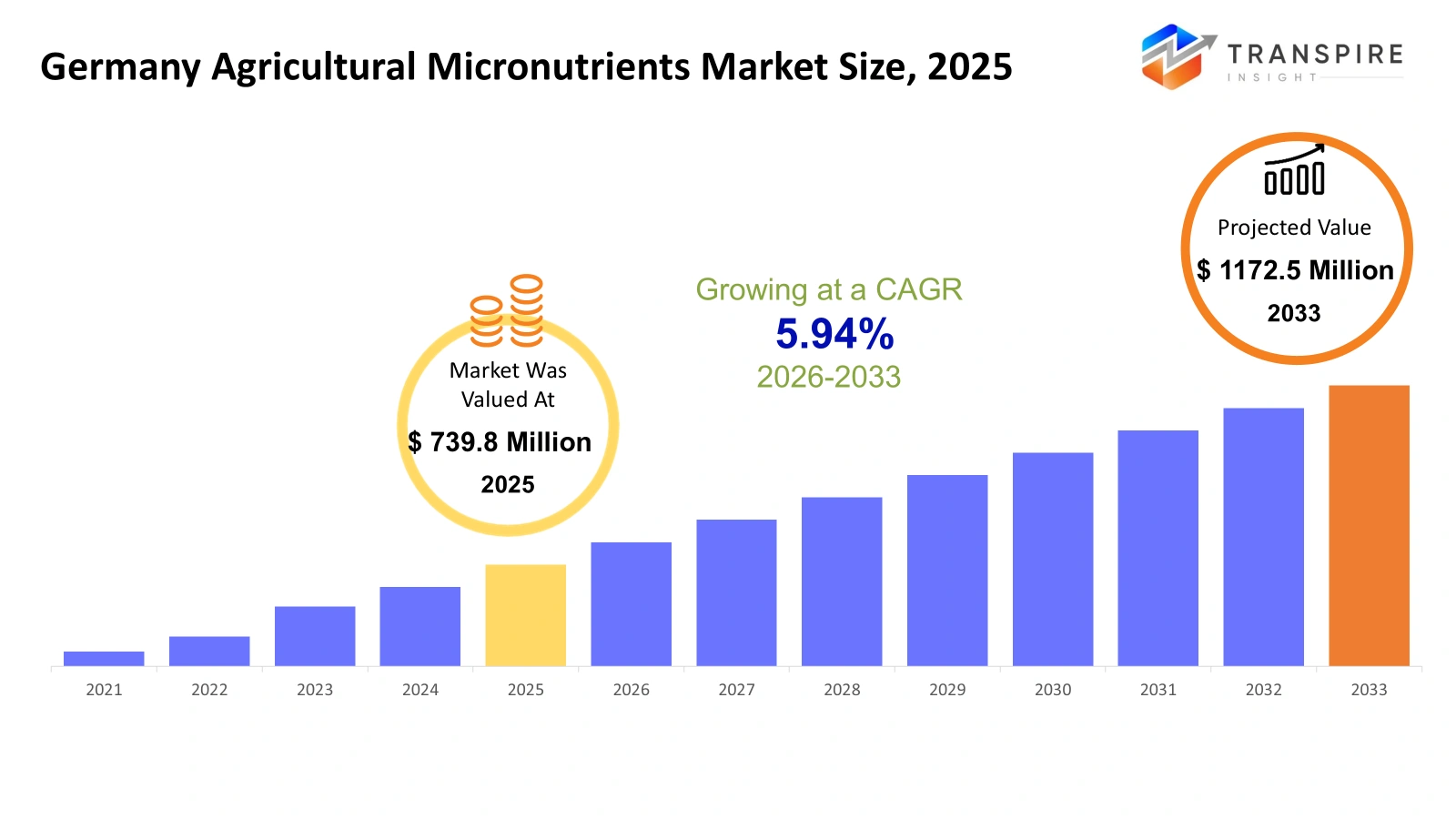
- Germany Agricultural Micronutrients Market Size 2025: USD 739.8 Million
- Germany Agricultural Micronutrients Market Size 2033: USD 1172.5 Million
- Germany Agricultural Micronutrients Market CAGR: 5.94%
- Germany Agricultural Micronutrients Market Segments: ByType (Chelated Micronutrients, Non-Chelated Micronutrients), By Application (Fruits & Vegetables, Cereals & Grains, Oilseeds), By Distribution Channel (Direct Sales, Distributors, Online)
To learn more about this report,  Download Free Sample Report
Germany Agricultural Micronutrients Market Summary:
The Germany Agricultural Micronutrients Market size is estimated at USD 739.8 Million in 2025 and is anticipated to reach USD 1172.5 Million by 2033, growing at a CAGR of 5.94% from 2026 to 2033. The Germany agricultural micronutrients market operates within the country's advanced agricultural input market. The market exists because farmers use precision nutrition methods to cultivate their crops. German growers will continue shifting toward balanced soil management as intensive cultivation and climate variability influence nutrient availability. Modern farming software and satellite mapping technology together with sensor-based soil diagnostics will help farmers apply micronutrients to their grain and vegetable and specialty crop fields with improved precision. Sustainable food production practices will become necessary for producers who want to meet consumer expectations because these practices safeguard soil health and enable consistent crop production. The development of product formulations will be influenced by regulations that require fertilizer products to demonstrate both efficient performance and safe environmental practices. Manufacturers will introduce chelated nutrients and controlled-release blends along with bio-compatible solutions which will be developed to meet the requirements of Germany's high-efficiency farming systems.
Key Market Trends & Insights:
The Germany agricultural micronutrients market will experience changes because farmers use more precision agriculture tools which lead to different soil management approaches. Digital soil testing platforms and satellite-guided nutrient mapping will help growers apply micronutrients more accurately, which reduces waste while improving crop nutrient balance for cereals, oilseeds, and high-value horticultural crops.
German farms will change their micronutrient application methods because consumers demand food products that contain no residues and come from sustainable production methods. Growers supplying supermarkets and organic food processors will adopt carefully balanced micronutrient programs that support plant health without excessive fertilizer application. The new requirement will lead suppliers to create nutrient products that meet environmental standards.
Fertilizer manufacturing technology will gradually change product development throughout the Germany agricultural micronutrients market. Chelated micronutrients and advanced foliar spray formulations will allow faster nutrient absorption and improved stability in varying soil conditions. Companies will work to build better efficiency systems which also need to work with today's irrigation and spraying technologies.
European regulatory frameworks on nutrient management will continue to steer product development and market operations. Environmental policies which promote proper fertilizer application will drive producers to improve their application methods. Manufacturers will create trace element mixes that enable lower application rates while sustaining agricultural output in Germany's various farming areas.
Germany Agricultural Micronutrients Market Segmentation
By Type
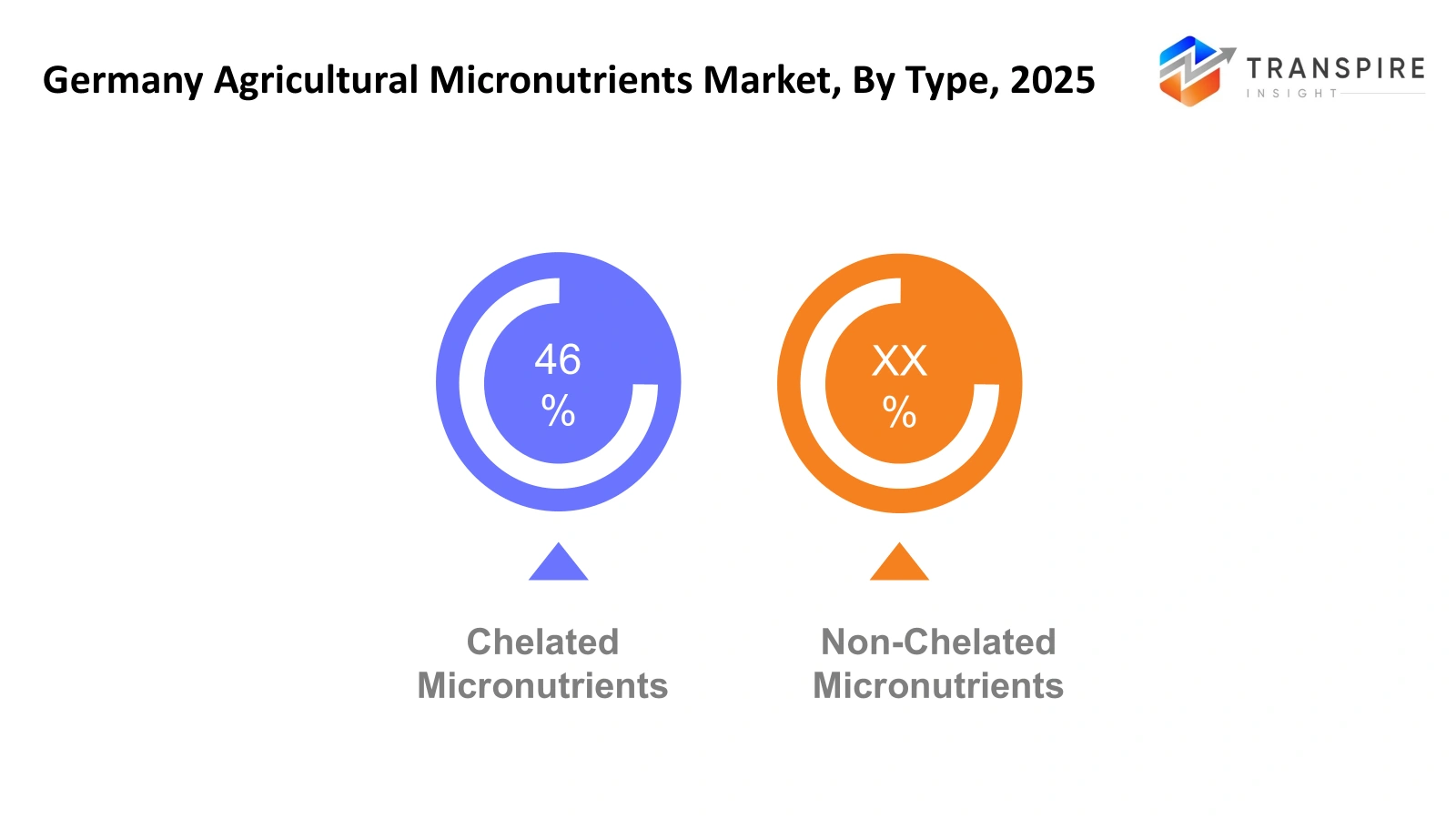
Chelated Micronutrients-German farmers will pay close attention to chelated micronutrients because these substances help maintain stable nutrients which plants can easily absorb. The formulations protect trace elements from soil reactions which enable crops to absorb zinc and iron and manganese under conditions of intensive agriculture.
Non-Chelated Micronutrients- Farmers will continue using non-chelated micronutrients because these products offer lower costs and work effectively with standard fertilizer methods. The large-scale cereal and grain producers will select these products for their extensive farmland which has soil conditions that support efficient nutrient absorption.
To learn more about this report, Download Free Sample Report
By Application
Fruits & Vegetables-The balanced application of micronutrients will become essential for Germany's fruit and vegetable farming industry. The growers will use trace nutrients to develop stronger plants which produce better fruits and resist diseases while keeping their productivity levels in both greenhouse and open-field horticulture.
Cereals & Grains-Cereal and grain farms will use micronutrients to keep their soil fertility levels intact while sustaining consistent crop yields. The application of zinc and boron and iron supplements will help establish grain production and support plant metabolic processes especially in regions that have lost nutrients through ongoing farming practices.
Oilseeds- The management of specific micronutrients will be essential for oilseed crops such as rapeseed to achieve optimal seed quality and oil production. Farmers will apply boron and molybdenum with their fertilizer programs to enhance their crops during the flowering period while building resistance.
By Distribution Channel
Direct Sales-Direct sales channels will remain important as fertilizer manufacturers continue their partnerships with major agricultural producers and cooperatives. The method enables personalized nutrient solutions to be developed through field tests which scientists provide technical support based on actual soil conditions.
Distributors-Micronutrient products will be distributed to regional farms through agricultural distributors who act as essential links in the supply chain. Farmers will obtain access to specialized fertilizer inputs through local dealers who offer product availability information and agronomic guidance and seasonal supply planning services.
Online-German farmers will begin using digital procurement systems which will lead to the expansion of online agricultural input platforms throughout the country. The platforms will enable users to compare products instantly while displaying actual prices and facilitating straightforward ordering of micronutrient fertilizers that come with digital agronomy recommendations.
Country Insights
Germany's agricultural system will keep prioritizing soil preservation together with effective nutrient control methods. Farmers have started to understand that providing proper amounts of micronutrients results in dependable crop output together with uniform crop quality. Agricultural advisors and cooperatives across the country will promote soil testing programs, encouraging growers to adjust micronutrient inputs according to regional soil composition and crop requirements.
Nutrient availability across various German agricultural areas will become affected by the changing climate. Soil nutrient movement will experience changes because of irregular rainfall patterns together with different seasonal temperature conditions. Farmers will use precise nutrient distribution methods through foliar feeding and specialized equipment to provide targeted micronutrient applications, which will help their crops maintain nutrient equilibrium during crucial growth periods.
Nutrient management practices will receive their main direction from government policies that support sustainable agricultural methods. Environmental regulations will encourage careful fertilizer use while protecting soil ecosystems. German agricultural institutions and research centers will collaborate with fertilizer producers to develop solutions that maintain productivity while aligning with national sustainability goals and European environmental standards.
German farms will experience increased technological adoption which will enhance the significance of micronutrient planning. Digital farm management platforms and satellite-supported soil mapping will guide nutrient decisions. Farmers will increasingly rely on data-driven recommendations to determine micronutrient timing and dosage, which will enhance their operational efficiency while maintaining their soil fertility for the future.
Recent Development News
The report about the Agricultural Micronutrients Market shows that it will take up more space because of the new size estimation- The worldwide agricultural micronutrients market will keep growing according to industry forecasts. The development of specialty foliar sprays and controlled-release micronutrient blends together with customized crop nutrition programs will enable farmers to achieve better nutrient uptake while solving their soil deficiency problems.
Germany Leads Europe in Soil Nutrient Strategy- Germany maintained a leading position within the broader European agricultural micronutrients market, holding nearly one-fifth of regional share thanks to rigorous soil testing requirements and advanced nutrient management practices. The country’s regulatory emphasis on soil quality and balanced fertilization will continue influencing micronutrient application patterns.
|
Report Metrics |
Details |
|
Market size value in 2025 |
USD 739.8 Million |
|
Market size value in 2026 |
USD 783.1 Million |
|
Revenue forecast in 2033 |
USD 1172.5 Million |
|
Growth rate |
CAGR of 5.94% from 2026 to 2033 |
|
Base year |
2025 |
|
Historical data |
2021 – 2024 |
|
Forecast period |
2026 – 2033 |
|
Report coverage |
Revenue forecast, competitive landscape, growth factors, and trends |
|
Country scope |
Germany |
|
Key company profiled |
BASF SE, Yara International, Syngenta, Nutrien Ltd., Mosaic Company, Haifa Group, ADAMA Ltd., Valagro S.p.A, Coromandel International, UPL Ltd., Kingenta Ecological Engineering, Sipcam Oxon, Helena Chemical Company, K+S AG. |
|
Customization scope |
Free report customization (country, regional & segment scope). Avail customized purchase options to meet your exact research needs. |
|
Report Segmentation |
By Type (Chelated Micronutrients, Non-Chelated Micronutrients), By Application (Fruits & Vegetables, Cereals & Grains, Oilseeds), By Distribution Channel (Direct Sales, Distributors, Online) |
Key Germany Agricultural Micronutrients Market Insights
The Germany agricultural micronutrients market will maintain its current alignment with the country's agricultural practices and its focus on soil productivity. Farmers will increasingly integrate micronutrient planning into crop management to maintain soil productivity and crop quality. German agricultural regions will develop their micronutrient selection methods and application processes and management systems through precision agriculture tools and research-based nutrient programs and sustainable fertilizer methods.
Company List
- BASF SE
- Yara International
- Syngenta
- Nutrien Ltd.
- Mosaic Company
- Haifa Group
- ADAMA Ltd.
- Valagro S.p.A
- Coromandel International
- UPL Ltd.
- Kingenta Ecological Engineering
- Sipcam Oxon
- Helena Chemical Company
- K+S AG
Germany Agricultural Micronutrients Market Report Segmentation
By Type
- Chelated Micronutrients
- Non-Chelated Micronutrients
By Application
- Fruits & Vegetables
- Cereals & Grains
- Oilseeds
By Distribution Channel
- Direct Sales
- Distributors
- Online
Frequently Asked Questions
Find quick answers to common questions.
The approximate Germany Agricultural Micronutrients Market size for the market will be USD 1172.5 Million in 2033.
Key segments for the Germany Agricultural Micronutrients Market By Type (Chelated Micronutrients, Non-Chelated Micronutrients), By Application (Fruits & Vegetables, Cereals & Grains, Oilseeds), By Distribution Channel (Direct Sales, Distributors, Online)
Major players in the Germany Agricultural Micronutrients Market are BASF SE, Yara International, Syngenta, Nutrien Ltd., Mosaic Company, Haifa Group, ADAMA Ltd., Valagro S.p.A, Coromandel International, UPL Ltd., Kingenta Ecological Engineering, Sipcam Oxon, Helena Chemical Company, K+S AG.
The Germany Agricultural Micronutrients Market size is USD 739.8 Million in 2025.
The Germany Agricultural Micronutrients Market CAGR is 5.94%.
- BASF SE
- Yara International
- Syngenta
- Nutrien Ltd.
- Mosaic Company
- Haifa Group
- ADAMA Ltd.
- Valagro S.p.A
- Coromandel International
- UPL Ltd.
- Kingenta Ecological Engineering
- Sipcam Oxon
- Helena Chemical Company
- K+S AG
Recently Published Reports
-
Apr 2026
Healthcare Polymer Packaging Market
Healthcare Polymer Packaging Market Size, Share & Analysis Report By Packaging Type (Syringes, IV Bottles and Pouches, Clamshells, Blisters, Bottles & Jars, Containers, Tubes, IV Parental Packaging, Others), By Type (Regulated, Non-regulated), By Polymer Type (LDPE (Low-Density Polyethylene), HDPE (High-Density Polyethylene), Homo-polymer (Homo), Random Copolymer (Random), Block Copolymer (Block), PET, Polystyrene, Polyvinyl Chloride, Polyamide/EVOH, Others), and Geography (North America, Europe, Asia-Pacific, Middle East and Africa, South and Central America), 2021 - 2031
-
Apr 2026
Hydrophilic Tape (Waterstop) Market
Hydrophilic Tape (Waterstop) Market Size, Share & Analysis Report By Type (Bentonite-Based Hydrophilic Tape, Rubber-Based Hydrophilic Tape), By Application (Residential Buildings, Commercial Buildings, Infrastructure Projects), and Geography (North America, Europe, Asia-Pacific, Middle East and Africa, South and Central America), 2021 - 2031
-
Apr 2026
Metalens Market
Metalens Market Size, Share & Analysis Report By Type (Visible Light Metalens, and Infrared Metalens), By Application (Consumer Electronics, Automotive Electronics, Industrial, Medical, and Others), and Geography (North America, Europe, Asia-Pacific, Middle East and Africa, South and Central America), 2021 - 2031
-
Apr 2026
PBT Resin Market
PBT Resin Market Size, Share & Analysis Report By Type (Reinforced PBT Resin, Unreinforced PBT Resin), By Processing Method (Injection Molding, Extrusion, Blow Molding, Others), By End-User (Automotive, Electrical & Electronics, Consumer Appliances, Industrial Machinery, Medical Devices, Packaging, Others), and Geography (North America, Europe, Asia-Pacific, Middle East and Africa, South and Central America), 2021 - 2031