
South Korea Stainless Steel Sheet Market Size & Forecast:
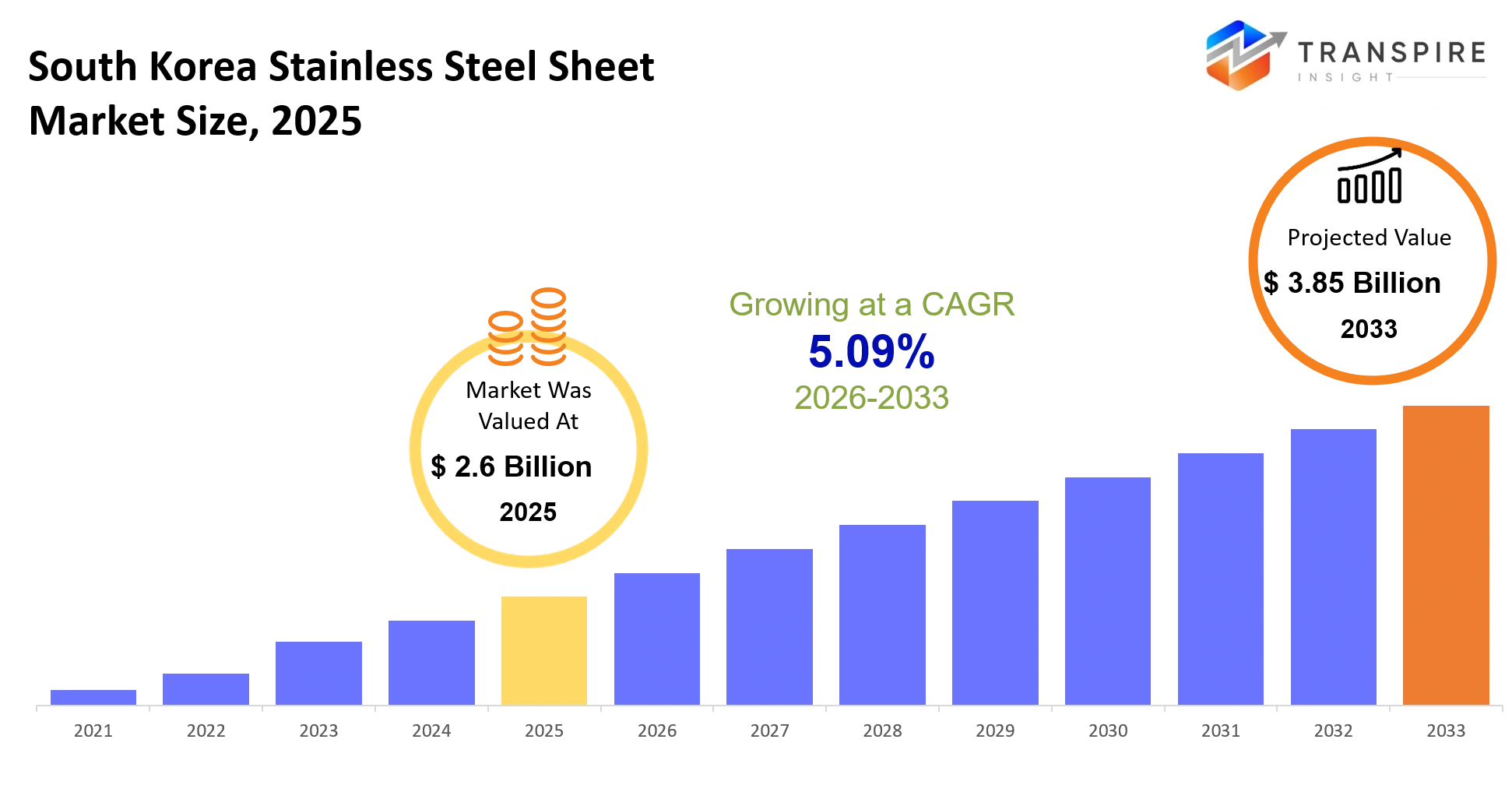
- South Korea Stainless Steel Sheet Market Size 2025: USD 2.6 Billion
- South Korea Stainless Steel Sheet Market Size 2033: USD 3.85 Billion
- South Korea Stainless Steel Sheet Market CAGR: 5.09%
- South Korea Stainless Steel Sheet Market Segments: By Grade (200 Series, 300 Series, 400 Series, Others); By Application (Construction, Automotive, Appliances, Industrial Equipment, Others); By Finish (Hot Rolled, Cold Rolled, Others)
South Korea Stainless Steel Sheet Market Summary
The South Korea Stainless Steel Sheet Market was valued at USD 2.6 Billion in 2025. It is forecast to reach USD 3.85 Billion by 2033. That is a CAGR of 5.09% over the period.
The stainless steel sheet market of South Korea is an essential bedrock to high value and long-lasting materials which are a must-have for sectors that depend on long service life, corrosion resistance, strength. Ships that navigate seas use stainless steel sheets to produce cargo tanks, exhaust systems and equipment on offshore platforms; manufacturers integrate them in manufacturing chips, batteries, food processing tools, and chemical factories, for which life of the material relates directly to the operational expense and safety of workers. The domestic market has gradually become a high-value, high-margin, specialized and a low-volume structure in recent years as market players move from mass producing to developing value added materials in alignment with innovative production sectors; this transformation is a direct result of disruptions of supply chains and wild commodity price swings that clearly define hazards of depending on imports and commodity. Investment into battery materials, semiconductor manufacturing facilities and environmentally friendly maritime industries is now becoming substantial; thus, high-margins of suppliers are increased, as a supplier's sales and value is now clearly correlated to market's modernization.
Key Market Insights
- The market share in south eastern South Korea dominates, by almost 60% share in 2025 due to compact stainless steel, shipbuilding, and manufacturing industries clusters in south eastern regions.
- The central region will emerge as the fastest growing region by 2032, fueled by investment in semiconductor fabrication and battery production.
- The industrialized region of Pohang and Gwangyang is still the most important industrial center for producing and exporting stainless steel sheets.
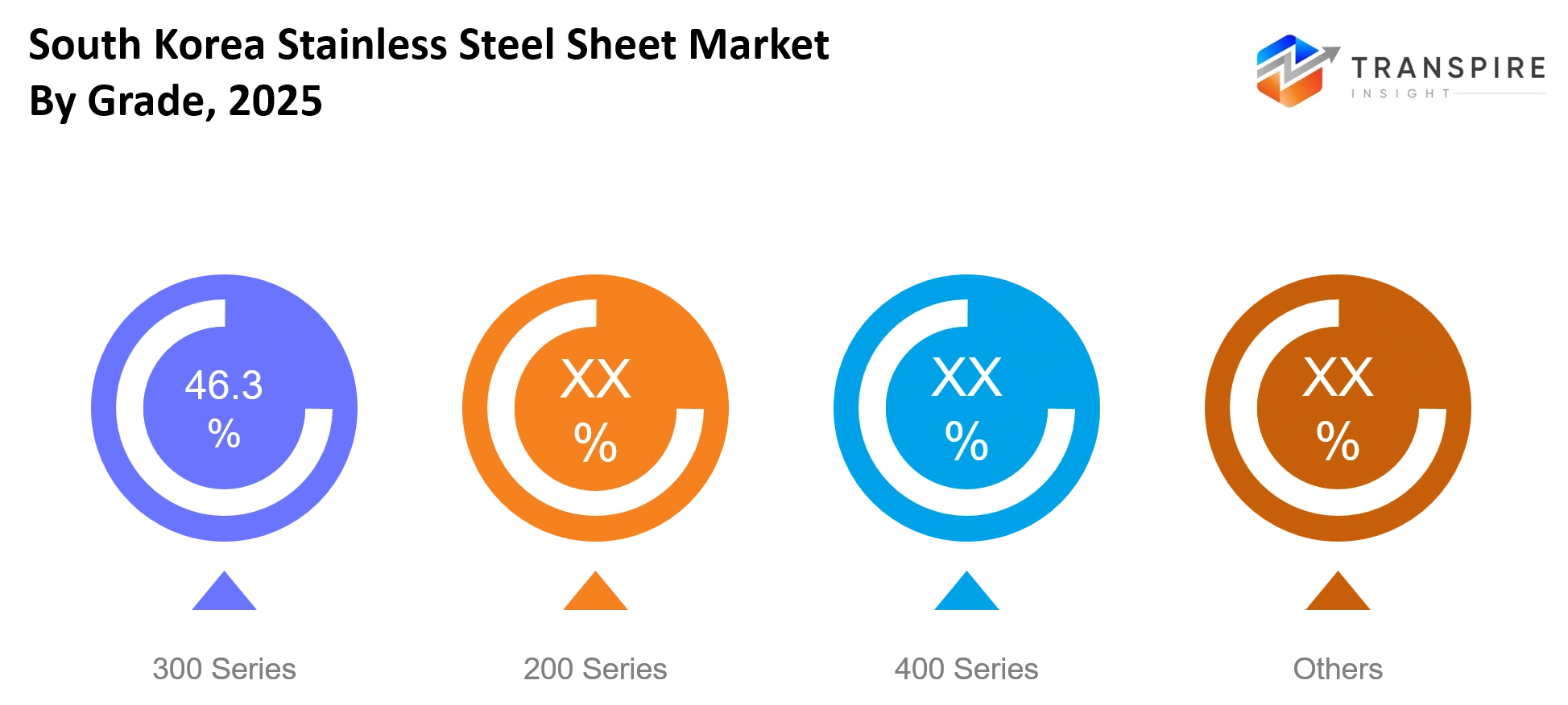
- Austenitic stainless steel holds the largest share in South Korea Stainless Steel Sheet Market by 65% of the market value, due to corrosion resistance and multiple uses.
- Ferritic stainless steel holds the second largest share as it holds competitive cost in automobile and home appliances application.
- The duplex stainless steel is growing the most in the segment by 2032 because of usage in offshore, chemical processing and energy industries projects.
- Industrial equipment applications hold more than 35% market share of this market, fueled by chemical processing and manufacturing industry growth.
- The rapidly developing application is battery manufacturing owing to South Korea expanding supply chains for EV and energy storage capacity.
- The manufacturing segment holds the largest share in the end-user category, holding close to 40% market share in 2025.
- The energy & advanced materials industry holds the fastest growing end-user category, fueled by investments in batteries, hydrogen and renewable infrastructure.
What are the Key Drivers, Restraints, and Opportunities in the South Korea Stainless Steel Sheet Market?
The growth drivers for the South Korea Stainless Steel Sheet Market are mainly centered on rapid expansion in manufacturing of batteries, semiconductors and advanced industrial machinery. High investment on battery production and chip manufacturing for EVs by the nation led to higher demand of corrosion resistant and high performance materials within the tightly regulated manufacturing environments, which is prompting companies to use high margin stainless grades, and supporting revenue growth and capacity expansion of producers.
The market’s heavy reliance on imported nickel and other alloying materials is the biggest restraining factor for the market. The price of nickel has remained quite volatile due to geopolitical issues and concentration of supply within a few countries. This is a long-term structural challenge that cannot be addressed overnight as it requires high investment and long lead times to set up alternate supply sources. This leads to compressed margins and procurement delay and fluctuating pricing across end use segments.
The potential opportunity lies within low-carbon stainless steel production. There is considerable investment happening in areas like EAFs, usage of recycled scrap, and hydrogen-based production of steel. Stainless sheet producers commercializing low-carbon products for batteries, renewable energy systems and green ship building can get good premium pricing and long term contracts with these developing industries.
What Has the Impact of Artificial Intelligence Been on the South Korea Stainless Steel Sheet Market?
The use of artificial intelligence in stainless steel sheet manufacturing is resulting in enhanced control, predictability of maintenance needs and optimization of manufacturing processes. Steel manufacturers are implementing AI-based monitoring systems to analyze parameters such as furnace temperatures, rolling pressures, and surface characteristics in real-time, automatically adjusting operating parameters. Such automated systems will result in less scrap and improved yield on manufacturing lines.
Machine learning is improving predictive maintenance. Analyzing such things as vibration and energy consumption and equipment wear, manufacturers can forecast equipment failure before production is halted. This leads to increased plant up time and reduced maintenance costs. AI-driven production planning can also lead to increased inventory management and raw material ordering flexibility to adapt to market nickel prices and incoming customer demand.
Enhanced digital twins will also be important to manufacturers. A digital twin is a simulated production line which manufacturers will use to predict the effects of changing parameters and alloying on the production line, prior to large-scale manufacturing. High costs of integration and incompatibility with old machinery, as well as small historical data sets, are among the limiting factors in using AI. Medium manufacturers do not have the cash flow for total digital transformation.
Key Market Trends
- Manufacturers began focusing on higher-end stainless grades since 2021. And the sales portion of high-value products exceeded half of the total industrial consumption in the country.
- Investments in battery and semiconductor plants, drastically changing sourcing practices as suppliers must now produce tailored corrosion resistant sheets instead of competing by scale.
- POSCO advanced its low-carbon steel initiatives after 2022, increasing scrap recycling usage and energy-efficient manufacturing due to stringent customer requirements on sustainability.
- The proportion of nickel in imported items reduced gradually as a variety of purchasing plans and long-term supply contracts are being introduced by steel makers to hedge against raw material price fluctuations.
- By 2020-2025 smart factory construction has grown rapidly as quality inspections based on AI reduce surface defects and increase production stability.
- The steel market of duplex or specialty stainless materials has grown as ship builders seek long-term use for its replacing of traditional products in offshore or marine applications.
- Instead of purchasing with price and schedule as main purchasing criteria, industrial buyers are looking at their suppliers' carbon footprint and stability of supply.
- The location of the smart factory cluster has shifted to the central part of South Korea from traditionally steel producing regions due to large-scale investment in battery and semiconductor plants.
- Competition in the steel industry heated up as Hyundai Steel, SeAH Steel and DKC continue to invest in specialty alloys, technology development and export-aiming product portfolios.
- The number of factories which adopted digital twins increased as manufacturers wanted a faster alloy development process and accurate and quick reply on customized requirements.
South Korea Stainless Steel Sheet Market Segmentation
By Grade:
These are generally most popular for lower cost, medium corrosive resistance applications. These are consumer goods, kitchen appliances and light industrial parts. The primary decision factor will be cost, as control is an issue. This type is most applicable where you have a cost vs. Performance ratio.
These are most popular due to their high corrosive resistance, longevity, and diverse applications. These sheets are used for construction applications, industrial machinery, food and beverage industry machinery and parts and automotive. The steady consumption is a fact, and reliance upon a good working performance ensures a high demand.
These offer excellent strength, wear resistance, and magnetic qualities. These parts are generally used in automotive exhaust systems, appliances and various industrial applications that have hardness and durability. The category, 'Others', covers specialized grades that have been designed for extreme environments.
By Application:
Another key application sector for stainless steel sheets is the construction sector where they are utilized in facade construction, structural elements, roofing and in internal installations. The corrosion resistance and longevity will require a reduced maintenance and maintenance cost along with a support to contemporary designs for both commercial and domestic use.
The car industry also makes use of stainless steel sheets in manufacturing of its parts like exhaust components, structural parts and even in ornamental purposes. In the appliances manufacturing section there is significant use of stainless steel sheets in the manufacture of refrigerators, washing machines, ovens, and kitchen apparatus etc. Strength of the material, its appeal and ability to resist moisture make them desirable in this sector for manufacturing longer-lasting products.
Industrial equipment makes for another large sector where Stainless steel sheets are heavily used for various uses in machinery, processes, storing devices and processing equipment/plant. The sector under Others encompass the hospital equipment, energy sector, and specialist engineering applications where robustness and resistance to harsh conditions is always required.
By Finish:
Hot rolled stainless steel sheets: produced by high temperature rolling. The hot rolled stainless steel sheets have good mechanical properties, high cost effectiveness and widely used in structural construction, machinery, construction machines and heavy machines as the required to finish are of no concern to appearance.
Cold rolled stainless steel sheets: The hot rolled stainless steel sheets will be further processed to get the high surface quality and dimension accuracy. It is still popular for automobile production, appliance and electrical instruments as well as architecture usage when the appearance is required for value add of product.
The others: the specific surface treatment in accordance with customer special needs. Support decorative and technology applications and the other specialty processes for enhancement texture, reflection or special function property requirements for specific end users.
What are the Key Use Cases Driving the South Korea Stainless Steel Sheet Market?
The predominant application for industrial equipment remains the number one market due to the necessity of having a corrosion and chemical resistant and temperature stable material for manufacturing facilities. Processing plants, storage devices, and heavy duty machines, rely on stainless steel sheets for efficient functionality and a longer operating life with decreased costs for maintenance.
Steady growth is seen in the construction and automotive sectors. The construction industry has started utilizing stainless steel sheets for facades, roofs, and internal structures, for increased durability and aesthetic value for commercial structures. The automobile industry, in turn, continues to move to higher grade steel for better durability in various systems such as exhaust manifolds and electric vehicle parts.
The market for new applications, such as for batteries and semiconductor factories, is now being developed. This high level of industrial machinery used to produce storage for energy devices needs durable equipment for stringent manufacturing environments. The increased investment for modern manufacturing equipment should contribute to growth in specialized stainless steel sheets markets for the duration of the forecast period.
|
Report Metrics |
Details |
|
Market size value in 2025 |
USD 2.6 Billion |
|
Market size value in 2026 |
USD 2.72 Billion |
|
Revenue forecast in 2033 |
USD 3.85 Billion |
|
Growth rate |
CAGR of 5.09% from 2026 to 2033 |
|
Base year |
2025 |
|
Historical data |
2021 - 2024 |
|
Forecast period |
2026 - 2033 |
|
Report coverage |
Revenue forecast, competitive landscape, growth factors, and trends |
|
Country scope |
South Korea |
|
Key company profiled |
POSCO, Hyundai Steel, Nippon Steel, JFE Steel, Outokumpu, Acerinox, Aperam, ArcelorMittal, Baosteel, Tsingshan, AK Steel, Yieh Corp, NSSMC, Sandmeyer Steel, Thyssenkrupp |
|
Customization scope |
Free report customization (country, regional & segment scope). Avail customized purchase options to meet your exact research needs. |
|
Report Segmentation |
By Grade (200 Series, 300 Series, 400 Series, Others); By Application (Construction, Automotive, Appliances, Industrial Equipment, Others); By Finish (Hot Rolled, Cold Rolled, Others) |
Which Regions are Driving the South Korea Stainless Steel Sheet Market Growth?
The southeastern region of the country is still the main center of production and consumption for stainless steel sheets in South Korea. Integrated steel mills of large scale are located in Pohang and Gwangyang, which have sophisticated port facilities and well-developed infrastructure contributing to effective production and exports. The constant government support for upgrades in advanced manufacturing and logistics has improved the region’s standing in the last ten years. The established networks between steel producers, shipbuilding firms, machinery manufacturing enterprises and component manufacturers provide the synergistic effect required to maintain its market leadership.
The central region is the second most significant market in terms of contributions to the total market although the driving forces behind its market expansion greatly differ from those in the southeast region. Instead of relying on the heavy industry segment for its market growth, the region leverages expanded manufacturing sites for semiconductors fabrication, battery production, electronics production, etc. Stable flows of investment along with availability of skilled workers and an adequate supply chain are among the factors rendering the region's market demand resilient to raw materials price fluctuations. The constant growth of the industrial structure enables the region to establish sustained demand across a variety of premium manufacturing industries.
The metropolitan area along with the nearby western areas represent the strongest growth dynamics. Investments in clean energy projects, advanced industrial parks, and next generation manufacturing technologies have brought about the new market outlook. Companies are beginning to establish processing facilities and distribution centers closer to industrial cluster points to facilitate faster delivery and enhance customer service. This growth trajectory will likely create an attractive investment destination for manufacturers, processors, and investors looking for exposure to premium stainless steel applications during the forecast period of 2026-2033.
Who are the Key Players in the South Korea Stainless Steel Sheet Market and How Do They Compete?
The competitive structure of the South Korean Stainless Steel Sheet market continues to be moderately consolidated. Most of the Korean stainless steel sheet production capacity is concentrated among several key manufacturers, while niche segments are served by specialized producers. The focus has shifted to factors beyond price, including the capability to deliver high grades, product quality and technological advancements. Larger manufacturers are likely to continue expanding investments into high-tech production systems and higher value-added products, due to the higher specifications required by industries.
POSCO will compete by further diversifying its portfolio and expanding investment in smart manufacturing technologies. High capabilities for premium grades of stainless steel, production capacity of battery materials and a focus on producing low-carbon steels enable the company to gain a competitive advantage from competitors. Hyundai Steel focuses on integrating its manufacturing operations with strong partnerships and customer relations among automobile and industry sectors. This would allow them to quickly respond to market and client demands and efficiently manage the supply chain.
SeAH Steel focuses on its ability to compete with specialty and value-added processed steels to be applied for industrial uses that require high specification and reliability. DKC Co., Ltd., expands market penetration by developing highly customized solutions for customers demanding high-specification of stainless steels. Investment to upgrade its technological level of the manufacturing lines and enhance manufacturing productivity and downstream collaboration are crucial parts of growth strategy, transcending from traditional volume-oriented competition.
Company List
- POSCO
- Hyundai Steel
- Nippon Steel
- JFE Steel
- Outokumpu
- Acerinox
- Aperam
- ArcelorMittal
- Baosteel
- Tsingshan
- AK Steel
- Yieh Corp
- NSSMC
- Sandmeyer Steel
- Thyssenkrupp
Recent Development News
In April 2026, POSCO and JSW Steel secured a joint venture agreement to build a 6 million tonne per year integrated steel plant in India. The 50:50 partnership will expand POSCO's access to high-growth Asian steel markets and strengthen capabilities in high-grade flat steel products used in automotive and industrial applications. Sourcehttps://newsroom.posco.com/
In January 2026, Hyundai Steel announced a capital increase of USD 2.9 billion through Hyundai-POSCO Louisiana LLC for investment in a new steel plant in the United States. The project supports production expansion outside South Korea and will strengthen supply capacity for automotive and premium steel products in North America. Sourcehttps://www.reuters.com/
What Strategic Insights Define the Future of the South Korea Stainless Steel Sheet Market?
Over the next 5-7 years, the South Korean stainless steel sheet market will gradually develop a more specialized and tech-oriented market structure. Growth will gradually shift from volumes-driven markets to premium stainless grades for battery, semiconductor, hydrogen infrastructure and sophisticated industrial machines applications driven by industrial policy, strategic industry investment and customer demands for higher performance and lower-carbon materials. However, the unseen risk is the raw material concentration risk.
Over-reliance on the imported nickel and chromium will make it vulnerable to supply disruption and fluctuating prices. A positive development in low carbon steel production driven by recycled materials and electric arc furnaces is being born. Early investment in sustainable production technologies and long term raw material purchasing arrangements is strongly advised as future competence will be equally valued by supply dependability and manufacturing scale.
South Korea Stainless Steel Sheet Market Report Segmentation
By Grade
- 200 Series
- 300 Series
- 400 Series
By Application
- Construction
- Automotive
- Appliances
- Industrial Equipment
By Finish
- Hot Rolled
- Cold Rolled
Frequently Asked Questions
Find quick answers to common questions.
The South Korea Stainless Steel Sheet Market size is USD 3.85 Billion in 2033.
Key segments for the South Korea Stainless Steel Sheet Market are By Grade (200 Series, 300 Series, 400 Series, Others); By Application (Construction, Automotive, Appliances, Industrial Equipment, Others); By Finish (Hot Rolled, Cold Rolled, Others).
Major South Korea Stainless Steel Sheet Market players are POSCO, Hyundai Steel, Nippon Steel, JFE Steel, Outokumpu, Acerinox, Aperam, ArcelorMittal, Baosteel, Tsingshan, AK Steel, Yieh Corp, NSSMC, Sandmeyer Steel, Thyssenkrupp.
The South Korea Stainless Steel Sheet Market size is USD 2.6 Billion in 2025.
The South Korea Stainless Steel Sheet Market CAGR is 5.09% from 2026 to 2033.
- POSCO
- Hyundai Steel
- Nippon Steel
- JFE Steel
- Outokumpu
- Acerinox
- Aperam
- ArcelorMittal
- Baosteel
- Tsingshan
- AK Steel
- Yieh Corp
- NSSMC
- Sandmeyer Steel
- Thyssenkrupp
About the Authors

Pankaj Ghogare Patil
I am Pankaj Ghogare Patil, a Senior Research Analyst at Transpire Insight, specializing in the Pharmaceutical, Chemicals & Materials, Healthcare IT, and Biotechnology industry. My expertise lies in conducting comprehensive market research, analyzing industry trends, evaluating competitive landscapes, and translating complex data into actionable insights. At Transpire Insight, I closely follow emerging technologies, regulatory developments, and market innovations to create accurate, well-researched, and informative content that helps businesses and professionals make informed decisions. I am committed to producing credible, evidence-based articles that reflect industry best practices while making technical topics accessible and valuable for a broad audience.

Chakradhar Khansole
Chakradhar serves as the Research Director at Transpire Insight, bringing over 8 years of experience in technology, innovation, and strategic market intelligence. He specializes in transforming complex market data into actionable business insights that enable organizations to make informed, growth-oriented decisions. Recognized for his strategic vision and analytical expertise, Chakradhar leads high-impact research initiatives, delivering comprehensive market assessments, competitive intelligence, and forward-looking industry analysis.
Recently Published Reports
-
May 2026
Healthcare Polymer Packaging Market
Healthcare Polymer Packaging Market Size, Share & Analysis Report By Packaging Type (Syringes, IV Bottles and Pouches, Clamshells, Blisters, Bottles & Jars, Containers, Tubes, IV Parental Packaging, Others), By Type (Regulated, Non-regulated), By Polymer Type (LDPE (Low-Density Polyethylene), HDPE (High-Density Polyethylene), Homo-polymer (Homo), Random Copolymer (Random), Block Copolymer (Block), PET, Polystyrene, Polyvinyl Chloride, Polyamide/EVOH, Others), and Geography (North America, Europe, Asia-Pacific, Middle East and Africa, South and Central America), 2021 - 2031
-
Apr 2026
Hydrophilic Tape (Waterstop) Market
Hydrophilic Tape (Waterstop) Market Size, Share & Analysis Report By Type (Bentonite-Based Hydrophilic Tape, Rubber-Based Hydrophilic Tape), By Application (Residential Buildings, Commercial Buildings, Infrastructure Projects), and Geography (North America, Europe, Asia-Pacific, Middle East and Africa, South and Central America), 2021 - 2031
-
Apr 2026
Metalens Market
Metalens Market Size, Share & Analysis Report By Type (Visible Light Metalens, and Infrared Metalens), By Application (Consumer Electronics, Automotive Electronics, Industrial, Medical, and Others), and Geography (North America, Europe, Asia-Pacific, Middle East and Africa, South and Central America), 2021 - 2031
-
Apr 2026
PBT Resin Market
PBT Resin Market Size, Share & Analysis Report By Type (Reinforced PBT Resin, Unreinforced PBT Resin), By Processing Method (Injection Molding, Extrusion, Blow Molding, Others), By End-User (Automotive, Electrical & Electronics, Consumer Appliances, Industrial Machinery, Medical Devices, Packaging, Others), and Geography (North America, Europe, Asia-Pacific, Middle East and Africa, South and Central America), 2021 - 2031