

Asia Pacific Sheet Metal Market Size & Forecast:
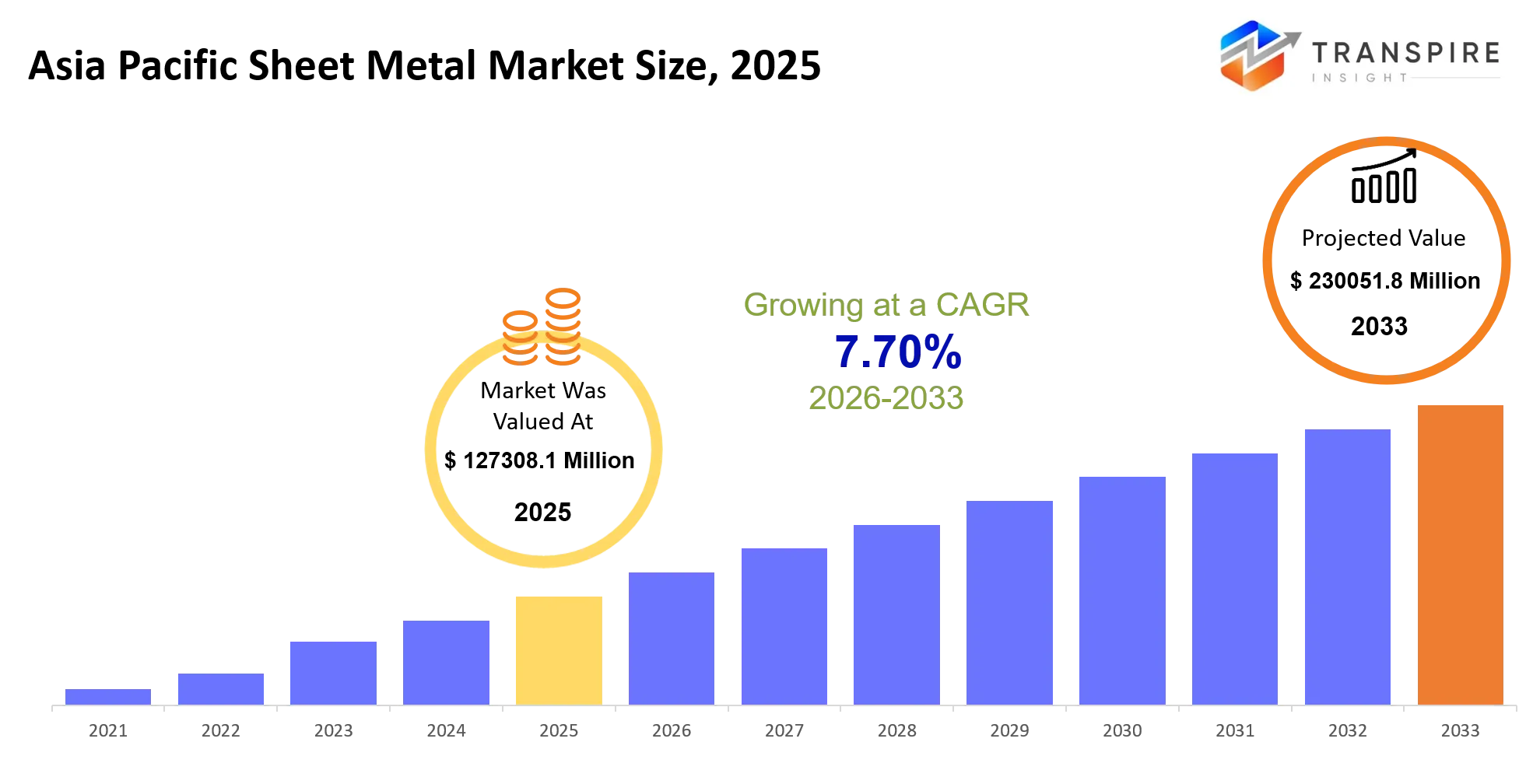
- Asia Pacific Sheet Metal Market Size 2025: USD 127308.1 Million
- Asia Pacific Sheet Metal Market Size 2033: USD 230051.8 Million
- Asia Pacific Sheet Metal Market CAGR: 7.70%
- Asia Pacific Sheet Metal Market Segments: By Product Type (Steel Sheets, Aluminum Sheets, Copper Sheets, Galvanized Sheets, Stainless Steel Sheets, Others); By Application (Automotive Manufacturing, Construction, Industrial Machinery, Aerospace, Consumer Appliances, Others); By End User (Automotive Industry, Construction Industry, Manufacturing Sector, Others)
To learn more about this report,  Download Free Sample Report
Asia Pacific Sheet Metal Market Summary
The Asia Pacific Sheet Metal Market was valued at USD 127308.1 Million in 2025. It is forecast to reach USD 230051.8 Million by 2033. That is a CAGR of 7.70% over the period.
The Asia Pacific sheet metal market kind of forms the base backbone of modern manufacturing, supplying precision cut , formed, and fabricated metal pieces that end up in automobiles, construction gear, industrial machinery, household appliances, electronics, and big infrastructure tasks. With these products, makers can push out durable but still light weight and cost efficient parts in large quantities, and at the same time keep structural strength , plus design flexibility too. In the last five years, something noticeable changed , because the whole space moved more decisively toward automated fabrication approaches like CNC laser cutting, robotic welding, and digital production systems. Those methods kind of boost accuracy too, and at the same time cut down a lot of material waste, so the whole process feels more efficient overall.
A pretty big trigger was what went down with the supply chain during the pandemic, because disruptions forced lots of manufacturers to rethink how they source and even to localize it a bit . Then, after that they went on and ramped up domestic metal processing capacity, which in turn helped the region stitch together a more resilient batch of production ecosystems across China, India, Japan, and Southeast Asia, yeah. And now, since governments keep pouring money into infrastructure, electric vehicles, renewable energy equipment, and wider industrial modernization, fabricators are seeing larger order volumes land in their pipeline. That in turn supports higher utilization, and it seems to generate longer lasting revenue possibilities across the entire sheet metal value chain.
Key Market Insights
- The Asia Pacific Sheet Metal Market still feels like the biggest global manufacturing hub , backed by pretty strong automotive , electronics, and industrial equipment output.
- In the region, East Asia keeps pulling ahead , with around 55%+ revenue share in 2025, basically driven by China, Japan,and South Korea , even if the pattern is pretty steady overall.
- South Asia on the other hand, is likely the fastest moving cluster through 2033, because industrial investments and infrastructure spending are ramping up year over year, not slowing down.
- When you look at materials, steel sheet metal comes in at close to 60% of total demand. It’s mainly a cost efficient choice and it works across a lot of industrial uses.
- Aluminum sheet metal ends up as the next big segment, largely helped by vehicle lightweighting and renewable energy set ups.
- On the fabrication side, precision laser-cut sheet metal fabrication is expected to grow at one of the quickest rates through 2033, sort of consistently outperforming more traditional approaches.
- And for end use, automotive manufacturing alone contributes more than 30% of sheet metal consumption across Asia Pacific.
- Also, electric vehicle production rose noticeably between 2021 and 2025, which is pushing demand for lightweight stamped plus fabricated components.
- Meanwhile, industrial machinery and equipment manufacturers keep expanding their buying of customized sheet metal assemblies , especially for automated production systems.
- Major players like ArcelorMittal, Nippon Steel, Tata Steel, POSCO, Baowu Steel Group, and JFE Steel are all investing in digital manufacturing, capacity expansion,and premium-grade steel production, so the whole supply chain is getting tighter and more modern.
What are the Key Drivers, Restraints, and Opportunities in the Asia Pacific Sheet Metal Market?
The main cause behind market expansion is the fast industrial shifting happening across Asia Pacific manufacturing economies. A lot of government-supported infrastructure programs, electric vehicle production targets, and renewable energy investments have made demand rise for fabricated steel as well as aluminum parts. The move toward electric mobility has been especially noticeable, because EV makers need big lots of lightweight body structures, battery housings, and more precise metal assemblies. So when output keeps climbing, sheet metal processors tend to get a higher order rhythm , along with steadier long-term contracts. That kind of momentum, basically, backs up revenue growth in a direct way.
Still, the biggest brake is raw material price turbulence. Prices for steel, aluminum, energy, and transport keep moving around , driven by worldwide trade conditions, political strain, and supply chain disruptions. This limitation feels structural because sheet metal manufacturers are stuck inside globally connected commodity markets, and those usually cannot be stabilized quickly. When sudden price swings happen, margins get squeezed, procurement timing gets pushed back, and smaller companies hesitate to sink money into capital-intensive advanced fabrication gear.
One key opportunity is smart manufacturing plus higher-value fabricated offerings. By putting money into automated laser cutting, robotic bending systems, AI-based inspection and AI-enabled quality control, and even digital factory platforms, companies can turn out intricate components with more repeatability. India and Southeast Asia, in particular, are becoming appealing places to invest as large multinational manufacturers diversify where they build production. They are moving away from only the usual industrial hubs, kind of spreading footprints more broadly.
What Has the Impact of Artificial Intelligence Been on the Asia Pacific Sheet Metal Market?
Artificial intelligence is getting more and more involved in sheet metal manufacturing, somehow improving production planning, pushing equipment utilization up, and helping with quality control in a more steady way. A lot of fabricators are rolling out AI vision systems that can look at cut edges, check weld quality, and verify dimensional accuracy in real time. In practice, these setups are often quicker at spotting defects than people doing the inspection by hand, and that ends up lowering scrap rates, while also boosting throughput a bit.
At the same time, machine learning models are backing predictive maintenance programs across fabrication sites. They look through sensor streams from laser cutters, stamping presses, robotic welding cells, plus CNC bending machines. The idea is to catch early signals of trouble before it becomes a full breakdown, which is pretty important because breakdowns are expensive. With this kind of monitoring, machine availability improves and unplanned downtime drops, so the plant can keep a higher level of production efficiency without as much disruption.
Beyond that, advanced analytics platforms are doing more than “just” reporting. They can forecast nesting patterns and help reduce sheet metal waste, which affects material costs directly. Some manufacturers say they see clear results in production scheduling, inventory handling, and even energy consumption when AI driven factory management systems are used. These improvements tend to translate into lower operating expenses and better profit margins overall.
Still, AI adoption isn’t smooth everywhere. A lot of small and medium sized fabricators don’t have the digital foundation needed to connect and run advanced analytics platforms. The integration usually feels pricey, plus there’s the issue of limited historical production data, and also the trouble of linking older, legacy equipment. Because of this, deployment across the regional manufacturing ecosystem keeps moving slowly.
Key Market Trends
- Since 2021, laser cutting adoption has sort of kicked into high gear as manufacturers are looking for quicker turnaround times, plus yeah lower material waste .
- Automotive suppliers have ramped up aluminum sheet metal usage by more than 20% across a handful of EV-focused production programs, between 2022 and 2025, too.
- Fabricators seem to be moving away from manual welding tasks toward robotic systems , mainly so they can get steadier results and better labor productivity.
- China’s industrial modernization efforts are still pushing investment into smart manufacturing sites and precision metal processing, basically everywhere important.
- In the meantime Indian manufacturers have expanded domestic fabrication capacity quite a bit between 2023 and 2026 to back infrastructure builds and automotive projects.
- More and more companies are leaning on digital twin technologies, to fine tune production planning , and also equipment performance in real operations.
- After 2020, supply chain diversification has nudged manufacturers to set up regional sourcing partnerships across Southeast Asia, which sounds obvious but it is been happening.
- Demand for premium-grade steel has grown because producers in renewable energy equipment need tougher, plus more corrosion resistant components.
- Big steel producers are also increasing spending on low carbon production technologies to satisfy customer sustainability requirements.
- And since 2024, strategic partnerships between steelmakers and downstream fabricators have become pretty common, to lock in long term supply agreements.
Asia Pacific Sheet Metal Market Segmentation
By Product Type
Steel Sheets end up taking a fairly big chunk of market consumption, mostly because strength, durability, and overall cost efficiency keep mattering across many industries. You can see it a lot in vehicle structures, industrial equipment , and construction projects, which helps keep demand pretty steady across the region. Also, raw materials are available without too much trouble and there are major production facilities, so market penetration tends to stay strong.
Aluminum Sheets are still moving upward, mainly since they are light weight and resist corrosion well, so they fit newer transportation setups and energy applications. Copper Sheets keep their place too, especially in electrical systems, electronics manufacturing, and certain specialized industrial needs where conductivity is the key. Then Galvanized Sheets add even more corrosion protection, so these kinds of products work well for outdoor infrastructure and long-term industrial installations.
Stainless Steel Sheets back up use cases that need hygiene , durability, and resistance when conditions are rough. Demand stays solid in food processing equipment, healthcare facilities, and advanced manufacturing spaces. And then there are other options like specialty alloys, plus customized sheet products made for specific industrial needs, performance standards, or yes, those particular requirements that don’t fit a simple category.
By Application
Automotive Manufacturing is still a big application area, mostly because making body panels, structural parts, battery covers, and chassis systems really needs huge quantities of fabricated metal products. When electric vehicle production keeps expanding, the amount of material used tends to grow too, especially across regional supply chains. And once the production line stays active, it helps keep long-term procurement agreements going, plus it justifies more fabrication investments.
Construction also holds a strong footing, since it shows up in commercial buildings, industrial sites, transportation infrastructure, and even residential projects. Industrial Machinery takes advantage of fabricated metal components for equipment frames, housing units, and other operating arrangements that have to last, and also stay accurate. Aerospace demand keeps moving upward as well, mainly for lightweight plus high-performance materials, but they still need to satisfy strict safety rules and engineering requirements.
Consumer Appliances drive consistent usage through building refrigerators, washing machines, air conditioners, and kitchen devices. The people making those products usually want durability, good formability, and a nice look on the final parts. Then there are Others, like renewable energy installations, electrical gear, and niche industrial needs that call for custom-made metal solutions, in practice.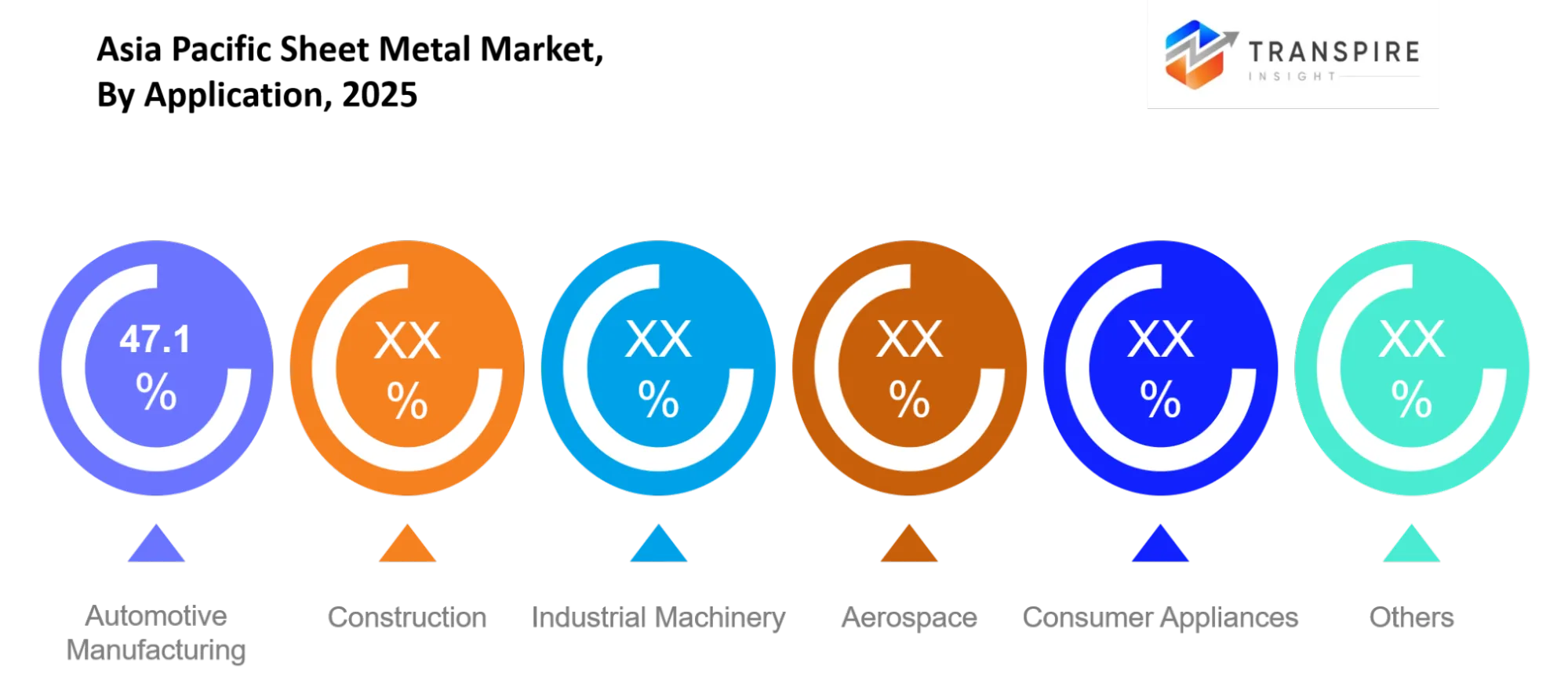
To learn more about this report, Download Free Sample Report
By End User
Automotive Industry has a pretty big spot in the market, mainly because vehicle makers need a nonstop flow of quality fabricated metal parts. As production ramps up for passenger vehicles, commercial vehicles, and electric vehicles, the overall material intake stays strong. At the same time ongoing investments into vehicle manufacturing facilities keep driving steady buying activity, for quite a while now.
Construction Industry uses sheet metal products in lots of places like roofing systems, structural uses, ventilation networks, and also broader infrastructure development. When cities keep expanding, when transportation projects move forward, and when industrial construction keeps happening, demand stays fairly consistent in this area. Also those long project schedules create repeat procurement moments for suppliers and fabricators, over and over.
The manufacturing sector counts as another key end user group, since fabricated metal parts show up across machinery, equipment, electronics, and industrial production lines. The demand stays tied to factory expansions, automation programs, and modernization efforts. Other buyers include energy providers, companies producing healthcare equipment, and specialized industrial operators who basically need customized sheet metal products, depending on how their operations are set up.
What are the Key Use Cases Driving the Asia Pacific Sheet Metal Market?
Most of the sheet metal demand kind of ends up with automotive manufacturing, and that is not surprising. Vehicle producers lean on stamped, cut, and formed metal components, for things like body panels, chassis systems, structural reinforcements, battery housings, and even interior assemblies. Because the production volumes are so high, automotive manufacturing becomes the most noticeable buyer of sheet metal products.
But it’s not only cars. Industrial machinery makers, construction equipment companies, and consumer appliance manufacturers keep ramping up their use of fabricated metal components. Heavy equipment producers need sturdy structural parts, while appliance manufacturers go for precision sheet metal in refrigerators, air conditioners, and washing machines.
Lately there are also new openings showing up in renewable energy and advanced electronics manufacturing. Solar mounting systems, wind turbine components, battery energy storage structures, and data center infrastructure increasingly lean on customized metal fabrication. Those areas are still smaller than the automotive slice of the market, however they’re expected to generate interesting growth during the forecast period.
|
Report Metrics |
Details |
|
Market size value in 2025 |
USD 127308.1 Million |
|
Market size value in 2026 |
USD 136857.3 Million |
|
Revenue forecast in 2033 |
USD 230051.8 Million |
|
Growth rate |
CAGR of 7.70% from 2026 to 2033 |
|
Base year |
2025 |
|
Historical data |
2021 - 2024 |
|
Forecast period |
2026 - 2033 |
|
Report coverage |
Revenue forecast, competitive landscape, growth factors, and trends |
|
Regional scope |
Asia Pacific (India, China, Japan, Australia, South Korea, Rest of Asia Pacific) |
|
Key company profiled |
ArcelorMittal, Nippon Steel, Tata Steel, POSCO, Baowu Steel Group, JFE Steel, Thyssenkrupp, Nucor Corporation, SSAB, Hyundai Steel, JSW Steel, Outokumpu, Voestalpine, AK Steel, United States Steel |
|
Customization scope |
Free report customization (country, regional & segment scope). Avail customized purchase options to meet your exact research needs. |
|
Report Segmentation |
By Product Type (Steel Sheets, Aluminum Sheets, Copper Sheets, Galvanized Sheets, Stainless Steel Sheets, Others); By Application (Automotive Manufacturing, Construction, Industrial Machinery, Aerospace, Consumer Appliances, Others); By End User (Automotive Industry, Construction Industry, Manufacturing Sector, Others) |
Which Regions are Driving the Asia Pacific Sheet Metal Market Growth?
East Asia still feels like the dominant regional market, mostly because so much automotive, electronics, shipbuilding, and industrial making is packed there. China, Japan, and South Korea keep large steel production and have mature fabrication ecosystems too. And you know, the government push for industrial modernization , plus the export-minded manufacturing approach , really tightens that regional lead. Also, the integrated supply chains make it easier for producers to work efficiently across several different industries , not just one niche.
South Asia comes next, and it’s a bit different from East Asia because it leans more on internal industrial expansion rather than pure export-driven output. India keeps putting serious resources into infrastructure, transportation corridors, renewable energy initiatives and broader manufacturing capabilities. Those efforts tend to build dependable long-term demand for fabricated metal items . Plus, a larger domestic consumer base supports appliance makers and also helps automotive manufacturers, so demand is not only coming from abroad.
Then there is Southeast Asia, which is showing up as the fastest-growing regional market. Foreign direct investment has increased , factory relocation strategies are happening , and industrial diversification programs have sped up production in countries like Vietnam, Indonesia, and Thailand. New money going into industrial zones , logistics improvements, and export-focused manufacturing capacity is also reinforcing the growth story. For investors and people entering new markets, the region should offer real chances between 2026 and 2033 , especially as supply chains keep spreading farther out from the classic manufacturing hubs.
Who are the Key Players in the Asia Pacific Sheet Metal Market and How Do They Compete?
Competition in the Asia Pacific sheet metal market feels moderately fragmented, like you get global steel producers going head to head with regional fabricators and specialized metal processors. In practice, competitive advantage is leaning more on production efficiency, product quality, technological capabilities and also having dependable access to raw material supplies. The big integrated steelmakers still hold scale advantages, however specialized manufacturers try to win by offering customization, and precision engineering type services, which sounds simple but it actually matters a lot.
ArcelorMittal tends to emphasize high strength steel solutions along with broad downstream processing, so it can support automotive and infrastructure customers using premium products. Nippon Steel differentiates through advanced metallurgy, specialty steel grades and heavy investments in low carbon steel technologies. POSCO keeps pushing outward internationally while also folding in digital manufacturing and more sustainable production methods across its operations, so it looks like a full cycle approach.
Tata Steel banks on its solid footprint in India to pick up infrastructure and manufacturing growth opportunities, while JFE Steel leans toward high performance steel products aimed at automotive and industrial applications. More and more, these players look for strategic partnerships, regional expansion projects, and targeted technology investments to reinforce their market position, and to keep long term customer relationships secure.
Company List
- ArcelorMittal
- Nippon Steel
- Tata Steel
- POSCO
- Baowu Steel Group
- JFE Steel
- Thyssenkrupp
- Nucor Corporation
- SSAB
- Hyundai Steel
- JSW Steel
- Outokumpu
- Voestalpine
- AK Steel
- United States Steel Corporation (U.S. Steel)
Recent Development News
In April 2026, JSW Steel and POSCO entered a joint venture agreement to establish a 6 million tonnes per annum integrated steel plant in Odisha, India. The project will expand regional steel production capacity and strengthen sheet metal supply for automotive, infrastructure, and manufacturing industries.https://www.jsw.in/newsroom
In April 2026, POSCO entered a joint development agreement with Electra and made a strategic investment in the company. The partnership aims to scale clean iron production technology, supporting low-carbon steel manufacturing and future advanced sheet metal production.https://www.globenewswire.com
In August 2025, JSW Steel and JFE Steel announced a USD 669 million investment commitment to expand cold rolled grain-oriented electrical steel production capacity in India. The investment will support growing demand from power infrastructure, renewable energy, and industrial equipment sectors while strengthening the regional specialty steel supply chain.https://www.reuters.com
What Strategic Insights Define the Future of the Asia Pacific Sheet Metal Market?
The Asia Pacific sheet metal market seems to be drifting toward a manufacturing setup that is more technology-heavy, and also less centralized than before, you could say, more regionally diversified. In the next five to seven years, the clearest momentum is expected from electric mobility , renewable energy infrastructure, industrial automation, and the whole advanced manufacturing push. These areas are basically asking for higher precision, better material performance , and faster production cycles , so naturally makers are going to put more money into digital fabrication technologies.
There’s also a smaller, kind of hidden risk though. Long-term dependence on raw material concentrations, plus trade policy uncertainty, can quietly mess things up later. If the supply leans too hard on a handful of steel-producing countries , manufacturers may face interruptions and pricing swings, even while overall demand in the region still looks solid.
At the same time, there is an emerging opportunity. AI-enabled smart fabrication facilities in India and parts of Southeast Asia look particularly promising. As multinational manufacturers keep extending their production footprints, the demand for digitally integrated sheet metal processing capability is likely to grow quite fast, maybe more than people expect.
So market players should focus more on automation, building localized supply chains , and offering high-value fabrication services, instead of only trying to outpace rivals on raw production volume. Firms that blend advanced manufacturing tools with a regional expansion mindset should end up in a better place to secure future market share , and also improve profitability over time.
Asia Pacific Sheet Metal Market Report Segmentation
By Product Type
- Steel Sheets
- Aluminum Sheets
- Copper Sheets
- Galvanized Sheets
- Stainless Steel Sheets
- Others
By Application
- Automotive Manufacturing
- Construction
- Industrial Machinery
- Aerospace
- Consumer Appliances
- Others
By End User
- Automotive Industry
- Construction Industry
- Manufacturing Sector
- Others
Frequently Asked Questions
Find quick answers to common questions.
The Expected Asia Pacific Sheet Metal Market size for the Market will be USD 230051.8 Million in 2033.
Key Segments for the Asia Pacific Sheet Metal Market are By Product Type (Steel Sheets, Aluminum Sheets, Copper Sheets, Galvanized Sheets, Stainless Steel Sheets, Others); By Application (Automotive Manufacturing, Construction, Industrial Machinery, Aerospace, Consumer Appliances, Others); By End User (Automotive Industry, Construction Industry, Manufacturing Sector, Others).
Major Asia Pacific Sheet Metal Market Players are ArcelorMittal, Nippon Steel, Tata Steel, POSCO, Baowu Steel Group, JFE Steel, Thyssenkrupp, Nucor Corporation, SSAB, Hyundai Steel, JSW Steel, Outokumpu, Voestalpine, AK Steel, United States Steel.
The Current Asia Pacific Sheet Metal Market size is USD 127308.1 Million in 2025.
The Asia Pacific Sheet Metal Market CAGR is 7.70% from 2026 to 2033.
- ArcelorMittal
- Nippon Steel
- Tata Steel
- POSCO
- Baowu Steel Group
- JFE Steel
- Thyssenkrupp
- Nucor Corporation
- SSAB
- Hyundai Steel
- JSW Steel
- Outokumpu
- Voestalpine
- AK Steel
- United States Steel Corporation (U.S. Steel)
About the Authors

Pankaj Ghogare Patil
I am Pankaj Ghogare Patil, a Senior Research Analyst at Transpire Insight, specializing in the Pharmaceutical, Chemicals & Materials, Healthcare IT, and Biotechnology industry. My expertise lies in conducting comprehensive market research, analyzing industry trends, evaluating competitive landscapes, and translating complex data into actionable insights. At Transpire Insight, I closely follow emerging technologies, regulatory developments, and market innovations to create accurate, well-researched, and informative content that helps businesses and professionals make informed decisions. I am committed to producing credible, evidence-based articles that reflect industry best practices while making technical topics accessible and valuable for a broad audience.

Chakradhar Khansole
Chakradhar serves as the Research Director at Transpire Insight, bringing over 8 years of experience in technology, innovation, and strategic market intelligence. He specializes in transforming complex market data into actionable business insights that enable organizations to make informed, growth-oriented decisions. Recognized for his strategic vision and analytical expertise, Chakradhar leads high-impact research initiatives, delivering comprehensive market assessments, competitive intelligence, and forward-looking industry analysis.
Recently Published Reports
-
May 2026
Healthcare Polymer Packaging Market
Healthcare Polymer Packaging Market Size, Share & Analysis Report By Packaging Type (Syringes, IV Bottles and Pouches, Clamshells, Blisters, Bottles & Jars, Containers, Tubes, IV Parental Packaging, Others), By Type (Regulated, Non-regulated), By Polymer Type (LDPE (Low-Density Polyethylene), HDPE (High-Density Polyethylene), Homo-polymer (Homo), Random Copolymer (Random), Block Copolymer (Block), PET, Polystyrene, Polyvinyl Chloride, Polyamide/EVOH, Others), and Geography (North America, Europe, Asia-Pacific, Middle East and Africa, South and Central America), 2021 - 2031
-
Apr 2026
Hydrophilic Tape (Waterstop) Market
Hydrophilic Tape (Waterstop) Market Size, Share & Analysis Report By Type (Bentonite-Based Hydrophilic Tape, Rubber-Based Hydrophilic Tape), By Application (Residential Buildings, Commercial Buildings, Infrastructure Projects), and Geography (North America, Europe, Asia-Pacific, Middle East and Africa, South and Central America), 2021 - 2031
-
Apr 2026
Metalens Market
Metalens Market Size, Share & Analysis Report By Type (Visible Light Metalens, and Infrared Metalens), By Application (Consumer Electronics, Automotive Electronics, Industrial, Medical, and Others), and Geography (North America, Europe, Asia-Pacific, Middle East and Africa, South and Central America), 2021 - 2031
-
Apr 2026
PBT Resin Market
PBT Resin Market Size, Share & Analysis Report By Type (Reinforced PBT Resin, Unreinforced PBT Resin), By Processing Method (Injection Molding, Extrusion, Blow Molding, Others), By End-User (Automotive, Electrical & Electronics, Consumer Appliances, Industrial Machinery, Medical Devices, Packaging, Others), and Geography (North America, Europe, Asia-Pacific, Middle East and Africa, South and Central America), 2021 - 2031