
Europe Metal Recycling Market Size & Forecast:
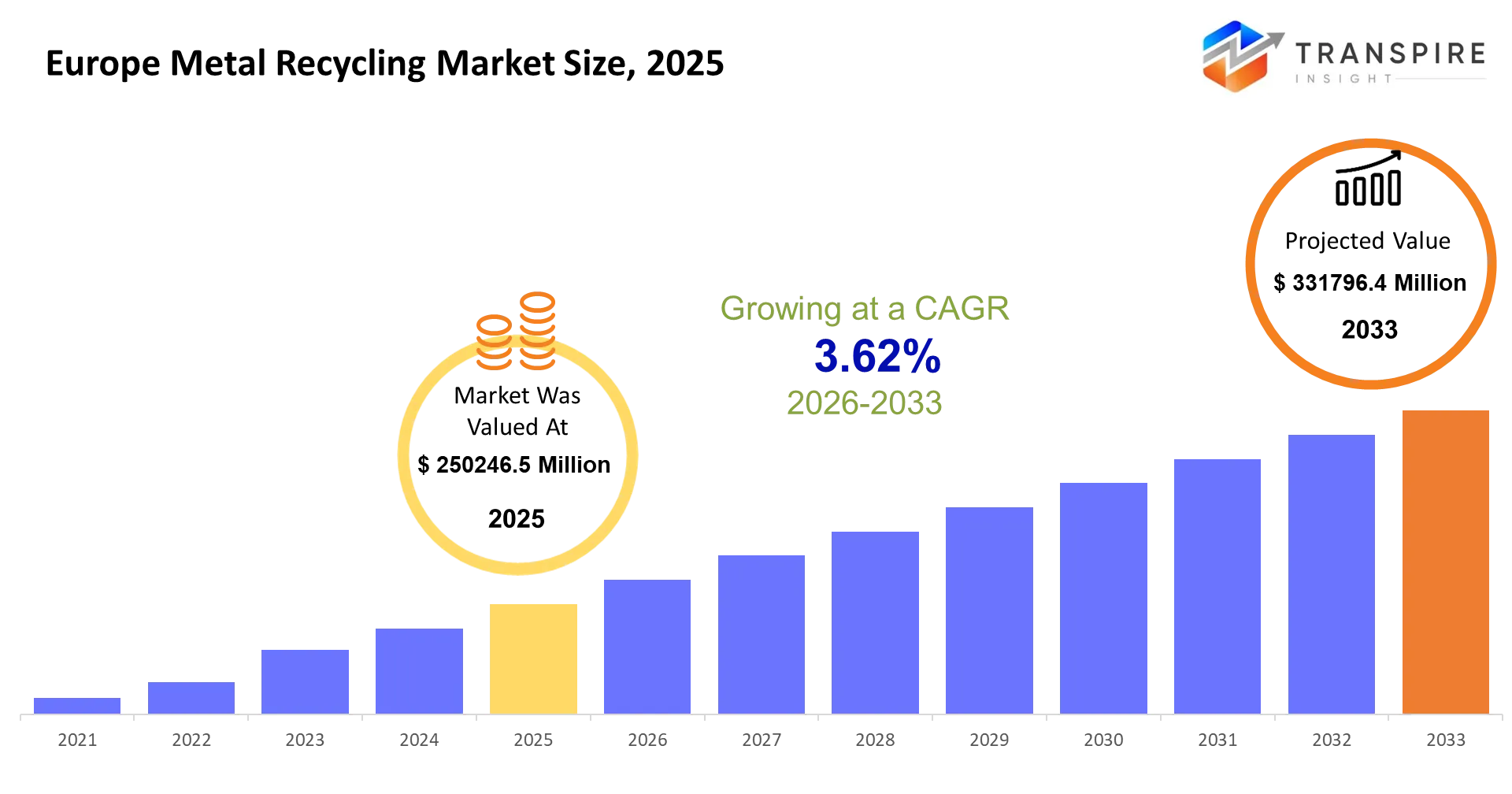
- Europe Metal Recycling Market Size 2025: USD 250246.5 Million
- Europe Metal Recycling Market Size 2033: USD 331796.4 Million
- Europe Metal Recycling Market CAGR: 3.62%
- Europe Metal Recycling Market Segments: By Type (Ferrous Metals, Non-ferrous Metals, Precious Metals, Scrap Recycling, Alloy Recycling, Electronic Scrap, Others); By Application (Construction, Automotive, Manufacturing, Electronics, Shipbuilding, Infrastructure, Others); By End-User (Industrial, Commercial, Government, Recycling Firms, SMEs, Others); By Process (Collection, Sorting, Processing, Smelting, Refining, Reuse, Others)
To learn more about this report,  Download Free Sample Report
Europe Metal Recycling Market Summary
The Europe Metal Recycling Market was valued at USD 250246.5 Million in 2025. It is forecast to reach USD 331796.4 Million by 2033. That is a CAGR of 3.62% over the period.
The Europe Metal Recycling Market operates through three main activities which involve collecting metals from discarded materials and industrial waste and processing those materials to create new steel and non-ferrous products. The system maintains production operations through its delivery of sustainable materials which serve as its primary resources while it decreases its need for outside iron ore and bauxite supplies. The European steelmaking industry has undergone permanent market transformations during the past three to five years because steel producers now prefer electric arc furnaces over traditional blast furnaces which require high-grade scrap materials. European Union circular economy laws and carbon emission taxation systems have created stronger financial advantages for businesses that want to recycle and reuse metals on a large scale. The Russia-Ukraine conflict created actual conditions which stopped raw material shipments from reaching manufacturers while rising energy and production costs forced them to obtain scrap materials from domestic sources. The recycling industry gained better control over pricing because of these factors which also led to people investing in new sorting methods and establishing more waste collection systems throughout Europe.
Key Market Insights
- Western Europe dominates the European Metal Recycling Market because it controls almost 42% of the market share which will reach this level in 2025 through its advanced industrial scrap collection systems.
- The strongest regional scrap production in Germany, France, and the UK comes from their automotive and construction demolition activities.
- The fastest-growing area between 2025 and 2032 is Eastern Europe because its infrastructure development efforts help increase industrial waste recycling.
- The ferrous metals segment holds 68% of the market because manufacturing industries produce high volumes of recycled steel.
- The second position goes to non-ferrous metals because the automotive industry requires large quantities of aluminum and copper for electric vehicle production.
- Industrial scrap processing services will expand the quickest between 2025 and 2032 because automation technology has improved sorting and shredding operations.
- Construction and demolition waste recycling dominates with about 38% share, fueled by urban redevelopment across major EU cities.
- The automotive recycling sector experiences its fastest expansion because of the electric vehicle market transformation and new laws about vehicle disposal.
- EU-supported green port initiatives have made shipbreaking and marine recycling more popular.
- The steel manufacturing industry leads all other sectors because it uses large quantities of recycled ferrous scrap.
What are the Key Drivers, Restraints, and Opportunities in the Europe Metal Recycling Market?
The primary driver is the accelerating transition toward electric arc furnace (EAF) steel production across Europe. The European Union introduced carbon pricing reforms and the Green Deal framework established stricter emissions limits which resulted in higher operational costs for blast furnace systems. The steelmakers now establish structural systems which depend on scrap metal as their main raw material because this process increases demand for recycled materials and creates reliable revenue streams which recyclers need to process ferrous materials.
The most significant restraint is the uneven quality and fragmentation of scrap collection systems across several European regions. Many countries still rely on informal or semi-organized recovery channels which results in inconsistent material purity and higher processing costs. The structural inefficiency of the system prevents expansion because the steel and manufacturing sectors need recycled materials that meet established quality standards. The existing infrastructure deficiencies and the extended approval processes for new sorting facilities create delays in revenue generation for markets with less developed operations.
Advanced AI-driven sorting systems and sensor-based metal separation technologies present a key opportunity for development. Aurubis and other companies are funding digital refining systems which enable better recovery of high-value non-ferrous metals including copper and aluminum. The EU-funded industrial modernization programs which develop recycling infrastructure turn Eastern Europe into a strategic expansion location that will become a future base for high-quality scrap material.
What Has the Impact of Artificial Intelligence Been on the Europe Metal Recycling Market?
The Europe Metal Recycling Market experiences operational efficiency improvements through artificial intelligence and advanced digital systems which particularly benefit high-energy processing operations and compliance-heavy recycling activities that handle industrial and maritime scrap materials.
AI-enabled control systems now operate at metal shredding lines to maintain furnace feed consistency while monitoring emissions through scrubber performance systems. The sensor-driven platforms used by Sims Metal Management operate in their large-scale facilities to track machinery health while they automatically modify operational settings throughout the day without requiring human input and they maintain continuous production during changes in scrap material input.
Machine learning models now predict equipment wear and maintenance cycles and energy consumption patterns through predictive analytics. The systems enable operators to minimize unplanned downtime while boosting fuel efficiency of their logistics fleets which handle scrap movement through European collection networks. Advanced plants that use predictive maintenance achieve measurable double-digit reductions in unscheduled stoppages and better furnace uptime stability which results in lower costs and more predictable production.
The recycling industry faces adoption challenges because of insufficient data standardization between separate facilities. The processing sites that were built before digital technology emerged today face difficulties because their systems lack complete digital capabilities which decrease model accuracy when handling actual material differences. The existing gap prevents recycling facilities from using AI-driven optimization systems while increasing integration expenses for smaller regional recyclers.
Key Market Trends
- The European Union system for carbon pricing which started in 2023, prompted steel manufacturers to switch from traditional blast furnaces towards electric arc furnaces.
- This change resulted in electric arc furnaces depending more on recycled metal materials which became common throughout European countries.
- The Western European region between 2022 and 2025 moved from using human workers to perform scrap metal extraction toward implementing artificial intelligence systems.
- This technology upgrade enhanced both the purity of extracted metals and the efficiency of operational processes.
- After the 2021 electric vehicle regulations mandated automotive manufacturers to use more recycled aluminum, they managed to decrease their dependence on new raw materials throughout their supply chains.
- The 2023 scrap export restrictions resulted in more ferrous metals being diverted from international markets into domestic recycling systems which enhanced the ability of local communities to maintain their resource requirements.
- After 2022 digital tracking systems started to grow quickly because they enabled regulators to implement more severe rules regarding international scrap transportation and pollution control.
- The implementation of sensor-based shredding and separation technologies by industrial recyclers after 2021, enabled them to achieve better recovery rates for non-ferrous metals such as copper and nickel.
- The recycling industry needed to minimize its furnace energy requirements because of rising energy costs which led to increased spending on predictive maintenance solutions and AI-based load management systems.
- The expansion of Eastern European recycling facilities followed the implementation of EU funding programs established in 2023 which helped to formalize previously unregulated scrap collection operations.
- The period from 2022 to 2025 saw major companies increase their market dominance through the acquisition of regional recycling companies which enabled them to obtain needed materials while expanding their processing operations.
Europe Metal Recycling Market Segmentation
By Type:
The Europe metal recycling market shows its main market share through the Ferrous metals segment which Industrial sectors like construction and rail and heavy engineering use in their operations. The market maintains its strong position because there exists a high supply of end-of-life steel products together with established collection networks. The market shows high demand for Non-ferrous metals because these metals have high value and automotive and electronics manufacturing require them. Precious metals and electronic scrap maintain smaller volume yet generate substantial revenue because of their recovery economics and e-waste stream regulation requirements.
The growth logic for each category differs from other categories. Ferrous recycling benefits from stable demolition cycles and infrastructure renewal projects. The Non-ferrous and electronic scrap segments receive their momentum from two main forces which include electrification trends and critical raw material security concerns. Precious metals recycling develops through circular economy regulations and new refinery technologies. The future shows that companies will increase their collection of high-value scrap materials through technology improvements which will enhance their recycling performance. The Europe Metal Recycling Market shows that investors and developers favor sorting automation and hydrometallurgical processing while buyers prefer supply stability and cost-effectiveness.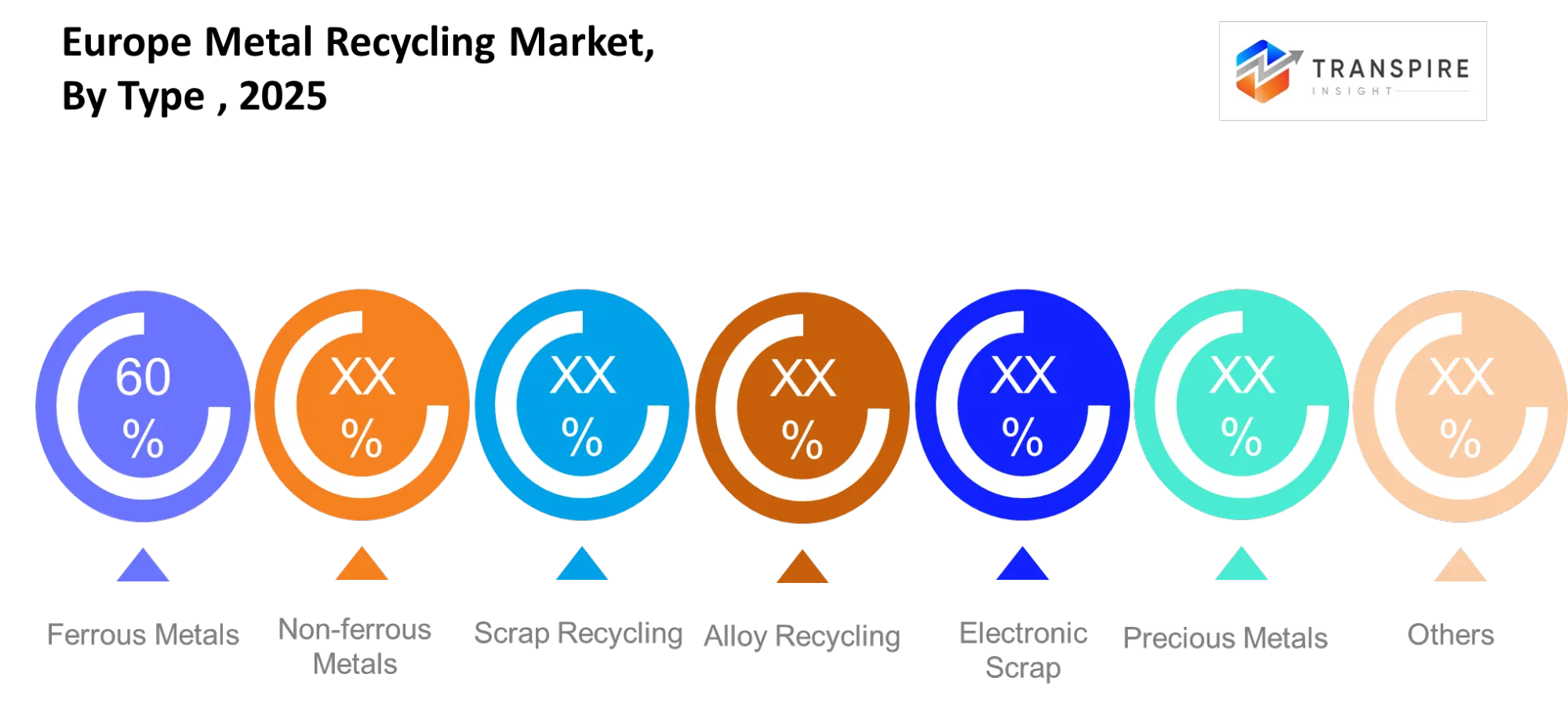
To learn more about this report, Download Free Sample Report
By Application:
The construction application segment leads because there is ongoing demand for both structural steel and demolition waste recovery. The automotive application sector handles a significant market share because end-of-life vehicle recycling and lightweight material recovery drive its activities. The manufacturing and infrastructure sectors experience consistent demand because industrial scrap generation and public works investment create constant requirements. Electronics and shipbuilding operate as niche markets, yet they generate high value because they require special material recovery processes.
The growth pattern follows industrial development trends together with recycling regulation systems which impose recycling requirements. The automotive industry shifts towards electric vehicles which drives up aluminum and copper recycling needs. The European Union builds new infrastructure which boosts scrap metal collection and supports European metal recycling operations while maintaining low concentration danger. The upcoming trend predicts that businesses will increasingly adopt closed-loop supply chains which they will implement through recycling partnerships across their manufacturing processes. Businesses that use automatic dismantling technology together with material tracing systems achieve better recovery rates which lead to more valuable investments in high-grade scrap processing facilities.
By End-User:
Industrial end-user segment dominates consumption of recycled metals because steel, automotive and machinery industries require continuous metal inputs to support their production processes. The recycling industry operates as a vital connection point because it handles the entire process which involves gathering objects and separating them before sending them to different locations from the various collection points which operate throughout the market. The government maintains large influence through its power to create rules and its work on restoring public facilities. The commercial segment together with small and medium-sized enterprises shows moderate market demand which comes from their need to support their production activities and local manufacturing operations.
Resource efficiency regulations have become stricter while the price of raw materials keeps rising which creates new business opportunities. Recycling organizations build additional resources through their use of automation technologies and their efforts to merge operations across different areas. Manufacturers in the industrial sector turn to recycled materials because it helps them control their expenses while decreasing their environmental impact through reduced carbon footprint. The future will show more recyclers and manufacturers working together through vertical integration which will create dependable supply networks.The procurement processes in Europe Metal Recycling Market now operate according to compliance requirements which control how industrial users select their purchases based on their traceability and certification requirements.
By Process:
The collection and sorting process functions as an essential entry point which enables the collection of scrap materials from residential areas industrial sites and commercial facilities. The processing and smelting stages create significant value through their ability to change materials and eliminate contaminants from the process. The growing need for high purity materials drives the increased importance of refining processes which enable the extraction of non-ferrous and precious metals. The circular manufacturing systems use reuse applications to maintain a small yet essential operational portion of their activities.
The market expands because technological progress enables automatic sorting systems to use sensors for identification while smelting operations achieve energy-saving results. The use of digital tracking systems enables better collection operations while they decrease the amount of contaminants that enter scrap materials. The development of refining technologies enables better recovery rates from complicated electronic waste materials. The future direction shows that organizations will allocate more funds to develop facilities which use low-emission processing methods and modern metallurgical processes. Europe Metal Recycling Market development operates according to sustainability requirements which force operators to implement cleaner production methods and achieve better material recovery results throughout their operational processes.
What are the Key Use Cases Driving the Europe Metal Recycling Market?
The primary demand for metal recycling in Europe originates from construction activities and infrastructure renewal projects which receive support through ongoing demolition work and urban redevelopment initiatives and public works projects that require steel materials. The Europe Metal Recycling Market derives its most powerful demand from building and bridge and transport infrastructure demolition activities which produce ferrous scrap material that steel manufacturers use for production purposes. Steelmakers use recycled materials because they help decrease greenhouse gas emissions and maintain consistent pricing for essential raw materials which leads to widespread usage throughout large-scale construction projects.
The growing application of automotive manufacturing and industrial production processes demonstrates their potential benefits through recycling of end-of-life vehicles and recovery of manufacturing scrap. Automotive original equipment manufacturers increase their use of recycled aluminum and copper because these materials help them achieve lightweight vehicle designs and electric vehicle development objectives. The recycling industry along with its industrial customers creates closed-loop supply chains which result in higher material efficiency throughout Europe's machinery and electronics manufacturing facilities.
The recycling of electric vehicle batteries together with the recovery of advanced electronics materials has developed into two promising future applications. The existing regulatory requirements for critical raw materials and e-waste management systems drive companies to invest in facilities that recover lithium and cobalt and rare metals. The shipbuilding industry together with renewable energy infrastructure demonstrates early market entry through its offshore wind and marine applications which require strong recycled alloys.
|
Report Metrics |
Details |
|
Market size value in 2025 |
USD 250246.5 Million |
|
Market size value in 2026 |
USD 258742.8 Million |
|
Revenue forecast in 2033 |
USD 331796.4 Million |
|
Growth rate |
CAGR of 3.62% from 2026 to 2033 |
|
Base year |
2025 |
|
Historical data |
2021 - 2024 |
|
Forecast period |
2026 - 2033 |
|
Report coverage |
Revenue forecast, competitive landscape, growth factors, and trends |
|
Regional scope |
Europe (Germany, United Kingdom, France, Italy, Spain, Rest of Europe) |
|
Key company profiled |
ArcelorMittal, Sims Metal Management, Nucor, European Metal Recycling, Schnitzer Steel, Tata Steel, Aurubis, Commercial Metals Company, Gerdau, Liberty Steel, OmniSource, Kuusakoski, SA Recycling, David J Joseph, EMR Group |
|
Customization scope |
Free report customization (country, regional & segment scope). Avail customized purchase options to meet your exact research needs. |
|
Report Segmentation |
By Type (Ferrous Metals, Non-ferrous Metals, Precious Metals, Scrap Recycling, Alloy Recycling, Electronic Scrap, Others); By Application (Construction, Automotive, Manufacturing, Electronics, Shipbuilding, Infrastructure, Others); By End-User (Industrial, Commercial, Government, Recycling Firms, SMEs, Others); By Process (Collection, Sorting, Processing, Smelting, Refining, Reuse, Others) |
Which Regions are Driving the Europe Metal Recycling Market Growth?
Europe maintains its status as the top region for metal recycling in the world because it enforces strict environmental rules and its circular economy practices are already established. The European Union enforces high recycling targets for steel, aluminum, and electronic waste, which drives consistent scrap collection and processing activity. The advanced port infrastructure in Germany, the Netherlands, and Belgium enables efficient scrap material movement between export and import operations. The industrial sectors benefit from a vast network of certified recyclers and integrated steel producers who enhance material recovery efficiency while maintaining constant demand. The European Metal Recycling Market maintains its sustained position because of strong enforcement practices which support carbon reduction rules.
North America functions as a stable mature market because it maintains both a substantial automotive fleet and ongoing industrial scrap production activities. The recycling market in this region depends on economic factors which drive recycling activities, unlike European systems that require centralized policy compliance. The United States and Canada have established steel manufacturing hubs which create stable market demand for recycled ferrous and non-ferrous metals. Industrial operations maintain their scrap output at constant levels because they establish resilient systems and conduct regular infrastructure maintenance activities. Global recycling systems receive funding from private companies, which establish permanent supply contracts that minimize market fluctuations while ensuring steady revenue streams.
The Asia Pacific region experiences its most rapid growth because of its quick industrial development and its recent implementation of strict waste material import regulations. The regional dynamics have changed because China decided to develop its domestic recycling facilities and India started to build official scrap collection systems. The establishment of new large shredding and sorting facilities will enhance material recovery processes in both urban areas and industrial zones. The combination of government infrastructure projects and increased electric vehicle manufacturing creates higher demand for recycled metals. The region presents strong growth opportunities to investors and newcomers who want to enter between 2026 and 2033 because of advancements in processing technologies and development of complete recycling systems.
Who are the Key Players in the Europe Metal Recycling Market and How Do They Compete?
The Europe Metal Recycling Market exhibits competitive behavior with two distinct compartments: an upper section which combines several major players with multiple smaller companies operating in specific regional markets. The large processors use their integrated logistics systems and port facilities to control the international movement of scrap material while the smaller processing yards operate at local markets by setting their collection areas and pricing rates. The competition between companies focuses on their ability to process materials, meet regulatory requirements, and digitally monitor the quality of their materials instead of measuring output through total volume production.
European Metal Recycling (EMR) achieves cost leadership through its vast network of scrap yards across the UK and continental Europe which handles export operations from its port facilities. Stena Metall establishes its unique market position through its closed-loop recycling services which serve industrial customers in Nordic countries by offering waste management solutions together with material supply agreements. The German operations of TSR Recycling gain strength through its extensive domestic collection system and established connections with car manufacturers.
Aurubis uses its advanced non-ferrous smelting and refining technology to achieve maximum copper and precious metal extraction from complex scrap materials. Sims Limited expands through a diverse range of international operations which include acquisitions that enhance its capacity to serve urban scrap markets and industrial contracts. Both companies build their businesses through investments in digital trading platforms and advanced sorting systems which enable them to achieve better material output and product traceability throughout Europe.
Company List
- ArcelorMittal
- Sims Metal Management
- Nucor
- European Metal Recycling
- Schnitzer Steel
- Tata Steel
- Aurubis
- Commercial Metals Company
- Gerdau
- Liberty Steel
- OmniSource
- Kuusakoski
- SA Recycling
- David J Joseph
- EMR Group
Recent Development News
“In April 2026, Aurubis AG announced operational expansion of its global recycling footprint through its newly commissioned non-ferrous processing assets in Europe and North America. The development strengthens its position in complex copper and precious metal scrap recovery, improving capacity for high-purity output and reinforcing its role in industrial circular supply chains. The expansion increases processing efficiency for electronic scrap and industrial catalysts, directly supporting Europe’s tightening raw material security framework.https://www.reuters.com
“In March 2026, Sims Limited advanced its European recycling strategy through targeted acquisitions of regional scrap processing facilities and integration partnerships with industrial suppliers. The move strengthens its urban scrap collection network and improves access to automotive and manufacturing waste streams across key European markets. The company focuses on consolidating fragmented yards to improve logistics efficiency and margin stability in ferrous and non-ferrous recovery.https://www.openpr.com
What Strategic Insights Define the Future of the Europe Metal Recycling Market?
The Europe Metal Recycling Market is shifting toward high-purity, technology-driven recovery systems as regulatory authorities and industrial decarbonization targets increase their demands. The market will experience increasing demand for advanced sorting technology and hydrometallurgical refining and traceable circular supply chains instead of conventional bulk scrap trading systems. The electrification of transport systems and the construction of renewable energy systems will result in greater demand for recycled materials such as copper and aluminum and specialty alloys which will force recyclers to handle these materials as precision materials instead of standard commodities.
The manufacturing process faces a hidden danger from technological substitution which results in decreased recoverable scrap quality through the use of lightweight composites together with non-recyclable hybrid materials. The situation will lead to reduced profit margins for processors who rely on standard ferrous material and result in unpredictable changes to their raw material supply. The process of merger activities among major recycling companies will create higher risks of price manipulation and will result in supply shortages during periods of increased demand.
Artificial intelligence systems for scrap identification which operate with automated dismantling lines present a new business opportunity that will benefit companies which specialize in urban electronic waste mining operations. The companies that operate in this market segment will experience rapid growth because Northern and Western Europe have already started using this technology. To maintain their competitive advantage market participants should establish digital sorting systems and build industrial partnerships that will help them maintain control over feedstock quality until their competitors enter the market.
Europe Metal Recycling Market Report Segmentation
By Type
- Ferrous Metals
- Non-ferrous Metals
- Precious Metals
- Scrap Recycling
- Alloy Recycling
- Electronic Scrap
- Others
By Application
- Construction
- Automotive
- Manufacturing
- Electronics
- Shipbuilding
- Infrastructure
- Others
By End-User
- Industrial
- Commercial
- Government
- Recycling Firms
- SMEs
- Others
By Process
- Collection
- Sorting
- Processing
- Smelting
- Refining
- Reuse
- Others
Frequently Asked Questions
Find quick answers to common questions.
The Europe Metal Recycling Market size is USD 331796.4 Million in 2033.
Key Segments for the Europe Metal Recycling Market are By Type (Ferrous Metals, Non-ferrous Metals, Precious Metals, Scrap Recycling, Alloy Recycling, Electronic Scrap, Others); By Application (Construction, Automotive, Manufacturing, Electronics, Shipbuilding, Infrastructure, Others); By End-User (Industrial, Commercial, Government, Recycling Firms, SMEs, Others); By Process (Collection, Sorting, Processing, Smelting, Refining, Reuse, Others).
Major Europe Metal Recycling Market Players are ArcelorMittal, Sims Metal Management, Nucor, European Metal Recycling, Schnitzer Steel, Tata Steel, Aurubis, Commercial Metals Company, Gerdau, Liberty Steel, OmniSource, Kuusakoski, SA Recycling, David J Joseph, EMR Group.
The Current Europe Metal Recycling Market size is USD 250246.5 Million in 2025.
The Europe Metal Recycling Market CAGR is 3.62% from 2026 to 2033.
- ArcelorMittal
- Sims Metal Management
- Nucor
- European Metal Recycling
- Schnitzer Steel
- Tata Steel
- Aurubis
- Commercial Metals Company
- Gerdau
- Liberty Steel
- OmniSource
- Kuusakoski
- SA Recycling
- David J Joseph
- EMR Group
Recently Published Reports
-
Apr 2026
Healthcare Polymer Packaging Market
Healthcare Polymer Packaging Market Size, Share & Analysis Report By Packaging Type (Syringes, IV Bottles and Pouches, Clamshells, Blisters, Bottles & Jars, Containers, Tubes, IV Parental Packaging, Others), By Type (Regulated, Non-regulated), By Polymer Type (LDPE (Low-Density Polyethylene), HDPE (High-Density Polyethylene), Homo-polymer (Homo), Random Copolymer (Random), Block Copolymer (Block), PET, Polystyrene, Polyvinyl Chloride, Polyamide/EVOH, Others), and Geography (North America, Europe, Asia-Pacific, Middle East and Africa, South and Central America), 2021 - 2031
-
Apr 2026
Hydrophilic Tape (Waterstop) Market
Hydrophilic Tape (Waterstop) Market Size, Share & Analysis Report By Type (Bentonite-Based Hydrophilic Tape, Rubber-Based Hydrophilic Tape), By Application (Residential Buildings, Commercial Buildings, Infrastructure Projects), and Geography (North America, Europe, Asia-Pacific, Middle East and Africa, South and Central America), 2021 - 2031
-
Apr 2026
Metalens Market
Metalens Market Size, Share & Analysis Report By Type (Visible Light Metalens, and Infrared Metalens), By Application (Consumer Electronics, Automotive Electronics, Industrial, Medical, and Others), and Geography (North America, Europe, Asia-Pacific, Middle East and Africa, South and Central America), 2021 - 2031
-
Apr 2026
PBT Resin Market
PBT Resin Market Size, Share & Analysis Report By Type (Reinforced PBT Resin, Unreinforced PBT Resin), By Processing Method (Injection Molding, Extrusion, Blow Molding, Others), By End-User (Automotive, Electrical & Electronics, Consumer Appliances, Industrial Machinery, Medical Devices, Packaging, Others), and Geography (North America, Europe, Asia-Pacific, Middle East and Africa, South and Central America), 2021 - 2031