
Middle East and Africa Copper Wire and Cable Market Size & Forecast:
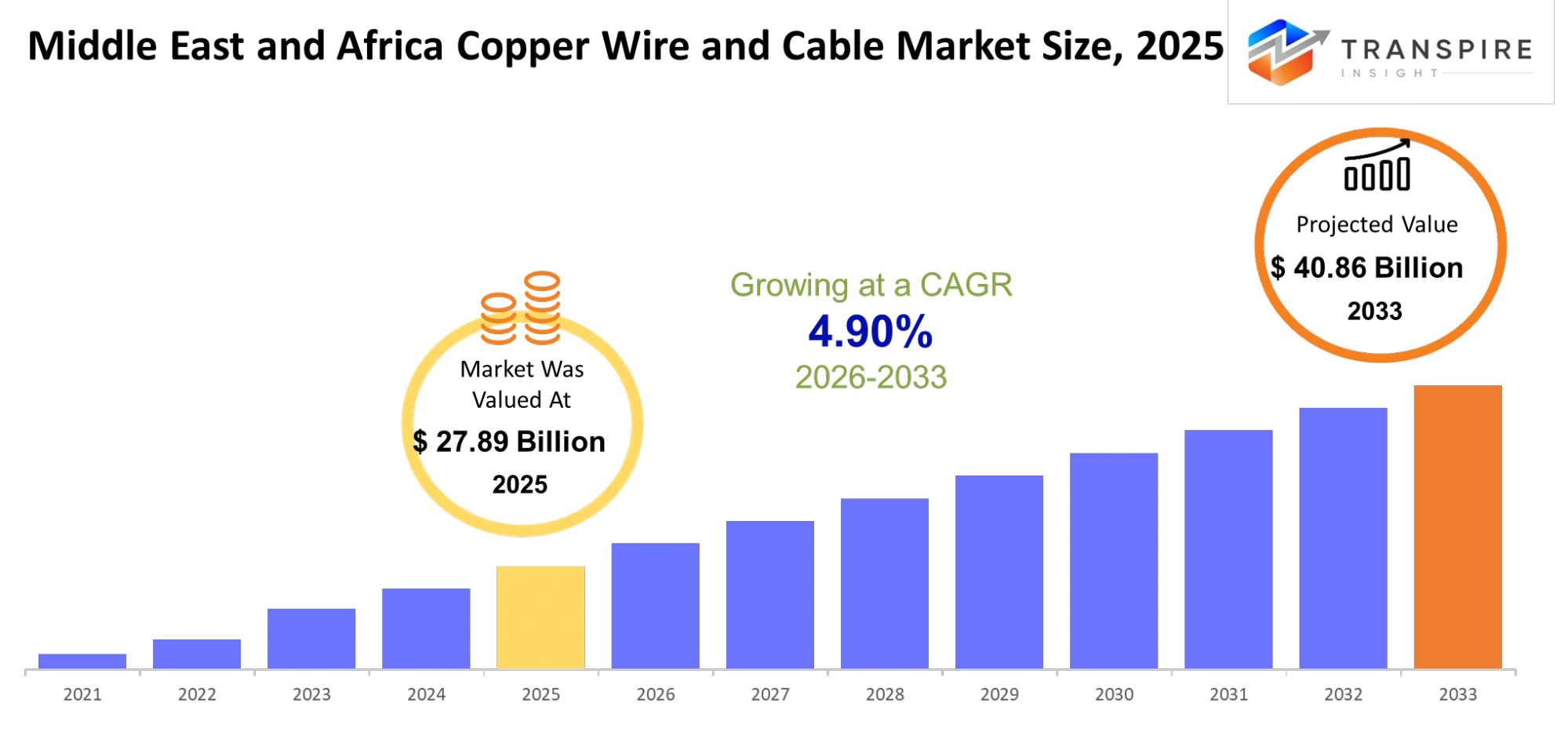
- Middle East and Africa Copper Wire and Cable Market Size 2025: USD 27.89 Billion
- Middle East and Africa Copper Wire and Cable Market Size 2033: USD 40.86 Billion
- Middle East and Africa Copper Wire and Cable Market CAGR: 4.90%
- Middle East and Africa Copper Wire and Cable Market Segments: By Type (Power, Communication, Instrumentation), By Voltage (Low, Medium, High), By Insulation (PVC, XLPE), By Installation (Overhead, Underground), By Application (Energy, Telecom), By End-User (Utilities, Industrial Manufacturers, Construction Companies, Telecom Operators)
To learn more about this report,  Download Free Sample Report
Middle East and Africa Copper Wire and Cable Market Summary:
The Middle East and Africa Copper Wire and Cable Market size is estimated at USD 27.89 Billion in 2025 and is anticipated to reach USD 40.86 Billion by 2033, growing at a CAGR of 4.90% from 2026 to 2033. The Middle East & Africa (Saudi Arabia, UAE, South Africa, Rest of Middle East & Africa) copper wires and cables market is part of the overall electric infrastructure and energy transmission market, in which the demand would grow in line with the growth in urbanization and digitization. In the given region, consumers would increasingly opt for more efficient materials due to their preference for reliable power delivery and future-proofing against smart grids.In Saudi Arabia and UAE, the demand for durable and heat-resistant cables would be influenced by their extensive construction and incorporation of renewable energy. For South Africa, there will be a gradual adaptation of the market because of attempts to make improvements in the transmission of power by upgrading the power grid. In other parts of the region, there will be increasing consumer adaptation to the standards of quality.
What Has the Impact of Artificial Intelligence Been on the Middle East and Africa Copper Wire and Cable Market?
The implementation of artificial intelligence throughout the Middle East and Africa copper wire and cable industry enables organizations to make strategic and operational decisions through data-based insights. Artificial intelligence will improve market research in the Middle East and Africa copper wire and cable industry by analyzing large datasets to discover consumer patterns and demand indicators that standard research techniques fail to detect. Businesses will gain the capability to enhance forecasting precision by obtaining tools to forecast infrastructure requirements and respond to evolving customer demands.
The businesses operating in the Middle East and Africa copper wire and cables market will ensure operational efficiency via the use of artificial intelligence technology because they will adopt machine learning technologies to optimize their manufacturing processes.
The Middle East and Africa copper wire and cable market will gain from artificial intelligence-driven innovations who create custom solutions that increase operational efficiency.Companies will use intelligent systems to design application-specific cables which will help them adapt their products according to new regulatory requirements while they keep their market advantage.
Key Market Trends & Insights:
- Saudi Arabia is at the helm of the Middle East and Africa copper wire and cables market share at almost 28%, due to its investment in infrastructure.
- The UAE region is growing at the highest rate with 7+ percent CAGR owing to its investments in renewable energy and smart cities.
- Low-voltage cables capture the largest share of above 45% in 2025, due to the increased need for residential and commercial construction.
- Medium voltage cables represent the second biggest share in the market, thanks to industrial and grid expansion.
- High voltage cables represent the fastest-growing segment, set to register a sharp growth through 2030.
- Applications related to power transmission and distribution represent more than 52% market share, as a result of constant grid modernization.
- Renewable energy applications are identified as the fastest growing application, backed by strong developments within solar and wind power across the Middle East and Africa copper wire and cable market.
- Utilities represents the leading industry application, capturing over 48% market share in 2025.
Middle East and Africa Copper Wire and Cable Market Segmentation
By Type
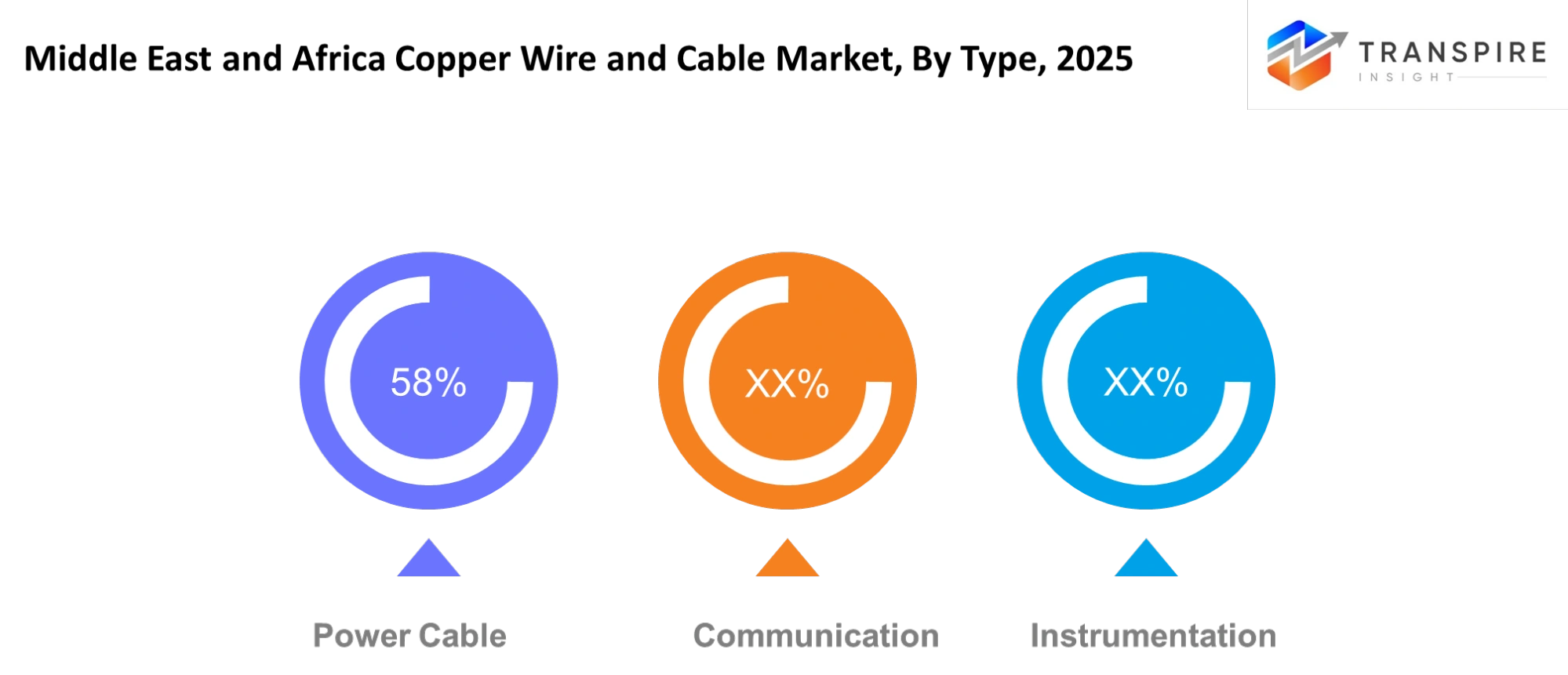
Power cables will be indispensable for electricity transmission and for building stable, strong infrastructure across multiple nations. There will be an increase in communication cables as data consumption grows, driven by the development of broadband internet and other digital services. Instrumentation cables will be needed because they will have applications in industry. The types will be used for different purposes, but all of them will support the increasing demands for electricity and connectivity.
There will be a trend towards more usage of communication cables in urban centers because of the growth of digital infrastructure. There will still be high demand for power cables, due to the development of energy infrastructure. In industries, instrumentation cables will see an increase in demand, because of automation.
To learn more about this report, Download Free Sample Report
By Voltage
The low voltage cables will enable construction works in residential and commercial sectors and therefore have high usage in both urban and semi-urban environments. The medium voltage cables will help greatly with the functioning of industries and power distribution networks. The high voltage cables will enable power transmission to distant areas from the source.
The demand for the low voltage cables will stay constant due to the ongoing construction activities. The medium voltage cables will be highly demanded due to the expansion of the industrial zones. The high voltage cables will gain much attention as more power transmission projects continue.
By Insulation
Use of PVC insulation material will still be popular since it is affordable and applicable in most common uses. Use of XLPE insulation will increase owing to the fact that it offers greater thermal resistance and performs well in harsh conditions. Materials choice will depend on many factors including durability, cost, and safety.
PVC insulation material will still be favored owing to the fact that it is cheap and works well in low cost and short distance projects. XLPE insulation material will be favored in high end projects like industrial work and high voltage.
By Installation
Overhead transmission lines will be implemented in those places where cost-effectiveness and maintenance become paramount. On the other hand, underground cables will be used in urban environments where space limitations and safety are major considerations. Both methods will present their own benefits depending on the geography, cost, and future planning for infrastructure development.
The use of overhead transmission lines will become common in areas with low population density. The use of underground cables will grow in urban areas because they provide better safety and visual appeal. Future projects for modernizing infrastructure will likely prefer underground cables.
By Application
Energy applications will dominate usage due to the ongoing need for electricity generation, transmission, and distribution. Telecom applications will grow with increasing demand for high-speed connectivity and digital services. Both sectors will drive consistent demand, supported by infrastructure investments and technological upgrades. The balance between these applications will reflect economic and digital development.
Energy-related demand will remain strong due to grid expansion and renewable projects. Telecom applications will rise with data usage and network upgrades. Investment in fiber and communication systems will support this growth. These applications will highlight the dual focus on power and connectivity.
By End-User
Utility companies will be the first to set demands because of power transmission projects. The industrial manufacturing sector will have an increase in demand due to cable requirements for its operations. There will be increased demand from construction companies. Telecom firms will drive greater demand for network expansion projects.
Utilities will remain influential in the industry because of ongoing investments in energy systems. Industrial manufacturing will drive demand further due to automation trends. Construction companies will boost demand in this market because of urbanization. Telecommunication will escalate demand in the sector.
What are the Main Challenges for the Middle East and Africa Copper Wire and Cable Market Growth?
Technical limitations and logistics continue to create barriers to expanding the Middle East and Africa copper wire and cable market. Issues related to performance, such as high temperature resistance, ability to withstand extreme weather conditions, and lack of maintenance often become apparent. Logistics problems, such as sourcing the required copper or delivering products to consumers, affect efficiency and create supply chain fluctuations. The problem of scaling is faced by companies that work with different geographical locations.
Problems that arise during manufacturing and marketing keep preventing further growth in the Middle East and Africa copper wire and cable market. Stringent manufacturing practices along with safety issues make it difficult and expensive to get started in the market. Fluctuating prices of copper and other raw materials add extra costs and low profits for businesses.
It is clear that adoption issues will persist due to lack of infrastructure and technology among other reasons in some underdeveloped regions. The Middle East and Africa copper wire and cable market experiences limitations because of old-fashioned power grids and inadequate funds needed for modernization. Lack of trained workers and inability to use sophisticated installation equipment also inhibit the efficiency of adoption, especially in rural and semi-urban settings.
Market restrictions are also caused by stiff competition from other sources of wires like aluminum wires, which can be adopted more cheaply. Financial considerations, changing regulations, and technology upgradation are other factors that contribute to future uncertainties, especially in the Middle East and Africa copper wire and cable market.
Country Insights
The market for copper wire and cable in the Middle East and Africa will demonstrate mixed performance depending on investment and energy consumption. The leading region will be Saudi Arabia because of its high expenditure on power generation and urbanization. United Arab Emirates will be the next due to the development of its cities and renewables. South Africa will be focused on grid development and revitalizing industries.
Other regions in the Middle East and Africa will experience gradual development in this market with backing from electrification and telecommunications sectors. The development pace will differ due to different economies and policies. Nevertheless, there is a positive trend related to governments' priority in improving connectivity and ensuring electricity supplies.
Higher consumption will be observed in urban areas because of increased construction and need for advanced information technologies. Rural zones will also develop due to initiatives for providing residents with electricity. The dynamics of the market will depend on the governmental policy, foreign investments, and implementation of projects.
Recent Development News
In Apr 2026, Codelco reported rising production costs. The company stated that ongoing Middle East conflict increased copper production costs by at least $0.10 per pound, impacting global supply economics.https://www.reuters.com/
In Apr 2026, CMOC, Glencore, and Eurasian Resources Group faced supply disruptions. Copper and cobalt miners in the Democratic Republic of Congo reduced chemical usage due to shipment delays linked to geopolitical tensions, affecting production stability.https://www.reuters.com/
|
Report Metrics |
Details |
|
Market size value in 2025 |
USD 27.89 Billion |
|
Market size value in 2026 |
USD 29.23 Billion |
|
Revenue forecast in 2033 |
USD 40.86 Billion |
|
Growth rate |
CAGR of 4.90% from 2026 to 2033 |
|
Base year |
2025 |
|
Historical data |
2021 - 2024 |
|
Forecast period |
2026 - 2033 |
|
Report coverage |
Revenue forecast, competitive landscape, growth factors, and trends |
|
Regional scope |
Middle East and Africa (Saudi Arabia, United Arab Emirates, South Africa, Rest of Middle East and Africa) |
|
Key company profiled |
Prysmian, Nexans, Southwire, LS Cable, Sumitomo Electric, Furukawa Electric, General Cable, KEI Industries, Polycab, Belden, Encore Wire, Finolex, Riyadh Cables, Elsewedy Electric, Ducab |
|
Customization scope |
Free report customization (country, regional & segment scope). Avail customized purchase options to meet your exact research needs. |
|
Report Segmentation |
By Type (Power, Communication, Instrumentation), By Voltage (Low, Medium, High), By Insulation (PVC, XLPE), By Installation (Overhead, Underground), By Application (Energy, Telecom), By End-User (Utilities, Industrial Manufacturers, Construction Companies, Telecom Operators) |
How Can New Companies Establish a Strong Foothold in the Middle East and Africa Copper Wire and Cable Market?
New companies aiming to enter the Middle East and Africa copper wire and cable market will need a focused and well-planned strategy to stand out in a competitive landscape. New market entrants will achieve better results through niche market entry which includes renewable energy cables and fire-resistant wiring and smart city infrastructure solutions. The specialized industry areas enable emerging companies to serve actual market requirements while they establish their foothold in the Middle East and Africa copper wire and cable market.
Innovation will play a key role in gaining traction through advanced materials and smart monitoring technologies. Companies can introduce cables with improved heat resistance and longer life cycles and integrated sensors for real-time performance tracking. Startups that develop AI-enabled cable monitoring systems will demonstrate how technology differentiation creates a competitive edge similar to Elsewedy Electric's innovation-driven divisions and smaller regional firms. The market growth plans will benefit from innovation strategies which attract infrastructure developers to their projects.
The establishment of strategic partnerships will enable market entry by linking new companies with local distributors and construction firms and energy providers. Market reach will improve through collaborations which will help supply chain problems and regulatory restrictions. Companies who partner with government-supported projects and telecom expansion initiatives will gain quick access to major business opportunities in the Middle East and Africa copper wire and cable market while establishing long-term credibility.
New entrants need to address actual industry challenges which include power network failures and expensive maintenance and inefficient installation processes. Companies that provide durable and affordable cable solutions which require simple installation will experience increased customer adoption. This practical approach will enable sustainable growth and help new players secure a strong foothold in the Middle East and Africa copper wire and cable market.
Key Middle East and Africa Copper Wire and Cable Market Company Insights
It is expected that competition in the market for copper wire and cable in the Middle East and Africa would be high, especially due to the availability of a large number of regional and foreign companies that concentrate on product quality, cost, and availability.
Strategic alliances and expansion in regional markets will play an important role in the competitiveness of various countries like Saudi Arabia, UAE, and South Africa, among others. Establishment of local factories will lower production costs and facilitate product supply. Innovation in fireproof and high-performing cables will contribute to building brand image. Pricing and availability will be the main determinants of market success.
Moreover, long-term business associations will be beneficial in obtaining sustainable sales and profitability through the use of agreements with utility providers and construction firms. Adherence to health and safety requirements will also be important in building a credible image. Higher levels of competition will prevail following the entry of additional market players offering cheaper goods.
Company List
- Prysmian
- Nexans
- Southwire
- LS Cable
- Sumitomo Electric
- Furukawa Electric
- General Cable
- KEI Industries
- Polycab
- Belden
- Encore Wire
- Finolex
- Riyadh Cables
- Elsewedy Electric
- Ducab
What are the Key Use-Cases Driving the Growth of the Middle East and Africa Copper Wire and Cable Market?
Demand for copper wire and cable in the Middle East and Africa is rising steadily due to strong growth opportunities in power transmission and distribution applications. Conductivity and robustness are very important characteristics of this product for these uses. With the growing need to expand power distribution networks and renewable energy infrastructure, such as solar and wind power plants, this type of cable becomes critical.
Another important factor driving the Middle East and Africa copper wire and cable market is construction activities. In the modern world, construction needs cannot be fulfilled without the use of quality wiring solutions, because not only is this essential for safety but it is needed for energy-efficient constructions that use smart technology. For example, low voltage cables are required for lighting and HVAC installations.
The telecom and data network will also play an increasingly important part, where increased internet connectivity and the implementation of 5G will require the use of communication wires. There will be additional support coming from the manufacturing industry in terms of automation and equipment, which will utilize reliable cables that can withstand extreme conditions. Finally, there will be increased demand coming from the healthcare sector for improvements to its infrastructure, where reliable electricity supply and wiring will be crucial.
Middle East and Africa Copper Wire and Cable Market Report Segmentation
By Type
- Power
- Communication
- Instrumentation
By Voltage
- Low
- Medium
- High
By Insulation
- PVC
- XLPE
By Installation
- Overhead
- Underground
By Application
- Energy
- Telecom
By End-User
- Utilities
- Industrial Manufacturers
- Construction Companies
- Telecom Operators
Frequently Asked Questions
Find quick answers to common questions.
The approximate Middle East and Africa Copper Wire and Cable Market size for the market will be USD 40.86 Billion in 2033.
Key segments for the Middle East and Africa Copper Wire and Cable Market are By Type (Power, Communication, Instrumentation), By Voltage (Low, Medium, High), By Insulation (PVC, XLPE), By Installation (Overhead, Underground), By Application (Energy, Telecom), By End-User (Utilities, Industrial Manufacturers, Construction Companies, Telecom Operators).
Major Middle East and Africa Copper Wire and Cable Market players are Prysmian, Nexans, Southwire, LS Cable, Sumitomo Electric, Furukawa Electric, General Cable, KEI Industries, Polycab, Belden, Encore Wire, Finolex, Riyadh Cables, Elsewedy Electric, Ducab.
The Middle East and Africa Copper Wire and Cable Market size is USD 27.89 Billion in 2025.
The Middle East and Africa Copper Wire and Cable Market CAGR is 4.90%.
- Prysmian
- Nexans
- Southwire
- LS Cable
- Sumitomo Electric
- Furukawa Electric
- General Cable
- KEI Industries
- Polycab
- Belden
- Encore Wire
- Finolex
- Riyadh Cables
- Elsewedy Electric
- Ducab
Recently Published Reports
-
Dec 2024
Healthcare Polymer Packaging Market
Healthcare Polymer Packaging Market Size, Share & Analysis Report By Packaging Type (Syringes, IV Bottles and Pouches, Clamshells, Blisters, Bottles & Jars, Containers, Tubes, IV Parental Packaging, Others), By Type (Regulated, Non-regulated), By Polymer Type (LDPE (Low-Density Polyethylene), HDPE (High-Density Polyethylene), Homo-polymer (Homo), Random Copolymer (Random), Block Copolymer (Block), PET, Polystyrene, Polyvinyl Chloride, Polyamide/EVOH, Others), and Geography (North America, Europe, Asia-Pacific, Middle East and Africa, South and Central America), 2021 - 2031
-
Jan 2025
Hydrophilic Tape (Waterstop) Market
Hydrophilic Tape (Waterstop) Market Size, Share & Analysis Report By Type (Bentonite-Based Hydrophilic Tape, Rubber-Based Hydrophilic Tape), By Application (Residential Buildings, Commercial Buildings, Infrastructure Projects), and Geography (North America, Europe, Asia-Pacific, Middle East and Africa, South and Central America), 2021 - 2031
-
Jan 2025
Metalens Market
Metalens Market Size, Share & Analysis Report By Type (Visible Light Metalens, and Infrared Metalens), By Application (Consumer Electronics, Automotive Electronics, Industrial, Medical, and Others), and Geography (North America, Europe, Asia-Pacific, Middle East and Africa, South and Central America), 2021 - 2031
-
Jan 2025
PBT Resin Market
PBT Resin Market Size, Share & Analysis Report By Type (Reinforced PBT Resin, Unreinforced PBT Resin), By Processing Method (Injection Molding, Extrusion, Blow Molding, Others), By End-User (Automotive, Electrical & Electronics, Consumer Appliances, Industrial Machinery, Medical Devices, Packaging, Others), and Geography (North America, Europe, Asia-Pacific, Middle East and Africa, South and Central America), 2021 - 2031