
Asia Pacific Hot Rolled Coil Steel Market Size & Forecast:
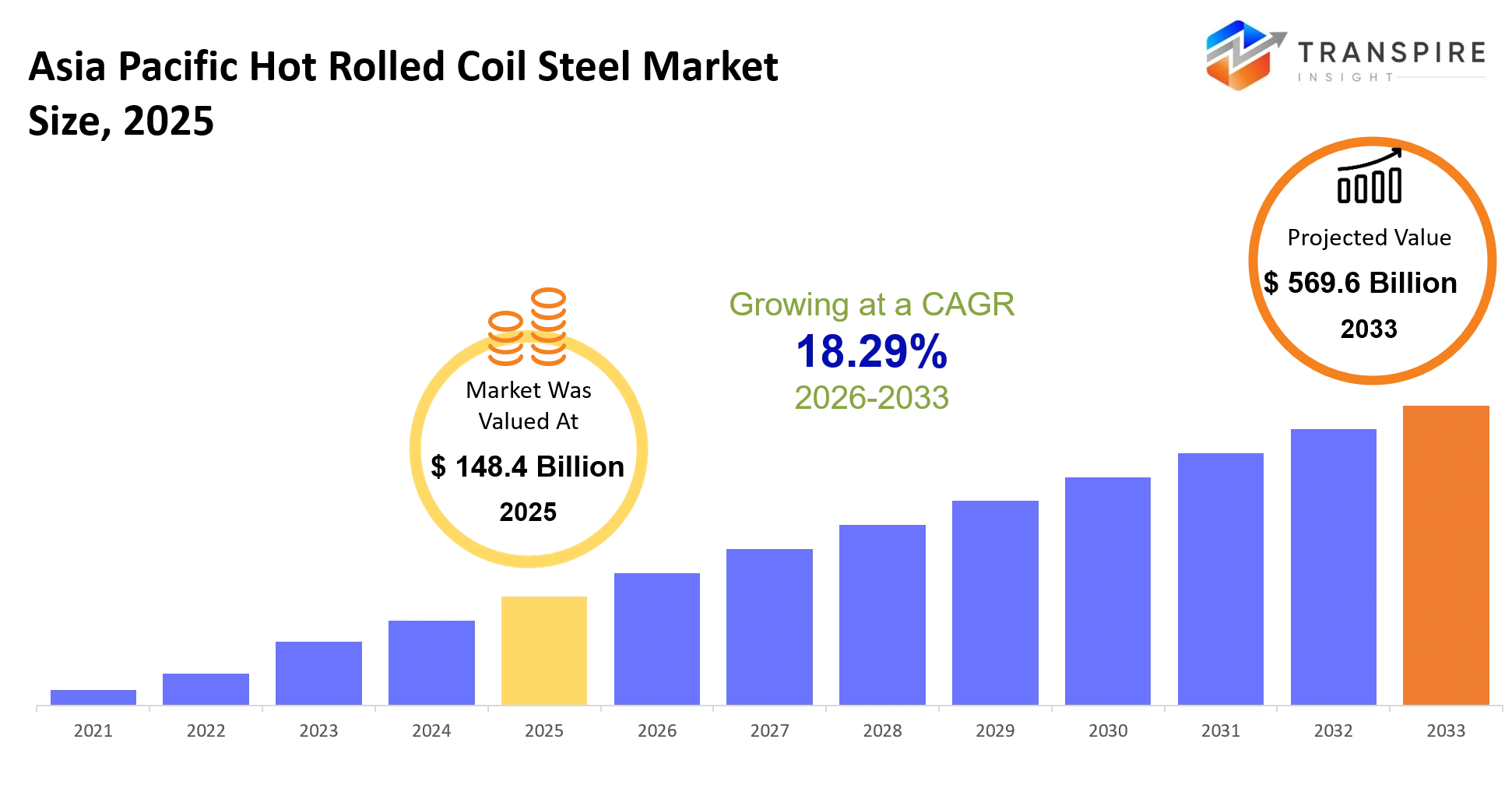
- Asia Pacific Hot Rolled Coil Steel Market Size 2025: USD 148.4 Billion
- Asia Pacific Hot Rolled Coil Steel Market Size 2033: USD 569.6 Billion
- Asia Pacific Hot Rolled Coil Steel Market CAGR: 18.29%
- Asia Pacific Hot Rolled Coil Steel Market Segments: By Product Type (Commercial Grade, Structural Grade, HSLA Steel, Pickled HRC, Alloy HRC, Others); By Thickness (Below 3mm, 3–6mm, 6–12mm, Above 12mm, Others); By Application (Construction, Automotive, Shipbuilding, Machinery, Energy, Others); By End User (Construction Firms, OEMs, Industrial Users, Others)
Asia Pacific Hot Rolled Coil Steel Market Summary
The Asia Pacific Hot Rolled Coil Steel Market was valued at USD 148.4 Billion in 2025. It is forecast to reach USD 569.6 Billion by 2033. That is a CAGR of 18.29% over the period.
The Asia Pacific Hot Rolled Coil steel market is the foundation of construction, hull plates, automobile framework, pipelines and heavy industrial machines which demand strengths, formability, and economic viability of downstream production. Within the past five years, structural change of the market is tending towards higher-grade and niche application coil products since the producers adjust their supply chains to the electric vehicle platforms, infrastructure replacement schemes.
During this period, supply chains are separated and fragmented as a result of post-pandemic issues, the shortage of transportation revealed dependence on steel clusters, so the region's capacity has become much increased and more localization for sourcing. What's more, the volatility of energy and coking coal prices caused by geopolitical issues had pushed the producers and buyers to strengthen domestic sourcing and obtain long-term agreements. Consequently, it led to slower demand cycles driven by volume but rather by industrial policy and domestic production ecosystem, and consequently steady uptake of demand for integrated steelmakers and adoption acceleration of higher-value hot rolled coil products.
Key Market Insights
- The Chinese market captures more than 50% of Asia Pacific Hot Rolled Coil Steel Market shares by virtue of huge steel integration and export-driven manufacturing capacity.
- The growth in India is estimated to be the fastest over the forecast period and will increase with higher infrastructure expenditure and rising automobile manufacturing capacity with favorable national industrial policies.
- The Southeast Asia market demand is set to rise with manufacturing diversification efforts and outsourcing of manufacturing facilities from the China supply chain by the phenomenon of near-shoring.
- Hot rolled coil plates within the size of 3 to 12 mm segment accounts for major share and is widely used in construction works, pipeline and structure manufacturing.
- The segment Standard carbon steel coils accounted for the second biggest share, due to its widespread utility in industries coupled with its cost-effective nature.
- High-strength low-alloy coils segment is estimated to be the fastest-growing segment during the period 2025-30, driven by growing demand for EV and lightweight engineering requirements.
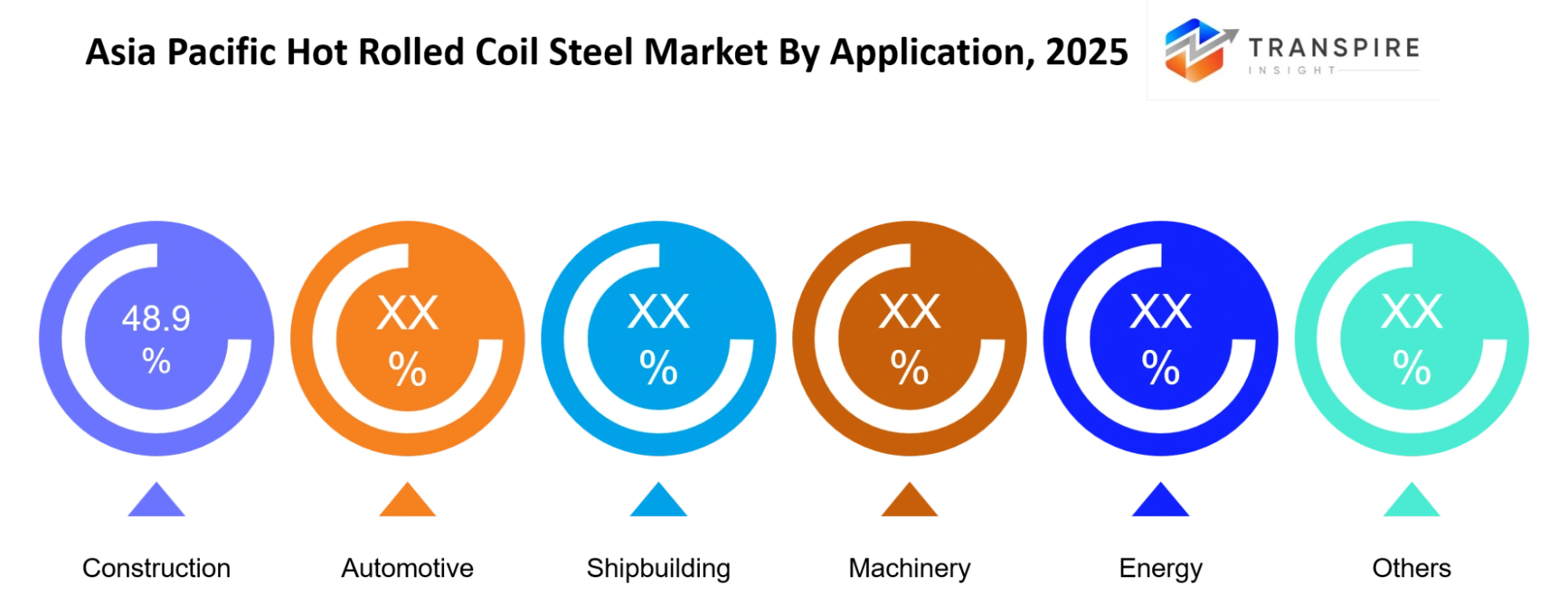
- The construction and infrastructure sector represents approximately 40% of the applications driven by urban transport, bridges, and industrial infrastructure.
- Automotive manufacturing is the fastest growing application for steel grades driven by requirements for lightweight and high-durable grades.
- Construction is the largest share of end-user application due to continued infra development throughout Asia-Pacific countries.
- OEMs (Automotive) are the fastest growing end-user because of EV platform scaling and localized networks of manufacturing.
What are the Key Drivers, Restraints, and Opportunities in the Asia Pacific Hot Rolled Coil Steel Market?
The most significant growth stimulant of the Asia Pacific Hot Rolled Coil Steel Market is industrialization and large-scale infrastructure across China, India and Southeast Asia. Government supported development of transportation corridors, urban housing and pipelines have created sustainable purchasing volumes that immediately increase steel mill utilization and contractual cash flow stability for integrated producers.
The main market restraint is the continued volatility of raw material prices and energy, especially the fluctuating cost of iron ore and coking coal as a result of export restraints and geopolitical events. This intrinsic instability in structural costs is impeding predictable long-term contract negotiations and creating prolonged buying hesitations in cost sensitive segments which squeeze already thin margins of non-vertically integrated mid-tier manufacturers.
The most important growth driver is expansion of the EAF, green steel segments and investment into new generation technologies like hydrogen based production and increased scrap availability through enhanced collection systems which are encouraged through carbon neutrality targets across Japan, South Korea and China. This enables a price premium, especially in the automotive segment with OEMs keenly working on low carbon steel sources.
What Has the Impact of Artificial Intelligence Been on the Asia Pacific Hot Rolled Coil Steel Market?
AI is a force in revolutionizing the Asia Pacific Hot Rolled Coil Steel Market. AI technologies and systems are deployed in smart furnace temperature and rolling pressure controls as well as for automated processing for maintaining coil thickness uniformity in blast furnace systems, and thereby enhancing production yield and reducing material defects in the large scaled hot rolled coil production plants.
Machine learning models are increasingly being applied on large sized industrial machinery for predictive maintenance; for blast furnaces and rolling machines, allowing maintenance and operators to anticipate machinery breakdowns in advance so as to decrease production downtime, these are implemented in automated steel complexes in China, Japan, South Korea, and such.
Artificial intelligence based supply chain forecasting also enables steelmakers to achieve better inventory management and synchronize their production activities with demand fluctuations of the construction and auto industries, thereby creating a significant decrease in the energy consumption in some of the integrated steel plants, and has been linked to increases in operational throughput. High implementation costs and non-uniformity in data quality are challenges for these integrated steel plants, which usually contain many older plants without unified sensor networks
Key Market Trends
- China has gradually given ground with share decreasing from >55% earlier to <50% as India and SEA build more localized steel capacity.
- Between 2020 and 2025 Japanese and Korean mills moved away from commodity grades and more towards high strength grades for automotive lightweighting.
- Geopolitical disruptions post 2022 have pushed ~30% of regional buyers to multi-country sourcing in lieu of their single-country procurement strategy.
- Increase in infrastructure spending has ramped up the consumption intensity of HR coil consumption by >20% in India since 2021 (rail, housing, energy).
- OEMs moved towards high strength low alloy coil after 2023 in their procurement based on crashworthiness and EV platform weight reduction.
- Acceleration in adoption of EAF has happened after 2021 and its share of capacity continues to grow driven by carbon compliance concerns across APAC.
- Intra- Asia steel flows have increased in 2022-2024, post intensification of trade policy, with reduced dependence on long haul exports from traditional surplus producing regions.
- Digital mill automation gained traction post 2020 with significant application of AI driven process control, which has led to reductions of defects by 15% at advanced steel mills.
- End-users moved away from spot procurement to longer term fixed contracts post the volatility in raw material price environment during 2021-2024.
- The competitive advantage of players such as Baowu Steel Group and POSCO will continue to be defined more on low-carbon steel offerings instead of plain capacity expansions.
Asia Pacific Hot Rolled Coil Steel Market Segmentation
By Product Type :
Commercial grade HR coil steel is still a large product in use due to low price and stable demand across a range of simple fabrication jobs. Structural grade steel has more growth from 2021, as government investment in infrastructure in construction projects ramped up. Demand for HSLA steel has accelerated since 2022 on the back of automotive lightweighting demands and stringent safety specifications being used in vehicle designs. Usage of Pickled HRC has risen as well for use in manufacturing processes where consistent surface finish is critical for subsequent work.
Alloy hot rolled coil steel use has been growing slowly as industries sought more robust steel types for their machinery and energy equipment. Other more specialized grades continue to be consumed for niche industrial uses where corrosion resistance and longevity are primary performance characteristics required. Overall product mix trended towards higher-performance grades, but traditional commercial steel will still be utilized extensively in price-sensitive applications, particularly throughout Asia Pacific markets.
By Thickness :
The usage of HR coil steel between 6 and 12mm thickness is still the largest segment that caters to a broad range of construction and structural needs. Demand below 6mm of HR coil steel, more specifically between 3-6mm has risen steadily since 2020 and will likely continue to climb on the back of increasing automotive and fabrication sectors. The below 3mm segment of HR coil steel is also growing, particularly among precision manufacturing applications where reduced material weight and reduced size of materials used becomes critical to efficiency and cost management.
HR coil steel thickness above 12mm is consumed in a broad range of industrial applications such as heavy structural uses, energy projects, as well as foundation for large infrastructure works. Other custom thickness sections also serve industry specific designs. The Asia Pacific Hot Rolled Coil Steel market will also see production and output adjust to more specific thickness demands of specific projects, moving away from general bulk output.
By Application :
The application for construction still takes up the largest share as building activities and infrastructure developments (transport corridors, residential housing) in major economies proceed and expand. Demand from the automotive sector grew considerably from 2022 with the accelerating adoption of electric vehicle models, prompting manufacturers' needs for higher strength and lightweight steel input. Machinery applications have also been on the rise because of developing countries' widening manufacturing bases.
Energy sector application demand has expanded following the growth of renewable energy infrastructure and power grid expansions. Ship building uses still count on the durable quality of the coil steel input for ship body and structures. General fabrication works and other applications make up other markets. The pattern of the demand structure of the Asia Pacific Hot Rolled Coil Steel Market has changed to one more geared toward industrial-specific applications instead of traditional demand solely from the construction sector.
By End User :
Construction companies have consistently been major end users of HRC due to ongoing development of infrastructure facilities and government projects. OEMs' consumption has accelerated rapidly since 2021 due to the shifting of automotive and equipment production toward localized supply chain models in Asia Pacific. Industrial end users maintain a strong demand due to the demand for producing machinery and large-scale industrial equipment.
Small fabricating units and specialized engineering industries which need custom input will be included into 'other end users'. End users are likely to move toward a contractually secured procurement scheme instead of short-term one as they attempt to secure steady supply against possible price volatility, and this has become more of the current buying behavior of end users in the Asia Pacific Hot Rolled Coil Steel Market.
What are the Key Use Cases Driving the Asia Pacific Hot Rolled Coil Steel Market?
Construction and Infrastructure remains the predominant application driving the Asia Pacific Hot Rolled Coil Steel Market. Robust demand in this sector is fueled by the increasing number of bridges, highway systems, factories and residential housing that rely on structural stability and cost-effectiveness to provide adequate housing, transportation, industrial space, etc. Large public investment plans in India, China and Southeast Asia are helping to maintain high levels of consumption for this sector.
Automotive Manufacturing and Industrial machinery are growing secondary applications. As more manufacturing returns home in response to ongoing supply-chain disruption, the production volumes of automotive frames, car bodies and industrial machinery components is on the rise. Demand from the energy sector for industrial pipelines and renewable energy generation structures is also steady for industrial consumers in the region.
Electric vehicle platforms and modular construction systems are emerging use cases. As EV production increases the market will look for stronger and lighter steel for chassis frames, as well as other vehicle structural elements. Prefabricated buildings also call for higher production speeds for steel framing, an aspect the steel producers in the region may be able to leverage.
|
Report Metrics |
Details |
|
Market size value in 2025 |
USD 148.4 Billion |
|
Market size value in 2026 |
USD 175.8 Billion |
|
Revenue forecast in 2033 |
USD 569.6 Billion |
|
Growth rate |
CAGR of 18.29% from 2026 to 2033 |
|
Base year |
2025 |
|
Historical data |
2021 - 2024 |
|
Forecast period |
2026 - 2033 |
|
Report coverage |
Revenue forecast, competitive landscape, growth factors, and trends |
|
Regional scope |
Asia Pacific (India, China, Japan, Australia, South Korea, Rest of Asia Pacific) |
|
Key company profiled |
ArcelorMittal, Nippon Steel, POSCO, Baowu Steel, JFE Steel, Tata Steel, JSW Steel, Hyundai Steel, BlueScope, Nucor, SSAB, HBIS, Shagang, Ansteel, Gerdau |
|
Customization scope |
Free report customization (country, regional & segment scope). Avail customized purchase options to meet your exact research needs. |
|
Report Segmentation |
By Product Type (Commercial Grade, Structural Grade, HSLA Steel, Pickled HRC, Alloy HRC, Others); By Thickness (Below 3mm, 3–6mm, 6–12mm, Above 12mm, Others); By Application (Construction, Automotive, Shipbuilding, Machinery, Energy, Others); By End User (Construction Firms, OEMs, Industrial Users, Others) |
Which Regions are Driving the Asia Pacific Hot Rolled Coil Steel Market Growth?
China, by virtue of its large integrated steel ecosystem and state-supported industrial policy, is leading the Asia Pacific Hot Rolled Coil Steel Market. Significant investments in infrastructure construction projects, highly concentrated manufacturing bases, and well developed port logistic infrastructure contribute to the steady consumption of hot rolled steel. Constructionmegaprojects and automanufacturing base centers located in the coastal industrial area also support steel consumption. As such,China can maintain its production scale and high exporting power.
The developed but steadily participating economy of Japan is differentiated from China by its high precision manufacturing requirement for high quality steel. Automobile engineering, electronic manufacturing and shipbuilding are dependent on reliable steel with standard qualities and stable production. Japan is a reliable contender, whose long-term stable production plans under stricter emissions regulations and energy efficiency requirements create its stable demands.
India's economy shows the strongest growth as infrastructure projects increased rapidly, and policies ofLocalization of the industrial system after2021were promoted. Steel consumption grows quickly from infrastructure improvement on new highway routes, railway upgrades, and urban house constructions. Industrialization has grown rapidly under government stimulus which further boosts the capacity of the Indian automotive and machinery industry. This market has the biggest chance between2026and2033.
Who are the Key Players in the Asia Pacific Hot Rolled Coil Steel Market and How Do They Compete?
The Asia Pacific Hot Rolled Coil Steel market is characterized by moderately consolidated competition in which major production capacities are accounted for by large, integrated steel makers across major countries. Market shares and competitive advantages are derived through cost-effectiveness, resource availability, and proximity to downstream markets. Incumbents use long-term agreements with automobile, construction and infrastructure customers to guard market share, while regional steel makers use price variability and local supply benefits to compete.
Baowu Steel Group is building a cost leadership strategy through scale driven by immense integrated manufacturing capacity and strong ties to the Chinese domestic market. It benefits from large-capacity blast furnace operations, coupled with strong forward integration into the construction and industrial purchasing markets throughout China. Its strategy of continuous expansion will involve increased capacity utilization and low-carbon steelmaking technology in conjunction with China's national industrial strategy.
POSCO has maintained its competitive stance through material innovation, such as specialized high-strength and corrosion-resistance steel, primarily targeting automobile and energy customers. Its key differentiation advantage is through advanced metallurgical know-how, with established connections with automobile manufacturers worldwide. It pursues growth opportunities through foreign investments in manufacturing facilities, and technical collaboration in low-emission steelmaking technology.
Tata Steel and JSW Steel have established market leadership in their segment through an increase in domestic capacity utilization and backward integration to enhance supply chain control over the surging Indian construction demand. Both firms build competitiveness by leveraging proximity to the rapidly growing construction and automobile markets and investing in plant expansion and downstream manufacturing capabilities and signing long-term contracts with industrial buyers.
Company List
- ArcelorMittal
- Nippon Steel
- POSCO
- Baowu Steel
- JFE Steel
- Tata Steel
- JSW Steel
- Hyundai Steel
- BlueScope
- Nucor
- SSAB
- HBIS
- Shagang
- Ansteel
- Gerdau
Recent Development News
In April 2026, Nippon Steel announced a merger integration involving Sanyo Special Steel Co., strengthening its control over downstream specialty steel production and improving coordination for hot rolled coil-linked value chains. The move enhances its ability to supply automotive and industrial steel with tighter quality control and reduces internal production fragmentation across Asia-focused operations. Source https://www.nipponsteel.com/
In August 2025, JSW Steel and POSCO agreed to explore a 6 MTPA integrated steel plant joint venture in India. The collaboration aims to expand long-term hot rolled coil capacity and strengthen regional supply chain integration across Asia Pacific.
Source https://economictimes.indiatimes.com/
What Strategic Insights Define the Future of the Asia Pacific Hot Rolled Coil Steel Market?
The Asia Pacific Hot Rolled Coil Steel Market is transitioning structurally to a value-driven and compliance-focused production model over the coming 5-7 years due to pressure for industrial decarbonisation and the rise of manufacturing nearshoring, with demand increasingly driven by infrastructure resilience initiatives and automotive electrification over construction-led demand cycles. The procurement of steel will therefore move towards certified high strength steel grades with lower carbon intensity, which command premium pricing.
A more hidden risk to this transition involves concentrated raw material supply, namely, reliance upon a small number of suppliers for the iron ore and coking coal used by much of the region. Price shocks caused by such supply-concentrated raw materials, or any interruption to supply for whatever reason, will be more acutely felt in a strong demand environment than suggested by current headlines, translating to significant and non-obvious margin volatility.
The obvious opportunity will be the advent of a new type of product: low-carbon hot rolled coil steel. This will be produced by Japanese and South Korean companies using hydrogen or electric arc furnace technology to create a more sustainable alternative, and pilot scale commercial production is already emerging due to governmental support. Market players should not underestimate the significance of investing in clean steel production capacity and forming long-term supply relationships with automobile manufacturers.
Asia Pacific Hot Rolled Coil Steel Market Report Segmentation
By Product Type
- Commercial Grade
- Structural Grade
- HSLA Steel
- Pickled HRC
- Alloy HRC
By Thickness
- Below 3mm
- 3–6mm
- 6–12mm
- Above 12mm
By Application
- Construction
- Automotive
- Shipbuilding
- Machinery
- Energy
By End User
- Construction Firms
- OEMs
- Industrial Users
Frequently Asked Questions
Find quick answers to common questions.
The Asia Pacific Hot Rolled Coil Steel Market size is USD 569.6 Billion in 2033.
Key segments for the Asia Pacific Hot Rolled Coil Steel Market are By Product Type (Commercial Grade, Structural Grade, HSLA Steel, Pickled HRC, Alloy HRC, Others); By Thickness (Below 3mm, 3–6mm, 6–12mm, Above 12mm, Others); By Application (Construction, Automotive, Shipbuilding, Machinery, Energy, Others); By End User (Construction Firms, OEMs, Industrial Users, Others).
Major Asia Pacific Hot Rolled Coil Steel Market players are ArcelorMittal, Nippon Steel, POSCO, Baowu Steel, JFE Steel, Tata Steel, JSW Steel, Hyundai Steel, BlueScope, Nucor, SSAB, HBIS, Shagang, Ansteel, Gerdau.
The Asia Pacific Hot Rolled Coil Steel Market size is USD 148.4 Billion in 2025.
The Asia Pacific Hot Rolled Coil Steel Market CAGR is 18.29% from 2026 to 2033.
- ArcelorMittal
- Nippon Steel
- POSCO
- Baowu Steel
- JFE Steel
- Tata Steel
- JSW Steel
- Hyundai Steel
- BlueScope
- Nucor
- SSAB
- HBIS
- Shagang
- Ansteel
- Gerdau
About the Authors

Pankaj Ghogare Patil
I am Pankaj Ghogare Patil, a Senior Research Analyst at Transpire Insight, specializing in the Pharmaceutical, Chemicals & Materials, Healthcare IT, and Biotechnology industry. My expertise lies in conducting comprehensive market research, analyzing industry trends, evaluating competitive landscapes, and translating complex data into actionable insights. At Transpire Insight, I closely follow emerging technologies, regulatory developments, and market innovations to create accurate, well-researched, and informative content that helps businesses and professionals make informed decisions. I am committed to producing credible, evidence-based articles that reflect industry best practices while making technical topics accessible and valuable for a broad audience.

Chakradhar Khansole
Chakradhar serves as the Research Director at Transpire Insight, bringing over 8 years of experience in technology, innovation, and strategic market intelligence. He specializes in transforming complex market data into actionable business insights that enable organizations to make informed, growth-oriented decisions. Recognized for his strategic vision and analytical expertise, Chakradhar leads high-impact research initiatives, delivering comprehensive market assessments, competitive intelligence, and forward-looking industry analysis.
Recently Published Reports
-
May 2026
Healthcare Polymer Packaging Market
Healthcare Polymer Packaging Market Size, Share & Analysis Report By Packaging Type (Syringes, IV Bottles and Pouches, Clamshells, Blisters, Bottles & Jars, Containers, Tubes, IV Parental Packaging, Others), By Type (Regulated, Non-regulated), By Polymer Type (LDPE (Low-Density Polyethylene), HDPE (High-Density Polyethylene), Homo-polymer (Homo), Random Copolymer (Random), Block Copolymer (Block), PET, Polystyrene, Polyvinyl Chloride, Polyamide/EVOH, Others), and Geography (North America, Europe, Asia-Pacific, Middle East and Africa, South and Central America), 2021 - 2031
-
Apr 2026
Hydrophilic Tape (Waterstop) Market
Hydrophilic Tape (Waterstop) Market Size, Share & Analysis Report By Type (Bentonite-Based Hydrophilic Tape, Rubber-Based Hydrophilic Tape), By Application (Residential Buildings, Commercial Buildings, Infrastructure Projects), and Geography (North America, Europe, Asia-Pacific, Middle East and Africa, South and Central America), 2021 - 2031
-
Apr 2026
Metalens Market
Metalens Market Size, Share & Analysis Report By Type (Visible Light Metalens, and Infrared Metalens), By Application (Consumer Electronics, Automotive Electronics, Industrial, Medical, and Others), and Geography (North America, Europe, Asia-Pacific, Middle East and Africa, South and Central America), 2021 - 2031
-
Apr 2026
PBT Resin Market
PBT Resin Market Size, Share & Analysis Report By Type (Reinforced PBT Resin, Unreinforced PBT Resin), By Processing Method (Injection Molding, Extrusion, Blow Molding, Others), By End-User (Automotive, Electrical & Electronics, Consumer Appliances, Industrial Machinery, Medical Devices, Packaging, Others), and Geography (North America, Europe, Asia-Pacific, Middle East and Africa, South and Central America), 2021 - 2031