
South Korea Stacker Crane Market Size & Forecast:
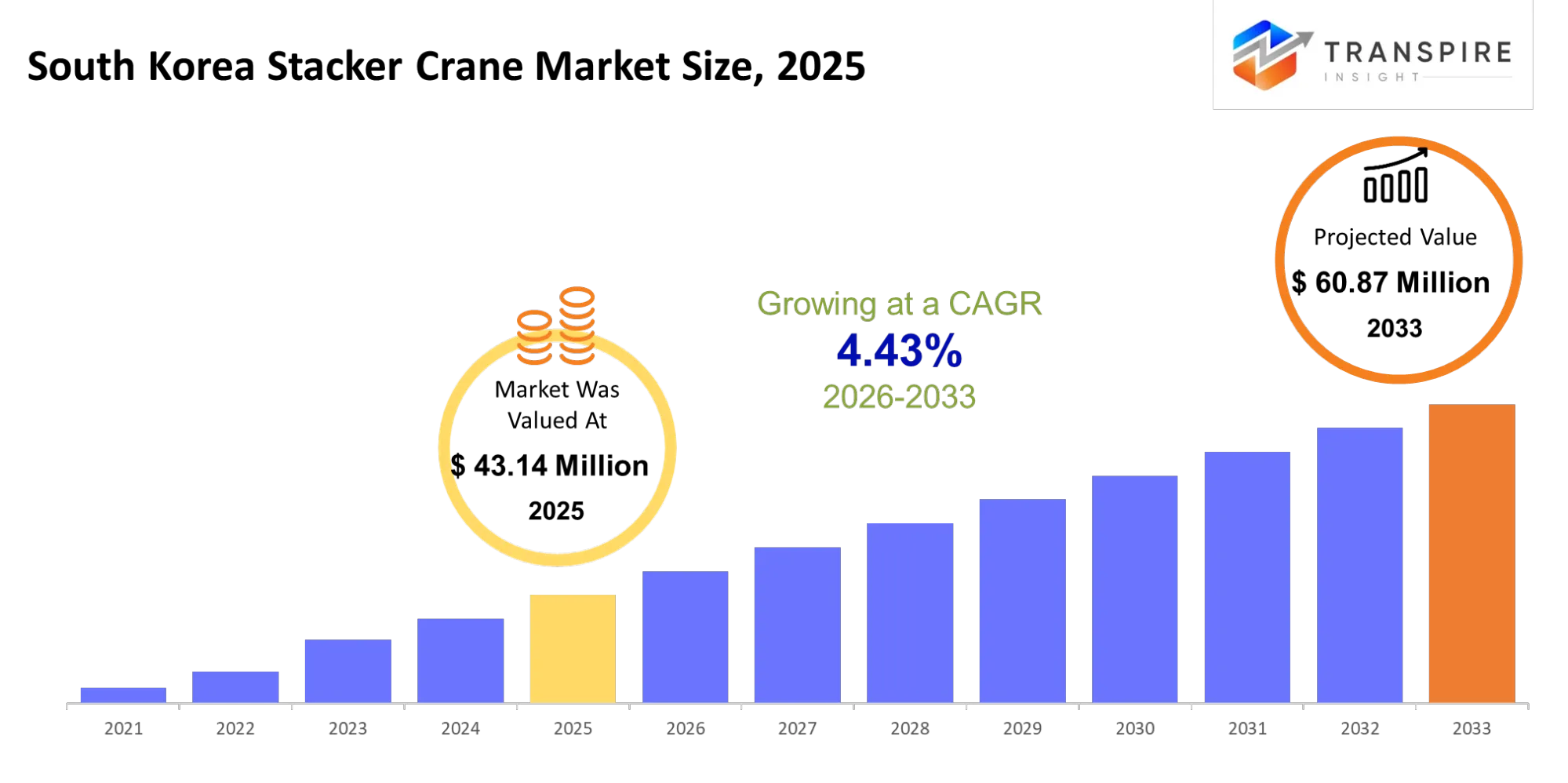
- South Korea Stacker Crane Market Size 2025: USD 43.14 Million
- South Korea Stacker Crane Market Size 2033: USD 60.87 Million
- South Korea Stacker Crane Market CAGR: 4.43%
- South Korea Stacker Crane Market Segments:By Type (Single Column, Double Column, Automated, Others); By Application (Warehousing, Manufacturing, Cold Storage, Retail Logistics, Others); By End User (E-commerce, Logistics, Automotive, Others).
To learn more about this report,  Download Free Sample Report
South Korea Stacker Crane Market Summary
The South Korea Stacker Crane Market was valued at USD 43.14 million in 2025. It is forecast to reach USD 60.87 million by 2033. That is a CAGR of 4.43% over the period.
High-density warehouse and factory storage systems in South Korea benefit from the use of stacker cranes that support quick retrieval and movement of materials to/from racks, increasing the speed of production due to their efficiency of space. To do this stackers automatically retrieve/store pallets or products from racking systems reducing manual labor as well improving the throughput in areas such as automotive/electronics/logistics hubs. Stacker cranes solve the problem associated with not having enough available industrial land for manufacturing by providing an opportunity to create vertically oriented storage in urbanised/industrial manufacturing areas.
The last three to five years have seen a trend away from traditional manual warehouse systems towards fully automated, software-based warehouse systems as stacker cranes have been integrated with smart Warehouse Execution Systems (WES). The COVID-19 pandemic highlighted inefficiencies of manual warehouse operations leading businesses to invest in more resilient automated warehouse solutions. With this increased investment and rapid adoption have resulted in faster order fulfilment cycles, less reliance on labour, therefore increasing the deployment of stacker cranes at distribution centres and production facilities.
As a result, equipment manufacturers are receiving an increased demand for integrated crane systems that are connected to real-time inventory management systems, leading to larger multi-year contracts and greater future service revenues.
Key Market Insights
The southern industrial sector is becoming more competitive in the stacker crane market, representing almost 40% of the expected value in 2025. This increase is attributed to concentrated manufacturing locations, logistics hubs bordering ports, and high levels of warehousing in that industrial region.
The capital region of Korea (Seoul metro area) grows the fastest for the market from 2026 to 2030. The smart logistics infrastructure now under development will expand the adoption of eCommerce fulfillment centers that use automated storage systems, among other factors.
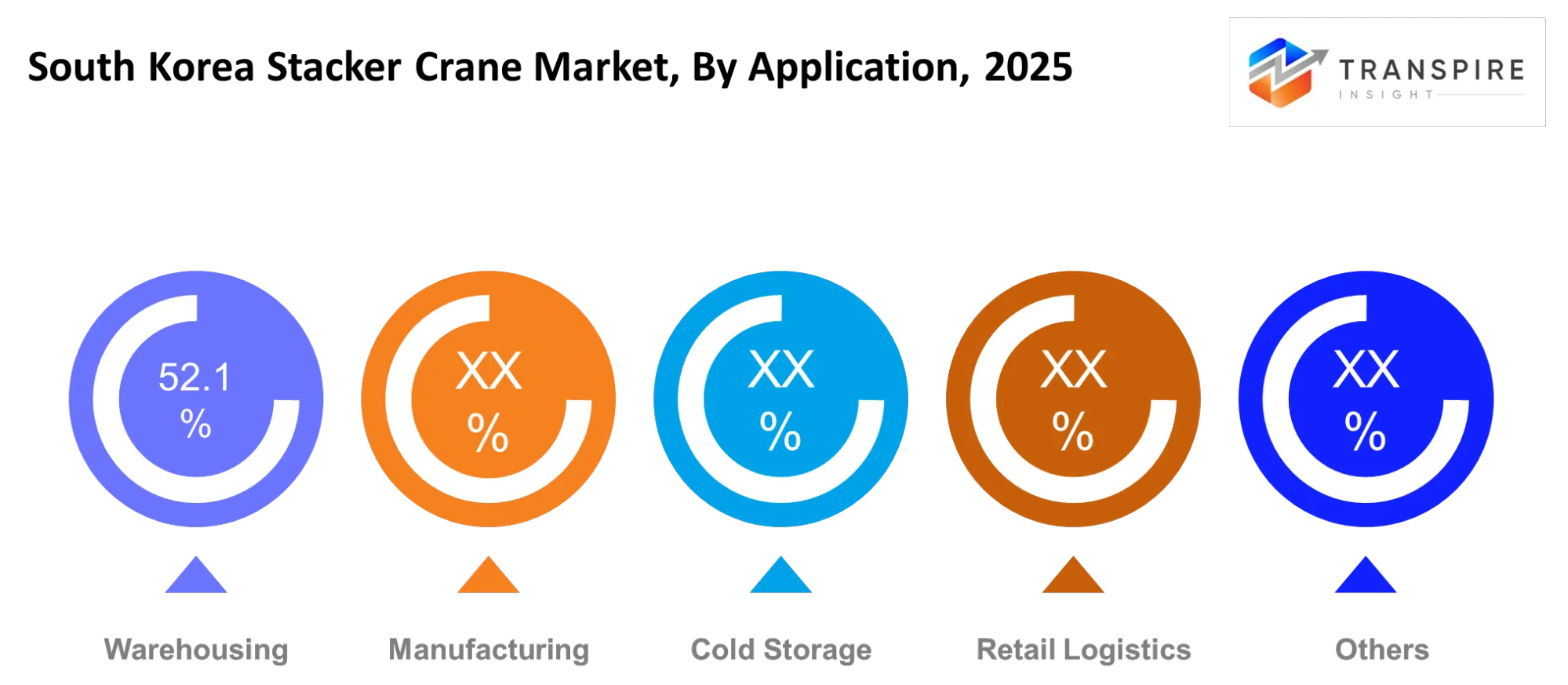
Considering the trend toward using more densely vertical warehouses (e.g., to maximize floor space), DMA (digital multiactivity, the movement to automate more aspects of warehouse operations and supply chains has caused the automated stacker crane systems to have almost a 52% share of the South Korean market.
The semi-automated stacker crane systems still represent the next largest segment because the mid-size manufacturers that constitute the group generally proceed on a slow basis to upgrade.
The largest percentage of stacker cranes used in warehouse logistics application is estimated at slightly under 45% of the total due to the growing importance of delivering orders quickly, maintaining an accurate count of inventory, and maximizing utilization of warehouse space at distribution centers.
The rapid growth of the e-commerce fulfillment centers is creating the next largest segment of stacker crane applications, with explosive growth created by increasing complexity of SKUs, the need for same-day delivery, and the rapid growth of online retail penetration.
The largest portion of the stacker crane market is the demand from the large manufacturers, which will account for approximately 48% of total demand; many will use stacker cranes as part of a smart factory ecosystem and production flow automation.
Third-party logistics providers (3PL) will continue to be the fastest-growing end users of stacker cranes as they expand the numbers of automated warehouses for handling increasing contract logistics volumes and grow their ability to provide services.
What are the Key Drivers, Restraints, and Opportunities in the South Korea Stacker Crane Market?
The South Korea stacker crane market is really taking off because companies are starting to use high-density warehouse automation. This is happening because the cost of land is going up. It is hard to find workers and companies need to get things to customers. In places like Busan and Incheon warehouse space is very limited so companies are using automated stacker cranes to store things. This means that companies are spending money on equipment and also need to pay for maintenance and software.
There is a problem. The machines are very expensive to buy at first. It is hard to set them up with the systems that are already in place. Many smaller companies do not have the money to spend on these machines. They have to wait a long time to get their money back. A lot of the warehouses in South Korea were built a long time ago so it is hard to add new automated systems without stopping work for a while. This means that some companies are not buying these machines because they do not want to lose time and money.
There is a chance for the market to grow more with the help of artificial intelligence and smart logistics. This can happen in cities like Seoul, where companies can use automation to get things to customers faster. Some companies are even building centers just for getting things to customers quickly. This could be an opportunity for companies that make automated stacker cranes and other logistics systems. The South Korea stacker crane market is going to keep growing with the help of new technologies like artificial intelligence. The South Korea stacker crane market will see a lot of changes in the future.
What Has the Impact of Artificial Intelligence Been on the South Korea Stacker Crane Market?
Artificial intelligence is changing the way automated storage and retrieval operations work in South Korea's stacker crane system. It gives them control over warehouse execution systems and helps them work better together in very crowded storage areas. Now, new installations use intelligence to control warehouse systems, which helps assign tasks to cranes, find the best routes, and balance loads across many aisles. This reduces the time the cranes are not doing anything and makes them work efficiently. The systems also use computer vision and sensors to detect safety issues in a timely manner, such as pallets not lined up properly or obstructions that could get in the way before the machines break down.
Artificial intelligence can also predict when something might go wrong. It looks at how the machines are vibrating, how much electricity they are using and how hot they are to figure out when important parts like the hoists, gearboxes and motors might wear out. This helps prevent the machines from breaking down and makes them last longer, by letting people fix them before they break. The people who run the warehouses also use intelligence to simulate how to store things and get them out which helps them pack things in more tightly and use less energy.
These new capabilities have made some improvements like the machines working more often costing less to fix and getting orders out faster in automated warehouses.. It is still hard for people to start using artificial intelligence because it costs a lot to add it to the old stacker crane system. A lot of warehouses still use systems that do not share information well which makes it hard for the artificial intelligence to make good decisions because it does not have all the information it needs.
Key Market Trends
- The South Korea stacker crane market is changing from storage systems to systems that use artificial intelligence and are very good at storing a lot of things in a small space. This is happening in places where things are made and in logistics hubs.
- The places that are seeing a lot of growth are the logistics corridors. This is because more people are buying things online and companies are spending money to automate their warehouses, which is changing the way warehouses work. The South Korea stacker crane market is really growing in these logistics corridors.
- The adoption of automated stacker crane technology has increased significantly since 2025, with over 50% of businesses now using automated cranes for high-density vertical storage systems instead of manual racking.
- The southeastern U.S. has consistently benefited from approximately 40% of total automated stacker crane shipments through 2025 but has recently experienced a shift in growth momentum towards the Capital Region's smart logistics expansion program.
- The demand for ecommerce fulfillment has been picking up speed since 2023. This has made warehouses rethink their layouts to handle products. The goal is to deliver products on the day.
- Logistics companies that work with businesses have started spending more on automation. This started after 2024. They are moving away from relying on people to do most of the work. Instead they are using machines and computers to get things done. This approach can grow with their business. Is based on contracts.
- Warehouse control systems that use intelligence have become popular since 2025. They help optimize how cranes move around, balance the load and keep track of inventory in time across many facilities.
- Predictive maintenance models have helped reduce downtime. They use data from the cranes like motor vibration and temperature to predict when a crane might fail.
- Top automation companies, like Daifuku and Dematic are strengthening their software offerings. They are adding software to their existing crane hardware.
- Semi-automated systems have been losing market share. Mid-sized manufacturers are delaying upgrades because they require a lot of money and take a long time to install.
South Korea Stacker Crane Market Segmentation
By Type
Automated stacker crane systems are becoming more popular in storage in South Korea.They are used because there is a need for high-density storage and fast retrieval.Automated systems are liked in distribution centers because they help save space and speed up operations.Double column systems are still used in places where heavy loads are stored and stability is important.Single column systems are used in facilities where basic automation is needed.However some are being replaced with efficient systems.People are moving away from handling in warehouses to automated systems.There is demand for crane installations that can be easily added to or changed.Software that controls automated crane systems is helping to improve operations in storage areas.In South Korea companies are investing in automation to increase capacity and use space better.
By Application
Warehousing is where automated stacker crane systems are used the most.Distribution centers are using storage systems to manage more inventory and fill orders faster. Manufacturing places are using stacker crane systems to keep production flowing and reduce delays.Cold storage facilities use automated systems to keep temperatures consistent and reduce handling.Retail logistics is also using automated systems as they adjust to products and faster delivery times.Warehouses are getting upgrades to improve storage management and retrieval.They are integrating automated systems to improve accuracy and reduce time.Manufacturing plants are using synchronized systems to support production. Retail logistics is expanding automation to speed up distribution.
To learn more about this report, Download Free Sample Report
By End User
Due to an increase in the number of transactions and a need to send products quickly, e-commerce businesses are spearheading the implementation of automated storage systems like stacker cranes. Many of these logistics firms are expanding their automated warehousing capabilities to keep pace with increasing storage and shipping demands from businesses in other industries. Many automotive manufacturers are improving production efficiency and reducing downtime by utilizing automated material handling systems using stacker cranes, while many other manufacturing companies are using automation technologies/facilities for their own specific needs.
There has also been a large movement toward digitalized warehouses throughout all types of users. Fulfillment centers for e-commerce use high-density storage systems to store items as well as provide them with same-day or next-day delivery. Logistics companies are developing automation systems to be able to scale according to their demand. The South Korean stacker crane market continuously evolves as automation systems are becoming increasingly synchronized with their material flow operations.
What are the Key Use Cases Driving the South Korea Stacker Crane Market?
Warehousing and distribution centers need stacker cranes the most in South Korea. This is because they want to store things in a space and send orders out fast. Cities are getting busier. This is causing problems with storing and moving goods. So these centers are using stacker cranes to make use of space and pick orders quicker.
Factories that make cars and places that pack and send out online orders are starting to use stacker cranes too. Car factories use them to move car parts easily. Online shopping centers use them to find and send out products. This helps them deliver goods the day even when they get a lot of orders at once.
Some new areas are starting to use stacker cranes well. These include storage places and small centers that help get goods to people fast. Some supermarkets and grocery delivery centers are also using them. This is because more people are shopping online and want their goods delivered quickly to their homes. These new uses for stacker cranes are becoming popular in cities.
|
Report Metrics |
Details |
|
Market size value in 2025 |
USD 43.14 Million |
|
Market size value in 2026 |
USD 44.95 Million |
|
Revenue forecast in 2033 |
USD 60.87 Million |
|
Growth rate |
CAGR of 4.33% from 2026 to 2033 |
|
Base year |
2025 |
|
Historical data |
2021 - 2024 |
|
Forecast period |
2026 - 2033 |
|
Report coverage |
Revenue forecast, competitive landscape, growth factors, and trends |
|
Regional scope |
South Korea |
|
Key company profiled |
Daifuku, Dematic, SSI Schaefer, Vanderlande, Honeywell, Murata Machinery, Mecalux, TGW, Jungheinrich, Toyota Industries, Knapp, BEUMER, Bastian Solutions, Swisslog, Körber |
|
Customization scope |
Free report customization (country, regional & segment scope). Avail customized purchase options to meet your exact research needs. |
|
Report Segmentation |
By Type (Single Column, Double Column, Automated, Others); By Application (Warehousing, Manufacturing, Cold Storage, Retail Logistics, Others); By End User (E-commerce, Logistics, Automotive, Others) |
Which Regions are Driving the South Korea Stacker Crane Market Growth?
In South Korea's stacker crane market, the Southeastern Industrial Zones have the most significant share of the market and will continue to hold this position due to their high density of manufacturers and their location near the ports of Busan and Ulsan, which have a lot of logistics activity associated with them. The volume of heavy industry and the extent of production for export creates a constant need for automated storage systems with high-density capabilities; thus, the presence of large shipbuilding, automotive and machine-building facilities, particularly in the southeastern portion of the country, supports the long-term deployment of these kinds of equipment. An existing logistics ecosystem with integrated warehousing and transportation corridors will also help to support this dominance.
The central Industrial Belt includes the Chungcheong region, which will provide a steady and reliable contribution to the stacker crane market due to its balanced level of manufacturing activity and the systematic development of industrial parks. The central region is also diversified in that it produces a balanced mix of electronic products, components and finished consumer goods, rather than exporting primarily to the southeastern region, as is the case for Southern Texas. The investment patterns being utilized by companies are consistent because they are slowly modernizing their warehouses instead of making rapid shifts to automation. Steady infrastructure support and stable regulatory implementation will contribute to continued and stable demand for stacker cranes.
The Capital Region (Seoul and surrounding logistics zones) is the fastest-growing in terms of its contribution to the demand for stacker cranes, primarily as a result of the rapid growth of e-commerce fulfillment centers and investments in smart logistics infrastructure. Increased urban warehouse network enhancements and tighter expectations for the timing of deliveries have resulted in increased levels of automation. In addition, the implementation of new logistics policies that promote the digital integration of supply chains has also contributed to the increase in stacker crane installations in this area.
Who are the Key Players in the South Korea Stacker Crane Market and How Do They Compete?
The South Korea stacker crane market has a few companies that control most of it. These companies are experts in automation. They work with local system integrators. They keep their customers by offering service for a long time, having their own special software to control warehouses and being able to connect all the different parts of the system together. They do not really compete on price. Now they are competing to see who can make their systems smarter with intelligence, who can keep their machines running all the time and who can make the whole process of moving things around the warehouse more efficient.
Daifuku makes systems that can store and retrieve things automatically. They can connect these systems to the main computer that controls the warehouse. This means that big distribution centers can use their systems and make them bigger or smaller as they need to. Toyota Industries connects the machines that move things around to the production lines in factories, which makes the process of making and moving things more efficient. SSI Schaefer makes systems that use racks to store things and they have software that can control the whole warehouse. This means that sized factories can start using automated systems a little at a time.
Dematic uses intelligence to make the systems that control the warehouses smarter. This means that the cranes can move around efficiently, they do not waste time just sitting there and the inventory is more accurate.
Company List
- Daifuku Co., Ltd.
- Dematic
- SSI SCHAEFER
- Vanderlande
- Honeywell
- Murata Machinery
- Mecalux
- TGW Logistics
- Jungheinrich
- Toyota Industries
- KNAPP AG
- BEUMER Group
- Bastian Solutions
- Swisslog
- Körber Supply Chain
Recent Development News
In March 2025, Daifuku expanded its automated storage and retrieval system deployment program for high-density warehouse projects in East Asia, including South Korea logistics hubs. The initiative focused on integrating stacker crane systems with AI-based warehouse control platforms to improve retrieval speed and reduce idle crane cycles. This development strengthened demand for fully automated vertical storage infrastructure in e-commerce fulfillment centers.https://www.daifuku.com
In January 2025, Dematic announced upgrades to its software-driven warehouse execution systems used in automated storage environments. The enhancement improved real-time coordination between stacker cranes, conveyor systems, and inventory tracking modules across large distribution centers. This advancement supported higher adoption of predictive maintenance and reduced operational downtime in automated warehouses.https://www.dematic.com
In November 2025, SSI Schaefer expanded its modular AS/RS solutions portfolio for mid-sized logistics operators in Asia-Pacific markets, including South Korea. The expansion emphasized scalable stacker crane configurations that allow phased automation without full warehouse redesign. This move helped smaller manufacturers accelerate automation adoption despite capital constraints.https://www.ssi-schaefer.com
In February 2026, Toyota Industries strengthened its integrated material handling solutions strategy by enhancing automated forklift and storage system interoperability within smart factory environments. The development improved synchronization between production lines and stacker crane-based storage systems, supporting just-in-time manufacturing models.https://www.toyota-industries.com
What Strategic Insights Define the Future of the South Korea Stacker Crane Market?
The South Korea stacker crane market is changing to have integrated and software-defined warehouse automation. This means crane systems work as part of a digital supply chain platform.
This change is happening because e-commerce is growing there is not land available in cities and there is a need for fast fulfillment in city logistics areas.Over the 5 to 7 years people will want storage systems that use AI and focus on real-time optimization not just how well the crane works on its own.There is a risk that not many suppliers will provide automation software. This could create pricing pressure. Make it hard for users to make different systems work together.Another challenge is that some companies that already automated their facilities might not see benefit from upgrading which could slow down the replacement cycle.
One new opportunity is in automating fulfillment centers in urban retail networks. Compact stacker crane systems that use AI to route products can help with same-day delivery.Companies in this market should focus on crane systems that're modular and can work with different warehouse management systems.This will allow them to easily expand to existing logistics sites.The South Korea stacker crane market will likely see demand for these types of systems.Stacker crane systems will play a role in this market.The use of stacker crane systems will continue to grow in the South Korea market.
South Korea Stacker Crane Market Report Segmentation
By Type:
- Single Column Stacker Crane Systems
- Double Column Stacker Crane Systems
- Automated Stacker Crane Systems
- Semi-Automated Stacker Crane Systems
- Others
By Application:
- Warehousing Applications
- Manufacturing Operations
- Cold Storage Facilities
- Retail Logistics Networks
- E-commerce Fulfillment Centers
- Others
By End User:
- E-commerce Companies
- Third-Party Logistics (3PL) Providers
- Automotive Industry
- Manufacturing Enterprises
- Retail Businesses
- Others
Frequently Asked Questions
Find quick answers to common questions.
The expected South Korea Stacker Crane Market size for the market will be USD 60.87 Million in 2033.
Key segments for the South Korea Stacker Crane Market are By Type (Single Column, Double Column, Automated, Others); By Application (Warehousing, Manufacturing, Cold Storage, Retail Logistics, Others); By End User (E-commerce, Logistics, Automotive, Others).
Major South Korea Stacker Crane Market players are Daifuku, Dematic, SSI Schaefer, Vanderlande, Honeywell, Murata Machinery, Mecalux, TGW, Jungheinrich, Toyota Industries, Knapp, BEUMER, Bastian Solutions, Swisslog, Körber.
The South Korea Stacker Crane Market size is USD 43.14 Million in 2025.
The South Korea Stacker Crane Market CAGR is 4.43% from 2026 to 2033.
- Daifuku Co., Ltd.
- Dematic
- SSI SCHAEFER
- Vanderlande
- Honeywell
- Murata Machinery
- Mecalux
- TGW Logistics
- Jungheinrich
- Toyota Industries
- KNAPP AG
- BEUMER Group
- Bastian Solutions
- Swisslog
- Körber Supply Chain
About the Authors

Mayur Shinde
I am Mayur Shinde, a Senior Research Analyst at Transpire Insight, specializing in the Automotive & Transportation and Information & Communication Technology (ICT) Industry. My work focuses on analyzing emerging market trends, technological advancements, competitive landscapes, and industry developments to deliver accurate, data-driven insights. I am passionate about transforming complex market information into clear, actionable content that helps businesses, professionals, and decision-makers stay informed and make confident strategic decisions.

Chakradhar Khansole
Chakradhar serves as the Research Director at Transpire Insight, bringing over 8 years of experience in technology, innovation, and strategic market intelligence. He specializes in transforming complex market data into actionable business insights that enable organizations to make informed, growth-oriented decisions. Recognized for his strategic vision and analytical expertise, Chakradhar leads high-impact research initiatives, delivering comprehensive market assessments, competitive intelligence, and forward-looking industry analysis.
Recently Published Reports
-
Apr 2026
ATV & UTV Market
ATV & UTV Market Size, Share & Analysis Report By Type (ATV, and UTV), By Variants (Less Than 400 CC, 400 CC To 800 CC, and More Than 800 CC), and Geography (North America, Europe, Asia-Pacific, Middle East and Africa, South and Central America), 2021 - 2031
-
Apr 2026
Automotive Central Gateway Module Market
Automotive Central Gateway Module Market Size, Share & Analysis Report By Type (Ethernet Central Gateway Module, CAN Central Gateway Module, LIN Central Gateway Module, and FlexRay), By Application (Powertrain Control, Body Control, Infotainment System, Advanced Driver Assistance Systems (ADAS), and Others), By End User (Passenger Vehicles, and Commercial Vehicles), and Geography (North America, Europe, Asia-Pacific, Middle East and Africa, South and Central America), 2021 - 2031
-
Apr 2026
Automotive Engine Oil Filter Market
Automotive Engine Oil Filter Market Size, Share & Analysis Report By Filter Type (Fuel Filter, Engine Oil Filter, Hydraulic Oil Filter, and Others), By Filter Media (Cellulose, Synthetic, and Micro), By Sales Channel (OEMs, and Aftermarket), By Vehicle Type (Passenger Cars, Light Commercial Vehicles, Heavy Duty Trucks, Buses and Coaches, and Off-road Vehicles), and Geography (North America, Europe, Asia-Pacific, Middle East and Africa, South and Central America), 2021 - 2031
-
Apr 2026
Automotive Parts Aluminium Die Casting Market
Automotive Parts Aluminium Die Casting Market Size, Share & Analysis Report By Production Process (Pressure Die Casting, Vacuum Die Casting, Squeeze Die Casting, Gravity Die Casting), By Application (Body Parts, Engine Parts, Transmission Parts, Battery And Related Components, Other Application Types), and Geography (North America, Europe, Asia-Pacific, Middle East and Africa, South and Central America), 2021 - 2031
Our Clients



