
South Korea Space Based Solar Power Market Size & Forecast:
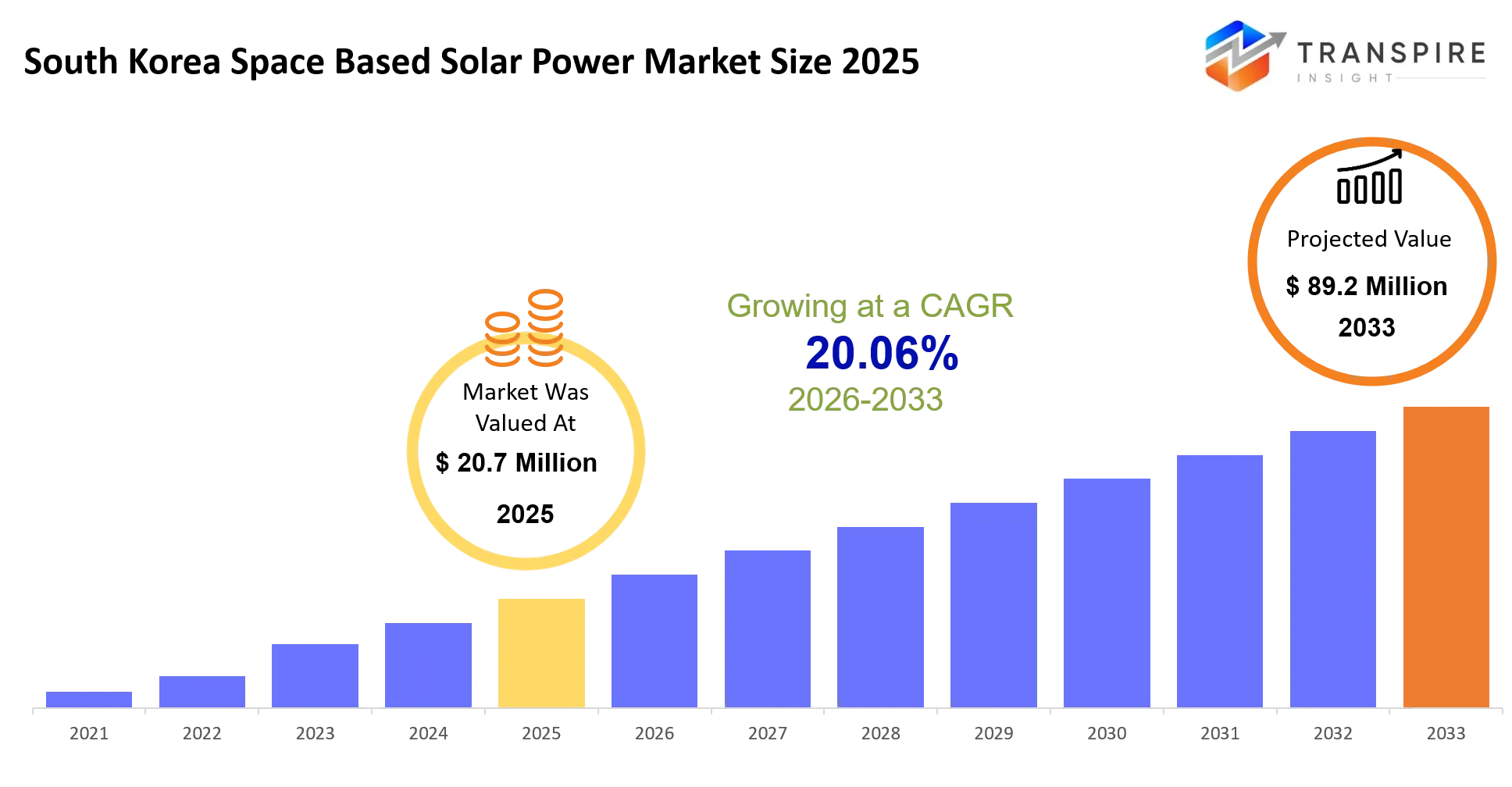
- South Korea Space Based Solar Power Market Size 2025: USD 20.7 Million
- South Korea Space Based Solar Power Market Size 2033: USD 89.2 Million
- South Korea Space Based Solar Power Market CAGR: 20.06%
- South Korea Space Based Solar Power Market Segments: By Component (Solar Panels, Power Transmission, Satellites, Energy Storage, Ground Stations, Others) | By Technology (Microwave, Laser, Wireless Power Transfer, Hybrid, Others) | By Application (Utility Power, Defense, Space Exploration, Emergency Power, Others) | By End User (Government, Space Agencies, Defense, Utilities, Others)
South Korea Space Based Solar Power Market Summary
The South Korea Space Based Solar Power Market was valued at USD 20.7 Million in 2025. It is forecast to reach USD 89.2 Million by 2033. That is a CAGR of 20.06% over the period.
South Korea’s space based solar power, SBSP, market seems to be chasing a real long-term energy security headache: getting steady , weather independent renewable electricity by grabbing sunlight up in space and sending it back down to Earth. In real practice, people are treating this as a kind of later stage add-on for land limited renewable output, so it can better serve industrial power needs, and at the same time lower the reliance on imported fossil fuels, you know the usual story.
Over roughly the past five years the whole thing has moved from mostly academic study into more government driven tech validation plus commercialization planning. Big national pushes for space capabilities, satellite know-how, and next generation energy systems have helped to pull more teamwork together among aerospace companies, research institutes, and energy stakeholders. One noticeable turning point was the increased worry about worldwide energy supply disruptions after geopolitical frictions, plus fuel price swings, which made clear how easily import dependent energy setups can get rattled.
Right now, the market momentum is coming from the meeting of energy security goals and newer progress in wireless power transfer, lightweight materials, and launch capabilities. As technical feasibility keeps improving and public funding grows, SBSP projects are drawing more targeted strategic money, so it becomes a cleaner route toward future deployment, and some eventual revenue coming in across both the space side and the energy side.
Key Market Insights
- The Seoul Capital Area kinda dominated the South Korea Space Based Solar Power Market with something like over 45% share in 2025, mostly because aerospace R&D infrastructure got really concentrated there.
- Daejeon came up as the fastest-growing regional hub during 2026–2032, backed by government research institutes plus advanced space technology programs not long after.
- Wireless power transmission systems were the big one in 2025, holding the largest market share, roughly nearly 38% of total industry development investments.
- Satellite platform and orbital infrastructure solutions took the second-largest segment, largely from ongoing demonstration mission planning and related steps.
- Lightweight solar array technologies are projected to be the fastest-growing segment through 2032, since launch efficiency turns into more of a priority, right?
- Utility-scale renewable energy generation led with around 42% share in 2025, which mirrors national energy diversification objectives though it’s more than just that.
- Remote and resilient power supply applications are expected to show the quickest growth during the forecast period.
- Government agencies and national research institutions together accounted for more than 55% of market activity in 2025.
- Aerospace and commercial energy companies represent the fastest-growing end user category, as commercialization pathways get clearer over time.
What are the Key Drivers, Restraints, and Opportunities in the South Korea Space Based Solar Power Market?
South Korea's Space Based Solar Power Market is being pushed mostly by the country's long term energy security strategy. South Korea is still pretty dependent on imported energy supplies, so keeping renewable power flowing without interruptions has become a kind of strategic must. Over the last years, improvements in reusable launch systems, lighter photovoltaic materials, and wireless power transmission techniques have made the whole space based power idea look more affordable. Also, government funding programs and national space development roadmaps turned a lot of the early research into working prototypes, and that has pulled interest from aerospace plus energy companies. In practice this is widening the project pipeline, and it is opening up fresh revenue chances in areas like satellite manufacturing , launch services and power transmission technologies.
The biggest problem however is the very high upfront capital needed for orbital infrastructure deployment. Space based solar power needs big satellite assemblies, advanced power beaming hardware, and launch capabilities that can be trusted. Those expenses stay “structural” because they ride on major technological leaps and large economies of scale that probably will not show up soon. So commercialization tends to take a long time, which makes private sector involvement weaker , and it pushes back wider revenue creation across the entire value chain.
A big opportunity is there, in trying to tie together space based solar power with the next gen wireless energy transmission systems. Right now there is steady investment going into microwave and laser power beaming approaches, and that is gradually pushing transmission efficiency upward, and also making operations more consistent. Some demonstration efforts in advanced space economies are sort of helping to prove technical feasibility. Meanwhile, South Korea has a really solid base in semiconductors, aerospace, and consumer electronics, so the commercialization path feels more realistic. And as launch costs keep sliding down, plus satellite manufacturing gets faster and more efficient, the market might shift from only experimental deployments, toward more scalable energy infrastructure during the coming decade, basically moving it out of the lab and into something bigger.
What Has the Impact of Artificial Intelligence Been on the South Korea Space Based Solar Power Market?
Artificial intelligence is becoming this kind of important enabler inside South Korea’s emerging space based solar power ecosystem. Developers are, more and more , leaning on AI driven simulation platforms to sort out satellite positioning, orbital energy collection rhythms , and wireless power transmission efficiency. In practice these systems chew through big volumes of environmental data and also operational data, then they help refine energy output forecasts and they back mission planning.
At the same time, machine learning models are improving predictive maintenance for satellite subsystems, solar arrays, power converters, and the transmission equipment itself. When they spot performance anomalies before failures even start, operators can dial down maintenance expenses , stretch asset lifecycles, and keep system availability higher. AI assisted digital twins are also letting engineers review thousands of operational scenarios, which speeds up development timelines a bit , and lowers design risks.
There are advanced analytics tools that support power transmission tuning by changing transmission parameters based on atmospheric conditions, orbital dynamics, and what the ground receiver performs like. Overall this raises system efficiency and it also strengthens long term operational steadiness.
Still though, AI adoption has a major snag: the lack of real world operational data. Because commercial scale space based solar power hasn’t yet been deployed widely, the training datasets stay pretty narrow. That limitation can weaken model accuracy , and it can raise uncertainty when predicting long duration performance under actual orbital conditions. Plus the high integration costs , and the sheer complexity of fitting AI platforms with advanced aerospace systems, also keeps broader implementation from moving fast.
Key Market Trends
- Since 2021, government funding has been kinda drifting away from more theoretical studies and toward prototype validation and a sort of orbital demonstration planning.
- After 2022, aerospace companies broadened collaboration with energy developers, building integrated value chains for future power beaming systems , so it’s less isolated work.
- Improvements in lightweight photovoltaic materials eased payload constraints , which made launch economics better than in earlier system designs.
- Between 2020 and 2025, research on wireless power transmission really picked up steam. Efficiency gains basically nudged the commercial outlook forward, and people started expecting stronger viability.
- South Korean institutions ramped up international cooperation programs too , this sped up access to advanced satellite tech and energy transmission technologies.
- Investors have gradually moved past funding “basic” research and now favor infrastructure and component development, aimed at future commercialization.
- Satellite manufacturing strategies now often stress modular architectures, which helps with scalable deployment and lowers lifecycle maintenance demands .
- Launch service planning has also shifted toward reusable, lower cost platforms , making long term project feasibility assessments more realistic.
- Competition is getting more focused on proprietary transmission technologies, advanced materials, and system integration capabilities, rather than satellite hardware alone .
- Energy security worries after global supply disruptions have pushed stronger policy support for continuous, weather independent renewable energy solutions, even when conditions are not ideal.
South Korea Space Based Solar Power Market Segmentation
By Component :
Solar panels basically become the main energy harvesting part in space based solar power setups. Putting them in orbit gives them a kind of continuous sunlight exposure for longer stretches, compared to the ones we have on land. High efficiency photovoltaic tech helps take that solar radiation and turn it into usable electrical energy, which can then be shipped back later to Earth.
Then the power transmission systems act like the central channel for moving the collected energy from space over to ground receiving sites. Satellites are there for positioning, communication, and overall coordination. Energy storage solutions handle the ups and downs, so the delivery stays steady and dependable. On the ground, ground stations take what was transmitted and turn it into electricity that fits distribution networks. The other category is a grab bag of supporting hardware, control systems, structural elements, plus monitoring technologies, all of it needed for the whole thing to actually run.
By Technology :
Microwave technology is one of the most studied routes for transmitting energy from orbit down to Earth. Microwave signals can cover long distances while staying relatively consistent, so it looks good for big scale power transmission ideas that are still in development.
Laser technology tends to focus on aiming a tightly concentrated energy beam at the receiving system. Wireless power transfer is broader, it includes approaches where energy moves without physical links. Hybrid technologies mix several transmission strategies to boost efficiency and operational flexibility. The other segment also covers emerging ideas, experimental transmission methods, and next generation solutions that keep moving forward through research and testing.
By Application :
Utility Power stays a pretty big application area, mainly because space-based solar power can maybe deliver steady electricity , like day after day without much interruption. This reliable inflow helps national energy infrastructure in practice, and it may also diversify electricity sources in the long run, which is kinda the point.
For Defense, the emphasis is on having dependable energy at the right moment for critical operations and strategic facilities. Then there is Space Exploration, where the whole idea is to back upcoming missions that will need more sustainable energy resources, not just something temporary tied to Earth. Emergency Power is another track, it’s essentially backup electricity when natural disasters happen, or when key infrastructure gets disrupted. As for the Others category, that’s more like industrial work, research efforts, and special uses that can pop up as technology progresses.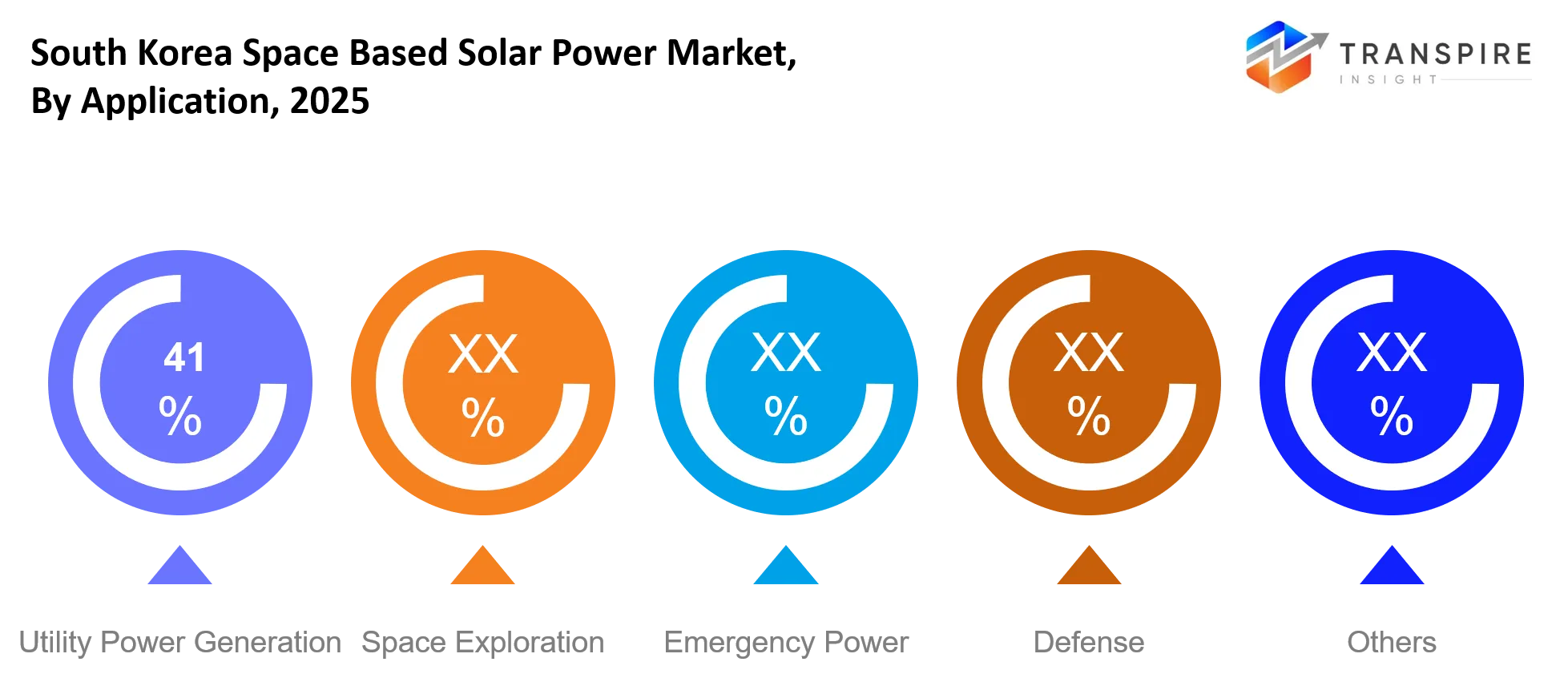
By End User :
Government organizations matter a lot here, via funding programs, policy development and broader national energy planning. Their public sector involvement supports long term research, and it can help move forward large scale projects that demand heavy investment, plus real technical know-how.
Space Agencies tend to drive things through technology development, satellite deployment, and mission planning activities. Defense organizations look closely at strategic energy options, especially for operational resilience , while Utilities think about how these systems could integrate with electricity networks. In the Others section you’ll usually find private aerospace firms, research institutions, technology developers, and commercial organizations that take part in innovation, and in project development across the whole industry, not just one lane.
What are the Key Use Cases Driving the South Korea Space Based Solar Power Market?
The main use case that is driving adoption in the South Korea Space Based Solar Power Market is utility scale electricity generation. Energy collected in space can be sent down to ground receiving stations and then put into the national power grid. This kind of application gets the most attention because it can work as a steady renewable power source, less bothered by weather patterns or by limits on available land.
Past everyday utility power, defense groups and government organizations are looking at space based energy systems for things like guarding critical infrastructure and improving energy resilience. At the same time space exploration programs are testing these approaches to deliver reliable power for satellites, lunar missions and future orbital activity where long term energy supply really matters.
More recently people are talking about emerging applications such as supplying electricity to remote islands, assisting disaster recovery, and supporting emergency response networks. There is also rising interest in providing energy for future space habitats, and commercial space infrastructure. Even if these areas are still kind of early, continued progress in wireless power transfer and satellite related technologies should make the longer run adoption outlook stronger.
|
Report Metrics |
Details |
|
Market size value in 2025 |
USD 20.7 Million |
|
Market size value in 2026 |
USD 24.8 Million |
|
Revenue forecast in 2033 |
USD 89.2 Million |
|
Growth rate |
CAGR of 20.06% from 2026 to 2033 |
|
Base year |
2025 |
|
Historical data |
2021 - 2024 |
|
Forecast period |
2026 - 2033 |
|
Report coverage |
Revenue forecast, competitive landscape, growth factors, and trends |
|
Country scope |
South Korea |
|
Key company profiled |
SpaceX, Airbus, Boeing, Lockheed Martin, Northrop Grumman, Mitsubishi Electric, JAXA, Thales Alenia, Hanwha Aerospace, KARI, Blue Origin, Maxar, BAE, Raytheon, OHB |
|
Customization scope |
Free report customization (country, regional & segment scope). Avail customized purchase options to meet your exact research needs. |
|
Report Segmentation |
By Component (Solar Panels, Power Transmission, Satellites, Energy Storage, Ground Stations, Others) | By Technology (Microwave, Laser, Wireless Power Transfer, Hybrid, Others) | By Application (Utility Power, Defense, Space Exploration, Emergency Power, Others) | By End User (Government, Space Agencies, Defense, Utilities, Others) |
Which Regions are Driving the South Korea Space Based Solar Power Market Growth?
South Korea, sort of, takes the leading spot in the market, mainly due to firm government backing , solid aerospace knowhow, and the steady push of national space program spending. Public dollars aimed at next generation energy methods and satellite building are speeding up both research and proof-of-concept demos. And yeah, the close coordination between research institutes , aerospace manufacturers and government agencies makes a pretty sturdy base for tech improvements. With that kind of setup, projects can slide from early idea work into practical validation faster than lots of other places.
North America lands as the second most influential region, though the momentum comes from a somewhat different mix. A well established commercial space industry, private launch teams, and long-term funding in advanced energy technologies keep things moving in a steady way. In contrast to South Korea, where state initiatives are a central driver, North American growth leans heavily on private sector involvement and venture-backed financing. Ongoing investment spanning aerospace, satellite fabrication, and wireless power transmission engineering makes the region a dependable source for global market income.
Asia Pacific, outside South Korea, is kinda emerging as the fastest-growing region, mostly because space ambitions keep expanding and energy security worries are getting louder. Lately there have been more investments into satellite infrastructure, launch capabilities, plus research on advanced power transmission, so the market activity is moving faster across a number of countries. Governments are rolling out new space development programs too, and they’re also backing local aerospace industries, through funding and policy moves that feel pretty targeted. If growth continues like this in the region it should open fresh chances for tech providers, makers of key components, and investors who want to plug in to commercial projects between 2026 and 2033.
Who are the Key Players in the South Korea Space Based Solar Power Market and How Do They Compete?
The competitive landscape is still kinda concentrated, because the industry is basically stuck in the research, development and demonstration phase. So competition stays more about what people can actually do technically, like satellite engineering know-how, wireless power transmission performance, and the ability to tap into government-backed programs. The bigger established aerospace organizations hold a leg up thanks to infrastructure, more research resources, and years of long-term project experience . Meanwhile the newer participants tend to zoom in on narrow, specialized technologies that may enhance system performance and help lower future deployment costs.
Korea Aerospace Industries leans heavily into satellite platforms, aerospace engineering, and system integration strengths that aim to support future space-based energy infrastructure. They get a boost from deep experience across domestic aerospace programs , and they also collaborate pretty closely with government-backed initiatives. Hanwha Aerospace, on the other hand, differentiates itself using advanced manufacturing capabilities, space technology development, and ongoing investments in next-generation satellite systems. As the overall space sector keeps expanding, it also tends to build more technical know-how that can then be used for future commercial applications.
The Korea Aerospace Research Institute, kinda focuses on research, testing and technology validation work that really helps move along wireless power transmission and orbital energy ideas. They also have strong ties with national space programs, which gives them access to longer term development openings. Then LIG Nex1 puts the spotlight on advanced electronics, comms systems and defense related technologies, that can back up secure energy transmission networks, in a practical way. Meanwhile SpaceX influences the whole competitive scene by driving down launch costs and pushing reusable launch tech, so in the future there are more workable pathways for large scale orbital infrastructure to be deployed economically.
Company List
- SpaceX
- Airbus
- Boeing
- Lockheed Martin
- Northrop Grumman
- Mitsubishi Electric
- JAXA
- Thales Alenia
- Hanwha Aerospace
- KARI
- Blue Origin
- Maxar
- BAE
- Raytheon
- OHB
Recent Development News
In May 2026, Hanwha Aerospace and the Korea AeroSpace Administration (KASA) launched a joint development program for a 4,500-pound-class turbofan engine through a matching-fund investment model. The program includes advanced aerospace technologies and strengthens South Korea’s broader space industry capabilities, supporting future large-scale orbital infrastructure initiatives. Sourcehttps://www.hanwha.com/
In May 2026, Hanwha Group increased its ownership stake in Korea Aerospace Industries (KAI) to more than 5% as part of a broader aerospace expansion strategy. The investment reflects growing commitment to South Korea’s space sector and enhances financial support for advanced satellite, launch, and space technology programs that could benefit future space-based solar power initiatives. Sourcehttps://koreajoongangdaily.joins.com/
What Strategic Insights Define the Future of the South Korea Space Based Solar Power Market?
The South Korea Space Based Solar Power Market seems to be heading into this sort of phase where winning is not so much about the basic research part, but more about how well you can actually show commercially viable energy transmission, at scale. In the next five to seven years, momentum from reusable launch systems , better satellite manufacturing efficiency and wireless power transmission is likely to push things toward pilot deployments and those early commercial projects. Underneath it all, there is this steady pull for stable, long-duration renewable power, the kind that is not limited by cloudiness, and also not stuck to land availability constraints.
There is also a risk that people don’t notice as quickly, which is technology substitution. If terrestrial renewables keep improving fast, plus grid-scale battery storage getting cheaper, and advanced nuclear moving ahead, then the economic edge that space based solar power is trying to carve out could get smaller. And if the deployment costs stay elevated, then a chunk of investment capital might just drift toward more established alternatives that are already “ready enough”.
Meanwhile, one emerging chance is building power-beaming infrastructure for remote islands and other critical facilities that can’t afford interruptions. Market participants should really lean into collaborations between aerospace companies, electricity providers , and the teams that develop transmission technologies. Getting involved early in demonstration work should help lock in intellectual property, practical know-how and a strategic position before big scale commercialization actually kicks off.
South Korea Space Based Solar Power Market Report Segmentation
By Component
- Solar Panels
- Power Transmission
- Satellites
- Energy Storage
- Ground Stations
By Technology
- Microwave
- Laser
- Wireless Power Transfer
- Hybrid
By Application
- Utility Power
- Defense
- Space Exploration
- Emergency Power
By End User
- Government
- Space Agencies
- Defense
- Utilities
Frequently Asked Questions
Find quick answers to common questions.
The South Korea Space Based Solar Power Market size is USD 89.2 Million in 2033.
Key Segments for the South Korea Space Based Solar Power Market are By Component (Solar Panels, Power Transmission, Satellites, Energy Storage, Ground Stations, Others) | By Technology (Microwave, Laser, Wireless Power Transfer, Hybrid, Others) | By Application (Utility Power, Defense, Space Exploration, Emergency Power, Others) | By End User (Government, Space Agencies, Defense, Utilities, Others).
Major South Korea Space Based Solar Power Market Players are SpaceX, Airbus, Boeing, Lockheed Martin, Northrop Grumman, Mitsubishi Electric, JAXA, Thales Alenia, Hanwha Aerospace, KARI, Blue Origin, Maxar, BAE, Raytheon, OHB.
The Current South Korea Space Based Solar Power Market size is USD 20.7 Million in 2025.
The South Korea Space Based Solar Power Market CAGR is 20.06% from 2026 to 2033.
- SpaceX
- Airbus
- Boeing
- Lockheed Martin
- Northrop Grumman
- Mitsubishi Electric
- JAXA
- Thales Alenia
- Hanwha Aerospace
- KARI
- Blue Origin
- Maxar
- BAE
- Raytheon
- OHB
About the Authors

Avinash Kumar
I’m Avinash Kumar, a Senior Research Analyst at Transpire Insight, with expertise in the Electronics and Semiconductor and Energy & Power industry. My work focuses on analyzing emerging technologies, market trends, industry developments, and innovation across these sectors. I specialize in transforming complex technical and market insights into clear, research-backed content that helps professionals, businesses, and decision-makers stay informed. Through continuous industry research and data-driven analysis, I strive to deliver accurate, reliable, and practical perspectives on the latest advancements shaping the semiconductor and energy landscape.

Chakradhar Khansole
Chakradhar serves as the Research Director at Transpire Insight, bringing over 8 years of experience in technology, innovation, and strategic market intelligence. He specializes in transforming complex market data into actionable business insights that enable organizations to make informed, growth-oriented decisions. Recognized for his strategic vision and analytical expertise, Chakradhar leads high-impact research initiatives, delivering comprehensive market assessments, competitive intelligence, and forward-looking industry analysis.
Recently Published Reports
-
Apr 2026
Active Power Filter Market
Active Power Filter Market Size, Share & Analysis Report By Type (Shunt Active Power Filters, Series Active Power Filter, Hybrid Active Power Filter), By Application (Harmonics Mitigation, Reactive Power Compensation, Voltage Regulation, Power Factor Correction), By Phase (Single Phase, Three Phase), By End-User Industry (Manufacturing, Healthcare, Commercial, Automotive, Oil and Gas, Others), and Geography (North America, Europe, Asia-Pacific, Middle East and Africa, South and Central America), 2021 - 2031
-
Apr 2026
Electrical Transformer Market
Electrical Transformer Market Size, Share & Analysis Report By Core (Closed, Shell, and Berry), By Insulation (Gas, Oil, Solid, Air, and Other), By Phase (Single, and Three), By Rating (100 MVA to 500 MVA, 501 MVA to 800 MVA, and 801 MVA to 1200 MVA), and Geography (North America, Europe, Asia-Pacific, Middle East and Africa, South and Central America), 2021 – 2031
-
Apr 2026
Hydraulic Piston Pumps Market
Hydraulic Piston Pumps Market Size, Share & Analysis Report By Type (Axial Piston Pumps, Radial Piston Pumps), By Operating Pressure (Low Pressure, Medium Pressure, High Pressure), By Application (Construction, Mining, Agriculture, Automotive, Oil & Gas, Industrial Machinery, Others), By End-User (OEMs, Aftermarket), and Geography (North America, Europe, Asia-Pacific, Middle East and Africa, South and Central America), 2021 – 2031
-
Apr 2026
Laboratory Gas Generators Market
Laboratory Gas Generators Market Size, Share & Analysis Report By Product (Nitrogen Gas Generator, Hydrogen Gas Generator, Zero Air Gas Generator, Purge Gas Generator, TOC Gas Generators, Others), By Application (Gas Chromatography, Liquid Chromatography-mass Spectrometry (LC-MS), Gas Analyzers, Others), By End-user (Life Science, Chemical & Petrochemical, Food & Beverage, Others), and Geography (North America, Europe, Asia-Pacific, Middle East and Africa, South and Central America), 2021 – 2031