

South Korea Sodium Benzoate Market Size & Forecast:
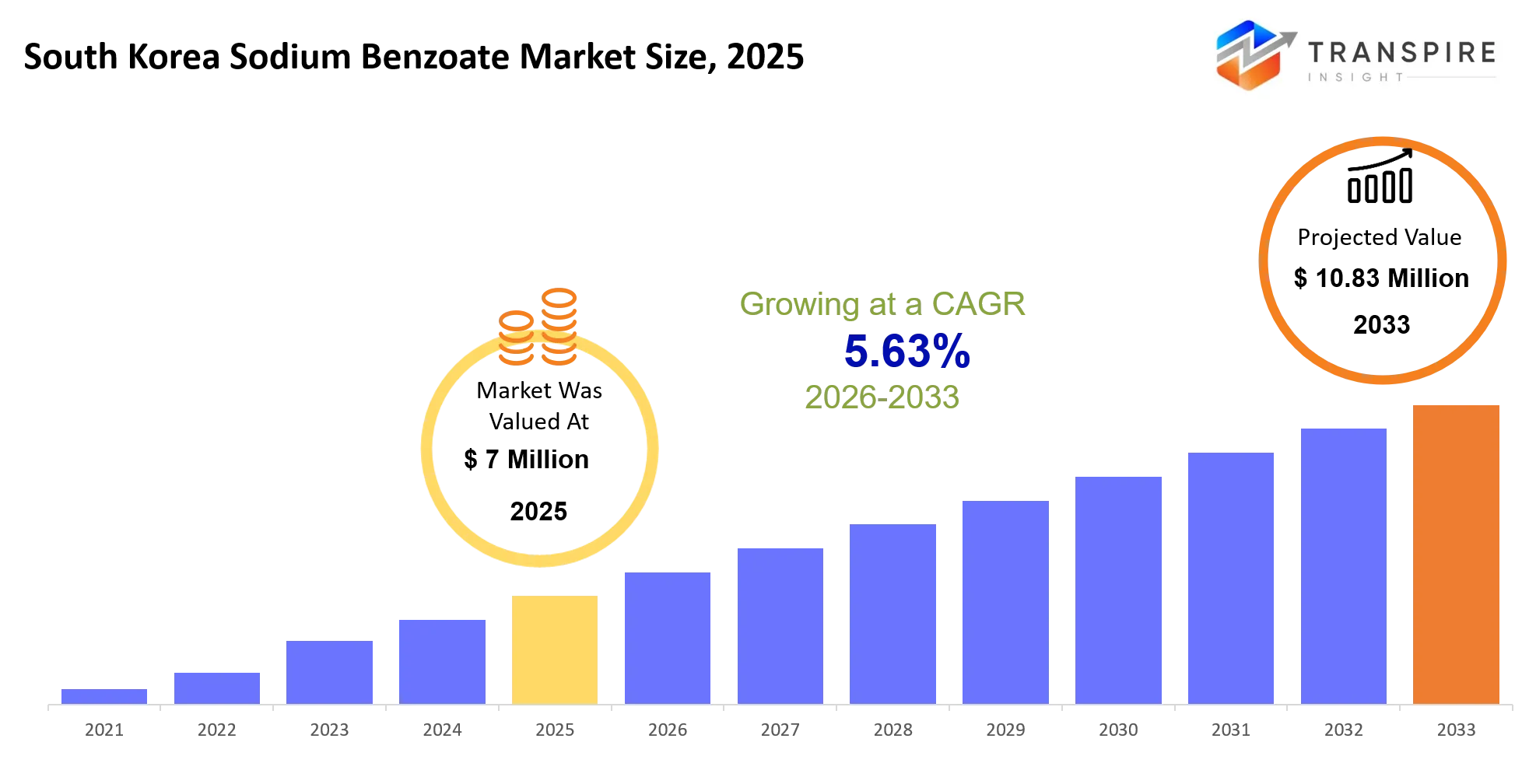
- South Korea Sodium Benzoate Market Size 2025: USD 7 Million
- South Korea Sodium Benzoate Market Size 2033: USD 10.83 Million
- South Korea Sodium Benzoate Market CAGR: 5.63%
- South Korea Sodium Benzoate Market Segments: By Grade (Food Grade, Pharmaceutical Grade, Industrial Grade, Feed Grade, Others); By Application (Food Preservation, Beverage Stabilization, Pharmaceutical Formulations, Personal Care Products, Others); By End User (Food & Beverage Industry, Pharmaceutical Industry, Cosmetics Industry, Chemical Industry, Others); By Form (Powder, Granules, Liquid Solutions, Others)
To learn more about this report,  Download Free Sample Report
South Korea Sodium Benzoate Market Summary
The South Korea Sodium Benzoate Market was valued at USD 7 Million in 2025. It is forecast to reach USD 10.83 Million by 2033. That is a CAGR of 5.63% over the period.
The South Korea sodium benzoate market ends up playing a practical kind of role in stretching the shelf life for packaged foods, beverages, personal care products, and even several pharmaceutical formulations. It works by limiting microbial spoilage during storage and the whole distribution cycle, so products don’t “fall apart” so fast, you know. For manufacturers, it also helps keep overall product quality steadier, cuts down on waste and supports nationwide supply chains that rely on longer lasting stability.
In the last few years, the whole market has been moving in a more structural way toward cleaner and more tightly controlled production routines. This is pushed by stricter food safety rules and higher product quality requirements, so companies have had to adapt. Then, after the COVID-19 period, global supply chain disruptions highlighted weak points, especially with raw material sourcing. That exposure made Korean manufacturers tweak procurement strategies and build more local supply resilience. Because of that shift, purchasing behavior across food processing and consumer goods has changed in noticeable ways.
Expansion is being helped by the rising preference for shelf-stable products, plus export-focused manufacturing, which really demand dependable preservation solutions. As production volumes go up and compliance requirements become more exacting, adoption of sodium benzoate keeps converting into stronger procurement spending. For suppliers, it tends to mean steadier revenue opportunities, and less uncertainty overall.
Key Market Insights
- The Seoul Capital Area kind of dominates the South Korean Sodium Benzoate market, pulling in an estimated 40%+ share in 2025, because its food processing base is highly concentrated.
- Gyeonggi Province kind of holds a big share of the overall activity, mainly because it has large-scale manufacturing facilities, and logistics infrastructure that really supports it, somehow.
- The Southeastern industrial region, like Busan and Ulsan, is set to become the quickest growing regional market all the way through 2030, it’s largely pushed by industrial expansion and related activity.
- In 2025, food grade sodium benzoate is basically taking over the market, around 60% or more share, it’s all supported by really wide use in packaged foods and drinks, you know, that kind of routine.
- Pharmaceutical grade sodium benzoate is basically the second-largest segment, in large part because it shows up in medicinal formulations and, these sort of specialty products too.
- It looks like the high-purity sodium benzoate formulations are supposed to be the fastest-growing segment, during 2025–2030, kinda due to tighter quality standards.
- Food and beverage preservation is still the main game, bringing in something like 65% of the industry total revenue in 2025 or so.
- Carbonated drinks, sauces and condiments, plus processed foods still seem to pull a lot of market demand, these days and, honestly, it keeps going on.
- Personal care and cosmetic compositions are, honestly, the quickest-growing use case segment across the whole forecast interval, you know, as things keep moving ahead.
- Pharmaceutical applications are really picking up, as manufacturers seem to focus more on product stability, and meeting regulatory compliance stuff. In a way it’s about keeping things steady over time and also staying within the required rules, which makes sense.
What are the Key Drivers, Restraints, and Opportunities in the South Korea Sodium Benzoate Market?
The primary force driving the South Korea Sodium Benzoate Market is the ongoing expansion of the country's processed food, and beverage manufacturing sector. Stricter food safety and shelf-life requirements have largely prompted manufacturers to adopt reliable preservation systems that reduce spoilage during storage and transport. This movement also seems to have been reinforced by the rise of convenience foods, ready to drink beverages, and export oriented food production. As manufacturers ramp output and widen distribution coverage, sodium benzoate use rises along with it, because it supports product stability and regulatory compliance. So the end result is higher purchasing volumes and more revenue across the preservative supply chain, overall.
The biggest obstacle to market growth is the tighter regulatory scrutiny of food additives and preservative usage. This issue feels structural, because it is tied to long-term consumer preferences, shifting safety standards, and regulatory frameworks that demand extensive testing, compliance documentation and more steps. Manufacturers cannot just change formulations overnight, without paying reformulation costs, waiting for regulatory approvals, and adjusting production lines. Because of that, some companies reduce preservative levels or attempt alternative ingredient systems. That can slow adoption rates and, in turn, reduce potential sales volumes for sodium benzoate suppliers.
A major opportunity shows up in the expansion of South Korea's pharmaceutical and personal care manufacturing industries. These areas increasingly call for high purity preservation ingredients that satisfy tough quality specifications. Investments in upgraded pharmaceutical production facilities, plus premium cosmetic product development, create favorable conditions for specialized sodium benzoate grade …
What Has the Impact of Artificial Intelligence Been on the South Korea Sodium Benzoate Market?
Artificial intelligence and more advanced digital technologies are starting to reshape operations across the South Korea Sodium Benzoate Market, sort of, by speeding up manufacturing, improving quality checks, and tightening supply chain management. Chemical producers are rolling out AI-enabled process control systems, which automatically monitor reaction conditions, raw material usage, temperature stability, and production yields inside sodium benzoate manufacturing plants. In practice this helps operators keep the product quality steady while cutting down on manual interruptions, plus it reduces production variability that can pop up unexpectedly.
Machine learning models are also being applied for predictive maintenance across chemical processing equipment, including reactors, pumps and packaging lines. These models look at sensor information to spot likely equipment failures before they actually happen. That means less unplanned downtime and better plant utilization rates, in other words more throughput without so many surprises. Alongside that, AI driven forecasting tools help producers estimate raw material needs and inventory levels with more accuracy, so procurement decisions get supported, and storage costs can be lowered too.
Overall these technologies support higher operational efficiency, better batch consistency, reduced maintenance spending, and stronger regulatory compliance too. Companies can fine-tune production scheduling, cut waste creation, and improve resource utilization which tends to lift profitability in a tough chemicals market. Still, AI adoption has a notable snag . Many older production sites need substantial investment to integrate digital sensors, connect data platforms, and add analytics software. Also, older process records can be scattered, or not enough, which makes predictive models less accurate and slows the pace of broad adoption across the industry, especially where budgets are constrained or data governance is messy.
Key Market Trends
- Since 2021, food manufacturers sort of moved to longer shelf-life formulations, and that’s where sodium benzoate use in packaged beverages, sauces, and convenience foods started getting more common, like a steady uptick.
- After all those global supply chain disruptions in 2020–2022, Korean buyers sort of start diversifying their sourcing methods to lower how much they rely on just one country raw material supplier. It makes sense, because being stuck with a single source is risky and a bit inflexible, so they leaned into different origins, different inputs and more of that cross sourcing approach, even when it’s not perfectly smooth.
- Since around 2022, regulatory inspections kind of got more rigorous, so manufacturers have been leaning in to invest in stronger quality assurance and more traceability systems.
- Pharmaceutical producers have basically been upping their purchases of high purity preservative ingredients over time, as the local drug manufacturing capacity has expanded across South Korea. In other words, it’s like they became more and more interested in that cleaner input, and they adjusted their buying accordingly, without too much drama about it.
- Since 2023, cosmetic and personal care brands have started to broaden their preservative sourcing portfolios a bit, to kind of support premium product launch plans and also export growth. It’s not only one reason, but mostly this push for, better supply options, and steadier access, so that they can keep moving.
- Chemical manufacturers are now kind of increasingly leaning into digital process monitoring systems, and that tends to improve production consistency, while also lowering batch variability compared with older, more traditional methods.
- Companies like Eastman Chemical and LANXESS have been putting more weight on specialty-grade chemical solutions, instead of just trying to outcompete others on sheer volume, you know, basically.
- Export oriented food processors have been expanding their preservative procurement a bit, because the overseas distribution networks now demand longer storage along with transportation stability, so yeah it’s kind of tied together in that way.
- Procurement teams are now, more or less, putting supplier reliability first along with the regulatory documentation stuff, like they’re moving away from buying decisions that are only based on price, and that sort of trend is getting stronger.
- Since 2023, sustainability initiatives keep pushing manufacturers to optimize resource usage, and in turn reduce production waste a bit more, while still keeping preservative performance standards steady.
South Korea Sodium Benzoate Market Segmentation
By Grade:
Food-grade sodium benzoate kinda keeps a leading position, because it is widely used in packaged foods, beverages, sauces, and processed products. You can see consistent demand from food manufacturers that supports steady consumption across large production sites . With strict food safety requirements, companies prefer approved preservation ingredients that really help hold product stability. It also shows up pretty often across everyday consumer goods, so this grade feels more and more important inside the industry.
Pharmaceutical-grade sodium benzoate is another major category, mostly tied to medicinal formulations and healthcare products. In pharmaceutical manufacturing, quality standards are higher, so there is demand for materials with higher purity, and dependable performance. Growth in domestic pharmaceutical production has supported purchasing activity in this segment. Greater emphasis on product quality and regulatory compliance will continue to support future development.
By Application:
Food, and beverage preservation is still the biggest application, mainly because preservation keeps a product’s quality in check while it sits in storage or moves through distribution. In other words packaged beverages, condiments, ready-to-eat meals, and processed foods pretty much stay dependent on preservation solutions that actually work. Lately, the expansion of convenience food production has helped adoption spread, not only in one place but across different manufacturing operations. Also, long distribution networks make it even harder, so they raise the pressure for stable product formulations.
On the personal care and cosmetic side, the importance keeps growing as manufacturers roll out more premium product portfolios. Those product stability demands often push teams to use preservation ingredients, but only in selected formulations, you know. Pharmaceutical uses also add to market momentum, since they show up in specific medicinal products. And because multiple industries are pulling on the same general need, the overall application scene stays more varied, which in turn supports longer term stability.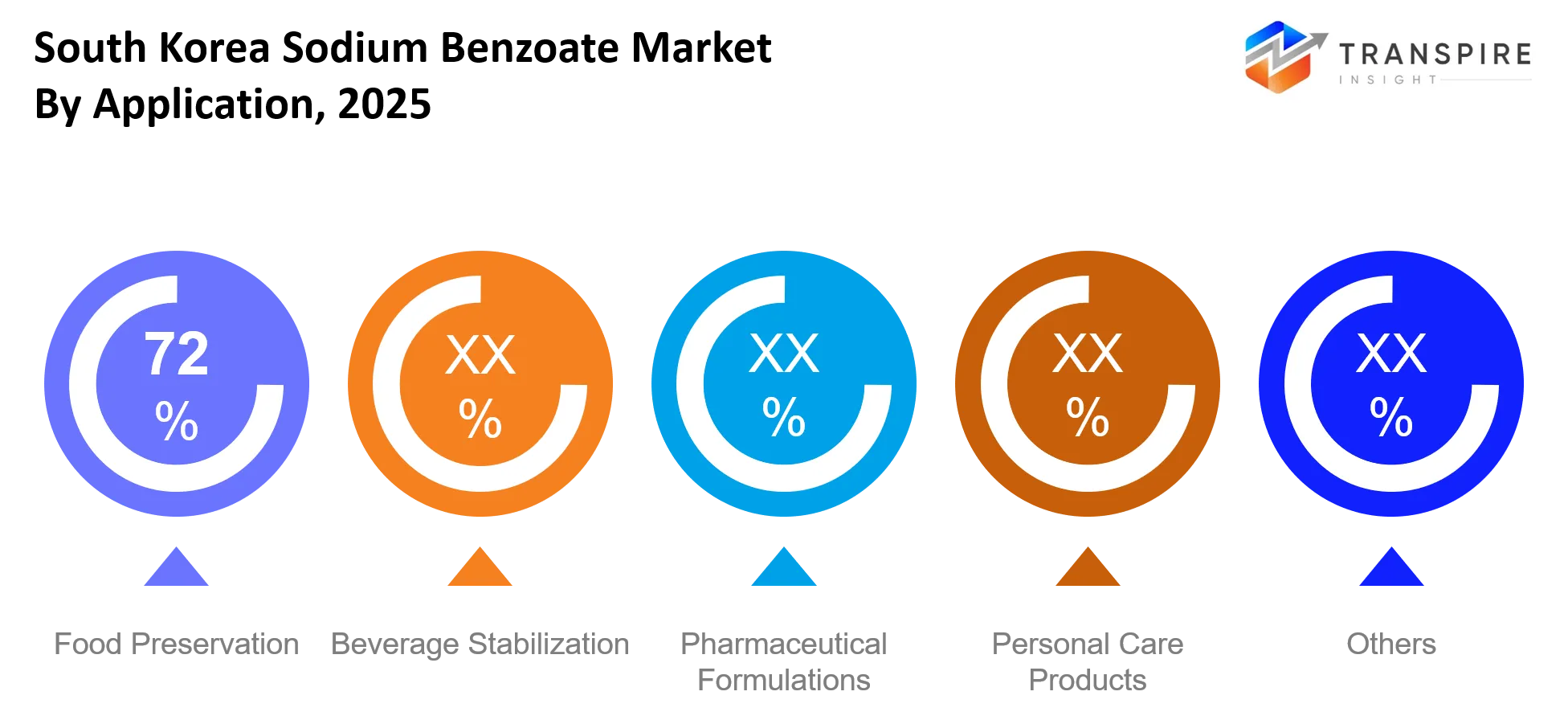
To learn more about this report, Download Free Sample Report
By End User:
The food processing industry is still kinda the largest end-user segment because of big scale production of packaged, shelf stable products. Food manufacturers need dependable preservation systems that help with quality, safety and regulatory compliance. When domestic production grows and export work keeps going, it tends to push purchasing requirements up. Overall, steady demand from this area keeps a strong slice of total consumption.
Beverage manufacturers are also notable users, because preservation stays important for a lot of drink types. Pharmaceutical companies add value through specialized formulation needs and very strict quality expectations. Personal care and cosmetics producers keep expanding procurement as their product line up grows and becomes more varied. Together these industries create several revenue streams so the business is less dependent on just one customer group.
By Form:
Powder form remains a widely preferred choice because, when it comes to storage, transportation, and handling, the routine is relatively simple and efficient. In most cases manufacturing facilities go with powder formulations too, mainly for that easy blending, plus a bit more production flexibility. Also, the longer storage stability kind of supports this adoption trend across different industries. When the product performance stays consistent, the demand for this form keeps getting stronger, especially for large scale operations, where everything has to behave the same.
Granular and other more specialized forms still end up serving specific processing requirements, because handling characteristics really steer purchasing decisions there. Product selection usually depends on manufacturing methods, the equipment configurations, and the exact formulation needs. Industrial users often weigh operational efficiency, not just performance, when deciding among the available forms. And ongoing process optimization, whether small adjustments or major revisions, will continue to affect preferences across end use sectors over time.
What are the Key Use Cases Driving the South Korea Sodium Benzoate Market?
In South Korea the main use of sodium benzoate is still basically food and beverage preservation, you know it helps keep products safe during storage and travel. Packaged drinks, sauces, condiments, and various processed foods depend on it to curb microbial growth and maintain consistent quality, even during long distribution cycles. This part likely makes up the biggest slice of the overall demand, because food makers run huge production volumes and they need reliable shelf-life results so their goods can move across the country retail channels and even for export shipments.
But the story does not stop there. Past food processing use is growing in pharmaceutical manufacturing and in personal care production. In pharma, companies apply sodium benzoate in certain formulations where stability is really critical, while cosmetic makers use it in skincare as well as personal hygiene items, in order to deliver dependable preservation. As premium consumer products have gained momentum, demand has followed through across these sectors too, more or less.
Meanwhile, some newer opportunities are starting to show up, especially in more specialized healthcare goods and in advanced cosmetic formulas that call for higher-purity preservation ingredients. At the same time, research focused on cleaner-label product development, plus new formulation techniques, is opening additional doors. Right now these applications are still relatively smaller, but if investment keeps rising in pharmaceutical and beauty product innovation, wider adoption could become more common across the forecast period.
|
Report Metrics |
Details |
|
Market size value in 2025 |
USD 7 Million |
|
Market size value in 2026 |
USD 7.38 Million |
|
Revenue forecast in 2033 |
USD 10.83 Million |
|
Growth rate |
CAGR of 5.63% from 2026 to 2033 |
|
Base year |
2025 |
|
Historical data |
2021 - 2024 |
|
Forecast period |
2026 - 2033 |
|
Report coverage |
Revenue forecast, competitive landscape, growth factors, and trends |
|
Regional scope |
South Korea |
|
Key company profiled |
Emerald Kalama Chemical, Tengzhou Tenglong Chemical, LANXESS, A.M Food Chemical, Wuhan Youji Industries, Eastman Chemical, FBC Industries, Ganesh Benzoplast, TNJ Chemical, BASF, Ueno Fine Chemicals, Jarchem Industries, Shandong Tong Tai Wei Run Chemical, Spectrum Chemical, Merck KGaA |
|
Customization scope |
Free report customization (country, regional & segment scope). Avail customized purchase options to meet your exact research needs. |
|
Report Segmentation |
By Grade (Food Grade, Pharmaceutical Grade, Industrial Grade, Feed Grade, Others); By Application (Food Preservation, Beverage Stabilization, Pharmaceutical Formulations, Personal Care Products, Others); By End User (Food & Beverage Industry, Pharmaceutical Industry, Cosmetics Industry, Chemical Industry, Others); By Form (Powder, Granules, Liquid Solutions, Others) |
Which Regions are Driving the South Korea Sodium Benzoate Market Growth?
The Seoul Capital Area still remains the leading region in the South Korea Sodium Benzoate Market, more or less because a lot of food processing companies, beverage manufacturers, pharmaceutical facilities, and big consumer goods producers are concentrated there. There is also strong regulatory oversight, so manufacturers keep trying to stay consistent with product quality and compliance standards, which in turn supports steady preservative consumption. On top of that the logistics setup is advanced enough to move raw materials and finished products, fast across both domestic routes and export channels. And because the industrial ecosystem is already well-established, with research institutions, distribution hubs and manufacturing clusters, the region keeps reinforcing its regional leadership, like it sort of never really stops.
Gyeonggi Province is the second-largest regional market, but the growth pattern is not exactly the same as the Seoul Capital Area. Instead of leaning heavily on corporate headquarters and commercial concentration, Gyeonggi leans into a broad manufacturing base spread across several industrial districts. With stable investment in food production, pharmaceuticals, and even specialty chemicals, demand for preservation ingredients stays fairly steady. Because this industrial mix is diversified, the region holds up better when consumer demand changes, or when supply chain conditions wobble a bit, so it becomes a dependable contributor to industry revenue.
Then you have the southeastern industrial corridor, covering Busan and Ulsan, which is emerging as the fastest-growing regional market. Recent investments in manufacturing capacity, export-focused production, and industrial modernization have ramped up demand for sodium benzoate used in food, personal care and pharmaceutical products. As export activity continues to expand, the requirement for longer product stability during transportation and storage has also gone up, and this is creating more openings for sodium benzoate… like additional chances that were not there before.
Who are the Key Players in the South Korea Sodium Benzoate Market and How Do They Compete?
The competitive environment in the South Korea Sodium Benzoate Market stays fairly fragmented, with involvement from global chemical producers, specialty ingredient suppliers, and Asian manufacturers. Competition tends to be about product quality, regulatory compliance, supply reliability and pricing, not so much pure production volume. Existing suppliers keep trying to hold their share via long-term customer ties, plus technical support that feels a bit more hands-on, while regional manufacturers push back by giving cost-efficient sourcing routes. Buyers are lately measuring suppliers based on quality consistency, documentation skills, and how well they can satisfy industry-specific needs across food, pharmaceutical and personal care uses.
Emerald Kalama Chemical kind of stands out by leaning hard into specialty preservation ingredients, along with application know-how for food, beverage and personal care manufacturers. They stress product consistency and regulatory compliance, which makes customers with very strict quality requirements more willing to adopt their materials. LANXESS takes a different angle through advanced chemical manufacturing capabilities and a diversified specialty chemicals portfolio, so they can engage customers across different industries. Eastman Chemical also tries to strengthen its role via broad distribution reach, technical service support, and investments in high-purity chemical solutions that target specialized industrial requirements, effectively.
Tengzhou Tenglong Chemical and Wuhan Youji Industries pursue growth using cost-competitive manufacturing, plus they keep expanding export activity across Asian markets. Competitive pricing together with scalable production capacity helps both companies serve customers who want dependable supply, but with cost controls. BASF differentiates itself through research-driven
Company List
- Emerald Kalama Chemical
- Tengzhou Tenglong Chemical
- LANXESS
- A.M Food Chemical
- Wuhan Youji Industries
- Eastman Chemical
- FBC Industries
- Ganesh Benzoplast
- TNJ Chemical
- BASF
- Ueno Fine Chemicals
- Jarchem Industries
- Shandong Tong Tai Wei Run Chemical
- Spectrum Chemical
- Merck KGaA
Recent Development News
In March 2026, LANXESS presented its cosmetics and personal care portfolio featuring Sodium Benzoate Purox S Scopeblue at in-cosmetics Global 2026. The product promotion reinforced the company's focus on sustainable preservative technologies and supported adoption among manufacturers seeking lower-carbon ingredient alternatives.https://lanxess.com
In April 2026, LANXESS entered a partnership with Fuelcare for fuel preservation solutions. Although not specific to sodium benzoate, the agreement expanded LANXESS' preservation technology portfolio and strengthened its specialty chemicals presence across industrial preservation markets.https://lanxess.com
What Strategic Insights Define the Future of the South Korea Sodium Benzoate Market?
Over the next five to seven years, the South Korea Sodium Benzoate Market is expected to start moving toward higher-value, application-based products instead of mostly competing on sheer volume. The main driver behind this change is likely going to be more stringent quality requirements across food processing, pharmaceuticals and personal care making, where customers are increasingly asking for steadier performance, traceability, and clear regulatory alignment. In other words, this shift will tend to reward suppliers who can offer tailored formulations and dependable technical guidance, not just standard batches.
There’s also a less obvious risk that can feel kind of invisible at first: the gradual pick up of alternative preservation systems. Even if sodium benzoate is still widely used, ongoing reformulation work and shifting ingredient preferences might slow down consumption growth in certain applications. On top of that, raw material price swings are a real challenge, especially for manufacturers who don’t have much room to adjust pricing when costs jump.
At the same time, there’s an emerging opening in higher-purity preservative solutions for advanced pharmaceutical production and premium cosmetic manufacturing. As South Korea keeps strengthening its role in both areas, the need for specialized inputs is probably going to rise. Market players should think about investing early in product differentiation, solid quality certifications, and partnerships that are strategically aligned with pharmaceutical and cosmetic manufacturers, so they can lock in a longer-term competitive footing.
South Korea Sodium Benzoate Market Report Segmentation
By Grade
- Food Grade
- Pharmaceutical Grade
- Industrial Grade
- Feed Grade
- Others
By Application
- Food Preservation
- Beverage Stabilization
- Pharmaceutical Formulations
- Personal Care Products
- Others
By End User
- Food & Beverage Industry
- Pharmaceutical Industry
- Cosmetics Industry
- Chemical Industry
- Others
By Form
- Powder
- Granules
- Liquid Solutions
- Others
Frequently Asked Questions
Find quick answers to common questions.
The Expected South Korea Sodium Benzoate Market size for the Market will be USD 10.83 Million in 2033.
Key Segments for the South Korea Sodium Benzoate Market are By Grade (Food Grade, Pharmaceutical Grade, Industrial Grade, Feed Grade, Others); By Application (Food Preservation, Beverage Stabilization, Pharmaceutical Formulations, Personal Care Products, Others); By End User (Food & Beverage Industry, Pharmaceutical Industry, Cosmetics Industry, Chemical Industry, Others); By Form (Powder, Granules, Liquid Solutions, Others).
Major South Korea Sodium Benzoate Market players are Emerald Kalama Chemical, Tengzhou Tenglong Chemical, LANXESS, A.M Food Chemical, Wuhan Youji Industries, Eastman Chemical, FBC Industries, Ganesh Benzoplast, TNJ Chemical, BASF, Ueno Fine Chemicals, Jarchem Industries, Shandong Tong Tai Wei Run Chemical, Spectrum Chemical, Merck KGaA.
The Current South Korea Sodium Benzoate Market size is USD 7 Million in 2025.
The South Korea Sodium Benzoate Market CAGR is 5.63% from 2026 to 2033.
- Emerald Kalama Chemical
- Tengzhou Tenglong Chemical
- LANXESS
- A.M Food Chemical
- Wuhan Youji Industries
- Eastman Chemical
- FBC Industries
- Ganesh Benzoplast
- TNJ Chemical
- BASF
- Ueno Fine Chemicals
- Jarchem Industries
- Shandong Tong Tai Wei Run Chemical
- Spectrum Chemical
- Merck KGaA
About the Authors

Pankaj Ghogare Patil
I am Pankaj Ghogare Patil, a Senior Research Analyst at Transpire Insight, specializing in the Pharmaceutical, Chemicals & Materials, Healthcare IT, and Biotechnology industry. My expertise lies in conducting comprehensive market research, analyzing industry trends, evaluating competitive landscapes, and translating complex data into actionable insights. At Transpire Insight, I closely follow emerging technologies, regulatory developments, and market innovations to create accurate, well-researched, and informative content that helps businesses and professionals make informed decisions. I am committed to producing credible, evidence-based articles that reflect industry best practices while making technical topics accessible and valuable for a broad audience.

Chakradhar Khansole
Chakradhar serves as the Research Director at Transpire Insight, bringing over 8 years of experience in technology, innovation, and strategic market intelligence. He specializes in transforming complex market data into actionable business insights that enable organizations to make informed, growth-oriented decisions. Recognized for his strategic vision and analytical expertise, Chakradhar leads high-impact research initiatives, delivering comprehensive market assessments, competitive intelligence, and forward-looking industry analysis.
Recently Published Reports
-
May 2026
Healthcare Polymer Packaging Market
Healthcare Polymer Packaging Market Size, Share & Analysis Report By Packaging Type (Syringes, IV Bottles and Pouches, Clamshells, Blisters, Bottles & Jars, Containers, Tubes, IV Parental Packaging, Others), By Type (Regulated, Non-regulated), By Polymer Type (LDPE (Low-Density Polyethylene), HDPE (High-Density Polyethylene), Homo-polymer (Homo), Random Copolymer (Random), Block Copolymer (Block), PET, Polystyrene, Polyvinyl Chloride, Polyamide/EVOH, Others), and Geography (North America, Europe, Asia-Pacific, Middle East and Africa, South and Central America), 2021 - 2031
-
Apr 2026
Hydrophilic Tape (Waterstop) Market
Hydrophilic Tape (Waterstop) Market Size, Share & Analysis Report By Type (Bentonite-Based Hydrophilic Tape, Rubber-Based Hydrophilic Tape), By Application (Residential Buildings, Commercial Buildings, Infrastructure Projects), and Geography (North America, Europe, Asia-Pacific, Middle East and Africa, South and Central America), 2021 - 2031
-
Apr 2026
Metalens Market
Metalens Market Size, Share & Analysis Report By Type (Visible Light Metalens, and Infrared Metalens), By Application (Consumer Electronics, Automotive Electronics, Industrial, Medical, and Others), and Geography (North America, Europe, Asia-Pacific, Middle East and Africa, South and Central America), 2021 - 2031
-
Apr 2026
PBT Resin Market
PBT Resin Market Size, Share & Analysis Report By Type (Reinforced PBT Resin, Unreinforced PBT Resin), By Processing Method (Injection Molding, Extrusion, Blow Molding, Others), By End-User (Automotive, Electrical & Electronics, Consumer Appliances, Industrial Machinery, Medical Devices, Packaging, Others), and Geography (North America, Europe, Asia-Pacific, Middle East and Africa, South and Central America), 2021 - 2031