
United States Sodium Thiosulfate Pentahydrate Market Size & Forecast:
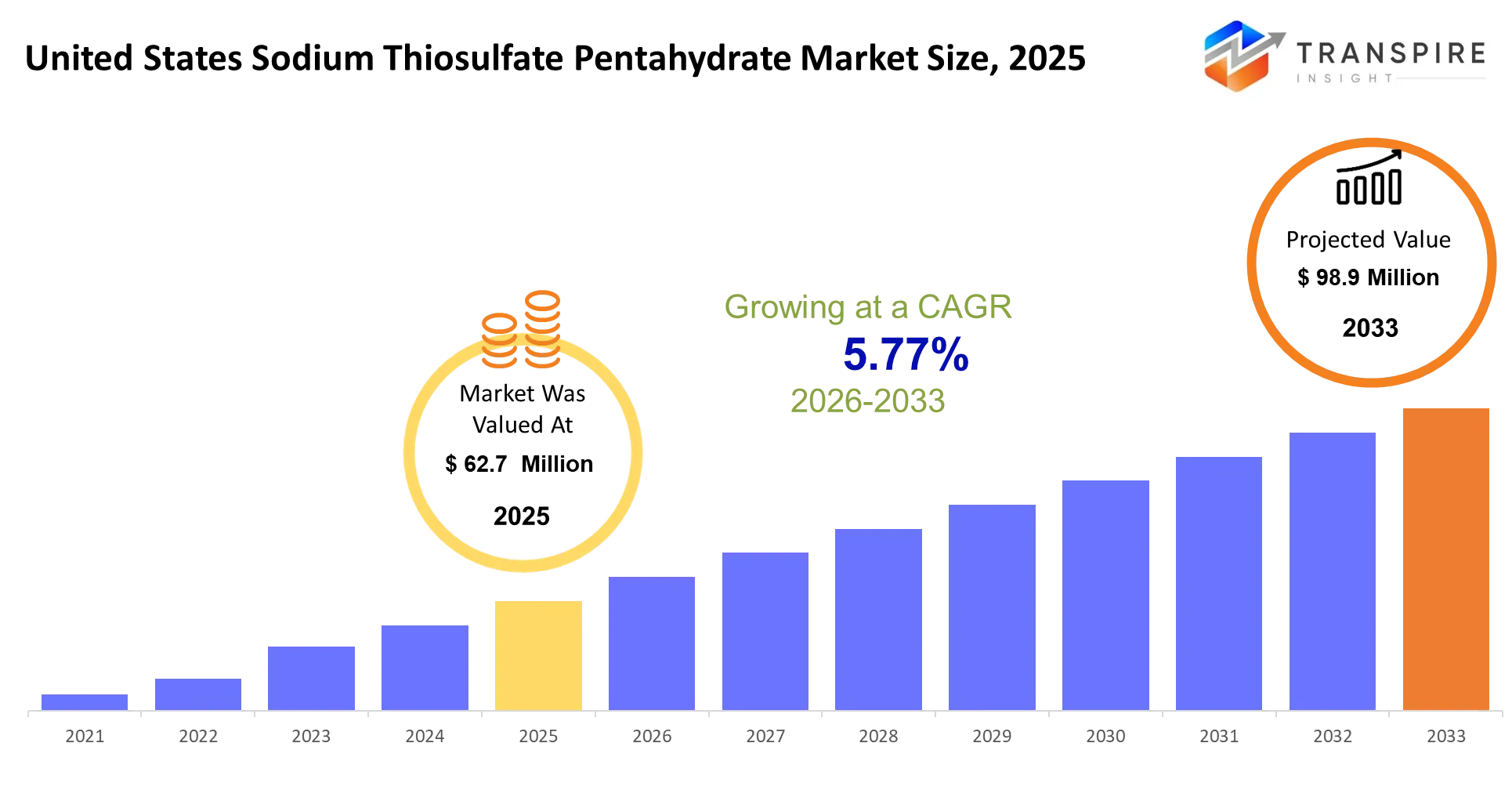
- United States Sodium Thiosulfate Pentahydrate Market Size 2025: USD 62.7 Million
- United States Sodium Thiosulfate Pentahydrate Market Size 2033: USD 98.9 Million
- United States Sodium Thiosulfate Pentahydrate Market CAGR: 5.77%
- United States Sodium Thiosulfate Pentahydrate Market Segments: By Grade (Industrial Grade, Pharmaceutical Grade, Food Grade, Analytical Grade, Others); By Application (Water Treatment, Photography Chemicals, Gold Extraction, Medical Applications, Textile Processing, Others); By Form (Crystals, Powder, Liquid Solutions, Granules, Others); By End User (Chemical Industry, Mining Industry, Healthcare Sector, Textile Industry, Water Treatment Plants, Others)
To learn more about this report,  Download Free Sample Report
United States Sodium Thiosulfate Pentahydrate Market Summary
The United States Sodium Thiosulfate Pentahydrate Market was valued at USD 62.7 Million in 2025. It is forecast to reach USD 98.9 Million by 2033. That is a CAGR of 5.77% over the period.
The United States Sodium Thiosulfate Pentahydrate market plays a kindof practical role in industries that need safe neutralization, dechlorination,and metal treatment in really strict operating scenarios. Water treatment facilities typically use it to strip out leftover chlorine before discharge, and mining, photography, healthcare, as well as chemical manufacturing, lean on it for detoxification and processing stability. On the maritime side, it has shown more relevance in ballast water treatment systems, where operators have to meet tighter discharge standards, without messing up onboard equipment.
Over the last five years, the market kind of moved away from simple commodity-style purchasing toward application-based sourcing, linked to environmental compliance and process reliability . A big trigger was new, stricter wastewater discharge regulations, plus extra scrutiny of industrial effluents following several regional contamination incidents, that somehow threw permitting and operating approvals off schedule. So utilities and industrial operators were pushed to adopt more dependable chemical treatment programs. As compliance expenses rose, buyers increasingly chose higher-purity and performance-certified sodium thiosulfate pentahydrate products, which let suppliers lock in longer contracts , charge premium rates,and maintain steadier recurring industrial demand.
Key Market Insights
- So, the Gulf Coast region pretty much dominated the United States Sodium Thiosulfate Pentahydrate Market, with almost 38% market share in 2025, mainly because there was strong chemical manufacturing capacity there .
- Texas is still the biggest production and consumption place, not surprising, since it has concentrated refinery activities, water treatment work, and a lot of industrial processing operations too.
- Then the Midwest kind of took the lead as the fastest growing regional market during 2026–2032, supported by upgrades to municipal water infrastructure , those modernization programs helped.
- Meanwhile, the West Coast saw demand climb a lot after newer industrial discharge compliance standards got tighter, and that pushed wastewater facilities toward dechlorination chemicals, faster adoption.
- When it comes to grade, industrial-grade sodium thiosulfate pentahydrate held more than 55% share in 2025, mostly due to broad industrial water treatment uses.
- And pharmaceutical-grade products sat as the second-largest segment, driven by increased use for medical detoxification , plus laboratory formulations where needed.
- High-purity sodium thiosulfate pentahydrate is expected to be the fastest-growing segment through 2032, mainly because tighter process control standards keep getting emphasized and, plus, because specialty chemical uses keep expanding in the background.
- Bulk packaging formats also picked up a lot more traction, as big industrial customers leaned into supply stability and lower transport costs, even if it feels a little less flexible day to day.
- In the United States Sodium Thiosulfate Pentahydrate market, water treatment took the lead with about 42% of revenue share in 2025.
- Industrial wastewater treatment adoption moved faster after stricter Environmental Protection Agency discharge regulations kicked in, which then pushed compliance related chemical buying to ramp up.
What are the Key Drivers, Restraints, and Opportunities in the United States Sodium Thiosulfate Pentahydrate Market?
The main thing, really driving the United States Sodium Thiosulfate Pentahydrate market , is the fact that industrial wastewater discharge rules keep getting tighter across municipal utilities, refineries , and chemical processing plants. When enforcement started showing up more often, especially around chlorine residuals and toxic effluent releases, operators felt they had to shift toward more dependable dechlorination and detoxification chemicals, not just “whatever works.” That momentum picked up after some states tightened their permitting expectations for industrial water discharge , between 2021 and 2025. Sodium thiosulfate pentahydrate did well in that environment because it neutralizes chlorine fast , and it does this without upsetting downstream treatment systems. Also , as compliance deadlines got closer, industrial buyers moved away from occasional spot buying and toward longer term supply arrangements, this improved repeatable revenue clarity for suppliers, and for distributors too.
The biggest slowdown though, still comes from the market’s dependence on sulfur based raw material supply lines and an energy intensive chemical processing setup. Put simply, the profit math stays exposed to swings in sulfur feedstock prices, plus shipping or transport costs and utility bills. These problems are kind of built-in, because any new domestic chemical processing capability needs big capital commitments, environmental approvals, and construction schedules that run for years. Smaller buyers frequently postpone procurement upgrades when pricing volatility shrinks their day to day budget, and that tends to curb wider adoption across the market.
A big chance is kinda taking shape because of ballast water treatment modernization in U.S. maritime operations. It seems like ports along the Gulf Coast and up the Atlantic corridor are adding more compliance infrastructure, related to those international marine discharge standards. In practice this is pushing demand for automated dosing systems—systems that integrate sodium thiosulfate pentahydrate directly into onboard treatment platforms, and that should open up some longer term supply opportunities for specialty chemical manufacturers.
What Has the Impact of Artificial Intelligence Been on the United States Sodium Thiosulfate Pentahydrate Market?
Artificial intelligence along with advanced digital technologies are in the process of reshaping the way sodium thiosulfate pentahydrate is handled across marine emission control systems, industrial water treatment processes, and exhaust gas cleaning tech platforms. In practice, shipping operators ,and industrial sites more and more rely on AI-enabled monitoring setups to automate chemical dosing, keep an eye on scrubber functionality, and generate discharge compliance documentation. These setups gather live sensor signals related to chlorine residuals, pH equilibrium, sulfur oxide capture efficiency and also wastewater discharge status. With that flow of data, operators can fine tune treatment dosages without someone standing there doing it by hand every time.
At the same time, machine learning models are getting better at forecasting maintenance needs for pumps, dosing components, and shipboard scrubber units. They look at vibration traces, corrosion growth rates and operational temperature shifts, so problems can be spotted before they turn into real breakdowns. A number of fleet operators mentioned fewer sudden maintenance incidents and better overall uptime after predictive analytics were added into their emission control frameworks. For industrial water treatment, AI-assisted optimization has meant less chemical wastage and reduced running expenses, mainly by tightening dosing precision when plant demand swings around.
Still, there’s a big problem with AI roll out in maritime settings because connectivity on vessels isn’t always steady, especially during long-distance trips. When offshore data transfer is spotty, real time analytics can become less dependable and cloud based predictive routines don’t improve as fast. This slows down outcomes particularly for fleets traveling across far, remote international shipping routes.
Key Market Trends
- Between 2021 and 2025, municipal utilities went ahead and increased their sodium thiosulfate procurement, once tighter chlorine discharge enforcement rolled out and compliance monitoring requirements, sorta expanded nationwide.
- Gulf Coast chemical producers started leaning into higher-purity formulations as pharmaceutical and specialty processing buyers pushed for stricter performance certified treatment chemicals, not just any workaround.
- Since 2023, maritime operators have really sped up adoption of automated ballast water treatment systems, and a bunch of them now integrate sodium thiosulfate based dechlorination modules for discharge compliance, which honestly makes audits easier.
- Industrial buyers cut back on spot-market purchasing after sulfur feedstock volatility made raw material pricing uncertainty, more pronounced across U.S. chemical supply chains during 2022 and also again through 2024.
- Companies like Hydrite Chemical Co. and American Elements, expanded specialty chemical distribution networks nearer to Gulf Coast and Midwest industrial clusters , so shipments could move faster.
- Water treatment facilities increasingly rolled out AI assisted dosing controls, after chemical overuse pushed operational costs higher during stretches of fluctuating wastewater treatment loads.
- Since 2022, industrial wastewater operators began swapping out lower-cost neutralizing chemicals for sodium thiosulfate pentahydrate, mainly to stay within stricter discharge permit thresholds, more consistently.
- Pharmaceutical and laboratory buyers increased domestic sourcing contracts after international logistics disruptions, delayed imported specialty chemical deliveries during the post pandemic recovery phase.
- Manufacturers have been investing in bulk packaging and automated handling systems as major industrial customers consolidated procurement under multi year supply agreements following 2023.
United States Sodium Thiosulfate Pentahydrate Market Segmentation
By Grade :
Industrial grade sodium thiosulfate pentahydrate, will back up large scale use across water treatment and chemical processing needs in the United States market, in a pretty straightforward way. Pharmaceutical grade, will end up serving medical related work with high purity level expectations. Food grade will likely stay limited but still matters for controlled processing tasks. Analytical grade will cover lab testing and quality control routines. Others will cover niche specifications for special industrial requirements. Overall demand for each grade should remain tightly tied to purity level needs, and the end use safety standards that come with it.
Pharmaceutical grade is set to feel more attention, because of higher medical usage tied to detoxification and supportive therapies. Analytical grade will keep a steady pace thanks to research labs and testing operations. Industrial grade will stay the dominant share because of bulk consumption in treatment plants and chemical manufacturing sites. Food grade and the other categories, will remain smaller but steady, supported by regulated sectors that require strict quality control, and dependable chemical composition.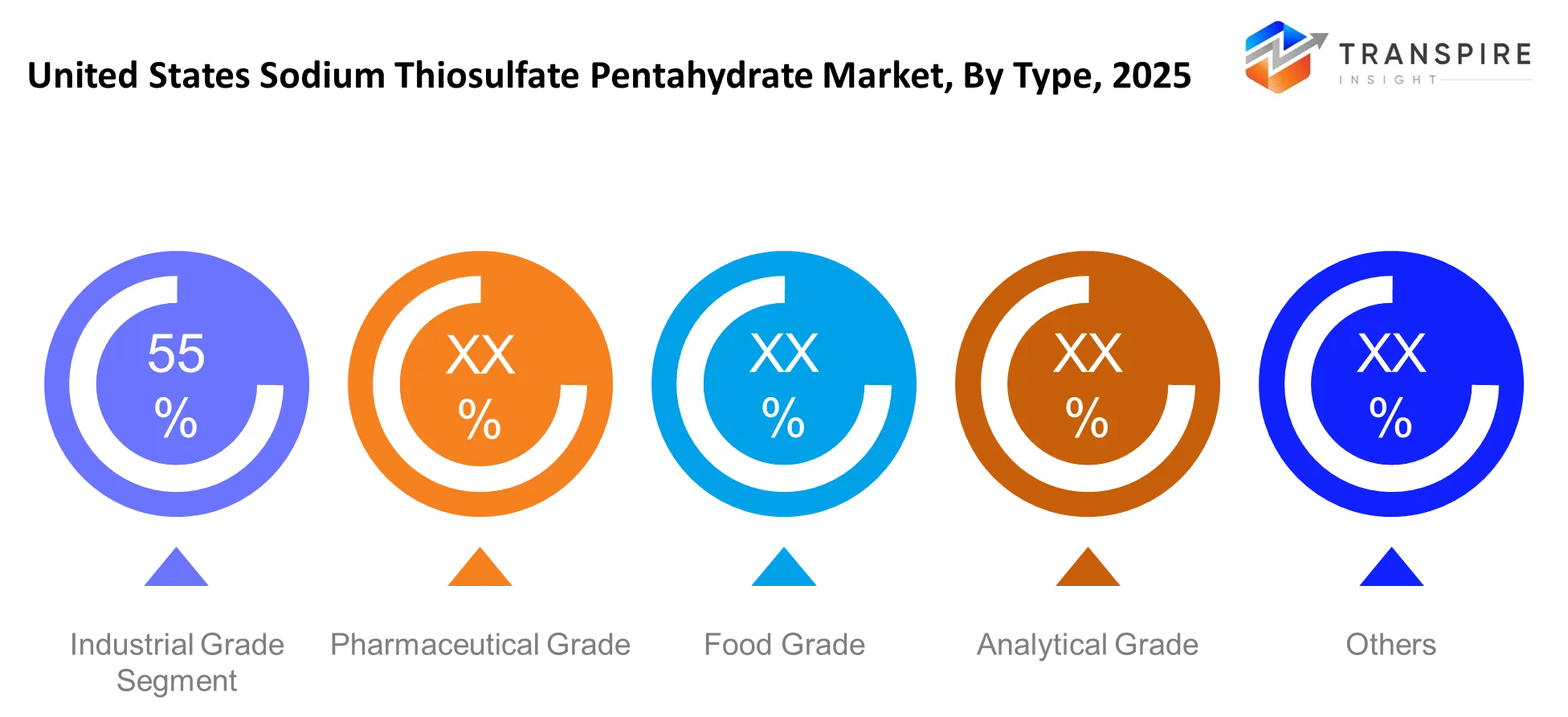
To learn more about this report, Download Free Sample Report
By Application :
Water treatment is gonna stay the main use because it’s still strongly used in chlorine neutralization and general purification steps, especially across the United States market. Photography chemicals should keep a steady demand but in a limited way, since conventional imaging keeps losing ground. For gold extraction , people will lean on sodium thiosulfate pentahydrate as a safer alternative within leaching operations. On the medical side, it will support controlled therapeutic use , in a more careful way. Textile processing will use it for chemical balancing and stability. Then there are the other uses, like small industrial related needs that don’t really dominate.
On the next note, water treatment plants will keep pulling bulk consumption forward, mainly due to strict environmental compliance needs. Gold extraction should grow little by little, because safer processing methods are getting more attention in mining operations. Medical applications will stay tied to regulated healthcare practices, plus controlled dosage expectations. Textile processing will hold relatively steady in dyeing and finishing stages. Photography chemicals may drop again but won’t fully disappear, since there are still niche professional and archival uses inside some specialized industries.
By Form :
Crystals will stay a commonly used type because storage is fairly easy, stability stays pretty good, and the shelf life is long for industrial handling. The powder kind will help with quick dissolution and kind of flexible usage inside different processing setups. Liquid solutions will likely get the preference in continuous dosing systems at treatment plants. Granules will handle the controlled release requirements more neatly. Others will show up as customized physical formats for particular industrial needs across the United States market.
Powder and liquid solution formats will probably dominate use since they let mixing happen faster and they apply more efficiently in water treatment and chemical processing systems, too. Crystals will keep a strong role for bulk storage and transport efficiency. Granules will fit controlled handling in industrial environments where measured release is required. The other options will remain relatively limited but they’ll still work for specialized needs in laboratories and niche manufacturing processes, especially where handling conditions are strict.
By End User :
The chemical industry will stay a big end user, because there is large scale use across production process, and all that chemical balancing stuff. The mining industry will keep using sodium thiosulfate pentahydrate for gold extraction operations. The healthcare sector will apply it for regulated medical treatments, in more controlled ways. The textile industry will use it during fabric processing operations. Water treatment plants will likely be the largest consumption base, mainly because there are constant purification requirements, so they never really pause. Other users will exist too, with smaller industrial consumption.
Water treatment plants will keep leading demand, since there’s a steady need for safe water discharge and treatment compliance. The chemical industry will maintain strong consumption, driven by production and formulation activities. The mining industry will grow gradually, with more emphasis on safer extraction methods. The healthcare sector will remain regulated, but also fairly stable in how it’s used over time. The textile industry will sustain demand for processing assistance, while other end users will add smaller but still consistent consumption.
What are the Key Use Cases Driving the United States Sodium Thiosulfate Pentahydrate Market?
Municipal and industrial water treatment is still the biggest use of sodium thiosulfate pentahydrate in the United States, mostly because operators have to neutralize leftover chlorine before any wastewater is released. Refineries, power stations, and chemical plants depend on it so they can stay inside tight discharge permit rules without upsetting downstream treatment setups.
Mining and metal recovery are using it more and more too, as cyanide detoxification benchmarks get stricter across many processing sites. On top of that, healthcare and pharmaceutical labs have ramped up adoption for decontamination blends and analytical testing workflows that need high purity chemical stability, with fewer unwanted side reactions.
New uses are showing up as well, especially in maritime ballast water treatment systems and in automated onboard discharge control platforms. Shipping companies along the Gulf Coast and Atlantic lanes are trying connected dechlorination arrangements to meet international marine release standards, while also cutting down on manual chemical handling during vessel operations.
|
Report Metrics |
Details |
|
Market size value in 2025 |
USD 62.7 Million |
|
Market size value in 2026 |
USD 66.8 Million |
|
Revenue forecast in 2033 |
USD 98.9 Million |
|
Growth rate |
CAGR of 5.77% from 2026 to 2033 |
|
Base year |
2025 |
|
Historical data |
2021 - 2024 |
|
Forecast period |
2026 - 2033 |
|
Report coverage |
Revenue forecast, competitive landscape, growth factors, and trends |
|
Geographic scope |
United States of America |
|
Key company profiled |
Merck KGaA, Thermo Fisher Scientific, American Elements, Solvay, BASF, GFS Chemicals, Spectrum Chemical, Noah Chemicals, Hydrite Chemical, Avantor, Fisher Scientific, Alfa Aesar, TIB Chemicals, Loba Chemie, Central Drug House |
|
Customization scope |
Free report customization (country, regional & segment scope). Avail customized purchase options to meet your exact research needs. |
|
Report Segmentation |
By Grade (Industrial Grade, Pharmaceutical Grade, Food Grade, Analytical Grade, Others); By Application (Water Treatment, Photography Chemicals, Gold Extraction, Medical Applications, Textile Processing, Others); By Form (Crystals, Powder, Liquid Solutions, Granules, Others); By End User (Chemical Industry, Mining Industry, Healthcare Sector, Textile Industry, Water Treatment Plants, Others) |
Which Regions are Driving the United States Sodium Thiosulfate Pentahydrate Market Growth?
The Gulf Coast region leads the United States sodium thiosulfate pentahydrate market, i mean it really pulls ahead because it wraps together large-scale chemical manufacturing , refinery operations and high volume maritime activity in one pretty concentrated industrial lane. Texas and Louisiana keep steady demand , largely because wastewater discharge compliance rules are strict and they’re connected to petrochemical processing plus port operations. Big harbors like Houston and New Orleans keep marine treatment chemical use running, especially with ballast water management and the industrial shipping setup. On top of that there’s a well-built supplier ecosystem there too , with sulfur processing facilities, chemical distributors, storage terminals, and linked logistics networks. That combination helps industrial buyers cut down procurement lead times, more or less.
Then the Midwest comes in as the second-largest regional contributor, though its position is more about infrastructure stability than intense export driven industrial clustering. Municipal water authorities across Illinois, Ohio, and Michigan gradually expanded dechlorination treatment initiatives. They do it through long-term modernization budgets, not sudden spikes. Compared with the Gulf Coast, Midwest demand is also less exposed to international shipping swings and energy market tremors. So ongoing investment in wastewater treatment improvements, aging pipeline replacement work and industrial water reuse programs forms a dependable revenue base for specialty chemical suppliers serving municipal providers and manufacturers.
The West Coast is sort of emerging as the most rapidly growing area after California, and Pacific port authorities strengthened environmental monitoring standards for industrial discharge , and maritime water treatment systems. Lately, there’s been more investment in cleaner port infrastructure , automated ballast water treatment technology, and digital compliance tracking, and that seems to have sped up adoption of sodium thiosulfate pentahydrate among shipping operators plus nearby coastal industrial facilities. Fleet modernization programs, linked to tougher Pacific shipping rules, also pushed demand for onboard dechlorination and discharge management systems. During the 2026–2033 window, this momentum should pull in specialty chemical manufacturers , marine treatment technology firms, and logistics providers looking for expansion chances in these high-compliance coastal markets.
Who are the Key Players in the United States Sodium Thiosulfate Pentahydrate Market and How Do They Compete?
The United States sodium thiosulfate pentahydrate market is still moderately fragmented, and the way firms compete is more about regional supply access, purity requirements , and technical service know-how than just raw production volume. Big chemical manufacturers keep trying to defend their share with integrated distribution routes and long-term industrial contracts, even when customers are shopping around a bit more. Smaller specialty suppliers, meanwhile, tend to go after pharmaceutical , laboratory, and stricter marine treatment uses where compliance matters more than price. In the last couple years—especially since 2022—buyers have been leaning harder toward supply reliability, certified purity levels, and formulation support that can be adapted to the site , because wastewater discharge rules and industrial process expectations have tightened. As a result, the old edge held by lower cost commodity suppliers has weakened, and the market is now asking for application-focused chemical expertise more often.
Hydrite Chemical Co. is active through a mix of regional distribution strength and technical support that is geared toward municipal plus industrial water treatment teams across the Midwest and Gulf Coast. Its quick delivery performance, along with customized chemical handling programs, tends to land well with utilities that run compliance work that can’t wait. Esseco Group differentiates more through sulfur chemistry focus , along with vertically integrated manufacturing that can help smooth out raw material availability when sulfur pricing swings. The company has also been widening its North American footprint by deepening industrial distribution relationships, particularly those connected to water treatment and specialty chemical applications.
Merck KGaA hones in on high purity , and lab grade sodium thiosulfate pentahydrate, used across pharmaceutical, research, and analytical work where consistency plus certification norms are kinda critical. Their main edge comes from pretty strict quality assurance protocols and global research supply routes, which smaller regional suppliers can be hard to mirror, even with effort. American Elements leans toward niche industrial and advanced material needs, by giving customized purity levels and specialty packaging shapes for research institutes and precision manufacturing clients. Thermo Fisher Scientific keeps pushing digital procurement, plus laboratory supply logistics, which helps industrial and healthcare buyers streamline their repeating chemical purchases, basically through centralized procurement systems.
Company List
- Merck KGaA
- Thermo Fisher Scientific
- American Elements
- Solvay
- BASF
- GFS Chemicals
- Spectrum Chemical
- Noah Chemicals
- Hydrite Chemical
- Avantor
- Fisher Scientific
- Alfa Aesar
- TIB Chemicals
- Loba Chemie
- Central Drug House
Recent Development News
In March 2026, ChemAnalyst (U.S. chemical pricing intelligence platform) documented a sustained rise in the Sodium Thiosulfate Pentahydrate Price Index in North America, driven by elevated production costs and stronger industrial demand in the United States chemical sector. This cost pressure reinforced supply-side adjustments among U.S. producers, influencing procurement and contracting behavior across water treatment and pharmaceutical end-use segments.Source https://www.chemanalyst.com/
In April 2026, PMC (National Institutes of Health publication authorship: Y. Deng et al.) reported expanded clinical validation of sodium thiosulfate in medical applications. The study highlighted strengthened pharmaceutical positioning of sodium thiosulfate in the United States, particularly for antioxidant and sulphide-releasing therapeutic use, supporting downstream pharmaceutical-grade demand growth in the U.S. market.
Source https://pmc.ncbi.nlm.nih.gov/
What Strategic Insights Define the Future of the United States Sodium Thiosulfate Pentahydrate Market?
The United States sodium thiosulfate pentahydrate market is kind of moving, in a more structural way toward tighter integration with compliance-heavy water treatment setups and these digitally managed industrial dosing platforms. In the next 5 to 7 years, the demand curve won’t be so much about raw volume growth but more about exact, almost measured usage needs, driven by stricter discharge monitoring across municipal utilities, refining clusters, and coastal marine operations. It looks like a real shift is starting where buyers will lean into specification-first procurement, more like value added purchasing, instead of just commodity buying. Suppliers then start competing less on “quantity” and more on reliability, how deep their certification goes, and whether their chemical works smoothly with the overall system compatibility.
There is also a quieter risk, and its substitution pressure, from other dechlorination and oxidation control chemistries that are being engineered for closed loop water recycling systems. If those alternatives start getting regulatory acceptance, they could slowly dial down sodium thiosulfate intensity in certain industrial settings, especially in newer treatment plants that are basically designed around advanced oxidation processes.
On the upside, there’s an emerging chance in integrated ballast water treatment retrofit programs across mid-sized commercial fleets operating along Gulf Coast and Pacific shipping lanes, where compliance upgrades often feel unfinished. Firms that line up chemical supply with automated dosing hardware and digital monitoring tools can potentially secure longer term contracted demand. Market participants should push for partnerships with equipment OEMs and wastewater technology providers, so they can lock in system level integration before standards become fully standardized across the board, or at least before everyone copies the same approach.
United States Sodium Thiosulfate Pentahydrate Market Report Segmentation
By Grade
- Industrial Grade
- Pharmaceutical Grade
- Food Grade
- Analytical Grade
By Application
- Water Treatment
- Photography Chemicals
- Gold Extraction
- Medical Applications
- Textile Processing
By Form
- Crystals
- Powder
- Liquid Solutions
- Granules
By End User
- Chemical Industry
- Mining Industry
- Healthcare Sector
- Textile Industry
- Water Treatment Plants
Frequently Asked Questions
Find quick answers to common questions.
The United States Sodium Thiosulfate Pentahydrate Market size is USD 98.9 Million in 2033.
Key segments for the United States Sodium Thiosulfate Pentahydrate Market are By Grade (Industrial Grade, Pharmaceutical Grade, Food Grade, Analytical Grade, Others); By Application (Water Treatment, Photography Chemicals, Gold Extraction, Medical Applications, Textile Processing, Others); By Form (Crystals, Powder, Liquid Solutions, Granules, Others); By End User (Chemical Industry, Mining Industry, Healthcare Sector, Textile Industry, Water Treatment Plants, Others).
Major United States Sodium Thiosulfate Pentahydrate Market players are Merck KGaA, Thermo Fisher Scientific, American Elements, Solvay, BASF, GFS Chemicals, Spectrum Chemical, Noah Chemicals, Hydrite Chemical, Avantor, Fisher Scientific, Alfa Aesar, TIB Chemicals, Loba Chemie, Central Drug House.
The Current United States Sodium Thiosulfate Pentahydrate Market size is USD 62.7 Million in 2025.
The United States Sodium Thiosulfate Pentahydrate Market CAGR is 5.77% from 2026 to 2033.
- Merck KGaA
- Thermo Fisher Scientific
- American Elements
- Solvay
- BASF
- GFS Chemicals
- Spectrum Chemical
- Noah Chemicals
- Hydrite Chemical
- Avantor
- Fisher Scientific
- Alfa Aesar
- TIB Chemicals
- Loba Chemie
- Central Drug House
Recently Published Reports
-
May 2026
Healthcare Polymer Packaging Market
Healthcare Polymer Packaging Market Size, Share & Analysis Report By Packaging Type (Syringes, IV Bottles and Pouches, Clamshells, Blisters, Bottles & Jars, Containers, Tubes, IV Parental Packaging, Others), By Type (Regulated, Non-regulated), By Polymer Type (LDPE (Low-Density Polyethylene), HDPE (High-Density Polyethylene), Homo-polymer (Homo), Random Copolymer (Random), Block Copolymer (Block), PET, Polystyrene, Polyvinyl Chloride, Polyamide/EVOH, Others), and Geography (North America, Europe, Asia-Pacific, Middle East and Africa, South and Central America), 2021 - 2031
-
Apr 2026
Hydrophilic Tape (Waterstop) Market
Hydrophilic Tape (Waterstop) Market Size, Share & Analysis Report By Type (Bentonite-Based Hydrophilic Tape, Rubber-Based Hydrophilic Tape), By Application (Residential Buildings, Commercial Buildings, Infrastructure Projects), and Geography (North America, Europe, Asia-Pacific, Middle East and Africa, South and Central America), 2021 - 2031
-
Apr 2026
Metalens Market
Metalens Market Size, Share & Analysis Report By Type (Visible Light Metalens, and Infrared Metalens), By Application (Consumer Electronics, Automotive Electronics, Industrial, Medical, and Others), and Geography (North America, Europe, Asia-Pacific, Middle East and Africa, South and Central America), 2021 - 2031
-
Apr 2026
PBT Resin Market
PBT Resin Market Size, Share & Analysis Report By Type (Reinforced PBT Resin, Unreinforced PBT Resin), By Processing Method (Injection Molding, Extrusion, Blow Molding, Others), By End-User (Automotive, Electrical & Electronics, Consumer Appliances, Industrial Machinery, Medical Devices, Packaging, Others), and Geography (North America, Europe, Asia-Pacific, Middle East and Africa, South and Central America), 2021 - 2031